INTRODUCTION
Jenyns' sprat Ramnogaster arcuata (Jenyns, 1842) is a small pelagic and zooplanktivorous (Cousseau, Reference Cousseau and Yáñez-Arancibia1985) fish that lives in coastal areas along the south-western Atlantic, from Uruguay and southern Brazil (estuary of the Patos Lagoon) to Tierra del Fuego, in southern Argentina (Roux, Reference Roux1973; Cousseau, Reference Cousseau1982; Vieira & Castello, Reference Vieira, Castello and Seeliger1997; Cione et al., Reference Cione, Azpelicueta and Casciotta1998). Whitehead (Reference Whitehead1985) described more southerly records, including genera and samples from the Beagle Channel (55°07′S). Other species of the genus Ramnogaster, such as R. melanostoma, live in fresh water environments at river mouths. However, R. arcuata apparently is confined to the external sectors of river and coastal lagoon mouths all along the South Atlantic coast, which are characterized by moderate salinity ranges (Whitehead, Reference Whitehead1985; Cione et al., Reference Cione, Azpelicueta and Casciotta1998; Cousseau et al., Reference Cousseau, Díaz de Astarloa, Figueroa and Iribarne2001). Ramnogaster arcuata has often been reported to be an estuarine-resident species that completes its whole life cycle within estuaries, as was observed by Garcia & Vieira (Reference Garcia and Vieira2001) in the Patos Lagoon. Cousseau et al. (Reference Cousseau, Díaz de Astarloa, Figueroa and Iribarne2001), instead, have referred to Jenyns' sprat as an estuarine-dependent species in the Mar Chiquita Lagoon (Argentine coast) because it spawns in marine waters adjacent to the estuary during late spring and early summer, and only larvae and juveniles are either transported or migrate into the estuary where they find shelter and food. In Bahía Blanca estuary (38°45′–39°25′S 61°15′–62°30′W), R. arcuata has a wide spatio-temporal distribution and it completes its life cycle within the area (Lopez Cazorla, Reference Lopez Cazorla1987, Reference Lopez Cazorla, Piccolo and Hoffmeyer2004).
Bahía Blanca estuary, the second largest estuary in Argentina, is very important as it is the site of the main deep-water sea port in the country (Cuadrado et al., Reference Cuadrado, Ginsberg, Gómez, Piccolo and Hoffmeyer2004). Climate in this area is temperate, with well defined seasons, winter and summer being rigorous, and autumn and spring being kind. It is also one of the most naturally eutrophic coastal environments in the world (Freije & Marcovecchio, Reference Freije, Marcovecchio, Piccolo and Hoffmeyer2004) and it is therefore a highly productive area in agreement with the high values of primary production of up to 300 mgC/m3h. The latter are among the highest values reported in the literature for similar areas in the world.
Ramnogaster arcuata is a main functional component of the ecosystem of Bahía Blanca estuary, where it is not only one of the most abundant species but also one of the most commonly caught fish. It also represents a key food item for the stripped weakfish Cynoscion guatucupa and the flounder Paralichthys orbignyanus (Lopez Cazorla, Reference Lopez Cazorla, Piccolo and Hoffmeyer2004), two of the most economically important fish species in the area. These characteristics as well as its coastal habits and its short life span make it an excellent organism to be considered as a bioindicator of aquatic environmental health. However, little attention has been paid to the biological parameters that typify Jenyns' sprat, not only in Bahía Blanca estuary, but also all along the region corresponding to its geographical distribution. Most of the studies conducted to date focus on the systematic and distributional features of this species (Whitehead, Reference Whitehead1964, Reference Whitehead1985; Ringuelet et al., Reference Ringuelet, Aramburu and Alonso de Aramburu1967; Cione et al., Reference Cione, Azpelicueta and Casciotta1998). The only biological data available about R. arcuata suggest that it reaches a total length of approximately 120 mm (Cousseau, Reference Cousseau and Yáñez-Arancibia1985) and that its spawning season occurs in the Río de la Plata estuary in winter (Rodrigues et al., Reference Rodrigues, Macchi, Acha and Militelli2008).
In view of the above, the present work is an attempt to provide the first lines of evidence about the biology of Jenyns' sprat in a temperate system. The objective of this study is to determine the key demographic traits of R. arcuata in Bahía Blanca estuary, namely sex ratio, length–weight relationships, age pattern and longevity based on whole otolith reading, growth rate, length and age at sexual maturity, and time of spawning.
MATERIALS AND METHODS
Study area
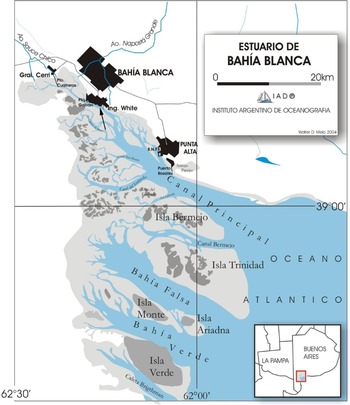
Bahía Blanca estuary has a funnel-like shape with a north-west–south-east orientation and a length of ~80 km (Figure 1). It contains a principal channel as well as several secondary channels separating inner islands and wide tidal flats (Piccolo & Perillo, Reference Piccolo and Perillo1990). The estuary has a surface of ~2300 km2 covering an area of 1900 km2 at high tide and 740 km2 at low tide. Tidal regime is semidiurnal, with an amplitude of ~4 m. On the northern shore, the estuary receives the fresh water input of two main water bodies, the Sauce Chico river and the Napostá Grande creek, with mean annual discharges of 1.9 m3 s−1 and 0.8 m3 s−1, respectively (Perillo et al., Reference Perillo, Piccolo, Palma, Pérez, Pierini, Piccolo and Hoffmeyer2004).
Bahía Blanca estuary, Argentina. The arrow indicates the sampling area.

The estuary is very shallow, with a mean depth of ~10 m (Perillo et al., Reference Perillo, Piccolo, Palma, Pérez, Pierini, Piccolo and Hoffmeyer2004), and it is highly turbid due to the presence of fine sediments that are transported in suspension into the water column (Cuadrado et al., Reference Cuadrado, Ginsberg, Gómez, Piccolo and Hoffmeyer2004). Temporal changes are complex, depending mainly on the variable fresh water input. Water temperature has a mean annual value of 13°C and varies seasonally, with highest values in summer (21.6°C; December–February) and lowest values in winter (8.5°C; June–August) (Perillo et al., Reference Perillo, Piccolo, Palma, Pérez, Pierini, Piccolo and Hoffmeyer2004). The estuary is classified as a salt marsh, and is seasonally mixed. Normally, salinity varies ~16–41 psu, with highest values during summer (Freije & Marcovecchio, Reference Freije, Marcovecchio, Piccolo and Hoffmeyer2004). The salinity of the water column in the area where the present study was performed is vertically homogeneous.
Fish sampling and data collection
Ramnogaster arcuata was sampled monthly by commercial catches in Bahía Blanca estuary between September 2005 and August 2006. Captures were carried out in an area close to Ing. White port (Figure 1) using shrimp nets of 1-cm-tail bag mesh (knot-to-knot).
In the laboratory, all fish were measured (total length: TL, mm) and subsequently grouped into 10-mm size-classes. A subsample (hereinafter referred to as the ‘sample’) composed of ten randomly selected specimens of each size-class was used for the study (N = 721). Total weight (TW, g) of each fish in the sample was measured. The maturity stage for males and females was determined macroscopically using a 5-Stage maturity key, namely: immature (I), developing (II), advanced maturation (III), spawning (IV) and resting (V).
Age was determined from the whole sagittal otoliths (N = 701), which were preserved dry. Prior to the reading, they were washed in warm water and the surrounding tissue was removed. They were then placed in water and examined under a binocular microscope (10×) with reflected light against a dark background. The number of hyaline (translucent) bands was recorded over the rostrum area. All otoliths collected were found legible. Readings were carried out twice by independent readers without prior information on fish length, sex, or time of capture.
Data analysis
Length–weight relationships were estimated using the potential model (W = a × Lb). Parameters a and b were calculated by least-squares on log-transformed data. The comparison of the estimated gradients for males and females was carried out via covariance analysis (ANCOVA, P ≤ 0.05). Deviation of the allometric coefficient b from the theoretical value of isometric growth (b = 3) was tested by t-test (Underwood, Reference Underwood1997).
For otoliths, the annual periodicity of band formation was assessed by examining the monthly evolution of the proportion of opaque and hyaline edges. Each specimen was assigned to an age group taking into account the number of hyaline bands counted, date of capture, birth date and edge type (opaque, hyaline). January 1st was considered as the birth date to assign individual ages to age groups. Systematic differences in estimated age (bias) between readers were assessed by age bias plot, and reproducibility of age interpretation (precision) was determined by the index of average per cent error (IAPE, Beamish & Fournier, Reference Beamish and Fournier1981) and the coefficient of variation (CV) (Campana et al., Reference Campana, Annand and McMilland1995; Campana, Reference Campana2001). For subsequent analysis, only coincident interpretations were accepted (N = 609).
The observed sizes-at-ages were used to fit von Bertalanffy- and Gompertz-growth curves. Equation parameters of von Bertalanffy were estimated following the maximum likelihood method (Kimura, Reference Kimura1980; Cerrato, Reference Cerrato1990). The length-at-age data for 170 unknown-sex-fish were included in the curves corresponding to males and females (N = 90 for age 0; N = 80 for age 1). To test the overall growth performance, phi-prime index Φ′ was calculated (Pauly & Munro, Reference Pauly and Munro1984), which has the main advantage of overcoming the problem of correlation between k and L∞: Φ′ = log10 k + 2 log10 L∞.
The monthly gonadosomatic index (GSI; N = 511) for males and females was calculated using the expression GSI = (GW/TW) × 100, where GW = gonad weight, and TW = total weight. Differences among sexes were tested by t-test. Length at first sexual maturity (TL50; Hernández & Cordo, Reference Hernández and Cordo1986) was determined also for both sexes.
RESULTS
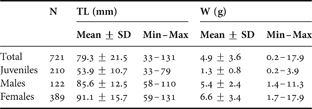
A total of 2588 individuals of Ramnogaster arcuata ranging from 30 to 131 mm TL was collected (mean ± SD: 69.9 ±19.3 mm), of which, 721 between 33 and 131 mm TL integrated the sample used for the present study. Of the fish examined, the highest percentage corresponded to females (54%), followed by juveniles (29%) and males (17%) (Table 1). The overall sex-ratio was established at 1:3.2 in favour of females. Juveniles were captured from September to May, with a maximum of 21% in October. The minimum sizes (30 mm class) were recruited from September (N = 11) to December (N = 2). The capture of adults of both sexes exhibited no seasonal variability.
Average values (±standard deviation (SD)) and range (Min – Max) of size (total length, TL) and weight (W) corresponding to total population, juveniles, and adults of Ramnogaster arcuata captured in Bahía Blanca estuary between September 2005 and August 2006. The sample size (N) is also indicated.

Min, minimum; Max, maximum.
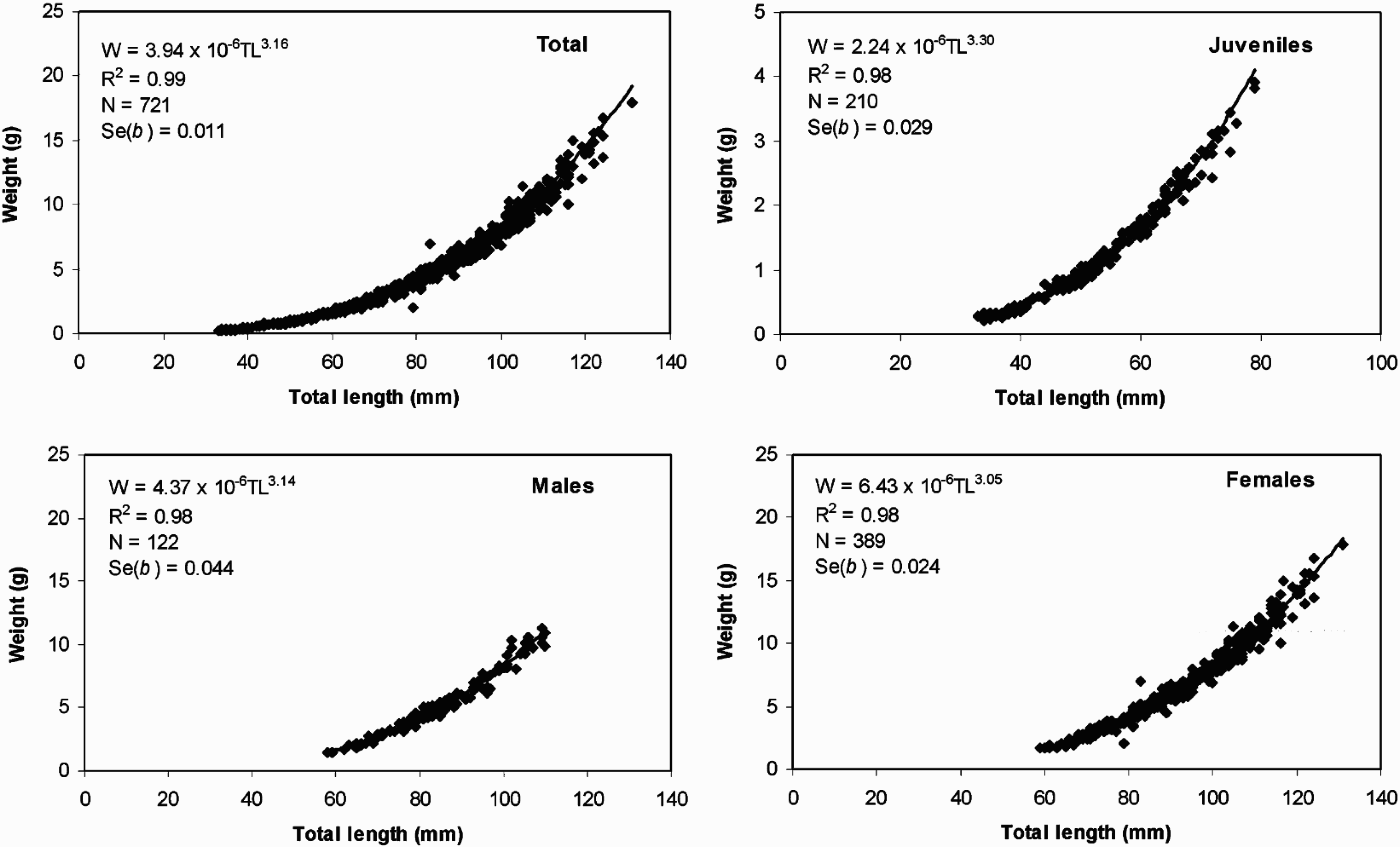
Females were larger and heavier than males, both in absolute and mean values (Table 1). The monthly mean total length of juveniles increased from 44.3 (September 2005) to 69.5 mm (May 2006). Length–weight relationships were found significant (P < 0.01) for the total population, juveniles, males and females (Figure 2). No significant differences were detected in the slopes or in the intercepts of the regression equations of both sexes (P > 0.10). Combined length–weight relationships in adults (intercept: 6.08 × 10⁻⁶; slope: 3.06) differed significantly from those in juveniles (intercept: 2.24 × 10⁻⁶; slope: 3.30). Positive allometric growth of weight with length was observed in juveniles (t-test, t = 10.38 > t 0.05, n>120 = 1.65), males (t-test, t = 3.11 > t 0.05, n>120 = 1.65), females (t-test, t = 2.04 > t 0.05, n>120 = 1.65), and sexes combined (t-test, t = 2.93 > t 0.05, n>120 = 1.65).
Length–weight relationships in Ramnogaster arcuata in Bahía Blanca estuary corresponding to total population, juveniles, males and females. The determination coefficient (R2), sample size (N) and standard error of the slope (SE(b)) are also indicated.

Ageing
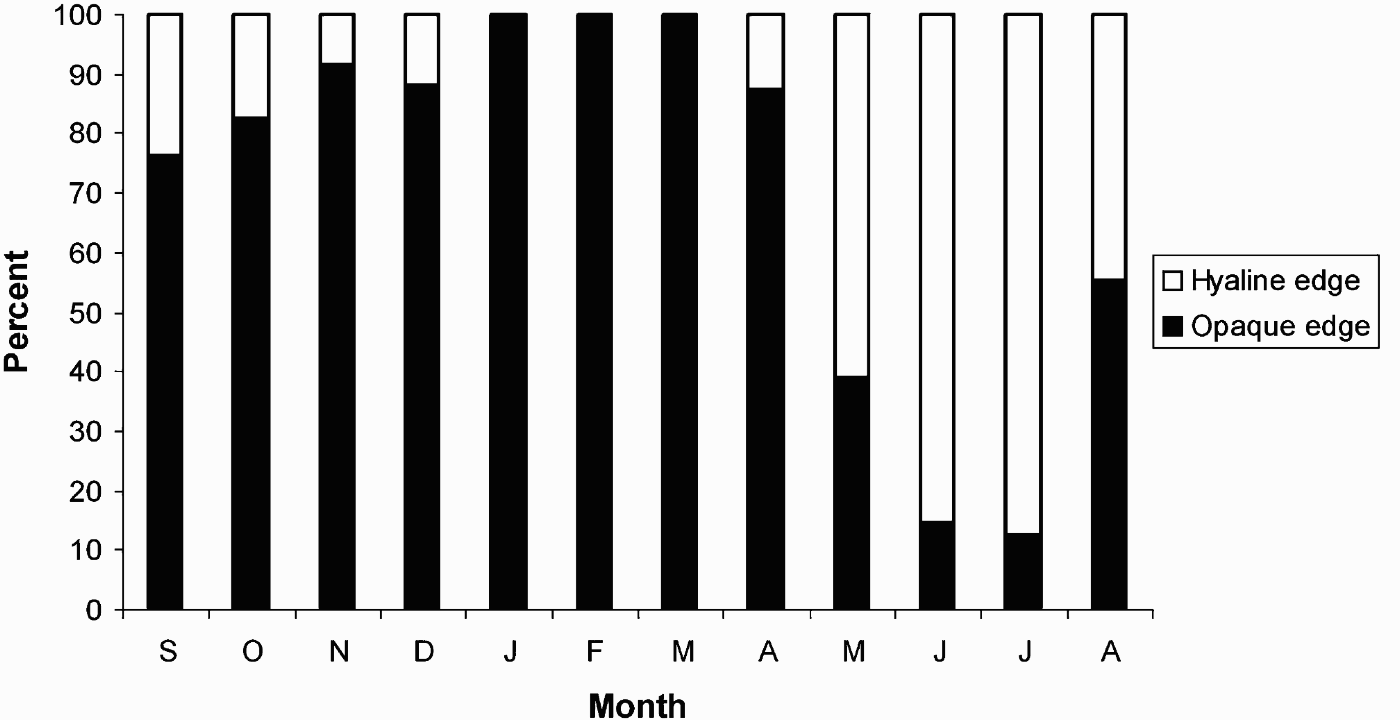
Otoliths of R. arcuata showed the typical pattern of teleosts, with an alternating sequence of narrow opaque and broad hyaline bands of similar width which became progressively narrower as the number of bands increased (Figure 3). An annual cycle in the seasonal evolution of the proportion of opaque and hyaline edges was observed (Figure 4). Otoliths with opaque margins increased in spring (September–December) and reached a 100% peak in summer (January–March). They decreased to a value of 13% in winter (July). These data indicate that only one hyaline band is formed yearly during late autumn–winter, and that the opaque band is deposited during late spring–summer.
Whole otolith removed from a 110-mm-TL, 10.6-g-W female Ramnogaster arcuata. Hyaline bands are indicated by white arrows. Solid bar is 1 mm long.

Monthly percentage of opaque and translucent edges in whole otoliths of Ramnogaster arcuata.

The estimated age from otoliths ranged from 0 to 3 years. Juveniles aged from 0 (53%) to 1 (47%), while males and females registered all ages. Age 1 was the most numerous in both sexes (males: 40%; females: 44%). Age bias plot (not shown) showed no systematic bias between the two age readers. The values of CV (11.7%) and IAPE (8.3%) obtained indicate a good level of accuracy in our readings.
Growth
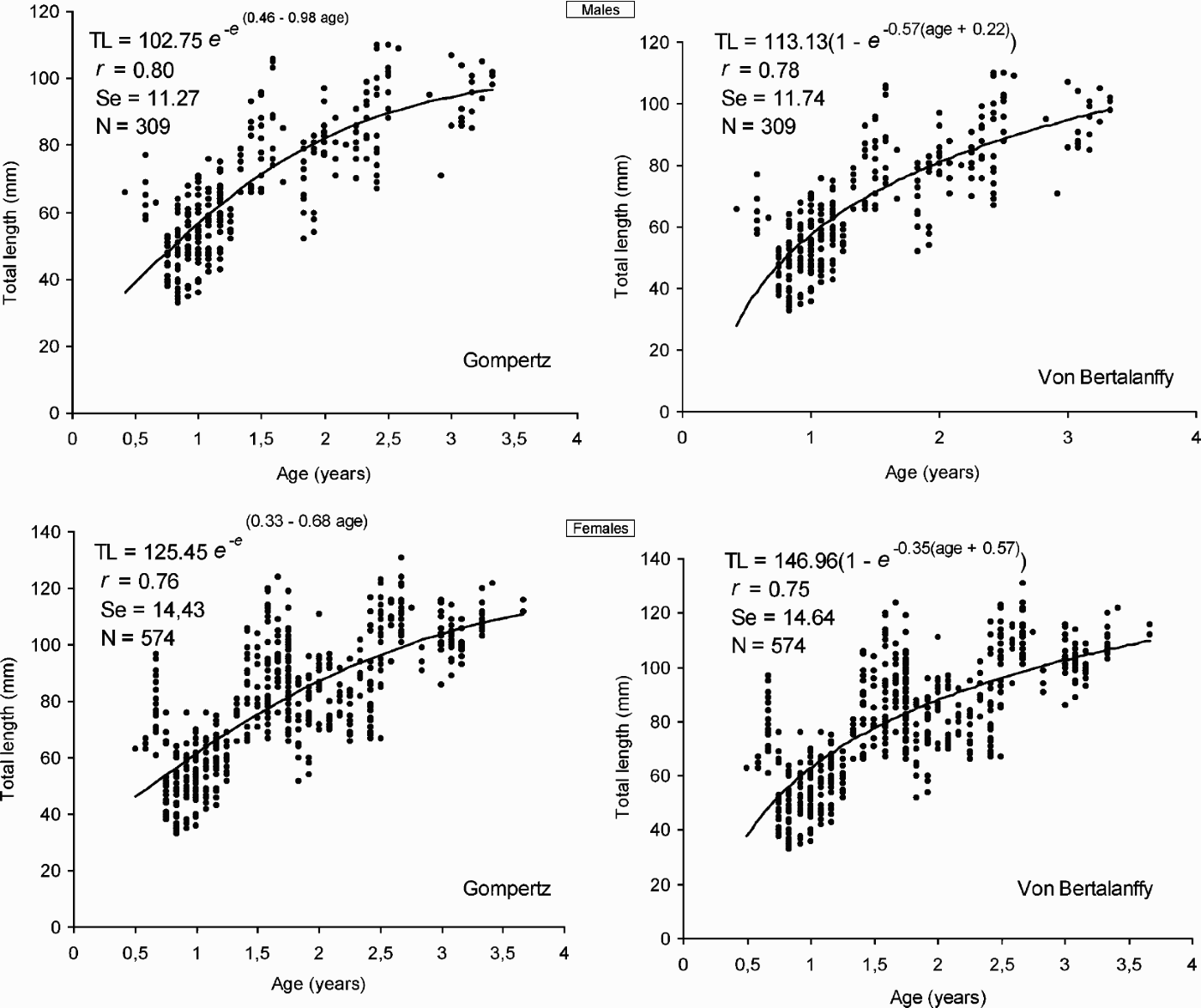
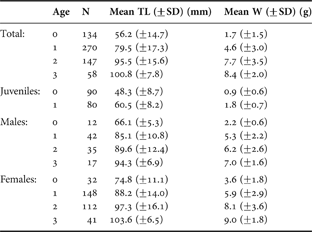
A consistent pattern of increase in length with age was observed (Table 2). The values of the correlation coefficient and the standard error indicated that in both sexes the Gompertz model fitted better to the age–length data than the von Bertalanffy model (Figure 5). Also, the L∞ obtained with the Gompertz model was smaller than some of the lengths observed in old males and females.
Total lengths (TL) and ages of male and female Jenyns' sprat. Lines show fits to the data of the Gompertz and von Bertalanffy growth models. r, correlation coefficient; SE, standard error; N, pairs of data.

Mean length and weight-at-age (±standard deviation (SD)) corresponding to total population, juveniles, males and females of Ramnogaster arcuata from the Bahía Blanca estuary according to otolith readings. N, sample size.

The growth performance index Φ′ was 3.69 and 3.71 for males and females, respectively.
Gonad development and length at first maturity (TL50)
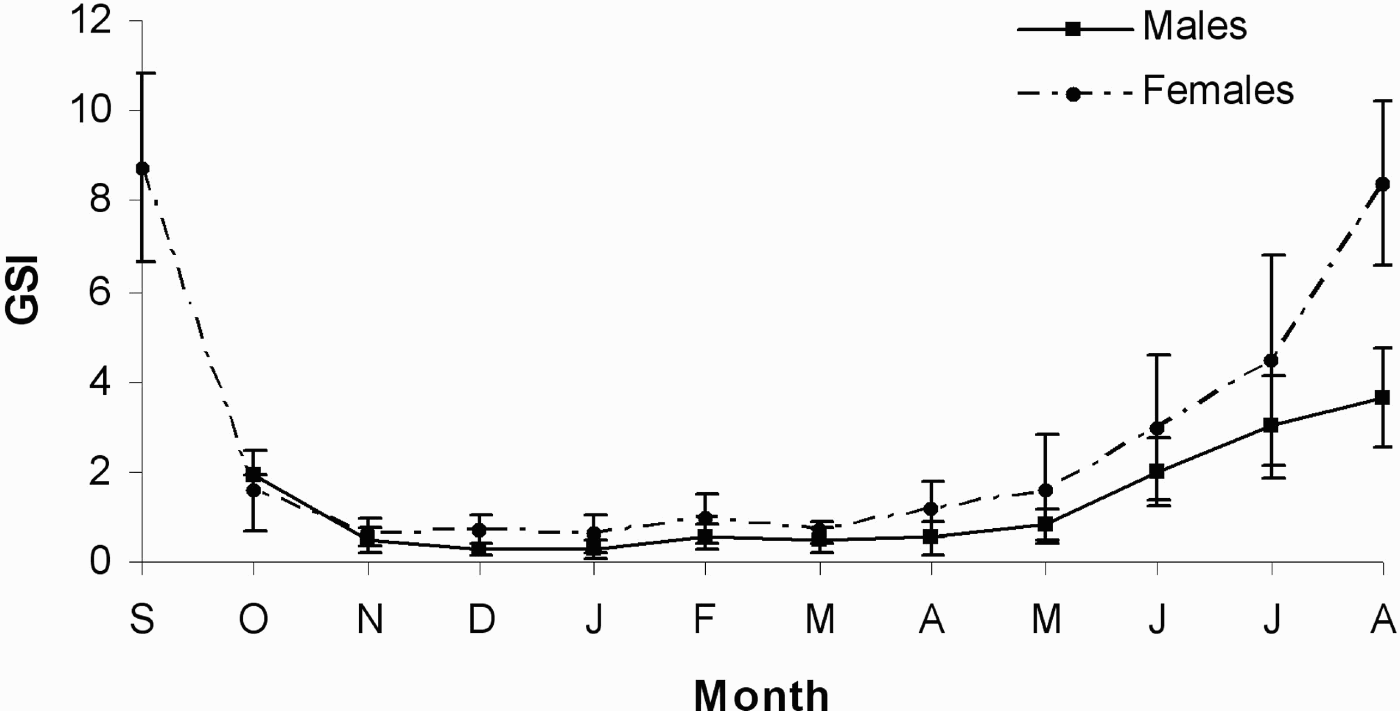
The mean monthly GSI for females started to increase during autumn (April) until it peaked in August–September and subsequently declined until total cessation in November (Figure 6). In spite of the absence of males in the September sample, GSI showed the same tendency although the seasonal change was less prominent than in females. No significant differences were detected in the GSI between sexes during October and November (P > 0.12) whereas during the rest of the year GSI for females was significantly higher than that for males (t-test, P < 0.05 in all cases).
Ramnogaster arcuata gonad development as described by the gonadosomatic index (GSI) in males and females. Lines link monthly mean values with standard errors.

Gonad inspection revealed an increase in the frequency of Stage III (advanced maturation) towards the end of winter up to a high value of 76% in August. As of October adult samples exhibited gonads with post-spawning traits. These results, in addition to the high percentage of fish of the smallest size-class captured during spring and summer samplings, indicate that the spawning season seems to begin in spring.
Length at first maturity (TL50) was similar in both sexes (males: 76 mm TL; females: 77 mm TL), and corresponded mainly to age 1 year. Males and females reached total sexual maturity (TL100) at 110 mm TL at age 3 years.
DISCUSSION
Results from the present study indicate that Ramnogaster arcuata is a small, relatively short-lived (maximum age registered: 3 years) and fast-growing iteroparous species that reaches sexual maturity during the second year of life (age 1). Small to medium-sized species of clupeoids from temperate marine environments typically live less than seven years, as it has been observed in Gudusia chapra (Narejo et al., Reference Narejo, Jafri and Shaikh2000), Sardinops caeruleus (Quiñonez-Velázquez et al., Reference Quiñonez-Velázquez, Alvarado-Castillo and Félix-Uraga2002), Spratelloides robustus (Rogers et al., Reference Rogers, Geddes and Ward2003), Engraulis encrasicolus (Basilone et al., Reference Basilone, Guisande, Patti, Mazzola, Cuttitta, Bonanno and Kallianiotis2004), and Sardinella brasiliensis (Fonteles-Filho et al., Reference Fonteles-Filho, Ximenes-Carvalho, Paiva and Petrere2005).
In addition, the present study demonstrates that R. arcuata evidences a similar abundance pattern in Bahía Blanca estuary all through the year. This coincides with previous studies carried out in the study area by Lopez Cazorla (Reference Lopez Cazorla1987), who reported to have captured the species through monthly samplings in a four-year period (May 1979–June 1983) in depth-ranges between 2 and 11 m, salinity values from 28.6 to 36.4 psu, and water temperature from 4.6 to 22.3°C. In contrast, based on historical data collected from cruises in the Río de la Plata estuary (35–36°20′S 55–57°20′W) Rodrigues et al. (Reference Rodrigues, Macchi, Acha and Militelli2008) reported that the highest incidence of R. arcuata occurs both in the estuarine area and in adjacent waters during winter whereas the lowest incidence occurs in summer. Concomitantly with this decrease in occurrence, a displacement of R. arcuata specimens towards the southern area of the Río de la Plata estuary was observed. In this respect, it is important to bear in mind that the environmental conditions in which Jenyns' sprat was captured in the Río de la Plata were more restricted than those in the present study. In fact, in the Río de la Plata salinity and temperature ranged between 2.5 and 27.5 psu and from 12°C to 14°C, respectively. The differences between Río de la Plata estuary and Bahía Blanca estuary could therefore be attributed to different characteristics of both environments, the former being characterized by marked horizontal and vertical salinity gradients and a mean freshwater run-off of 22,000 m3 s−1 (Rodrigues et al., Reference Rodrigues, Macchi, Acha and Militelli2008).
Sagittal otoliths seem to be useful for ageing purposes along the entire life of Jenyns' sprat because they show a clear and interpretable band pattern which is formed in a regular and determinate time scale. The good level of precision obtained (IAPE = 8.3%; CV = 11.7%) as well as the absence of either under- or over-estimations indicate that whole otoliths are reliable tools for age determination in this species.
Ramnogaster arcuata in Bahía Blanca estuary forms a single increment per year on its otoliths. In general, the mechanisms that regulate the annulus formation pattern on otoliths and other hard parts of fish have not yet been fully elucidated. The most widely accepted hypothesis in this respect lies in that band development is controlled by a complex combination of endogenous and exogenous factors which vary at different ages and between sexes (Morales-Nin et al., Reference Morales-Nin, Torres, Lombarte and Recasens1998). In Jenyns' sprat, hyaline band formation on otoliths was observed to occur during late autumn–winter, at the same time of gonad maturation (see below). As to opaque bands, it was observed that they start to be laid down in spring, coinciding with the seasonal increase in water temperature in the area. Data about age and growth of clupeoids are scarce in Argentina. Gru & Cousseau (Reference Gru and Cousseau1982) studied age and growth of Sprattus fuegensis through otolith reading in the south-western Atlantic waters, and reported a maximum age of 5 years. Lopez Cazorla (Reference Lopez Cazorla1985) and Morales-Nin et al. (Reference Morales-Nin, Fauquet and Lopez Cazorla1985) performed age determinations in Brevoortia aurea through scale readings in Bahía Blanca estuary and detected the formation of only one annulus per year in winter. Similar phenomena could be observed in fish belonging to other families in Bahía Blanca estuary, such as the weakfish Cynoscion guatucupa (Sciaenidae) and the flounder Paralichthys orbignyanus (Paralichthyidae), in which only one increment per year was detected on their otoliths and scales, respectively (Lopez Cazorla, Reference Lopez Cazorla2000, Reference Lopez Cazorla2005).
Estimates of growth parameters for Jenyns' sprat suggest that this fish is a relatively fast growing species. It was in fact observed that R. arcuata reached 50% of the estimated L∞ (i.e. approximately 51–63 mm TL) during the first year of life (age 0–1). Growth continued to be rapid up to age 2, but beyond this age the growth rate diminished. Since TL50 was observed at age 1, the physiological event proposed to be responsible for this sudden decrease in somatic growth is the onset of maturity. Studies about life history strategies in clupeoids suggest that metabolic energy is allocated sequentially to growth processes and then reproduction (Rochet, Reference Rochet2000). Our results suggest that R. arcuata has a life history strategy similar to that of other temperate clupeoids. Rogers & Ward (Reference Rogers and Ward2007) reported that the sandy sprat Hyperlophus vittatus and the sardine Sardinops sagax in the Indo-Pacific and southern Australia reach maturity at ages 12 and 18 months, respectively, after approximately 70% of growth has occurred and that growth rates in these species decrease significantly after sexual maturity.
As stated above, gonad maturity in Jenyns' sprat occurs in winter. This may account for hyaline band formation on otoliths. Males and females mature at the same size (76–77 mm TL), thus indicating that they become part of the spawning stock at the same time (age 1 year). On the other hand, differences in GSI indicate a lower cost for producing sperm than for producing eggs. Spawning period seems to begin in spring, as was indicated not only by gonad inspection and evolution of GSI, but also by the high percentage of small-size fish captured during the end of spring and summer samplings. Our results agree with previous unpublished observations by R. Camina (Department of Mathematics, Universidad Nacional del Sur, personal communication, 1997), who detected a high percentage of eggs of R. arcuata from ichthyoplankton samples collected in Bahía Blanca estuary during spring (between September and October) in 1983. However, Camina claimed to have observed a second, less pronounced, period of appearance of eggs in plankton during the autumn of 1984, which was not observed in the present study. On the other hand, Rodrigues et al. (Reference Rodrigues, Macchi, Acha and Militelli2008) reported that Jenyns' sprat spawning period occurred during winter in the Río de la Plata estuary. Hunter & Goldberg (Reference Hunter and Goldberg1980) suggested that spawning frequencies for clupeoids are limited by energy reserves and food availability. This may partially explain why R. arcuata's spawning period in Bahía Blanca estuary occurs in spring, when zooplankton densities begin to increase (Hoffmeyer, Reference Hoffmeyer, Piccolo and Hoffmeyer2004 and references therein).
The present study provides the first lines of evidence resulting from the analysis of several biological parameters of R. arcuata, which are fairly consistent with the biology of other clupeoids. However, future studies are necessary to be able to conclude whether or not the results observed in the present research can be extended to this species all along its geographical distribution range. The high degree of variability in the biological parameters of fish of the same species belonging to different populations seems be due to adaptations to local selective pressures. In effect, some biological and non-biological factors, such as chlorophyll concentration, water pollution, temperature and salinity, among others, may be as important as the inherent biological parameters in the life history of a species for the determination of the demography and ecology of a fish population. In this respect, it has been demonstrated that salinity has a great impact on the growth rate of fish (Peterson et al., Reference Peterson, Comyns, Rakocinski and Fulling1999; Cardona, Reference Cardona2000; Imsland et al., Reference Imsland, Foss, Gunnarsson, Berntssen, FitzGerald, Bonga, Ham, Nævdal and Stefansson2001). Therefore, based on the high salinity values in Bahía Blanca estuary (up to 41 psu), it could be reasonable to assume that R. arcuata's growth performance in this area (Φ′ = 3.69–3.71) is quite different from that of the same species in other parts of its distribution range.
ACKNOWLEDGEMENTS
Financial support from the Universidad Nacional del Sur (UNS, PGI 24/B111) is gratefully acknowledged. The authors are also thankful to Professor Ricardo Camina for his statistical assistance, and to Dr Walter Melo for the cartography.