Palenque, Chiapas, Mexico, was a powerful polity in the Western Maya Lowlands during the Mid- to Late Classic period (AD 450–830). The city was 2.6 km2, but more than 1,400 stone structures crowded terraces carved into the side of the sierras, making Palenque a densely built city with an estimated population of 6,000 to 8,000 people (Barnhart Reference Barnhart2001; Liendo Stuardo et al. Reference Liendo Stuardo, Mejía, Jiménez Delgado, Chase, Chase and Chase2024). It is known for its monumental architecture, associated art, and epigraphic record. Although much work has focused on Palenque’s dynastic history, less is known about the residential sectors that surround the civic-ceremonial core, including the extent and the organization of crafting in Palenque.
Rands and Bishop (Reference Rands, Bishop and Robert1980) found secondary evidence through sourcing clay/temper that some pottery production was local. In addition, they argued that the modeled incensario stands were most likely produced in the city of Palenque, as were small figurines, as evident from the recovery of figurine molds. Until the recent discovery of a large obsidian workshop by the Tren Maya initiatives (Morales Reference Morales2022; Rainsford Reference Rainsford2023), no flaked stone workshops had been identified at Palenque. Given the lack of studies focused on craft specialization and only brief considerations of Palenque’s economic organization as a market economy or an economy based on elite redistribution (see Barnhart Reference Barnhart2001:101; Roldan Reference Roldan2022), there is still much to learn about the procurement, production, and distribution of goods from Palenque.
Based on recent excavations in a residential area, we argue that multiple economic mechanisms existed at Palenque, including centralized marketplaces and production and exchange at the local household level. Items including figurines, ceramics, and obsidian were available to the city at large, most likely through a marketplace, given the relatively even distribution of these items across all excavated residential groups (Hirth Reference Hirth1998; see also G. Braswell Reference Braswell, Christopher and Barbara2010; Johnson Reference Johnson2016). Some residential groups were engaged in a limited amount of crafting, enough to meet household needs with small quantities of finished tools. However, during recent excavations, we identified one residential group that was engaged in surplus craft production—that is, specialization, citing Andrieu [Reference Andrieu, Masson, Freidel and Arthur2020]. It was likely a multicrafting household (Hirth Reference Hirth and Kenneth2009), in which domestic work included both the production and use of tools contingent with the making of a finished product for extra-household distribution.
Palenque Neighborhoods
The study of neighborhoods, particularly in Classic period Maya cities, has become popular over the past decade. In numerous Maya settlements, even those exhibiting “low-density” urbanism, smaller communities seemed to have formed as discrete spatial units. These neighborhoods provided opportunities to create direct relationships through “face-to-face” interactions (Arnauld et al. Reference Arnauld, Manzanilla and Smith2012). Domestic crafting supported interhousehold economic dependencies, either directly or through neighborhood marketplaces (Anaya Hernández et al. Reference Hernández, Armando, Walker and Dunning2021; King Reference King2015).
Previous mapping and settlement studies of Palenque by Barnhart (Reference Barnhart2001) and a test-pitting program in recent years (López Bravo and Venegas Reference López Bravo and Venegas Durán2012) have hypothesized potential neighborhoods, or minimally “discrete residential groupings,” whose “internal organization and articulation are unknown” (Liendo Stuardo Reference Liendo Stuardo, Hudson and Ardren2020:334). More recently, Campiani (Reference Campiani2015, Reference Campiani, Trivelloni, Canino and Romani Salas2024), refined the boundaries of Palenque’s distinct residential clusters, improving the urban morphology approach using lidar. Neighborhoods are defined by the topographic characteristics of the plateau, such as fractures in the terrain caused by riverbeds, and steep slopes, and by areas free of buildings and the retaining walls of terraces, a ubiquitous built feature at Palenque (Figure 1). At Palenque, an architectural compound with elaborate two-story buildings and shrines around a central plaza typically occupies the flatter area of each neighborhood, representing its center. This same pattern is noted in other Maya settlements, where high-ranking households or social groups are argued to have attracted smaller social groups, leading to a layout where the largest and most elaborate residential compounds—what some have called a “Barrio Leader” (Lemonnier Reference Lemonnier2012) or a leading “House” (i.e., Strauss’s “house” model; see Joyce and Gillespie Reference Joyce and Gillespie2000)—are surrounded by smaller residential groups. This type of arrangement suggests that the residential compound had considerable historical depth and would have been not only one of the largest but also one of the oldest structures. This idea has also been proposed by McAnany (Reference McAnany1995) as the “first founder principle.” Others have suggested that some communities formed around a shared industry or economic activities, a pattern seen in cities outside the Maya area, such as Teotihuacan (Filini Reference Filini2015).
Map of residential sector with location of Structure J37.

Since 2016, El Proyecto Regional Palenque has worked as a collaborative team, focusing efforts on a single residential cluster surrounding an elaborate patio group known as “Group IV” (Group J and Group J West, as mapped by Barnhart [Reference Barnhart2001]). Group IV is located at the relative center of the proposed “neighborhood” and is the largest and most elaborate residential group, with structures adhering to a formal patio group arrangement. In addition to the size and quality of its architecture, this group had an extensive history of occupation, spanning AD 500–800. Numerous burials were clustered on the east side of the plaza in and around formal mausoleum structures (Liendo Stuardo Reference Liendo Stuardo2016; Rands and Rands Reference Rands and Rands1961). In addition, Group IV is the location of the well-known “tablet of the slaves,” a carved tablet detailing the life and achievements of Chak Suutz’, a sajal or “lower lord” who was an occupant of the residence. Given its size, location, occupation history, and funerary focus, we hypothesize that this group acted as a leading house for the neighborhood (Johnson et al. Reference Johnson, Johnson, Campiani, Liendo Stuardo and Joyce2023). What is less known from these excavations is the relationships that the nearby smaller residences had with Group IV. Beginning in 2022, investigations occurred at structures surrounding this group. This work is exploring areas of urban life that are still largely understudied at Palenque, including crafting and industry and the extent of state-level involvement in the economic and domestic life of this city.
Structure J37
Structure J37 is located just east of Group IV and was initially mapped as an L-shaped structure (Figure 2). It measures roughly 16 m in length running east–west and 8 m running north–south. Multiple clearing and trench excavations reveal this was a compound of multiple structures, including a vaulted structure running north–south and an elevated platform running east–west that most likely supported a perishable structure. On the back sides of these structures were dense midden deposits, common in Palenque residential groups where space was restricted in the city. In the deepest strata of a midden located on the east side of the vaulted structure, carbon was recovered (D-AMS 053574, 1714 BP ± 23, cal AD 350), indicating that the earliest occupation was during the Early Classic period. Ceramics from the upper layers—where the majority of debitage and tools are found—span the Middle to Late Classic period, or the Motiepa to Murcielagos ceramic phases.
Structure J37 overview with artifact concentrations. (Color online)

Each locus was subject to flotation, and a sample was screened at ⅛ inch, resulting in the recovery of micro-debris. In addition, we recovered typical domestic debris including faunal remains, manos and metates, obsidian, some finished tools, and figurines. However, after multiple years of excavating residential groups in this “neighborhood,” what became clear was the high relative frequency of flaked stone, including both debitage and finished tools.
Results
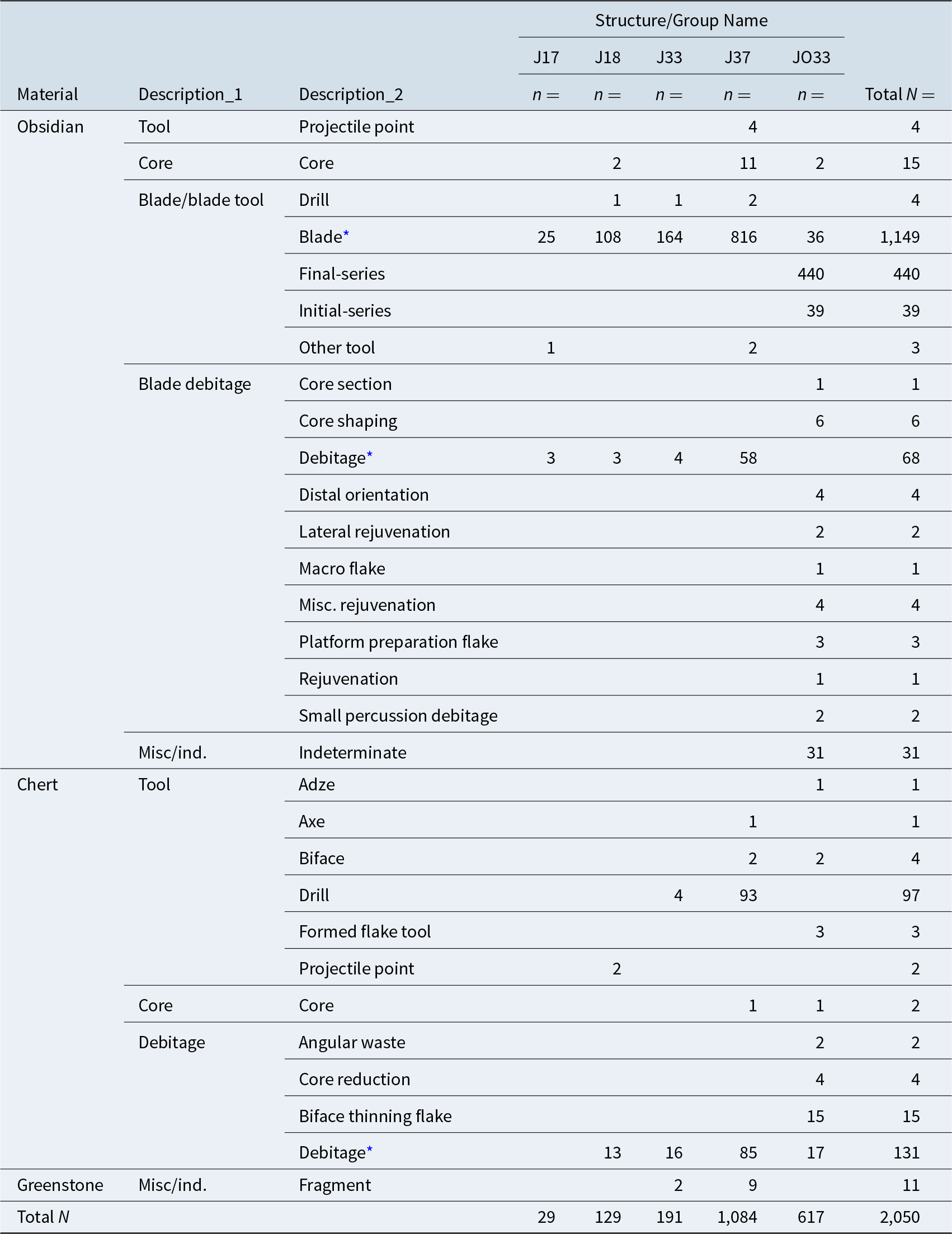
Technologically, obsidian blades account for most of the recovered lithics from more than 800 artifacts (Table 1). This is a high frequency of blades given the kinds of contexts we excavated. When blades are excluded from analysis, the data show a near-equal proportion of obsidian and chert debitage. Both obsidian and chert cores are also present. The presence of several cores, some debitage, and many tools from these contexts suggests a workshop location where lithic reduction occurred and blade tools and drills were used. Drills were recovered from all operations and suboperations, with the highest concentrations in Op 472C and Op 472B (Figure 2).
Summary of Obsidian, Chert, and Greenstone Data from Excavated Residential Structures.

* These are sorted into more specific blade, tool, or debitage categories within each material type.
The recovered drills vary in terms of length and distal wear. Some exhibit heavily rounded bits, whereas others are extremely small—recovered from flotation heavy fraction—and show very sharp bits that were possibly used for incising or scoring. Morphologically, drills from Palenque accord with those from other Lowland Maya sites: they are made from reducing blade cores and have thick platforms, high dorsal ridges, and shaped lateral sides, with some distal resharpening resulting in a highly standardized form (Figure 3; Johnson et al. Reference Johnson, Carpenter, Chase and Chase2015). There was a paucity of debitage from chert blade reduction, which is typically done to make small drill tools (Johnson and Johnson Reference Johnson and Lucas R. Martindale2021)—suggesting that the residents may have acquired finished chert drill tools from elsewhere. They were, however, clearly producing obsidian blades and crafting some limestone and chert bifaces. A very small quantity of greenstone micro-debitage was recovered in flotation (OP472B and -C; n = 9). These fragments were found in the same areas with chert drills (OP472C locus 2; n = 40 drills). In this area we also found small, smoothing stones, also considered to be tools.
Sample of chert dills found in Structure J37.

A partial bone spindle whorl was also found, but in this context, it did not appear related to textile production. No other weaving or spinning-related artifacts were found in this group. One possibility is that the cylindrical whorl was used as part of a composite pump drill tool (Kovacevich Reference Kovacevich, Wells and Davis-Salazar2007).
Discussion
The recovery of greenstone micro-debitage from structure J37, in the same general area as many chert drills were found, may suggest that the crafters in this residential group were engaged in some greenstone production, among other types of crafting. Braswell (Reference Braswell, Charles and Borgstede2004:177) stated that “excavation methods practiced until at least the 1960s were—and still are, in many cases- insufficient for recovering small lithic tools and debitage (by-products).” This may have been the reason why there are few documented workshops devoted to lapidary work, outside the major jade production sites of Cancuén (Kovacevich Reference Kovacevich, Wells and Davis-Salazar2007). Another reason may be the practice of curating or caching the highly valued fragments of jade working, effectively removing any primary evidence for greenstone production (Widmer Reference Widmer2009). As Masson and her colleagues (Reference Masson, Hare, Peraza Lope, Escamilla Ojeda, Paris, Kohut, Russell and Cruz Alvarado2016:231) have reiterated, everyday items used by much of the population would have been produced in larger quantities and left more debris and byproducts than luxury items that were made in much smaller quantities. The finished objects are typically gone, no doubt buried in tombs with their owners or in other ritualized contexts.
What we are left with are the tools used to grind, shape, or drill the crafted objects. Systematic flotation and screening methods are reliable ways to recover micro-debitage. Together with a tool kit that was found near the greenstone fragments and had tools like those associated with known jade workshops (Kovacevich Reference Kovacevich, Wells and Davis-Salazar2007), we can recognize domestic workshops that may otherwise go unidentified. Use-wear studies to determine the use of stone tools on plants/wood at Cancuén found that chert drills were most likely used to perforate different materials, including minerals and wood (Cadalen et al. Reference Cadalan, Beyries, Trabanino and Andrieu2023). In this preliminary report, we have yet to complete use-wear analyses of these tools. In other cities, drills were used in a variety of contexts, including multicrafting households where they were used on materials such as slate and shell (J. Braswell Reference Braswell, Lisa and Yaeger2010; Johnson et al. Reference Johnson, Carpenter, Chase and Chase2015). We have not recovered slate or shell debitage in these excavations, and so drills may have been more likely used on organic materials.
Data thus far suggest that Group IV may have served as the ritual center for the neighborhood as a leading house under which the neighborhood identified and congregated. Broader urban trends are reflected in the sharing of figurines, access to obsidian, and a suite of domestic foodstuffs. There are, however, differences in the number of tools recovered from each residence thus far, indicating that some intensified their crafting efforts for extra-household production. The numerous drills from structure J37 suggest surplus crafting. Interestingly structure J37 shows evidence that this intensive crafting took place during the height of Group IV’s involvement in Palenque’s political and military affairs (Bernal Romero and Venegas Durán Reference Bernal Romero and Venegas Durán2005). It is possible that the increase in crafting and production was due to increased demands from a growing political class.
Additional excavations in adjacent structural groups within the proposed neighborhood will help expand our understanding of the history and relationships that smaller dwellings had with the broader city.
Acknowledgments
Our work would not have been possible without the permission of the Instituto Nacional de Antropologia (INAH), and Dr. Rodrigo Liendo Stuardo, director of the Proyecto Regional Palenque (PREP).
Funding Statement
Research at Palenque is funded by NEH Grant #RZ-266160-19 and UC Berkeley Stahl Grants.
Data Availability Statement
The flaked stone artifacts of the Palenque site excavations described in this report are currently curated in the MayaLab of the University of Nevada, Las Vegas.
Competing Interests
The authors declare none.