Introduction
Terricolous lichens dominate many tundra ecosystems (Matveyeva & Chernov Reference Matveyeva and Chernov2000) to such an extent that they are visible from outer space (Tømmervik et al. Reference Tømmervik, Hogda and Solheim2003) and change the shortwave albedo of the land surface (Bernier et al. Reference Bernier, Desjardins, Karimi-Zindashty, Worth, Beaudoin, Luo and Wang2011). In cold climatic zones, lichens fulfil important ecological roles. They participate in nutrient cycles (Chapin et al. Reference Chapin, Matson and Vitousek2012), they represent the most important winter forage for reindeer and caribou, key arctic-alpine herbivores (Heggberget et al. Reference Heggberget, Gaare and Ball2002; Rees et al. Reference Rees, Stammler, Danks and Vitebsky2008), and lichens with cyanobacteria fix N2 (as reviewed by Nash Reference Nash III2008). Arctic and alpine areas are among those most affected by global warming (Elmendorf et al. Reference Elmendorf, Henry, Hollister, Björk, Bjorkman, Callaghan, Collier, Cooper, Cornelissen and Day2012a , Reference Elmendorf, Henry, Hollister, Björk, Boulanger-Lapointe, Cooper, Cornelissen, Day, Dorrepaal and Elumeeva b ; IPCC 2014). Lichens in particular are declining in such ecosystems (Cornelissen et al. Reference Cornelissen, Callaghan, Alatalo, Michelsen, Graglia, Hartley, Hik, Hobbie, Press and Robinson2001; Walker et al. Reference Walker, Wahren, Hollister, Henry, Ahlquist, Alatalo, Bret-Harte, Calef, Callaghan and Carroll2006; Lang et al. Reference Lang, Cornelissen, Shaver, Ahrens, Callaghan, Molau, ter Braak, Hölzer and Aerts2012). Meta-analyses relate the declining lichen biomass to increased competition from plants facilitated by global warming. However, direct effects of snow depth, duration and quality on lichens in natural habitats are less recognized and only partly understood (Wahren et al. Reference Wahren, Walker and Bret-Harte2005).
Predicted and realized climate change most strongly influences the winter season at higher latitudes with important implications not only for the vegetation itself (Phoenix & Lee Reference Phoenix and Lee2004; Bokhorst et al. Reference Bokhorst, Bjerke, Tømmervik, Callaghan and Phoenix2009, Reference Bokhorst, Bjerke, Davey, Taulavuori, Taulavuori, Laine, Callaghan and Phoenix2010), but also for large-scale processes such as lemming cycles (Kausrud et al. Reference Kausrud, Mysterud, Steen, Vik, Østbye, Cazelles, Framstad, Eikeset, Mysterud and Solhøy2008). Although the Arctic land covered by snow in early summer has reduced by 18% since 1966 and the southern limit of permafrost has retreated, the maximum snow depth is increasing over wide areas in northern Eurasia, but with large variation from place to place (AMAP 2012). Modelling indicates future increases in winter temperatures and precipitation, and a greater annual variability in snowfall (Saha et al. Reference Saha, Rinke and Dethloff2006; AMAP 2012).
Compared to gradual, long-term temporal changes in snow depth over the years, the steep spatial gradient from windswept, bare ridges to snow beds downhill with heavy snow accumulation is easy to observe. Moderate snow depth has a positive insulating effect on most vascular plants during winter, whereas dominant lichens avoid snow thicker than 1 m (e.g. Nordhagen Reference Nordhagen1928; Jonasson Reference Jonasson1981). Lichens associated with deeper snow are weak competitors with low biomass in their natural habitats (Gilbert & Fox Reference Gilbert and Fox1985; Gilbert et al. Reference Gilbert, Fryday, Giavarini and Coppins1992). They can be photosynthetically active under thin snow (Kappen et al. Reference Kappen, Sommerkorn and Schroeter1995; Schroeter & Scheidegger Reference Schroeter and Scheidegger1995; Pannewitz et al. Reference Pannewitz, Schlensog, Green, Sancho and Schroeter2003). Thick snow reduces the abundance of lichens (Dahl Reference Dahl1956), probably because light is too low for net photosynthesis at temperatures that allow respiration (Kappen Reference Kappen1993), and because anoxic conditions sometimes occur when wet snow refreezes into ice (Bjerke Reference Bjerke2009, Reference Bjerke2011). Growth rates in snow-demanding and snow-avoiding lichens exposed to various snow depths are poorly known. Furthermore, little is known about how snow affects secondary metabolism in lichens. The mycobiont synthesizes carbon-based secondary compounds (CBSCs) with various functions (Molnár & Farkas Reference Molnár and Farkas2010). Stress, or conditions causing low growth rates, may trigger the production of CBSCs with antimicrobial roles (Ingólfsdóttir Reference Ingólfsdóttir2002) that may protect lichens from degrading bacteria under the snow (Schadt et al. Reference Schadt, Martin, Lipson and Schmidt2003).
We studied four mat-forming terricolous lichens with increasing natural abundance at increasingly thicker snow levels in the following sequence: Alectoria ochroleuca (Hoffm.) A.Massal., Flavocetraria nivalis (L.) Kärnefelt & Thell, Cladonia mitis Sandst., and Cetrariella delisei (Bory ex Schaerer) Kärnefelt & Thell. These widespread species are often amongst the dominant lichens at high latitudes and/or elevations across the Northern Hemisphere, and they represent important reindeer and caribou fodder (e.g. Svihus & Holand Reference Svihus and Holand2000). In order to test the effect of snow depth, we used a transplantation design that minimized competition from plants. By reciprocal transplantations along natural gradients of snow depths, from wind-swept ridges to snow beds in a high precipitation oceanic-alpine environment (western Norway), we quantified lichen growth rates as well as their CBSC investments. By comparing species with contrasting tolerance to snow, we wanted to improve the knowledge of how lichen growth will respond to change in snow depth. We hypothesized 1) that growth rates are highest in the natural habitat of each species, and 2) that CBSCs increase with decreased growth rates and thus with increased stress.
Materials and Methods
Study area
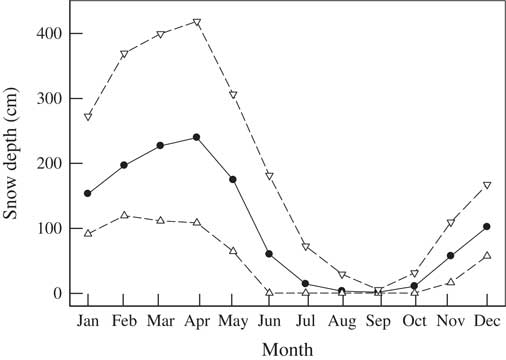
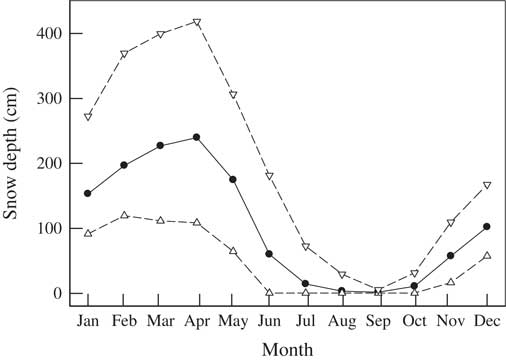
The study area was an undulating, large, U-shaped valley bottom at 1200–1220 m a.s.l. in south-western Norway, 1·5 km east of Finse railway station (60·60°N, 7·50°E). This is in the low alpine zone, 250 m above the tree line; the climate is oceanic-alpine (Moen Reference Moen1999) with high annual precipitation (1030 mm; Førland Reference Førland1993) and a mean temperature in January and July of −10 °C and 7 °C, respectively (Aune Reference Aune1993; Førland Reference Førland1993). Average, minimum and maximum monthly snow depths for the period 1960–90, measured in the meteorological station at Finse, are shown in Fig. 1.
Mean (●), minimum (▵) and maximum (▿) monthly snow depth (cm) for the meteorological station at Finse, south-western Norway for the period 1960–1990 (eKlima 2015).
Lichen material
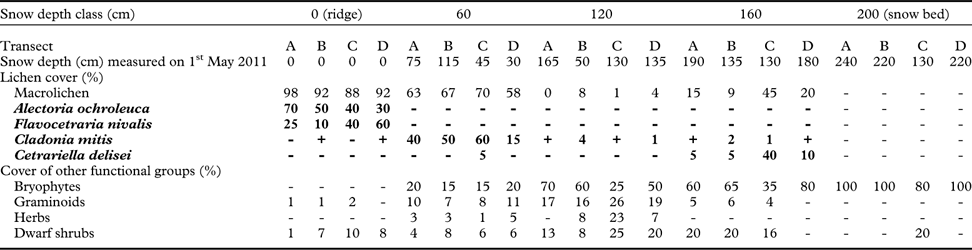
Four locally dominant lichen species were collected on 11 September 2010: Alectoria ochroleuca, Flavocetraria nivalis, Cladonia mitis and Cetrariella delisei. The lichens were collected from several separate mats in places at the study site where they had their highest percentage cover (Table 1). Debris and the lowermost dead and decaying portions of the thalli were removed to minimize basal degradation in mats during the experiment (Gaio-Oliveira et al. Reference Gaio-Oliveira, Moen, Danell and Palmqvist2006). One hundred thalli of each species were randomly selected for transplantation. They were dried for 48 h at room temperature before weighing (±0·1 mg). To calculate oven dry mass (DM) of transplants, we subjected some additional thalli of each species to the same treatment. Afterwards, these additional thalli were kept for 24 h at 70 °C and then reweighed. We calculated DM by multiplying the air-dry mass with a correction factor made from the oven-dried thalli. This weighing protocol was repeated after harvesting 12 months later. Average thallus DM at the start was 146±43 mg for A. ochroleuca, 105±29 mg for Cetrariella delisei, 169±34 mg for Cladonia mitis and 132±25 mg for F. nivalis (mean±1 SD; n=100).
Variation in % cover of four mat-forming lichens (in bold) and total % cover of macrolichens, bryophytes, graminoids, herbs, and dwarf shrubs with snow depth class at each of four transects (A – D) recorded in September 2010 in a low alpine zone in Norway
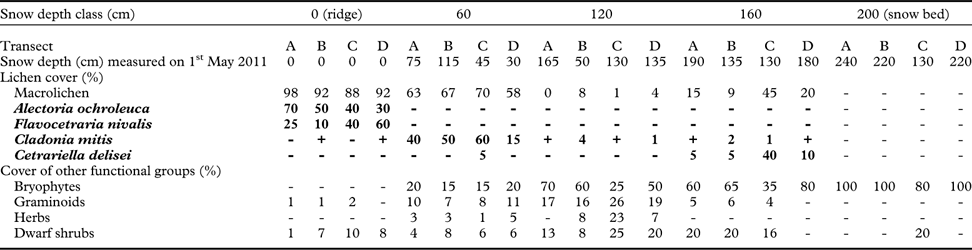
+: present at <1% cover. - : not present
The ridge to snow bed gradient transect
We selected four (A – D) separate ridge to snow bed gradient transects. A transect was chosen where its plant communities followed previously described zonation from ridge to snow bed (e.g. Dahl Reference Dahl1956). Percentage cover of the species at five points along each transect was estimated visually and the total % cover calculated within each functional group i.e. macrolichens, bryophytes, graminoids, herbs and dwarf shrubs. Snow depth was measured on 1 May 2011, after a winter with only 72% of the normal snow depth compared to the last 30-year period from 1961–90 (eKlima 2015) (Fig. 1).
Transplantation design
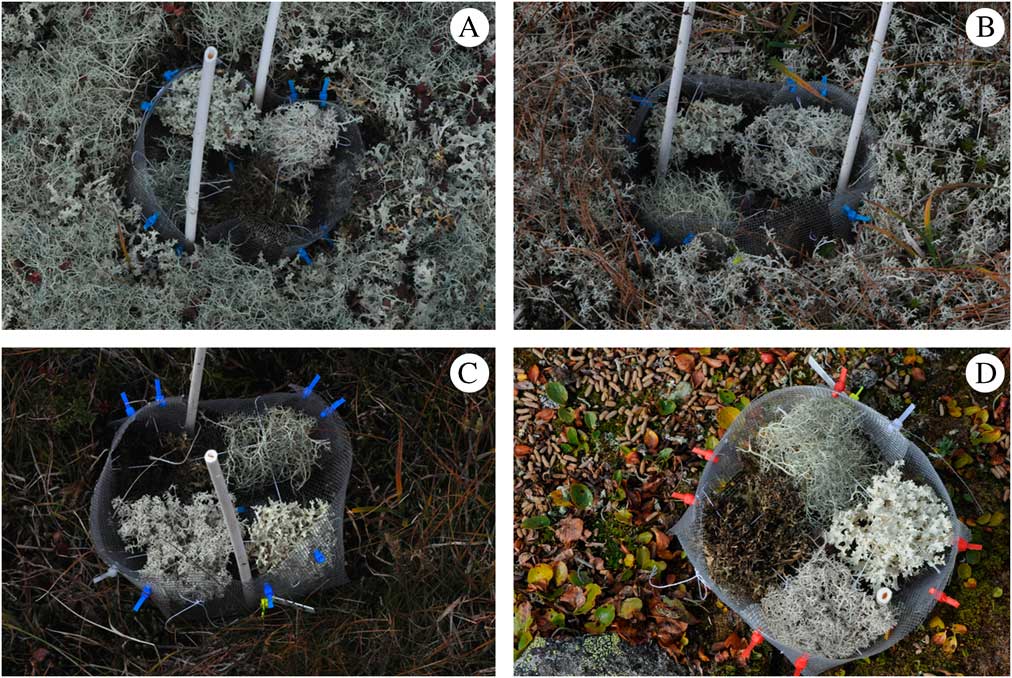
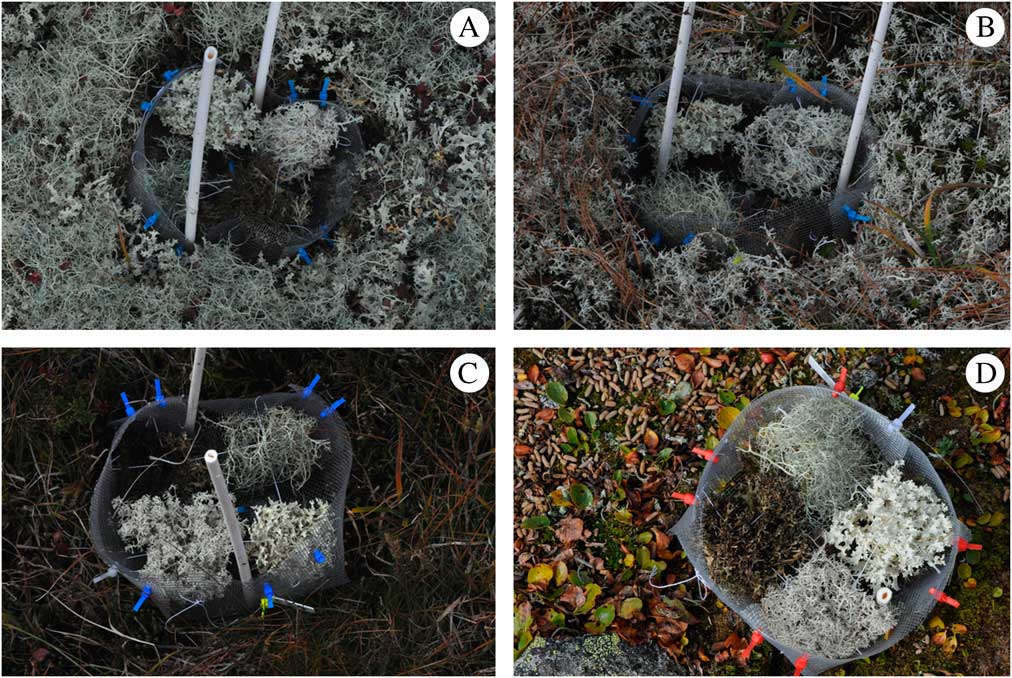
Thalli of each of the four lichens studied were secured in position using polyester thread into a basket made of plastic netting, 10×10×5 cm (Fig. 2). Five replicate baskets were placed at each of the five snow depth classes along the transects, including the zones where transplants had been collected. We fixed the baskets with lichens to the ground using 40 cm long plastic sticks. The transect was considered a random variable. The low, open vegetation did not shade the transplants (Fig. 2), even in the peak growing season, minimising competition from surrounding vegetation. The lichens were left for one year from 15 September 2010.
Lichen transplant baskets at 4 snow depth classes. A, 0 cm snow depth class (ridge top) where Alectoria ochroleuca is normally dominant; B, 60 cm snow depth class where Cladonia mitis is normally dominant; C, 120 cm snow depth class where vascular plants are normally dominant; D, 180 cm snow depth class where Cetrariella delisei is present in patches. Photographs taken in early September 2010 at the start of the transplantation. In colour online.
Growth measurements
A few thalli (1–6 for each species) were lost because of unknown disturbance to the nets. For each of the remaining thalli, growth was measured as relative growth rate, RGR=(ln (DMend/DMstart))*1000/Δt (mg g−1 d−1) (Evans Reference Evans1972), Δt =365 days. The baseline for comparison of experimental results is the performance of transplants of each species in their preferred habitat. RGR is expressed as mean ± 1 SE; n=94–99.
Extraction of secondary compounds and HPLC analyses
Thalli were finely ground using a mixer mill (MN 301, Retsch GmBH, Germany), and 15 mg of each thallus was placed in an Eppendorf vial with 500 μl 100% acetone. After 10 min extraction, the vials were centrifuged for 3 min at 15 000 rpm. The supernatant was then transferred to a 10 ml glass vial. The procedure was repeated three times and the three extracts were combined. Acetone was then left to evaporate from the tubes using a Concentrator plus/Vacufuge™ plus (Eppendorf, Hamburg, Germany) and the dried material was stored at −18 °C for 5 days until analysis.
HPLC analyses were carried out following Feige et al. (Reference Feige, Lumbsch, Huneck and Elix1993) and modified by Nybakken & Julkunen-Tiitto (Reference Nybakken and Julkunen-Tiitto2006). Dried material was dissolved in 500 μl of 100% acetone and CBSCs were analyzed using an 1100 series chromatograph (Agilent Technologies, Waldbronn, Germany) fitted with a 1040M diode-array detector and an ODS Hypersil column (50×4·6 mm). The solvents for the mobile phase at 2 ml min−1 were 0·25% orthophosphoric acid and 1·5% tetrahydrofuran in Millipore (Millipore, Billerica, MA, USA) water (solution A) and 100 % methanol (solution B); the UV detection was at 245 nm. The injection volume for the analysis was 10 μl. The run started with 30% solution B, then increased to 70% after 15 min and to 100% after another 15 min. The condition was held for 5 min and then solution B was reduced to 30% within 1 min. Before the next analysis, a 10 min post-run with 30% solution B was performed. The identification of CBSC was based on retention time, online UV spectra and co-chromatography of commercial standards.
Statistical analyses
All statistical analyses, including regression analyses, were run in SigmaPlot 11.0 (Systat Software Inc., Ashburn, VA). A Kruskal–Wallis ANOVA with all pairwise multiple comparison procedures (Dunn’s method) was run with snow depth classes as the factor. Means±1 standard error are given in the text and figures.
Results
The four lichen species studied had specific niches at different snow depths across the ridge to snow bed gradient (Table 1). The study area is generally characterized by long-lasting snow cover (Fig. 1), snow depth varying during the study period from c. 0 m at the ridge, where thin snow stayed for a maximum of one month, to c. 2 m in the snow bed where the snow lasted for more than eight months. A. ochroleuca is the least frequent species, occurring exclusively on the wind-exposed ridges (snow depth class 0 cm). Here, A. ochroleuca co-occurred with F. nivalis which extended slightly downhill until it was replaced by C. mitis in deeper snow (snow depth class 60 cm). Cladonia mitis had the widest ecological amplitude. Lichens dominated the two shallowest snow depth classes (Table 1) while vascular plant abundance was highest at snow depth class 120 cm. In deeper snow, lichens were present in significant amounts only at snow depth class 160 cm, where C. delisei was common, contributing a mean cover of 15%. The bryophyte cover gradually increased from 0% at the ridge to 100% in snow depth class 200 cm (late snow beds), whereas graminoids were best represented at intermediate snow depths.
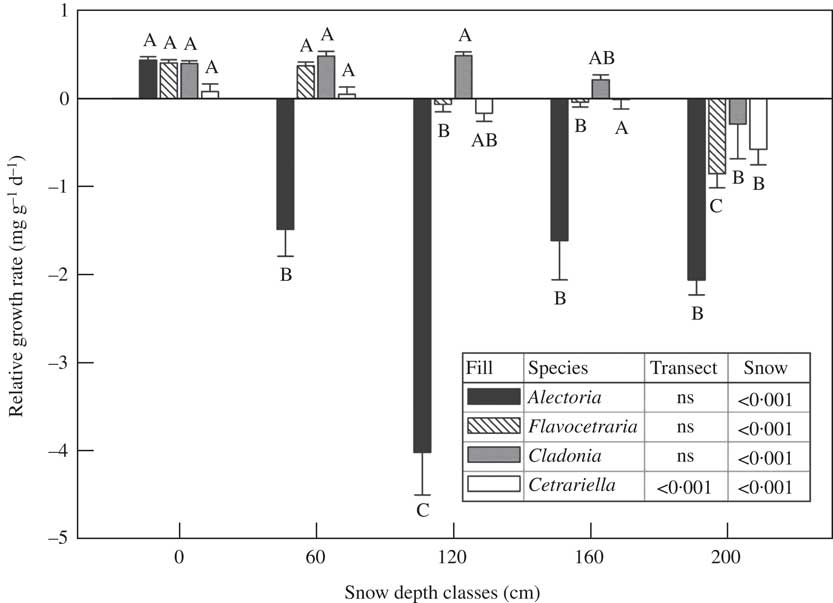
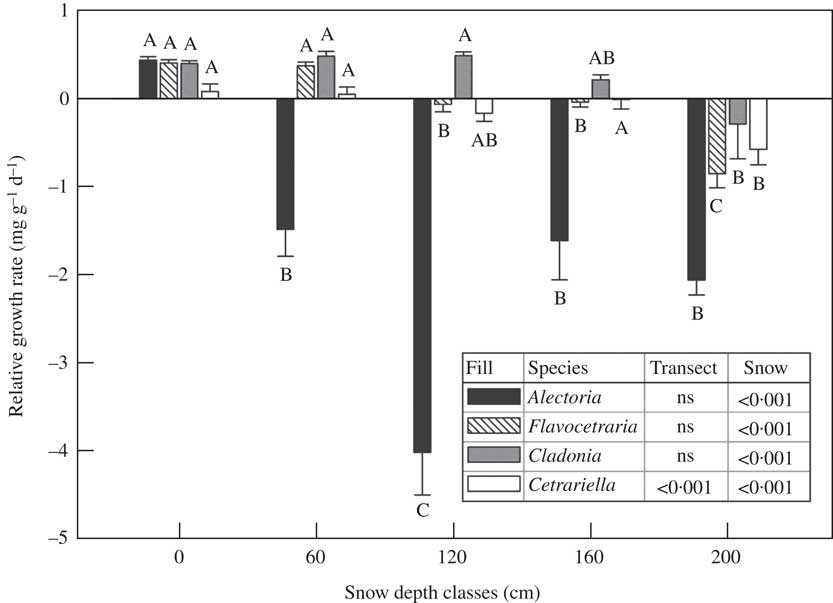
Average RGR across all transects was positive only for the generalist C. mitis (0·34±0·26 mg g−1 d−1) and negative for the more specialized species. The highest mean percent annual growth for each species was 17·8±1·8% for A. ochroleuca (0 cm snow class), 16·4±1·6% for F. nivalis (0 cm snow class), 20·1±2·3% for C. mitis (60 cm snow class; also almost as high at 0 cm class), and 4·0±3·1% for C. delisei (0 cm snow class). Hence, the growth rates were highest in the habitats with the highest % cover for three of the four species. However, if snow depth exceeded those typical for these lichens, the effect on RGR was more detrimental than if they were exposed to less snow. This was the case even for the most snow tolerant species C. delisei and C. mitis. Thus, the relationship between snow depth and growth rates for all species is highly significant (Fig. 3). Only for C. delisei, did an individual transect significantly affect growth rates (P<0·001). The largest mean annual percent loss at any one point along a transect was −70·5±5·5% for A. ochroleuca (120 cm snow class), −25·1±4·1% for F. nivalis (200 cm snow class), −1·2±5·5% for C. mitis (200 cm snow class), and −16·7±4·5% for C. delisei (200 cm snow class). The highest individual RGRs were 0·84 mg g−1 d−1 (=37·0% DM gain) for C. mitis, 0·70 mg g−1 d−1 (=29·9% DM gain) for A. ochroleuca, 0·78 mg g−1 d−1 (=34·0% DM gain) for C. delisei, and 0·66 mg g−1 d−1 (=28·0% DM gain) for F. nivalis.
Mean relative growth rates of Alectoria ochroleuca, Flavocetraria nivalis, Cladonia mitis and Cetrariella delisei after transplantation for one year at five snow depth classes across four snow-depth gradient transects. For each species, bars with different letters are significantly different as determined by Kruskal–Wallis ANOVA with all pairwise multiple comparison procedures (Dunn’s method). Error bars indicate 1 SE (n=20). The inset table provides P-values (species-wise Kruskal-Wallis ANOVA) for the effect of snow depth class and transect on these lichens.
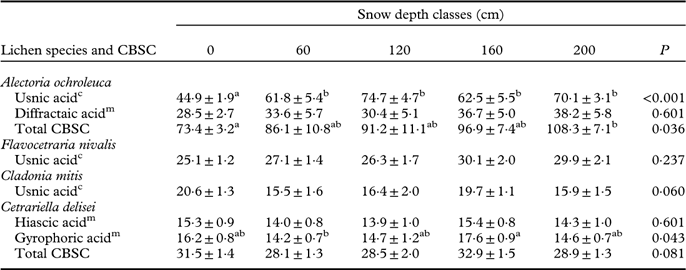
With respect to secondary metabolites, of the species studied only F. nivalis and C. mitis produced the cortical compound usnic acid. Alectoria ochroleuca contained usnic acid and the medullary compound diffractaic acid, whereas C. delisei contained two related medullary compounds, hiascic and gyrophoric acid, but no extractable cortical compounds (Table 2). Total mean CBSC concentration at the end of the experiment was 9% of DM in A. ochroleuca, which was 3–5 times higher than in the other species. Snow depth influenced the usnic acid concentration in A. ochroleuca by a factor of 1·6 (P<0·001), but not in F. nivalis and C. mitis (Table 2). Other CBSCs studied were not, or only marginally (gyrophoric acid in C. delisei), affected by snow depth.
Carbon-based secondary compound (CBSC) concentrations (mg g−1) in Alectoria ochroleuca, Flavocetraria nivalis, Cladonia mitis and Cetrariella delisei after transplantation for one year at five snow depth classes taken from four ridge to snow bed transects
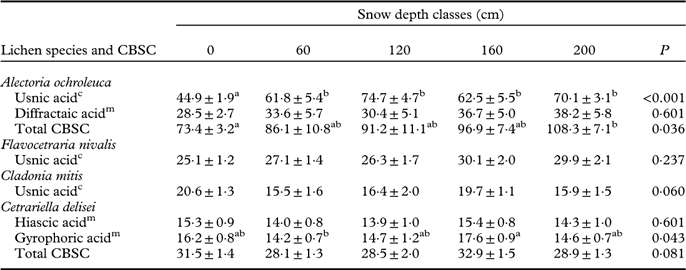
Means±1 standard error (n=20). P-values were calculated using a Kruskal–Wallis one way analysis of variance on ranks. m=medullary; c=cortical compounds. Means with different superscript letters (a, b) denote that CBSC concentrations are significantly different using pairwise multiple comparison procedures (Dunn’s Method).
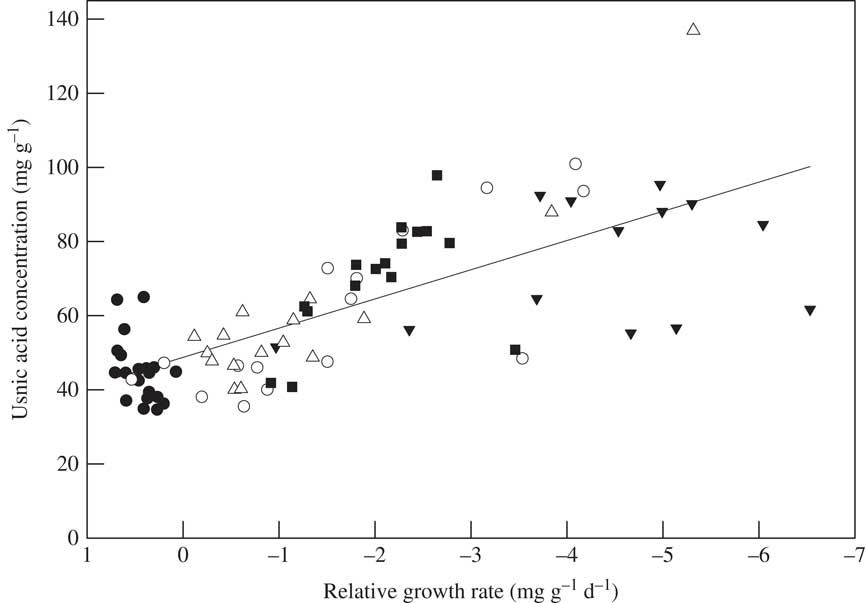
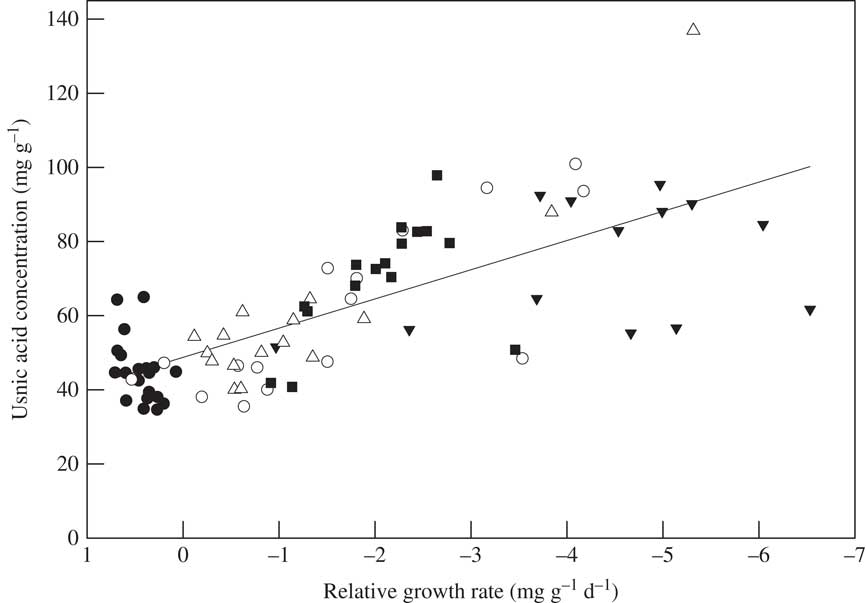
In the ridge specialist, A. ochroleuca, there was a highly significant increase in concentration of usnic acid as RGR decreased (Fig. 4). RGR accounted for up to 51·6% of the variation in usnic acid concentration in this species (Fig. 4). Loss of biomass in A. ochroleuca was substantial at all snow depths apart from the snow-free ridge top, but particularly high at the intermediate snow depth (Fig. 3). Biomass loss also occurred in F. nivalis, but only in some specimens experiencing the deepest snow. No significant relationships occurred between CBSCs and RGR in F. nivalis, C. mitis or C. delisei.
The relationship between relative growth rate and usnic acid concentration in Alectoria ochroleuca across five snow depth classes (snow depth measured 1 May): 0 cm (●), 60 cm (○), 120 cm (▼), 160 cm (▵), 200 cm (■). (r 2 adj =0·516; P<0·001; n =92).
Discussion
Despite positive effects of snow on some terricolous lichens (Bjerke Reference Bjerke2009), growth was reduced by snow deeper than the depths recorded at maximum coverage (Table 1) for each of the lichen species studied (Fig. 3), in a year with much less snow than normal. Snow-induced growth reduction was strongest for A. ochroleuca, the most snow-avoiding species. Here, loss of green colour, indicating chlorophyll degradation, was easily visible at all positions with snow accumulation, and the tension in A. ochroleuca branches was lost to such an extent that the fruticose growth form collapsed to a carpet of decaying tissue. Thus, the DM loss causing negative RGR of this species is degradation rather than fragmentation. Lichens decompose rapidly in winter under snow (Moore Reference Moore1984; Taylor & Jones Reference Taylor and Jones1990; Coxson & Curteanu Reference Coxson and Curteanu2002), although decay rates are lower in terricolous lichens than in lichens on other substrata (Asplund & Wardle Reference Asplund and Wardle2013). A thin snow cover might not necessarily reduce lichen growth because lichens can be photosynthetically active even under 15 cm of snow (Pannewitz et al. Reference Pannewitz, Schlensog, Green, Sancho and Schroeter2003), but our results, as well as those of Scott & Rouse (Reference Scott and Rouse1995), show that deeper snow for just one winter causes sensitive species to disappear. Thus prolonged snow cover directly affects lichen fitness, and our results support the view that A. ochroleuca strongly avoids deep snow (Larson & Kershaw Reference Larson and Kershaw1975).
The high growth rate of F. nivalis at the two shallowest snow classes and its negative rates in deeper snow is consistent with the reported snow avoidance of this species (Hestmark et al. Reference Hestmark, Skogesal and Skullerud2005). Cladonia mitis had the broadest ecological amplitude with respect to snow depth (Table 1), consistent with positive RGRs in all but the deepest snow classes (Fig. 3). Its field distribution is less limited by snow cover (Jonasson Reference Jonasson1981) than by other abiotic factors or competition (Sheard Reference Sheard1968). At its highest cover in the alpine ridge to snow bed gradient, growth was comparable to growth rates measured in mat-forming Cladonia species in forests in, for example, Canada (Boudreault et al. Reference Boudreault, Zouaoui, Drapeau, Bergeron and Stevenson2013) and Sweden (Gaio-Oliveira et al. Reference Gaio-Oliveira, Moen, Danell and Palmqvist2006).
As in earlier studies (Cooper et al. Reference Cooper, Smith and Wookey2001; Uchida et al. Reference Uchida, Nakatsubo, Kanda and Koizumi2006), C. delisei had low RGRs, even in its natural habitat. RGR was positive only at snow depth classes 0 and 60 cm (Fig. 3), where it rarely occurs (Table 1). The highly significant effect of site (Fig. 3) is probably due to this species’ preference for depressions temporally inundated with water (Thell & Moberg Reference Thell and Moberg2011) that are likely to occur at small, but undocumented spatial scales within the study sites. Cetrariella delisei has more patchy occurrences than the other species. It also differs from most mat-forming lichens by having absorbing, melanic compounds, rather than reflecting cortical pigments such as usnic acid (Solhaug et al. Reference Solhaug, Larsson and Gauslaa2010). It is therefore unable to trap light downwards in its canopy as usnic lichens do by their reflecting surfaces. Dark, melanic pigments can be an adaptation to cold climates and/or cold seasons (Gauslaa Reference Gauslaa1984; pp 13–22), consistent with this species’ frequent submersion in cold water. The unique ecological demands of C. delisei may not have been matched in many of the transplantation sites, and causing the low growth. The positive growth rates on ridges without snow may have occurred because its dark colour allowed growth in the winter even though ridges are not its normal habitat, possibly due to competition.
With respect to CBSCs, snow depth strongly influenced the usnic acid concentration in the most snow-avoiding lichen (Table 2). Usnic acid screens the lichen by reflecting excess solar radiation (Solhaug & Gauslaa Reference Solhaug and Gauslaa2012). Its synthesis is triggered by UV-B and boosted by photosynthates (Bjerke et al. Reference Bjerke, Lerfall and Elvebakk2002; McEvoy et al. Reference McEvoy, Nybakken, Solhaug and Gauslaa2006). However, the increase in usnic acid in decaying A. ochroleuca under snow, excluding UV-B and photosynthates, presumably occurred because usnic acid was more resistant to decomposition than other organic compounds in this lichen, including the diffractaic acid. It has been shown that a number of CBSCs, including usnic acid, regulate lichen decomposition owing to their antimicrobial properties (Lawrey Reference Lawrey1986; Crittenden & Porter Reference Crittenden and Porter1991; Huneck Reference Huneck1999; Ingólfsdóttir Reference Ingólfsdóttir2002). In this study, the highest usnic acid concentration occurred in the species with the fastest biomass loss, which is not consistent with a strong antimicrobial effect of this compound in the lichen thallus. Field studies show that neither the presence of usnic acid (Wetmore Reference Wetmore1982) nor cortical CBSCs in general (Asplund & Wardle Reference Asplund and Wardle2013) seem to influence lichen degradation rates. Stark & Hyvärinen (Reference Stark and Hyvärinen2003) showed that usnic acid acts as a source of energy for soil microbes once leaked from the thalli. However, the increase in usnic acid in A. ochroleuca during degradation suggests that not much usnic acid leaks, or that it leaks at slower rates than other compounds during degradation. This is consistent with the reported low solubility of CBSCs in water, particularly at ambient low pH (Kristmundsdóttir et al. Reference Kristmundsdóttir, Aradóttir, Ingólfsdóttir and Ögmundsdóttir2002).
Snowfall is predicted to increase in western alpine Norwegian sites (AMAP 2012), and lichens are photosynthetically active mostly after snow disappears (Pannewitz et al. Reference Pannewitz, Schlensog, Green, Sancho and Schroeter2003). Therefore snow-avoiding lichens, an important fodder for reindeer and caribou (Heggberget et al. Reference Heggberget, Gaare and Ball2002; Vistnes & Nellemann Reference Vistnes and Nellemann2008), might decline with negative impacts at an ecosystem level (Nieminen & Heiskari Reference Nieminen and Heiskari1989; van der Wal et al. Reference van der Wal, Brooker, Cooper and Langvatn2001; den Herder et al. Reference den Herder, Kytöviita and Niemelä2003). One may argue that snow always blows away from exposed ridges, and therefore increased snow will not reduce ridge lichens. However, in the wetter coastal mountains west of Finse, snow becomes so thick and wet that bryophytes replace lichens even on ridges, whereas in continental and drier areas further east, A. ochroleuca often dominates much of the landscape (Y. Gauslaa, pers. obs.). Snow quality also matters, which might explain why lichens can grow under deeper snow in some parts of the world than others. With warmer and wetter winters in Norway (AMAP 2012; IPCC 2014), hardness of snow increases. Wet snow affects lichens more severely (Bjerke Reference Bjerke2011) than the well-documented adverse effects of snow in general (Benedict Reference Benedict1990, Reference Benedict1991), and leads to lower accessibility to fodder for reindeer and caribou that depend on lichens during the winter (Turunen et al. Reference Turunen, Soppela, Kinnunen, Sutinen and Martz2009).
Conclusion
A single winter was enough to have an adverse impact on the ridge lichens A. ochroleuca and F. nivalis transplanted to deeper snow. Snow can shape the zonation of dominant terrestrial mat-forming lichens from ridge to snow bed habitats. The negative response of these lichens to excess snow could cause changes in Scandinavian alpine ecosystems under the predicted increase in precipitation, even in the absence of competition by plants. Species tolerant to snow cover such as C. mitis might expand their realized ecological niche at the expense of the ridge lichens.
We thank Finse Alpine Research Center for providing accommodation and access to laboratory facilities during fieldwork, and A. Chapuis for help with snow measurements. We also thank P. D. Crittenden and S. Will-Wolf for constructive comments.