

INTRODUCTION
Flooding seriously affects plant survival and crop production in farmlands worldwide. More than 16% of lowlands planted to rice (Oryza sativa L.) worldwide and over 20 million ha of rainfed lowlands in tropical Asia are adversely affected by floods every year (Mackill et al., Reference Mackill, Ismail, Singh, Labios and Paris2012). Transient flash floods cause the complete submergence of rice plants for a few days to a few weeks. When flooding occurs, rice yield is reduced by 10–100% depending upon flood duration, depth, and floodwater conditions (Singh et al., Reference Singh, Dar, Singh, Zaidi, Bari, Mackill, Collard, Singh, Singh, Reddy, Singh and Ismail2013).
Submergence-tolerant but low-yielding rice landraces have been known to rice breeders in eastern India more than 50 years ago (Bailey-Serres et al., Reference Bailey-Serres, Fukao, Ronald, Ismail, Heuer and Mackill2010) and physiological and genetic mechanisms of complete submergence tolerance in rice have been studied (Colmer et al., Reference Colmer, Armstrong, Greenway, Ismail, Girk and Atwell2014). Consequently, a major quantitative trait locus controlling submergence tolerance named SUB1 was identified (Mackill et al., Reference Mackill, Ismail, Singh, Labios and Paris2012). SUB1 suppresses the ethylene-activated shoot elongation under submergence, reducing carbohydrate consumption and enhancing survival (Fukao et al., Reference Fukao, Xu, Ronald and Bailey-Serres2006). Recently, submergence-tolerant modern varieties (hereafter referred to as Sub1 varieties) were developed by the introgression of the SUB1 gene into popular varieties through molecular breeding (Mackill et al., Reference Mackill, Ismail, Singh, Labios and Paris2012). These Sub1 varieties can survive 2–3 weeks of complete submergence (Singh et al., Reference Singh, Mackill and Ismail2009). For example, in eastern India in the wet season of 2008, farmers' fields where Swarna (the original non-Sub1 variety) was planted were entirely destroyed by 12–17 days of submergence during vegetative growth stage, while Swarna-Sub1 yielded 2.9–3.3 t ha−1 (Singh et al., Reference Singh, Dar, Singh, Zaidi, Bari, Mackill, Collard, Singh, Singh, Reddy, Singh and Ismail2013). SUB1 was introduced into more than 10 varieties in South and Southeast Asia that included seven mega varieties: Swarna, Samba Mahsuri and Savitri from India, BR11 from Bangladesh, IR64 from the Philippines, Thadokkham 1 from Laos and Ciherang from Indonesia. To date, more than a million rice farmers have adopted these Sub1 varieties since these were first released in 2009 (Mackill et al., Reference Mackill, Ismail, Singh, Labios and Paris2012).
The importance of crop management for ill-drained, flood-prone rice fields was recognized by physiologists over 40 years ago (Palada and Vergara, Reference Palada and Vergara1972; Yamada, Reference Yamada1959). It was suggested that N application and nursery bed management would affect the health of the plant and its survival under submergence. Improved nursery management was tested in field experiments conducted in eastern India in the 1980s (Panda et al., Reference Panda, Reddy and Sharma1991). These experiments found that fertilizer application on the nursery bed increased the rice yield of a semi-dwarf high-yielding variety under submergence stress. In the early 2000s, Ella and Ismail (Reference Ella and Ismail2006) evaluated the carbohydrate dynamics of rice seedlings prepared in different nutrient management regimes and put under submergence stress. They concluded that excess N applied to rice during the pre-submergence period reduces the plant's non-structural carbohydrate (NSC) content and the survival rate under submergence. Although fewer in number than studies on genetics and molecular physiology, these pioneering agronomy studies before the release of Sub1 varieties emphasized the significant effect of crop management on rice adaptation to submergence.
Farmers living in stress-prone environments are often reluctant to increase their investment on farming for fear of crop failure by the hazardous weather (Haefele et al., Reference Haefele, Kato and Singh2016). However, the rapid dissemination of Sub1 varieties in flood-prone areas of Asia provides them a great incentive for improving their management practices (Singh et al., Reference Singh, Dar, Singh, Zaidi, Bari, Mackill, Collard, Singh, Singh, Reddy, Singh and Ismail2013). Instead of examining the small effect of each management aspect on yield, recent agronomy studies centre the integrative effect of best-bet management treatments to make full use of newly released stress-tolerant varieties and give solutions to farmers (Haefele et al., Reference Haefele, Kato and Singh2016). Recently, the integrated management guidelines that included the preparation of nursery bed, proper seedling age and fertilizer application for Swarna-Sub1 and Samba Mahsuri-Sub1 were developed and were proven to enhance rice yield by 16–29% in on-farm trials in West Bengal (Bhowmick et al., Reference Bhowmick, Dhara, Singh, Dar and Singh2014) and Bihar (S. Singh, unpublished data), India. However, the physiological basis of increase in yield by such a management recommendation remains unknown.
While complete submergence often occurs even at the late vegetative stage, previous studies mostly targeted the effect of this stress when imposed at the seedling stage when rice is most susceptible to submergence. Furthermore, agronomy studies in the last century could not easily touch the crop management against submergence stress, because it kills out all the plants in non-Sub1 varieties. In this study, we examined the two hypotheses. First, submergence at the late vegetative stage should considerably reduce leaf growth and stem reserves and, thereby, biomass accumulation after water recession (Ismail et al., Reference Ismail, Ella, Vergara and Mackill2009). Panicles m−2 might be largely reduced due to reduced tillering caused by the stress (Singh et al., Reference Singh, Mackill and Ismail2009). Second, an integrated management approach should enhance the stem reserves and green leaf retention of a Sub1 variety under severe submergence and improve growth recovery (Panda et al., Reference Panda, Reddy and Sharma1991; Yamada, Reference Yamada1959). If these hypotheses are true, the previous findings on submergence tolerance mechanisms in rice and the recommended management practices could be applied at any time before the reproductive stage on Sub1 varieties subjected to severe stress.
The overall aim of this study was to improve the management recommendation for Sub1 rice varieties under complete submergence stress. The first objective was to characterize the physiological and agronomic traits under complete submergence at the late vegetative stage. The second objective was to test early season management practices on the rice response to submergence stress and its growth recovery after water recession.
MATERIALS AND METHODS
Set-up of field trials
Experiments were conducted at the farm of the International Rice Research Institute (IRRI) in Los Baños, Philippines (14°11′N, 121°15′E, altitude 21 m) during the dry season (DS; January to May) and wet season (WS; July to November) of 2013. The soil (0–20 cm) at the site is an Aquandic Epiaquoll with 25% sand, 35% silt, 40% clay, pH (H2O) 7.4, 23.0 g kg−1 total C, 2.0 g kg−1 total N, 25.9 mg kg−1 Bray-II P, 1.35 cmol kg−1 exchangeable K, 0.38 mg kg−1 exchangeable Zn and 41.3 cmol(+) kg−1 cation exchange capacity. Weather data were obtained from the meteorological station at the IRRI farm: the mean air temperatures, solar radiations, and total rainfall of 2013 were 27.5 °C in DS and 27.6 °C in WS, 16.4 MJ m−2 d−1 in DS and 13.2 MJ m−2 d−1 in WS, and 425 mm in DS and 1595 mm in WS, respectively.
A deep water pond-cum-irrigation and drainage facility (360 m2) was used. The two management practices were arranged in a randomized complete block design with three replications. The size of each replicate was 108 m2. The submergence-tolerant rice variety IR64-Sub1 was used and the submergence-intolerant variety IR42 was planted in the surrounding areas. Seedlings were transplanted on 7 January and 6 July 2013 for the DS and WS, respectively, with 3 seedlings per hill. Submergence stress was imposed for 14 days (from 37 to 50 days after transplanting; DAT) for both DS and WS by maintaining the water depth at 150 cm. The pH (H2O) of water was 7.0 and the reductions of solar radiation intensity at water depths of 20 cm, 50 cm and 80 cm (below water surface) were 53%, 70% and 79%, respectively. Water depth was maintained at 2–3 cm for the rest of the growth period.
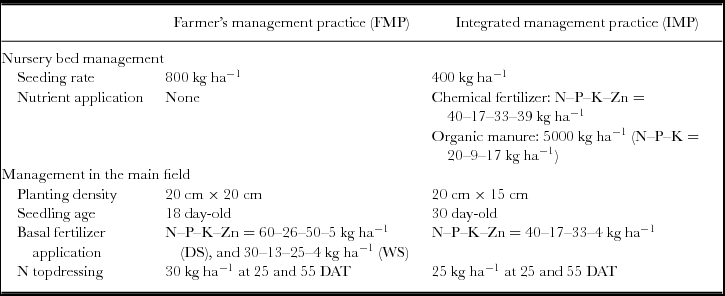
Two combinations of nursery bed management and crop management i.e., farmer's management practice (FMP) and IMP in the main field, were compared in this study (Table 1). FMP was based on a survey conducted in the low-lying areas in India, Bangladesh and the Philippines (Sarangi et al., Reference Sarangi, Maji, Singh, Sharma, Burman, Mandal, Singh, Ismail and Haefele2016), while IMP followed the recommended practice for flash floods with some adjustments (Bhowmick et al., Reference Bhowmick, Dhara, Singh, Dar and Singh2014; Singh et al., Reference Singh, Dar, Singh, Zaidi, Bari, Mackill, Collard, Singh, Singh, Reddy, Singh and Ismail2013). Briefly, the major modifications in IMP included (i) fertilizer application to the nursery bed, (ii) reduced seeding rate on the nursery bed, (iii) use of older and taller seedlings and (iv) higher transplanting density.
Two treatments of crop management.

DS; dry season, WS; wet season, DAT; days after transplanting.
Measurements
In order to determine tiller number, aboveground biomass and leaf area index, 6 hills (0.24 m2) were sampled from each plot for 5–6 times including before and after the period of submergence imposition (35 and 58 DAT). Leaf area was measured using a leaf area meter (LI-3000, LI-COR, Lincoln, NE, USA) after separating the samples into green leaves and stems and is expressed as leaf area index. Three soil cores were collected from each plot to a depth of 30 cm by using a metal cylinder (diameter = 13 cm) at the position of rice hills. Samples were washed with a gentle stream of water on a 1.0-mm-mesh screen to determine the root biomass. In the DS, an 8-bit grayscale image of each root sample with a resolution of 400 dpi was acquired with a flatbed image scanner (Epson V700, Epson, Long Beach, CA, USA) to analyse the root lengths and specific root lengths (i.e., root length/root weight) using commercial software (WinRHIZO v. 2009a, Regent Instruments, Montreal, QC, Canada). The dry weight of leaf, stem and root was determined after oven-drying the samples at 80 °C for 72 h. In the WS, the lengths of fresh young panicles were measured to determine the growth of reproductive organs using a binocular microscope. About 2–3 main tillers were collected from each plot 6 times from 24 to 79 DAT.
In the DS, concentrations of non-structural carbohydrate (%NSC) were also determined before and after the period of submergence imposition. Three medium-sized plants were collected from each plot and stems were immediately excised and fresh frozen in liquid N2, and then freeze-dried. Concentrations of soluble sugar and starch were measured according to Ismail et al. (Reference Ismail, Ella, Vergara and Mackill2009). Samples were assayed for soluble sugars using anthrone reagent and starch concentration was determined after hydrolysis with amyloglucosidase, followed by glucose assay using glucose oxidase (Sigma Chem. Co., MO, USA). The %NSC of stem was expressed as the sum of the concentrations of soluble sugars and starch.
Heading date was recorded when 50% of the panicles reached heading. At physiological maturity, 12 hills were randomly chosen to measure aboveground biomass, harvest index, and yield components. Plants were separated into straw and panicles. Panicles of all 12 hills were hand-threshed to separate the filled spikelets from the unfilled spikelets by submerging them in tap water: spikelets that floated were considered as unfilled. The numbers of filled and unfilled spikelets were determined to calculate spikelets panicle−1 and filled-grain percentage. Samples were oven-dried at 80 °C for 72 h. Grain yield was determined from a 5.0 m2 area (excluding border rows) and adjusted to a moisture content of 0.14 g H2O g−1.
Data were analysed by using the generalized linear model procedure of SAS for a randomized complete block design. The effect of treatment×season interaction was also assessed by combined analysis of variance.
RESULTS
Grain yield and yield components
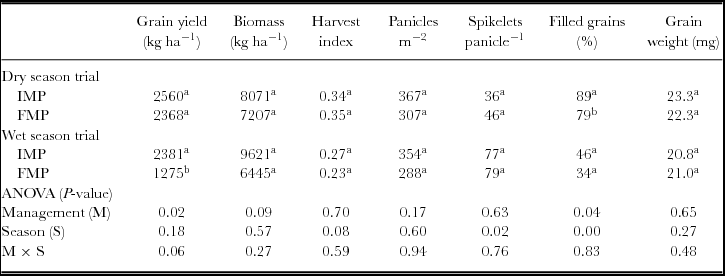
The percentage of survived plants of IR64-Sub1 for DS and WS was 88% and 61%, respectively, and there was no treatment difference. However, no plant of IR42 survived under the 14-day submergence stress. Grain yield of IR64-Sub1 was higher by 35% in the DS than in the WS (Table 2). IMP yielded higher than FMP by 8% and 87% in the DS and the WS, respectively. Although the difference was not significant, IMP had a higher aboveground biomass in both DS and WS as well as a higher harvest index but only in the WS. For yield components, panicles m−2 and the filled-grain percentage tended to be higher in IMP than FMP, while spikelets panicle−1 tended to be lower.
Rice yield and yield components in integrated management practice (IMP) and farmer's management practice (FMP) in the dry and wet seasons of 2013.

Different letters in superscript following values indicate statistical significance in each trial (P< 0.05).
Rice response to submergence stress
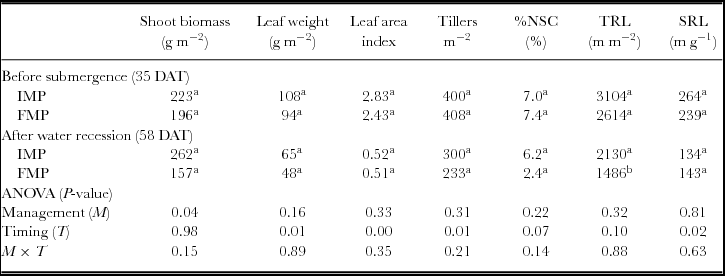
The size of seedlings at transplanting was different between IMP and FMP. In the WS, tillers plant−1, plant height and shoot biomass plant−1 in IMP and FMP were 4.5 and 1.1, 46 cm and 23 cm, and 819 mg and 54 mg, respectively. Before the submergence imposition, shoot biomass, leaf area, total root length and specific root length tended to be higher in IMP than FMP, while there was no difference in tillers m−2 and %NSC (Table 3).
Shoot biomass, leaf growth, concentration of non-structural carbohydrate (%NSC), total root length (TRL) and specific root length (SRL) in integrated management practice (IMP) and farmer's management practice (FMP) in the dry season of 2013.

DAT; days after transplanting. Different letters in superscript following values indicate statistical significance at each timing (P < 0.05).
There was no treatment difference in leaf area index and specific root length after water recession and these parameters were reduced by 79–82% and 40–49%, respectively, by submergence stress (Table 3). Shoot biomass, tillers m−2, %NSC, and total root length were higher in IMP than FMP during the recovery period.
Growth recovery after water recession
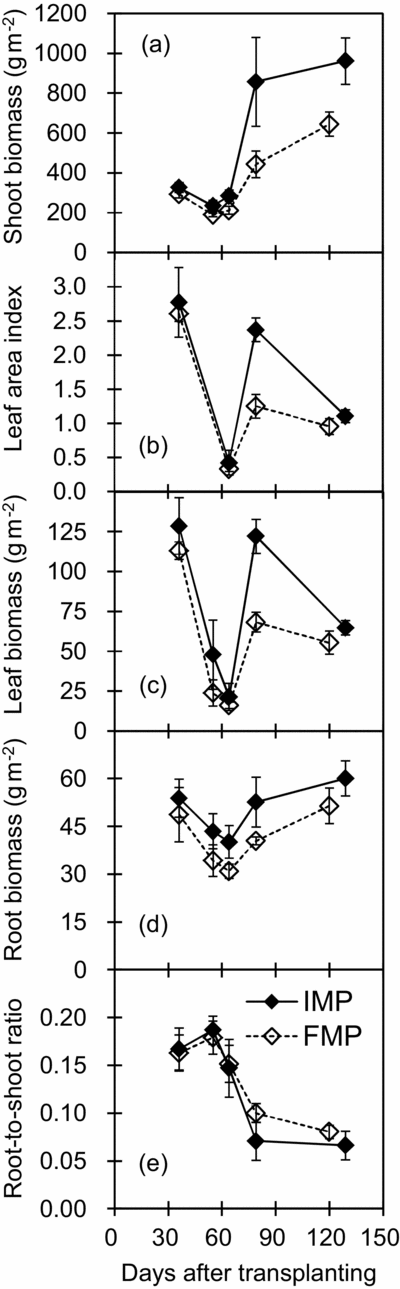
Leaf growth was much more severely damaged by submergence stress than shoot and root growth until 2 weeks after the water recession (Figure 1). Its growth rapidly recovered thereafter and shoot biomass concomitantly increased. Growth recovery of root was milder than that of shoot, and consequently the root-to-shoot ratio rapidly dropped during the recovery phase. The growth recovery of leaf and shoot was much higher in IMP than FMP.
Time course of shoot biomass, leaf and root growths in integrated management practice (IMP) and farmer's management practice (FMP) in the wet season of 2013. Bars indicate standard error (n = 3).

The heading date was 82–85 DAT for both IMP and FMP in both DS and WS at 32–35 days after the water recession. In IMP, panicle initiation occurred before the onset of submergence stress (Table 4). During the period of submergence imposition, no apparent growth of young panicles was observed and growth only resumed after water recession. On the other hand, panicle initiation in FMP occurred soon after water recession and the primary branches were initiated at around 55 DAT.
Panicle length (cm) at the pre-anthesis stage in integrated management practice (IMP) and farmer's management practice (FMP) in the wet season of 2013.

DAT; days after transplanting, n.d.; panicle was not detectable.
DISCUSSION
Drastic change in the energy balance occurs when rice gets completely submerged in water. The diffusion of O2 and CO2 in floodwater is 10,000 times slower than in air, which significantly lowers photosynthesis and respiratory efficiency. Indigenous gaseous hormone ethylene also accumulates in the stem, triggering a series of unique physio-morphological responses such as shoot elongation and leaf chlorosis (Fukao et al., Reference Fukao, Xu, Ronald and Bailey-Serres2006). In addition, floodwater intercepts radiation and only a limited amount of light reaches the submerged plants (Colmer et al., Reference Colmer, Armstrong, Greenway, Ismail, Girk and Atwell2014). All these factors lead to the depletion of the substrates in the plant body. Seedling stage is the most critical for plant survival under submergence because only a little amount of NSC is accumulated in the small body (Ismail et al., Reference Ismail, Ella, Vergara and Mackill2009). The effects of submergence stress at the seedling stage on crop growth and grain yield of Sub1 varieties have been dissected (Singh et al., Reference Singh, Mackill and Ismail2009; Reference Singh, Dar, Singh, Zaidi, Bari, Mackill, Collard, Singh, Singh, Reddy, Singh and Ismail2013; Reference Singh, Mackill and Ismail2014). In on-farm trials in India, Swarna-Sub1 and Samba Mahsuri-Sub1 yielded 3.1–3.8 t ha−1 in the WS, with the reduction caused by submergence for 12–17 days being 26–51% (Singh et al., Reference Singh, Dar, Singh, Zaidi, Bari, Mackill, Collard, Singh, Singh, Reddy, Singh and Ismail2013). At the IRRI farm, Swarna-Sub1, Samba Mahsuri-Sub1 and IR64-Sub1 yielded around 4.4–4.7 t ha−1 in the DS under submergence for 17 days, with a yield reduction of around 25% (Singh et al., Reference Singh, Mackill and Ismail2009). In this study, the impact of submergence stress will only be known when yield potential under shallow water conditions is examined. However, the observed yield levels (2.5 and 1.8 t ha−1 in DS and WS, respectively) implied that the impact of submergence at the late vegetative stage may be comparable to that at the seedling stage. There is much less time for the rice crop to recover until flowering when the submergence occurs at the late vegetative stage (e.g., 32–35 days in this study), compared with the stress at the seedling stage (e.g., 85–109 days; Singh et al., Reference Singh, Mackill and Ismail2009). Field studies on submergence tolerance in rice are often conducted in dry seasons as well as wet seasons due to the easiness of precise control of water regimes (Mackill et al., Reference Mackill, Ismail, Singh, Labios and Paris2012), while the severity of the stress tends to be weaker compared with wet seasons (Kato et al., Reference Kato, Collard, Septiningsih and Ismail2014; Singh et al., Reference Singh, Mackill and Ismail2009).
This study found that the effect of submergence stress at the late vegetative stage on the shoot growth is the same as at the seedling stage (Singh et al., Reference Singh, Mackill and Ismail2014). In agreement with previous findings for rice seedlings (Fukao et al., Reference Fukao, Xu, Ronald and Bailey-Serres2006), leaf growth was considerably reduced upon submergence and was further damaged by the oxidative stress occurring after water recession (Figure 1). Even for a large canopy at the late vegetative stage, leaf area index was reduced by over 80% with the two-week submergence. This means that the quick recovery of leaf growth is important for biomass accumulation after water recession. In contrast, stem growth was much less damaged by submergence stress and was even increased in the DS trial (Table 3). This is not uncommon (Singh et al., Reference Singh, Mackill and Ismail2014) and there is an increasing evidence of the active leaf photosynthesis taking place underwater and its importance for submergence tolerance in rice (Winkel et al., Reference Winkel, Colmer, Ismail and Pedersen2013). Photo-assimilation during the period of submergence is less expected in the WS trial (Fig. 1) due to lower radiation. Root biomass growth was less affected by submergence at the late vegetative stage (Fig. 1), similar to the stress at the seedling stage (Singh et al., Reference Singh, Mackill and Ismail2014). Rice develops a large root system with more thick and sturdy nodal roots at the late vegetative stage, which may lead to less decay caused by submergence. However, fine roots (mostly lateral root branches) were considerably reduced by submergence, as indicated by the 40–50% reduction in specific root length (Table 3). This might be due to the difference in aerenchyma formation in nodal and lateral roots, which is critical for continued growth under hypoxia stress (Colmer et al., Reference Colmer, Armstrong, Greenway, Ismail, Girk and Atwell2014).
The effects of submergence at the seedling and the late vegetative stages were different in the yield components (Table 2; Singh et al., Reference Singh, Mackill and Ismail2009). Singh et al. (Reference Singh, Mackill and Ismail2009) showed that panicles m−2 are drastically affected by submergence at the seedling stage, while spikelets panicle−1 are reduced by only 8–12% for Sub1 varieties. In this study, spikelets panicle−1 in the DS and filled-grain percentage in the WS were considerably affected by submergence, while panicles m−2 and grain weight were less affected (Table 2). Severe abiotic stress at the late vegetative stage would suspend the development of young panicles until water recession and/or postpone panicle initiation (Table 4). Our observation is similar to the previous finding of Lilley and Fukai (Reference Lilley and Fukai1994) on the effect of drought on young panicle formation. They showed that rice panicle formation proceeds more slowly under mild drought stress and is suspended under severe stress during the reproductive stage. In addition, young panicles have to compete with the vegetative organs quickly recovering from a flood for available assimilation (Kato et al., Reference Kato, Collard, Septiningsih and Ismail2014). Submergence stress at both seedling and late vegetative stages causes low grain-filling (34–89%) and harvest index (0.23–0.37) in Sub1 varieties (Table 2; Singh et al., Reference Singh, Mackill and Ismail2009). This may be attributed to insufficient photo-assimilation to support grain filling although there was no abiotic stress after the reproductive stage.
Integrated crop management differed from the conventional practice in the nursery bed management and transplanting density. Previous studies suggested that bigger seedlings with higher %NSC would improve submergence tolerance unless plant N% is at the excess level (Ella and Ismail, Reference Ella and Ismail2006; Panda et al., Reference Panda, Reddy and Sharma1991). High %NSC is important not only for plant survival but also for the quick emergence of new leaves and regeneration of tillers after water recession (Panda et al., Reference Panda, Sharma and Sarkar2008). In flood-prone environments where tillering is often suppressed (Kato et al., Reference Kato, Collard, Septiningsih and Ismail2014; Singh et al., Reference Singh, Mackill and Ismail2014), increasing the planting density would compensate for the effect of reduced tillering caused by flooding stress (Sarangi et al., Reference Sarangi, Maji, Singh, Sharma, Burman, Mandal, Singh, Ismail and Haefele2016). This study found that IMP enhanced the yield of IR64-Sub1, which coincided with previous findings of studies on non-Sub1 varieties which were subjected to mild submergence stress (Panda et al., Reference Panda, Reddy and Sharma1991). This would be attributed to the quicker resumption of leaf area growth and hence greater biomass accumulation during the recovery phase. Although the difference was small (not significant), the greater recovery in IMP than FMP may be associated with the larger biomass and leaf area before the onset of submergence, the larger biomass, %NSC, and tillers m−2 immediately after water recession. Accumulation of small effects in physiological adaptation to abiotic stresses should often result in the significant difference in integrated traits (Lafitte et al., Reference Lafitte, Guan, Shi and Li2007). Quick growth recovery of aboveground organs is also a critical rice characteristic of drought resistance at the vegetative stage (Mitchell et al., Reference Mitchell, Siamhan, Wamala, Risimeri, Chinyamakobvu, Henderson and Fukai1998). More biomass accumulation after the reproductive stage also contributed to better grain growth and, hence, higher grain-filling percentage at maturity in IMP than the conventional practice. However, the enhanced growths of vegetative organs and higher %NSC would not be necessarily associated with the growth of young panicles and spikelets panicle−1 when the stress occurs at the late vegetative stage (Tables 2, 4). It implies that the availability of growth substrate (i.e., carbohydrate) cannot fully explain the detrimental effect of complete submergence on the formation of reproductive organs.
The appropriate management for complete submergence stress would be different from the one for non-submergence conditions. Increasing seedling age from 21 days to 30 days has a yield penalty of 10% under non-submergence, where fertilizer application and reduced seeding rate in the nursery bed do not significantly affect rice yield (Lampayan et al., Reference Lampayan, Faronilo, Tuong, Espiritu, de Dios, Bayot, Bueno and Hosen2015). This means the use of 30-day-old seedlings, together with slightly lower fertilizer application rate for the main field, may cause slight yield reduction in favorable years when submergence does not occur in flood-prone areas. The main physio-morphological reason for this yield penalty would be the suppression of early tiller emergence by the use of old seedlings (Pasuquin et al., Reference Pasuquin, Lafarge and Tubana2008). On the other hand, the use of young seedlings increases the risks of partial submergence in the ill-drained fields with the depth of standing water kept over 10 cm (Kato et al., Reference Kato, Collard, Septiningsih and Ismail2014; Sarangi et al., Reference Sarangi, Maji, Singh, Burman, Mandal, Sharma, Singh, Ismail and Haefele2015; Reference Sarangi, Maji, Singh, Sharma, Burman, Mandal, Singh, Ismail and Haefele2016). To further improve the management recommendation for Sub1 rice varieties, future research on crop modelling is needed to quantify the risk and benefit of using old seedlings under various intensities of submergence stress.
CONCLUSION
It was found that the effect of submergence stress at the late vegetative stage on rice growths was similar to that at the seedling stage, as reported in previous studies. Leaf growth was considerably reduced upon submergence and further damaged after water recession, while growths of other organs were much less damaged. Improved management approach consisting of: (i) application of fertilizer (compared with no fertilizer use in conventional practice), (ii) use of lower seeding rate (400 vs. 800 kg ha−1) in the nursery bed, (iii) use of slightly older seedling for transplanting (30 vs. 18 day-old), and (iv) higher planting density (33.3 vs. 25.0 hills m−2) contributed to quicker resumption of leaf growth and greater biomass accumulation during the recovery phase, and hence improved grain yield of IR64-Sub1 under submergence compared with the conventional practice by 87% (2.4 vs. 1.3 t ha−1), especially in the wet season (natural rainfed rice season). Any innovative practices had not been attractive for the resource-poor rice farmers in flood-prone areas before, since flash floods kill out all the plants in the field. However, the release of Sub1 varieties will completely change the approach towards the adoption of rice management practices that reduce the risk of submergence. The development of management guidelines for submergence-prone rice areas is on-going in national agricultural research institutes and extension agencies in tropical Asia (Manzanilla et al., Reference Manzanilla, Singh, Kato and Johnson2016).
Acknowledgments
We thank Dr Sarah E.J. Beebout (soil scientist, IRRI) for providing valuable comments on an early version of our manuscript. We also thank the IRRI editorial team for editorial assistance. We acknowledge the support of the International Fund for Agricultural Development (IFAD) for the Consortium for Unfavorable Rice Environments (CURE) and Global Rice Science Partnership (GRiSP).