Introduction
Activity patterns of herbivorous insects are often influenced by spatial and temporal variations in abiotic conditions. Temperature, humidity, and wind, for instance, can dictate when activities take place within and among days (Harris and Rose Reference Harris and Rose1991; Quiring Reference Quiring1994; Gillespie et al. Reference Gillespie, Opit and Roitberg2000; Johns et al. Reference Johns, Boone, Leggo, Smith, Carleton and Quiring2012). Understanding insect activity patterns and how they vary in time and space relative to their environment is not only important in ecology, but can also provide essential information for various aspects of integrated pest management, for example, for sampling and treatment application (van Frankenhuyzen and Espinasse Reference van Frankenhuyzen and Espinasse2010; Holmes et al. Reference Holmes, Kettela, Nigam, Heard and Johns2012).
Diel activity patterns have been described for numerous insect herbivores, including the adults of several Cecidomyiidae (Diptera) species attacking apple (Malus Miller (Rosaceae) species) trees (Harris et al. Reference Harris, Galanihe and Sandanayake1999; Heath et al. Reference Heath, Zhang, Roelofs and Smith2005) and maize (Zea mays ssp. mays Linnaeus (Poaceae)) (Modini et al. Reference Modini, Page and Franzmann1987; Bergh et al. Reference Bergh, Harris and Rose1990; Pivnick and Labbé Reference Pivnick and Labbé1992, Reference Pivnick and Labbé1993). Such studies have identified several fairly common trends among cecidomyiids, including calling and mating in the morning and increased female flight and oviposition in the afternoon or evening (Heath et al. Reference Heath, Zhang, Roelofs and Smith2005). Most studies also indicate that adults are averse to activity during wind and rain and are poor fliers and weak dispersers (Gagné Reference Gagné1989).
We investigated the diel activity patterns of two interacting cecidomyiid species on young, open-grown balsam fir (Abies balsamea (Linnaeus) Miller). One species, the balsam gall midge, Paradiplosis tumifex (Gagné) (Diptera: Cecidomyiidae), is a major pest of balsam fir Christmas trees in eastern North America (Osgood et al. Reference Osgood, Bradbury and Drummond1992). During outbreaks, this gallmaker can cause significant damage to the growth and development of trees, reducing crop marketability, as well as causing tree mortality (Giese and Benjamin Reference Giese and Benjamin1959). The other species, Dasineura balsamicola (Lintner) (Diptera: Cecidomyiidae), an inquiline of the gallmaker, is beneficial to the Christmas tree industry, functioning as a natural biocontrol agent by killing the gallmaker as it usurps the gall for its own use (Akar and Osgood Reference Akar and Osgood1987).
Both cecidomyiid species are univoltine and have similar life histories, as described in detail by Osgood et al. (Reference Osgood, Bradbury and Drummond1992). In New Brunswick, Canada, the gallmaker emerges from diapause as an adult in mid-May through early June. Emergence is protandrous, with peak male emergence occurring one to two days before females. Adults mate soon after emerging from the duff layer, and females proceed to lay eggs between the needles of developing balsam fir shoots. After two to three days, eggs hatch, and larvae move to needles to initiate gall formation (Osgood and Gagné Reference Osgood and Gagné1978). By mid-June, galled needles are easily distinguishable from nongalled needles. In mid-September, the larvae begin to drop from needles to the soil, where they overwinter as larvae (Smith and Forbes Reference Smith and Forbes1962). Galled needles turn yellow and typically fall from the trees within one season (Lintner Reference Lintner1888; Giese and Benjamin Reference Giese and Benjamin1959), often resulting in severe defoliation. The inquiline follows a similar pattern of seasonal development to the gallmaker, although with two exceptions: (1) inquiline emergence occurs ~one to two weeks later than that of the gallmaker; and (2) inquilines are unable to form galls independently and must therefore rely on the gallmaker larvae to provide them with a gall in which to feed and develop. To accomplish this, the adult inquiline lays its eggs next to gallmaker eggs and, as the gallmaker larvae initiate the gall, the larvae of both insects are enveloped (Akar and Osgood Reference Akar and Osgood1987). The mechanism by which the inquiline kills the gallmaker has not been verified, however, it is believed that the spines on the integument of the inquiline larvae may puncture the midge as the larvae grow (Shorthouse and West Reference Shorthouse and West1986).
The most effective management strategy currently employed against the gallmaker is to treat the newly hatched larvae with pesticide before they enter the gall in the spring. However, the long-term value of this tactic may be diminished if the inquiline is accidentally targeted during treatment, which would reduce the impact of a potentially important natural mortality agent. Knowing when and where to sample for midges thus requires an understanding of activity patterns of both the gallmaker and the inquiline within balsam fir crowns. Here, we present results from field studies examining variations in the diel activities of the adult balsam gall midge (2012) and its inquiline (2013) within and below crowns of young balsam fir.
Methods
Study site characteristics
Studies were carried out in a stand of unmanaged, young, balsam fir trees contained within a former Christmas tree plantation near McGivney, New Brunswick, Canada (46°20'58''N, 66°33'53''W). Despite being largely unmanaged, the plantation structure was similar to that of operational plantations in that trees occurred in well-defined rows, spaced at ~2 m, with minimal overstorey. An unmanaged stand was used to ensure that no pesticides, herbicides, or any other form of tree management, such as shearing and mowing, could interfere with the normal insect behaviours. The stand was surrounded by a mature forest composed primarily of balsam fir, black spruce (Picea mariana (Miller) Britton, Sterns, and Poggenburg (Pinaceae)), yellow birch (Betula alleghaniensis (Britton) (Betulaceae)), and a small plantation of red pine (Pinus resinosa (Aiton) (Pinaceae)). One other Christmas tree pest, the balsam shootboring sawfly, Pleroneura brunneicornis (Hymenoptera: Xyelidae), occurred in appreciable densities. The sawfly population was negligible during 2012 (only one tree was symptomatic of the 15 trees examined); however, densities rose drastically in 2013 (13 of 15 trees), with ~80% of all balsam fir trees sustaining damage on >30% of new shoots. Dissections of developing shoots indicated that the presence of sawfly does not interfere with the gallmaker’s ability to oviposit; however, it is uncertain whether sawfly-attacked shoots were preferentially attacked or avoided by the gallmaker.
Diel activity patterns
Although our aim was to study gallmaker activity in both years, the gallmaker population largely collapsed across the province in 2013 (C. Dickie, InFor Inc., Fredericton, New Brunswick, Canada, personal communication), thus the gallmaker was studied only in 2012 and the inquiline only in 2013. Adult gallmaker abundance (i.e., the total number observed) and behaviour were recorded hourly during 18 and 24 May 2012, which represented the peak and end of the gallmaker flight period, respectively, based on emergence trap data (not shown). Observations on 28 May 2013 represented the peak of inquiline flight, again based on emergence trap data (not shown). Observation dates were considered ideal for monitoring general trends because they occurred during both peak emergence and under ideal weather conditions for midge activity (i.e., no precipitation, little to no wind, temperatures within seasonal averages).
Each year, we haphazardly selected 15 balsam fir trees with an average height of 3.2 m (±0.2 m SE). The lowest branches were typically <0.5 m from the ground. To determine the effect of crown level on midge abundance and behaviour, observations were made on the terminal bud cluster of one branch in each of the upper-crown, mid-crown, and lower-crown levels and in each cardinal direction (i.e., 12 bud clusters/tree/ha). In order to obtain sufficient data for subsequent analyses, these sample units were combined, collectively referred to hereafter as the “crown”. In addition to crown sampling, adult activity was monitored beneath the drip-line of each tree by placing a 225 cm2 quadrat on the ground in each cardinal direction (i.e., N, S, E, W), hereafter referred to as the “ground”. Preliminary 24-hour observations conducted on 17 May 2012 indicated that the gallmaker was inactive during the coldest hours of the day, ~23:00–06:00 hours; thus, hourly observations were not conducted during those hours on any days thereafter. To identify gallmaker and inquiline activity, two observers slowly approached each tree and each observed either a bud cluster (on the crown) or a quadrate (on the ground) for 5–30 seconds before reporting the number of cecidomyiids engaged in the following activities: (1) walking; (2) resting (>5 seconds spent motionless); (3) flying (hovering, left or alighted on a bud or substrate); (4) calling (females standing on substrate with ovipositor extended upward and moving in wafting pattern (Gagné Reference Gagné1989)); (5) mating (male and female engaged in copulation for any duration); (6) ovipositing (females remained motionless for >10 seconds with ovipositor inside the scales of the bud or between the closed needles of the bud). After completing an observation, the observer would advance to the next bud cluster or quadrate and repeat the procedure. With practice, species were easily distinguished based on differences in body colour, as well as wing and antennal morphology, all of which were evident when the adults ceased flight (Giese and Benjamin Reference Giese and Benjamin1959; Osgood and Gagné Reference Osgood and Gagné1978). To identify the sex of the insects, we relied on abdominal morphology (male claspers versus female tapered abdomen) (Giese and Benjamin Reference Giese and Benjamin1959; Osgood and Gagné Reference Osgood and Gagné1978). Where necessary, observations were confirmed by collecting adults using a sweep net or aspirator. To ensure consistent reporting, one observer was assigned to monitor the crown and the other was assigned to the ground for the duration of the observation period. Each adult was scored for only one activity, per hour, and an individual insect was not observed for more than 30 seconds. Additional field observations of >30 seconds were conducted outside of the sample unit areas during the course of these experiments and are referenced in the general discussion. During the early morning and late evening when light became dim, observers used light-emitting diode (LED) headband flashlights with a red filter lens to illuminate the observation areas. Preliminary trials indicated that neither lights nor movement by researchers had any obvious effect on cecidomyiid behaviour. Weather data were collected using a Watchdog 2000 portable weather station (Spectrum Technologies Inc., Paxinos, Pennsylvania, United States of America) placed centrally in the stand. Temperature and relative humidity measurements were collected at 30-minute intervals.
Statistical analyses
To determine the influence of time of day and adult sex on the total gallmaker and inquiline abundance within and below the crown, we fit the data to a generalised linear model (proc GENMOD dist=Poisson link=log; SAS Institute (1999)). We used the same model and parameters to assess the hourly variations in the number of female and male gallmakers and inquilines engaged in each activity within and below the crown.
Results
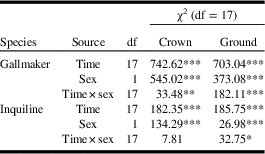
Gallmaker abundance declined from 18 to 24 May 2012. Despite this decline, activity and weather patterns were similar on these dates, so we merged the data for all subsequent analyses. Activities by each sex were greatly compartmentalised to either the ground (males) or the crown (females) for both gallmaker and inquiline; females made up 97.9% of all gallmaker and 96.9% of all inquiline observations in the crown (Figs. 1A, 2A), but only 29.8% and 24.7% on the ground (Figs. 1B, 2B). Thus, crown and ground data were analysed separately for both species. Regardless of species or sex, the number of adults observed was greatest in late afternoon/early evening (Figs. 1, 2), resulting in a significant interaction in the temporal abundance of adults of either sex, and for both species (Table 1).
Average (±1 SE) abundance of adult gallmaker in (top) the vegetative crown and (bottom) on the ground beneath young balsam fir in 2012.

Average (±1 SE) abundance of adult inquiline in (top) the vegetative crown and (bottom) on the ground beneath young balsam fir in 2013.
Results of a generalised linear model assessing the effects of time of day and adult sex on the abundance of a gallmaker (Paradiplosis tumifex) and its inquiline (Dasineura balsamicola) within the vegetative crown of young balsam fir and on the ground beneath the crown, in 2012 (gallmaker only) and 2013 (inquiline only).
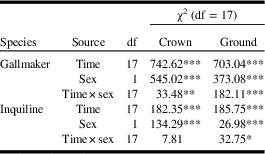
*P<0.05, **P<0.01, ***P<0.001.
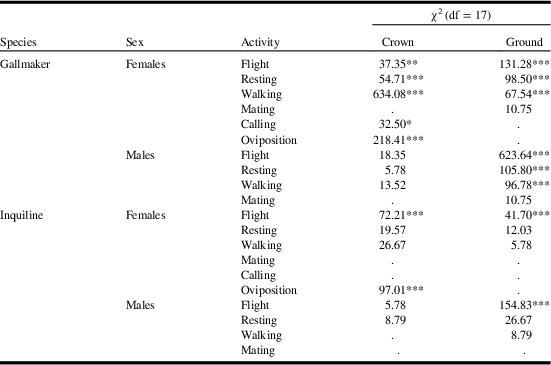
Although female gallmakers were observed throughout the daylight hours, the numbers flying, ovipositing, walking, and resting increased significantly from 17:00 to 22:00 hours (Table 2) (Fig. 3A–3D). Trends were similar for the inquiline (Fig. 4A–4D); only the numbers flying and ovipositing differed significantly (Table 2). Females were observed in flight in the crown shortly after direct sunlight illuminated the trees (~08:00 hours), and although there was a decrease in flight activity during the hottest hours of the day, flight did not cease until 22:00 hours (Fig. 3B). Inquiline females were more active than gallmaker females, and more time was typically spent in flight between buds than spent on any individual bud. Once females selected a bud, time was spent probing between the tightly packed needles for a suitable site to oviposit.
Diel pattern of gallmaker (A) ovipositing, (B) flying, (C) walking, (D) resting, and (E) ambient temperature and humidity on 18 and 24 May 2012 in the crown of a young balsam fir stand. Asterisks indicate time of sunrise and sunset.
Diel pattern of inquiline (A) ovipositing, (B) flying, (C) walking, (D) resting, and (E) ambient temperature and humidity on 28 May 2012 in the crown of a young balsam fir stand. Asterisks indicate time of sunrise and sunset.
Results of a generalised linear model assessing the effects of time of day on male and female activities of a gallmaker (Paradiplosis tumifex) and its inquiline (Dasineura balsamicola) within the vegetative crown of young balsam fir and on the ground beneath the crown, in 2012 (gallmaker only) and 2013 (inquiline only).
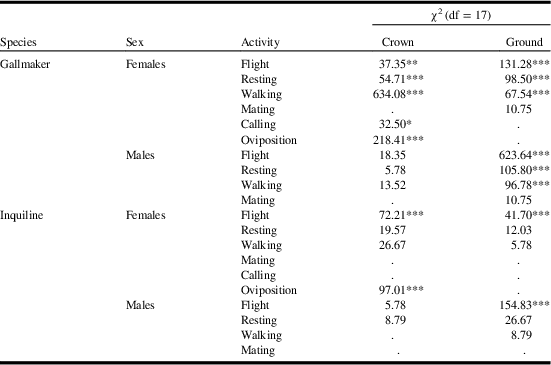
*P<0.05, **P<0.01, ***P<0.001.
At ground level, gallmaker activities began in early morning (~06:00 hours) (Fig. 1B). In general, females spent little time under the trees. In the morning, they were seen walking to the top of the vegetation growing under the trees and then resting. Once female calling began (~08:00 hours), males became noticeably active (i.e., flight). Calling events were reported from 08:00 to 17:00 hours, which coincided with mating observations (Fig. 5B, 5C). Females were seen resting at the tops of vegetation with their hind legs extended slightly, such that their abdomens were sticking upward with their ovipositors extended in a typical calling posture as described by Gagné (Reference Gagné1989). Male behaviours at ground level were characterised by short periods of flight, typically 5–30 seconds, interspersed with periods of walking and/or resting on foliage (Fig. 5A, 5D, 5E). During calling, males were often seen in close proximity to females (~1–5 cm), either on the same or adjacent plants. After a short period, a male would typically land on or beside the female and, using its claspers, grasp the female to mate. Although copulation times were not strictly monitored, observed copulations usually lasted <30 seconds. After mating, females remained on the foliage for a short period of time (30–90 seconds), then flew upward toward the crown. The number of females beneath the crown dropped off considerably at ~17:00 hours, as the majority of females dispersed to the crown.
Diel pattern of gallmaker (A) flying, (B) calling, (C) mating, (D) walking, and (E) at rest on the ground beneath young balsam fir trees on 18 and 24 May 2012.
Inquilines were not observed mating or calling within sample plots; however, during field observations made throughout the emergence period of the inquiline, mating behaviour similar to that of the gallmaker was observed. As in the gallmaker, mating occurred at the ground level, and most females spent very little time underneath the trees before dispersing to the crown in search of oviposition sites, whereas males remained underneath the trees (Fig. 6A–6C).
Diel pattern of inquiline (A) flying, (B) walking, and (C) at rest on the ground beneath young balsam fir trees on 28 May 2013.
Discussion
The diel activity patterns displayed by both the gallmaker and the inquiline were similar to those commonly reported in other cecidomyiid species (reviewed in Gagné Reference Gagné1989). In general, activity initiated shortly after direct sunlight illuminated the trees. Gallmaker females spent the early hours under the crown near the ground resting, calling, and mating before dispersing to the crown in the early afternoon to find suitable oviposition sites. Calling and mating behaviours were similar to those described for Douglas-fir cone gall midge (Contarinia oregonensis (Foote) (Diptera: Cecidomyiidae); Miller and Borden Reference Miller and Borden1984), Hessian fly (Mayetiola destructor (Say) (Diptera: Cecidomyiidae); McKay and Hatchett Reference McKay and Hatchett1984), and apple leaf curling midge (Dasineura mali (Kieffer) (Diptera: Cecidomyiidae); Heath et al. Reference Heath, Zhang, Roelofs and Smith2005) and were soon followed by female dispersal to the crown for oviposition. Males of both species flew throughout the day for short durations and, with rare exceptions, remained close to the site of emergence near the ground, another tactic commonly reported in cecidomyiids (Gagné Reference Gagné1989). Male activity rapidly ceased as direct sunlight left the lower portions of the trees. Oviposition and associated activities (i.e., walking, flying, and resting on foliage) in the crown occurred mainly in the afternoon/evening. Foraging by inquiline females was more active than that of the gallmaker. While searching for suitable oviposition sites, inquiline females visited more new shoots but spent less time on each compared with the gallmaker, often using their ovipositors to probe between needles, presumably searching for gallmaker eggs. This higher activity rate has been noted by Osgood et al. (Reference Osgood, Bradbury and Drummond1992) and is likely born of the necessity to find gallmaker eggs at a suitable stage of development for its own offspring’s success. Locating suitable oviposition sites may have been difficult for the inquiline during 2013 due to the decline in the gallmaker population, resulting in fewer available hosts. The decline in gallmaker populations was part of a regional trend that had been occurring over the previous three years. The presence of all other insect herbivores, including balsam shootboring sawfly, was not considered a contributing factor in the decline of the gallmaker populations.
Neither species was active during the majority of scotophase (21:00–07:00 hours), when temperatures were lowest and dew and/or frost was often present. Anecdotal evidence obtained by gently prodding adults just after flight had ceased suggested that neither species may have been capable of flight at this time. Interestingly, in both species, oviposition was still observed for a short period of time after flight ceased (Figs. 3A, 4A). In some instances, females remained on a bud with their ovipositors inserted between needles overnight, only to complete the task the following morning when air temperatures rose again. Similar behaviours have been observed in the orange wheat blossom midge (Sitodiplosis mosellana Géhin (Diptera: Cecidomyiidae); Pivnick and Labbé Reference Pivnick and Labbé1993).
Cecidomyiids are generally considered to be poor flyers (Gagné Reference Gagné1989), with wind and rain likely to have the most adverse effects on flight and movement capabilities. Throughout the field season, adults of both species were commonly observed landing prior to wind gusts and were rarely observed on the foliage or underneath trees during rain events, even if these events occurred on days when peak adult flight was predicted. We recognised that such adverse weather conditions are likely to alter their behaviour, likely truncating the active periods, thus, our observations were designed to occur during ideal conditions for both species.
Recommendations for monitoring
The balsam gall midge is considered one of the major pests of young balsam fir in Atlantic Canada due to its impact on needle retention in cultivated Christmas tree stands. Successful management of this insect is tricky and relies on a combination of factors. First, mitigation (in this case, insecticide application) requires precise timing, targeting the narrow phenological window during which larvae are entering the gall. Second, the decision to apply insecticide is made based on observations of adult populations that suggest densities have exceeded an “acceptable” level. The latter requires accurate information about when adults are emerging during the season, what the pattern of emergence may look like (i.e., a few days versus prolonged over several weeks) (report in progress), as well as when and where adults are active throughout the day (reported here). To the casual observer, this decision-making process is further complicated by the presence of the somewhat cryptic inquiline, which displays a similar diel activity pattern, and whose presence could lead to misinterpretation of the gallmakers’ status (both in number and in timing of emergence). In addition, the potentially significant contribution of the inquiline to gallmaker mortality makes it desirable to avoid unnecessary confusion of the two species. Therefore, it is recommended that growers rely on a combination of monitoring tools, including ground emergence traps, sticky traps, and/or aspirators to ensure that suppression is based on densities of the gallmaker and not the inquiline. We recommend that active (pheromone-baited) or passive sticky traps are placed under the tree crown, near the point of emergence to ensure optimal capture.
We are not aware of any other study that describes the diel activity patterns of both a gallmaker and its inquiline. The similarities exhibited by the two species are not surprising given their shared evolutionary ancestry and how closely the inquiline must rely on the gallmaker for survival and given the similar environmental constraints imposed on both species. Future research should focus on the true impact of the inquiline as a biocontrol agent and the potential deleterious effects that mitigation techniques may have on its populations.
Acknowledgements
The authors thank K. Burgess and A. Morrison of Natural Resources Canada, Canadian Forest Service for technical support, as well as S. Heard at the University of New Brunswick for methodological assistance. They thank C. MacQuarrie, J. Sweeney, and G. Thurston for comments on earlier versions of this manuscript, as well as two anonymous reviewers for their comments on earlier versions of the manuscript. This research has been supported by InFor Inc., Forest Protection Limited, and Natural Resources Canada, Canadian Forest Service.