


Introduction
Rational Emotive Behaviour Therapy (REBT) is the original form of cognitive behaviour therapy (CBT) (see Ellis, Reference Ellis1958, Reference Ellis1962). The general theory of REBT is built upon Ellis’ (Reference Ellis1962, Reference Ellis1994) “ABC” model, which presents the core theoretical principle of CBT that beliefs (B) mediate the relationship between activating events in our internal or external environments (A) and a range of cognitive-emotional-behavioural-physiological consequences (C) that can be experienced. REBT theory is distinguished from other CBT models in that it hypothesizes that evaluative/appraisal beliefs represent the most proximate cognitive antecedents of cognitive-emotional-behavioural-physiological responses (Hyland and Boduszek, Reference Hyland and Boduszek2012).
Contemporary REBT theory discusses two general belief groups, namely irrational beliefs, and rational beliefs (David, Lynn and Ellis, Reference David, Lynn and Ellis2010). Within both belief groups, REBT theory discusses four types of belief processes. The primary irrational belief process is stated to be Demandingness beliefs. These beliefs are rigid, absolutistic insistences for how things “must be”, “ought to be”, “should be”, or “have to be” (e.g. “I must give a good presentation at work.”). The secondary irrational belief processes include Catastrophizing beliefs, which refer to beliefs that an individual holds where unpleasant events are evaluated in the most extremely negative fashion possible (e.g. “If I don't give a good presentation, it will be a complete disaster.”); Low Frustration Tolerance beliefs, which are beliefs that reflect a person's evaluation that they are completely incapable of withstanding, tolerating, or being capable of experiencing any kind of happiness should they not get what they demand they must get, or get what they demand they must not get (e.g. “I couldn't bear it if I were to give a poor presentation.”); and Depreciation beliefs in which a person makes overgeneralized and all encompassing negative conclusions about themselves, others, or the world when they do not live up to their self-imposed demands (e.g. “If I give a bad presentation, I would be a complete failure.”). REBT theory therefore predicts that Demandingness beliefs, as the primary irrational belief process, impacts upon various forms of emotional distress and psychopathology through the secondary irrational belief processes of Catastrophizing beliefs, Low Frustration Tolerance beliefs, and/or Depreciation beliefs. Various studies have been undertaken to investigate the organization and interrelations between the irrational beliefs and there is substantial evidence supporting the predictions of REBT theory (David, Schnur and Belloiu, Reference David, Schnur and Belloiu2002; David, Ghinea, Macavei and Kallay, Reference David, Ghinea, Macavei and Kallay2005; DiLorenzo, David and Montgomery, Reference DiLorenzo, David and Montgomery2007, Reference DiLorenzo, David and Montgomery2011; Moldovan, Reference Moldovan2009).
Each irrational belief processes is hypothesized to share an alternative rational belief. The rational alternative to Demandingness beliefs are Preference beliefs. Preference beliefs reflect flexible beliefs about how a person wants, desires, or prefers something to be (e.g. “I'd like to make a good presentation at work but obviously there is no reason why I have to give a good presentation just because I want to.”). The secondary rational belief processes include: Non-catastrophizing beliefs whereby an individual evaluates negative events in realistic terms (e.g. “Giving a bad presentation would be bad, but it wouldn't be the end of the world.”); High Frustration Tolerance beliefs whereby a person believes that they can tolerate and withstand difficulties or discomforts in life (e.g. “It would be very unpleasant to give a poor presentation but I could stand the unpleasantness.”); and Acceptance beliefs whereby an individual does not make a global evaluation of one's own or another's worth on the basis of a single behaviour; rather the person legitimately rates one's behaviour but not their whole self (e.g. “I gave a very poor presentation on this occasion, but I can accept myself as a fallible human being that sometimes performs poorly at certain things.”).
There is a large body of empirical evidence that demonstrates that irrational beliefs are critical cognitive variables in the emergence of various forms of psychopathology, including mood disorders (Macavei, Reference Macavei2005; Muran, Kassinove, Ross and Muran, Reference Muran, Kassinove, Ross and Muran1989; Nelson, Reference Nelson1977; Prud'homme and Barron, Reference Prud'homme and Barron1992; McDermutt, Haaga and Bilek, Reference McDermutt, Haaga and Bilek1997; Blatt, Reference Blatt1995), major depressive disorder (Szentagotai, David, Lupu and Cosman, Reference Szentagotai, David, Lupu and Cosman2008), various anxiety disorders (Nieuwenhuijsen, Verbeek, Boer, Blonk and van Dijk, Reference Nieuwenhuijsen, Verbeek, Boer, Blonk and van Dijk2010; Lupu and Iftene, Reference Lupu and Iftene2009; DiLorenzo et al., Reference DiLorenzo, David and Montgomery2007; Montgomery, David, DiLorenzo and Schnur, Reference Montgomery, David, DiLorenzo and Schur2007; Lorcher, Reference Lorcher2003), anger disorders (Jones and Towers, Reference Jones and Towers2004; Martin and Dahlen, Reference Martin and Dahlen2004; Silverman and DiGiuseppe, Reference Silverman and DiGiuseppe2001; Bernard, Reference Bernard1998), symptoms of various general psychiatric disorders (Alden, Safran and Weideman, Reference Alden, Safran and Weideman1978), lack of assertiveness (Alden and Safran, Reference Alden and Safran1978), type A coronary prone behaviour pattern (Smith and Brehm, Reference Smith and Brehm1981), trait anger, trait depression, and trait anxiety (Bernard, Reference Bernard1998), and state anger, state guilt, and state anxiety (David et al., Reference David, Schnur and Belloiu2002).
While a great deal of research has examined the role of irrational beliefs as cognitive vulnerability factors in the emergence and maintenance of psychopathology, comparatively little is known about the role of rational beliefs. There is evidence that activation of rational beliefs during activating events gives rise to non-distorted automatic thoughts, functional and healthy emotional responses, and various adaptive behavioural and physiological responses (see David et al., Reference David, Lynn and Ellis2010 for a full review). This seems to suggest that rational beliefs may serve as cognitive protective factors against the development of psychological distress. Additionally, rational beliefs are also theorized not to represent bipolar manifestations of their irrational counterparts but rather are believed to represent a unique and distinct cognitive construct. While there has been little effort to directly investigate the nature of the relationship between rational and irrational beliefs, what evidence that does exist provides tentative support for the hypothesis that rational and irrational beliefs are not bipolar cognitive constructs. Bernard (Reference Bernard1998) found a moderate, negative statistically significant correlation of −0.44 between rational beliefs and irrational beliefs in a study of the latent structure of the General Attitudes and Belief Scale. In another study of the underlying factor structure of the Romanian version of the Attitudes and Belief Scale-2 (Macavei, Reference Macavei2002), rational beliefs and irrational beliefs were found to possess a weak, negative, statistically significant correlation of −0.32 (Fulop, Reference Fulop2007). Additionally, DiLorenzo et al. (Reference DiLorenzo, David and Montgomery2011) found similar levels of association between the various rational and irrational beliefs under investigation (correlations ranged from −0.29 to −0.34). These findings suggest that although a person may report high levels of irrational beliefs, this does not necessarily indicate low levels of rational beliefs.
The aim of the current study is to add to the existing REBT literature with regards to the possible protective role of rational beliefs in the emergence of psychopathology in a unique and novel way by investigating whether or not the presence of rational beliefs can serve to moderate the impact of the various irrational belief processes on levels of posttraumatic stress symptomology (PTS). This investigation will therefore serve to further elucidate the role played by both rational and irrational beliefs in psychopathology by investigating for the first time the direct impact of the various irrational beliefs on levels of PTS, as well as to assess whether the presence of rational beliefs can serve to moderate the impact of irrational beliefs on symptoms of PTS. The current study will therefore provide additional evidence regarding the nature of the relationship between rational and irrational beliefs.
Method
Participants and procedures
The sample for the current study consisted of 313 participants, including an international group of soldiers (n = 81, 25.9%), police officers (n = 183, 58.5%), and associated emergency service personnel (n = 49, 15.7%) recruited from active duty while serving in the Republic of Ireland and the Republic of Kosovo over a 12-month period (June 2011–2012). All participants in the current study had been exposed to at least one major traumatic experience. The sample consisted of 212 males (67.7%) and 101 females (32.3%). The participants ranged in age from 23 to 65, with the mean age of the total sample being 38.18 years (SD = 8.70). Participants were informed of the nature of the study either by a member of the research team or an assigned liaison for a particular organization, and each participant's involvement in the research project was voluntary. No obligations were placed upon potential respondents nor were any inducements employed to recruit the sample. Each participant was assured about confidentiality and those who chose to take part in the research project had the option of completing either an anonymous self-administered paper-and-pencil version of the questionnaire or an electronic version that was delivered and returned via email. The majority of respondents chose the paper-and-pencil option (63.26%, n = 198).
Materials
The Posttraumatic Stress Diagnostic Scale (PDS; Foa, Cashman, Jaycox and Perry, Reference Foa, Cashman, Jaycox and Perry1997) is a 49-item self-report measure of the severity of posttraumatic stress symptomology related to a particular traumatic event. The PDS assesses all aspects of a PTSD diagnosis from Criteria A to F as outlined in the Diagnostic and Statistical Manual of Mental Disorders IV (American Psychiatric Association, 1994). The PDS measures the nature of the traumatic experience, the duration of the experienced symptoms, the impact of the experienced symptoms on daily functioning, and the severity of the symptoms. Seventeen items measure the 17 identified symptoms of PTS along a 4-point Likert scale. Respondents rate the severity of each symptom ranging from a score of 0 (not at all or only one time) to 3 (5 or more times a week/almost always). This produces a total range of scores from 0 to 51, with higher scores indicating higher levels of posttraumatic stress symptomology. The PDS possesses strong psychometric properties with Griffin, Uhlmansiek, Resick and Mechanic (Reference Griffin, Uhlmansiek, Resick and Mechanic2004), demonstrating that it shares a strong correlation with the Clinician-Administered PTS scale (Blake et al., Reference Blake, Weathers, Nagy, Kaloupek, Charney and Keane1995).
The Abbreviated Version of the Attitudes and Belief Scale 2 (AV-ABS2) is a 24-item self-report measure of rational and irrational beliefs, as defined by current REBT theory (David et al., Reference David, Lynn and Ellis2010). The AV-ABS2 measures all four irrational belief processes (Demandingness, Catastrophizing, Low Frustration Tolerance, and Depreciation) and their corresponding four rational belief processes (Preferences, Non-Catastrophizing, High Frustration Tolerance, and Acceptance). Each subscale is measured via three items. The AV-ABS2 produces a total composite score for both rational and irrational beliefs as well as producing total scores on each of the individual rational and irrational belief processes. Items are scored along a 5-point Likert scale from 1 (Strongly Disagree) to 5 (Strongly Agree), with higher scores in each case indicating higher levels of the respective variable. Possible scores for each subscale range from 3–15 with higher scores indicative of higher levels of each belief process. The AV-ABS2 exhibited satisfactory internal consistency, with all subscales recording a Cronbach's Alpha level above .70 (see Table 1).
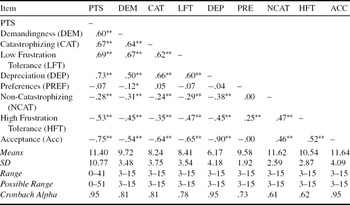
Descriptive statistics, Cronbach alpha, and correlations between all measured variables

Notes: ** is significant at the .01 level; * is significant at the .05 level
Results
Descriptive statistics and correlations
The descriptive statistics shown in Table 1 indicate that the current sample of 313 police officers, military personnel, and related emergency service workers demonstrated relatively low levels of PTS, on average. In terms of the irrational belief processes, moderate levels of Demandingness beliefs, Catastrophizing beliefs, and Low Frustration Tolerance beliefs were reported while low-to-moderate levels of Depreciation beliefs were reported. In terms of the rational belief processes, moderate levels of each of the four rational belief processes (Preferences, Non-Catastrophizing, High Frustration Tolerance, and Acceptance) were indicated.
Table 1 also reports the correlations amongst the predictor variables (Demandingness, Catastrophizing, Low Frustration Tolerance, Depreciations Preferences, Non-Catastrophizing, High Frustration Tolerance, and Acceptance) included in the study. Those correlations between the predictor variables that were statistically significant generally ranged from weak to moderate, indicating multicollinearity was unlikely to be a problem (see Tabachnick and Fidell, Reference Tabachnick and Fidell2007). However, one correlation was strong and reached a level that indicated a possible violation of multicollinearity. This correlation was between Depreciation and Acceptance beliefs (r = .90, p < .001); however, investigation of the Tolerance and VIF statistics demonstrated that, although high, these levels did not exceed an acceptable level. On the basis of these VIF and Tolerance values, and the fact that these beliefs are the rational and irrational counterparts of each other, it was decided to retain these two variables rather than collapse them into a single variable.
Furthermore all predictor variables, with the exception of Preference beliefs, were significantly correlated with PTS. These correlations with the dependent variable (PTS) ranged from weak to strong, ranging from r = −.28, p < .001 between Non-Catastrophizing and PTS to r = −.75, p < .001 between Acceptance beliefs and PTS. These results indicate that the data were suitably correlated with the dependent variable for examination through multiple linear regression to be reliably undertaken.
Sequential moderated multiple regressions
A sequential moderated multiple regression analysis, as the recommended method for testing interaction effects (Cohen and Cohen, Reference Cohen and Cohen1983), was applied in order to investigate the predictive relationship between the irrational belief processes (Demandingness, Catastrophizing, Low Frustration Tolerance, and Depreciations) and PTS, while also examining for the moderating role of each of the four rational belief processes (Preferences, Non-Catastrophizing, High Frustration Tolerance, and Acceptance). Four separate models were thus specified and empirically tested with all predictor and moderator variables being centred as suggested by Aiken and West (Reference Aiken and West1991).
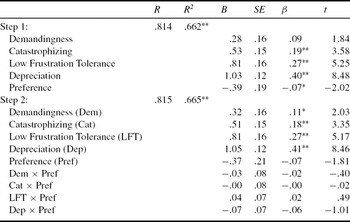
The first model considered the moderating role of Preference beliefs. In the first step of sequential moderated multiple regression, five predictors were entered: Demandingness beliefs, Catastrophizing beliefs, Low Frustration Tolerance beliefs, Depreciation beliefs, and Preference beliefs. This model was statistically significant F (5, 298) = 116.82; p < .001 and explained 66.2% of variance in levels of PTS (see Table 2). All variables, with the exception of Demandingness beliefs, were statistically significant predictors of levels of PTS; however the strongest predictor of PTS was Depreciation beliefs (β = .40 p < .001). The final step consisted of entering the interaction terms coding interactions between Preference beliefs and all four irrational belief processes. After the entry of the interaction effects the model as a whole explained 66.5% of variance in intentions F (9, 294) = 64.80; p < .001. The addition of the interaction effects at Step 2 only accounted for an additional 0.3% of variance in levels of PTS and this change was not statistically significant (R2 Change = .003; F (4, 294) = .582; p = .676). The results at this step indicated that Demandingness beliefs (β = .11, p = .043), Catastrophizing beliefs (β = .18, p = .001), Low Frustration Tolerance beliefs (β = .27, p < .001), and Depreciation beliefs (β = .41, p < .001) were all significant predictors of levels of PTS. Additionally, no empirical evidence was found that Preference beliefs directly impact on levels of PTS or moderate the impact of any of the irrational beliefs on PTS.
Regression model of PTS with Preference beliefs as a moderator

Notes: ** is significant at the .01 level; * is significant at the .05 level
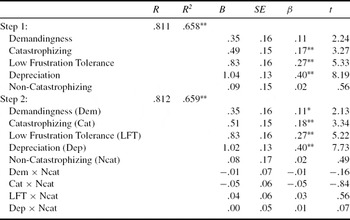
The second model considered the moderating role of Non-Catastrophizing beliefs. In the first step of sequential moderated multiple regression, five predictors were entered: Demandingness beliefs, Catastrophizing beliefs, Low Frustration Tolerance beliefs, Depreciation beliefs, and Non-Catastrophizing beliefs. This model was statistically significant F (5, 298) = 114.61; p < .001 and explained 65.8% of variance in levels of PTS (see Table 3). All predictor variables at this step, with the exception of Non-Catastrophizing beliefs, were statistically significant predictors of levels of PTS, with Depreciation beliefs identified as the strongest predictor of PTS (β = .40, p < .001). The final step consisted of entering the interaction terms coding interactions between Non-Catastrophizing beliefs and all four irrational belief processes. After the entry of the interaction effects the model as a whole explained 65.9% of variance in intentions F (9, 294) = 63.21; p < .001. The addition of the interaction effects at Step 2 only accounted for an additional 0.1% of variance in levels of PTS and this change was unsurprisingly not statistically significant (R2 Change = .001; F (4, 294) = .299; p = .879). These results indicated that Demandingness beliefs (β = .11, p = .034), Catastrophizing beliefs (β = .18, p = .001), Low Frustration Tolerance beliefs (β = .27, p < .001), and Depreciation beliefs (β = .40, p < .001) were all significant predictors of levels of PTS. Additionally, no empirical evidence was found that Non-Catastrophizing beliefs directly impact upon levels of PTS or moderate the impact of the various irrational belief groups on levels of PTS.
Regression model of PTS with Non-Catastrophizing beliefs as a moderator

Notes: ** is significant at the .01 level; * is significant at the .05 level
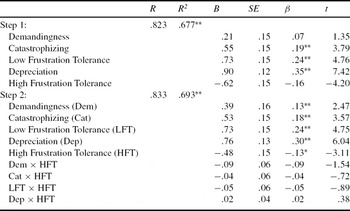
The third model considered the moderating role of High Frustration Tolerance beliefs. In the first step of sequential moderated multiple regression, five predictors were entered: Demandingness beliefs, Catastrophizing beliefs, Low Frustration Tolerance beliefs, Depreciation beliefs, and High Frustration Tolerance beliefs. This model was statistically significant F (5, 299) = 125.12; p < .001 and explained 67.7% of variance in levels of PTS (see Table 4). All predictor variables, with the exception of Demandingness beliefs, were statistically significant predictors of levels of PTS and the strongest predictor of PTS at this step was again Depreciation beliefs (β = .35, p < .001). The final step consisted of entering the interaction terms coding interactions between High Frustration Tolerance beliefs and all four irrational belief processes. After the entry of the interaction effects the model as a whole explained 69.3% of variance in intentions F (9, 295) = 65.84; p < .001. The addition of the interaction effects at Step 2 accounted for an additional 1.7% of variance in levels of PTS and this change in explained variance was statistically significant (R2 Change = .017; F (4, 295) = 3.98; p = .004). These results indicated that Demandingness beliefs (β = .13, p = .014), Catastrophizing beliefs (β = .18, p < .001), Low Frustration Tolerance beliefs (β = .24, p < .001), Depreciation beliefs (β = .30, p < .001), and High Frustration Tolerance beliefs (β = −.13, p = .002) were all significant predictors of levels of PTS. Additionally, no empirical evidence was found that High Frustration Tolerance beliefs serve to moderate the impact of the various irrational belief groups on levels of PTS.
Regression model of PTS with High Frustration Tolerance beliefs as a moderator

Notes: ** is significant at the .01 level; * is significant at the .05 level
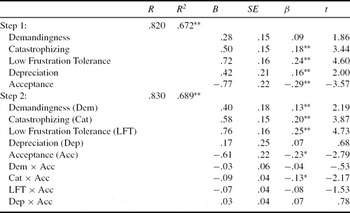
The fourth model considered the moderating role of Acceptance beliefs. In the first step of sequential moderated multiple regression, five predictors were entered: Demandingness beliefs, Catastrophizing beliefs, Low Frustration Tolerance beliefs, Depreciation beliefs, and Acceptance beliefs. This model was statistically significant F (5, 298) = 121.89; p < .001 and explained 67.2% of variance in levels of PTS (see Table 5). All variables with the exception of Demandingness beliefs were statistically significant predictors of levels of PTS and the strongest predictor of PTS was Low Frustration Tolerance beliefs (β = .24, p < .001). The final step consisted of entering the interaction terms coding interactions between Acceptance beliefs and all four irrational belief processes. After the entry of the interaction effects the model as a whole explained 68.9% of variance in intentions F (9, 294) = 72.38; p < .001. The addition of the interaction effects at Step 2 accounted for an additional 1.7% of variance in levels of PTS and this additional variance was statistically significant (R2 Change = .017; F (4, 294) = 4.12; p = .003). These results indicated that Demandingness beliefs (β = .13, p = .029), Catastrophizing beliefs (β = .20, p < .001), Low Frustration Tolerance beliefs (β = .25, p < .001), and Acceptance beliefs (β = −.23, p = .006) were all significant predictors of levels of PTS.
Regression model of PTS with Acceptance beliefs as a moderator

Notes: ** is significant at the .01 level; * is significant at the .05 level
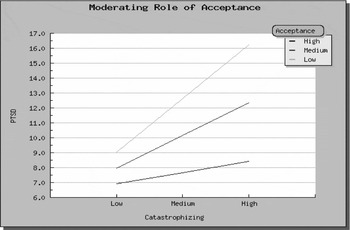
One statistically significant moderating effect was observed for the interaction between Catastrophizing beliefs and Acceptance beliefs (β = −.13, p = .031) indicating that the impact of Catastrophizing beliefs on levels of PTS depends upon the levels of Acceptance beliefs. Simple slopes for the relationship between Acceptance beliefs and PTS were investigated for low (-1 SD below the mean), medium (mean), and high (+1 SD above the mean) levels of Acceptance beliefs (see Cohen and Cohen, Reference Cohen and Cohen1983; Jaccard, Turrisi and Wan, Reference Jaccard, Turrisi and Wan1990). Each of the simple slope tests indicated a positive association between Catastrophizing beliefs and PTS; however Catastrophizing beliefs were most weakly associated with levels of PTS when levels of Acceptance beliefs were high (see Figure 1).
Relationship between Catastrophizing beliefs and PTS moderated by Acceptance beliefs

Discussion
The current study was carried out in order to provide additional empirical evidence to the REBT literature with regards to the hypothesized protective role of rational beliefs in the development of psychopathology by conducting the first empirical investigation of the moderating role of rational beliefs in the relationship between irrational beliefs and psychopathology. This study also sought to assess, for the first time, the direct impact of the various irrational and rational beliefs on levels of PTS, as well as to further investigate whether rational and irrational beliefs are best conceptualized as bipolar constructs or whether they represent qualitatively distinct cognitive constructs.
As can be seen in Table 1, findings of the current study provide equivocal indications regarding the relationship of irrational beliefs to rational beliefs. No statistically significant associations were observed between the primary rational and irrational belief processes (Preference and Demandingness beliefs), while a weak, negative association was identified between Non-Catastrophizing and Catastrophizing beliefs, and a weak-to-moderate negative association was discovered between High Frustration Tolerance and Low Frustration Tolerance beliefs. These results strongly suggest that these three rational and irrational belief processes are not bi-polar constructs. Contrastingly, there was a strong, negative association identified between Acceptance and Depreciation beliefs, indicating that these variables are bipolar constructs of each other. Given that none of the other rational and irrational belief process approached this level of association, it is possible that the strong (negative) relationship observed between Acceptance and Depreciation beliefs is a consequence of an inability of the AV-ABS2 to properly discriminate between these constructs. Additional research utilizing generalized, and ideally, disorder-specific measures of rational and irrational beliefs will be required to gain better insight into whether or not these particular belief processes are bipolar constructs. Overall, current results support previous indications (Bernard, Reference Bernard1998) that rational and irrational beliefs represent separate cognitive constructs.
In order to investigate the unique direct effects of rational and irrational beliefs on PTS, and the interaction effects of the four rational belief processes (Preferences, Non-Catastrophizing, High Frustration Tolerance, and Acceptance beliefs), four distinct models were estimated and tested. In the first model we sought to assess the direct impact of each of the irrational belief processes (Demandingness, Catastrophizing, Low Frustration Tolerance, and Depreciations) along with Preference beliefs. The results indicated that Preferences had a very weak, negative direct impact on levels of PTS, suggesting that those who have higher levels of Preference beliefs tend to experience lower levels of PTS. Additionally, Catastrophizing, Low Frustration Tolerance, and Depreciation beliefs all positively influenced levels of PTS, with Depreciation beliefs being the strongest predictor of PTS. Catastrophizing and Low Frustration Tolerance beliefs have been predicted, in general, to be important variables in the emergence of anxiety disorders (see David, Reference David and Dryden2003) and the present results provide support for this prediction of REBT theory.
It is interesting to note that Depreciation beliefs, which are normally more commonly observed as key cognitive variables in the development of mood disorders, were the strongest predictor of PTS among the current sample. Posttraumatic stress disorder (PTSD) and depression have been well established to share a high degree of comorbidity (Kessler, Sonnega, Bromet, Hughes and Nelson, Reference Kessler, Sonnega, Bromet, Hughes and Nelson1995; Zlotnick et al., Reference Zlotnick, Johnson, Kohn, Vicente, Rioseco and Saldiva2006) and this may well account for the discovery that self-depreciatory beliefs were consistently identified as the strongest predictor of PTS. Also of interest is that Demandingness beliefs were not a statistically significant predictor of levels of PTS. REBT theory predicts that Demandingness beliefs should exert their influence on psychological distress through the secondary irrational belief processes, and thus the observation of no direct influence of Demandingness beliefs on PTS is understandable in light of theoretical predictions. Within this model, Preference beliefs did not serve to moderate the relationship of any of the four irrational beliefs with levels of PTS.
A very similar pattern of results emerged from the next two models, which assessed the direct and moderating effects of Non-Catastrophizing, and High Frustration Tolerance beliefs respectively. Again we observed that Depreciation beliefs were the strongest predictor of PTS, and in both cases neither rational belief process had a direct impact on levels of PTS, nor did either belief process exhibit a moderating effect for any of the irrational beliefs on PTS.
The final model considered the direct and moderating role of Acceptance beliefs. In this case, Acceptance beliefs demonstrated a weak but statistically significant direct effect on levels of PTS, suggesting that higher levels of Acceptance beliefs are associated with lower levels of PTS. Moreover, Acceptance beliefs were found to moderate the impact of Catastrophizing beliefs on levels of PTS. These results indicate that Acceptance beliefs serve as important cognitive protective factors in the emergence of PTS, not only directly as would be expected, but also by modulating in a positive direction the impact that Catastrophizing beliefs can have on levels of PTS.
These results, considered in their totality, provide strong empirical support for REBT theory within the context of a psychiatric disorder not yet examined by the REBT community. Our results demonstrated that the irrational beliefs hypothesized as crucial in the emergence and maintenance of psychopathology by REBT theory are indeed very important predictors of PTS, and served to explain a substantial percentage of variance in levels of PTS. Furthermore, current results indicate that Preference and Acceptance beliefs directly impacted upon levels of PTS such that higher levels of each of these rational beliefs contributed to lower levels of PTS. Additionally, Acceptance beliefs were found to moderate the impact of Catastrophizing beliefs on levels of PTS. These results provide additional and unique support for the cognitive protective role played by rational beliefs.
Findings from the current study are not limited to REBT theory, but can be viewed as having significance to the wider CBT community. As a consequence of REBT being the original cognitive-behavioural model, many of the important functional and dysfunctional cognitive processes first described within REBT theory have been adopted and incorporated into distinct CBT models. For example, Catastrophizing beliefs are an integral component of contemporary cognitive therapy models of PTSD, as well as panic disorder and generalized anxiety disorder (see Clark and Beck, Reference Clark and Beck2010). Low Frustration Tolerance beliefs are synonymous with “distress intolerance” beliefs, which are a key component of Dialectical Behavioural Therapy's theory of borderline personality disorder (Linehan, Reference Linehan1993). More recently distress intolerance beliefs have been demonstrated to be important predictors of PTSD (Marshall-Berenz, Vujanovic, Bonn-Miller, Bernstein and Zvolensky, Reference Marshall-Berenz, Vujanovic, Bonn-Miller, Bernstein and Zvolensky2010; Vujanovic, Bonn-Miller, Potter, Marshall-Berenz and Zvolensky, Reference Vujanovic, Bonn-Miller, Potter, Marshall-Berenz and Zvolensky2011). Additionally, Acceptance beliefs share a certain degree of similarity to the concept of acceptance described in Acceptance and Commitment Therapy (ACT; Hayes, Strosahl, Bunting, Twohig and Wilson, Reference Hayes, Strosahl, Bunting, Twohig, Wilson, Hayes and Strosahl2004) and within other mindfulness-based disciplines (e.g., Mindfulness-Based Stress Reduction, and Mindfulness-Based Cognitive Therapy). Although REBT theory and these mindfulness-based models talk of acceptance, there are important distinctions. The mindfulness-based approaches encourage full attending to, and non-judgemental acceptance of, all contents of consciousness however pleasant or unpleasant, desirable or undesirable, they may be. Contrastingly, in REBT theory Acceptance beliefs involve an active process in which the contents of consciousness (thoughts, emotions, physical sensations), as well as the realities of the external world, are explicitly judged as being undesirable, unpleasant, or painful, but are accepted because that is the nature of reality in that moment. Moreover, in REBT theory Acceptance is the process of evaluating internal and external occurrences without making illogical overgeneralizations (e.g. not judging a person totally, based upon one moment of poor behaviour). Current findings consequently can be viewed as not only providing empirical support for a number of important predictions of REBT theory, but as widely supportive of the more general CBT model of psychopathology.
As with any research endeavour there are a number of limitations associated with the current study that ought to be considered. The nature of the sample is limited to a very specific strata of the population (law enforcement, military, and emergency service personnel) experiencing symptoms of PTS, and thus generalizations of current findings to the other contexts is not possible. Future research should seek to replicate this study within populations that experience various other psychological maladies in order to generate more robust and reliable conclusions. The current study also employed a measure of general rational and irrational beliefs; however it would have been preferable to examine the role of disorder-specific rational and irrational beliefs, as disorder-specific beliefs would likely provide a much clearer indication of the true role played by these cognitions in PTS. Additionally, a self-report measure of PTS was used and although self-report measures of PTS such as the PDS used in the current study have been shown to highly correspond with clinician-administered measures (Griffin et al., Reference Griffin, Uhlmansiek, Resick and Mechanic2004), clinician based measures would have been preferable as they are considered the gold standard method of assessing PTSD symptomology.
In conclusion, this study substantially contributes to the scientific literature in a number of important ways. It is the first of its kind to investigate the role of rational or irrational beliefs in the context of symptoms of PTS. As such this study has established the important cognitive vulnerability role of irrational beliefs, and the important cognitive protective role of rational beliefs, in PTS. This provides important additional evidence in support of REBT theory. Moreover, this study provides the first piece of empirical evidence that rational beliefs can serve to moderate the impact of irrational beliefs on psychological distress, although the protective role appears to be limited specifically to Acceptance beliefs. Current results provide a new perspective on the protective role played by rational beliefs and thus opens up a new area of research for those in the REBT community to further explore in the context of a variety of other forms of psychopathology.



Comments
No Comments have been published for this article.