Introduction
Binaural hearing is based on the ability of the auditory system to detect two different signals, analyse their differences and perceive a single auditory event. A listener's ability to perceive and organise the auditory environment depends partly on the use of two ears, and the resulting neural interactions that occur between the binaural signals as they progress through the auditory pathways.
Over the decades, binaural advantage has been studied extensively in normal and clinical populations. The advantages of binaural hearing include: better perception of speech under adverse listening conditions, reduction of the effect of background noise (squelch effect), enhanced sound localisation and better spatial balance.Reference Pollack and Pickett1,Reference Konkle, Schwartz, Bess, Freeman and Sinclair2 HirshReference Hirsh3 reported that binaurally presented stimuli are 6 dB louder than monaural signals at the 35 dB sensation level. Pollack and PickettReference Pollack and Pickett1 reported a 40 per cent improvement in word recognition ability in the presence of speech babble when listening binaurally as opposed to monaurally.
Binaural phenomena have been widely studied at the subcortical and cortical level using electrophysiological tests. The brainstem processing of binaural auditory stimuli has been delineated using tone burst and click evoked auditory brainstem responses (ABRs)Reference Dobie and Berlin4–Reference Ito, Hoke, Pantev and Lütkenhöner6 and frequency-following responses.Reference Parthasarathy and Moushegian7–Reference Ballachanda and Moushegian9 At the cortical level, binaural processing has been extensively studied through middle latencyReference McPherson, Tures and Starr10,Reference Suzuki, Kobayashi, Aoki and Umegaki11 and late latency auditory evoked potentials.Reference Debruyne12,Reference McPherson and Starr13 However, similar parametric studies have not been conducted for speech stimuli.
Individuals with unilateral or asymmetric hearing loss are devoid of the aforementioned binaural advantages. Bamford and SaundersReference Bamford and Saunders14 reported that hearing-impaired individuals exhibit greater difficulties with sound localisation and listening in noisy or reverberant environments. Furthermore, these difficulties are prevalent not only in those with hearing impairment, but also in older adults with or without significant hearing loss.Reference Jerger, Jerger, Oliver and Pirozzolo15–Reference Dubno, Lee, Matthews and Mills17
The difficulties in speech understanding reported by older adults with normal hearing are due to numerous structural and functional changes that take place with advancing age.Reference Willott18 Along with degraded cognitive functioning, complex central auditory interactions in binaural hearing sensitivity have also been found to be more affected in older adults compared with younger ones.Reference Moore, Vickers and Mehta19,Reference Gallun, McMillan, Molis and Kampel20 With ageing, the deterioration of the central auditory system is enhanced, increasing the difficulty of perceiving fine temporal structures of the speech signal.Reference Frisina and Frisina21,Reference Schneider, Pichora-Fuller, Craik and Salthouse22
Many investigators have attributed decreased speech perception abilities in older adults to the age-related changes in peripheral hearing sensitivity.Reference Humes16,Reference Dubno, Lee, Matthews and Mills17,Reference Humes and Roberts23,Reference Wiley, Cruickshanks, Nondahl, Tweed, Klein and Klein24 However, other studies have indicated a central involvement, in addition to the deterioration in hearing sensitivity.Reference Humes and Christopherson25–Reference Jerger and Chmiel27 Central auditory system involvement has also been suggested as the cause of difficulty in understanding speech in adverse listening conditions despite essentially normal peripheral hearing sensitivity.Reference Helfer and Wilber28–Reference Wingfield, McCoy, Peelle, Tun and Cox30 Older adults with peripheral hearing loss still tend to perform poorly on several auditory measures, even when the hearing loss is taken into account or corrected.Reference Divenyi, Stark and Haupt31 Similar studies investigating biological ageing in animals without peripheral hearing difficulties have also suggested changes at various levels of the central auditory system. These changes include degeneration of the myelin sheath, and reductions in auditory nerve neurons,Reference Xing, Samuvel, Stevens, Dubno, Schulte and Lang32 cochlear nucleus neuronsReference Frisina and Walton33,Reference Walton34 and inferior colliculus neurons.Reference Willott, Parham and Hunter35–Reference Milbrandt, Holder, Wilson, Salvi and Caspary37 These changes are consistent with the reduction in inhibitory g-aminobutyric acid (GABA) neurotransmitters with advancing age.Reference Milbrandt, Holder, Wilson, Salvi and Caspary37,Reference Caspary, Raza, Armour, Pippin and Arneric38
These changes in the central auditory system might also lead to changes in the neurophysiological representation of acoustic stimuli in older adults. Studies in humans investigating the effect of ageing on the neurophysiological processing of auditory stimuli have revealed significant differences between younger and older adults. Delayed latency and decreased amplitude were observed in ABRs, associated with advancing age.Reference Rosenhamer, Lindström and Lundborg39,Reference Soucek and Mason40 Significant delays in latency were also observed in auditory middle latency responsesReference Lenzi, Chiarelli and Sambataro41,Reference Kırkım, Madanoglu, Akdas and Serbetcioglu42 and auditory late latency responses.Reference Pfefferbaum, Ford, Roth and Kopell43,Reference Picton, Stuss, Champagne and Nelson44
Moreover, some researchers have also suggested that certain auditory abilities decline in middle age. Even in those individuals with normal hearing ability, comparatively lower speech perception scores in adverse listening situations were observed than in their younger counterparts.Reference Barr and Giambra45,Reference Neupane, Gururaj, Mehta and Sinha46 Additionally, several psychoacoustic and auditory processing studies have reported: a decline in auditory functioning, such as deficits in temporal processing, above the age of 40 years;Reference Schneider, Pichora-Fuller, Craik and Salthouse22,Reference Fitzgibbons and Gordon-Salant47,Reference Grose, Hall and Buss48 deficits in listening to spatialised noise above the age of 50 years;Reference Glyde, Hickson, Cameron and Dillon49 and deficits in subjective hearing ability above the age of 45 years.Reference Helfer and Vargo50
These phenomena of the brainstem processing of speech sounds can be explored with electrophysiological testing, namely speech-evoked ABR testing;Reference Russo, Nicol, Musacchia and Kraus51–Reference Sinha and Basavaraj54 this can assess the neural timings and provide information regarding the encoding of speech cues at the subcortical level.Reference Krishnan55–Reference Akhoun, Moulin, Jeanvoine, Ménard, Buret and Vollaire57 Moreover, speech-evoked ABR testing performed with binaural stimulation can provide a better understanding regarding the functional changes at the level of the brainstem for complex speech stimuli, especially in the middle-aged.
The effect on the binaural advantage is not restricted to clinical populations (individuals with unilateral hearing loss, asymmetrical hearing loss etc.); it is also seen in older adults with or without significant hearing loss.Reference Jerger, Jerger, Oliver and Pirozzolo15–Reference Dubno, Lee, Matthews and Mills17 Therefore, the neural encoding of speech cues in middle-aged adults needs to be understood and compared with that in younger adults. Hence, the present study aimed to compare the neural encoding of a binaural speech stimulus, in terms of evoked ABRs, for middle-aged adults versus younger adults.
Materials and methods
Participants
Fifteen younger adults aged 17–25 years (mean age, 22 years) and 15 middle-aged adults aged 40–60 years (mean age, 50 years) participated in the study. Consideration of 40–60-year-olds as middle-aged was based on earlier literature in which participants of a similar age range were considered to be middle-aged.Reference Neupane, Gururaj, Mehta and Sinha46,Reference Grose, Hall and Buss48,Reference Helfer and Vargo50
All participants had normal hearing sensitivity in both ears, as revealed by pure tone audiometry. None of the individuals had any middle-ear pathologies, as revealed by ‘A’ type tympanograms and the presence of acoustic reflexes in both ears. None of the participants reported any other history of otological or neurological problems. There were no diabetic participants in either group.
Informed consent was given by all participants before the initiation of the test procedures. All measures performed in the study relating to human participants were conducted in accordance with the Helsinki Declaration of 1975, as revised in 2008.
Instrumentation
A calibrated GSI-61 audiometer (Viasys Healthcare, Madison, Wisconsin, USA), with Telephonics Dynamic (TDH-39) headphones (Telephonics, Farmingdale, New York, USA) enclosed in an MX-41/AR supra-aural cushion, and a Radioear B-71 bone vibrator (Kimmetrics, Smithsburg, Maryland, USA), were employed for the estimation of air-conduction and bone-conduction pure tone thresholds, respectively. A calibrated Grason-Stadler Tympstar™ middle-ear analyser was used with a 226 Hz probe tone for immittance evaluation. A Bio-Logic® Navigator Pro evoked potential unit (version 7) with Bio-Logic ER-3A insert earphones was used for recording ABRs to click and speech stimuli, in both groups.
Procedure
Pure tone audiometry
Using a modified Hughson and Westlake procedure,Reference Carhart and Jerger58 thresholds were estimated at octave frequencies of 250–8000 Hz (air conduction) and 250–4000 Hz (bone conduction) for all participants in both groups.
Immittance audiometry
Immittance audiometry was carried out by automatic sweeping of pressure from +200 to −400 daPa, to screen the status of middle-ear functioning and the acoustic reflex pathway. Tympanometry was conducted using a 226 Hz probe tone, to rule out middle-ear pathology. Reflexometry was carried out for both ipsilateral and contralateral stimuli, at 500, 1000, 2000 and 4000 Hz.
All individuals were found to have type ‘A’ tympanograms, with the presence of both ipsilateral and contralateral reflexes, indicating normal middle-ear functioning and integrity of the acoustic reflex pathway.
Auditory brainstem responses with click stimulus
Auditory brainstem responses were evoked using click stimuli presented at 90 dB nHL, at a repetition rate of 11.1 per second. A non-inverting electrode was placed on the vertex, an inverting electrode was placed on the ear lobe of the test ear, and a ground electrode was placed on the opposite ear lobe. It was ensured that the impedance of each electrode was less than 5 kΩ and inter-electrode impedances were within 2 kΩ. The acquisition setting was maintained with a filter setting at 100–3000 Hz and a 12 ms time window. A total of 1500 sweep stimuli were used to evoke click ABRs. The click-evoked ABR was recorded twice to ensure the replicability of the responses. Individuals in whom click ABRs were present were chosen as subjects for speech-evoked ABR testing.
Speech-evoked auditory brainstem responses
The 40 ms synthesised speech syllable /da/, generated with the Klatt synthesiser (first developed by Cunningham et al. in 2001), was utilised in the study. The stimulus waveform of /da/ is shown in Figure 1.
Waveform of /da/ stimulus.

The default BioMark™ program was built especially for the recording of speech ABRs with a 40-ms /da/ stimulus. The participants were seated in a reclining chair, in a double-walled, sound-treated room, and were relaxed during the recording. The non-inverting electrode was placed on the vertex, the inverting electrode on the ear lobe of the test ear, and a ground electrode on the ear lobe of the non-test ear. The intra-electrode impedance was lower than 5 kΩ, and inter-electrode impedances were lower than 2 kΩ. The stimulus was presented at 80 dB nHL in alternating polarity at a rate of 10.9 per second. The responses were band-pass filtered between 30 and 3000 Hz, with amplification of 100 000. The analysis window was kept at 70 ms (10 ms pre-stimulus and 60 ms post-stimulus). Speech-evoked ABRs were recorded initially for the left and right ear separately, and then for binaural stimulation, for all participants in both groups.
Fast Fourier transform of the waveform was carried out to understand encoding of the fundamental frequency (F0), first formant frequency (F1) and second formant frequency (F2). Fast Fourier transform was analysed from 16 to 44 ms. In order to perform the fast Fourier transform analysis, activities occurring in the frequency range of the response corresponding to the F0 of the speech stimulus (103–121 Hz), F1 of the stimulus (220–720 Hz) and higher formants (721–1200 Hz) were measured for all participants. The amplitudes of the F0, F1 and F2 frequency components of the frequency-following responses were noted separately for right-ear, left-ear and binaural recordings. Fast Fourier transform analysis was conducted using a custom-made program with Matlab® software. Brainstem Toolbox, developed at Northwestern University, Illinois, was utilised alongside Matlab to provide the fast Fourier transform information.
Analysis parameters
For the speech-evoked ABR testing, the latencies of wave V for monaural and binaural recordings were measured for both groups. Additionally, the amplitudes of F0, F1 and F2 for monaural and binaural recordings were measured for all participants in both groups.
Statistical analysis
Descriptive statistics for the study were calculated using SPSS version 23 software (IBM, New York, USA). A Shapiro–Wilk test was carried out to understand the distribution of the data prior to further inferential analysis.
Results
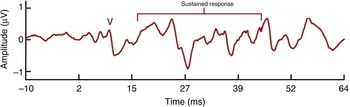
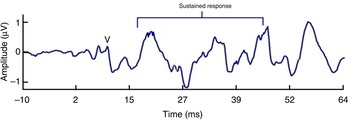
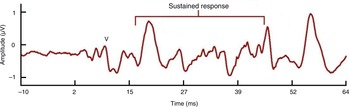
The click-evoked ABRs were present for all participants in both groups; hence, all participants underwent speech-evoked ABR recordings. In addition, the speech-evoked ABRs were present for monaural and binaural recordings for all participants in both age groups. In the present study, the components of speech-evoked ABRs, such as wave V latency and F0, F1 and F2 amplitudes, for left-ear, right-ear and binaural stimulation, were measured for both groups. Auditory evoked potential data were converted to American Standard Code for Information Interchange (‘ASCII’) in order to calculate the grand average waveform of the responses to monaural and binaural stimulation in both age groups, as shown in Figures 2–7.
Grand average speech-evoked auditory brainstem response waveforms of young adults for right-ear stimulation.

Grand average speech-evoked auditory brainstem response waveforms of young adults for left-ear stimulation.

Grand average speech-evoked auditory brainstem response waveforms of young adults for binaural stimulation.

Grand average speech-evoked auditory brainstem response waveforms of middle-aged adults for right-ear stimulation.

Grand average speech-evoked auditory brainstem response waveforms of middle-aged adults for left-ear stimulation.

Grand average speech-evoked auditory brainstem response waveforms of middle-aged adults for binaural stimulation.

The mean and standard deviation values for wave V latency, and the amplitudes of F0, F1 and F2 frequency components, for monaural and binaural recordings, were calculated, for both groups. These data are shown in Table 1.
Latency of wave V and amplitudes of F0, F1 and F2 frequency components of frequency-following response in younger and middle-aged participants

F0 = fundamental frequency; F1 = first formant frequency; F2 = second formant frequency; SD = standard deviation
The Shapiro–Wilk test revealed a normal distribution (p > 0.05) of the data. Accordingly, a parametric independent sample t-test was performed to investigate differences between the two groups. The independent sample t-test revealed no significant differences between the two groups for wave V latency for right-ear (t(22) = 1.01, p > 0.05), left-ear (t(22) = 0.80, p > 0.05) or binaural stimulation (t(22) = 0.81, p > 0.05). No significant differences between the two groups were observed for the encoding of F0 (t(22) = 1.98, p = 0.05), F1 (t(22) = 0.28, p > 0.05)) or F2 (t(22) = 0.03, p > 0.05) for the right ear. Also, no significant differences were observed between the two groups in F0 (t(22) = 0.94, p > 0.05), F1 (t(22) = 0.52, p > 0.05)) or F2 (t(22) = 0.30, p > 0.05) for the left ear. No significant differences were observed between the two groups for F1 (t(22) = 0.85, p > 0.05)) or F2 (t(22) = 1.66, p > 0.05) for binaural stimulation. However, the independent sample t-test revealed a significant difference between the two groups in the encoding of F0 recorded for binaural stimulation (t(22) = 2.45, p = 0.02).
In summary, there were no differences between the younger and middle-aged groups for wave V latency, the encoding of F0, F1 and F2 recorded with monaural stimulation, and the encoding of F1 and F2 recorded with binaural stimulation. However, the encoding of F0 for binaural stimulation was affected, with a lower value in the middle-aged group compared with their younger counterparts.
Discussion
The present study assessed the encoding of a binaural speech stimulus at the brainstem level in middle-aged adults in comparison to younger adults. The results displayed no significant differences between the two groups in the latency of wave V or the neural encoding of F1 and F2 for monaural and binaural stimulation. However, the results revealed a significant difference between the two groups in the neural encoding of F0 for binaural stimulation, an effect which was absent in the case of monaural stimulation.
The results of the present study did not reveal any significant difference in wave V latency between the younger and middle-aged groups. These findings are not in agreement with the literature on speech-evoked ABRs in the ageing population, which has indicated prolonged wave V latency in the elderly population.Reference Anderson, Parbery-Clark, Yi and Kraus59–Reference Parbery-Clark, Anderson, Hittner and Kraus62 Anderson et al.Reference Anderson, Parbery-Clark, Yi and Kraus59 reported a significant delay in onset responses elicited by speech stimuli for participants aged 60–73 years with a hearing threshold below 25 dB HL. In another study, Anderson et al.Reference Anderson, Parbery-Clark, White-Schwoch and Kraus60 again reported a significant delay in the latency of wave V in participants aged 60–67 years compared with their younger counterparts aged 18–30 years. Parbery-Clark et al.,Reference Parbery-Clark, Anderson, Hittner and Kraus62 utilising a 170-ms /da/ stimulus, also reported a delay in the latency of wave V for speech-evoked ABRs in normal hearing individuals aged 45–65 years compared with younger counterparts with normal hearing aged 18–30 years.
The differences between the study findings could be because of variations in the participants. In the present study, participants’ ages were lower compared with the earlier studies. The difference in latency between the younger and the older group in the earlier studies could be because of the slightly higher auditory thresholds in the high frequencies. For example, Vander Werff and BurnsReference Vander Werff and Burns61 presented the results of speech-evoked ABRs to the identical /da/ stimulus in two groups (20–26 years, n = 13; and 61–78 years, n = 18). The older group demonstrated a significant delay in wave V latency for the speech-evoked ABRs, associated with advancing age. However, the participants aged 61–78 years had high-frequency hearing loss. After the group differences in hearing loss in the high-frequency range were adjusted as a covariate, the onset responses did not show any significant delay in the wave V latency elicited by the speech stimulus.
The results of the present study, which showed no significant differences between the two groups in the neural encoding of F0, F1 and F2 during monaural stimulation, are consistent with the findings of an earlier study.Reference Neupane, Gururaj, Mehta and Sinha46 However, Clinard et al.Reference Clinard, Tremblay and Krishnan63 reported delayed latency and reduced amplitude of the tone burst evoked frequency-following response in older subjects as compared with their younger counterparts. The reduced amplitude of the frequency-following response might be attributed to an age-related decline in phase-locking ability or reduced neural synchrony. The participants in the present study were younger than those in the earlier reported studies; hence, the participants’ age might be a possible reason for the discrepancy in the findings. The results of the present study are also in agreement with a study by Vander Werff and Burns,Reference Vander Werff and Burns61 which found no significant difference in encoding in terms of frequency-following response between younger and older adults.
Conversely, F0 encoding was reduced in middle-aged adults when ABRs were evoked using binaural speech stimulation. The encoding of F0 was associated with a reduction in amplitude even in middle-aged adults, in the present study; this suggests that adults older than 40 years might have reduced encoding of binaural speech stimuli. Anderson et al.Reference Anderson, Parbery-Clark, White-Schwoch and Kraus60 recorded speech-evoked ABRs to binaural speech stimuli (duration of stimulus, 170 ms) presented at 80 dB SPL, in both a younger and older population (60–67 years), and reported that the older population had reduced encoding of F0 and higher harmonics compared with the younger adults. However, Anderson et al.Reference Anderson, Parbery-Clark, White-Schwoch and Kraus60 did not compare the responses between monaural and binaural stimulation. Anderson et al.Reference Anderson, Parbery-Clark, Yi and Kraus59 also reported reduced encoding of F0 in a group of older adults (60–73 years). Among older adults, participants with better speech-in-noise ability had superior F0 encoding scores as compared to those with the poorer speech-in-noise test results. In the present study, we found reduced F0 encoding for binaural stimulation in those aged between 40–60 years, which might be due to diminished binaural interaction ability at the brainstem level.
The encoding of F0 and other pitch cues plays a role in auditory object identification, allowing the listener to ‘tag’ the target voice with a specific identity, and to follow this particular voice among competing voices or other noises.Reference Anderson, Parbery-Clark, Yi and Kraus59 Several studies have also reported age-related changes in perceptual measures involving the processing of F0 differences.Reference Sanchez and Lam64–Reference Harris, Mills, He and Dubno66 Harris et al.Reference Harris, Mills, He and Dubno66 recorded P1–N1–P2 auditory evoked potentials in younger and older participants by utilising a 150 ms change in frequency in otherwise continuous 500 and 3000 Hz tones. The P1–N1–P2 threshold was defined as the smallest change in frequency required to evoke a P1–N1–P2 response. That study found that older adults were less sensitive to the frequency changes than younger adults. It was therefore concluded that the changes in frequency discrimination abilities in older adults may be in part related to changes in pre-attentive levels of auditory processing.
The results of the present study suggest reduced encoding of F0 cues at the level of the brainstem itself in middle-aged adults. A significant reduction in the amplitude of F0 in those aged over 40 years could be due to reduced phase-locking ability and changes in neural synchrony of the peripheral auditory nerves.Reference Clinard, Tremblay and Krishnan63 This disrupted neural synchrony may arise as a result of the age-related changes in cochlear metabolic activity or the reduction in auditory nuclei.Reference Mills, Schmiedt, Schulte and Dubno67 Such reduced phase-locking could be due to changes in the capacitance of inner hair cells, or damage to the synapses between the inner hair cells and the auditory nerves.Reference Moser, Neef and Khimich68 These changes might result in the reduction of F0 amplitude in middle-aged adults compared with their younger counterparts.
• There is a significant difference in neurophysiological processing of auditory stimuli between younger and older adults
• Middle-aged adults with normal hearing sensitivity have comparatively lower behavioural speech perception scores in adverse listening conditions
• There is a difference between middle-aged and younger adults in the neural encoding of binaurally evoked auditory brainstem responses to a speech stimulus
• This study also suggests reduced encoding of fundamental frequency to binaural speech in middle-aged adults
Speech recognition abilities in quiet and noisy conditions were not assessed in the present study. Therefore, it is not known whether the reduced amplitude of F0 on binaural stimulation in middle-aged adults is related to the difficulty in speech perception in adverse listening conditions. In combination with behavioural test results, physiological test results assessing subcortical and cortical structures are worthy of future exploration for diagnostic and management options relevant to ageing.
Conclusion
The results of the present study revealed a reduced amplitude of F0 evoked with a binaural speech stimulus in middle-aged adults. This could be attributed to the age-related metabolic transformation in inner hair cells, synapses and the auditory nerve, resulting in disrupted neural synchrony and phase-locking ability in middle-aged adults as compared with their younger counterparts.
Acknowledgements
We would like to thank all the participants who volunteered to take part in the study.
Competing interests
None declared