INTRODUCTION
This article focuses on how local indigenous testimonies are embedded in distinguishable forms of historical memory by closely examining the former Cohuixca province of Tepecoacuilco (Cohuixcatlacapan) in the northeastern part of the present state of Guerrero in the central Mexican highlands, from shortly after the beginning of the Spanish conquest up to the last decades of the sixteenth century. The utilization of distinct cultural patterns to describe situations that are consistent with past conventions and norms, as though the Spanish colonial regime had never fully been enforced upon this region, can be identified within the primary sources from this region.
During the first decades of the sixteenth century, the ancient legacies that survived in each of the indigenous towns in the area concerned themselves primarily with imposing ethnic identities, hegemonies, and self-rule in the face of the Spanish conquest. By the 1560s, however, these legacies had to be revived and retold, mainly in response to the successful challenging of the new colonial borders established between the colonial provinces, that had been implemented in the conquered towns and provinces throughout New Spain, and which, ostensibly, had been granted universal legitimacy. Throughout this new process, long-term memory was often brought to the arena of the colonial court by both litigating parties, extending back in time for 208 years, that is, in four cycles of 52 years in accordance with the Nahua calendar. As such, litigating towns concertedly re-asserted the mythological genealogy of their ancient rulers. It is possible that such long term memory was based on repositories of locally produced lands and genealogy documents still extant at the time of the lawsuits, which referred to these mythological kings and supreme lords, directly associating them with ancient sites and sacred geography. The slow subsequent change in the content of formal, standardized forms of oration and testimony, adapted as they were to Spanish conventions of speech and writing, primarily affected how such procedures and forms of delivery were expressed and recorded in the Spanish Colonial courts. Moreover, these changes had also affected which significant, past antecedents should be emphasized and which should be disregarded (Lockhart Reference Lockhart1992; Mignolo Reference Mignolo1992). This point is complementary to Kellogg and Restall's (Reference Kellogg and Restall1998:293) suggestion regarding inheritance that “wills themselves were an instrument of cultural change, being part of the shift in the cultures of legal practices and gender structures.” The intended contribution of the present article to the general discussion is the identification and characterization of pervasive patterns that guided indigenous testimony in the Spanish courtroom (Megged Reference Megged2014). To accomplish this, I rely on what has been called the “ethnography of speaking,” the intention of which is the pursuit of formalized frames of communicative actions and interpretations, or what ethnoscience has termed “cultural grammars, which are analogous to the grammars of linguistics” (Sherzer Reference Sherzer1983:84; Bricker Reference Bricker, Bauman and Sherzer1981; Malinowski Reference Malinowski1935; Robins Reference Robins1959). I also rely closely on what Dehouve (Reference Dehouve and Peperstraete2009:26) has recently termed “metaphor by extension” (the actual definition of the act placed under the guise of a metaphor) found within ritualistic discourse.
I also intend to identify the singularity of such speech forms as being consistent with indigenous traditional cultural forms of communication that survived the vast changes in Mexican society that took place starting in 1519. Earlier work on this methodological approach has been done by Mesoamerican anthropologists in the contexts of ritual discourse and prayer in Mesoamerican languages, both of which employ such effects and utilize them as mnemo-techniques (e.g., Heyden Reference Heyden and Gossen1986; Mikulska Dabrowska Reference Mikulska Dabrowska2010).
What I seek to find in my analysis of courtroom sources are deviations, variations, and contradictions within and across given indigenous testimonies. Where one encounters such individual anomalies is precisely where one also finds repeated patterns of what I call speech formulae. These patterns are based on cultural constructs, which constitute the more monolithic nature of contexts that are being utilized, for example, the testimony of indigenous individuals in Spanish colonial courts. In doing so, one must also closely consider the specific historical and cultural circumstances in which the testimonies were actually given. For example, one should be cognizant of the attitude towards the Spanish conquest of the elite indigenous persons, whose testimony was recorded in court and for whom the European subjugation must have been a kind of reliving of the collective experience of conquest of this province by the Aztecs. That is, we should be sensitive to the possible presence of repeated patterns or speech formulae that very likely originally came into existence for the sake of coping with an earlier, Aztec conquest, which the present, Spanish conquest itself eliminated. Specifically, my precise aim is to highlight how local elders in this province interwove different symbolisms and representations of power in order to establish a seemingly coherent narrative of the past that would overcome fragmentation and chaos. Townsend's (Reference Townsend2009) penetrating study of the 1553 lawsuit between the Cholultecan, Nahua, and Pinome lineages in Cuauhtinchan brought to light the “cellular” nature of the testimony, showing how it was heavily influenced by pre-Columbian allegiances and animosities going back to the fourteenth century. Complementary to Townsend's analysis, one of the major goals in this essay is to try to discern among the court transcripts any pervasive schemata that guided as well as constituted the verbal expressions utilized by the indigenous litigants, setting aside the standardized legal procedure and style of the Spanish colonial administration. As will be detailed further on, four distinct major themes can be gleaned from these primary sources: a) ritual practices involving the realm of the sacred cultural habits; b) distinct patterns of Aztec presence in the province; c) traditional patterns of labor drafts and tribute assessments; and, d) distinct patterns of former alliances, genealogical ties, and animosities.
HISTORIOGRAPHICAL BACKGROUND
Relatively little has been written so far on the pre-Columbian and early Colonial ethnohistory of the northeastern region of Guerrero compared to other regions of central and southwest Mexico. Nevertheless, a number of important studies have enriched our understanding of this important area, including: Dehouve's (Reference Dehouve1994) excellent ethnohistorical research over the years and, in particular, that of the eighteenth century lienzos from the Tlapa region; Litvak King's (Reference King1971) book on Cihuatlan and Tepecoacuilco; Oettinger's (Reference Oettinger1982) study of the Lienzo de Petlacala; Barlow's (Reference Barlow1954) and Galarza's (Reference Galarza1972) monographs on local lienzos and codices; Gutierrez and Medina's (Reference Gutiérrez and Lima2008) recent study on the Nahua and Tlapanec toponyms in the codices and lienzos of Eastern Guerrero; Amith's (Reference Amith2005) book, which explores the complexity of the diachronic transformation of space in central Guerrero through an analysis of land tenure, migration, and commercial exchange as a direct consequence of the Spanish conquest of the area; and the archaeological study by Silverstein (Reference Silverstein2001) of the Late Postclassic Aztec-Tarascan site of Oztuma-Cutzamala in northern Guerrero. Ethnohistoric documentation includes the Tlapanec Codices, which record a myriad of historical, genealogical, and tributary censuses associated with this region and have recently been published in facsimile form, mainly by Vega Sosa (Reference Vega Sosa1991) and, more recently, in collaboration with Oudijk (Vega Sosa and Oudijk Reference Vega Sosa and Oudijk2012). These include: the Códice Azoyú 2 (Códice Ortega), corresponding in some sections to the Códice Azoyú 1, mainly for the period between 1429 and 1564; and the Humboldt Fragment 1, Lienzo de Tlapa, Códice Veinte Mazorcas, Lienzo de Aztatepec-Citlaltepec, and Lienzo de Chiepetlan (Vega Sosa and Oudijk Reference Vega Sosa and Oudijk2012). Gutiérrez, Koenig, and Brito (Reference Gutierréz, Konig and Brito2009) have published, in parallel, a facsimile edition of the tribute list for the Tlapa-Tlachinolli province contained in the Humboldt and Códice Azoyú 2. In addition to the above, it is worth mentioning the Seminario sobre Guerrero, of the Instituto Nacional de Antropología e Historia, whose members have been conducting in-depth ethnographic research of contemporary Tlapanec rituals for approximately the past eight years (Jiménez Padilla and Villella Flores Reference Jiménez Padilla and Flores2003). Most of the above studies focus on the southeastern part of Guerrero, in particular the province of Tlapa bordering with the State of Oaxaca, while the northeastern part of the state remains neglected. This imbalance is due to the large repository of local lienzos and codices found in the southeastern part of the state, which have served as the basis for solid ethnohistorical studies, while primary sources pertaining to the early Colonial era and the period before the Spanish Conquest for the northeast part of the state are extremely scarce.
In recent years, the study of social memory has generated much interest in the fields of pre-Columbian and colonial Mesoamerica history and ethnohistory. Wood and Megged (Megged Reference Megged2010b; Megged and Wood Reference Megged and Wood2012), along with a number of colleagues from Europe, Mexico, and the United States, have also engaged this theme and recently published a volume detailing their individual efforts. In addition, in 2010, this journal issued a special section entitled Maya Archaeology and Social Memory. Miller's (Reference Miller, Küchler and Melion1991) earlier study of this theme is also noteworthy. Additional contributions to the study of the contents and contexts of indigenous memory are found in works by Haskett (Reference Haskett2005), Restall (Reference Restall1997, Reference Restall1998), and Wood (Reference Wood2003), as well as in essays by Bernal-García (Reference Bernal-García and Conan2007), Florescano (Reference Florescano1994, Reference Florescano2002), García-Zambrano (Reference García-Zambrano and Conan2007), Gillespie (Reference Gillespie, Silvermanand and Small2002), Gruzinski (Reference Gruzinski1986, Reference Gruzinski1993), and Lockhart (Reference Lockhart, Collier, Rosaldo and Wirth1982). Boone's (Reference Boone2000) treatment of native memory, within the larger context of pictorial forms of writing, is especially noteworthy, as is an article by Sousa and Terraciano (Reference Sousa and Terraciano2003) that compares Mixtec and Nahua historical memory of the Spanish conquest.
THE SOURCES
The documentation of the two specific lawsuits analyzed below is supplemented with primary sources of the period, both indigenous (the Códice de Teteltzingo) and Spanish (the local relaciones geográficas [geographical accounts] of the former province of Cohuixca). The relaciones were prepared for submission by the Spanish corregidores (royal officers responsible for maintaining law and order in their districts) and alcaldes mayores (chief magistrates of a province or district, usually in sparsely settled areas). In the early years of the colonial system, these positions often went to conquerors of the indigenous communities in Mexico or to their sons. The relaciones geográficas play a crucial role in our ability to piece together the acts of recording, which were originally accompanied by oral recitations, but which were only partially documented using the alphabetic modes adapted by the native scribes to record their past. The relaciones geográficas are based on a rigidly dictated questionnaire arranged by the Spanish authorities into a formalized set of 42 “chapters” or topics, to which the local elders of each of the towns in this province were obliged to respond. Despite the uniformity of the questionnaire, the replies of the respondents recorded in the individual documents are extremely varied and display a diversity of interests and concerns ranging over a broad spectrum of information. The most striking aspect of this variety is the skill with which the different indigenous communities responding to the questionnaire shed light on their unique treatment of the past through oral channels. In this essay, the ethnohistorical data extracted from these sources is juxtaposed with the oral testimony from two lawsuits conducted in the court of the audiencia in Mexico City between 1531 and 1561.
The records and testimonies belonging to these two lawsuits, both of which were related to the same general dispute, were recently found by the author in the Archivo General de Indias in Seville, Spain. These documents are among the earliest sources that provide information related to the presence of the Aztecs in the former Cohuixca province of Tepecoacuilco (see Figure 1) as well as on the first decade of Spanish rule in the area. The first lawsuit was conducted in the years 1531–1540, between the encomendero of Oapan, Martín de Ircio, and Diego Xaramillo, the encomendero of Tzompanco (Zumpango). The second suit, spanning the years 1537–1561, involved a litigation conducted by don Martín Mayaque, the local governor and cacique of the former altepetl of Tixtlan and, once again, Martín de Ircio, now serving as the latter's legal representative, against Xaramillo and, subsequent to Xaramillo's death, Cecilia Lucero, his widow and heir (Archivo General de Indias [AGI], Justicia, legajo 127, ff. 1–860r). The verdict handed down for this litigation by the audiencia in Mexico City demanded that Xaramillo return to Ircio and the town and jurisdiction of Tixtlan the estancia of Chilpancingo, one of the nine adjoining settlements which had been unjustly removed from Ircio's encomienda during the latter's absence from the area.Footnote 1 Despite repeated pleas by the Xaramillos for a review, the judgment of the audiencia remained unchanged until the case was brought once again before the authorities, this time in Spain. On July 16, 1566, the Royal Council in Spain passed their final judgment on the case, reversing the earlier verdict of the audiencia, and returned the estancia to Xaramillo's widow, while issuing instructions that all further appeals be cancelled.
Map of the Cohuixca province of Guerrero. Drawing by Noga Yoselevitch.

The major task faced by the indigenous witnesses in the two separate cases was essentially to consolidate and rebuild entire schemata of old alliances, and depict the old versus new modes of labor recruitment and the traditional forms of service granted by subject towns, as well as the revived notions of space and time founded on the former rule of the altepetl. Focusing on particular historical episodes that had disrupted and reformed the geographical configuration of the area prior to the Spanish Conquest, the lords of both the Oapan and Tixtlan appear to have attempted to reaffirm and reconsolidate old alliances based upon the legacies and power relations of the former altepetl, by reviving in court common interests and old affiliations. The impression we get from the testimony presented in these two separate lawsuits, as well as from complementary sources we have concerning the area in question, indicates that political structures and social alliances had been consolidated and remained in effect ever since the conquest of this region had begun under Itzcoatl, emperor of the first Mexica Triple Alliance, who ruled between 1427 and 1440.
A close reading of the different sources, replete with oral discourses, uncovers a number of distinct speech formulae, nonverbal cues, and conceptual constructs all of which, more than anything else, shed light on the cultural predispositions of communities and individuals. This is demonstrated by the records from the two cases in question conducted in the Spanish colonial courtroom of the audiencia. The testimony of the witnesses in this early colonial Mexican court were a product of a distinct cultural exchange, involving both Spanish and indigenous participants, that itself was embedded within a particular Colonial context or discourse, and which, furthermore, reflected the confrontation between two distinct systems of writing and rhetoric. Under such circumstances, the translation into Spanish of the testimony, as well as the transliteration of these accounts from one or at times even two native languages, involved a significant shift from one set of cultural modes of oral performance and verbal expression, writing, and imagination, to another. It is most unfortunate that the original Nahuatl and Chontal testimony given by the indigenous witnesses from this province were never written down by the court scribe, as was the case in all other court proceedings throughout the Colonial era. Rather, in this province the translation to Spanish by the native interpreter from these indigenous languages was taken down simultaneously and, thus, only the Spanish text remains. Nevertheless, some unique cultural traits are partially preserved and are detectable even within the Spanish translation.
The native rulers of the former ethnic states regarded the recently established Spanish court of the audiencia as likely to be a potentially beneficent framework in which to resolve to their long-lasting conflicts that initially arose prior to the Spanish conquest. One possible explanation for such a strategy is that these rulers had ascertained over time that the Spanish judges were not sufficiently competent in understanding native realities and history, as the lawsuits between the various indigenous towns involved complex issues that the Spanish judges were not able to fully grasp. Thus, the rulers reasoned, they could afford to stretch their lawsuits out over many days, even years, and bring to court hundreds of witnesses in the hope of achieving the desired outcome via a plethora of complex testimony, based on a strategy of trial and error opposite the unpredictable Colonial court. It is possible to even imagine how rehearsals were conducted before the local ruler and elders in preparation for the depositions and the hearing at the Spanish court of the audiencia in Mexico City. Indeed, within the two sources I have found evidence that indicates that such rehearsals in fact took place in the home communities prior to the witnesses’ giving testimony in the court of the audiencia. For instance, the sources relate how the Valades brothers had shown to those who would be questioned in court a native pictorial depicting a wedding ceremony between the tlatoani of Oapan and the tlatoani of Mayanalan's daughter (see below). In this way, all prospective witnesses for one side would connive to offer a coherent testimony by getting together to prepare a version that, once written down by the court, would with the passing of time become canonical. Other discrepant testimony would then simply be disregarded (see below).
As Gibson (Reference Gibson1964) correctly noted in this same context, far more legal disputes occurred between native towns than between indigenous nobles and Spaniards. In fact, during the first half of the sixteenth century, the audiencia in Mexico City was the scene of civil lawsuits conducted by at least thirty towns from the Basin of Mexico against one other, out of a total of 50 ethnic states that had existed during the late Aztec empire. As the growing number of native appeals placed a heavy burden on the Spanish colonial courts, reform became a central issue. Legislators in Spain and prominent public figures New Spain concerned themselves with this. We may ask ourselves at this point how differential was the Spanish colonial justice system. For example, in favoring more prestigious towns that had more financial resources to cover court expenses over less prestigious, more peripheral communities or towns that were unable to keep up with the expenditure over the occasionally long period of time that those court procedures lasted. In addition, it is likely that prominent indigenous rulers, who were far more involved in trade and local politics with Spanish authorities than others, had a better chance of winning their cases at the audiencia.
The Cohuixca Province Before and After the Spanish Conquest According to the Primary Sources
In the Codex Mendoza (Berdan and Anawalt Reference Berdan and Anawalt1997:f. 37r), nine cabeceras (head-towns) are mentioned for the province of Tepecoacuilco (Cohuixcatlacapan), a territory of approximately 12,000 square kilometers with a total population of 184,615 families: Tepecoacuilco, Chilapan, Oapan, Huitzoco, Tlachmalacac (Tasmalaca), Yoallan (Iguala), Cocolan (Cocula), Atenanco, and Chilacachapan (Litvak King Reference King1971:110). To the east of this province was the Mixtec-speaking province of Tlapan (Tlachinollan). Tzompanco and Tixtlan, as well as Chilapan and Muchitlan (its subject town), all belonged to the greater altepetl of Oapan and the latter also possessed the silver mines near Tzompanco. The Minas de Zumpango were perhaps the first silver mines to be exploited in the New World. Some evidence suggests that around the middle of the sixteenth century, Zumpango provided Taxco and Sultepec with litharge, a flux used in smelting silver with lead content. Little silver was mined in Zumpango after midcentury and the shipments of litharge were probably minimal.
Tzompanco rendered services and tribute to Tixtlan. As we are able to deduce from the two lawsuits, under Aztec rule the biggest and most significant altepetl in the Cohuixca province was Oapan, which was comprised of four adjoining major districts (with head-towns), namely Tzompanco, Tixtlan, Chilapan, and Mochtitlan as a single kingdom. The line of authority and control in the province extended all the way from the tlatoani (indigenous ruler of a town or a district) of Oapan, down to the tlatoani of Tixtlan and Tzompanco, the tlatoani of Chilpancingo, and, last, to the calpolli (district within an ethnic state), each of which was headed by two elderly lords (teuctlatoani or teuctli) (AGI, Justicia, legajo 127, f. 597r).
As we are told by the documents, besides its own cabecera (head-town), Chilpancingo had under its jurisdiction 11 calpoltin (subdistricts), each of which was supervised by one or two elderly principales, with no sons or daughters. The first was called Matititetlan and had eight households; its lord was Tequepantl. The local arrangement was that Tequepantl should send a number of local men to work in the mines of Tixtlan and that seven others would remain behind to cultivate Xaramillo's land. The second, Coatepeque, had two lords, Quechinagual and Yachipotequegua. All together there were fifteen households and the lords provided three local men for the mines every 20 days while the rest remained behind to work the land. Another of the calpolli was Almolonga, which had 11 households. The lord overseer there was Tepantlecal and he also provided men for service in the mines. Yet another was Tlamayalpotlan, with six households and one lord, Tuamilcal, who provided only one man for the mines while seven others were sent to work the land of their encomendero. Another calpolli was Apaqugo, with five households, the lord of which was Tamasalqua, who sent six men to work the land. The sixth calpolli was Tlacolotlam, which had eight households; its lord was Diaque, who sent two men for service in the mines and another eight to work the milpas. The seventh was Chilotlan; it had two households with only six persons in each. The eighth was Tepetlagutla, and its lord was Alconchal. One man was sent to the mines while two others were taken to cultivate the land. The ninth, Comalachan, had fourteen households; its lord was Menitlal and, by his orders, two men went to the mines while ten others went to work the land. The tenth, Apoylan, had four households, with eight to ten persons each, and its lord was Acatequetl. The last was Conacaguago, with three households; its lord was Zongohueve, and he contributed only one person for the mines and three for the plots (AGI, Justicia, legajo 125, f. 90v).
Five major languages were spoken in the province of Tepecoacuilco: Nahuatl, Cohuixca, Chontal, Mazahua, and Tlapaneco. To the north and west of Tlapa[n] (Tlachinollan), most of the populations spoke Nahuatl; both Chontal and Mazahua were spoken in the northeast (Litvak King Reference King1971); Cohuixca was spoken between Tepecoacuilco and Chilapan; Tlapaneco was spoken in Tlapan province (Tlachinollan) located to the southeast of Tepecoacuilco and also to the south of the province (Dehouve Reference Dehouve1994). The province of Tlapan was conquered during the rule of Ahuitzotl (1486–1502), and included eighteen tributary towns where Mixtec was also spoken, while to the northwest was Oztuma, of the Chontal people. Tlapanec speakers were extended to the south to an area just above the Costa Chica. These Tlapanec speakers were descendants of people who once inhabited Tlapan (Tlachinollan), their pre-Hispanic capital. Mixtec speakers were generally located to the south and east of Tlapa and extended into the highlands of Oaxaca (Barlow Reference Barlow1949; Galarza Reference Galarza1972; Oettinger Reference Oettinger1982; Toscano Reference Toscano1943).
Pedro de Alvarado conquered the area in 1522, founding the town of Acatlán the same year. In the Códices Azoyú 1 and 2 (Toscano Reference Toscano1943:ff. 12, 32), the entry of the Spaniards to Cozcatepec (Tlaca-Tlachinollan province) is recorded as having taken place in the year 3 Wind of the Tlapanec calendar. Facing the toponym of Cozcatepec, a local guard is depicted defending the town against the invading army (Vega Sosa and Oudijk Reference Vega Sosa and Oudijk2012). The Aztec garrisons in the province capitulated to the Spaniards early, in 1521 or 1522 (Gerhard Reference Gerhard1993). The final subjugation of this area to Spanish control took place around 1525. Oapan was initially given as an encomienda to Martín de Ircio, who had served as a page to Hernán Cortés, and who was married to Doña María de Mendoza, the half-sister of Viceroy Mendoza (Acuña Reference Acuña1985 [1581–1582]:vol. 1).
According to the two lawsuits, Ircio, who was in Cuba during 1519, sailed with the Narváez entrada the following year to join his brother Pedro in Mexico and participated in the conquest of Tenochtitlan together with Gonzalo de Sandoval. After a number of entradas, Ircio became a vecino of Mexico City, where he maintained his casa poblada, arms, and horses. In 1522, Cortés divided the conquered province into fourteen encomiendas and the first one to receive his share was Ircio, to whom Cortés bequeathed the major altepetl of Oapan, which also included the major towns of Tixtlan and Tzompanco as well as about nine adjoining settlements (estancias). Between 1523 and 1524, Ircio temporarily left the area to take part in the conquest of Guatemala from where he returned gravely ill, taking some time to recuperate in Mexico City. During Ircio's absence, Cortés removed Tzompanco and Tixtlan, as well as eight other estancias from Ircio's encomienda of Oapan, and granted them to Diego Santa Cruz, a majordomo of Mexico City's municipal treasurer, Alonso de Estrada:
“Diego, indio, y en nombre de indio, Cahulapan, cacique y vecino de Huichiltepeque: estando Don Miguel, padre del dicho, don Diego, cacique, que a la sazón era de Zumpango, en Coyoacan, y estando con el Marqués del Valle, y presente este testigo, le dixo el dicho Marqués al dicho Don Miguel, como había dado el dicho pueblo de Zumpango con su sujetos a Diego de Santa Cruz? y el estaba diciendo, cata haya Vuestro Amo, a quien havias de contribuir y les mando que le sirvensen y asi mando, y estaban presente el tlacatecatl de Huichiltepeque y desde entoces el dicho pueblo de Zumpango y sus estancias de Huchiltepeque y Chilpancingo sirvieron y contribuyeron a Diego de Santa Cruz…” [“Diego, Indian, and by Indian name Cahulapan, cacique y vecino de Huichiltepeque, while don Diego's father, don Miguel, who at the time lived in Tzompanco, was in Coyoacan with the Marqués del Valle, and this witness was also present, the aforementioned Marqués told don Miguel: how had the said town of Tzompanco and its subjects been given to Diego de Santa Cruz? And thereafter he instructed him: he will be your master, to whom you should contribute and I order you to serve him, and, thus I order, and the tlacatecatl of Huichiltepeque were also present, and from there on the town of Tzompanco and its estancias de Huchiltepeque y Chilpancingo served and contributed their share to Diego de Santa Cruz…”] (AGI, Justicia, legajo 125, f. 503v; translation by the author).
Subsequently, Cortés transferred these same properties to Pedro Zamorano Cendejas, a married conquistador. Following Zamorano's death in 1526, Cortés passed the above towns over to Diego Xaramillo and later to his wife, Cecilia Lucero, as his heir, the two of them being latecomers to the province. The removal of the two towns of Tzompanco and Tixtlan and their adjoining settlements, which served as the source of the conflict fought out in the courts—the documentation from which provide our historical sources here—constituted serious economic losses for Ircio. Before his departure for Guatemala, Ircio had obtained a considerable annual income of 3,000 ducados from each of the two towns (AGI, Justicia, legajo 125, ff. 1–1112r). Thus, when Cortés was away in Higueras, Ircio, apparently trying to make up some of the loss, had attempted to levy tributes from the inhabitants of the peripheral centers that were part of Tixtlan's jurisdiction but they refused, saying that they were exclusively the subjects of Tzompanco. Some of them vacated their households (AGI, Justicia, legajo 127, f. 180r; Gonzáles de Cossío Reference Gonzáles de Cossío1952). By 1535 Xaramillo, the encomendero of Tzompanco, owned an estancia of pigs within the limits of Chilpancingo in addition his fresh ventures in the metal mines next to Zumpango, which he had discovered a year earlier. Chilpancingo was not included within the limits of Tzompanco but had been appropriated and subjected to Zumpango's jurisdiction after November 1537 (AGI, Justicia, legajo 127, f. 170r). As testified by the cacique and principales of Tixtlan, an estancia (cattle or hog ranch) named Chilpancingo was at the core of this dispute. The estancia was situated on the fringes of Tixtlan, outside the original jurisdiction of the encomienda of Diego Xaramillo (Tzompango), but had been attached to Tzompanco's encomienda since November 1537. Xaramillo owned a hog ranch within the limits of Chilpancingo but, in February 1539, the audiencia annulled Xaramillo's possession of the estancia and acknowledged Tixtlan's jurisdiction over it. Discovered by the Spaniards in 1524, Taxco and its silver mines became a vital stop on the road between Mexico City, the port of Acapulco, and the Colonial trading routes to the Philippines. While Chilapan, Tixtlan, Oapan, and Muchitlan belonged to the bishopric of Tlaxcala, about two hundred kilometers away, Zumpango and Huiziltepec formed part of the great archbishopric of Mexico.
By the mid-Colonial period, the Iguala Valley in northern Guerrero served as the breadbasket for the entire mining area of Tasco and Zacualpa, as well as an alternative maize repository for urban centers extending from Mexico City to Guanajuato (Davies Reference Davies1987). No doubt, the most significant factor regarding the area of Guerrero in western Mexico being studied here is that it had functioned for centuries as a buffer zone between the central highlands of Mexico and the Pacific coast. Amith (Reference Amith2005:37) notes that “the divergent processes were influenced by a cultural landscape that, during the first century after the conquest emerged out of the interplay of pre-Hispanic political geography, post-conquest demographic change (death and migration) and the Spanish conceptions of indigenous social and spatial organization that influenced the implementation of early colonial resettlement policies… the assumption of continuity, so important in prescription, disappears in colonial society. For in these newly acquired territories the legal memory of the European state begins at conquest, and possession beyond legal memory is almost by definition an indigenous right.”
THE FOUR MAJOR THEMES DISCERNIBLE IN THE SOURCES
The Limits of Communicative Memory According to the Witnesses
What I term “the limits of communicative memory” reflects the degree to which commonly shared historic memory was widespread; historic memory that would have circulated within the boundaries of a defined area beyond the limits of one's own immediate community of elders who cherished, maintained, and transmitted past traditions and histories across this province (tlalnamiquiya = “necessarily possessed form of one's [social] memory”; Karttunen Reference Karttunen1992:275). Or, in other words, communicative memory defined the provenance of oral traditions, as well as gossip, familiar to a large circle within which networks of alliances, cooperation, and exchange continued to exist between the 1530s and 1560s. This, in turn, produced shared sets of worldviews, which intermingled with and filtered what the imperial rulers were dictating from above.
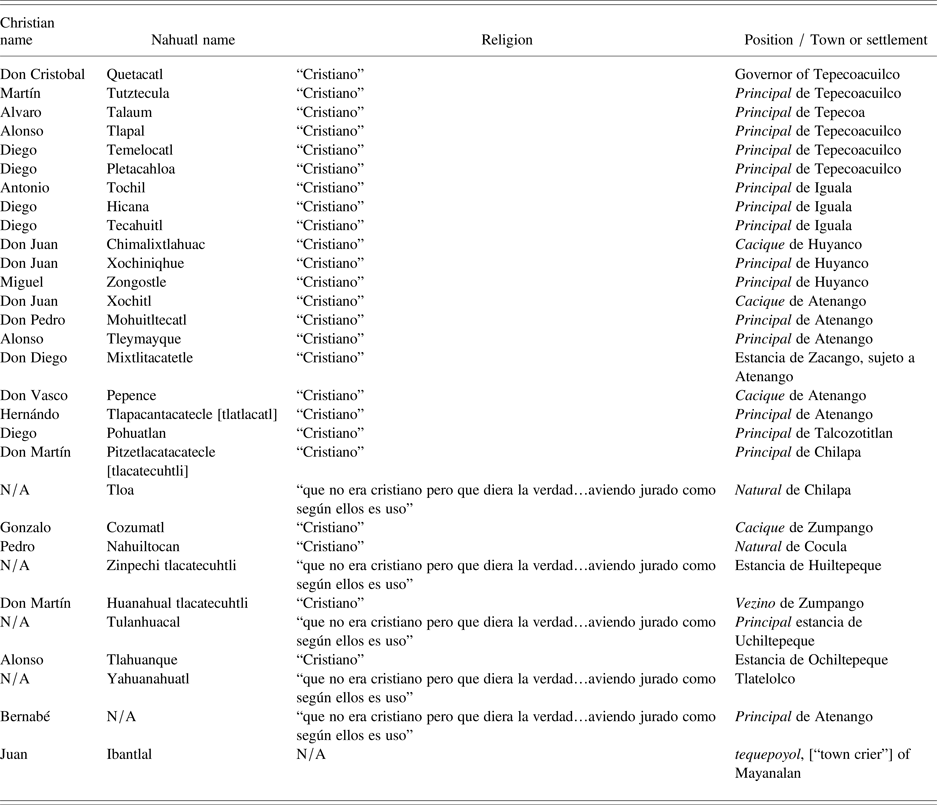
Reviewing a sample of 28 witnesses out of 38 presented in the two separate lawsuits discussed here (see Table 1), most of them were between 30 and 60 years old, their towns of origin and the information contained in their testimony, we can surmise how extensive, or how limited, was the communicative memory of the area, either per auditum (hearing about it from someone) or publica fama (i.e., what was socially accepted as reliable). This, in turn, can assist us in determining the witnesses’ access, or lack thereof, to the relevant information and traditions involved in the cases, as well as perhaps how this information was transmitted to them. At the outset we have to emphasize that the area under scrutiny was subject to legacies and political jurisdictions that were only very minimally modified by the Spanish conquest, so that former alliances and networks of political and social connections were still undeniably present in the form of cultural memory which had operated there for generations.
Witnesses, their religious affiliations, positions, and communities (from Archivo General de Indias [AGI], Justicia, legajos 125 and 127).

The Recurring Themes
The four distinct major themes gleaned from our primary sources, the records and transcribed testimonies of witnesses in the two trials described above, are elaborated below.
Ritual Practices, the Realm of the Sacred, and Cultural Habits
For the present-day Nahuas of Mexico, the subtle meaning of costumbre (custom, habit, as well as sacrificial offering) is “remembrance” and, at the same time, “commemoration.” The word signifies the constant reassertion of the memory of their ancestors’ instructions on nourishing their relationships with the gods by way of offerings as well as the commemoration of their ancestors and their sacred abodes on their own merit (Reyes García Reference Reyes García and Christensen1990). Costumbre involved reverential and sacred patterns, ritual games, traditional clothing (worn on special occasions), as well as dietary habits, and abstinence from sex during times of fasting and commemorations. All of these elements serve as beacons that stimulate the activity of recording, that raise it into the consciousness.
In the geographical accounts (relaciones geográficas) of the former province of Cohuixca, there are identifiable distinct speech formulae that focus on ritual cleansing and acts of purification. In Nahua culture, rites of purification were aimed at the sacralization of certain sites and the entire space surrounding them prior to investiture, and often included abstinence from food, as well as atonement, sexual abstinence, the burning of incense, and bloodletting. The geographical accounts of the Minas de Tasco composed on March 7, 1581, also refer to ritualized purification performed according to local Cohuixca traditions during a transitional phase from a state of chaos to one of order. What this Spanish source (Acuña Reference Acuña1985 [1581–1582]:vol. 7, pp. 115–132) is recounting is something that prominent indigenous Tlamacatzapan witnesses attributed to the intertwining of their town's name with such acts of purification, thereby creating an extended metaphorical memory cue. As Dehouve (Reference Dehouve2011:156) has written, “[t]o be able to analyze the ritual language it is essential to depart from the definition of the metaphor as a cognitive mechanism.” In this way, they memorialized how Motecuhzoma I, the Aztec king, “delivered his guards to watch over the boundaries of these towns.” Upon their arrival in the town, Mexica guards are described as having immediately proceeded to purify themselves under what, we may surmise, was the guidance of the local religious instructors in charge of the altepetlteocalme, (the religious congregation), in a water source called “río de los sacerdotes” (“priests’ river”). This action may very well be associated with the performance of tlatocapaca, meaning, “bathing like a lord,” which, in pre-Columbian times, signified preparing to participate in a war for the capture of prisoners who would ultimately provide sacrificial victims (Acuña Reference Acuña1985 [1581–1582]:vol. 7, pp. 115–132; Vega Sosa and Oudijk Reference Vega Sosa and Oudijk2012).
With which cultural roots can we associate the above? In the Historia Tolteca-Chichimeca, as well as in many of the manuscripts belonging to the genre of primordial texts, reverential recitations addressed to and by the gods all emphasize the arrival at the Place of Penitence, where acts of purification and penitence are to be performed prior to the final settling on divine lands. We have a detailed account of such an act of purification in Durán's (Reference Durán1967) description of the Feast of Water at Tenochtitlan, in honor of the great flood of water that poured into the lake during the reign of Ahuitzotl. A woman dignitary in the guise of the goddess of water and springs, Chalchihuitlicue (“Woman of the Jade Skirt”) came out to receive the water, after which temple priests sounded conches [teucciztli] before her, and the priests made sacrificial offerings of quail in her honor. The embodied goddess, priests, and dignitaries then threw blue maize flour, the conches, and rattles as an offering into the water-sewer (Durán Reference Durán1967). Tezozómoc, the indigenous chronicler, also provides a detailed description of the same event and ceremony in his Crónica Mexicana describing how, upon seeing the huge mass of water pouring into the lake, the king Ahuitzotl knelt down, kissed the earth, and poured the blood of the sacrificial quails onto the water as an act of purification, and then welcomed the water, addressing it as “Lady – goddess of the water,” Chalchihuitlicue. When the water reached the site of Pantitlan mid-lake, the huge inundation of water was drained by a giant whirlpool formed there (Tezozómoc Reference Tezozomoc1987).
The performance of acts of purification against looming supernatural threats was a regular part of native life. Therefore, the sites where purification was to be performed would have become common destinations for pilgrims, as were, in fact, a series of sacred sites where local elders and accompanying inhabitants would regularly go to perform cleansing linked ritualistically to the land of the ancestral dead. In this sense, we should interpret the account just cited as a means of remembrance, so that purification rituals were performed according to a very definite prescribed set of formulae.
As yet another example to this mode of recording, the phonetic sign and pictogram (toponym) of one of the locations falling within the jurisdiction of this town, Pilcayac (pilcac = “something hung, or executed”; Molina Reference Molina2001:81), signified, according to prominent witnesses whose testimony was recorded, the living memory of “an idol hung inside a mountain” (“colgaron un idolo en un cerro”) (Acuña Reference Acuña1985 [1581–1582]:vol. 7, pp. 115–132), possibly, the memory of an ancient form of worship in the local pantheon of a certain deity associated with the Earth.
In the Relación de las Minas de Tasco, composed on March 7, 1581, one finds that the responses made by the local witnesses regarding the ritual use of the sacred lienzos, made of coarse bark paper, amacuahuitl (literally “paper tree”), relates to the Ficus nimphacifolia or wild fig tree, and that maguey fiber paper is directly linked with ornamentations, ritual banners, and costumes, as well as with shrouds. The witnesses described how sheets of paper were tied to “stones” and how acts of ritual cleansing were performed before any offering was made to the gods. Corpses spread impurity and contaminate their surroundings. In all cultures, the core of death rites is dedicated to cleansing, whether the cleansing of the body about to be buried or cremated, or the cleansing of the site or land where the dead are put to rest in order to enable the discharging of the departed souls and secure their safe passage to the next world. The various customs by which the dead are remembered are inseparable from this larger context. In the first part of the Telleriano-Remensis Codex dedicated to the annual feasts, one finds one of the most detailed accounts of the rites of death performed by the Nahua before and after the Spanish Conquest. Paper was ritually associated with the rain god Tlaloc and was understood to be the material from which clothing worn by several divinities was made. The Códice Vaticanus A contains an account of the thirteenth veintena, the great feast of Pachtle dedicated to Tlaloc, the God of Rains, who resides in the mountains. The accompanying text describes how paper offerings were hung on the mountain slopes (Anders et al. Reference Anders, Jansen and García1996; Quiñones Keber Reference Quiñones Keber1995). Arnold (Reference Arnold, Carrasco and Keber2002:232–234) interpreted the ritualistic use of paper as being “related to earth and fertility deities and therefore arbitrated between human and sacred landscapes.” Here we are again within the sacred context of transcendence.
A clearer interpretation of the significance of paper wrappings appears in chapter four of Ruiz de Alarcón's (Reference Ruiz de Alarcón, Andrews and Hassig1984) Treatise on the Heathen Superstitions. There, he cites two elderly inhabitants of Atenango, don Baltasar de Aquino and don Diego de San Mateo, who described to him the types of sacrificial offerings that local men and women would carry to the sites of worship at the top of mounds and hills. These included “some skins of thick cotton thread poorly spun, or some small piece of cloth woven of that kind of thread… poton [a bandage, or cover up with feathers or cloth, feather poultice (Molina Reference Molina2001:83)]… and they used to accompany the offering with that which they call quauhamatl, which is a kind of a [white] paper, like linen, that is made in Tepozotlan from the soft bark of a tree. The offering used to be wrapped in this paper, [possibly simulating the wrapping or bundling of the dead body], and it served together with the cotton as something for the god or idol, to whom it was being offered, to wear…” (Alarcon Reference Ruiz de Alarcón, Andrews and Hassig1984:53–54; Schaefer Reference Schaefer, Schaefer and Furst1996:349–350). In this account the paper serves for wrapping the poton, as an incense offering, and as a covering for the godly effigy. In addition, in Nahua iconography, folded paper ornamentation is often found on mortuary handles (tetehuitl = “paper tied to a wooden pole”), which I suggest might have been the term and practice of that time and place. Mikulska Dabrowska (Reference Mikulska Dabrowska2015) has also recently explored the intertwining of meanings between paper and captive for sacrifice.
Midnight bathing in a deep river was followed by the placing of small stones of paper and hollow canes at the foot of effigies (after adhering to strict instructions: “bathe!”; “tie up the papers”). Such a ritual action in which stones made of sheets of paper serve as metaphorical replacements, is very similar to the manner in which Dehouve analyzes the utilization of paper and serpent effigies during the sacrificial rituals in the Huitzilopochtli temple at the Templo Mayor, metaphorically representing the centzontli (400) huitznahuas that were primordially and mythologically sacrificed (Dehouve Reference Dehouve2011). This could also be associated with how in contemporary Tlapa, on April 25 and 27 (Day of San Marcos), as well as on June 1 and 3, local ritual performers climb on top of Cerro Petlacaltepetl, where they carry out unique rituals in which they dance and invoke the Lienzo de Petlacala in front of a wooden cross, offering it food and drinks while asking for rains (see Padilla and Flores Reference Jiménez Padilla and Flores2003:Figures 4–5).
Furthermore, in the Relación for Tixtlan (and Mochtitlan) (Paso y Troncoso Reference Paso y Troncoso1905–1947:vol. 5, pp. 261–278) recorded on March 7, 1582, the first matter of significance recalled by the elderly interviewees was that Tixtlan had once been an important center for the production of chia (Salvia hispanica) oil. Their tlacuilo (“scribe”, “painter”) had used it for the painting of pinturas mounted on cloth describing their past as well as their present. Upon these large cloth layers, “maps” (tlalamatl) were drawn, depicting the exact borders and boundary stones dividing the land between the various towns and ethnic states of the province of Cohuixca. “Senior persons” of Chilapan corroborated the use of chia oil in the production of pictorials.
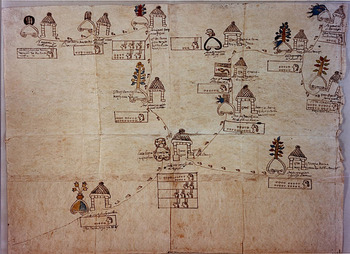
Bygone histories were retold, long after some of the old centers had been abandoned. Apparently, magical healing and ritual cleansing practices were still very vibrant around these old sites of worship. Some men and women who had filled these roles and who were still addressed as amantecatl (“healers”), who treated the sick and the afflicted with herbs, roots, liquids, and the letting of blood from the arms were still alive (Real Academia de la Historia, Madrid (RAH) 9–25.4/4663, XXXVI-1.6; Paso y Troncoso Reference Paso y Troncoso1905–1947:vol. 5, pp. 104–119). The Mochitlan “map” that accompanied the geographical account of this town (Acuña Reference Acuña1985 [1581–1582]:vol. 5, pp. 261–278), is considered to be one of the finest examples of “native” pictorials of the Relaciones (Figure 2). Drawn on March 10, 1582, and measuring 56.5 × 76 cm, it contained both Spanish and Nahuatl glosses and native pictorials. Its “native” style was kept intact, however. This included: pictograms depicting the number of tribute-payers in each of the parcialidades; the towns’ ancient toponyms; pictograms of peculiarities of landscape, locations of the old temples, and ideograms signaling relationships maintained between the former major seats of power—towns and their neighboring rural settlements, all of them represented by their toponyms; the place of the old tianquiz (market-place); and the boundary markers, as well as local watering holes. Mundy (Reference Mundy1996) has meticulously deciphered this particular map. In this map, one fine example of the commemoration of old religious and ritualistic contents drew my attention. It is the toponym of one of the sites depicted, the logographic place-name of Santa María Mictlantzinco, meaning “honored place of the dead”; “a head of a person, seated at the top of a tepetl (hill) symbol has eyes closed in death and face painted with stripes, characteristic of the dead and victims of sacrifice”; again, an extended metaphor in action (Mundy Reference Mundy1996).
The Muchitlan Map. Courtesy of Archivo General de Indias, Seville.

Within the context of reverential speeches and actions, the testimonies of indigenous sources recounting their encounters with individual Spaniards place the latter within seemingly frozen or mythical social settings. There, influenced by local ritualistic patterns and customs in which, ostensibly, no major changes had taken place, the contents all appear in an idealized guise, and the Spaniards themselves “have gone native.” This form of recording, indeed, replicates the Nahua nahualtlatolli or “veiled speech of the sorcerers” as it was called, that could be identified through the often “obscure,” reverential nature of its contents (see Mikulska Dabrowska Reference Mikulska Dabrowska2010). The text consists of a series of reverential speeches, addresses, and mythical dialogues between the living and the dead and between human and godly personalities, not a few of them containing parts which one could justifiably ascribe to incantations, similar to Nahua classic passages. In this manner, what follows strictly adheres to the centuries-old Nahua tradition of the huehuetlatolli directed towards the present rulers (including the Spaniards), who, in turn, are instructed to abide by godly will and goals and, thereby, avoid divine retribution. In the primordial title (título primordial) Coatepec de las Bateas, for example, this form of impersonation is apparent in the simulated dialogue between the hero-leader, Nicolás Miguel, and the Spanish Viceroy (Máynez et al. Reference Máynez, Paciano and Francisco1995:19–23), which clearly imitates the traditional Nahua form of reverential addresses between godly/superior figures and human beings (Megged Reference Megged2009). In the Cohuixca province, certain indigenous figures are similarly placed within a mythical time-space framework in which seemingly divine-human encounters take place among local indigenous nobles, the encounters being dictated by sacred forms of speech and behavior. One such indigenous figure in local accounts was Juan de Aguilera. A young man in his early twenties, he was nominated as a calpixqui (Aztec tax or tribute collector; from calli, house, and pixqui, guardian) in Tepecoacuilco during the reign of Motecuzoma II, and he served there for ten years prior to the Spanish conquest (AGI, Justicia, legajo 127, f. 467v). Subsequently, right after the Spanish conquest of the area, he was asked by the local encomendero, Hernán de Torres, to become an interpreter for the Spaniards because of his proficiency in the local dialects and his thorough knowledge of native affairs. Francisco Neyotl, who served as a tequitlato (a lesser official; foreman of drafted labor) of Tepecoacuilco likewise describes Juan de Aguilera in the following manner:
“…[H]e ate and drank with the native lords, he ate what they offered him, tamales, locusts, and other dishes that they had, such as pozol…He played the bateyan with one local resident, who was the head of this town of Tepecoacuilco, but who is now dead…He [Francisco Neyotl] has seen him twice in this game, and on different occasions. To be able to play, he took off his Castilian attire and remained only with his underclothes, which he lifted up and parted in the thighs, and then he put on a deer's skin and naguas …And this game was played by wearing cotton clothes and huipiles, which is the natives’ natural outfit… and he was told that on several occasions over his Castilian clothes Juan de Aguilera put on garments typical to Jilotepeque, made of fine cotton and richly decorated with designs, such as those of a leopard's skin. And he has seen him a few times dressed in these clothes, seated on the ground, bashful, in the same manner that the native inhabitants are seated. And due to all this, Juan de Aguilera, in all his ways, appears as though he was a native lord…” (AGI, Justicia, legajo 125, f. 750r; translation by the author).
In addition to that, Martín Coatlal described Juan de Aguilera:
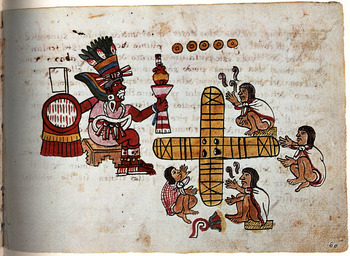
“‘He ate grass roots and small reptiles’ together with the lords of Tepecoacuilco, especially with Comitzin, the tlatoani for the previous fifty-one years. Juan de Aguilera played an indigenous game of chance with black beans, seated on the ground on a petlatl (mat)” [patolli, the Race Game, which Fray Durán described as “the mat game”] (AGI, Justicia, legajo 125, f. 750r; translation by the author).
The mat used in the game had an X painted on it with liquid rubber. Within the arms of the X, lines were drawn to form squares. Twelve pebbles, red and blue, were put in these squares. Onlookers and gamblers pressed against one other around the mat, some waiting to play, others to place bets. Durán's (Reference Durán1967) text is accompanied by a colored illustration of the game (Boone Reference Boone1983).
Coatlal had seen Aguilera one day in an estancia of this town, Aguatlan, where Aguilera strutted among the local inhabitants “dressed like a cacique, wearing maxtlatl [a loose loincloth]and lavishly adorned with lots of feathers and with rabbit wool…He was dressed in a loin cloth and leather acatls, which is typical for the principales and the elderly who cover themselves, and the cloth and the maytle, were lavishly styled” (AGI, Justicia, legajo 125, f. 750v).
Here we are faced with a complete mental operation: a metaphor by extension, within a ritual discourse, as Dehouve (Reference Dehouve2011) would put it (see also Mikulska Dabrowska Reference Mikulska Dabrowska2010:340). Aguilera's fitting into the local indigenous worldview is purely defined by indigenous cultural traits and “wholeness” demonstrated in his gestures, his clothes, his way of eating (he is described as participating in a meal with local lords), his speaking, his way of playing the patolli, and his humility, all of which emanate from the realm of the gods (Figure 3).
A game of patolli being watched by the god Macuilxochitl, as depicted in the Codex Magliabecchiano (Boone Reference Boone1983:f. 60r).

In stark contrast, when Spaniards were called in to testify about Aguilera's deeds in the area, they described him as abiding by purely Spanish norms and mores, a symbol of all possibly evils and contempt, habits that were undesirable, inferior, uncivilized, and lowly; in short, according to the Spanish interviewees, one whose testimonies could not be trusted, due to his “degenerate, uncouth manners.” Spanish-European cultural views entirely degraded Aguilera's seemingly godly reverential aura in indigenous eyes. The overwhelmingly contradictory nature of the cultural criteria adopted by the two sides in their respective descriptions of Aguilera's persona is indeed striking. In the Nahuatl language, a person being portrayed as the Spaniards have in fact described Aguilera could have been dubbed as xolopinemi, “badly disciplined,” (Molina Reference Molina2001:161), or alternatively as tenquauhxolotl, “a man of foul/coarse language” (Molina Reference Molina2001:161), simply uncouth. Both of these Nahuatl terms are derived from xolotl, the figure of the double-faced god, who represented an impostor.
Distinct Patterns of Aztec Presence In the Province
The results of prior Aztec invasions of Cohuixca on the local power relations that developed between the different towns and ruling ethnic states functioned as the backdrop for an intermeshing of Aztec invasions and the later Spanish conquest within the local discourse. This synthesis of the invasions allowed the native population to plead and negotiate with the Spanish within a frame of reference that was familiar to them. From the sources we know that the initial Aztec reconnoitering of the province of Cohuixca was initiated in 1430, under the reign of Itzcoatl. That year, Aztec warriors penetrated the areas of both the Chontal and Cohuixca ethnic groups and succeeded in subjugating the altepeme of Tepetlacinco, Tepecoacuilco, Igualan, and Cuetzalan.
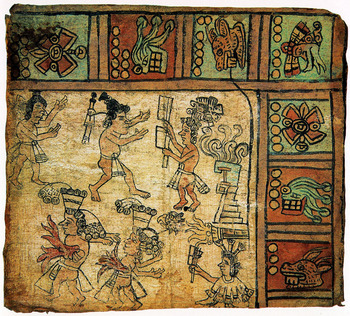
Figure 4 from folio 27 of the Códice Azoyú 1 depicts how, in 1486, the principal temple of the Tlapa-Tlachinollan polity was burnt, marking the final conquest of the enemy. In the image, below the burning temple situated at center right are three Aztecs walking away from the scene carrying torches and a flag, representing some sort of sacrifice that had taken part during the conquest. The conquest of Tlapa is also illustrated in the Códice Mendoza (Berdan and Anawalt Reference Berdan and Anawalt1997:f.13r).
Códice Azoyú 2 depicting the Aztec conquest of the Tlapa-Tlachinollan kingdom in Guerrero (Vega Sosa and Oudijk Reference Vega Sosa and Oudijk2012:f. 27). The person at the lower right, below the burning temple, is carrying a flag, symbolic of a sacrificial act. Courtesy of Fondo de Cultura Económica, Mexico.

By the time of the Aztec conquest, an Aztec garrison had already been established in the cabecera of Tepecoacuilco itself. It was also about this time that the Aztec empire extended its frontiers to the east and west, initiating additional campaigns of conquest in the territories of Chalca and Tlaxcallan, as well as into more distant zones lying to the southwest of the Valley of Mexico. Coinciding with the first Aztec forays into the region was the initial settlement of Nahua-Tepanec groups who advanced from the Lake Texcoco area. The Tepaneca established themselves side-by-side with the Otomi and Tlahuica groups who possibly preceded them, all of them speaking Nahuatl as their lingua franca. Nearby dissident towns of the Tepanecs, including Coyoacan and Xochimilco, were soon re-conquered by the Mexica. Similarly, in the eighth episode of the Lienzo de Petlacala (Oettinger and Horcasitas Reference Oettinger1982:30), it is recorded how: “[t]hen they set out from there. They came to rest in Totlalsonatzin Asopsio. They stayed 15 years and two months” (“Niman onpa oquisque omotlalico totlalsonatzin asopsio oquichihuque caxtolix ihuitly pan ome metztli”; translation by Oettinger and Horcasitas). The place mentioned in this last text, Totlalsonatzin Asopsio, is now known as Asunción Milpa Alta, the mountainous barrier of the Axoxco crater, reaching an altitude of 3,940 m, having become the new frontier of this empire. The relative isolation of this place undoubtedly provided shelter for the fleeing Tepanec groups who settled on the slopes and gorges surrounding Mount Axoxco and extending down to Mount Metzontepec. Nearby was the settlement of Topilejo, of Acolhua origins (Percheron Reference Percheron1983). It is very possible that, while extending his campaign of conquests to the southwest to the towns of Guerrero, Itzcoatl intentionally avoided crossing this mountainous barrier of the Sierra de Axoxco and instead took the road from central Mexico through the territory of Tlahuica near Cuernavaca and from Chilpancingo to Acapulco (Megged Reference Megged2010a:110). Additional groups of Tepanec migrants followed suit, moving along parallel routes into Guerrero.
The Lienzo de Petlacala, for example, relates how Popochtecatl, pressured by the demands of the ruling elites in Tenochtitlan, departed on a sixty-four-year journey from the Valley of Mexico at the head of an unspecified number of followers. The neighboring towns of Chiepetlán, Tzaqualtipan, Tenanco, Ocotequila, and Xalatzapa all documented similar migration routes for the inhabitants who eventually settled in each of these locales (Galarza Reference Galarza1972; Oettinger Reference Oettinger1982). In a similar fashion, the Ocotequila and Xalatzala Nahuatl documents describe the departure of a group of migrants from Xochimilco under the leadership of Ocotequiltentli and Ocoxaltentl, who eventually settled in the kingdom of Tlapa-Tlachinollan where a local noblewoman, Doña Ana Cortés Alvarado gave them lands. In Zoyatlan, the newly arrived migrants were welcomed by Xochitonaltentli, the local tlatohani, and were subsequently given lands (Dehouve Reference Dehouve1976). This settlement pattern coincided with the one initiated by the Aztec king, Axayacatl, in the Valley of Toluca in 1463 (Quiñones Keber Reference Quiñones Keber1995:f. 33v). In addition, not a few of the migrants to the kingdom of Tlapa apparently originated from Toluca, as the Xalatzala (Dehouve Reference Dehouve1976:146–152) document emphasizes: “aunque ellos son originarios de Toluca” (the original in Nahuatl is missing from the text). They took the road from Toluca and were joined by the Mexica and the Xochimilca. The Lienzo de Chiepetlán II provides a parallel account of the founding of Chiepetlán by migrant groups originating from the Valley of Mexico and the establishment of its boundaries (Galarza Reference Galarza1972). After the great famines that ensued, which are well documented in the Lienzo de Petlacala, the Aztecs utilized this area for the supply of grains. Following Itzcoatl's death, the entire area was placed under the rule of the Triple Alliance between 1440 and 1468, according to Barlow's (Reference Barlow1948) reckoning, as a result of Motecuhzoma Ilhuicamina's advances. Motecuhzoma Ilhuicamina also appears in the Mendoza Codex as the leader who re-conquered Tepecoacuilco, Ohuapan, and Chilapan, as well as many other towns in this province. The Nahuas or the Cohuixca, who settled in the region together with the Chontales and the Matlazinca sometime before 1250, could easily have assisted the troops of the alliance.
The final Aztec invasion of the region from the east occurred by 1486. Ongoing wars with the Yope in the south and with the Tarascan state to the north, however, persisted well into the period after the Spanish arrival in the area. Tezozomoc (Reference Tezozomoc1987:343) proposes in Crónica Mexicayotl that, by 1487, the entire area was already under the dominance of the Triple Alliance, under the Aztec king Ahuitzotl and that the Chontales were finally subdued, enslaved, and “wiped from the face of the earth”—an inaccurate and exaggerated account. After finally conquering the area southwest of the Río Balsas and the Sierra Madre del Sur, the Aztecs divided the region that constitutes present-day Guerrero into six provinces: Tlaxco, Tepecoacuilco, Tlacozauhtitlan, Tlachinollan, Cihuatlán, and Quiauhteopan (Berdan and Anawalt Reference Berdan and Anawalt1997:ff. 37r–39r). Tax collection was introduced and the centralized Aztec government exerted influence over the local natives. One part of Guerrero, Acapulco, never came under the direct control of the Aztecs, but rather remained subject to local caciques. Cohuixca was essentially a frontier province, sharing both western and southwestern borders with groups fiercely hostile to the so-called Triple Alliance (Berdan and Anawalt Reference Berdan and Anawalt1997:ff. 32r–33v; Carrasco Reference Carrasco1999). On its southernmost border, Cohuixca bounded the unconquered Yope territory, the capital of which was Yopetzinco, near the Costa Chica. Incorporated loosely into the Aztec empire, this area's polities were gradually brought under the orbit of the Spanish during the sixteenth century.
Thus, in both the Códice Azoyú 2 and the Humboldt Fragmento 1, the tribute registry for the province of Tlapa-Tlachinollan begins in the year 7 Deer (1486) of the Tlapanec calendar, the year of the Aztec conquest, and ends in the year 3 Deer (1522), the year of the Spanish conquest. In these sources appear formulae that centered on particular historical episodes that had rocked, yet shaped, the area prior to the Spanish conquest and which, following the European invasion, confirmed and reconsolidated traditional oral/visual accounts that refer to distinct spans of time, each serving a particular purpose. These formulae played a significant role in the accounts of the diverse indigenous witnesses given as testimony before the Spanish colonial court during the two lawsuits discussed in this essay, and they bore on both Spanish and indigenous modes of control and rule in the area. These accounts rebuilt and consolidated entire schemata of old alliances, the old-new modes of labor recruitment, traditional forms of services granted by subject towns, and revived notions of space and time based on the former rule of the ethnic state.
Indigenous contents belonging to this particular theme focus on three major patterns identifiable in the sources: Aztec presence in this area; the belligerent relationship that existed with the Yope; and the power relations between the different ethnic states in the area (Paso y Troncoso Reference Paso y Troncoso1905–1947:vol. 5, pp. 104–119.). Similarly, the Iguala witnesses also recalled the significant presence of the Aztec pochtecatl (long distance, professional-royal merchants and diplomats), as well as the fact that all the groups originated from central Mexico, and had been loyal vassals of Motecuhzoma. They also recalled that Tzompanco had served as a center for the gathering of war slaves taken from the Yopes during the reign of Motecuhzoma II (Noguez Reference Noguez1999; Quiñones Keber Reference Quiñones Keber1995). Tzompanco may have also participated in Motehcuhzoma Xocoyotzin's 8 Calli, the 1513 war of the province of Tlapan against the Yope, which is mentioned in the Códice Telleriano Remensis. Some of these slaves were delivered to Tenochtitlan, as an acknowledgment of its rule over the province and the town of Iguala. The others were most likely sacrificed upon a wooden platform or tzompantli (skull rack) in Durán's (Reference Durán1967) Historia. In the various relaciones, the native witnesses also recalled how the inhabitants of this area were made to contribute to the wars that the Mexica fought against the Yope, as well as how the people of Tzompanco provided services and slaves from among the prisoners of war they had captured in their battles against the Yopes (Paso y Troncoso Reference Paso y Troncoso1905–1947:vol. 1, pp. 189–202).1
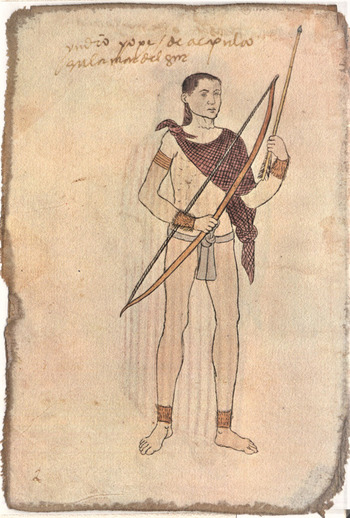
In the Relaciones Geográficas of Chilapan, Tixtlan, and Mochtitlan, witnesses described how the Valley of Iguala served as the breadbasket for the Valley of Mexico during the reign of Motecuhzoma Illhuicamina when severe famines struck the heartland of the Aztec empire in 1450. It was during that same period that Motecuhzoma Illhuicamina also assigned Aztec captains and overseers to establish garrison towns as frontier posts bordering with the belligerent Yopes. The southernmost Aztec garrison established by 1450 was located in the town of Quecholtenanco, south of the ethnic state of Chilapan. These garrison towns are described as having been founded around 1458 by a settlers sent by Motecuhzoma Ilhuicamina to cultivate plots and take part in the war against the Yope of the frontier (Paso y Troncoso Reference Paso y Troncoso1905–1947:vol. 5, pp. 228–229). In the Codex Tudela (Boone Reference Boone1983:f. 4v), one gets a glimpse of a typical Yope warrior from Acapulco (Figure 5).
A Yope Indian from Acapulco, as depicted in the Codex Tudela (Boone Reference Boone1983:f. 4v). Courtesy of Biblioteca Nazionale Centrale, Florence.

In the 1581 Relación Geográfica of Tixtlan, the elders stated that “Chilapan and Tzompanco maintained a close alliance against the Yope, to their west” (Paso y Troncoso Reference Paso y Troncoso1905–1947:vol. 5, pp. 228–229). The Chilapan Relación, composed in 1577, was originally accompanied by a cadastral map, now lost, of about 56.5 × 76 centimeters (RAH, legajo 4663, ff. 9–25).Footnote 2 As the witnesses attested, the historical map demonstrated that around 1458, in the Relación de Chilapan it is said that “a ciento y veinte y quarto años…Texoloteuhtle le…fue enviado por Motecuma a haser esta población,” a certain master mason [texolotecuhtli] was sent to the site by Motecuhzoma to establish the town, possibly in order to set up a frontier garrison against the Yope (RAH, legajo 4663, ff. 9–25.). The witnesses recall that they were direct subjects of Motecuhzoma I and II and emphasized that “only this town would deliver to Tenochtitlan leopards and eagles, as a sign of acknowledgment” (Berdan and Rieff Anawalt Reference Berdan and Anawalt1997:ff. 37r–38r). The ethnic state was governed by a tlatoani nominated by Tenochtitlan and assisted by a tlapixqui (caretaker or guardian in Nahuatl; Molina Reference Molina2001:132).Footnote 3 In the Códice Azoyú 2 and in Humboldt 1, a Tlapa (Tlachinollan) tribute list covering the years 1487 to 1521 attests that payment to the Aztec capital was made on four months or feasts of the year: Tlacaxipehualiztli, Etzacualiztli, Ochpaniztli, and Panquetzaliztli (a total of 80 days) (Vega Sosa Reference Vega Sosa1991). The first day of each of these 20-day periods fell on March 21, June 9, September 17, and December 6, respectively, according to the calendar transcribed by Durán (Reference Durán1967:bk. I, pp. 213–293). This would give four annual dates for paying tribute to Tenochtitlan, unique in the Aztec tributary system. They cover periods of 80, 100, 60, 20, and 105 days, respectively.
Mechanisms of control, the modus operandi of how the local inhabitants should obey and serve local Aztec interests, and the means by which they were made to accept Aztec power and adopt its conventions, were all fully incorporated in the dominant memory schemata. Aztec military outposts or garrisons in this region, such as that of Tepecoacuilco, are also given a dominant place in the local peoples’ memories. By the 1450s, Tepecoacuilco had already become an important head town for the Aztecs stationed in the province of Cohuixca and the tax collection center for the entire province. From there, the Aztecs staged further intrusions down to Chilapan and Tlapan-Tlachinollan: “[l]os señores de México…presidio de gente de guarnición que cobraban los tributes y recogián de toda la Cuixca…” (Paso y Troncoso Reference Paso y Troncoso1905–1947:vol. 5, pp. 104–119). In this very context, shared memory also focused upon the placement of special delegates, or calpixqui, to watch over the limits of the towns and to collect tribute as early as the reign of Motecuhzoma II. In the two lawsuits, the important role of Motecuhzoma's calpixque in the witnesses’ social memory merits our attention. Their role is highlighted within the interrogatory section, when the indigenous witnesses are counter-interrogated by the litigants. Let us closely examine the questions put before them:
Q. 5: “Iten si saben que antes que los españoles viniesen a la conquista e pacificación de esta Nueva España, los dichos pueblos de la dicha provincia servían y contribuían todos con sus tributos y servicio al dicho motecuzoma y a los calpixques, recogedores que el dicho Motecuzoma ponía que cobrasen los dichos tributos?” (“Whether they know that before the Spaniards came to conquer and pacify New Spain, the aforementioned towns of the said province served Motecuhzoma and contributed to him and his calpixqui—collectors and that the aforementioned Motecuhzoma placed them to collect their tribute and services?”)
Q. 6: “Iten si saben que los dichos calpixques recogedores del dicho Motecuhzoma estaban y residían en Tepecoacuilco, y otros en Oapan, por ser como son pueblos gruesos y de mucha gente apazibles y en comarcas de la dicha provincia y cercanos de esta ciudad?” (“Whether they know that the aforementioned calpixqui, Motecuhzoma's collectors, were there and resided in Tepecoacuilco while others [resided] in Oapan; for these towns were large and they and their environs were pacified, and were close to this city [Mexico City]?”)
Q.7: “Iten si saben que no embargante que la provincia toda y pueblos de ella acudían con los tributos a las dichas dos cabeceras y a los calpixques que allí estaban, no por eso fueron sujetos a los dichos pueblos sino que acudían con sus tributos a los calpixques como personas por Moctezuma y no como subjetos a los dichos dos pueblos?” (“Whether they know that, undoubtedly, in the aforementioned province, all the towns there brought their tribute along to the two head-towns and to the calpixqui that were there, this does not mean that they became subjects of those towns, but only that they sent their tribute to those calpixqui as Motecuhzoma's representatives, and not as subjects to these towns?”) (AGI, Justicia, legajo 125, f. 393v–393r; translation by the author).
Forty-year-old Tocoal, from the barrio of Santa María in Mexico City, claimed to have been sent down by Motecuhzoma from Tenochtitlan, to be stationed in Oapan as a calpixqui [y estuvo allí residente tiempo y espacio de ocho años…] He said that he remained there for tiempo y espacio [“time and space”] of eight years, up to 1518” (AGI, Justicia, legajo 125, f. 355r).Footnote 4
During Motecuhzoma II's rule over the area, Andrés Peres was stationed in the mines of Tzompanco (Zumpango) to supervise the payment of tribute and to assess production. Immediately after the Spanish conquest of the area, he became an interpreter for Xaramillo's men in the mines. Pablo, a principal from Tepecoacuilco, recalled how, over thirty years earlier (around 1510), he was instructed by Pedro Tocalpan, Motecuhzoma's calpixqui stationed in his head-town of Tepecoacuilco, to go and collect the tribute from the center at Tzompanco (AGI, Justicia, legajo 127, f. 209v). Later, however, Peres had apparently “crossed the lines” and passed information to Ircio's men concerning the meager value of Chilpancingo and its subject hamlets. Apparently, Ircio had succeeded in persuading Peres to abandon the mines and go into hiding after he had abandoned his former master.
This shared memory was obviously reinforced by the living, firsthand memory recalled in the testimony of Pedro Tocalpan in answer of the questionnaire in the two separate lawsuits conducted between 1537 and 1562 in the Spanish colonial court of the audiencia in Mexico City. When asked, Tocalpan described himself as having been the calpixqui (the Aztec overseer) in the area, sent by Motecuhzoma, well before the Spaniards’ arrival. For more than 20 years, he had resided in both Tixtlan and Zacapan. Shortly after the Spaniards conquered the area, he had left for good, never to return. In the two separate lawsuits, many of the witnesses from Tixtlan and Zumpango, having been subjects of the Oapan's altepetl, recalled contributing their share to the overall quota of tribute due from this altepetl and transferred to the residing Aztec calpixqui sent from Tenochtitlan (AGI, Justicia, legajo 127, ff. 554r–557v; also Yannakakis Reference Yannakakis2013). In the Lienzo de Chiepetlán 1 (Galarza Reference Galarza1972:ff. 3–7), there we find a similar report on visits made by emissaries sent on a mission from Tenochtitlan to the Tlapa province and their encounters with Quiahuitl, the local ruler of Tlachinollan around 1461, during the wars with the Yope (Galarza Reference Galarza1972).
Traditional Patterns of Labor Drafts and Tributes
As various witnesses recalled, local services and labor drafts were still based upon what was known as the traditional institution of the llamamiento—meaning “convocation”—specifically for labor under the authority of tequitlato (an individual official in charge of levying tribute for a town) (Gibson Reference Gibson1956).Footnote 5 Under such an institution, the tlatoani would call on the other rulers, as his subordinates, to provide men and various services, and they were obliged to obey him, usually within a cycle of eighty days (nauhpohualtica could possibly have been the term used in Nahuatl = “every 80 days,” nahui = 4 × cempoalli = 20) (Barlow Reference Barlow1949). In this we can include the 20-day cycles of labor recruitment for the altepetl. The number of men employed in the mines on one particular day within this cycle from Chilpancingo and its settlements was 40 (15 from Chilpancingo itself and 25 from its subject settlements). Then, 40 men (i.e., ompohualli as they could have said in Nahuatl, which is 2 × 20) were recruited and sent there from Tzompanco, while another 40 were sent to work the maize plots, or vice-versa (AGI Justicia, legajo 125, f. 141v). We are told that Xaramillo apparently continued this same traditional form of the llamamiento recruitment, sending 20 local men every 20 days to serve in the mines of Zumpango (AGI Justicia, legajo 125, f. 296v). Reyes García (Reference Reyes García1988) mentions such a pattern of labor recruitment in sixteenth century Cuauhtinchan. There, the macehualtin were to be formed into units of five groups of 20 and that each group of 20 was led by a centecpanpixque, and each unit of five groups of 20 was led by a macuiltecpanpixque [“those who guarded 5 × 20 (100)”],Footnote 6 the same as before the coming of the Spaniards. As Francisco Xochibocal concluded his testimony, however, such customs and cycles, had ended, “upon the arrival of Xaramillo, when everything changed, so that Tzompanco was annexed to his encomienda…” (AGI Justicia, legajo 127, f. 44r; translation by the author). The rounds of service and tribute of 200 (matlacpual = 10 × 20) jars of honey were levied from Tepecoacuilco every 80 days. As Francisco Suchabocal testified, however, such customs and cycles ended “upon the arrival of Xaramillo, when everything changed, so that Tzompanco was annexed to his encomienda” (AGI Justicia, legajo 127, f. 44r; see also Berdan and Anawalt Reference Berdan and Anawalt1997:f. 36v–37r, 57r). Seventy-five year old Zinpechitacatecle, from the estancia of Huiltepeque, testified that he and his kin were not Christian, (“no son cristianos”); to the third question, he replied that, “during the dry season, the estancias harvested around 200 cargas de maiz and, during times of drought, no more than 80 cargas de maiz, and they gave the tribute to the cacique of Zumpango, every 80 days one fanega of maize and another of frijoles, and one loaf of salt…” (AGI, Justicia, legajo 125, f. 229r).Footnote 7 Forty-five year old Yahuanagual, of Tlatelolco, who, as a tax collector during Motecuhzoma's days, would visit the province and the estancia de Huichiltepeque, in particular, on many occasions, said that he collected tributes every cycle of 80 days, (de ochenta a ochenta días), six or seven cotton cloths, and some turkeys, which he took with him to Tenochtitlan. On March 24, 1537, during their cross examination of the witnesses, Cecilia Lucero's legal representatives in court, stated that the estancias located in the jurisdiction of Zumpango (Tzompanco) comprised 400 “men of service”; that cotton, maize, beans and maguey were their major produce with a total annual value of three hundred pesos oro de minas (1 peso de oro de minas = 12.5 reales de plata or, 450 maravedíes). These estancias also provided some 30 men for labor in the mines of Zumpango, whose work was worth 400 pesos oro de minas and that, all together, the widow and her son would have derived an income of some 2,000 pesos oro de minas from the property and labor (AGI Justicia, legajo 127, f. 236r). The cycles of service were apparently maintained even as late as 1557, as the Códice de Teteltzingo attests. Teteltzingo, situated on the Río Mezcala (Balsas), was one of Oapan's subject towns.
The Códice de Teteltzingo, belonging to the mixed pictorial and written genre of native relaciones of this period, is an account delivered to Viceroy Luis de Velasco by don Tomás de Tapia, principal of Tepeaca and the judge of Oapan. Don Tomás de Tapia was probably called by the Spanish corregidor to serve as an arbitrator in the conflict that arose between the two towns, with Teteltzingo refusing to adhere to the traditional forms of coercion that existed between the two. Tomás de Tapia describes how he reformed the system of service and tribute levied by the governor and lords of Oapan from the people of Teteltzingo, thereby adhering to the New Laws of 1542 (whereby the Spanish crown ordered that indigenous slavery be abolished; compulsory labor drafts of native men be terminated; and that encomiendas be maintained for no more than two generations). In this way he abolished the system of unpaid, local repartimiento (i.e., the colonial allocation of indigenous manpower to the Spanish conquerors and settlers). While don Tomás de Tapia moderated the quotas, however, he kept intact the conditions of subjection existing between the two towns. Consequently, the local principales of Teteltzingo were still obliged to pay to a number of lords of Oapan one peso de oro de minas, 100 cocoa beans, and one turkey every week, in addition to paying don Diego Tlacatecotl, the calpixqui two golden pesos every 80 days (nauhpualin = 80 [4 × 20 days; or, four veintenas]). They were also obliged to provide a number of able-bodied men and women to work the fields of these lords (“the workers should be paid one real a week and given food”) (Barlow Reference Barlow1954:65–68). In addition, for the feast day of San Francisco, which became the major feast celebrated in Oapan, the local principales of Teteltzingo were obliged to donate five golden pesos and “some labor,” besides paying every 80 days one golden peso to each of the local mayordomos of Oapan who were in charge of maintaining the image of San Francisco. On the left side of the document's leaf appears the same description in ideograms, with a number of glosses in Spanish below them. The document is signed by don Luis de Velasco, the Spanish viceroy (Barlow Reference Barlow1954). This documento de Ohuapan demonstrates visually how the local inhabitants were still obliged to cover the salaries of the local governor, Don Gaspar, as well as the alcalde, mayordomos, principales and the local scribe, “every 80 days.” In addition, they were obliged to provide the governor with a man and woman servant, who looked after his household, and to cover the costs of the yearly feast for the local patron saint, San Agustín.
The figures of the local governor and the alcalde are seated upright in the traditional way on a tepotzoicpalli (reed mat seats with a back), while the alcalde is holding a bastón as the insignia of authority. The casa de la comunidad is also painted in the traditional form of a T-shaped structure with a thatched roof. Above, to the right, is the Oapan (Ohuapan) toponymic glyph: óhuatl = caña dulce, and the additive tepetl = mountain. From this, one can also conclude that the recalling of traditional forms of labor recruitment, tax levying, the surveying of land, weights and measures, and the emphasis on these patterns in the testimony, could well be interpreted in terms of providing a source/sense of security, as one relies on the old, familiar patterns of visual transmissions, in the exact manner as in the pictorial texts, that were by then in a state of transition and change.
Distinct Patterns of Former Alliances, Genealogical Ties, and Animosities
On the eve of the Spanish conquest, the archives in almost every town or altepetl contained pictorial texts, cadastral “‘maps”' recording both secular and sacred affairs of the past, the present, glyphic imprints of pre-Columbian forms of tribute quotas levied on the altepetl, and records showing the recruitment of labor. Their contents were constantly displayed in the course of lawsuits between various towns. It should be noted that during the first decades after the Spanish conquest, graphic forms of communication routinely served towns and individuals to confirm historical antecedents. They redefined the new order of things and reshaped former power relations, alliances, and enmities that had their memorable history reaching back to the times before the Spanish invasion. They altered current relationships with the Spanish ruler and captured old traditions in their customary forms, legitimizing persistent affiliations between former allies, reformulating or ending alliances with former indigenous sovereigns, and settling ongoing disputes over lands and other resources. Such visual means were also employed for what Marcus (Reference Marcus1992) termed “a manipulated history in which the facts are altered to meet successive rulers’ changing political and ideological needs.” I have found some evidence in the two sources that point to rehearsals utilizing graphic forms, having taken place in the home communities prior to giving testimony in the court of the audiencia in Mexico City. Both Oapan's and Tixtlan's lords seem to have tried to reaffirm and reconcile old alliances based upon the legacies and power relations of the former altepetl, by reviving in court common interests and old affiliations. Appearing in court, the lords and principales of these towns associated their former and present authority directly with the historical jurisdiction of the ex-province of Tepecoacuilco (Cohuixcatlacapan). This can be compared with Vega Sosa and Oudijk's (Reference Vega Sosa and Oudijk2012) suggestion that the Códice Azoyú 2 may well have been utilized in court by feuding factions in the former kingdom of Tlapa-Tlachinollan to serve their conflicting claims over jurisdiction and social control.
The use of graphic forms of memorializing past events for the sake of reconsolidating former alliances in the area was also utilized in a significant way in the early hearings of the two lawsuits of Oapan and Tixtlan. In 1540, the Valades brothers, commissioned by the Zumpango rulers against the Tixtlan nobility, interrogated witnesses in several towns. While examining the witnesses they had shown them a Pre-Columbian pictorial map, presumably provided to the Valades by the Zumpango nobility, of all of the lands which had formerly belonged to Oapan, the major former ethnic states in the area, and the land divisions between Zumpango and Tixtlan. The pictographic record also contained many figures of the lords of Zumpango. Showing the map to the witnesses, the Valades brothers indicated to what and how they should testify (AGI Justicia, legajo 127, f. 421v; also Cummins Reference Cummins1995). The Valades brothers, for instance, showed those being questioned a native pictorial mounted on cotton cloth (pinturas sobre algodón) depicting a wedding ceremony between the tlatoani of Oapan and the tlatoani of Mayanalan's daughter. The lienzo likewise depicted the Christian sacramental form of marriage and the newlyweds being escorted by the local nobility to Oapan, in a very similar style that we are familiar with in Pre-Columbian procession scenes. The significance of the act of inscribing in memory the graphic content of such recording could be seen in what Juan Ibantlal of Mayanalan described on December 25, 1540, in his testimony in court, while looking at the native pictorial shown to him.
Juan Ibantlal, who was Mayanalan's tequepoyol, [“town crier”], recalled that, one morning in 1535, he saw a number of senior notables, men and women, arriving from Oapan at his town. The journey, of 57 kilometers on foot, must have taken them between 12 and 14 hours. At the same time, he had heard that, a few days earlier, another delegation of lords from Oapan had arrived in town to arrange the betrothal between Oapan's supreme ruler and Ana Conxochil, the daughter of don Alonso Taxtetl, Mayanalan's governor. He then witnessed these men and women discuss the act of drawing up the marriage contract, as well as the wedding arrangements with doña Luisa, Ana's mother, and the local ruler's wife. A procession led by the lordly emissaries from Oapan and the mother and daughter of Mayanalan's ruler then left doña Luisa's house, and proceeded to Chilapan, to the Augustinian monastery, where the bride and groom were wed in a public ceremony. From there the procession made its way to Oapan, where the newlywed couple established their permanent home in the local ruler's palace (AGI Justicia, legajo 127, f. 602r). At that time, the Augustinian monastery of Chilapan, as don Francisco Maysoloto, tequitlato (the delegate in charge of drafting men for labors) of Tlasco [Taxco], also emphasized in his testimony, was becoming the center for evangelization of this area as well as the locus where the present rulers at that time would come to hear mass and meet in order to confirm and consolidate former alliances (AGI Justicia, legajo 127, f. 531r). Ibantlal enlightened the judges by explaining that, “as a consequence of this marriage, the lords and governors of Tixtlan and Oapan had since strengthened and maintained their relationships with one another, hosting one another in their homes and offering a variety of mutual services and commitments for the future” (“y que pueden como en sus proprias casas pueden sosetiene y publicana por amigos, los unos de los otros y los otros de los otros…”) (AGI Justicia, legajo 127, ff. 603r–604v; translation by the author).
Furthermore, in the course of the early hearings the noble witnesses all reiterated that Coapotlal, the tlatoani of Oapan (until 1522), was the most powerful person around. The testimony emphasizes that Zumpango and Tixtlan, as well as Chilapan, and Muchitlan (its subject town) all belonged to the greater altepetl of Oapan, which also possessed the silver mines near Zumpango. The line of authority and control came all the way from the tlatoani of Oapan, down to the tlatoque of Tixtlan-Zumpango, down to the tlatoani of Chilpancingo, and, last, to the calpoltin, each of which headed by two elderly lords (teuctlatoani). Diego Tezainitl, principal of Iguala, likewise emphasized that he had seen how, in the time of Motecuhzoma II, the tlatoani of Zumpango placed two of his relatives from the cabecera as local overseers, until the time when those of Chilpancingo rebelled and declared war against Tzompanco (Zumpango) (ca. 1515) (AGI Justicia, legajo 127, f. 597r). Francisco Xochibocal, principal of Mayanalan, testified that he had known don Martín Mayaque, the supreme lord of Tixtlan, for the past 30 years. He recalled having been told that, for 60 or 80 years or so before Mayaque's rule, his father, Aixpotetle, would be shown reverence and receive tribute from the lords of Tzompanco as well as from the lords of Chilpancingo and its calpolli. The latter would also render services and personal tributes to individual lords of Tixtlan (AGI, Justicia, legajo 127, f. 44r). Twenty-eight year old Bernabé, a principal of Atenango (who admitted in court “not to be a Christian,” in contrast to the term for those “Cristiano”), similarly told the judges that he recalled how, “when he was only a small child,” he had seen how Mayaque's father, Aixpotetle, was recognized by the lords of Chilpancingo as Tixtlan's ruler; “the lords of Tzompanco brought tribute to Aixpotetle as well as to his son” (AGI, Justicia, legajo 127, f. 44v). Fifty-year old Taconxtetle, principal of Xalpotlan (yet another native who admitted to not being a Christian), also recorded that the lords of Tzompanco rendered tribute to Tixtlan, as though it were the exclusive head-town with no other beside it (“como era la uniqua cabecera y no tenia otra”) (AGI, Justicia, legajo 127, f. 46v). It is possible to deduce from the above accounts that, after Aixpotetle had died, at least some of the local lords of Tzompanco no longer displayed submission and reverence to his successor, Mayaque (AGI, Justicia, legajo 127, f. 23v).
In the course of their testimony, the witnesses also emphasized the animosity that had once existed between the ethnic state of Tzompanco and the coastal towns of Axapoteca and Xaltzapotla (a semi-independent state connected with the Cuilatecas of Mexcaltepeque), over the lands bordering the Río de Achulapa. It was here, around 1515, that troops from Tzompanco succeeded in an incursion due to the reigning chaos from the time of the Mexica onslaught (AGI, Justicia, legajo 127, f. 561r). The local inhabitants had been advised by Motecuhzoma's delegates in the Tepecoacuilco garrison to vacate their lands (so as not to fall under the rule of Tixtlan) and, subsequently, they all fled to the coast. During the two lawsuits, the witnesses all emphasized that conflicts over lands between Tzompanco, Chilapan, and Tepecoacuilco had erupted well before the Spaniards arrived in the area and that enmity and occasional warfare remained, despite a Spanish presence in the area. Don Francisco Mysoloto, principal y tequitlato of Chilapan, was able to reconstruct from local recall that such enmity in those times was due to a constant struggle over lands between the towns ruled by Colapotlal and the lords of Tzompanco (“porque han tenido querellas entre estos pueblos los unos con los otros sobre ciertas tierras”) (AGI, Justicia, legajo 127, f. 531r). This was also due, he explained, to Tzompanco's subjugation of a few small towns bordering with Cipotlan and Tepecoacuilco. Endless conflicts between the different towns must have been connected to the absence of the powerful state of Ayotlan to the west, close to the coast, which had previously been decisive, as numerous witnesses testified. The process of both recording and transmitting information of what took place during local negotiations to resolve conflict within the traditional framework of lawmaking at the court of the tlatoani was partially or entirely meshed in the cadastral maps with the historical schema introduced by the historic memory of the Aztec-Cohuixca. We get a glimpse of how such this was done mainly from the testimony of the elderly witnesses in the two lawsuits.
Ongoing conflicts over land between Tzompanco and its neighboring states/coastal towns of Axapoteca and Xaltzapotla were also memorialized as having played a central role in this area's political life. According to the testimony of Diego Chiloxochil, a principal of Chilapan, during the wars of around 1515 both sides had taken prisoners of war and Tzompanco had apparently succeeded in encroaching on lands well beyond its limits, for a distance of ten to twelve leagues, towards the coast and succeeded in maintaining a garrison post in that area. In the counter-interrogation of Ircio's witnesses in December of 1540, in response to question Number 54,Footnote 8 Diego Chilosuchial, principal of Chilapan, for example, “recalled,” or seemed to have heard that, around 1515, there were ongoing conflicts over lands between Tzompango and its neighbouring states/sub-states, the coastal towns of Axapoteca and Xaltzapotla. (Xaltzapotla, a semi-independent state, was related to the Cuilatecas of Mexcaltepeque). During those wars, he was told, or had heard, that both sides took prisoners of war, and Tzompango had apparently waged war well beyond its limits, around ten to twelve leagues towards the coast, successfully maintaining a garrison-post in that area (AGI, Justicia, legajo 125, f. 740v; AGI, Justicia, legajo 127, f. 540v).
This version is also corroborated by the Relación de Tlacotepec, a town situated to the northwest of Chilpancingo, in which it is said that “trayán guerras con los de la Costa, que eran los pueblos de Tequepa, Acamalutla, Temazcaltepec…” (Barlow Reference Barlow1946:70–73, Reference Barlow1948:181–190). According to don Juan Xochil's testimony, when they returned not much later, they were all placed under the rule of Tzompanco (AGI, Justicia, legajo 125, f. 231r). The ongoing conflict between the rulers of Ilapotla and Tzompanco, as well as that of the latter with Chilapan and Tepecoacuilco over jurisdiction and lands was also recorded and emphasized in the recollections of various witnesses to the area's affairs.
CONCLUSIONS
The main goal of this article has been to identify and classify what I have termed “pervasive patterns” that both guided and were repeated in the testimony of indigenous witnesses in the Spanish courtroom. In doing so I relied upon the “ethnography of speaking,” which pursues formalized frames of communicative actions and interpretations, as well as upon what Dehouve (Reference Dehouve2011) has recently called “metaphor by extension” within ritual discourse. Utilizing this methodological framework, I have identified and classified four major themes that arose from the indigenous testimonies given in the colonial court of the audiencia in Mexico City between 1532 and 1565. These have been corroborated and grouped with indigenous responses to the questionnaires of the relaciones geográficas for the provinces of Guerrero. We have seen that the essence of these towns’ collective memory of their common heritage concerned the alliances established, the lands divided and boundaries set, and the rulers who had dominated the area prior to the arrival of the Spaniards. Those who gave testimony before the court made repeated reference to what they recalled of what had been the most prominent emblems, cultural forms, and patterns in local heritage, inscribed upon the lienzos. These data could well be interpreted here as innate models or constructs upon which memory was collectively imparted through the process of memorialization. Within them, however, one can also clearly identify particular sites/apparatuses inserted within the text that play the role of memory beacons, or cues. Nonetheless, additionally the conflicting, ambivalent relationships formed between former dependents and allies became a major factor that significantly impacted the structuring of collective memory.
In the aftermath of the Spanish conquest, the entire area naturally became exposed to ongoing competition for power and attempts to re-appropriate. The “task” faced by the native witnesses was essentially to consolidate and rebuild entire schemata out of the new-old modes of rule. This is what these constructs are all about. Thus, I would argue that what one is able to identify here are unique cultural grammars, which are analogous to the grammars of linguistics firmly embedded in their environment and cultural experience. Consequently, in order to establish a seemingly coherent plot of the past that can overcome fragmentation and chaos, the indigenous witnesses appearing in the sources cited here relied heavily on unique indigenous schemata that were based upon two corresponding systems: the graphic communication system and the oral performance system. These helped them assemble the mental shreds and remnants of past experiences and restore them within the traditional framework and formulae of transmission of information that had only been modestly affected by Spanish impact. The most significant outcome of this approach is that the four themes identified within the testimonies examined indeed correspond to contents and contexts familiar to us in pre-Columbian pictorial texts. As such, these early colonial testimonies were deeply embedded in the amoxtli (tlalamatl altepeamatl = land papers), titles of each town and district in the former Cohuixca province of Tepecoacuilco (Cohuixcatlacapan) and were heavily reinforced by their retelling.
By the latter part of the sixteenth century, the shift from oral-pictorial modes of recording to an alphabetic culture, together with the process of internalizing Christianity and the passive and active adaptation to religious change, had greatly affected the nature of how memory was subsequently forged in the indigenous groups of Mexico. Quite expectedly, one notices within the sources the gradual disappearance of such forms from the testimonies given in the Spanish colonial courtroom by indigenous witnesses and defendants.
Finally, when comparing the data here with sources emerging from other areas of central Mexico cited above, here, too, Spanish presence in the area, at least in the early stages of such contacts, is almost entirely absent from court testimony and other local accounts. The general impression is that the Spaniards are virtually only in the very background of native autochthonous controversies and disputes which stretch back to long before the Europeans arrived and that they were essentially not the issue. Social spaces are where Spaniards and indigenous individuals and groups spoke of the matters for which they had established communication with one another. Spanish figures, if mentioned at all in indigenous testimonies from this province, are the local encomenderos, their agents and foremen, a few travelers, silver miners, mayordomos, tax collectors, a few of the early estancieros. Martín de Ircio, the Spanish encomendero, for example, is observed by indigenous populace traveling along the road from Iguala to the silver mines, regularly stopping to chat with the local caciques of Oapan and Tixtlan. Another prominent Spaniard was Pedro de Torre Castillia, who travelled widely in the area, and seems to have been well acquainted with the local lords in the various towns. Juan de Mesa, who was apparently fluent in Nahuatl and resided permanently in Tasmalacan, also figures prominently in local indigenous accounts. He was nominated in 1540 to serve as an interpreter to the commission of inquiry for the Tixtlan-Zumpango case. Thus, when Spaniards do appear in these recollections, memory produces a whole sequence of phenomena closely related to the task of gathering the shreds of local traditions, the rudiments of cultural memory.
RESUMEN
Se ha escrito relativamente poco hasta ahora en la etnohistoria precolombina y colonial temprana de la región del noreste de Guerrero, comparada a otras regiones del área central y el sur de México. La mayor parte de los estudios se centran en la parte al sudoriental del Estado de Guerrero, particularmente la provincia de Tlapa, mientras que la parte del noreste del Estado sigue descuidada. Este desequilibrio es debido al depósito grande de lienzos locales y de los códices encontrados en el sudoeste que han servido como la base para los estudios etnohistóricos sólidos, mientras que las fuentes primarias referentes a la era colonial temprana y al período antes de la conquista española para la parte nordestal del estado son extremadamente escasas.
El análisis aquí está basado en testimonios indígenas que pertenecían a dos pleitos judiciales, que fueron encontrados recientemente por el autor en el Archivo General de Indias en Sevilla, España. Estos documentos están entre las fuentes más tempranas que proporcionan la información relacionada con la presencia de los Aztecas en la antigua provincia de Cohuixca-Tepecoacuilco, así como en la primera década de la regla española en el área. El primer pleito fue conducido en los años 1531–1540, entre el encomendero de Oapan, Martín de Ircio, y Diego Xaramillo, el encomendero de Tzompanco (Zumpango). El segundo juego, atravesando los años 1537–1561, implicó un pleito conducido cerca pone Martín Mayaque, el gobernador local y cacique del antiguo altepetl de Tixtlan y, de Martín de Ircio, ahora sirviendo como el último representante legal, contra Xaramillo y, subsecuente a la muerte de Xaramillo, a Cecilia Lucero, a su viuda y a heredera.
La meta principal de este artículo ha sido identificar y clasificar lo que llamamos los “patrones penetrantes” que fueron repetidos en el testimonio de los testigos indígenas en la sala de tribunal colonial española. Al hacer eso basamos nuestro análisis en la “etnografía del discurso,” que persigue los marcos formalizados de acciones y de interpretaciones comunicativas, así como en lo que ha llamado Danièle Dehouve recientemente “metáfora por la extensión” dentro del discurso ritual. Utilizando este marco metodológico, identificamos y clasificamos cuatro temas importantes que se presentaron en los testimonios indígenas dados en la corte colonial de la audiencia en la Ciudad de México, entre 1532 y 1565. Hemos visto que la esencia memorial colectiva de estas antiguas ciudades-estados de su herencia común se refirió a las alianzas establecidas, las tierras, los límites fijados, y los reglas que habían dominado el área antes de la llegada de los españoles. Los que dieron testimonio antes de que la corte hiciera referencia repetida a lo que él recordó de cuál habían sido los emblemas más prominentes, las formas culturales, y los patrones de la herencia local, inscrito sobre los lienzos. Estos datos se interpretan aquí como los modelos o construcciones naturales sobre los cuales la memoria colectiva de aquella provincia de Cohuixca-Tepecoacuilco fue impartida colectivamente con el proceso del memorialization. Sin embargo, dentro de ellos, uno puede también identificar claramente los sitios/aparatos particulares insertados dentro del texto que desempeñan el papel de los “faros de la memoria.” No obstante, qué se convierte en además un factor importante que afectó perceptiblemente la estructuración de la memoria colectiva eran el estar en conflicto, las relaciones ambivalentes formadas entre los antiguos dependientes y los aliados del presente.
En las consecuencias de la conquista española, el área entera naturalmente se expuso a la competición en curso para las tentativas reapropiadas. La “tarea” hecha frente por los testigos nativos era esencialmente consolidar y reconstruir esquemas enteros fuera de los nuevo-viejos modos de la regla. Esto es sobre cuál están todas estas construcciones. Así, discutiría que cuál uno puede identificar aquí son las “gramáticas culturales únicas, que son análogas a las gramáticas de la lingüística” encajada firmemente en su ambiente y experiencia cultural. Por lo tanto, para establecer un diagrama aparentemente coherente del pasado que puede superar la fragmentación y el caos, los testigos indígenas que aparecen en las fuentes que citamos aquí confiado pesadamente en esquemas culturales, visuales únicos. Éstos les ayudaron a superar los fragmentos y los remanentes mentales de experiencias previas y a restaurarlas dentro del marco y de los fórmulas tradicionales de la transmisión de la información que había sido afectada solamente modesto por impacto cultural/mental español. El resultado más significativo de este acercamiento es que los cuatro temas identificados dentro de los testimonios examinados corresponden al contenido y los contextos familiares en textos ilustrados precolombinos. Como tal, estos testimonios coloniales tempranos fueron encajados profundamente en las historias cartográficas y los mapas históricos de cada ciudad-estado y distrito en la antigua provincia de Cohuixca de Tepecoacuilco (Cohuixcatlacapan) y reforzados pesadamente por su recuento.