Even though maltreatment is arguably one of the most stressful experiences that children can encounter, some maltreated children exhibit remarkable resilience, for example, they do not display maladaptive behaviors or psychopathology in the face of adversity (Cicchetti & Lynch, Reference Cicchetti, Lynch, Cicchetti and Cohen1995; Cicchetti & Valentino, Reference Cicchetti, Valentino, Cicchetti and Cohen2006). The field of developmental psychopathology has expended much effort to try to understand these individual differences and contextual factors that could explain both developmental trajectories leading to mental health problems in maltreated individuals and the absence of signs of psychopathology in some of them (Cicchetti, Reference Cicchetti2013; Cicchetti & Rogosch, Reference Cicchetti and Rogosch1997). Resilience is not “magic” (Masten, Reference Masten2001), and research has suggested that individuals who are less scathed by adversity can be understood by examining the interactions between protective and risk factors at multiple levels of analysis, including environmental inputs and biological parameters (for a more comprehensive and recent review on the topic, see Cicchetti, Reference Cicchetti2013). The same developmental cascades that can amplify maladaptive outcomes over time can perpetuate or amplify positive outcomes when the individual benefits from some combination of experiences and/or biological propensities that tip the initial balance toward adaptive outcomes.
For instance, it is increasingly recognized that genetic variations and their downstream effects on physiology and behavior may interact with environmental risk factors such as maltreatment to create vulnerability to mental health symptoms (Caspi & Moffitt, Reference Caspi and Moffitt2006; Karg, Burmeister, Shedden, & Sen, Reference Karg, Burmeister, Shedden and Sen2011) and may help to explain some of these individual differences, as well as the positive outcomes when they do occur.
It is important that research on gene–environment interactions as predictors of psychopathology pursue the study of biological systems that are plausibly related to the environmental exposure of interest to avoid spurious findings (Rutter, Reference Rutter2010). We chose the oxytocin (OT) system as a target for investigation in this sample of maltreated adolescents because of the well-recognized role of OT in social–affiliative behaviors such as attachment, social support, trust, and empathy (Ebstein, Knafo, Mankuta, Chew, & Lai, Reference Ebstein, Knafo, Mankuta, Chew and Lai2012; Meyer-Lindenberg, Domes, Kirsch, & Heinrichs, Reference Meyer-Lindenberg, Domes, Kirsch and Heinrichs2011). Genetic variation in the oxytocinergic system is thus plausibly involved in shaping individual responses to an interpersonal trauma such as maltreatment. There is increasing evidence implicating the sensitivity of the OT system to maltreatment. For instance, adult women with a history of childhood maltreatment exhibit lower levels of OT in cerebrospinal fluid (Heim et al., Reference Heim, Young, Newport, Mletzko, Miller and Nemeroff2009). The second theoretical justification for this investigation lies in the role of OT in the stress-reducing properties of social support (e.g., Chen et al., Reference Chen, Kumsta, von Dawans, Monakhov, Ebstein and Heinrichs2011). Given the important role of stress in the development, maintenance, or aggravation of many types of child and adolescent psychopathology (Grant et al., Reference Grant, Compas, Stuhlmacher, Thurm, McMahon and Halpert2003), we hypothesized that variation in the oxytocinergic system could be linked to higher levels of distress or psychopathology when social support levels are low (i.e., in maltreating families). Below we review the theoretical and basic science justification for the present study, beginning with a review of the roles of OT and of variation in the OT receptor gene (OXTR) in social behavior, and continuing with their more specific roles in stress reduction and protection from psychopathology.
The Roles of OT and of Variation in the OXTR Genotype in Social Behavior
OT is an evolutionarily conserved neuropeptide that regulates various aspects of social and reproductive behavior in humans and many species (Donaldson & Young, Reference Donaldson and Young2008; Heinrichs & Domes, Reference Heinrichs and Domes2008). Aside from its role in parturition and milk production, OT also has been implicated in a broader range of social and affiliative behaviors. For instance, increases in human participants' plasma or urinary OT have been noted in tasks involving empathy with a stranger's distress (Barraza & Zak, Reference Barraza and Zak2009), trust and generosity in monetary games (Zak, Kurzban, & Matzner, Reference Zak, Kurzban and Matzner2005), receiving a massage (Morhenn, Park, Piper, & Zak, Reference Morhenn, Park, Piper and Zak2008), natural variations in maternal and paternal behaviors with infants (Feldman, Gordon, Schneiderman, Weisman, & Zagoory-Sharon, Reference Feldman, Gordon, Schneiderman, Weisman and Zagoory-Sharon2010; Gordon, Zagoory-Sharon, Leckman, & Feldman, Reference Gordon, Zagoory-Sharon, Leckman and Feldman2010), and mother–daughter communication subsequent to a stressor (Seltzer, Ziegler, & Pollak, Reference Seltzer, Ziegler and Pollak2011). OT plasma levels have also been used to predict behavior, for example, maternal–infant interactions (for a review, see Galbally, Lewis, IJzendoorn, & Permezel, Reference Galbally, Lewis, IJzendoorn and Permezel2011). Experimental manipulations involving intranasal administration of OT also reveal effects consistent with the presumed role of OT in prosocial behavior: increases in trust (Kosfeld, Heinrichs, Zak, Fischbacher, & Fehr, Reference Kosfeld, Heinrichs, Zak, Fischbacher and Fehr2005), generosity (Zak, Stanton, & Ahmadi, Reference Zak, Stanton and Ahmadi2007), self-reported attachment security in adulthood (Buchheim et al., Reference Buchheim, Heinrichs, George, Pokorny, Koops and Henningsen2010), ability to “read the mind” of another person (Domes, Heinrichs, Michel, Berger, & Herpertz, Reference Domes, Heinrichs, Michel, Berger and Herpertz2007), paternal responsiveness to infants during play (Naber, van IJzendoorn, Deschamps, van Engeland, & Bakermans-Kranenburg, Reference Naber, van IJzendoorn, Deschamps, van Engeland and Bakermans-Kranenburg2010), and positive communication during couple conflict (Ditzen et al., Reference Ditzen, Schaer, Gabriel, Bodenmann, Ehlert and Heinrichs2009).
Variation in OT receptor function is also related to social behavior. Rodent models show that the distribution of OT receptors across the brain is related to the social organization of a species (Insel & Shapiro, Reference Insel and Shapiro1992) and to natural variations in maternal care behavior, variations which are eliminated by OT receptor antagonists (Champagne, Diorio, Sharma, & Meaney, Reference Champagne, Diorio, Sharma and Meaney2001). Furthermore, knockout mice deficient in the OXTR gene display pervasive social deficits (Takayanagi et al., Reference Takayanagi, Yoshida, Bielsky, Ross, Kawamata and Onaka2005). The human genotype has a single OXTR gene, which is located on chromosome 3p25, spanning 17 kb and containing three introns and four exons (Gimpl & Fahrenholz, Reference Gimpl and Fahrenholz2001; Inoue et al., Reference Inoue, Kimura, Azuma, Inazawa, Takemura and Kikuchi1994). The gene encodes a 391 amino acid protein that belongs to the Class I G-protein coupled receptor family (Inoue et al., Reference Inoue, Kimura, Azuma, Inazawa, Takemura and Kikuchi1994). A single nucleotide polymorphism (SNP) with unknown function in the third intron of the OXTR gene has been garnering increased attention recently, rs53576 (G/A). This SNP was associated with autism in a family transmission study of a Chinese Han population, with preferential transmission of the A allele among autistic individuals (Wu et al., Reference Wu, Jia, Ruan, Liu, Guo and Shuang2005). This association was not found in Caucasians (Jacob et al., Reference Jacob, Brune, Carter, Leventhal, Lord and Cook2007). Compared to A-carriers, individuals with the G/G genotype perform better on laboratory measures of empathy (Rodrigues, Saslow, Garcia, John, & Keltner, Reference Rodrigues, Saslow, Garcia, John and Keltner2009; but not on self-rated scales of empathic concern in patients with schizophrenia, Montag et al., Reference Montag, Brockmann, Lehmann, Müller, Rujescu and Gallinat2012), manifest more trust during laboratory economic games (Krueger et al., Reference Krueger, Parasuraman, Iyengar, Thornburg, Weel and Lin2012), and are rated as more prosocial according to self-reports (Tost et al., Reference Tost, Kolachana, Hakimi, Lemaitre, Verchinski and Mattay2010) and to observers (Kogan et al., Reference Kogan, Saslow, Impett, Oveis, Keltner and Rodrigues Saturn2011; please see correction of the statistics and effect size from this study in Jostins, Pickrell, MacArthur, & Barretta, Reference Jostins, Pickrell, MacArthur and Barretta2012). Furthermore, higher levels of perceived threat from others predict lower engagement in charitable activities for A-allele carriers but not for G/Gs (Poulin, Holman, & Buffone, Reference Poulin, Holman and Buffone2012). In the parenting domain, G/Gs exhibit higher levels of maternal sensitivity toward their toddlers compared to parents with the AA or AG genotype (Bakermans-Kranenburg & van IJzendoorn, Reference Bakermans-Kranenburg and van IJzendoorn2008) and more pronounced physiological reactivity to recordings of infant crying in childless women of reproductive age (Riem, Pieper, Out, Bakermans-Kranenburg, & van IJzendoorn, Reference Riem, Pieper, Out, Bakermans-Kranenburg and van IJzendoorn2011). There have also been some null results among studies examining associations of OXTR rs53576 with social behavior, for instance, a failure to replicate its links with behavior in an economic game (Apicella et al., Reference Apicella, Cesarini, Johannesson, Dawes, Lichtenstein and Wallace2010) and a lack of significant effects in predicting breastfeeding duration for new mothers (Tharner et al., Reference Tharner, Luijk, Raat, Ijzendoorn, Bakermans-Kranenburg and Moll2012).
OXTR Genotype, Distress, and Psychopathology
The effect of the rs53576 OXTR alleles on brain function is currently unknown, but one study found smaller hypothalamic volumes and increased coupling of the hypothalamus with the amygdala and the dorsal anterior cingulate during a face emotion-processing task in A-carriers compared to G/Gs, suggesting alterations in limbic–hypothalamic structure and function that may have clinical significance given the involvement of these regions in stress and emotion (Tost et al., Reference Tost, Kolachana, Hakimi, Lemaitre, Verchinski and Mattay2010). Studies focusing on clinically relevant outcomes suggest that the A allele is associated with lower levels of self-reported positive affect (in German males, Lucht et al., Reference Lucht, Barnow, Sonnenfeld, Rosenberger, Grabe and Schroeder2009), as well as decreased levels of optimism, mastery, and self-esteem, which in turn predict higher levels of depressive symptoms in a general nonclinical sample (Saphire-Bernstein, Way, Kim, Sherman, & Taylor, Reference Saphire-Bernstein, Way, Kim, Sherman and Taylor2011). However, the G/G genotype was found to be overrepresented in a sample of clinically depressed patients, and these depressed homozygotes also reported higher levels of adult anxious attachment (Costa et al., Reference Costa, Pini, Gabelloni, Abelli, Lari and Cardini2009). However, the same study reported that there was no link between OXTR rs53576 and adult attachment status in a nondepressed control sample, which is consistent with null findings in another study (Gillath, Shaver, Baek, & Chun, Reference Gillath, Shaver, Baek and Chun2008).
It is interesting that the OXTR genotype seems to play differential roles under high and low distress conditions. For instance, Americans who are G-allele carriers report more emotional support seeking under distress compared to A-carriers, whereas in Koreans there is no difference by genotype, with neither group exhibiting differences by genotype under low distress (Kim et al., Reference Kim, Sherman, Sasaki, Xu and Chu2010). In another investigation showing differential susceptibility across contexts, G/G mothers exhibited greater sensitivity to their 2-year-old toddlers under low levels of interparental conflict compared to high levels of conflict, whereas A-carriers did not differ across levels of conflict (Sturge-Apple, Cicchetti, Davies, & Suor, Reference Sturge-Apple, Cicchetti, Davies and Suor2012). Another study showed that the OXTR genotype (G/G- vs. A-carriers) related differentially to variation in social competence among nonmaltreated children aged 6–12, whereas maltreated children did not differ by genotype (Cicchetti & Rogosch, Reference Cicchetti and Rogosch2012). This is likely because maltreated children showed significantly lower levels of social competence, suggesting a possible overpowering of genetic effects by maltreatment. Because we would predict G/Gs to have higher social competence than A-carriers, the finding that maltreated individuals did not show any difference by genotype suggests a possible vulnerability factor for G/Gs, who perhaps experience higher need for social interaction/prosocial behavior than do A-carriers but do not have the behavioral skills and social competence (based on peer nominations, and counselor and teacher reports in this study) to be effective in close interactions, owing to their disruptive caregiving.
It is not surprising that the OXTR genotype seems to have different effects in low and high distress contexts given the roles that OT plays in stress and anxiety reduction at the neural, hormonal, and behavioral levels (Neumann, Reference Neumann2008). Studies have shown that social partners can minimize stress responses across development and in many species (Hennessy, Kaiser, & Sachser, Reference Hennessy, Kaiser and Sachser2009; Hostinar, Sullivan, & Gunnar, Reference Hostinar, Sullivan and Gunnar2014), while in humans social support has been associated with beneficial health outcomes across the life span (Cohen, Reference Cohen2004). However, there are individual differences in the propensity to benefit from the stress-buffering effects of OT. One investigation found that adults who had experienced early parental separation did not show decreases in cortisol with intranasally administered OT, whereas the comparison group did (Meinlschmidt & Heim, Reference Meinlschmidt and Heim2007). Based on the vast literature linking social support to stress reduction, individuals with the G/G genotype would be expected to more readily harness the benefits of social support, given that they seem to be more receptive to social cues and more prosocial. A recent study showed that individuals carrying the G allele exhibited reduced cortisol responses to a laboratory stressor after social support, whereas A/A homozygotes did not (Chen et al., Reference Chen, Kumsta, von Dawans, Monakhov, Ebstein and Heinrichs2011).
However, few studies have examined whether the OXTR G/G polymorphism (rs53576) confers vulnerability under destructive relationship contexts. Relevant to this question, Poulin et al. (Reference Poulin, Holman and Buffone2012) reported that higher levels of perceived threat from others predicted lower engagement in charitable activities for A-allele carriers but not for G/Gs. More directly pertinent to maltreated samples, a recent report examining African American adults showed that G/G-carriers who reported being exposed to the most severe levels of childhood abuse described higher levels of symptoms on an emotional dysregulation scale and increased levels of self-reported attachment disorganization (Bradley et al., Reference Bradley, Westen, Mercer, Binder, Jovanovic and Crain2011) compared to A-allele carriers. Individuals experiencing childhood maltreatment are in general at higher risk for experiencing physical and emotional symptoms (Rogosch, Dackis, & Cicchetti, Reference Rogosch, Dackis and Cicchetti2011). Furthermore, they experience social relationships that are detrimental to their development, beginning with insecure attachment patterns in infancy and preschool (Cicchetti & Barnett, Reference Cicchetti and Barnett1991; Cicchetti, Rogosch, & Toth, Reference Cicchetti, Rogosch and Toth2006) and extending to problems with peers, which suggests a transfer of social dysfunction from the family context to new relationships that place them at risk for future maladaptation (Bolger, Patterson, & Kupersmidt, Reference Bolger, Patterson and Kupersmidt1998; Rogosch, Cicchetti, & Aber, Reference Rogosch, Cicchetti and Aber1995). Adolescents who were maltreated as children similarly exhibit relational problems with peers, as well as higher rates of drug use, depression, and self-harm (Rogosch, Oshri, & Cichetti, Reference Rogosch, Oshri and Cicchetti2010; Scott, Wolfe, & Wekerle, Reference Scott, Wolfe and Wekerle2003). For these reasons, we predicted that maltreated adolescents would report not only less total social support but also less support from both family and nonfamily (i.e., peers).
In addition, we expected psychological symptoms and perceived social support to vary according to maltreatment parameters such as duration, developmental timing/onset, and type, based on previous research suggesting that variation along these categories is important to consider when predicting the adjustment of maltreated children (Kaplow & Widom, Reference Kaplow and Widom2007; Manly, Kim, Rogosch, & Cicchetti, Reference Manly, Kim, Rogosch and Cicchetti2001). One of the strengths of the present study is the focus on an adolescent sample, given that this developmental period is marked by the emergence of many types of psychopathology (Merikangas et al., Reference Merikangas, He, Burstein, Swanson, Avenevoli and Cui2010) and by multiple puberty-related alterations in brain affective systems (Crone & Dahl, Reference Crone and Dahl2012). Furthermore, animal models suggest that the OT system matures during adolescence owing to interactions with gonadal steroids that rise with puberty (Chibbar, Toma, Mitchell, & Miller, Reference Chibbar, Toma, Mitchell and Miller1990). Thus, this period may be ideal for beginning to observe the interaction of maltreatment and OT receptor genotype in predicting psychopathology.
Hypotheses
Based on the prior literature, the present study aimed to examine the following hypotheses. First, we predicted that social support and conflict would be associated with emotional problems in adolescents with or without maltreatment histories. Second, maltreatment was expected to be correlated with higher levels of total psychological symptoms, including internalizing and externalizing. Furthermore, we predicted based on prior literature (Kaplow & Widom, Reference Kaplow and Widom2007; Manly, Cicchetti & Barnett, Reference Manly, Cicchetti and Barnett1994; Manly et al., Reference Manly, Kim, Rogosch and Cicchetti2001) that symptoms would be related to maltreatment type, number of developmental periods with maltreatment, and onset, such that adolescents would report more symptoms if they experienced more maltreatment types, greater number of developmental periods when maltreated, or maltreatment that started early in life. Third, OXTR rs53576 was hypothesized to be related to perceived social support from one's social network (total support, as well as support from family and from nonfamily) in each group. Based on one finding in maltreated adults (Bradley et al., Reference Bradley, Westen, Mercer, Binder, Jovanovic and Crain2011), we predicted that G/Gs in the maltreated group would perceive less support, whereas G/Gs in the nonmaltreated group would report more social support. Fourth, the OXTR genotype was expected to moderate the relation between maltreatment and total psychological symptoms. Given the prediction for G/Gs to report less support if maltreated, this group is also expected to report more symptoms than maltreated A-carriers, whereas nonmaltreated G/Gs are expected to have lower symptoms given the expectation that they would perceive higher support and the known associations between social support and well-being already reviewed above. We also examined if the moderation effect would be uniquely related to internalizing or externalizing symptoms, to provide further useful clinical information regarding specificity. Given gender differences in psychopathology (Nolen-Hoeksema, Reference Nolen-Hoeksema2012), as well as sexually dimorphic roles of OT in many species (Carter, Reference Carter2007), we included gender as a covariate in all analyses.
Methods
Participants
Recruitment
Maltreating families were randomly contacted by a Department of Human Services (DHS) recruitment liaison who explained the study. Interested parents signed consent forms releasing their contact information to research staff, who subsequently recruited families for participation. Indication of interest and/or participation was voluntary and could be declined at any time without consequence. Parents provided written consent for youth participation and for complete access to DHS family records. Adolescents aged approximately 13–15 were recruited and provided signed assent for their own participation. Records of DHS investigations of child abuse and/or neglect were used to identify all maltreated participants. The resulting sample of maltreating families was representative of the local DHS population.
Because the preponderance of maltreated youth represent low-income families (Sedlak et al., Reference Sedlak, Mettenburg, Basena, Petta, McPherson and Green2010), demographically comparable families without maltreatment experiences were recruited through the Aid to Families with Dependent Children program. Nonmaltreating families also were randomly contacted by a DHS liaison and recruited in the same manner as maltreating families. The absence of maltreatment experiences was verified through searches of the child abuse registry prior to recruitment. In addition, study interviews were conducted with caregivers to confirm a lack of DHS involvement (i.e., documented maltreatment or receipt of preventive services). Mothers of youth identified as nonmaltreated completed the Maternal Maltreatment Classification Interview developed by Cicchetti, Toth, and Manly (Reference Cicchetti, Toth and Manly2003). The procedures in this investigation were approved by the Research Subjects Review Board at the University of Rochester.
Demographics
We recruited 432 adolescents, including both maltreated (N = 270) and nonmaltreated (N = 167) youth with a mean age of 13.78 years (SD = 1.05). This is an independent and nonoverlapping sample to that described in Cicchetti and Rogosch (Reference Cicchetti and Rogosch2012), which examined the OXTR genotype and maltreatment in the context of other psychosocial outcomes in younger children. We used the Add Health system to code race and ethnicity in a single variable (http://www.cpc.unc.edu/projects/addhealth/data/code/race), with the exception that “American Indian” was coded as “other” because only 2 participants were identified as such. The sample was diverse (60.4% Black, 26.4% White, 11.6% Hispanic, and 1.6% Other). We excluded 7 participants under the “other” race/ethnicity category from all analyses in order to be able to include it as a categorical covariate, because the cell size for this group was too small to identify a main effect. Thus, the remaining sample size was 425, with 263 maltreated and 162 nonmaltreated. Maltreated and nonmaltreated youth did not significantly differ in sex distribution, χ2 (1) = 0.61, p = .44, or on whether they had a history of receipt of public assistance, χ2 (1) = 0.07, p = .80. The difference in race/ethnicity distribution was not statistically significant, χ2 (2) = 5.61, p = .06. Nevertheless, race/ethnicity was included as a categorical covariate in all analyses (see Data Analysis Plan). Controlling for race/ethnicity also was used to address potential population stratification differences. Marital status (i.e., 1 = never married; 2 = married or living with partner; or 3 = no longer married [divorced, separated, or widowed]) of the primary caregiver also differed across groups, χ2 (2) = 25.06, p < .01, such that caregivers of nonmaltreated youth were more likely to be married or living with partners (50.3%) compared to caregivers of maltreated youth (26.2%). However, the main results of the paper remained significant when controlling for caregiver marital status; the interaction of the OXTR polymorphism by maltreatment in predicting social support remained significant, F (1, 400) = 11.97, p = .001, as it was in predicting internalizing, F (1, 402) = 6.38, p = .01. Thus, this factor did not bias our results, and we exclude it from future analyses for simplicity.
Measures
Childhood maltreatment
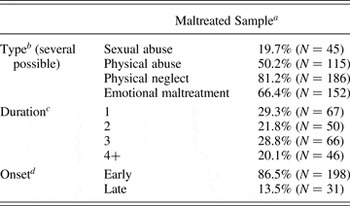
Thorough searches for DHS maltreatment records were conducted, and the obtained information was coded in accordance with the criteria detailed in the Maltreatment Classification System (MCS; Barnett, Manly, & Cicchetti, Reference Barnett, Manly, Cicchetti, Cicchetti and Toth1993). The reliability and validity of the MCS have been established in previous research (e.g., Bolger & Patterson, Reference Bolger and Patterson2001; Manly, Reference Manly2005). The MCS utilizes comprehensive DHS information to categorize maltreatment experiences independently from legal classifications and case dispositions. Specifically, each maltreatment subtype (i.e., sexual abuse, physical abuse, physical neglect, or emotional maltreatment) was identified and coded (interrater reliability was high, κ = 0.93), with the severity of each maltreatment experience also being coded (reliability was high, intraclass correlation of 0.96). Information about onset and duration of maltreatment was also obtained. Table 1 shows these sample characteristics. For 98.6% of maltreated individuals, the mother was one of the perpetrators for at least one of the maltreatment subtypes. Participants experienced on average 2.17 maltreatment subtypes (SD = 0.97, range = 1– 4).
Maltreatment sample characteristics

a N = 229 with available information.
b Comorbidity of maltreatment types is relatively common (Manly, Reference Manly2005).
c The duration of maltreatment was the number of developmental periods with documented maltreatment (out of six possible periods: infancy, 0–18 months; toddlerhood, 19–35 months; preschool, 36–59 months; early school age, age 5–7; later school age, age 8–12; adolescence: age 13–16 in this sample).
d Early onset was considered to occur during infancy, toddlerhood, or the preschool period, whereas late onset was coded if maltreatment began in the early or late school age period or during adolescence.
In this classification system, sexual abuse was defined as sexual relationships between children and adults, whereas physical abuse was recorded in situations when a caregiver inflicts a physical injury to the child by other than accidental means. Physical neglect was defined as failure to provide for the child's nutritional, medical, and cleanliness needs and/or a lack of supervision (e.g., leaving a young child unattended or with a caregiver known to be inappropriate, such as someone predisposed to violence). Emotional maltreatment was conceptualized as those acts deemed by Child Protective Services to be instances of maltreatment that involved thwarting of children's basic emotional needs. These needs included needs to psychological safety and security in the environment, for acceptance and positive regard, and for age-appropriate autonomy.
Network of Relationships Inventory (NRI)
The revised NRI (Furman & Buhrmester, Reference Furman and Buhrmester1992) was designed to be used with children and adolescents and it assesses 10 relationship qualities, including seven aspects of support (reliable alliance, enhancement of worth, affection, companionship, instrumental help, intimacy, and nurturance) and three other relationship features (conflict, punishment, and relative power). Subjects rated these qualities using three Likert-type questions for each of eight specific relationships: mother, father, sibling, grandparent, closest same-sex friend, closest opposite-sex friend, romantic partner, and any one extra individual. For instance, participants had to use 1–5 scales to rate “how much does this person like or love you” or “how often do you and this person get mad at or get in fights with each other.” Derived scales include support, conflict, punishment, and relative power, and Furman and Buhrmester (Reference Furman and Buhrmester1992) reported a mean alpha for these scales of 0.81. Principal components analysis indicated that the seven aspects of support all loaded highly on a single factor (loadings = 0.75–0.89), whereas conflict and punishment loaded highly on a second factor (loadings = 0.82–0.65). Thus, we created a total social support composite by averaging the means for the seven support scales (α = 0.94) and a total conflict composite by averaging the means for the conflict and punishment scales (α = 0.84). Relative power was dropped from analyses because it did not load highly on any of the two factors and it was only measured by three questions. We also calculated separate composites for family and nonfamily members based on the information available (i.e., if an adolescent did not have any opposite-sex friends, this was treated as missing data and not included in the mean for nonfamily). All maltreated participants were still living with their original families (no foster care experiences) and described these relationships with the NRI.
Youth Self-Report (YSR)
Internalizing and externalizing symptoms were assessed using the YSR (Achenbach, Reference Achenbach1991). The YSR is a self-report questionnaire designed for 11- to 18-year-olds that measures a comprehensive set of behavioral disturbances subsumed under two broadband dimensions of internalizing (i.e., anxious depressed, withdrawn, and somatic complaints) and externalizing (i.e., aggressive and rule-breaking behavior) symptoms. Responses to the 118 items were provided on a 3-point scale (0 = not true, 1 = somewhat or sometimes true, 2 = very true or often true). Raw summed scores for internalizing and externalizing symptoms were transformed to T scores based on extensive normative data such that higher scores reflect higher levels of symptoms. We used the T score for total problems (average of internalizing and externalizing) as an index of current youth symptoms. The YSR is a widely used, well-validated, and reliable measure (Achenbach, Reference Achenbach1991; Achenbach & Rescorla, Reference Achenbach and Rescorla2001).
DNA collection, extraction, and genotyping
Using an established protocol, trained research assistants obtained DNA samples from participants by collecting buccal cells with Epicentre Catch-All Collection Swabs. Subsequently, using the conventional method, DNA was extracted with the Epicentre BuccalAmp DNA Extraction Kit, in order to prepare DNA for polymerase chain reaction amplification. DNA was whole-genome amplified using the Repli-g kit (Qiagen, Catalogue No. 150043) per the kit instructions to provide sufficient material for this and other genotyping experiments without exhausting the original sample. Amplified samples were then diluted to a working concentration.
The OXTR rs53576 SNP was genotyped for individual alleles using a TaqMan SNP assay from Applied Biosystems, Inc (C__3290335_10) with TaqMan Genotyping Master Mix (Applied Biosystems, Catalog No. 4371357) performing amplification on an ABI 9700 thermal cycler and analyzing the endpoint fluorescence using a Tecan M200 with JMP 8.0 (SAS, Inc.). Human DNA from immortalized cell lines was used as positive controls and “no template” served as the negative controls. The positive control samples genotypes were confirmed using Dye Terminator Cycle Sequencing chemistry on an ABI 3130xl. All genotyping controls represented 9% of the total data output. Any samples that were not able to be genotyped to a 95% or greater confidence level were repeated up to four times under the same conditions before a null result was reported.
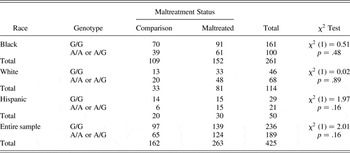
The genotype distribution for OXTR was in Hardy–Weinberg equilibrium for both the comparison group (n = 11 A/A, n = 54 A/G, n = 97 G/G), χ2 (2) = 1.38, p = .50, and the maltreated group (n = 15 A/A, n = 109 A/G, n = 139 G/G), χ2 (2) = 1.1, p = .58. As expected, the A/A genotype was relatively infrequent; thus, we combined A/A- and A/G-carriers to form one group (A-allele carriers) in all analyses contrasting them to G/Gs. This approach also allows comparability with prior studies adopting the same grouping strategy (Kogan et al., Reference Kogan, Saslow, Impett, Oveis, Keltner and Rodrigues Saturn2011; Krueger et al., Reference Krueger, Parasuraman, Iyengar, Thornburg, Weel and Lin2012; Rodrigues et al., Reference Rodrigues, Saslow, Garcia, John and Keltner2009; Tost et al., Reference Tost, Kolachana, Hakimi, Lemaitre, Verchinski and Mattay2010). Genotype group distribution (A-carriers vs. G/Gs) did not differ significantly by maltreatment status, χ2 (1) = 2.01, p = .16. We present sample size by race, genotype, and maltreatment status in Table 2, showing also that genotype distributions did not differ by maltreatment status within any of the three race groups. This suggests that, at least in this sample, there is no evidence that OXTR genotype correlates with maltreatment status. Within the maltreated group, individuals with the G/G genotype did not differ significantly from A-carriers on any objective measures of maltreatment type and severity, such as mean number of maltreatment subtypes experienced, t (222) = 0.40, p = .69; sum of the severities for each maltreatment type encountered, t (222) = 0.05, p = .96; proportion of adolescents in each maltreatment subtype category, χ2 (3) = 5.06, p = .17; number of developmental periods with documented maltreatment, t (222) = 1.41, p = .16; or developmental period for maltreatment onset, χ2 (5) = 5.43, p = .37.
Sample size by race, genotype, and maltreatment status

The genotype distributions differed by race, χ2 (2) = 14.7, p < .001, with Whites having more A-carriers than G/Gs and the opposite pattern being true among Blacks and Hispanics (see Table 2 for frequencies), which was another rationale to control for the main effect of race in all analyses.
Data analysis plan
Data preparation
Variables were examined for normality of distributions. None of the continuous variables exhibited excessive skewness or kurtosis; thus, untransformed scores were used in statistical analyses. There were no univariate outliers for NRI social support and conflict or YSR measures (defined as scores more than three standard deviations from the mean). Mean-centered variables were used in regressions. Multivariate outliers exerting disproportionate effects on the outcomes of analyses of covariance (ANCOVAs; Cook distance >4/n − k − 1) were excluded from analyses. Regression diagnostics (Q-Q plots for assessing normality of residuals and the Levene test for the equality of error variances) indicated that the assumptions needed for conducting ANCOVAs/multivariate analyses of covariance (MANCOVAs) were met for each analysis conducted.
Analyses
We used multiple regression analysis, MANCOVAs, and ANCOVAs to examine links among genotype, maltreatment, social support, and total problems, while using sex, age, and race/ethnicity as covariates. Race/ethnicity was included as a categorical covariate in all analyses. Our approach was to first conduct a separate ANCOVA testing for the effects of maltreatment status, genotype, and their interactions on total social support, total conflict, and total problems, and then follow-up with MANCOVAs including subcomponents of these composites as dependent variables (i.e., support from family and from nonfamily, and internalizing and externalizing problems).
Results
Associations among social support, conflict, total problems, and maltreatment
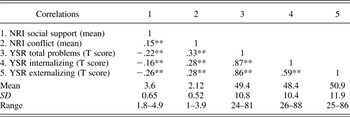
Means, standard deviations, and correlations for the main study variables are presented for the entire sample in Tables 3 and 4. In a multiple regression analysis with total problems as the dependent variable and sex, age, and race as control variables (only sex was significant, β = 0.1, t = 2.12, p = .04, with adolescent females reporting more problems), we examined the following independent variables: social support, conflict, maltreatment status, and the interaction terms of support by maltreatment and conflict by maltreatment. Social support and conflict were each independently and significantly correlated with total problems, with support negatively associated (β = –0.31, t = –4.06, p < .001) and conflict positively associated (β = 0.33, t = 4.47, p < .001) with total problems. Maltreatment status was not a significant predictor of problems (β = –0.01, t = –0.29, p = .77) and neither was the interaction of maltreatment by support (β = 0.05, t = 0.64, p = .52) nor maltreatment by conflict (β = 0.08, t = 1.02, p = .31). Regression analyses within each of the maltreated groups revealed that support and conflict remained independently and significantly associated with total problems within each group. When analyzing internalizing or externalizing separately instead of total problems, the same pattern of results was obtained, with only support, conflict, and sex being significant correlates in the same direction as described above. ANCOVAs conducted within the maltreated group revealed that total problems did not differ by maltreatment type, F (3, 230) = 0.62, p = .60, by number of developmental periods with maltreatment, F (3, 230) = 0.48, p = .70, or by onset, F (1, 230) = 1.26, p = .26 (see Table 1 for categories included under each variable), while controlling for sex, age, and race as in all other analyses. The same nonsignificant findings were obtained when analyzing internalizing or externalizing problems separately instead of total problems.
Correlations and descriptives for main continuous study variables in the entire sample

Note: NRI, Network of Relationships Inventory; YSR, Youth Self-Report.
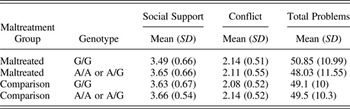
Raw means and standard deviations for main study variables by group and genotype

Variation in OXTR genotype and perceived social support
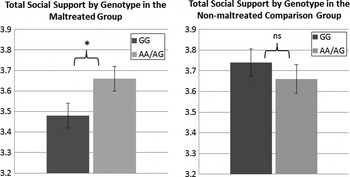
We used an ANCOVA to examine the effects of OXTR genotype, maltreatment, and their interaction on perceived total support, while controlling for sex, age, and race. There was a significant interaction of maltreatment status and genotype in predicting total social support, F (1, 401) = 4.04, p = .045, ηp 2 = 0.01, with a nonsignificant main effect of maltreatment, F (1, 401) = 3.44, p = .06, and no main effect of genotype, F (1, 401) = 0.97, p = .33. We then conducted ANCOVAs within each maltreatment group to follow-up on the interaction effect. In the maltreated group, there was a significant main effect of genotype, F (1, 251) = 5.47, p = .02, ηp 2 = 0.02, such that carriers of the G/G genotype reported significantly less support (M = 3.48, SE = 0.06) compared to A-allele carriers (M = 3.66, SE = 0.06). In the comparison group, the effect of genotype was not significant, F (1, 146) = 0.88, p = .35, with G/Gs showing similar means (M = 3.74, SE = 0.07) compared to the A-allele carriers (M = 3.66, SE = 0.07). Estimated marginal means by group and genotype are presented in Figure 1. Follow-up ANCOVAs also indicated that within the G/G genotype, the maltreated group reported significantly less support compared to the nonmaltreated group F (1, 216) = 8.26, p = .004, ηp 2 = 0.04. However, among individuals with the AA or AG genotype, maltreated participants did not report different levels of support when compared to nonmaltreated adolescents, F (1, 181) = 0.003, p = 96.Footnote 1
The estimated marginal means of perceived total social support after controlling for age, sex, and race. Error bars represent standard errors of the means. Differences were considered significant at p < .05.

To investigate whether the effect on total support was carried by support from family or nonfamily, a MANCOVA with family support and nonfamily support as the dependent variables was conducted. The analysis revealed that the interaction effect of genotype by maltreatment was nonsignificant for social support from family, F (1, 396) = 3.16, p = .076, ηp 2 = 0.01, and significant for nonfamily, F (1, 396) = 5.01, p = .026, ηp 2 = 0.01. The follow-up ANCOVA for the significant interaction predicting support from nonfamily revealed the same pattern of results as above, with main effects of genotype being significant in the maltreated group, F (1, 246) = 5.01, p = .026, ηp 2 = 0.02, whereas in the comparison group there was no effect of genotype, F (1, 146) = 0.94, p = .33.
In a MANCOVA predicting total conflict from genotype, maltreatment, and the interaction of maltreatment by genotype, with sex, age, and race as covariates, there were no significant effects of genotype, F (1, 399) = 0.32, p = .57, maltreatment, F (1, 399) = 2.56, p = .11, or the interaction of maltreatment by genotype, F (1, 399) = 1.76, p = .19. Similar nonsignificant results were obtained for family conflict and nonfamily conflict separately.
OXTR genotype and internalizing, externalizing problems
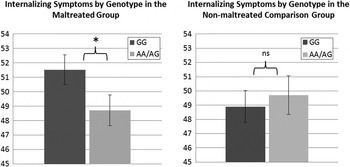
An ANCOVA was used to examine the effect of genotype, maltreatment, and their interaction on total YSR problems, while controlling for sex, age, and race. There was no main effect of genotype, F (1, 402) = 2.44, p = .12, or maltreatment, F (1, 402) = 0.002, p = .97, with a significant interaction effect of Gene × Maltreatment, F (1, 402) = 3.8, p = .05, ηp 2 = 0.01. We then conducted a MANCOVA with total internalizing problems and total externalizing problems as the dependent variables to examine whether the interaction effect of Gene × Maltreatment was statistically significant for only one of these dimensions included in total problems. The MANCOVA revealed that the interaction between genotype and maltreatment was significant for internalizing, F (1, 402) = 6.42, p = .01, ηp 2 = 0.02, but not for externalizing F (1, 402) = 2.58, p = .11, problems. We then probed the interaction effect by running separate ANCOVAs to examine the effect of genotype on internalizing within each maltreatment group, controlling for sex, age, and race. In the maltreated group, there was a main effect of genotype, F (1, 249) = 7.03, p = .01, ηp 2 = 0.03, such that G/Gs reported higher mean levels of internalizing symptoms (M = 50.3, SE = 1.02) compared to A-allele carriers (M = 46.9, SE = 1.07). In the nonmaltreated comparison group, there was no effect of genotype on internalizing, F (1, 153) = 1.31, p = .25. Follow-up ANCOVAs controlling for age, sex, and race also revealed that among individuals with the G/G genotype, maltreated participants reported significantly higher levels of internalizing symptoms than did the nonmaltreated comparison group, F (1, 221) = 5.06, p = .025, ηp 2 = 0.02. Among the AA/AG-carriers, mean levels of internalizing symptoms did not differ by maltreatment status, F (1, 169) = 1.86, p = .18.Footnote 2 Estimated marginal means for each genotype and maltreatment group controlling for sex, age, and race, are presented in Figure 2.
The estimated marginal means of internalizing symptoms after controlling for age, sex, and race. Error bars represent standard errors of the means. Differences were considered significant at p < .05.

Discussion
To our knowledge, the present study is the first investigation of the role of the OXTR genotype in risk for psychopathology in a developmental sample (i.e., maltreated adolescents). The results provided evidence of a genotype by maltreatment interaction, such that adolescents with maltreatment histories and the G/G variant of OXTR rs53576 perceived significantly less social support compared to maltreated A-carriers. They also reported significantly higher levels of internalizing symptoms compared to A-carriers. It is important to note that the two genotype groups did not differ on any objective measures of maltreatment type, duration, or severity. Given that prior literature suggests that G/G homozygotes may be more receptive to social cues and more prosocial compared to A-allele carriers (Kogan et al., Reference Kogan, Saslow, Impett, Oveis, Keltner and Rodrigues Saturn2011; Tost et al., Reference Tost, Kolachana, Hakimi, Lemaitre, Verchinski and Mattay2010), we interpret the present findings to indicate that G/Gs may be more attuned to and affected by negative social experiences such as being maltreated. Furthermore, being more likely to seek social interaction may be detrimental when living with an abusive caregiver, while being more empathic (Rodrigues et al., Reference Rodrigues, Saslow, Garcia, John and Keltner2009) may expose children to higher levels of emotional arousal, stress, and anger displayed by their maltreating parents. It is known that maltreatment negatively impacts one's ability to form relationships with peers (Bolger et al., Reference Bolger, Patterson and Kupersmidt1998; Rogosch et al., Reference Rogosch, Cicchetti and Aber1995), and thus it is consistent that G/Gs also reported less perceived support from nonfamily members. Another possible interpretation of these results is that adolescents with the G/G genotype might objectively elicit less support; however, this is unlikely given that the genotype has previously been associated with more prosocial, generous, and empathic behavior in the general population.
The findings reported here replicate the pattern of results obtained in an adult sample from a prior study (Bradley et al., Reference Bradley, Westen, Mercer, Binder, Jovanovic and Crain2011) that similarly found higher levels of emotional dysregulation among G/Gs who experienced three or more types of childhood abuse compared to A-allele carriers in an urban African American sample. The present study extends these findings to adolescents and a more ethnically diverse group. There are a number of methodological advantages to the present report, including an objective documentation of child maltreatment based on DHS records. Measurement in adolescence is another advantage, because this is more proximal to the maltreatment experience, whereas assessment in adulthood may introduce the possibility of additional intervening factors that could compound the effects. In addition, we adopted highly reliable, widely utilized, and nationally normed scales for measuring internalizing and externalizing symptoms (the Achenbach's YSR) and perceived support/conflict of adolescents (the NRI). It is important that our findings are consistent with those of Bradley et al. (Reference Bradley, Westen, Mercer, Binder, Jovanovic and Crain2011) given difficulties in replicating other Gene × Environment findings in the literature. Difficulty in replicating other Gene × Environment findings may stem from inconsistency or lack of rigor in measuring the environment component (Monroe & Reid, Reference Monroe and Reid2008). We believe that our use of objective measures of maltreatment and widely utilized measures of psychological symptoms and support/conflict should facilitate future replication in other laboratories.
It must be noted that we found no evidence of gene–environment correlation between OXTR genotype and maltreatment status in our sample. This is not surprising, given that studies on human and nonhuman animals have not been able to identify evidence of genetic transmission of maternal maltreating behaviors. In contrast, experimental rodent models have provided evidence for environmental effects on maltreatment. For instance, rodent models have been shown to induce abusive maternal behavior toward pups by limiting the availability of bedding materials for the nest, a chronic stressor for the mother (Avishai-Eliner, Gilles, Eghbal-Ahmadi, Bar-El, & Baram, Reference Avishai-Eliner, Gilles, Eghbal-Ahmadi, Bar-El and Baram2001; Rainecki, Moriceau, & Sullivan, Reference Raineki, Moriceau and Sullivan2010; Roth & Sullivan, Reference Roth and Sullivan2005). Furthermore, cross-fostering studies in rhesus monkeys have shown that females who were maltreated in early development are significantly more likely to become maltreating mothers, but if offspring of maltreating mothers are raised from birth by good adoptive mothers, then they will not maltreat their descendants, suggesting an environmental rather than a genetic transmission of maltreatment (Maestripieri, Reference Maestripieri2005). This does not rule out the possibility that OXTR shapes normative variations in parenting sensitivity in humans, as has been suggested (Bakermans-Kranenburg & van IJzendoorn, Reference Bakermans-Kranenburg and van IJzendoorn2008); however, the OXTR genotype cannot be the sole cause of maltreatment in our sample given the lack of differences in genotype distributions by maltreatment status.
It was surprising that we did not detect a main effect of maltreatment on psychological symptoms, internalizing, or externalizing; however, our gene–environment interaction results suggest that this is likely because A-carriers (47% of the maltreated sample) exhibited comparable levels of symptoms to participants in the nonmaltreated sample (Figure 2). Furthermore, this is consistent with prior literature on resilience in maltreated populations, which suggests that the experience of maltreatment does not deterministically lead to psychopathology (Cicchetti, Reference Cicchetti2013; Cicchetti & Rogosch, Reference Cicchetti and Rogosch1997). Variation in outcomes is the very phenomenon that our study set out to understand. We must also remember that the comparison group was a sample of adolescents living in poverty, who could exhibit comparable levels of symptoms owing to other types of adversity that are unmeasured here. The fact that we also did not find a main effect of maltreatment on social support, especially support from family, could have the same explanations (i.e., a high-poverty comparison group and the moderation effect by genotype). Another prediction that did not materialize was the fact that maltreatment type, duration, and onset did not have significant effects on our measures of symptoms (total, internalizing, or externalizing) in the maltreated group.
We did not find an effect of genotype on perceived social support or total problems in the nonmaltreated group. The effect size for the difference in mean total social support between G/Gs and A-carriers in this nonmaltreated comparison group was so small (ηp 2 = 0.006) that a power analysis indicated that we would need approximately 2,155 participants to detect a significant effect with a power of 0.95 and a significance criterion of α = 0.05 in this group. Thus, the nonsignificant effect in the comparison group was not due to having a smaller sample compared to the maltreated group. The finding may be because this low-income group of adolescents is quite heterogeneous, with some experiencing other social adversity associated with living in poverty (e.g., exposure to violence) that is unmeasured here and that is perhaps associated with higher levels of symptoms in G/Gs similar to the pattern observed with the maltreated group, whereas some of them may experience the more normative pattern of lower psychological symptoms for G/Gs, possibly averaging out to an absent main effect of the OXTR genotype on symptoms in the nonmaltreated comparison group.
Strengths and limitations of the present study
This study has a number of strengths, including the recruitment and assessment of a challenging population and reliance on objective DHS records to identify maltreatment and to conduct a thorough classification of maltreatment characteristics, as already described. The present investigation also has the advantage of including a racially and ethnically diverse population, and a comparison group that is as closely matched as possible with respect to low family income, sex, and age. Finally, this report addresses an important question regarding the sources of individual differences in mental health outcomes among maltreated youth and would be the first study conducted with a developmental sample to investigate the potential interaction of the OXTR gene with maltreatment in predicting psychopathology. However, this project also has a number of limitations described below.
One of the limitations that must be acknowledged was that both perceived support and internalizing/externalizing symptoms were derived from self-report measures. The specificity of our OXTR × Maltreatment interaction in predicting perceived social support but not conflict derived from the NRI scales gives us some confidence in the validity of this measure, given that it is biologically plausible to link OT to perceived social support, whereas there would be less of a theoretical grounding for results involving conflict. With respect to using the YSR measure, emotional symptoms are often more accurately reported by the individuals themselves (especially internalizing) than by external observers. This is perhaps why we did not find a Gene × Environment effect with respect to externalizing symptoms, given that individuals may be less likely to accurately report their own aggressive and rule-breaking behaviors that were sampled by this measure. Another reason to expect this differentiation is that OXTR polymorphisms have been linked by a few prior studies with symptoms from the internalizing spectrum such as depression (Costa et al., Reference Costa, Pini, Gabelloni, Abelli, Lari and Cardini2009; Saphire-Bernstein et al., Reference Saphire-Bernstein, Way, Kim, Sherman and Taylor2011), whereas the minimal information existing for links with externalizing (e.g., aggression and conduct problems) indicates no associations with OXTR function (Malik, Zai, Abu, Nowrouzi, & Beitchman, Reference Malik, Zai, Abu, Nowrouzi and Beitchman2012; Sakai et al., Reference Sakai, Crowley, Stallings, McQueen, Hewitt and Hopfer2012). It may be that additional environmental or genetic factors need to be accounted for in predicting externalizing symptoms.
A second limitation is the examination of a single gene, given the recognition that resilience is a complex, dynamic process that likely encompasses multiple systems affecting emotional and physiological reactions to maltreatment (e.g., the serotonin, dopamine, or corticotropin-releasing hormore systems; Cicchetti & Rogosch, Reference Cicchetti and Rogosch2012). However, given the lack of any developmental studies on the role of the OXTR genotype in predicting psychopathology in maltreatment, this is an important gap to fill in the literature.
The third limitation is that, given that our sample was 13–15 years old, most if not all participants provided data after the onset of puberty; thus, unfortunately we were not able to examine the interaction of puberty onset with OT function and maltreatment. This is an important question for future studies, given the role of gonadal steroids, which rise with puberty, in the maturation of the OT system (Chibbar et al., Reference Chibbar, Toma, Mitchell and Miller1990).
A fourth limitation was that the majority of our sample (more than 60%) was African American, which limits the generalizability of these findings to Whites and Hispanics, especially given the fact that similar findings from the adult study by Bradley et al. (Reference Bradley, Westen, Mercer, Binder, Jovanovic and Crain2011) also characterized an African American sample. We reported the main analyses within the African American sample in the results presented above to include in future meta-analyses and argue that we must be cautious in interpreting these results as applying to all ethnicities. Future studies should explore similar questions in ethnically homogeneous samples of White or Hispanic adolescents, given evidence that some Gene × Environment effects involving other genes differ by ethnicity (van IJzendoorn, Belsky, & Bakermans-Kranenburg, Reference van IJzendoorn, Belsky and Bakermans-Kranenburg2012). Even though we are not able to rule out population stratification effects in this mixed-ethnicity sample, we statistically controlled for the main effect of race in all analyses, ascertained Hardy–Weinberg equilibrium, and noted that maltreatment did not correlate with genotype in any of the three ethnic groups. Future studies should incorporate ancestral proportion scores to replicate these findings while controlling for any possible stratification effects.
Conclusions
One of the most remarkable findings of this study was that maltreated adolescents who were A-carriers had similar levels of perceived social support and internalizing problems to nonmaltreated adolescents, suggesting possible protective effects conferred by the allele in this adverse social-rearing environment. These findings reinforce the perspective that developmental outcomes are shaped by complex interactions between environmental characteristics and genes across development (Cicchetti, Reference Cicchetti2010). The results of this study may be combined with other insights to discover underlying processes that may contribute to resilience. The effect of being an A-carrier in the context of maltreatment seems to be opposite to some of the findings in the general population, where G/Gs seem better adjusted according to some criteria such as levels of positive affect, optimism, and self-esteem (Lucht et al., Reference Lucht, Barnow, Sonnenfeld, Rosenberger, Grabe and Schroeder2009; Saphire-Bernstein et al., Reference Saphire-Bernstein, Way, Kim, Sherman and Taylor2011), findings which are consistent with the overall beneficial effects of social support for human development and for coping with stress under typical rearing conditions. These results suggest that future mental health interventions will be more successful if they account for individual differences in genetics and in psychological patterns of responding to adverse environmental conditions (Cicchetti & Blender, Reference Cicchetti and Blender2006).