Since 1990, more than 50 women's parties have gained seats in local, national, and regional legislatures globally.Footnote 1 These parties commonly advance agendas related to inclusion and equality in a variety of contexts, but the literature reveals little about their experiences and achievements. As we search for ways to improve women's descriptive and substantive representation, we should ask whether women's parties are useful tools for women's movements. Do they help improve women's political representation, and if so, how?
Small and novel parties outside the mainstream, women's parties resemble niche parties of the “new” Left (e.g., Green or consumer parties), the “new” Right (e.g., radical Right/nationalist/anti-immigrant parties), or ethno-regional parties. Many studies have attempted to explain and document the process through which niche parties influence other parties in the system to adopt their issues and embrace their agendas (see, inter alia, Budge Reference Budge2015; Green-Pedersen Reference Green-Pedersen2012; Lefevre, Tresch, and Walgrave Reference Lefevre, Tresch and Walgrave2015; Meguid Reference Meguid2005, Reference Meguid2008, 3; Van der Wordt Reference Van der Wordt2015). In this article, I focus on the ability and mechanisms for women's parties to affect women's political representation by influencing mainstream political parties.
Primarily, I examine Zürich's Frauen Macht Politik (FraP!), one of eight women's parties in Switzerland in the 1980s and 1990s and the only one to gain representation at the national level. FraP! is a fascinating example of a women's party that united a social movement with formal politics to both maximize its impact and advance women's representation. Using electoral records, party archival material, newspaper accounts, scholarly sources, and interviews, I consider whether and how well this tactic worked. I argue that, as the “parliamentary arm of the women's movement” (FraP! -X-Press 1996), FraP!’s “double feet” allowed it to further the agenda of the women's movement in Zürich by shifting the agendas of the other parties, pressuring them to address the concerns of the movement and increase women's descriptive and substantive representation in the system.
This study contributes to multiple bodies of literature: first, it addresses a gap in the social movement literature, which considers how movements matter but neglects the potential of using a political party as a tool of a movement. The neglect of a women's party as a hybrid form of women's movement organization ignores the momentum building in social movement scholarship to consider the intersection of movements with other forms of social organization (see Armstrong and Bernstein Reference Armstrong and Bernstein2008; Clemens Reference Clemens1997; Goldstone Reference Goldstone and Goldstone2003; McAdam and Tarrow Reference McAdam and Tarrow2010; McAdam, Tarrow, and Tilly Reference McAdam, Tarrow and Tilly2001). If women's parties can have measurable effects, these must be integrated into the scholarship on social movement outcomes.
Second, this study contributes to the scholarship on contagion theory that considers the dynamics of relative party position-taking and how niche parties affect mainstream party issue ownership. The scant previous scholarship on women's parties indicates that electoral structures, political uncertainty, and the structure of other parties can shape the opportunities these parties have to influence outcomes (Cowell-Meyers Reference Cowell-Meyers2011). The study of FraP!’s experience reveals new variables that may shape the process of contagion because they govern the relationships between parties.
Finally, this article invites feminist scholars to contend with the potential of women's movement organization as a party. The literature has demonstrated that mainstream parties do not represent women as well as movements do (Weldon Reference Weldon2011), but it has generally tended to neglect the potential of a women's party. Where they have been examined, case studies indicate that women's parties can have disproportional and significant impact on political systems (see Cowell-Meyers Reference Cowell-Meyers2014, Reference Cowell-Meyers2017; Dominelli and Jonsdottir Reference Dominelli and Jonsdottir1988; Levin Reference Levin1999), yet a strain of feminist scholarship contends that women's parties represent a marginalization of women's issues that should be incorporated into mainstream parties. For example, Matland contends that where women's parties have emerged, they “have drained [activists] away from more mainstream parties” or harmed the cause with their “poor electoral fortunes” (Reference Matland, Matland and Montgomery2003, 328). However, in my study of women's parties in Europe, I found that parties mostly emerge only where strong, autonomous feminist movements exist and mainstream parties are not engaging or representing women (Cowell-Meyers Reference Cowell-Meyers2016). Feminist scholarship increasingly acknowledges the state as a necessary actor in the resolution of feminist demands (see the Research Network on Gender Politics and the State [RNGS] project led by Mazur and McBride Stetson). Thus, the study of a movement's mechanisms for engagement with the state is essential. The Swiss case provides insight into how women's parties present an avenue for advancing women's movement goals.
CONTAGION THEORY, ISSUE OWNERSHIP, NICHE PARTIES
The core function, theoretically, of most political parties is to win elections. Parties compete with one another to attract voters and, in so doing, adapt their electoral platforms and policy positions. They may move “toward better regions of space” (Kollman, Miller, and Page Reference Kollman, Miller and Page1992, 929); follow “the shifting affiliations of voters” (Laver Reference Laver2005, 263); borrow practices from other, more successful parties (Matland and Studlar Reference Matland and Studlar1996); learn from past electoral performance (Laver Reference Laver2005); and/or respond to the emergence of new issues or actors (Budge Reference Budge and Riker1993; Green-Pedersen Reference Green-Pedersen2007). Considerable scholarship has been devoted to tracing the process whereby a party attempts to adjust its portfolio of “owned” issues, giving attention to or “taking up” the issues or practices of other parties (Green-Pedersen Reference Green-Pedersen2012; Green-Pedersen and Mortensen Reference Green-Pedersen and Mortensen2010; Lefevre, Tresch, and Walgrave Reference Lefevre, Tresch and Walgrave2015; Van der Wordt Reference Van der Wordt2015; Vliegenthart, Walgrave, and Meppelink Reference Vliegenthart, Walgrave and Meppelink2011). This process of transfer of issues and practices across parties, or “contagion” (see Duverger Reference Duverger1954), explains how niche parties such as the Green parties in Western Europe encouraged other parties to adopt more environmentally-friendly policy positions and include environmental issues in their party platforms (Eatwell Reference Eatwell2000; Golder Reference Golder2003; Hug Reference Hug2001; Müller-Rommel Reference Müller-Rommel2002). This process also explains how radical Right parties have encouraged mainstream parties to become more anti-immigrant and less multicultural (Bale Reference Bale2003; Bale et al. Reference Bale, Luther, Green-Pedersen, Krouwel and Sitter2010; Han Reference Han2015).
Parties do not compete over core questions of identity but over issues in a Left–Right dimension (see Sani and Sartori Reference Sani and Sartori1983). In multiparty systems, contagion is most likely to occur between parties that share positions in this Left–Right ideological space (proximate parties) because they do not want to lose voters to innovating and successful parties who compete against them (see Matland and Studlar Reference Matland and Studlar1996). Parties may move slowly or adapt only incrementally (see Harmel and Janda Reference Harmel and Janda1994; Kollman, Miller, and Page Reference Kollman, Miller and Page1992), and they may also incur risks in altering their positions (Tavits Reference Tavits2007) because they may lose core supporters or may appear to take principled positions only for expediency. In short, however, parties are not immobile or fixed; they adjust their Left–Right spatial positioning, their policy stances, and their issue ownership in the context of policy and voter-driven competition.
When a new party emerges that presents or frames a new issue, as Meguid (Reference Meguid2005, Reference Meguid2008) notes, mainstream parties face a choice: they can ignore the new party (a dismissive strategy), adopt an accommodative strategy (converging with the policy stance of the new party), or adopt an adversarial one (diverging from the new party's position). Either strategy can change the salience of a political issue and reconfigure the political landscape by altering the terms of mainstream party competition (see Green-Pedersen Reference Green-Pedersen2012). The sole purpose, in short, of small and niche parties may not be to win votes but to shape the behavior or commitments of the established parties.
WOMEN, PARTIES, AND WOMEN'S PARTIES
Political parties play a significant role in the representation of women. The extent to which parties (a) recruit, train, equip, and fund female candidates, (b) promote female officials, and (c) attend to women's issues in their party platforms and manifestos matter in many ways. These undertakings affect how many women are elected, what resources they have in office, what role women play in party leadership, and how well parties address policy matters related to women's substantive representation (see, inter alia, Caul Reference Caul1999, Reference Caul2001; Norris Reference Norris1997). And, as the literature on party systems indicates, these are not decisions or practices that parties adopt in a vacuum. Instead, party competition, in combination with structural pressures from citizen groups and social movements, drives how parties relate to women. For example, when one party in a system adopts a gender quota or increases its percentage of female candidates, other parties are likely to follow suit (Caul Reference Caul2001; Matland and Studlar Reference Matland and Studlar1996). Women's movements can also pressure parties to shift their policy positions on women's issues (Wolbrecht Reference Wolbrecht2000).
Women's parties can have a particular and profound effect on the inclusiveness of the political system. Drawing on the scholarship on contagion and niche parties, and examples of women's parties in Sweden, Iceland, Israel, and Northern Ireland, I argue that women's parties can influence the practices and policy stances of larger parties in ways that enhance women's representation descriptively and substantively. Where women's parties threaten or otherwise pressure established parties, they can change the strategic incentives for party elites in other parties to represent women (see Freidenvall Reference Freidenvall2003, 5), including running, training, and funding female candidates and prioritizing women's issues in their party platforms and election manifestos. Merely the emergence of women's parties can draw attention to women's issues but where women's parties win seats, or appear poised to win even a small number of seats, they can trigger a process of contagion. This process can force mainstream parties to adapt their pattern of issue ownership in the direction of convergence, thereby adding to the issue agenda by encouraging mainstream parties to increase the representativeness of the political system. Thus, women's parties may be useful tools for women's movements because they provide a means to expand the opportunities for the movements to pressure larger political parties. In addition, in forming a political party, a women's movement may gain institutional resources accorded to such parties and, thus, expand their repertoires of contention. Finally, as movement–party hybrids, women's parties can engage citizens in new forms of interaction with the state and alter the dynamics of political inclusion.
METHODS
According to this theory, the impact of a hybrid movement–party manifests in the behavior of other parties in the system as they respond to the emergence of the party. Therefore, I first consider whether women's descriptive representation changed overall or in the mainstream parties after the FraP! party emerged. I then consider whether “women's issues,” as defined by FraP! in their election materials, were taken up by the other parties in the system. I use election manifestos because they are considered one of the most reliable measures of party issue positions and are highly correlated with other measures such as expert, mass, and elite surveys (see, inter alia, Green-Pedersen and Mortensen Reference Green-Pedersen and Mortensen2010).Footnote 2 This approach uses FraP!’s archival material, held in the Swiss Sozialarchiv in Zürich, and was used for reference and for comparison with the mainstream parties’ election manifestos.Footnote 3 In addition to the archival material, I conducted eight interviews of FraP! and other politicians, civil servants, and academics from the period in which FraP! was active. I collected newspaper accounts, public opinion polls, and scholarly accounts, where they existed, to trace the party's impact by considering how the party was perceived by its members, leaders, and competitors as well as by outside observers, such as journalists.Footnote 4 Thus, I have documented how and how well the mainstream parties responded to this women's party, and I have presented evidence of how the party was able to impact women's representation on behalf of the movement.
SWISS POLITICS AND GENDER
Many aspects of Swiss politics mark its distinctiveness and contribute to the potential for women's party emergence. For example, the system is highly representative, with relatively low electoral thresholds, high party fractionalization scores, multiple legislatures (municipal, cantonal, national), power-sharing and referenda as standard institutional features, and an inclusive electoral system that combines open-list PR with the ability of voters to reorder candidates (cumulation) and even move them to other parties' lists (panachage). The party system is also unusually decentralized. In this confederal system, the national government is relatively weak, and cantonal parliaments have jurisdiction over significant policy areas. These features facilitate the emergence of women's parties (see Cowell-Meyers Reference Cowell-Meyers2016).
Eight women's parties emerged in Switzerland in the late 20th century in different cantons, primarily in the German-speaking east, though only FraP! has succeeded in gaining national-level representation. Most of these parties won no seats at all. One, Frauenliste-Basel (Fra-B) in Basel-Stadt, was more successful in the cantonal legislature than FraP! but never gained national representation. Basel-Stadt, although it has a large cantonal legislature (n = 130), elects only six members to the National Council, or lower house of parliament; thus, the effective threshold for representation was far beyond the reach of Fra-B. Zürich, Switzerland's most populous canton, in contrast, elects 34 members.Footnote 5
The sociohistorical context of Switzerland during this period provides a highly interesting case for the study of women's political mobilization. Switzerland was one of the last countries in the world to enfranchise women. Women won the suffrage in 1971 for national offices, though they could vote in some cantons before then, but they could not vote or hold office at the cantonal level in all of the cantons until 1990! The country combined this record with a high level of movement activism in general. And, because suffrage came so late, first- and second-wave movements virtually overlapped temporally, if not in membership. Women's descriptive representation was quite low in the 1980s (i.e., approximately 10% on average at all three levels of government, though with considerable cantonal variations), and the mainstream political parties did not, typically, advance women's substantive issues. Two events occurred at the national level in the early 1990s that united disparate women's movements and focused popular attention on the treatment, status, and representation of women.
First, in June of 1991, a national women's strike (Frauenstreik) was sparked specifically by the frustrations of women in the watch industry who, despite a 1981 constitutional amendment guaranteeing equal pay for equal work and collective bargaining agreements, were still paid considerably less than their male colleagues doing the same jobs. The year 1991 also marked the 10th anniversary of the Equal Rights Amendment, the 20th anniversary of the extension of the suffrage, and the 700th anniversary of the [mythical] birth of the nation. The energy surrounding these jubilees and the irony of the women's situation triggered a day of protests and collective action that engaged a broad swath of Swiss society, including approximately half a million women in a society of 6.5 million people. In Zürich, more than 10,000 women marched or participated in the rally at the Helvetiaplaz (Küng Reference Küng2015; Scheidegger Reference Scheidegger1992). Although it was more a “happening” than a strike, it was the largest manifestation in Switzerland since 1918 (Kaiser Reference Kaiser2011). The strike was featured on the front pages of almost all the German-speaking newspapers the next day and was discussed extensively on television and radio (Frauenstreik in den Medien, 1992).
The Frauenstreik had two ramifications. The first lay in the extent to which it convinced the union leadership and that of the mainstream political parties of the mobilizing power of these women's organizations and their claims (see Landolt and Suter Reference Landolt and Suter2011; Scheidegger Reference Scheidegger1992). Pressure on the parties and recognition of the need to retain female voters shifted the political footing moving forward (Joris Reference Joris2011). As Zita Küng, a longtime feminist activist, lawyer, and official with the Equality Commission in Zürich noted, “They knew whenever we have a vote about this and a problem with this, then we have a strike” (Küng Reference Küng2015).
The Frauenstreik also reinvigorated the women's movement and elevated consciousness and dialogue around the issues it raised. The strike altered women's confidence to press their demands and increased their sense of solidarity with other women (see comments from party leaders and officials in Scheidegger Reference Scheidegger1992). Although the strike was supported by the unions, the logistics were coordinated independently by the separate women's organizations, which, according to Joris, were buoyed by its success (Joris Reference Joris2011). Carving out a common message and agenda across the diverse groups of women was critical to subsequent movement success (see Fuchs Reference Fuchs2009). The Frauenstreik also effectively moved the discussion from local conversations to a national level. The networks and coalitions it produced were critical to the second event that electrified gender politics in Switzerland.
In 1993, the Social Democrats nominated Christiane Brunner, trade union leader and principal organizer of the Frauenstreik, to a vacant cabinet position. Had she been elected, she would have been the second woman ever to serve in the Federal Council, the seven-member executive council that shares power across the four largest parties. Instead, a whisper campaign began in the months before the vote to discredit her, and the parliament, in a secret ballot, elected a male instead. Within hours, protests began outside the parliament building in Bern, swelling to more than 10,000 people, according to the Associated Press (1993). Within a week, the party had changed tack, nominating a different woman, Ruth Dreifuss. However, as Joris notes, it was “only thanks to this multi-layered networking [of women's organizations]” fostered by the Frauenstreik that “such a rapid and broad protest movement” could have been organized (Joris Reference Joris2011).Footnote 6
The so-called Brunner affair reverberated across the political stage, affecting women's descriptive representation in most of the political parties as well as their engagement and their substantive success. In the aftermath, women from “all political parties created a shadow council called the Frauenbundesrat, which demanded a 50% quota for Nationalrat seats” (Banaszak Reference Banaszak1996, 853). By the 1995 election, women's membership in the Ständerat had doubled, and the SPS had adopted a 50% quota for female candidates. “The considerable electoral successes of the SPS Women and the media coverage about women's representation pressured the FDP and CVP” (Seitz 2004). In fact, women in the CVP were adamant in their condemnation of their own party's leadership surrounding the Brunner affair (see Eva Segmüller's comments in Hasler Reference Hasler1993). And, where public trust and political participation in general declined sharply in 1995, “These events [the Frauenstreik and the mobilization in response to Brunner's defeat] reached beyond feminist circles to involve women from across Swiss society and likely contributed to stemming the reduction in the level of participation of women in 1995” (Engeli, Ballmer-Cao, and Guigni Reference Engeli, Ballmer-Cao and Guigni2006, 219–20). In short, the inclusiveness of its electoral law and its decentralization, coupled with an activated women's movement and a pattern of political neglect, presented ripe conditions for the emergence of women's parties (see Cowell-Meyers Reference Cowell-Meyers2016) and a conducive environment for them to exert influence.
FRAUEN MACHT POLITIK!
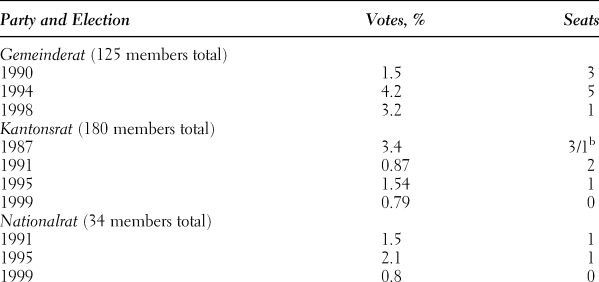
Frauen macht Politik!, or FraP!, emerged in 1986 and began contesting elections for the cantonal parliament (Kantonsrat) and the Council of States (Ständerat) in Zürich in 1987. A “loose, heterogeneous coalition of women's groups, autonomous feminists and members of political parties” (quoted in Neue Zürcher Zeitung, 13 February 1990), its roots lay in the activist culture of Zürich's civil society where demonstrations were common and there was extensive antiestablishment organizing. Many of the founders and key participants were active in women's organizations such as Organisation für die Sache der Frau (OFRA), student politics, the peace movement, the environmental movement, labor unions, Christian groups, and Marxist-Leninist and Trotsky-ist politics. The creation of the party was to give the movement “double feet… We wanted to be represented in the parliament but at the same time we wanted to be integrated in a movement”(Joris Reference Joris2015b).Footnote 7 The party won two seats in the cantonal legislature in 1987, three seats at the municipal level in 1990, and one in the national parliament in 1991. The party lost its last seat (at the municipal level) in 2002 and folded.
From its founding until approximately 1997, despite contesting elections at all levels (national, cantonal, municipal, as well as school board), the party claimed not to be a party. Instead, it defined itself as a movement and sought to connect civil society actors with formal politics, to act as a conduit between public spheres, and to be the “parliamentary arm of the women's movement” (FraP! -X-Press 1996). Party election materials assert that FraP! intended to represent a feminist perspective on all issues and “to analyze, criticize and change power relations” (FraP! 1991a). According to their press statements, election materials, and internal documents, their main concerns included gender roles and the division of labor between men and women; women's educational and economic opportunities; violence against women; environmental protection; and the social/political exclusion of women, immigrants, minorities, and the poor.
WOMEN'S DESCRIPTIVE REPRESENTATION
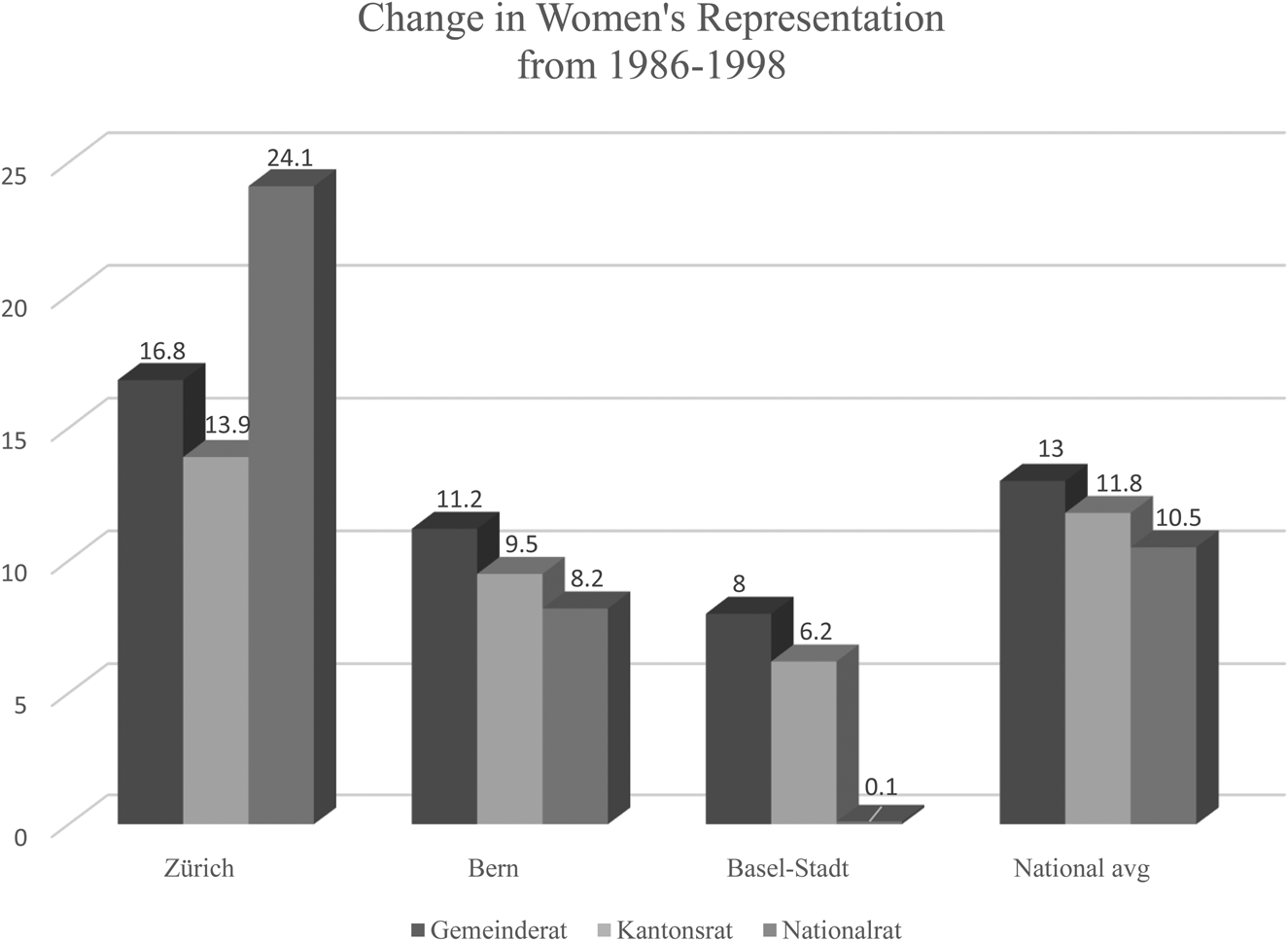
In Switzerland in general, and in even more so in Zürich, women's descriptive representation jumped dramatically in the years that FraP! was active. In 1986, as the party was forming at the municipal level across Switzerland, women comprised 8.6% of elected officials, 10.2% at the cantonal level, and 11% at the national level. Over the next 12 years, women's representation increased on average: 13% at the municipal level, 12% at the cantonal level, and 10.5% at the national level.
In Zürich, however, women began their dramatic upward climb at a much higher point, at least for the subnational levels of government, than in Switzerland as a whole (Table 2). In 1986, women comprised 20% of local councillors, 15% of cantonal representatives, and 17% of members in the lower house of the national parliament. Over the next 12 years, women's representation increased by 17% at the municipal level, 14% at the cantonal level, and 24% at the national level. In fact, by 1995, women's descriptive representation in Zürich was approximately 20% higher at the local and national levels than in other parts of Switzerland on average (though only 7% higher at the cantonal level). Moreover, if Zürich's high figure is removed from the calculation, the average female representation across cantons in the Nationrat drops 7%, down to 14%. Although this was a moment of tremendous opportunity for women in Swiss politics in general, the change was much more intense in Zürich, suggesting that either the canton was experiencing something particular and unique relative to other parts of Switzerland, or that the size of the legislatures (120 for the lower house at the municipal level, 180 at the cantonal level and 34 at the national level) enabled the system to be especially responsive to popular pressures, or both.
FraP! Election Resultsa

a Data for the Kantonsrat and Nationalrat come from the Federal Statistical Office. Data for the Gemeinderat appears in the Statistical Yearbook of the State of Zürich 2000.
b FraP! ran in coalition as Grün Alternative/POCH/FraP! The list took three seats total.
Women's Descriptive Representation in Zürich

Percent of the total members in Zürich, national average in parentheses.
The transformation that occurred nationally and in Zürich in particular was primarily a story of transformation in the Red and Green parties on the Left (the Socialists and the Greens) in the first phase, though some adjustment did follow in the parties of the center Right.Footnote 8 In Zürich, women comprised approximately one-third of all representatives from the SPS at all levels in 1986. However, by 1998, women comprised more than 60% of all SPS representatives at the municipal, cantonal, and national levels. Within the Green Party delegations, women gained 43% representation at the municipal level in this window, 50% at the cantonal level, and 50% at the national level.
Part of the improvement in women's descriptive representation throughout Switzerland is attributable to the adoption of internal party quotas and to the introduction of separate electoral lists for men and women. Although the SPS was already using 33% gender quotas for internal bodies and candidate lists by 1983, they raised the threshold to 50% by 1995. The Greens adopted quotas in 1991. In addition, Swiss electoral law allows parties to run separate linked lists (listenverbindung), which then pools their vote totals. Larger parties across the spectrum have used separate lists of men and women, young people, and the elderly to appeal to different constituencies within their respective parties. In Zürich, however, these gender-based lists were only used once at the national level, by the SPS in the 1991 elections, which were the first elections in which they had an opportunity to respond to FraP!’s organizing. Importantly, neither the SPS nor the Greens used the gender-based or gender-balanced/zebra lists until after FraP! appeared and challenged both their access to votes and the narrative they sought to present of being strong on women's issues.
WOMEN'S SUBSTANTIVE REPRESENTATION
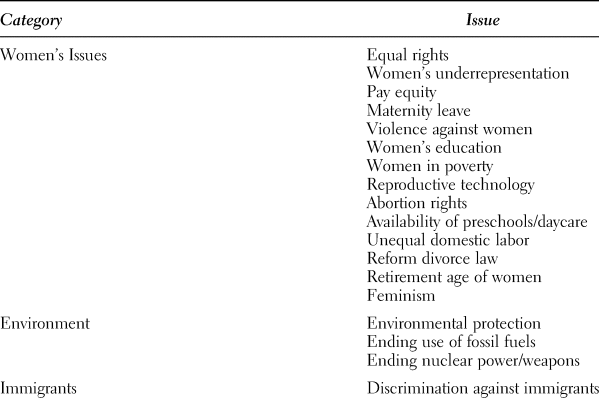
Because FraP! did not identify as a party, they refused to issue a platform.Footnote 9 Thus, to evaluate the extent to which FraP! influenced the agenda of other parties, I developed a list of themes that appeared in their election materials, press releases, official comments in newspapers, etc., and compared the extent to which the other political parties addressed these issues in their platforms before and after FraP! emerged. Curiously, Swiss election manifestos are not aimed at the public but are typically sets of instructions and arguments in favor of various policy positions offered to cantonal parties as guidance in their development of election materials. The party system is also unusually decentralized, which is a problem because no archives exist of cantonal party manifestos and party positions vary across the federation. Hug and Schulz contend, however, that the parties are “sufficiently cohesive such that one may neglect cantonal differences for most purposes of research” (Reference Hug and Schulz2007, 321), Thus, I analyzed national-level party documents.Footnote 10
Issues on FraP!’s Political Agenda

Working from a composite list of issues mentioned in FraP! publications, I reviewed all manifestos from the SPS, the Greens, the Liberals (FDP), the Christian-Democrats (CVP), and the Swiss People's Party (SVP) from 1983 (the election before FraP! emerged) to 1999 (the first election in which they did not take any seats). These five parties were the largest parties in Zürich at all three levels, though the balance differed across the municipal, cantonal, and national assemblies.Footnote 11 I looked for references to 14 women's issues and three issues related to environmental protection as well as the prevention of discrimination against immigrants.
The results of this analysis offer some interesting findings. First, many of the issues important to FraP! were already on the agendas of the political parties, particularly the SPS, at the national level by the early 1980s. In 1983, the party mentioned 94% of the issues that FraP! eventually campaigned on and all of the issues by 1987. In 1991, the SPS mentions 82% of these issues. In fact, the manifestos mention women approximately 100 times each in these three election years. In addition, the party labeled itself “feminist” in 1983, 1987, and 1991 (though not in 1995 or 1999). Thus, the issues were on the radar of the SPS before FraP! emerged. Although the SPS made more consistent and extensive reference to these issues in the 1980s, the FDP and CVP referred to 53% and 42% of the women's issues, respectively, by 1987, and the CVP referred to 53% in 1991. Even the SVP raised women's legal equality, pay equity, and flexible work schedules in their manifestos in 1983 and 1987.
However, something strange happened next: attention to these issues among parties on the Right (the FDP, CVP, and SVP) declined. The FDP became silent on these issues (or returned to being silent on these issues for the most part.Footnote 12 In 1995, the CVP mentioned women only four times (down from 12 and 10 references in the previous two cycles, respectively), and it mentioned only 24% of the women's issues. All of the parties referred to the need for gender equality throughout this 15-year period, but the Right seemed to withdraw from engagement with the remaining issues in the 1990s, ceding ownership to the parties on the Left.
Clearly, however, something raised FDP consciousness of women voters by 1995. The FDP referred to itself as a “women's party” in its election manifesto that year, though it made almost no references to the issues that FraP! or the other parties were discussing. In its manifesto, the party appears to have been responding to pressure to adopt quotas because it talked about why it opposed them. As attention shifted to women's representation and women's concerns in politics over these years, the FDP seems to have defined and consolidated its laissez-faire approach.
The CVP continued to direct attention to many of the issues of concern raised by FraP! in 1991, but it did not do so in its 1995 or 1999 manifestos, despite mounting pressure.Footnote 13 Although their attention to the issues on FraP!’s list varied, their approach did not in the sense that almost all of the discussion surrounded providing opportunities for women to reintegrate themselves into the workforce after raising children, to combine childrearing work with some flexible work arrangements, and to earn retirement benefits and social recognition for their domestic labor or care work. In other words, the CVP agenda reflected their embrace of traditional gender roles and their commitment to the family as the central unit of society. They also consistently opposed abortion rights. In short, where there was overlap with FraP! and the Left on the need to adjust school hours, working conditions, and the social disregard for domestic labor, the CVP backed away from these issues by the mid-1990s. They do not appear to have adapted their agenda to respond to external pressures, and when they did discuss the issues that concerned FraP! candidates, their position was adversarial, in Meguid's wording (Reference Meguid2005, Reference Meguid2008). Again, this evidence points to the Right ceding this ground to the Left, thus reconfiguring the political space.
The third phenomenon that unfolded during this period was the Green Party adjustment in its approach to women's issues. In 1987, they were almost entirely silent on FraP!’s issues; however, by 1991 they had clearly boarded the train, mentioning 59% of the issues, including calling for quotas for female representation. In addition, by 1991, the Greens decried traditional gender roles and called for their restructuring. They had become the only party that consistently advocated for quotas in all political bodies. This shift shows, if not a change of direction from their position in 1983, an increase in attention and a sophistication of their approach.
There is almost no discussion of violence against women in any of the mainstream platforms. The SPS and Greens make occasional reference to it, but the Right parties make none. Nor does the objectification of women or their exploitation appear in the election documents of the mainstream parties from this period. These topics remain marginalized.
Consensus on the need for gender equality was present in every party's election manifesto across the ideological spectrum from 1987 to 1999. Consensus was also present on the need for greater environmental protection, and all parties made extensive reference to this in every manifesto.Footnote 14 Finally, there was also a surprising degree of consensus across the spectrum on immigration or asylum policy within even Left parties, calling at various points for stabilizing the levels of immigrants and asylum seekers. The Greens, the FDP, the CVP and even the SVP also discussed improving integration of legal immigrants already present in Switzerland, an issue upon which FraP! was particularly active.
Although the SPS seems to have already developed rather compatible positions with FraP!, the founding and appeal of FraP! point to a lack of action by the SPS. Following the argument of Meyer and Miller (Reference Meyer and Miller2015) and Meguid (Reference Meguid2008) that niche parties emphasize policy areas that are otherwise neglected within the system, the emergence of FraP! is an indication of a kind of market failure by the other parties to move forward on these ideas. In the materials and comments of FraP! members, an image emerges of the SPS, at least in Zürich, as being stodgy, closed to new modes of thinking, out of touch with movement politics, and dominated by old men (even POCH was criticized by some FraP! members for this). Even Doris Stump, an SPS MP from 1995 to 2011 contended that in the 1990s, “Feminist topics were not very high in the esteem of the party” (Stump Reference Stump2015). The idea that women's representation was a theoretical but not a practical possibility appears repeatedly in the comments FraP! and other women made at the time and in subsequent interviews for this article (Joris Reference Joris2015b; Goll Reference Goll2015; Küng Reference Küng2015). Even among the bourgeois parties, frustration at the lack of concrete policy action emerged. For example, the Tages-Anzeiger ran an article under the headline “More Action than Words” on October 23, 1993, referring to the frustrations of the women in the CVP who were demanding more power within their party.
THE ROLE OF FRaP!
Although the Frauenstreik and the Brunner affair drew public attention to women's underrepresentation, their status, and their concerns, FraP! played a significant part in the dramatic transformation that occurred in Zürich. First, consistent with the theory articulated in the preceding text, FraP! was clearly an agent of contagion in making the Socialists and the Greens, the key parties responsible for the increase in women's representation in the legislatures, both give more attention to women's descriptive and substantive representation and sustain that attention (Goll Reference Goll2015; Jegher Reference Jegher2015; Joris Reference Joris2015b; Küng Reference Küng2015; Seitz Reference Seitz2015; Stump Reference Stump2015). For example, the SPS did not offer a separate list of female candidates in Zürich or introduce a placement mandate until 1991, the election after FraP! appeared, and this shift was frequently mentioned in interviews with FraP! and other politicians (Jegher Reference Jegher2015). FraP! served as a “dynamic innovator” for established parties” (Joris Reference Joris2015b) and as a “transmission organ” (Jegher Reference Jegher2015). According to Joris, “FraP! brought new questions, an expanded set of issues that reached beyond the more common planks about abortion, divorce and suffrage. And new dynamic energy. This was spoken about in the socialist movement but FraP! put it on the agenda” (Joris Reference Joris2015b). Multiple examples include the fact that FraP!’s work on women's descriptive representation and on migrant women was frequently taken over by women in the SPS (Isele Reference Isele1996; see also Jegher Reference Jegher2015).
Although FraP! never posed a large electoral threat to the Socialists and the Greens, there was a sense of uncertainty about FraP!’s potential in the early 1990s that enabled them to extract concessions from the more mainstream parties. As the Neue Zurcher Zeitung noted in July 1991, the introduction of their own list for the Nationalrat transformed FraP! from a difficult fraction partner at the cantonal level to a threat to the SPS (1991). In fact, according to Marlies Strech from the Tages-Anzeiger, in the 1991 election at the national level, FraP! cost both the SPS and the Greens one seat (Strech Reference Strech1995). At the municipal level, by 1994, FraP! appeared to be on a trajectory to supplant the Greens, having won the same number of seats, whereas the Green Party's delegation declined by half between 1990 and 1994. Electoral uncertainty increased the pressure on the established parties, coinciding with their increased willingness to co-opt FraP!’s issues.
FraP! also manipulated the party dynamic and issue space available to the other parties. The Socialists and Greens responded not only to competitive pressures but also because they knew that they always had a left flank on women's issues. FraP! created space for the mainstream parties to assume positions on women's representation that might have seemed risky otherwise. For example, when FraP! candidate Zita Küng ran for Ständerätin in 1987, she deliberately adopted a strategy, coordinated with the only other female candidate, to take an extreme left position in every public debate. She did this in order to leave room for the other candidate to stake a position to the left of the male candidates from the bourgeois parties yet come across as moderate. Their joint strategy was successful in preventing the election of the SVP politician Christoph Blocher in that election. At other points, the Left parties collaborated through joint electoral lists and common fractions, supported each other on various motions and legislative initiatives, and even cooperated in election campaigns, primarily at the local level. For example, when the SPS had difficulty finding people to serve on behalf of the party for the Schulpflege (school board), they permitted FraP! to nominate their candidates instead. On another occasion, the SPS chose not to run a candidate against a FraP! woman for the Ständerätin in 1987 (Küng Reference Küng2015). Thus, at various points, FraP! operated as a coalition partner, a flank, and a foil, all of which contributed to improvements in women's representation.
FraP! also provided a powerful example to women in the other parties and an object lesson on the electability of women and the appeal of their issues to the other parties' leadership, particularly the SPS. In fact, the deathblow for FraP! came when Christine Goll left the party in 1997 and took her mandate in the Nationalrat to the SPS. Although this act triggered the collapse of FraP!, it revealed that the SPS and FraP! were similar enough on important matters related to women's concerns to allow movement between them. And, like women in Sweden's Socialist Party, SPS women used the threat of mimicking FraP! and forming their own party multiple times to pressure the SPS to place more women on their lists (Stump Reference Stump2015).Footnote 15
Beyond the sheer party-level dynamics, FraP! provided crucial organizational linkages with the broader movement for women's rights within civil society. For example, FraP! was “essential to the organization” of the Frauenstreik and the mobilization in reaction to Brunner's defeat in Zürich (Joris Reference Joris2015a). In addition, FraP! banners featured prominently at the Frauenstreik in Zürich, according to video and news coverage of the day. Furthermore, the issues identified by the organizers of the Frauenstreik overlapped substantially with the campaign literature of FraP! itself. FraP! even used the slogan, “Wenn Frau will, steht alles stille” (Everything grinds to a halt if women want it to) of the Frauenstreik in their national campaign in 1991 (FraP! 1991b). In other words, the energy, the conviction, the intensity of the demands, as well as the repertoire and organizational skills and networks of FraP! figures were instrumental in the broader mobilizations that occurred during this period. According to Joris, “You have to see FraP! in these dynamics” (Joris Reference Joris2015b).
As “the parliamentary arm of the new women's movement,” FraP! also served the women's movement in direct and pointed ways. For example, FraP!’s presence in formal politics gave the movement institutional prerogatives such as the power to appoint members to the Schulpflege (school board), which was a prerogative reserved for parties in the Gemeinderat (municipal council), as well as representation on the Equality Commission, members of which were nominated by the Gemeinderat. In addition, at one point, due to the established rotation of executive authority and its cooperation with the Socialists, FraP! Gemeinderatin Reni Huber served as president of the municipal council, chairing its meetings for a year and placing FraP! at the center of the very power politics it denounced. How significant that was for its agenda is difficult to determine, especially because a Gemeinderatspräsidentin is expected to be party neutral, but symbolically, it was critical.
FraP! also connected the energy of the street to formal politics. For many of the members, FraP! was an extension of autonomous feminist organizing in the movement spaces of the 1980s and was a means to expand the conversation about how power was constituted and exercised by challenging the traditional institutions of power in the formal realm (Isele Reference Isele1996, Joris Reference Joris2015a). They sought to act as a bridge for women who lacked the skills, education, or resources to participate in politics.Footnote 16 They thus made politics accessible, particularly at the municipal and cantonal levels, for women who otherwise were or felt themselves to be marginalized by the institutions. A specific example is the way that Anjuska Weil, as member of the Kantonsrat, used her membership in the body to invite immigrant women to have tea with members of parliament on breaks between sessions. She arranged these “meet and greets” at local restaurants. According to Weil, “I often had this function to connect people from outside with parliamentarians” (Weil Reference Weil2015).
Finally, the argument that FraP! contributed to the uniquely large transformation in Zürich is supported by the fact that the only other canton with population size and district magnitude comparable to that of Zürich,Footnote 17 Bern, which never produced a women's party, had a much smaller increase in women's representation during this period (Figure 1). Whereas Basel-Stadt also had a robust women's party at the cantonal level, its district magnitude is so small that the party never competed with the other parties at multiple levels. Women's representation also did not change at all during this period in Basel-Stadt's delegation at the national level (1 of 6 members), and it grew by only 8% at the local level and by 5% at the cantonal level during this period (Figure 1). Undoubtedly, the situation had multiple causes, but these two counter-examples point to the important interaction of women's party presence and electoral structures in increasing women's descriptive representation.
Change in women's representation from 1986 to 1998. Note that the national average for each level of office is likely skewed by Zürich's abnormally high figures.

DISCUSSION
The evidence indicates that FraP! offered the women's movement in Zürich unique opportunities to shape the behavior and practices of the mainstream parties with regard to women's descriptive and substantive representation. Clearly, the party placed pressure on the other parties, particularly the proximate parties of the Greens and the SPS, and they responded in ways that enhanced the representativeness of the political system, adopting internal quotas or raising their thresholds and giving more attention to the interests of the movement. The party was also able to reconfigure elements of the political system in Zürich, albeit temporarily, by engaging the movement with the state in ways that other parties either could not or would not. Several important caveats and limitations, however, must be included in the analysis in terms of how and under what conditions this kind of influence was exerted in this case.
First, FraP! had a different identity than most niche parties: FraP! was not, according to its members, a party. Their authenticity derived from their street connection, their informality, and their otherness (see, e.g., Jegher Reference Jegher2015; Joris Reference Joris2015a). They contested elections, so they were technically a party (see Burstein Reference Burstein, Giugni, McAdam and Tilly1999), but their orientation was as outsiders, and they were deeply conflicted about how much they wanted to become part of the system (Joris Reference Joris2015a). The nature of the organization and its goals are important in terms of how much impact the party had and how their impact is assessed or measured.
Second, causality can be difficult to trace when movements and parties hybridize. The membership of FraP! was entirely intertwined in networks that stretched across different organizations and arrangements of civil and political society, including trade unions, OFRA, and even other political parties. The movement and orientation of FraP! meant that the members could maintain their multiple memberships and their associations with others groups while part of FraP!. As an example in the extreme, Anjuska Weil, a two-term member of the Kantonsrat for FraP!, never surrendered her membership in the PdA (the Swiss Party of Labor or Communist Party) and remained a paid employee in the office of the PdA throughout and even after her official service to FraP!. Because the boundaries between the organizations were fluid and the organizations were tightly interwoven, it is nearly impossible to separate the contributions of the separate organizations.
Third, the Swiss case highlights the ways that movements, particularly women's movements, may actually not make good parties. One weakness is organizational: in the case of FraP!, remaining true to their desire to be a loose confederation of organizations and their feminist commitment to avoiding a hierarchical structure meant that they lacked the necessary infrastructure to support their candidates in office. Although the most-oft cited explanation for her resignation from FraP! is that she needed a group to work with in the Nationalrat, in her resignation letter, Christine Goll was very clear that one of the reasons she could no longer represent FraP! was that she had no support—financial, personal, or informational—to help her be an effective representative, at least not coming from the party. She also complained that there was insufficient discourse about political topics, no development of proposals, and no discussion of position-taking to support her. Christine Schwyn, a FraP! member of the Kantonsrat from 1991 to 1995, decried the lack of political skills training, saying that discussion was lacking and that people were not developed as political candidates (Schwyn Reference Schwyn2015). Also, she recounted that even elected members would take widely different positions on issues, and there was no movement or mechanism to reconcile these, which hindered the development of enduring political programs of action (see Schwyn Reference Schwyn2015 and Küng Reference Küng2015). Although some Green, workers’, and other movements have crossed over successfully into parties, why some movement–party hybrids succeed and others do not remains an open and fascinating question. In FraP!, the extent to which the movement was unwilling to organize itself like a party impeded its institutional development, which impeded its success in the long run (e.g., note Polletta's discussion of this same phenomenon within women's movements in Polletta Reference Polletta2002). The fact that the women's parties could not seem to organize across cantonal boundaries, despite their proximity and commonality of purpose, provides further evidence of this lack of institutional capacity.
Another weakness was lack of resources. In fact, most of the women interviewed complained that the salaries of representatives at any level were insufficient to hire staff and that without the public resources available to members of parliamentary groups, individual members lacked the institutional support to do their jobs. FraP! lacked a base beyond their membership like that which the SPS had in the unions or the bourgeois parties had in the business community. All the work was voluntary or paid for by membership dues, and their membership was almost entirely women, many of whom did not do paid work outside the home. Being so small, they did not qualify for the media coverage that was guaranteed to the established political fractions. Because the Swiss system does not confer resources to the parties or the politicians (see Fuchs Reference Fuchs2009, 591), parties must have a revenue stream to be self-sustaining, and the women's organization could not support the party sufficiently.
Fourth, several features of the Swiss electoral system color the interaction of Swiss parties in ways that altered the opportunities for FraP! to influence the other parties. Panachage/panchiere can blur the lines between parties as votes for particular candidates transfer to another party but indicate support for the original parties’ ideas. At some level, this worked in FraP!’s favor by allowing SPS voters to signal support for FraP!. Listenverbindung (LVB) encourages interparty alliances (see Lijphart Reference Lijphart1994, 150), including between large parties and small, proximal ones. According to Bochsler (Reference Bochsler2010), LVB increases a small party's chance of receiving a seat, if they are allied with other small parties; however, the benefits usually accrue to larger parties in asymmetrical agreements. Although FraP! stole votes and seats from the SPS and the Greens at times, fitting the model of competitor party, it also appealed to these parties as a list and fraction partner at times, which provided it other avenues for influence than were present in more competitive systems. In addition, the Swiss system of consociationalism, which operates in some form at all levels of government, ensures that the opposition must be incorporated into governing decisions and present in the institutions of the executive branch itself (e.g., FraP! held the mayoralty at one point). FraP! likely benefitted from this climate of consensus and inclusiveness. Conversely, these institutions may limit the appeal of outsider groups because parties do not need to accommodate them to gain power. This, in turn, can make the system less responsive to outsiders (see Banaszak Reference Banaszak1996). Thus, the Swiss case makes clear some of the ways electoral systems and institutions structure the extent to which and the mechanisms through which hybrid and niche parties influence mainstream parties.
FraP! was also a profoundly local phenomenon. Although women's parties existed in seven other cantons in Switzerland in the 1980s and 1990s, FraP! was the only party to make it into office at the national level—but FraP! itself had no national reach. It attempted to coordinate with other women's parties in other cantons during the national elections in 1995, but that was a narrow effort largely aimed at gaining the media access guaranteed to lists that poll a certain percentage. To be successful at the national level, as Goll's resignation made so clear, the party needed allies and resources that reached across the federation. The confederal Swiss system made it nearly impossible for FraP! and the other women's parties to have national impact.
Finally, as detailed in the preceding text, at times FraP!’s electoral role appeared to be oriented as much to preventing the Right from succeeding as it was to winning seats. Meguid (Reference Meguid2005, Reference Meguid2008) theorizes about this kind of interplay in which the niche party on one wing is used by a mainstream party on the other side of the spectrum to box in their opposing mainstream party, for example, when a party on the Left takes a strong adversarial position in response to a radical Right party to embarrass their center-Right competition. In this case, however, the niche party was doing the manipulating, making extreme claims to create space for the mainstream party to appear moderate while positioning themselves left of center. Thus, the movement, by constituting itself as a party, was able to influence the outcome of elections, though its ability to do so was governed by the extant party issue space in the system in which it operated. This case illustrates that the configuration of the mainstream parties in relation to each other shapes the available opportunities for movement-parties.
CONCLUSIONS
In this project, I considered how well and in what ways a women's movement–party hybrid might impact the representation of women and the inclusiveness of the political system. In the context of scholarly neglect of women's parties, and in contrast to claims made that women's exclusive mobilization is detrimental to movement goals, the evidence in this case study shows that forming a political party may be a useful strategic tool for a social movement.
The history of FraP! is a fascinating story in which a women's movement created a political party and used it to improve women's descriptive and substantive representation, pressuring mainstream parties to attend to their issues and, consequently, expanding the political agenda as a whole. FraP! increased the direct electoral pressure on parties in Zürich, gave the movement an institutional presence and, thus, some prerogatives and powers, as well as access to the mainstream media it would not have had from outside formal politics. FraP! served as a formal structure for connecting outsiders to insiders and as a platform for articulating the concerns of the movement, such as for the integration of immigrants, especially women, in new venues.
Digging deeply into the nexus of parties and movements, this case study also points to ways to conceive of social movement outcomes to include shifting the behavior and agendas of political parties. If by forming a party, a movement is able to use institutional opportunities to “ ‘force’ opponents to pay attention to issues they would rather avoid” (Green-Pedersen Reference Green-Pedersen2012, 118), the mechanism of party competition offers the movement new opportunities to influence outcomes, even without broad electoral support. And because it triggers a transformation process in other parties, even a temporary foray as a hybrid movement–party may be more useful to the movement than remaining outside formal politics.
The effects of FraP! on the change in women's representation in Switzerland introduces many variables that must be considered in the analysis of how small parties influence the behavior and policy commitments of more established, and catch-all parties. Clearly, the case of FraP! indicates that the nature of the small party, its composition, intent, reach, resources, the boundaries of the organization and its institutional context matter a great deal in terms of whether or not it can influence the other parties and how it might do so.
This project considers only the tip of the iceberg in terms of unpacking the puzzle of whether women's parties are useful for women's movements and what variables govern this. Further research is necessary and should include other cases and other aspects of the process, for example, parliamentary actions undertaken by parties in all of the legislative bodies and whether legislation changed as a result of women's party pressure. The Swiss case, however, is fascinating both in terms of how FraP! used aspects of the party system to further women's inclusion and in relation to the broader societal transformations occurring at the time.