Introduction
Since the 1990s and perhaps before, second language (L2) vocabulary and the continuing drive to reform quantitative practices in second language acquisition (SLA) research have been of particular interest to the field (Nicklin & Vitta, Reference Nicklin and Vitta2021). Considering the former, there has been a growing interest in vocabulary as the key to developing and accounting for L2 proficiency (McLean et al., Reference McLean, Stewart and Batty2020). Lewis (Reference Lewis1993) for instance proposed an entire L2 curriculum based on the learning of multiword lexis while seminal studies such as Laufer and Nation (Reference Laufer and Nation1995, Reference Laufer and Nation1999) demonstrated the primacy of vocabulary in predicting L2 outcomes. Considering the latter, L2 quantitative research in general is undergoing a methodological reform in which the field has displayed somewhat consistent and incremental improvement over time (Lindstromberg, Reference Lindstromberg2016), with recent literature covering issues such as outlier treatment (Nicklin & Plonsky, Reference Nicklin and Plonsky2020) and the need to check for publication bias when reporting meta-analyses (Vitta & Al-Hoorie, Reference Vitta and Al-Hoorie2020). The reform is driven by the assumption that as a field, SLA “can only thrive and develop if our [SLA’s] research demonstrates rigor” (Gass et al., Reference Gass, Loewen and Plonsky2021, p. 1).
The present study is a focused methodological synthesis conducted at the intersection between L2 instructed vocabulary experimentalFootnote 1 research and the ongoing L2 methodological reform. Methodological synthesis is a type of systematic review or approach (Plonsky & Gonulal, Reference Plonsky and Gonulal2015), which is an explicit process (comprising a system) whereby a set of reports meeting inclusion criteria are critically assessed to address research questions (O’Connor et al., Reference O’Connor, Green, Higgins, Higgins and Green2008). As the name implies, a methodological synthesis concerns the methodologies observed in the reports. The present methodological synthesis was conducted to advance the generalizability and rigor of L2 instructed vocabulary research through three aspects of sample design. The first aspect considered was sample-size determination and involved an investigation into how researchers planned the number of participants that they recruited. Such planning references effect sizes, which are metrics that quantify the experimental and correlational effects observed in a given sample to facilitate generalizations about the population (Plonsky et al., Reference Plonsky, Sudina and Hu2021). Classical power is perhaps the best-known planning process and involves the determination of the minimum number of subjects required to significantly detect a predetermined (referencing relevant past studies) effect size in the sample (Brysbaert, Reference Brysbaert2019). The second aspect considered was randomization, which takes two distinct forms in experimental design. Random selection relates to the expectation that participants are chosen by chance and without bias (i.e., randomly) from the intended population (Harter, Reference Harter and Lavrakas2008), while random assignment concerns the allocation of participants to experimental conditions by chance (Kuehl, Reference Kuehl2000). These two strands of randomization have historically been argued as essential features of experimental samples (Fisher, Reference Fisher1935). Because true random selection is impractical for most L2 researchers, particularly those investigating less common languages (Nicklin & Vitta, Reference Nicklin and Vitta2021; Vitta & Al-Hoorie, Reference Vitta and Al-Hoorie2021), multisite samples have been presented as a compromise (Moranski & Ziegler, Reference Moranski and Ziegler2021), and also comprise the third aspect considered in the present study. Samples recruited from more than one location are an achievable means of attaining a sufficient number of participants to meet the requirements for L2 researchers’ analyses of choice (Nicklin & Vitta, Reference Nicklin and Vitta2021), and also temper the bias that single-site samples introduce to quantitative inquiries (Morgan-Short et al., Reference Short, Marsden, Heil, Issa, Leow, Mikhaylova, Mikołajczak, Moreno, Slabakova and Szudarski2018).
The case for viewing these three aspects as prerequisites for generalizable experimental sample designs is both historical and modern, with numerous prominent voices in statistical and L2 literature promoting the benefits of sample-size planning (e.g., Brysbaert, Reference Brysbaert2019; Cohen, Reference Cohen1988; Lakens et al., Reference Lakens, Adolfi, Albers, Anvari, Apps, Argamon and Zwaan2018), randomization (e.g., Fisher, Reference Fisher1935; Rogers & Révész, Reference Rogers, Révész, McKinley and Rose2020), and multisite sampling (e.g., Moranski & Ziegler, Reference Moranski and Ziegler2021; Morgan-Short et al., Reference Short, Marsden, Heil, Issa, Leow, Mikhaylova, Mikołajczak, Moreno, Slabakova and Szudarski2018). However, assessment of published L2 vocabulary experimental samples in relation to these three aspects is relatively scarce. L2 vocabulary research syntheses are overwhelmingly meta-analytic and instead focus on aggregating observed effects (e.g., Lin & Lin, Reference Lin and Lin2019; Zhang & Zhang, Reference Zhang and Zhang2020). When issues such as sample size have been reviewed, such as by Elgort (Reference Elgort2018), it was done so without overt discussion on the relationship between sample size planning and generalizations about the population. This should not be considered a flaw in Elgort’s report because it was a systematic review of existing technology-mediated L2 vocabulary research. Thus, the present study aims to address this gap in the existing literature. The seed of the present methodological synthesis was rooted in a meta-analytic project promoting power-informed sample sizes for future L2 instructed vocabulary experiments (Nicklin & Vitta, Reference Nicklin and Vitta2021). During the coding process for this prior project, we observed that the majority of L2 instructed vocabulary studies included no overt sample-size planning, inconsistently reported randomization procedures, and overwhelmingly involved single-site samples. In the current study we aim to empirically quantify this prior informal observation.
Literature Review
Two themes in the literature underpin this current methodological synthesis. The first theme is the experimental nature of L2 instructed vocabulary research and its importance within SLA. The unpacking of this theme also highlights that vocabulary-centric methodological syntheses of sample designs appear to be lacking. The second theme relates to systematic reviews, and thus methodological syntheses, being theory-driven in relation to their focus (Siddaway et al., Reference Siddaway, Wood and Hedges2019). Accordingly, given the present study’s focus, how L2 researchers and social scientists conceptualize effect size–driven sample-size planning, randomization, and multisite use is also reviewed.
L2 Instructed Vocabulary Research: Experimental Designs and Research Syntheses
Vocabulary as a strong predictor of L2 proficiency has been established across skills, from listening and reading (e.g., McLean et al., Reference McLean, Stewart and Batty2020; Vafaee & Suzuki, Reference Vafaee and Suzuki2020) to speaking and writing (e.g., Hulstijn et al., Reference Hulstijn, Schoonen, de Jong, Steinel and Florijn2012; Vo, Reference Vo2019). L2 instructed vocabulary research complements these investigations and pertains to “the best means of achieving good vocabulary learning” (Schmitt, Reference Schmitt2008, p. 329). Nicklin and Vitta (Reference Nicklin and Vitta2021) labeled the subfield as L2 instructed vocabulary acquisition (L2 IVA) to house it under instructed SLA (Loewen, Reference Loewen2015; Loewen & Sato, Reference Loewen, Sato, Loewen and Sato2017) as L2 IVA inquiries are within the domain of instructed second language. Given the focus on best means, L2 IVA research tends to feature experimental designs. For instance, in a recent systematic review of technology-mediated L2 vocabulary research, Elgort (Reference Elgort2018) observed that such designs were involved in 63 (77%) of 82 reports. These inquiries usually include a comparison of vocabulary learning conditions, operationalized as treatment and comparison groups, in which a set of target items are taught (Nicklin & Vitta, Reference Nicklin and Vitta2021).
L2 IVA experimental research has the potential to address theoretically grounded questions on how students learn new lexical items, where age, L1, and target items are controlled. Shintani (Reference Shintani2013) presented a typical model of such inquiry. Her study compared task-based teaching with a teacher-led present-practice-produce (PPP) approach in the context of elementary Japanese English learners (see Willis & Willis [Reference Willis and Willis2007] for an overview of the debate between the two methodologies). Shintani chose a set of appropriate target adjectives and nouns according to corpus-based frequency values. The treatment group studied the words under a task-based condition featuring focus-on-form activities that were somewhat meaningful in representing language use outside of the classroom. The comparison group studied the target words under a PPP condition. Shintani’s results indicated that adjectives were learned better under the treatment condition and in the discussion she explained why and how to researchers and teachers alike.
L2 vocabulary research syntheses, including L2 IVA such inquiries, have overwhelmingly been meta-analytic where the primary interest is on observed effects and not study quality (e.g., Lin & Lin, Reference Lin and Lin2019; Uchihara et al., Reference Uchihara, Webb and Yanagisawa2019; Webb et al., Reference Webb, Yanagisawa and Uchihara2020; Yanagisawa et al., Reference Yanagisawa, Webb and Uchihara2020; Zhang & Zhang, Reference Zhang and Zhang2020). In the main, strong to moderate effects have been observed. For instance, in a summative review of 81 L2 IVA experiments, Nicklin and Vitta (Reference Nicklin and Vitta2021) reported that treatment conditions performed 62% of a standard deviation better than comparison ones when the experiment employed independent groups (i.e., between-subject designs). Vocabulary researcher’s meta-analytic focus on effect stands in contrast to L2 research syntheses in general where methodological syntheses are also somewhat common (see review in Farsani & Babaii, Reference Farsani and Babaii2020). When vocabulary research design features have been synthesized, the focus appears to be on aspects of the treatment design with study quality often omitted. Lin and Lin (Reference Lin and Lin2019), for example, framed their meta-analysis of vocabulary-focused MALL (mobile application language learning; in this case mobile phone applications focusing on L2 IVA) experimental reports with a systematic review. This effort was undertaken to uncover moderator variables, such as the length of treatment and whether the target word forms were productively or receptively learned. Methodological design features reflecting study quality were omitted from the analysis. Cisco and Padrón (Reference Cisco and Padrón2012) likewise catalogued how vocabulary research reports presented strategy use instruction. Elgort (Reference Elgort2018), in a systematic review of technology-mediated L2 vocabulary research, catalogued the average sample size of the papers in the report pool and their testing designs, but the only aspect of the report directly connected to study quality was related to enhancing vocabulary measurements’ overall validity. Elgort’s work in this regard was exemplary and was indeed one of the rare L2 IVA reviews investigating study quality. However, Elgort’s focus was not on sample design, which is the subject of the present review. The apparent lack of focus on study quality in general and sample design study quality in particular in these reports should not be considered a flaw because such a focus is in the domain of systematic reviews and especially methodological syntheses (Plonsky & Gonulal, Reference Plonsky and Gonulal2015; Siddaway et al., Reference Siddaway, Wood and Hedges2019). This lack of focus did however motivate the present study, along with the previously mentioned informal observations regarding three aspects of experimental design: sample-size planning, randomization, and multisite sampling.
Three Related Aspects of Experimental Sample Design Impacting Rigor and Generalizability
Effect Size–Driven Sample-Size Planning
The sample-size planning process begins with effect sizes, whether it is classical power, driven by null hypothesis significance testing (NHST), or another process such as precision (Cumming, Reference Cumming2012; Norouzian, Reference Norouzian2020). In both of these approaches, researchers reference effect sizes from the relevant domain to plan the number of participants they require. Effect size metrics, as highlighted in the preceding text, quantify an observed sample’s experimental and correlational effects to enable generalizations to the population. Such metrics are numerous but tend to be organized under mean difference (d family), strength of association (r family), and odds ratio categories (Plonsky et al., Reference Plonsky, Sudina and Hu2021). L2 experimental meta-analyses have usually expressed experimental effect sizes in standardized mean difference metrics, the d family, despite the catalogued reports sometimes utilizing different metrics (e.g., Bryfonski & McKay, Reference Bryfonski and Mckay2019; Lin & Lin, Reference Lin and Lin2019; Vitta & Al-Hoorie, Reference Vitta and Al-Hoorie2020). As highlighted by Brysbaert (Reference Brysbaert2019), effect size metrics convert from one to another quite easily while expressing the same underlying effect. When d = 1.00, a group’s performance averaged one pooled standard deviation higher than another; when d = .50, the group was 50% of a standard deviation better.
Classical a priori NHST power analysis is perhaps the best-known method to plan sample sizes using effect sizes. Recent L2 methodological syntheses (e.g., Farsani & Babaii, Reference Farsani and Babaii2020; Lindstromberg, Reference Lindstromberg2016; Vitta & Al-Hoorie, Reference Vitta and Al-Hoorie2021) have exclusively coded for classical power given NHST’s prevalence among SLA quantitative research, despite arguments to move away from it (e.g., Cumming, Reference Cumming2012; Plonsky, Reference Plonsky and Plonsky2015). As highlighted by Nicklin and Vitta (Reference Nicklin and Vitta2021) and Brysbaert (Reference Brysbaert2019), such power analyses should reference relevant standardized effect sizes.Footnote 2 The process entails the calculation of the sample size required to detect a certain effect size assuming predetermined alpha (α) and beta (β) thresholds. The α thresholds relates to Type I error (i.e., false positive probability) and is conventionally set at 5%, while β thresholds relate to Type II error (i.e., false-negative thresholds) and are typically set at 20% (Lakens et al., Reference Lakens, Adolfi, Albers, Anvari, Apps, Argamon and Zwaan2018). For fixed-effects testing (e.g., ANOVA and multiple regression), calculators such as G*Power (Faul et al. Reference Faul, Erdfelder, Lang and Buchner2007) are useful for conducting a priori power analyses but they can be limited in their ability to model interactions. However, this issue can be addressed using simulations (see Lakens & Caldwell [Reference Lakens and Caldwell2019] for details). Mixed-effects models where random effects (i.e., not a part of the experimental design) at the item and person levels likewise require a priori power to be addressed using simulations analyses (e.g., Brysbaert & Stevens, Reference Brysbaert and Stevens2018; Green & MacLeod, Reference Green2016).
Precision has recently been introduced within the SLA arena and acts as a useful exemplar of a non-NHST a priori, effect size–driven sample-size planning procedure (Norouzian, Reference Norouzian2020). This approach determines the sample size required to narrow the confidence interval (CI) for a certain effect size. Much like G*Power, Norouzian’s precision calculator is turnkey whereby the researcher selects the effect size, the parametric test, and the degree to which the CI is narrowed. According to Norouzian’s SLA-specific precision calculations, the trend of larger samples for small effects is present in a general sense. For example, Norouzian demonstrated that precision in regression modeling increased with sample size when effect size was held constant. Certain conditions, however, saw almost identical sample sizes providing adequate precision for different effect sizes (see Figure 3 in Norouzian, Reference Norouzian2020, p. 854).
Small samples that have not been planned with relevant effect sizes are problematic in relation to both small and large effects (Brysbaert, Reference Brysbaert2019). A small sample might lead toward a false negative discovery, or Type II Error. In this situation, a researcher determines that a small effect in the sample does not exist in the population when in reality it does, but the sample was too small to significantly detect it (as argued by Brysbaert within an NHST paradigm). Fraley and Vazire (Reference Fraley and Vazire2014) demonstrated that when samples are underpowered the distribution of observed sample effects is wider than the distribution in higher-powered samples. In other words, there is a higher chance of studies observing larger and smaller effects in relation to the true population effect. This can lead to the publication of large effect “flukes,” which occur when a large significant effect in a small sample is generalized to the population by the researcher when in reality it does not exist. For instance, Yang et al. (Reference Yang, Shintani, Li and Zhang2017) reported a very large effect size (d s = 1.75)Footnote 3 in favor of a sentence writing L2 IVA condition group over an essay writing group while the median between-subject d in SLA was estimated as 0.70 (Plonsky & Oswald, Reference Plonsky and Oswald2014). Because Yang et al.’s sample comprised only 19 and 18 students in the respective sentence and essay writing subgroups from a single Chinese university, the concern of this huge observed sample effect being a fluke relative to the population emerges. When one couples this with the observed publication bias toward large and significant effects (Fanelli, Reference Fanelli2010), the need for L2 IVA and L2 experimental designs to plan their sample sizes with reference to relevant effect sizes before data collection begins is clear.
Given the problems that samples constructed without a priori size planning present, it is concerning that the process has been almost never observed when L2 methodological syntheses sought to investigate it. When reviewing L2 interaction inquiries, Plonsky and Gass (Reference Plonsky and Gass2011) observed that only three (1.72%) of 174 studies reported power in any fashion, with it being unclear if any of them employed a priori or post hoc procedures. Farsani and Babaii (Reference Farsani and Babaii2020) likewise observed 6 (2.10%) of 285 Iranian graduate theses reporting power without considering if any were a priori. In a review of quantitative reports published in Language Teaching Research from 1997 to 2015, Lindstromberg (Reference Lindstromberg2016) overtly mentioned that no study engaged in an a priori sample planning process. His null finding corresponded to Vitta and Al-Hoorie’s (Reference Vitta and Al-Hoorie2021) observation that none of the 56 experimental reports investigating L2 flipped learning, in which new content is presented to students before class as homework (see Mehring, Reference Mehring, Mehring and Leis2018 for more on the approach), featured a priori power assessments while two (3.57%) considered post hoc power considerations.
This observed, albeit limited application of post hoc (NHST) power highlights another issue with the field’s failure to conduct a priori power analyses. Post hoc power analysis, which is classical NHST power analysis conducted after data has been collected, is routinely criticized as illogical because the power serves the purpose of determining the sample size an inquiry requires (e.g., Cumming, Reference Cumming2012; Field, Reference Field2018). Proponents of post hoc power emphasize its utility in assessing the power of a finding assuming that it truly exists in the population. This utility however has been noted as “pointless and potentially misleading” (Perugini et al., Reference Perugini, Gallucci and Costantini2018, p. 3), with Cohen (Reference Cohen1988) noting that sample-size planning should occur before the study is undertaken. Another option available to researchers is sensitivity analysis, which determines the minimal effect size that a sample can significantly detect given its size. This effect size is then the baseline that the study can accept in relation to detecting effects in the sample that generalize to the population. Some researchers have presented sensitivity analysis as a compromise between the ideal a priori and problematic post hoc sample-size determination analyses (Perugini et al., Reference Perugini, Gallucci and Costantini2018). A sensitivity analysis probably does avoid the “illogical” flaws of its post hoc counterpart. Nevertheless, only a priori effect size–driven planning with relevant effect sizes located in prior research allows researchers to situate their proposed sample size in the existing body of inquiries (Brysbaert, Reference Brysbaert2019; Nicklin & Vitta, Reference Nicklin and Vitta2021).
Randomization: Sampling and Assignment
When an experimental design features a randomized sample with random assignment of participants, it has stronger representativeness in relation to the intended population (Fisher, Reference Fisher1935). “Random” and “randomized” imply that chance drives either the selection or assignment process. This removes the bias that a researcher-controlled procedure might introduce, which in turn degrades the generalizability of the sample vis-à-vis the intended population.
Randomized sampling is the process by which participants are randomly selected from the intended population. According to most frameworks (e.g., Harter, Reference Harter and Lavrakas2008), randomized sampling is the superordinate under which one can subsume probability sampling procedures such as stratification and clustering. Stratification, as defined by Harter, is the identification of subgroups, or strata, within the population that should be represented in the sample, with participants randomly selected from each strata. Clustering is the random selection of participants from randomly selected clusters, which are intact groups existing in the population (Trochim et al., Reference Trochim, Donnelly and Arora2016). Among L2 researchers, such sampling is rarely implemented, given the practical constraints that the field faces. In a recent review of L2 research, only 2 (8.4%) of the 282 reviewed samples employed randomized sampling, subsuming fully randomized, clustered, and/or stratified procedures (Farsani & Babaii, Reference Farsani and Babaii2020). In a similar vein, Vitta and Al-Hoorie (Reference Vitta and Al-Hoorie2021) informally observed that none of the 56 L2 flipped learning experimental reports that were coded involved a randomized sampling process and thus the procedure went unanalyzed in the synthesis. Earlier reviews of L2 samples omitted the issue entirely with only randomized assignment being analyzed (e.g., Plonsky, Reference Plonsky2013).
The potential of randomized sampling within L2 research is noteworthy, however. Hiver and Al-Hoorie (Reference Hiver and Al‐Hoorie2020) could not replicate the conclusions and findings of You et al.’s (Reference You, Dörnyei and Csizér2016) L2 learning motivation study. One of the differences between the studies was that the replication study employed a randomized stratified sample, while You et al. employed a nonprobability snowball sample. Snowball, or chain sampling, involves participants enlisted for earlier iterations of the research assisting in participant recruitment for later iterations (see methods in You et al.). According to Trochim et al. (Reference Trochim, Donnelly and Arora2016), this procedure is subject to low external validity, entailing biased results and a lack of generalizability. While Hiver and Al-Hoorie’s failure to replicate cannot be fully ascribed to the sampling difference, this finding invites randomized sampling replications of prior findings from early studies that employed convenience samples.
Unlike with randomized sampling, L2 methodological syntheses have reported that L2 researchers are more prone to employ randomly assigned experimental conditions. Random assignment is the process of assigning participants to experimental conditions (e.g., treatment and comparison) by chance. Farsani and Babaii (Reference Farsani and Babaii2020) observed that 100 (58%) of 170 classroom experiments featured randomized assignment at either the class or participant level. This was higher than the overall 47% observed by Plonsky (Reference Plonsky2013) seven years’ earlier in 606 quantitative reports published in popular L2 SSCI (Web of Science’s Social Science Citation Index) journals, and also higher than the 32% observed by Lindstromberg (Reference Lindstromberg2016). The relatively high observed frequency of random assignment in comparison with random sampling and sample-size determination procedures allows for assessment of the association between time and random assignment. However, divergent findings have been reported. Lindstromberg observed a small correlation (ρ = .17) between year of publication and the use of random assignment in 76 between-subject comparison experimental designs. Plonsky (Reference Plonsky2014), however, observed that the use of random assignment in SSCI journals’ reports decreased when comparing the 1990s (40%) to the 2000s (36%).
While random assignment at the participant level is the gold standard (see Rogers & Révész, Reference Rogers, Révész, McKinley and Rose2020) and corresponds to Fisher’s (Reference Fisher1935) guidance, L2-centric reviews have made the distinction between random assignment at either the class/group or participant level. In classroom-centric SLA subfields such as L2 IVA, assessing random assignment at the class/group level is sensible as research is often conducted on intact classes. For instance, Peters (Reference Peters2019) randomly assigned instructed vocabulary conditions to classes and would have been coded as employing random assignment at the class level in reviews such as Plonksy and Gass’s (Reference Plonsky and Gass2011). Additionally, there have been divergent findings when it comes to the balance between random assignment at the class and participant levels. Plonsky (Reference Plonsky2013) observed that in both classroom and lab conditions, random assignment was more prevalent at the participant level. Farsani and Babaii (Reference Farsani and Babaii2020), however, observed that classroom experiments presented in Iranian theses had more group-level random assignments than person level with the opposite trend observed in lab conditions. Lindstromberg’s (Reference Lindstromberg2016) assessment of Language Teaching Research found that random assignment was overwhelmingly at the class level. Taken together, these syntheses paint a mixed picture with regard to random assignment at the participant and the class levels.
Despite the historical (Fisher, Reference Fisher1935) and current (Rogers & & Révész, Reference Rogers, Révész, McKinley and Rose2020) case for participant-level random assignment as the gold standard, some have argued that nonrandom procedures are also suitable. Farsani and Babaii (Reference Farsani and Babaii2020), for instance, coded studies that undertook purposeful assignment. When employing this strategy, as highlighted by Farsani and Babaii, L2 researchers consider tangential aspects such as L2 proficiency during the group construction process (e.g., ensuring groups are not significantly different in IELTS scores). Such procedures, however, violate the decades-old expectation that researchers do not introduce bias into the sample with their choices (Fisher, Reference Fisher1935). Furthermore, purposeful assignment becomes unnecessary when linear mixed-effects models (LMMs) and multivariate models with covariates are utilized. These analyses partial out constructs (i.e., covariates and random effects) that are tangential with the experimental condition(s) in predicting the outcome L2 IVA variable (Brysbaert & Stevens, Reference Brysbaert and Stevens2018).
Multisite Sampling
Recruiting participants from the intended population across two or more institutions or locations constitutes a multisite sample. The process of recruiting from multiple locations relates to the need for randomized sampling in quantitative research (Vitta & Al-Hoorie, Reference Vitta and Al-Hoorie2021). Moranski and Ziegler (Reference Moranski and Ziegler2021) argued that single-site samples present an external validity limitation, which reduces the ability to generalize findings beyond the context in which the data was collected. The authors also connected multisite samples with power, whereby the use of the former improves the latter. Such connections help reinforce the focus of this current study. Randomized samples from meaningful populations will additionally be multisite and thus the two constructs are related. For example, if a researcher intended to construct a sample that was representative of Saudi university EFL students and randomly selected 100 of such students from a national database, the probability of all participants’ being from the same university approaches zero.
A further benefit of multisite sampling is the facilitation of a “random(effect)-by site” analysis (Morgan-Short et al., Reference Short, Marsden, Heil, Issa, Leow, Mikhaylova, Mikołajczak, Moreno, Slabakova and Szudarski2018, p. 408). Under ideal conditions, the effect of the location should approach zero with experimental grouping variables and theory-driven covariates accounting for the dependent variable’s variance. Checking for this effect of location corresponds to the call for L2 researchers to consider clustering effects within their samples and data, whereby the different locations account for influence over the model estimates and parameters (Al-Hoorie & Vitta, Reference Al-Hoorie and Vitta2019). Although a multisite sample in L2 research would most likely be a nonprobability convenience sample conceptually, a random-by-site cluster check moves samples away from the biases that single sites introduce. As highlighted by Vitta and Al-Hoorie (Reference Vitta and Al-Hoorie2021), multisite sampling represents a compromise in relation to respecting the historical need for randomized sampling (Fisher, Reference Fisher1935) and recent L2 studies investing in the process (e.g., Hiver & Al-Hoorie, Reference Hiver and Al‐Hoorie2020).
Convenience samples from one location, regardless of the observed sample size, therefore have an inherent representativeness limitation in relation to generalizations beyond the setting from which they came (Moranski & Ziegler, Reference Moranski and Ziegler2021). While it is unreasonable to expect an L2 researcher to have access to national databases, multiple sites that are chosen with some randomness are perhaps within the realm of possibility. In the seminal reviews that started the L2 methodological reform (e.g., Plonsky, Reference Plonsky2013; Plonsky & Gass, Reference Plonsky and Gass2011), the need to consider power and thus construct robust samples was presented, but overt cataloguing of single- versus multisite samples appears to have been omitted until recently. Vitta and Al-Hoorie (Reference Vitta and Al-Hoorie2021) observed that 10 (18%) of 56 flipped learning experimental designs employed multi-site samples. Furthermore, in a review of L2 research practices, Farsani and Babaii (Reference Farsani and Babaii2020) noted that most of the observed samples were convenience samples, but the single- versus multisite issue was not assessed. From such limited data points, one cannot generalize more broadly about the state of multisite sample research in SLA. This view is somewhat reinforced by the observation that Moranski and Ziegler (Reference Moranski and Ziegler2021) and Morgan-Short et al. (Reference Short, Marsden, Heil, Issa, Leow, Mikhaylova, Mikołajczak, Moreno, Slabakova and Szudarski2018) presented position pieces with examples on the issue as opposed to dedicated methodological syntheses, a gap in the literature that the present study intends to fill by analyzing single- and multisite sampling in L2 IVA research.
Research Questions
Situated in the literature and motivated by the apparent lack of an L2 IVA-centric review of experimental sample designs, this focused methodological synthesis addressed four general research questions (RQ1–RQ4). RQ1, RQ2, and RQ3 were grounded in the foci of related L2 sample design methodology syntheses (e.g., Farsani & Babaii, Reference Farsani and Babaii2020; Plonsky, Reference Plonsky2013; Vitta & Al-Hoorie, Reference Vitta and Al-Hoorie2021). RQ4 was motivated by past assessments of how synthesized methodological features changed over time (e.g., Lindstromberg, Reference Lindstromberg2016; Plonsky, Reference Plonsky2014):
-
RQ1. To what extent do L2 IVA researchers engage in effect size–driven sample-size planning procedures with regard to:
-
a. A priori procedures?
-
b. Other procedures?
-
-
RQ2. To what extent do L2 IVA researchers engage in randomization with regard to:
-
a. Randomized sampling, subsuming probability sampling?
-
b. Random assignment, at the participant level?
-
c. Random assignment, at the class/group level?
-
-
RQ3. To what extent do L2 IVA researchers:
-
a. Employ multisite samples?
-
b. Consider the statistical clustering effect when multisite samples are employed?
-
-
RQ4. What is the association between time and:
-
a. Effect size–driven sample-size planning procedures?
-
b. Randomization?
-
c. Multisite use?
-
Methodology
Report Pool Construction
The report pool consisted of 110 studies retrieved from six renowned journals that were selected using a multistage systematic process. The first stage involved identifying candidates from a list of 35 field specific journals (Egbert, Reference Egbert2007) that were (a) SSCI indexed since 2010, (b) broad in focus (e.g., not ReCALL), and (c) targeted (in part) toward an audience of practitioners or agents of language teaching. SSCI indexed journals were considered important because Al-Hoorie and Vitta (Reference Al-Hoorie and Vitta2019) demonstrated that the quality of the statistical analyses is generally higher in such journals. This stage resulted in six candidate journals. The second stage involved a comparison of the six journals with two lists of SSCI journals from quantitative L2 research (Al-Hoorie &Vitta, Reference Al-Hoorie and Vitta2019; Plonsky & Gass, Reference Plonsky and Gass2011). Following this stage, one journal, ELT Journal, was removed for not being on both lists. In the final stage, three external experts confirmed that the five remaining journals could be labeled as “SSCI-indexed journals that are well-known, somewhat trusted in relation to their quantitative papers, and intended for practice-level research.” The five journals were Language Learning, Language Teaching Research, The Modern Language Journal, System, and TESOL Quarterly and they were employed to construct the report pool for Nicklin and Vitta (Reference Nicklin and Vitta2021). Subsequent expert review (two independent expert judgments) suggested that Studies in Second Language Acquisition should be included as its scope and prestige in the field mirrored that of Language Learning, which was included in the original report pool. To validate the inclusion, this rationale and the process of selecting the original five journals was presented to two other experts (the final external expert review) who concurred with adding Studies in Second Language Acquisition while also agreeing with the process and rationale for the selection of the five original journals.
From the six nominated journals, 1,053 reports, published between January 1, 2000 and December 31, 2020 were initially collected. The reports were retrieved from the EBSCO databases using the following search terms: vocab*, lexi*, idiom*, collocat*, phrasal, multiword, and formula, where * represented a “wild card” search term for which any character was valid. The EBSCO platform was employed for the search because individual journal platforms have inconsistent search options. EBSCO helped to systematize this process of the study (for a similar rationale for using Scopus to search journals; see Vitta & Al-Hoorie, Reference Vitta and Al-Hoorie2020). Because the search was conducted with EBSCO host, advance online publications were omitted from the report pool. For incorporation in the final pool, the reports were required to include (a) dependent variables measuring student acquisition of a set of target vocabulary items, (b) measurements enabling the dependent variables associated with L2 IVA (e.g., a vocabulary knowledge test), and (c) vocabulary treatment and comparison conditions that could be expected to occur in the classroom. When applying criteria (b) and (c), psycholinguistic measurements such as reaction times and very short treatments (e.g., 3,000 ms) were excluded as they were outside the intended L2 IVA focus. Because the report pool was originally constructed for another study, the reports were also required to contain sufficient information for effect size calculation. However, this final criterion had no bearing on the current study’s research questions. Analysis of the 1,053 reports, by the first author, resulted in a final pool of 110 that satisfied the three criteria.
The final report pool consisted of 110 reports from six journals: Language Learning (k = 11), Language Teaching Research (k = 39), The Modern Language Journal (k = 9), System (k = 18), Studies in Second Language Learning (k = 19), and TESOL Quarterly (k = 14). Supplementary Materials A contains a list of the studies comprising the report pool. A randomly selected group of 148 reports (from the 1,053) were independently coded by a second researcher to validate their inclusion in or exclusion from the final sample and confirm the criteria judgments. This process resulted in 89.80% agreement (κ = .80), which became 100% following deliberation.Footnote 4
Instrumentation and Coding
The present study’s first three research questions were operationalized as a series of dichotomous judgments regarding each report (see Table 1). These judgments comprised the study’s instrumentation. RQ1 involved judgments about the use of effect-size driven a priori sample-size planning procedures and procedures besides a priori ones. RQ2 necessitated judgments about (a) random assignment at either the participant or group level, and (b) randomized sampling. The judgment concerning the use of multisite samples in the operationalization of RQ3 required nuance. Some reports presented subsamples or sequenced experiments. In these cases, it was possible to conceptualize each report as a singular design. Accordingly, they were coded as employing multisite samples for respecting the bias that single sites introduce (Moranski & Ziegler, Reference Moranski and Ziegler2021). For example, Hulstijn and Laufer (Reference Hulstijn and Laufer2001) investigated reading, reading + fill-in, and writing interventions with Dutch and Hebrew L1 learners of English. This study was coded as multisite despite the inferential tests being confined to single settings. RQ3 also involved a dichotomous, complementary judgment regarding the consideration of cluster effects between multiple sites.
Coding Questions, Interrater Agreement, S index, and Notes

Note. RQ = Research Question
Using this framework, the primary researcher analyzed each of the 110 reports from the pool and dichotomously coded them as “1” for yes or “0” for no in relation to the questions listed in Table 1. Twenty-two (20%) randomly selected reports were independently coded by two researchers (the primary and a secondary researcher). The overwhelming frequency of no judgments prohibited inferential assessments using Cohen’s κ. As highlighted by McHugh (Reference McHugh2012), κ statistics are driven by the chi-squared test and an abundance of no judgments unbalance the contingency table rendering the test inappropriate. In response to this limitation of κ, the S Index was employed to assess observed interrater reliability. Norouzian (Reference Norouzian2021) presented the SLA research community with a turnkey program to calculate the S Index metric for interrater reliability (Falotico & Quatto, 2010, 2015, as cited in Norouzian, Reference Norouzian2021), which like κ partials out change agreement but is not sensitive to the imbalance that renders κ unusable in cases found in this current study (see Figure 3, Norouzian, Reference Norouzian2021, p. 6). As highlighted in Table 1, all judgments had high (.80 to .89) to very strong (.90 to 1.00; ‘NA’ denotes perfect agreement with only one or zero ‘yes’ judgments) observed S Index values according to Norouzian’s stated magnitude thresholds, except for random assignment at the participant level (RQ 2b; S Index = .73; “acceptable”). The relatively low value for the random assignment at the participant level judgment could be attributed to the ability to engage in the design process without having to overtly label it as “random assignment.” Some report authors engaged in the design feature without overtly employing the “random” label (e.g., Traxler & Nakatsukasa, Reference Traxler and Nakatsukasa2020) while others noted random assignment in past studies but omitted detailing the feature in their methodology (e.g., Choi, Reference Choi2017). Power considerations, conversely, do not facilitate such variation in wording when presented in the methods.
In line with past L2 meta-analytic reports (e.g., Al-Hoorie & Vitta, Reference Al-Hoorie and Vitta2019; Nicklin & Vitta, Reference Nicklin and Vitta2021; Vitta & Al-Hoorie Reference Vitta and Al-Hoorie2020, Reference Vitta and Al-Hoorie2021), the primary and secondary researchers who coded the 22 reports for the reliability check discussed disagreements to identify possible systemic issues in the coding process and to identify points of clarification. Such discussion resulted in agreement with the primary researcher’s judgments and rationale behind them being accepted by the second coder while highlighting points of clarification such as double site studies where inferential tests were constrained to single sites being coded as multisite as highlighted in the preceding text.
Analysis
In addressing the first three research questions, each of the 110 reports from the pool was coded according to the seven questions in Table 1, and the tallied responses (judgments) are presented visually. To address RQ4, which related to changes in sample-size planning, randomization, and multisite sampling over a 20-year period, the results for each of the dichotomous judgments (or aggregates of them) were correlated with the year of publication. To frame the correlation values further, an analysis of report publication by year was also conducted. Simple regressions with year as the dependent variable and a series of dummy variables representing each coded binary judgment as the predictors were conducted. Visual inspection of scatterplots, with standardized residuals on the y-axis and standardized predicted values on the x-axis, suggested that the homoscedasticity assumption might not have been met because cases unevenly straddled the x-axis (see Osborne & Waters [Reference Osborne and Waters2002] for using residual scatterplot to check this assumption). This was unsurprising given the extreme frequency of “no” judgments, thus Spearman’s rho (ρ) tests were conducted. Dellinger (Reference Dellinger and Allen2017) summarized the assumptions of Spearman’s ρ as (a) paired observations, (b) ratio, interval and/or ordinal variables, and (c) a monotonic relationship (i.e., no change in direction), which are less stringent assumptions than those associated with parametric correlation testing (see Field, Reference Field2018). In presenting the case to use ρ with binary (1/0) and ranked variables, Glass (Reference Glass1965) highlighted the procedure’s “weak” assumptions in comparison to parametric assumptions as an advantage for extreme distributions of variables (e.g., the overwhelming frequency of “no” judgments across reports in this current study). Spearman’s ρ and accompanying 95% confidence intervals (CIs) were calculated using the spearmanCI package (de Carvalho, Reference de Carvalho2018) in R (R Core Team, 2020).
Finally, the possibility of a by-journal clustering effect was assessed with Fisher’s (for 2×2 contingency tables) and Fisher-Freeman-Halton (for contingency tables exceeding 2×2) Exact testing, despite the conceptual justification for viewing them as being a homogenous group (see preceding text). A cluster effect within the journals occurs if reports from one or more of the six journals comprises a subset that is more likely than the rest of the journals to include one of the three aspects of research design under investigation. Because the expected cell count was less than five in more than 20% of the cells, Χ2 testing was not employed, as recommended by Field (Reference Field2018). Nonsignificant associations between the journals and the dichotomous judgments operationalizing the first three research questions suggested that clustering concerns were mitigated.
Results
In the a priori clustering check, nonsignificant results for Fisher-Freeman-Halton Exact tests were observed in six of the seven judgments, .258 ≤ p s ≤ 1. A significant effect, p < .001, was observed between journal and multisite usage, where two journals, Modern Language Journal (MLJ) and Language Learning (LL), employed more multisite samples (9 [45.00%] of 20 total reports) than the other four journals (7 [7.78%] of 90 reports). Further Exact tests revealed nonsignificant differences within the two sets of journals: Set 1 (MLJ & LL), p = .406 (Fisher’s Exact test); Set 2 (other four journals), p = .360 (Fisher-Freeman-Halton Exact test). Because of the externally confirmed label capturing all six journals and the belief that there was no reason to assume any journal would favor multisite samples more or less than the others, we acknowledge the finding but still treat the six journals as a homogenous group.
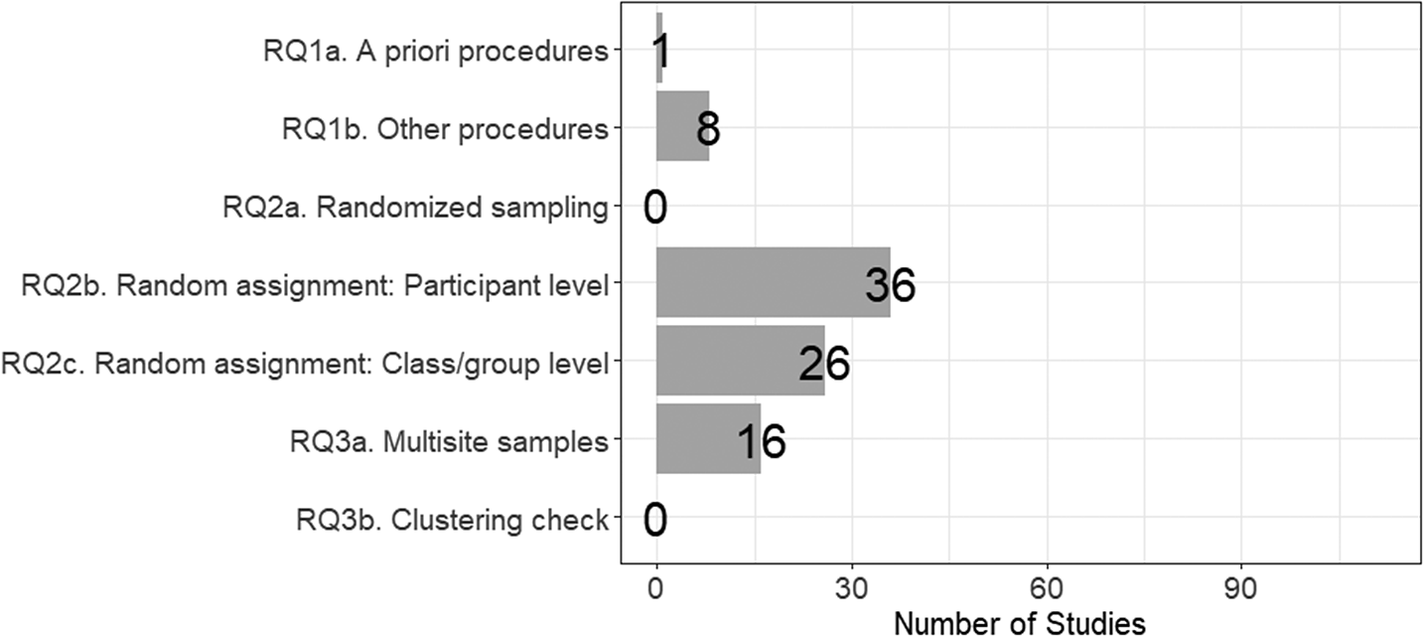
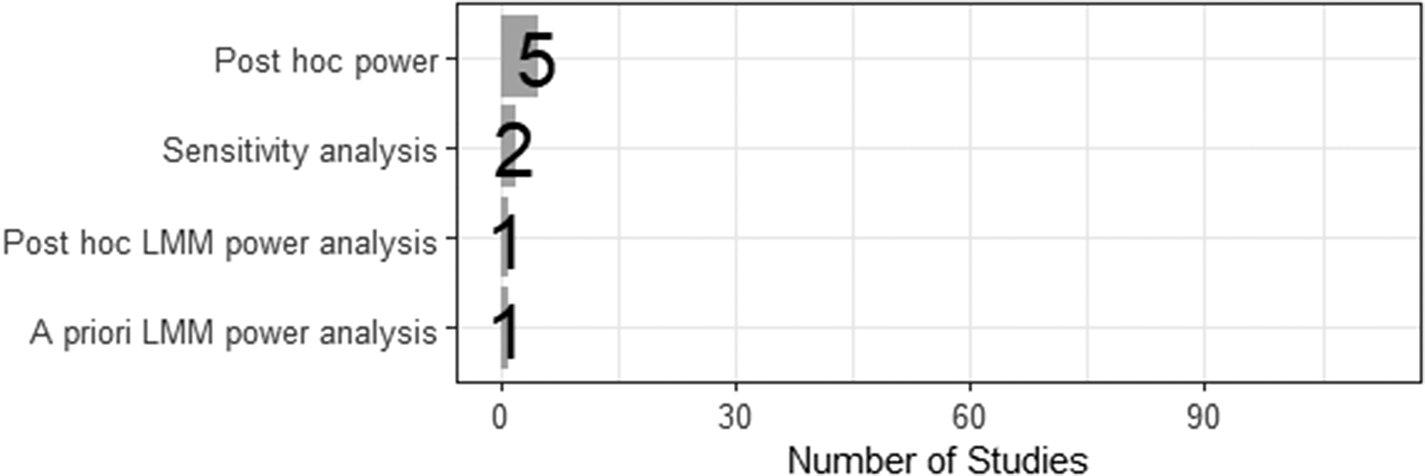
Figure 1 displays the results of the dichotomous coding questions that were detailed in Table 1. Regarding the first research question, merely nine (8.18%)Footnote 5 reports considered power in any fashion, with only one (0.91%) report engaging in a priori sample-size determination procedures referencing past L2 IVA experimental effects (RQ1a), and eight (7.27%) performing other procedures. A follow-up analysis was conducted to investigate which procedures L2 IVA researchers utilized to determine sample sizes. The nine reports in which sample-size planning was utilized were reviewed and coded according to the following coding scheme, which was developed as the process progressed: 1 = Post hoc power; 2 = Sensitivity analysis; 3 = Post hoc LMM power simulation; and 4 = A priori LMM power simulation. The results in Figure 2 show that post hoc power was the most common procedure, accounting for five (4.55%) reports, while two (1.82%) reports involved sensitivity analysis, one (0.91%) included a post hoc LMM power analysis, and one (0.91%) contained an a priori LMM power analysis. With respect to RQ2, no report engaged in randomized sampling procedures (RQ2a). However, 62 (56.36%) reports featured random assignment, with participant-level assignment being more frequent (RQ2b; k = 36 [32.72%]) than class/group level (RQ2c; k = 26 [23.63%]). Finally, the results for RQ3 show that while 16 (14.55%) of the reports included samples constructed from multiple sites (RQ3a), none presented an empirical clustering check (RQ3b).
Sample-size determination, randomization, and multisite usage in 110 L2 IVA research reports.
Note: Although the maximum count is 36, the bar chart displays up to 110 to emphasize how infrequently the procedures were utilized.

Sample-size determination procedures utilized by L2 IVA researchers across 110 reports.
Note: Although the maximum count is five, the bar chart displays up to 110 to emphasize how infrequently the procedures were utilized.

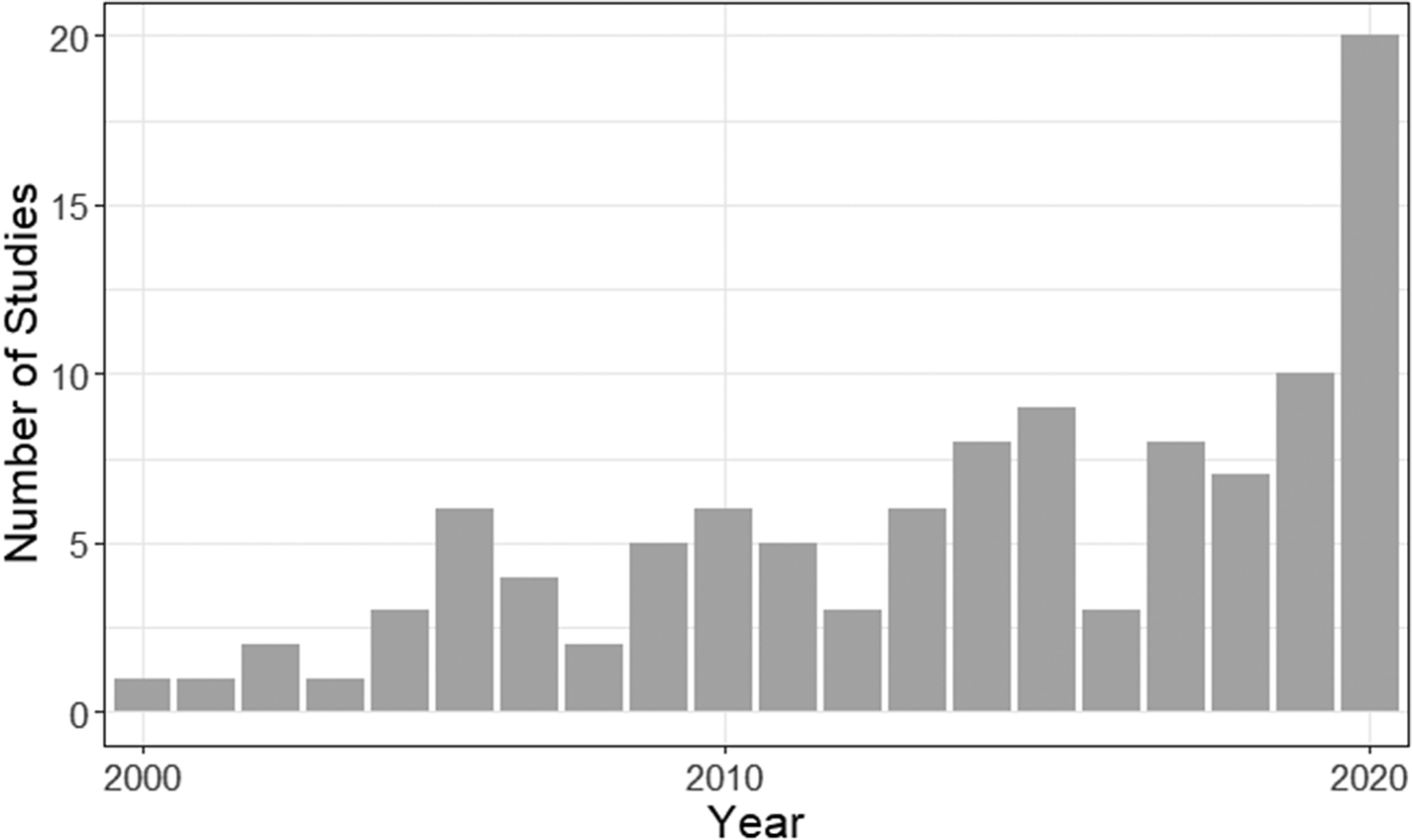
Spearman’s ρ was utilized to answer RQ4 regarding the associations between time and (a) effect size–driven sample-size planning procedures, (b) random assignment, and (c) multisite sample use. Because there was only one report coded “1” (i.e., yes) for a priori planning (RQ1a), it was aggregated with the eight reports featuring other procedures (RQ1b) to represent any sample-size planning procedure. Random assignment at the group and participant levels was conflated given the observation that they are both suitable for L2 experimental designs (Rogers & Révész, Reference Rogers, Révész, McKinley and Rose2020; Vitta & Al-Hoorie, Reference Vitta and Al-Hoorie2021) and the desire to present the results as parsimoniously as possible. The assumptions of ρ were met given the ordinal and ranked nature of the variables and a visual inspection of scatterplots revealed no monotonicity issues (see Supplementary Materials B). Figure 3 shows that the number of L2 IVA experimental reports published in the six journals increased with time. However, there were no practical associations between time and effect size–driven sample-size planning ρ = .18 [–.03; .38] and random assignment, ρ = .06 [–.13; .25], n = 110, with CIs inclusion of zero implying nonsignificant results (Cumming, Reference Cumming2012). A smallFootnote 6 negative relationship was observed between time and multisite sample usage, ρ = –.30 [–.48, –.12], n = 110, with zero outside the CI rendering the relationship significant. In other words, L2 IVA experimental reports employed slightly less multisite samples as time went on. This negative relationship should be read with caution, however, given that only 16 reports were coded as “1” (i.e., yes) and that the upper boundary value (ρ = –.12) of the CI interval implied no practical association.
Number of L2 IVA reports published by year.

Discussion
The results of the current study can be summarized thus to address the four research questions:
-
(a) Few reports featured samples that were planned with effect size–driven sample-size planning procedures (RQ1).
-
(b) Random sampling was entirely omitted while random assignment was inconsistently employed (RQ2).
-
(c) A small minority of the reports featured multisite samples (RQ3).
-
(d) Only multisite sample use displayed a practical and significant association with time where the direction was negative (RQ4).
For each of the three sample design areas investigated, the findings are further analyzed by situating them among relevant observations of past L2 syntheses and then guidance is given in the area using positive examples from the report pool. Finally, the current study’s limitations are presented to constrain the analysis of findings.
Effect Size–Driven Sample-Size Planning in L2 IVA Experiments
Only one (0.09%) of 110 reports presented an a priori sample-size planning procedure, which corresponded to the null observations of Vitta and Al-Hoorie (Reference Vitta and Al-Hoorie2021), Lindstromberg (Reference Lindstromberg2016), and the observation of Plonsky (Reference Plonsky2013) where only 4 of 606 reports might have engaged in a power procedure that was not a post hoc process. The observation that nine (8.18%) of 110 reports (RQ1a + RQ1b) employed any effect size–driven procedure was substantially higher than what has recently been presented to the field (e.g., 2.10% [Farsani & Babaii, Reference Farsani and Babaii2020]; 3.57% [Vitta & Al-Hoorie, Reference Vitta and Al-Hoorie2021]) and seminal syntheses such as Plonsky and Gass (Reference Plonsky and Gass2011; 1.72%). The virtually null association (ρ = .18) between effect size–driven sample-size planning and time reported in this current study can probably be ascribed to such low frequency of yes observations. As a final note, no report analyzed here presented a planning procedure outside of NHST-driven power analyses. This corresponds to past observations (e.g., Nicklin & Vitta, Reference Nicklin and Vitta2021; Vitta & Al-Hoorie, Reference Vitta and Al-Hoorie2021) while highlighting the opportunity to engage with other procedures such as precision (Norouzian, Reference Norouzian2020).
Only one report in the pool involved a priori sample-size planning. Elgort et al. (Reference Elgort, Beliaeva and Boers2020) investigated their participants’ declarative and nondeclarative knowledge of 90 target vocabulary items using meaning generation and self-paced reading tasks, respectively. Because the authors’ data analysis was conducted with LMMs, they conducted a power simulation using R along with the simr package (Green & MacLeod, Reference Green2016). Simr enables simulated data to be constructed based upon parameters from previous research, such as random effect variance and variance-covariance matrices. Researchers select the number of items and participants to be modeled, which can cover a specified range, and the number of simulations to be performed, which can number hundreds or even thousands. The package reports power based upon the number of simulations that resulted in a significant result, along with 95% CI. If, for instance, the package reports that 89% [81, 95] of simulations with 45 participants were significant, but only 82% [74, 87] were significant with 40 participants, then a researcher is justified to conduct their experiment with 45 participants. Elgort et al. conducted a simr power analysis with the results from a previous meaning generation task (Elgort, Reference Elgort2017), which were collected from an L2 sample with comparable proficiency and backgrounds to Elgort et al.’s (Reference Elgort, Beliaeva and Boers2020) participants. Future L2 IVA researchers are advised to adhere to this procedure when planning sample sizes for experiments involving LMM analyses. Furthermore, researchers should report the results of LMMs in full, including coefficients for random effects and correlations between random intercepts and slopes, which are all essential for future power simulations based upon those models.
When researchers use simpler fixed-effect testing designs, they can employ tools such as G*Power or Norouzian’s (Reference Norouzian2020) R functions for calculating precision to plan the number of participants required beforehand. Unlike simulations, these calculations are somewhat straightforward. Because no reports in this current study reported such procedures, Nicklin and Vitta (Reference Nicklin and Vitta2021) is employed here to model the process with fixed-effect designs. This prior study, using G*Power, demonstrated that between-subject experimental designs including treatment, comparison, and true control groups required 492 or 144 participants (split equally into three groups) to meet the respective thresholds. These figures assume the observed small (g s = .33) or medium (g s = .62) L2 IVA effect sizes, where the omnibus one-way ANOVA is followed by post hoc one-way t-tests, a testing procedure also modeled by Brysbaert (Reference Brysbaert2019). Smaller samples could meet power threshold holds using post hoc comparison tests such as Tukey. However, these tests are somewhat problematic because they increase the chance of Type II error (Gravetter & Wallnau, Reference Gravetter and Wallnau2015). Because the reports catalogued by Nicklin and Vitta mostly omitted covariate controls, the researchers suggested powering between-subject designs to the small effect size. In contrast, within-subject counterbalanced designs offered a power advantage whereby 95 to 203 participants are required depending on the correlation between the repeated measures. Higher and lower correlation coefficients respectively inflate or deflate the observed meta-analytic effect size suggested in the study (g av = .25). Norouzian’s precision tool operates in a similar manner, but its use is still emerging in SLA and none of the 110 reports synthesized here utilized the procedure. As a final note, the eight reports catalogued in the current study that involved procedures other than a priori ones are by no means flawed but we have chosen not to review them given the recent emphasis on planning sample sizes before the study is undertaken (Brysbaert; 2019; Brysbaert & Stevens, Reference Brysbaert and Stevens2018; Nicklin & Vitta, Reference Nicklin and Vitta2021; Vitta & Al-Hoorie, Reference Vitta and Al-Hoorie2021).
Randomization
No catalogued L2 IVA report involved randomized sampling. This corresponds to past L2 syntheses such as Plonsky (Reference Plonsky2013, Reference Plonsky2014) and Vitta and Al-Hoorie (Reference Vitta and Al-Hoorie2021) that have omitted the area altogether from their analyses. It is also noteworthy that recent guidance for L2 experimental designs have emphasized random assignment in lieu of randomized sampling (e.g., Rogers & Révész, Reference Rogers, Révész, McKinley and Rose2020). Regarding the other plane of randomization, the observed use of random assignment (56.36%) was approximately the same as the recently observed 58% by Farsani and Babaii (Reference Farsani and Babaii2020), but higher than what most L2 methodological syntheses have observed (e.g., 47% [Plonsky, Reference Plonsky2013]; 36% [Vitta & Al-Hoorie, Reference Vitta and Al-Hoorie2021]; 32% [Lindstromberg, Reference Lindstromberg2016]). The near zero association between its use in the report pool and time (ρ = .06) points to L2 IVA researchers being mindful of the practice for some time. The preference for random assignment at the participant level corresponded to Plonsky (Reference Plonsky2013) who observed the same, while contradicting Farsain and Babaii (Reference Farsani and Babaii2020) who observed the opposite. The observed split in the present study was slightly in favor of participant-level assignment over class/group (58% to 42%) and is thus not overwhelming in terms of redefining the general trend observed in SLA research. More investigations into the area are required.
Regarding randomization guidance for future L2 IVA experimental research, it is probably unreasonable to assume that L2 IVA experimental researchers will have access to the resources required for randomized sampling. For those intending to do so, Hiver and Al-Hoorie’s (Reference Hiver and Al‐Hoorie2020, p. 71) process is useful. The authors referenced Korean government data (Korean Statistical Information Service, 2016 as cited in Hiver & Al-Hoorie) to construct strata in the sample representing population demographic, regional, and socioeconomic differences and then randomly selected participants from each of these strata. Randomized assignment, however, is within the practical scope of L2 IVA experimental design. Sometimes L2 researchers are forced by contextual constraints to use intact classes, but as highlighted by Rogers and Révész (Reference Rogers, Révész, McKinley and Rose2020) random assignment at the class level is an acceptable alternative. Busse et al. (Reference Busse, Cenoz, Dalmann and Rogge2020) provides a useful example of the utility of this procedure. The study explicitly stated that the two intact groups were randomly assigned to either the experimental condition of “multilingual approach with affective-experiential activities” (p. 371) or the comparison condition comprising regular teaching. With such explicit labeling of random assignment, the reader can assume that the researchers worked to eliminate injecting bias into the design in relation to the assignment of learning conditions. In counterbalanced within-subject designs where learners learn target words under different conditions and subgroups experience the conditions in different orders of exposure, there is also room for such explicit labeling. When executing such a design, Folse (Reference Folse2006) featured “a random assignment of practice condition to each (counterbalanced) group” (p. 278) and thus met an expectation of experimental sample design dating back to Fisher (Reference Fisher1935). The overarching point is that L2 IVA experimental samples, regardless of their variation across designs, can feature random assignment.
Multisite Sample Use
A randomized sample from a meaningful population having all participants from a single school or university has a probability of virtually zero (Nicklin & Vitta, Reference Nicklin and Vitta2021; Vitta & Al-Hoorie, Reference Vitta and Al-Hoorie2021). Such single-site convenience samples accordingly present bias and external validity limitations that are difficult to overcome no matter the sample size (Morgan-Short et al., Reference Short, Marsden, Heil, Issa, Leow, Mikhaylova, Mikołajczak, Moreno, Slabakova and Szudarski2018; Moranski & Ziegler, Reference Moranski and Ziegler2021). Multisite sample use appears underresearched in past L2 methodological syntheses but the observed frequency of multisite sample use in this current study (16 [14.54%] of 110 L2 IVA experimental reports) corresponds to Vitta and Al-Hoorie (Reference Vitta and Al-Hoorie2021), who reported that 18% of 56 L2 flipped learning experiments featured such samples. These low frequencies highlight the need for L2 experimental designs to employ multisite samples. Furthermore, more L2-focused methodological syntheses investigating the issue are required. The observation that no multisite sample report checked the statistical clustering effect (RQ3b) among different sites highlights a tangential area of improvement. As highlighted by Morgan-Short et al., these different sites constitute a random effect and when its influence is marginal we can feel more confident about the generalizations that the sample can facilitate about the population.
The observed small, yet trustworthy (CI boundaries outside of zero; Cumming, Reference Cumming2012) negative association between time and multisite use in L2 IVA experimental research was a surprising finding as L2 research is undergoing a reform with observed improvement over time (e.g., Lindstromberg, Reference Lindstromberg2016). From the report pool (see Supplementary Materials A), one might notice that several researchers have published numerous reports over time. L2 IVA, given its classroom focus, could have naturally gravitated toward single-site samples to which these researchers had access. This is by no means a criticism of these inquiries and indeed L2 IVA is squarely within the instructed SLA arena where this classroom focus is justified (Loewen & Sato, Reference Loewen, Sato, Loewen and Sato2017). Vocabulary represents an area of interest to both teachers and researchers (Nicklin & Vitta, Reference Nicklin and Vitta2021) and thus teachers who decided to conduct L2 IVA experiments would use their classrooms and schools in conducting their research. In both cases, the observed growth in L2 IVA research over time visible in Figure 3 could also contribute to the negative association where more single-site studies increased with the growth of L2 IVA publications.
What becomes clear in light of these findings is that L2 IVA experimental designs have room for improvement in terms of the frequency and manner of multisite sample use. To help realize such improvement, we present four points of guidance for constructing future L2 IVA experimental samples. To provide such guidance, reports from our pool featuring multisite samples are referenced in relation to how future L2 IVA designs could improve upon them. The first point of guidance is that the multisite sample planning process should begin with an a priori effect size-driven sample-size planning process. None of the 16 multisite reports catalogued in this current synthesis engaged in any such process and this can be improved upon by future designs. Nicklin and Vitta (Reference Nicklin and Vitta2021) provided L2 IVA-specific effect sizes and G*Power a priori power calculations for several common statistical analyses adopted by L2 IVA researchers that can be used as a starting point for sample-size planning. For those wishing to use precision, these L2 IVA effect sizes could be entered into Norouzian’s (Reference Norouzian2020) R programs for calculating precision.
After estimating the number of participants required, the second point highlights the need for researchers to collaborate with colleagues to gain access to multiple sites from the intended population that are representative of differences and diversity within it. The fact that 12 of the 16 multisite reports in our pool had multiple authors indirectly substantiates the need for such collaboration. As a reference point regarding representativeness, Kim (Reference Kim2008) made L2 IVA inferences about the American ESL population from data collected from a midwestern American university and southeastern one. Data from the Eastern seaboard and West Coast locations would add to the robustness of the generalizations that future replications of the study could have (Morgan-Short et al., Reference Short, Marsden, Heil, Issa, Leow, Mikhaylova, Mikołajczak, Moreno, Slabakova and Szudarski2018). However, it is important to note that multisite samples are still convenience samples at the conceptual level, as argued in the preceding text, and represent only a compromise between the ideal randomized sample and flawed single-site samples (Vitta & Al-Hoorie, Reference Vitta and Al-Hoorie2021).
To better realize this compromise, the third guidance point pertains to how future designs could incorporate a degree of randomization to these convenience samples. We exemplify this using Webb and Kagimoto (Reference Webb and Kagimoto2009), who wisely drew their sample from two universities in Fukuoka and investigated verb-noun collocations such as raise questions. A replication of the study could involve collaborators to enable access to sites across Japan. After utilizing a priori effect size–driven sample-size planning, the replication researchers could recruit access to 150% to 200% of the participants required to meet the predetermined threshold. Sites could then be randomly excluded until 120% of the participants remain. This random exclusion works to somewhat mitigate the bias that a convenience sample of multiple locations would have.
To check for the clustering effect of multiple sites, which constitutes the final guidance point, there are two options that most L2 IVA researchers could execute. The first option is an a priori check. In this current study, such an assessment revealed that for all coded sample design judgments, except multisite sample use, the effects of which journal published the report were nonsignificant. When using multisite samples in L2 IVA research, a nonsignificant effect of the location grouping variable allows for a circumspect claim that clustering concerns are mitigated and thus generalizability to the population are enhanced. The second option involves analysis with LMMs where the sites can be incorporated as a random effect (Morgan-Short et al., Reference Short, Marsden, Heil, Issa, Leow, Mikhaylova, Mikołajczak, Moreno, Slabakova and Szudarski2018) and the contribution of the fixed (experimental) and random effects can be ascertained separately. The lower the effect of the sites, the stronger the evidence is that the data from the multisite sample is representative of the intended population.
Limitations
The analysis of the findings of this current study, a focused methodological synthesis, should be viewed in conjunction with its unavoidable limitations, of which three are most consequential. First, only six journals have been analyzed and thus publication and selection bias are concerns. The journal selection process, however, was systematized to represent perhaps the highest quality L2 IVA experimental research as SSCI journals have been observed to present higher quality quantitative research than journals not in the index (Al-Hoorie & Vitta, Reference Al-Hoorie and Vitta2019). Even with this SSCI-focus, the observed frequency of reports satisfying the three aspects of experimental design that were considered was still low overall. The next limitation was the focused nature of this synthesis. There are other important aspects to sample design such as under- and over-investigated populations. Andringa and Godfroid (Reference Andringa and Godfroid2020) highlighted for instance that Western, educated, industrialized, rich, and democratic (WEIRD; Henrich et al. [2010], as cited in Andringa & Godfroid, Reference Andringa and Godfroid2020]) samples dominate L2 quantitative research and thus such populations are overinvestigated. The areas presented in the present study are important, but not everything that should guide future L2 IVA experimental sample construction. Finally, the low number of reports satisfying the three aspects under consideration constrained the statistical analysis presented in this report. This was especially the case in the correlational analysis between time and coded sample design aspects addressing RQ4.
Conclusion
In this focused methodological synthesis, we analyzed 110 L2 IVA experimental reports and synthesized three sample design features: effect size–driven sample-size planning, randomization, and multisite use. From relevant literature (e.g., Cohen, Reference Cohen1988; Fisher, Reference Fisher1935; Morgan-Short et al., Reference Short, Marsden, Heil, Issa, Leow, Mikhaylova, Mikołajczak, Moreno, Slabakova and Szudarski2018), there is a strong argument that the three areas investigated in this current study work together to support the generalizability of inferential testing conducted on data from the samples. With the exception of randomized assignment, few reports satisfied the required criteria of these areas and thus this report acts as a call for sample design improvement in future L2 IVA experimental research. The low frequency of reports coded as meeting expectations in these areas corresponded to past syntheses (e.g., Farsani & Babaii, Reference Farsani and Babaii2020; Lindstromberg, Reference Lindstromberg2016; Plonsky, Reference Plonsky2013; Vitta & Al-Hoorie, Reference Vitta and Al-Hoorie2021). Unlike some past L2 research syntheses, where observed quantitative design quality, in the main, improved with time (e.g., Lindstromberg, Reference Lindstromberg2016), time did not associate with most of the methodological features synthesized here. The only significant association was a small negative effect between time and multisite use which was surprising given the ongoing state of L2 methodological reform (Gass et al., Reference Gass, Loewen and Plonsky2021). As highlighted in the discussion, however, the interpretation of this negative correlation needs to be made with caution. Finally, guidance on how future L2 IVA experimental research could improve in the three areas synthesized was provided referencing results and examples from the report pool.
Supplementary Materials
To view supplementary material for this article, please visit http://doi.org/10.1017/S0272263121000541.
Competing Interest
None.