INTRODUCTION
Invasive weeds are transformative, changing the character of natural ecosystems over substantial areas (Richardson et al. Reference RICHARDSON, PYSEK, REJMANEK, BARBOUR, PANETTA and WEST2000) often resulting in homogenized biospheres of non-indigenous species (McKinney & Lockwood Reference MCKINNEY and LOCKWOOD1999). Empirical studies have shown that invasive weeds can negatively impact habitat selection and use by both wild and domestic ungulates (Hein & Miller Reference HEIN and MILLER1992, Trammell & Butler Reference TRAMMELL and BUTLER1995). For example, elk (Cervas elephas nelsoni) in Western Montana were attracted to habitats where the invasive knapweed (Centaurea spp.) had been removed (Thompson Reference THOMPSON1996). Invasive weeds compete with and replace native forage species (Belcher & Wilson Reference BELCHER and WILSON1989) thereby reducing the amount of food available to herbivores (DiTomaso Reference DITOMASO2000) through reduced forage production (Lym & Messersmith Reference LYM and MESSERSMITH1985).
One invasive weed of international significance is Lantana camara L., which was introduced to India from South America at the Indian Botanic Garden, Calcutta, as an ornamental plant in 1809 (Thakur et al. Reference THAKUR, AHMAD and THAKUR1992). This widely invasive species grows particularly well in unshaded, anthropogenically disturbed habitat (Gentle & Duggin Reference GENTLE and DUGGIN1997, Sharma et al. Reference SHARMA, RAGHUBANSHI and SINGH2005).
The Asian elephant (Elephas maximus) is a wide-ranging species traversing human-made administrative boundaries (Baskaran et al. Reference BASKARAN, BALASUBRAMANIAN, SWAMINATHAN, DESAI, Daniel and Datye1995, Desai Reference DESAI1991). Humans have converted and developed forest habitat for agriculture or urban development (Desai & Baskaran Reference DESAI and BASKARAN1996) making the conservation of large herbivores such as elephant challenging. In addition to illegal logging, cattle grazing, collection of fuel wood and non-timber forest produce, weed invasion appears to threaten many conservation areas including elephant habitat in the Nilgiri Biosphere Reserve, south India (Desai & Baskaran Reference DESAI and BASKARAN1996, Silori & Mishra Reference SILORI and MISHRA2001).
Elephants are megaherbivores which require large amounts of forage to survive. The primary impact that L. camara has on elephant habitat is a reduction in grass cover. As L. camara spreads, grass cover declines and is replaced by L. camara because both vie for the same space (Wilson, unpubl. data). This reduction may be most pronounced in dry deciduous forest (DDF) where grass is the dominant food source for elephants and where elephant density is highest in the dry season (Sivaganesan Reference SIVAGANESAN1991, Sivaganesan & Johnsingh Reference SIVAGANESAN, JOHNSINGH, Daniel and Datye1995).
In this study, we examined the influence of L. camara on habitat use by elephant at the landscape level and within habitat in Mudumalai Tiger Reserve, southern India. The following hypotheses were tested: (1) the addition of L. camara significantly predicted elephant habitat use across habitats at the landscape level; (2) models containing L. camara better explained elephant habitat use across habitats using an information-theoretic approach; (3) finally, because our results indicated a significant interaction between the DDF and L. camara, we tested whether L. camara significantly influenced habitat use by elephant within the DDF at a lower spatial scale.
METHODS
Study site and methods
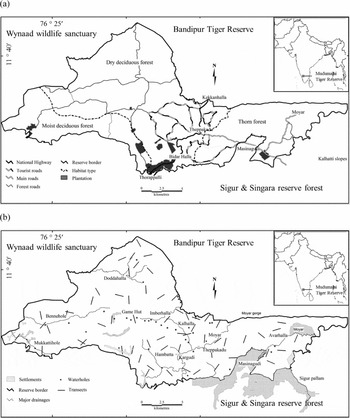
Mudumalai Tiger Reserve (hereafter Mudumalai; 11°32′–11°42′N, 76°20′–76°45′E) includes 321 km2 of plains and foothills of the Nilgiri district in Tamil Nadu state, southern India. The reserve is bounded to the north by Bandipur Tiger Reserve and to the west and north-west by Wynaad Wildlife Sanctuary. Singara and Sigur Reserve forests form Mudumalai's southern and eastern boundaries (Figure 1a). Mudumalai and its surrounding reserves are part of the 5500-km2 Nilgiri Biosphere Reserve (NBR) (Sukumar et al. Reference SUKUMAR, SURESH, DATTARAJA, JOHN, JOSHI, Losos and Leigh2004). The wild elephant population in Mudumalai ranges from approximately 350 to 1000 elephants depending on seasonal movement of elephants across the NBR (Baskaran et al. Reference BASKARAN, UDHAYAN and DESAI2010a, Daniel et al. Reference DANIEL, DESAI, SIVAGANESAN and RAMESHKUMAR1987).
Mudumalai Tiger Reserve and its location in India showing the reserve with the major habitats: moist deciduous, dry deciduous and thorn forest delimited by a line. The road network distinguished as National Highway, main road for public use, tourist roads where only forest department vehicles are permitted, and forest roads are shown. Plantations are shown as black dotted patches (a); layout of the 62 transects across Mudumalai. Major drainages are shown by dotted lines. The location of water holes is shown by stars. Settlements are shaded in grey (b).

Tropical forest types in Mudumalai include moist deciduous, dry deciduous (mixed and Shorea vegetation) and thorn forest (Champion & Seth Reference CHAMPION and SETH1968) (Figure 1a). Tectona grandis plantations and native trees were commercially logged in Mudumalai from the beginning of the 19th century and continued until the 1980s (Srivastava Reference SRIVASTAVA2009). The presence of L. camara was described as a problem to the dry deciduous forest and T. grandis plantations in Mudumalai, Benne and Theppakadu blocks of Mudumalai in 1941 (Ranganathan Reference RANGANATHAN1941).
Field observations and measurements were conducted between January and May 2009, and November 2009 and May 2010 to estimate elephant dung density and habitat assessments. A topographic map (1 : 50 000) of Mudumalai derived from ground surveys was divided into 94, 2 × 2-km cells using MapInfo Professional 7.8 (MapInfo Corporation, Troy, New York, USA). Sixty-two cells were selected randomly to receive a 1-km transect. Transect locations are shown in Figure 1b. Each transect's start coordinates were randomly located within each cell. End coordinates were obtained from a randomly selected compass direction 1-km away from the start coordinates, uploaded on to a handheld GPS (Garmin 60) using Garmin MapSource 6.11.6 (Garmin Ltd. Olathe, USA), and located on foot.
Elephant dung density as an index of elephant distribution and habitat use
We used elephant dung density to assess elephant habitat use. Elephant dung density has been used as an index of elephant distribution and habitat use for both African forest elephant (Loxodonta africana cyclotis) (Barnes et al. Reference BARNES, BARNES, ALERS and BLOM1991) and Asian elephant (Varma Reference VARMA2008). Line transects as described by Buckland et al. (Reference BUCKLAND, ANDERSON, BURNHAM, LAAKE, BORCHERS and THOMAS2004) were used to estimate elephant dung densities and the data were analysed using the program DISTANCE 6.0 (Thomas et al. Reference THOMAS, BUCKLAND, REXSTAD, LAAKE, STRINDBERG, HEDLEY, BISHOP, MARQUES and BURNHAM2010). The perpendicular distance of all dung piles sighted from the line transect was measured using a standard 30-m measuring tape. Estimates of dung density were obtained from the perpendicular distances (Barnes & Jensen Reference BARNES and JENSEN1987).
Predictors of variation in elephant dung density
We reviewed the literature on elephant habitat use to derive a set of likely environmental variables that have previously been suggested to influence elephant distribution and density in Mudumalai (Daniel et al. Reference DANIEL, DESAI, SIVAGANESAN and RAMESHKUMAR1987, Desai & Baskaran Reference DESAI and BASKARAN1996, Sivaganesan Reference SIVAGANESAN1991). To estimate L. camara invasion intensity, the girth of all L. camara stems were measured at ground level within 10 × 1-m plots defined every 100 m to sample at 11 plots along each transect. We used 1-cm categories. The average L. camara girth for each plot was averaged over all 11 plots to give a L. camara invasion intensity for each transect.
Grass cover (forage) and canopy cover (shade) were estimated in each plot. A visual estimate of percentage grass cover to the nearest 5% cover was recorded in the plots. The average of all values of grass cover for each plot was used as the estimate for each transect. Canopy cover along each 1-km transect was estimated every 100 m using a 24 × 16-cm convex mirror divided into 24 equal cells (6 × 4 cells) and placed on the ground to reflect the canopy. If a cell reflected > 50% canopy cover then it was counted as having canopy cover. If a cell reflected < 50% canopy cover, it was ignored. Percentage canopy cover at the point was estimated as an index of shade. The average value of canopy cover from all points along each transect was used as the estimate in the analysis.
The size and thus potential impact of settlements on elephant varied throughout Mudumalai. We therefore had three categories for the variable settlement: (1) if a transect fell more than 2 km from a minor settlement; (2) if a transect fell within 2 km from a minor settlement; and (3) if a transect fell within 2 km of a major settlement. Similarly, the potential impact of roads on elephant differed, with the greatest impact from the National Highway passing through Mudumalai. This highway was considered to have the highest impact because vehicular traffic that included goods, passenger, tourist and private vehicles used the National Highway. The impact of roads were categorized as follows: (1) Kekkanhalla to Theppakadu and Theppakadu to Masinagudi; (2) Theppakadu to Bidderhalla; (3) Bidderhalla to Thorappalli; (4) Kalhatti slopes; (5) forest roads within the tourist zones in Mudumalai where only Forest Department vehicles are allowed; (6) all other roads within Mudumalai (Figure 1a). As the Moyar river runs parallel to the National Highway between Theppakadu and Bidderhalla, this part of Mudumalai was considered to have high impact on elephant because elephants regularly crossed the roads to drink from the river but were often stranded because of vehicular traffic. Within Mudumalai, smaller forest roads that were used only by the forest department's tourist vehicles had less impact while roads beyond the tourism zone were considered to have minimal impact on elephant distribution and habitat use.
To measure water availability, linear distances between the midpoint of each transect and the closest waterhole were measured from 1 : 50 000 topographic maps using MapInfo Professional 7.8 (MapInfo Corporation, Troy, New York, USA) (Figure 1b). The influence of anthropogenic fire on each transect was assessed by calculating the time since the last burn occurred in the area sampled. Thus, a transect sampled in 2009 that had burned in the year 2008 was given a value of one indicating that it was at least 1 y since it last burned. If more than 50% of a transect length burned in a particular year, it was considered as burned that year. Data on fire burns between 2003 and 2008 were obtained from the Tamil Nadu Forest Department Management Plan (Srivastava Reference SRIVASTAVA2009), as monitored by Centre for Ecological Sciences, Indian Institute of Science, Bangalore. One of us (GW) recorded whether the transect burned in the year of sampling. Transects were overlaid on these fire maps and assessed.
Statistical methods
DISTANCE program 6.0 (Thomas et al. Reference THOMAS, BUCKLAND, REXSTAD, LAAKE, STRINDBERG, HEDLEY, BISHOP, MARQUES and BURNHAM2010) was used to analyse estimates of elephant dung density along the transects. Data filters and models were performed at various levels of truncation to improve the model fit (Buckland et al. Reference BUCKLAND, ANDERSON, BURNHAM, LAAKE, BORCHERS and THOMAS2004). The fit of the best possible model was determined by using Akaike's Information Criterion (AIC) (Akaike Reference AKAIKE, Petrov and Csàki1973) values that were generated by the program as well as by visually judging the fit of the proposed model to the observed distance data close to the line transect.
Dung density was first examined for normality. The skewness and kurtosis were both within the limits of normality and so normal theory models were used. Throughout, we used the Generalized Linear Model approach (McCullagh & Nelder Reference MCCULLAGH and NELDER1983), with normally distributed errors and the identity link, as this allowed comparable analyses between the General Linear Models and the information–theoretic (I–T) approach. To investigate multicollinearity between the predictor variables, a correlation analysis was conducted. The largest correlation across habitats was between grass cover and L. camara, and was −0.360. We therefore concluded that multicollinearity was not a significant issue with these data, and the parameter estimates and P-values were valid. SPSS Statistics, release version 20.0 (IBM SPSS Inc., Chicago, IL, USA) was used to analyse the data.
Our first hypothesis tested whether the addition of L. camara to other environmental variables significantly predicted habitat use by elephant across habitats in Mudumalai. We used a Generalized Linear Model (with a normal distribution and identity link) to predict elephant usage (based on dung density estimates).
Our second hypothesis tested whether models containing L. camara better explained elephant habitat use across habitats. We used an I–T approach (Burnham & Anderson Reference BURNHAM and ANDERSON2002) to develop the best model using available environmental (predictor) variables to explain elephant habitat use based on dung density estimates across Mudumalai. The I–T methods provide formal measures of the strength of evidence for alternative models, given the data (Hegyi & Garamszegi Reference HEGYI and GARAMSZEGI2011). The I–T approach allows us to rank and weigh multiple competing models. We used a second-order Akaike's Information Criterion (AICc) as our I–T statistic because models were large (i.e. with up to 51 explanatory variables; Burnham & Anderson Reference BURNHAM and ANDERSON2002). Models with Δ AICc ≤ 2 were considered to have substantial support from the data and models with Δ AICc > 12 to have no support or be implausible (Burnham & Anderson Reference BURNHAM and ANDERSON2002).
Our third hypothesis examined whether L. camara along with significant environmental variables predicted habitat use by elephant within the dry deciduous forest. A Generalized Linear Model (with a normal distribution and identity link) was used to predict elephant usage (based on dung density estimates) using the main effect of L. camara and significant environmental variables from the models and tested for overall significance.
RESULTS
Elephant dung density and Lantana camara
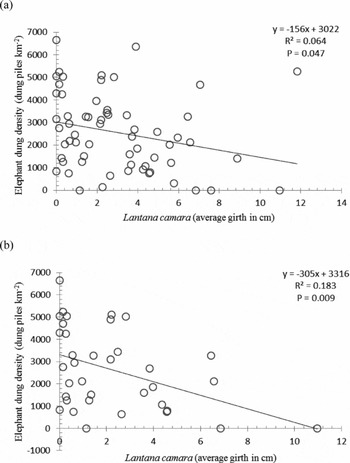
The number of elephant dung piles counted along 1-km line transects varied between zero and 32 dung piles in Mudumalai. Estimates of dung pile density based on the DISTANCE algorithm ranged from zero to 6650 dung piles km−2 with an interquartile range of 2265 dung piles km−2. Lantana camara density per 10 × 1-m plot varied from 0 to 39 individuals and average stem girth per 10 × 1-m varied from 0.14 cm to 11.8 cm. There was a significant negative correlation between elephant distribution and L. camara at the landscape level (r = −0.253, n = 62, P = 0.047, Figure 2a).
The relationship between elephant dung density (dung piles km−2) and Lantana camara across habitats (a) and in the dry deciduous forest (b) in Mudumalai Tiger Reserve.

Influence of Lantana camara on elephant habitat use at the landscape level in Mudumalai
We first fitted a model (Model 1) which included habitat, impact of settlement, impact of roads, canopy cover, grass cover, fire, distance to water, and second-order interactions between factors. This model overall did not significantly predict dung density (χ2 = 28.6, df = 23, R2 = 0.37, P = 0.191, AICc = 1440.56). Impact of settlement (P = 0.007), impact of roads (P = 0.035) and habitat by impact of settlement interaction (P = 0.030) were individually significant.
To examine our first hypothesis that the addition of L. camara significantly predicted dung density across all habitats, we added L. camara to Model 1, to give Model 2. This model, overall did not significantly predict dung density (χ2 = 30.4, df = 24, R2 = 0.39, P = 0.172, AICc = 1582.19). Only impact of settlement (P = 0.003) and habitat by impact of settlement interaction (P = 0.024) were significant predictors of dung density.
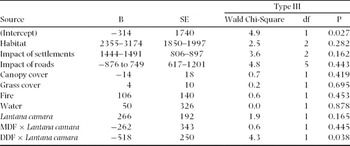
Model 3 included habitat, impact of settlements, impact of roads, canopy cover, grass cover, fire, water, L. camara and its interaction with habitat (DDF by L. camara, MDF by L. camara). Model 3 did not significantly predict dung density (χ2 = 21, df = 16, R2 = 0.81, P = 0.178, AICc = 1130.02). The only significant predictor in the model was DDF by L. camara interaction (P = 0.038, Table 1).
Model 3 with Lantana camara on its own, the interaction terms of L. camara with the dry deciduous (DDF) and moist deciduous forest (MDF) and environmental variables predicting elephant dung density estimates across habitats in Mudumalai Tiger Reserve. The beta coefficients, SE, Wald Chi-Square and levels of significance with main effects of environmental variables measured are shown. Factors (habitat, impact of settlements and roads) are entered as multiple dummy variables. For categorical factors with greater than two levels, the ranges of beta coefficients and SE are given.

Lantana camara was significantly related to dung density (χ2 = 4.1, df = 1, R2 = 0.06, P = 0.039), but when other variables were accounted for, the relationship between L. camara and dung density was only through habitat. In particular, L. camara had a strong negative relationship with dung density in the DDF (P < 0.05).
Comparison of models using the information–theoretic approach
Our second hypothesis tested whether models containing L. camara better explained elephant habitat use across habitats. We used the I–T approach to develop the most informative model. Model selection using the I–T approach indicated that the model explaining elephant habitat use based on elephant dung-density estimates was Model 3 that included habitat, impact of settlement, impact of road, canopy cover, grass cover, fire, distance to water, L. camara and its interaction with DDF (∆AICc ≤ 2; ωi = 1.000). This was the only model to receive any support. The two other models (Model 1 and Model 2) received no support and were implausible (i.e. ∆AICc > 10, Table 2).
Three statistical models for elephant habitat use in Mudumalai Tiger Reserve between January and May 2009 and November 2009 and May 2010. The models are in descending order based on the second-order Akaike's Information Criterion (AICc). The model consisting of Lantana camara and its interaction with habitat along with other environmental variables was the leading model and only model to receive substantial support. K is the number of parameters in each model which includes the intercept.

Influence of Lantana camara on elephant habitat use within the dry deciduous forest in Mudumalai
Our third hypothesis tested whether L. camara significantly influenced habitat use by elephant at a lower scale, within habitat. We analysed the data for the DDF separately given that the interaction term DDF by L. camara was significant in Model 3.
The model included impact of settlement, impact of road and L. camara which significantly predicted dung density in the DDF (χ2 = 8.6, df = 3, P = 0.04). Lantana camara was the only significant predictor (χ2 = 4.6, df = 1, P = 0.03, B = −300 ± 140). There was a significant negative correlation between elephant distribution and L. camara in the DDF (r = −0.427, n = 36, P = 0.009, Figure 2b). There was also a significant negative correlation between per cent grass cover and L. camara (r = −0.565, n = 36, P < 0.05) in the DDF.
DISCUSSION
Influence of Lantana camara on elephant habitat use at the landscape level in Mudumalai
Our first hypothesis determined whether the addition of L. camara had an influence on elephant habitat use in Mudumalai. The results of our study found no evidence that the addition of L. camara did influence elephant habitat use at the landscape level, however, we did find support for the hypothesis that L. camara negatively influenced elephant habitat use within the DDF at a lower spatial scale.
Our study shows that habitat and the impact of settlements are associated with elephant habitat use in Mudumalai and appear to have substantially more of an influence on elephant distribution and habitat use at the landscape level than L. camara. Although elephants are known to use all habitats throughout the year in MTR, their densities vary across habitats (Sivaganesan Reference SIVAGANESAN1991). Movement across different habitats is governed by seasons and home ranges (Baskaran Reference BASKARAN1998, Sukumar Reference SUKUMAR1989). Elephants have large home ranges in excess of 550 km2 in the study area (Baskaran et al. Reference BASKARAN, BALASUBRAMANIAN, SWAMINATHAN, DESAI, Daniel and Datye1995) and hence they move across multiple habitats based on movement patterns established by individual clans and bulls. So habitat-use at the landscape level is largely governed by seasonal changes in resource availability. Additional problems in detecting the influence of L. camara on elephant distribution at the landscape level originate because elephants may have used L. camara areas just for resting or to pass through while looking for suitable feeding grounds and feeding on available grass patches around L. camara and during this time may have defecated. Such habitat use would make the influence of L. camara less visible, especially at the landscape level.
Invasive weeds such as L. camara on the other hand, would potentially influence elephant habitat use at lower scales covering smaller patches within a given habitat. Lantana camara patches are significantly smaller than settlements. Additionally, L. camara patches are not uniformly distributed and hence the influence of L. camara for different transects could vary, unlike settlements which are avoided by elephants (Desai & Baskaran Reference DESAI and BASKARAN1996) and their impact therefore is uniform for a given distance from the settlement. However, L. camara has an influence on a much smaller spatial scale which represents smaller areas within a habitat. This is clearly evident as the interaction term, DDF by L. camara, in Model 3 is statistically significant. Hence, analysing the influence of L. camara within individual habitats is more appropriate, as on a larger spatial scale, variables such as habitat and settlements confound the results.
Comparison of models using the information–theoretic approach
Our second hypothesis tested whether models containing L. camara better explained elephant habitat use across habitats by using the I–T approach to compare models explaining elephant habitat use. The addition of L. camara to the model that included habitat, impact of settlement, impact of roads, canopy cover, grass cover, fire, distance to water, and second-order interactions between factors was not supported nor was the model without L. camara. The only model that received strong support was Model 3 that included habitat, impact of settlements, impact of roads, canopy cover, grass cover, fire, water, L. camara and its interaction with habitat (DDF by L. camara, MDF by L. camara). The only significant predictor in this model was the interaction term, L. camara by DDF, indicating that L. camara may in fact have a role at a different spatial scale.
Influence of Lantana camara within the dry deciduous forest of Mudumalai
Our third hypothesis determined whether L. camara significantly influenced habitat use by elephant within the DDF, since the interaction between L. camara and DDF was significant. Given that habitat and impact of settlements may confound the results at larger spatial scales, one would therefore expect that an analysis on a smaller spatial scale, within individual habitats, would show that L. camara has an influence on elephant distribution; especially within habitats. Our results indicated a significant influence of L. camara in the DDF. These results are supported by other empirical studies that have shown a negative impact of invasive weeds on ungulates (Hein & Miller Reference HEIN and MILLER1992, Trammell & Butler Reference TRAMMELL and BUTLER1995). Typically the elephant is more dependent on grass in the DDF and the thorn forest (TF) than in the moist deciduous forest (MDF) (Baskaran Reference BASKARAN1998, Sivaganesan & Johnsingh Reference SIVAGANESAN, JOHNSINGH, Daniel and Datye1995). However, the negative correlation between L. camara and grass cover implies that the elephant may be avoiding areas where there is more L. camara due to the loss of grass. The negative correlation between elephant distribution and L. camara was statistically significant in the DDF but was not statistically significant in the TF and MDF. Grass is not a major food source in MDF but is a dominant food in both DDF and TF (Baskaran et al. Reference BASKARAN, BALASUBRAMANIAN, SWAMINATHAN and DESAI2010b). Thus, analysis at the landscape level results in the major predictors for movement at larger scales (habitat and impact of settlements) to be detected but L. camara drives habitat selection at a far smaller scale of a few ha to a few km2 and hence its influence is more easily detected when within-habitat assessment is performed.
Implications for conservation
Invasive weeds such as L. camara influence elephant at different spatial scales and have different influences in different habitats. Our study finds no evidence that L. camara has affected elephant habitat use at the larger spatial scale of a landscape, but we did find support for the hypothesis that L. camara does have an influence at the smaller spatial scale of a single habitat. Since L. camara patches are not uniformly distributed and elephant do not eat L. camara, they are forced to selectively graze within and around L. camara patches (Wilson, unpubl. data). The primary influence L. camara has on the elephant habitat is the reduction of grass cover. This is clearly seen from the negative correlation L. camara has with grass in the dry deciduous forest. The presence and spread of L. camara can therefore be considered as being adverse to elephants and other grazing herbivores. Selective grazing can reduce available forage and possibly favour the spread of invasive weeds (Lym & Kirby Reference LYM and KIRBY1987, Vavra et al. Reference VAVRA, PARKS and WISDOM2007) such as L. camara. This selective grazing in turn could reduce the overall carrying capacity of elephants in Mudumalai. In North Dakota, leafy spurge (Euphorbia esula)-infested areas represented an annual herbage loss of 35% (Lym & Kirby Reference LYM and KIRBY1987). A similar loss to grass and other native tree species may be occurring within Mudumalai. Lym & Kirkby (Reference LYM and KIRBY1987) reported an increased use of sites by cattle not infested by leafy spurge, which decreased preferred herbage and decreased species diversity. An increased use of non-infested sites would reduce the carrying capacity as a result of over-grazing and over-browsing of sites free of infestations (Trammell & Butler Reference TRAMMELL and BUTLER1995). Managers should consider removal of weeds particularly in the DDF, and thereby increase forage production in order to maintain habitat suitability for elephants and other grazing herbivores.
As L. camara densities vary in different vegetation (Wilson, unpubl. data) and the evidence shows that L. camara influences habitat use at different spatial scales, it would be important that further studies at different spatial scales within each habitat be conducted to assess the true impact of L. camara on elephant and their habitat use. Our study indicates that the effect of L. camara is not uniform, and thus L. camara management could focus on specific habitats enabling managers to use their limited resources where they are most required.
ACKNOWLEDGEMENTS
Thanks to the Principal Chief Conservator of forests & Chief Wildlife Warden, Tamil Nadu (Ref. No. WL5/57210/2008), and Dr Rajiv K. Srivastava, Field Director, Mudumalai Tiger Reserve, for permitting the study to be carried out (Ref. No. T/7240/2008). Funding for this project was provided by Rufford Small Grants, UK, United States Fish and Wildlife Services (96200-9-G171, Grant No. ASE-0435) and Mohammed Bin Zayed Species Conservation Fund (Project number: 1025959). We thank N. Kalaivanan, who helped establish the project in Mudumalai. We extend our thanks to Phil J. Lester, R. Nagarajan, Monica A.M. Gruber and M. Ashok Kumar for statistical advice and comments on previous drafts of this manuscript. Maps of the study area were provided by N. Mohanraj, WWF-India. Thanks to field assistants and forest staff of Mudumalai for their help and cooperation.