The received wisdom is that protectionism rises during economic recessions. Much of the empirical support for this claim is drawn from work on the United States,Footnote 1 although the extant research is hardly limited to this country.Footnote 2 Despite the pervasive view that dips in the business cycle generate anti-trade sentiment, however, little empirical research has attempted to evaluate whether recessions prompt the mass public to become more hostile to trade and, if so, why.
In this study, we address whether the American public became more protectionist during the Great Recession of 2007–09, the worst economic downturn in the United States since the Great Depression. We surveyed a representative sample of Americans in July 2007 – before the recession’s onset – and the same individuals again in July 2009 – after the recession’s conclusion. During this period, the US unemployment rate nearly doubled, leading many observers to express concern that protectionist pressures would increase. As Forbes magazine put it during the summer of 2009, ‘rising unemployment figures … are a strong leading indicator of social pressures that can drive governments to restrict or distort trade’.Footnote 3 Consistent with this claim, political economists frequently argue that recessions generate protectionist pressures because individuals who lose jobs during downturns worry that they may experience difficulty finding alternative employment. These concerns are likely to be especially pronounced among workers in import-competing industries that face growing competition from foreign producers.Footnote 4
Our results provide some support for this argument. Although rising unemployment did not influence the trade preferences of most Americans, individuals working in import-competing industries who lost their jobs during the Great Recession did become more hostile to trade. However, consistent with a number of recent studies that have emphasized non-economic influences on trade attitudes, we find that influences beyond economic self-interest generate even greater increases in hostility to trade than unemployment in import-competing sectors.Footnote 5 Existing research indicates that opposition to international trade is linked to an aversion to engagement in foreign affairs more generally, and to prejudice toward people of different races and ethnicities.Footnote 6 In the same vein, we find that increasing ethnocentrism and opposition to involvement in world affairs between 2007 and 2009 help to account for growing antipathy toward trade. Further, we find that increasing concern among Americans that foreign commerce could harm them in the future, even if it had not done so thus far, contributed to rising opposition to trade among the American public.
In light of the Great Recession’s magnitude, it is not surprising that researchers have expressed substantial interest in this event’s impact on the global economy, global governance, trade policy and the domestic political economies of various countries.Footnote 7 More surprising, however, is that despite the burgeoning literature on mass attitudes toward trade and globalization, virtually no research has addressed whether – and, if so, why – such attitudes changed during the recession. More generally, there is almost a complete absence of work on the dynamics of trade attitudes.Footnote 8 Almost all of the existing research on mass opinion about trade attitudes is cross-sectional and cannot address why these attitudes shift over time.
The Great Recession provides a very useful setting in which to address the connection between changing economic conditions and trade attitudes. This event was a sudden exogenous shock that precipitated a sharp and rapid decline in perceptions of the country’s economic well-being. Methodologically, this helps to establish that economic change is driving trade attitudes. Moreover, our use of panel data also makes it possible to rule out many potentially spurious associations. We take advantage of this unusual setting to break new ground in understanding changes in trade preferences.
THE GREAT RECESSION
Although the Great Recession had global repercussions, national polls consistently suggest that Americans did not attribute the US financial crisis to international commerce. In January 2008, before the downturn was officially declared a recession, a representative sample of Americans was asked who or what should be blamed if a recession occurred.Footnote 9 President George W. Bush topped the list, the risky loans of mortgage lenders were second and the third most popular target of blame was Congress.Footnote 10 Trade was mentioned by under 5 per cent of the sample.
Other studies conducted after the recession similarly indicated that Americans blamed government institutions that did not do enough to regulate banks and financial institutions, banks and financial institutions that made risky loans or investments, individuals who borrowed money that they could not afford to repay and, to a lesser extent, large corporations.Footnote 11
Importantly, none of the targets of blame for the recession involved trade, offshore outsourcing or foreign competition. Thus there was no ostensible reason for the American public to become more anti-trade in response to this economic decline. Consequently, the Great Recession poses an especially challenging test of the hypothesized relationship between economic downturns and public attitudes toward trade. To the extent that economic declines prompt waning support for trade, even when the decline is perceived to be domestic in origin, we have an opportunity to better understand why this pattern occurs.
Further, there are various reasons why it is important to analyze the basis of Americans’ trade opinions and how they responded to the Great Recession. First, the United States is the dominant country in the global economy and has led the international trading system for over half a century. Secondly, the Great Recession was triggered by a crisis in the United States, and its effects were especially severe in that country. In addition, as a result of the United States’ importance in international trade, the burgeoning literature on trade opinions has focused primarily on American attitudes.Footnote 12 All of these factors make the United States an ideal setting in which to assess the impact of the Great Recession on mass attitudes toward trade.
POTENTIAL THEORETICAL EXPLANATIONS
We examine a range of possible explanations for why protectionist sentiment might rise during recessions. The two most prominent political economy theories about the origins of trade preferences – the Stolper-Samuelson and Ricardo-Viner models – both emphasize personal economic self-interest (in the former case, rooted in one’s current skill level, and in the latter case, rooted in one’s current industry of employment). Based on the Stolper-Samuelson approach, high-skilled labor in the United States should support open trade, whereas low-skilled labor should oppose it. The Ricardo-Viner approach predicts that individuals employed in industries harmed by trade should be more likely to oppose it. Cross-sectional evidence has yielded only scattered and indirect evidence that either approach explains trade preferences.Footnote 13
Both theories assume that trade attitudes are fixed. As such, neither provides an obvious explanation for why these attitudes should change over the course of a recession, unless someone’s skills or industry of employment change. Among workers whose skills change during a recession, only those who experience a reduction in skills would be expected to grow more hostile to trade. Based on the Ricardo-Viner approach, it should be those individuals who shift into industries negatively affected by trade during a recession that become more opposed to trade. Yet it is improbable that enough individuals would suffer a decline in skills or gain employment in these sectors to account for the rise in protectionism that recessions are purported to stimulate. For these reasons, we look elsewhere for explanations of why protectionism should increase in response to a recession.
Rising Unemployment
Is unemployment the engine driving growing protectionism during economic hard times? For centuries, concern about unemployment has been at the core of protectionist arguments.Footnote 14 As Irwin explains, ‘The [protectionist] argument that resonates most strongly with the public and with politicians is that imports destroy jobs.’Footnote 15 It is widely believed that unemployment fosters protectionist pressures and is a key influence on trade policy.Footnote 16
Further, job loss during a recession might provoke antipathy to trade regardless of whether the downturn is perceived to be caused by trade. One of the most striking features of the Great Recession was the accompanying surge in unemployment. Individuals in import-competing industries who sustained a job loss during this period might have become more hostile to trade if they gained a growing awareness of their import-competing status and believed that it damaged their prospects of re-employment. Even if they become successfully re-employed, workers who are displaced by rising imports are likely to suffer a significant and permanent reduction in wages.Footnote 17
If people in industries or occupations adversely affected by trade were ever going to react to their personal vulnerability, it would likely occur when they become jobless during a severe economic downturn. Those losing a job in a threatened occupation or industry should become more opposed to trade, while those who lose a job in an occupation or industry benefitting from trade should become more supportive of international commerce. If someone loses a job and is aware that his or her prospects of re-employment are threatened by imports, it would be surprising if the person did not become more hostile to trade.
Intensification of Anti-Trade Preferences
The simplest explanation for growing opposition to trade during recessions is that many individuals already believe that trade is economically harmful.Footnote 18 In the face of economic downturns, their anti-trade views intensify in response to the need for economic improvement. Those who believe trade is beneficial to the economy should also logically become increasingly supportive of trade. To the extent that more of the mass public believes trade is harmful than beneficial, one would expect a net decline in support for trade from intensification of initial preferences.
Rising Ethnocentrism
Because trade involves foreign countries, ethnocentric individuals may oppose it without any apparent economic motive. For example, one cross-sectional survey found that domestic ethnocentrism (that is, how racial and ethnic in-groups feel about out-groups) is negatively correlated with support for trade in the United States.Footnote 19 Some experimental results also suggest that ethnocentrism stimulates opposition to trade.Footnote 20
If ethnocentrism increases during economic hard times, it could also help explain a heightened public aversion to trade. This prediction is consistent with the idea that economic downturns prompt increases in ethnocentrism because adopting more negative attitudes toward people of other races and ethnicities is one way that people cope with the frustration of economic hardship.Footnote 21 However, this argument fell out of favor long ago due to a lack of supporting evidence.Footnote 22 Nonetheless, to address this possibility, we examine whether levels of ethnocentrism increased during the downturn and whether changing levels of ethnocentrism led to changes in trade preferences. Further, we analyze whether the recession activated ethnocentrism among people with already high levels of ethnocentrism.
Generalized Anxiety
Yet another explanation for why economic downturns precipitate hostility to trade is that downturns produce generalized anxiety among members of the public. Recessions highlight individuals’ lack of personal control over the economy and thus produce anxiety. The most common phrase used to describe what happens when the economy falters is that people ‘turn inward’ psychologically to protect themselves from negative external events.Footnote 23 The image of turning inward or ‘hunkering down’ in response to a sense of threat, anxiety or generalized fear has been advanced in various popular media accounts of recessions.Footnote 24 Although the term ‘protectionism’ technically implies protection from foreign competition, being protected from danger of all kinds is an especially appealing idea when feeling threatened.Footnote 25
Psychological research makes it clear that negative stimuli automatically cause aversive reactions. Moreover, a wide range of negative events – from economic downturns to terrorist acts to natural disasters – can make people increasingly risk averse. When people realize that times are hard, they may become anxious about their future economic well-being even if they have not personally suffered. For example, one recent study demonstrated that individual financial damage or loss of life within the family did not affect levels of risk aversion in Thailand as much as risk aversion stemmed from merely living in an environment where things had turned out badly for others.Footnote 26 Likewise, studies of the impact of the Great Depression and the Great Recession suggest that macroeconomic shocks affected financial risk-taking behavior independent of any individual-level impact.Footnote 27 Growing anxiety is not simply a reaction to changes in individual economic well-being. As one recent study concluded, ‘[r]isk aversion increases even among those who did not experience any loss … [because] investors were emotionally affected by a stock market crash even if they were not financially affected by it’.Footnote 28 This same pattern has been noted in studies of terrorist attacks. For example, those who experienced increased anxiety as a result of 9/11 exhibited heightened sensitivity to threat and an overestimation of future risks.Footnote 29
Appraisal theories of emotion suggest that anxiety about the future is linked to uncertainty and a lack of control over some undesirable outcome.Footnote 30 Importantly, one need not have been personally affected in order to experience rising anxiety.Footnote 31 Thus, we hypothesize that anxiety about the prospect of economic loss during the Great Recession caused people to become more risk averse, which in turn led them to adopt more protectionist stances.Footnote 32
Heightened concern may produce risk-aversive reactions even when the source of anxiety is not directly tied to the risk under consideration. In a compelling example, Guiso, Sapienza and Zingales randomly assigned students to watch or not watch a fictional horror movie before tapping their levels of risk aversion.Footnote 33 Both qualitative and quantitative measures of risk aversion rose in response to the horror movie. Likewise, Renshon, Lee and Tingley find that even when experimentally induced anxiety was incidental to the issue at hand, it encouraged greater anti-immigration attitudes by means of a similar protection-oriented mechanism.Footnote 34
This anxiety-based theory is particularly promising for the purposes of explaining foreign trade aversion in response to a domestic economic crisis because it demonstrates that cause and effect need not be logically related. Few Americans think trade was responsible for the Great Recession, but their generalized anxiety may have prompted anti-trade attitudes because people became more likely to think that they would be future victims.Footnote 35 Widespread anxiety – enough to affect aggregate levels of support for trade – is only likely when something is so highly publicized that it stimulates anxiety in large numbers of people simultaneously. The Great Recession qualified as just such an event. Consistent with the generalized anxiety explanation, Americans reduced their domestic civic engagement and volunteerism during the Great Recession.Footnote 36 Contrary to the received wisdom, economic insecurities and fear tend to demobilize citizens by prompting them to turn inward rather than outward.Footnote 37
In addition, one might expect that membership in groups that encourage anxiety and actively discourage support for trade might exacerbate negative reactions to overseas commerce. Union membership, in particular, has been associated with trade opposition in cross-sectional studies.Footnote 38 Because union membership was highly stable during the recession, it cannot have served as an engine of opinion change at the individual level. However, to the extent that union communications capitalized on the recession to encourage members to blame trade, union members should experience a greater-than-average decline in support for trade. For example, AFL-CIO communication campaigns during this period explicitly linked trade agreements to high unemployment, thus implicitly connecting the recession to trade.Footnote 39
Domestic Focus
Finally, and related to the generalized anxiety explanation, the public may prefer that attention be focused on domestic affairs during economic hard times. As the Council on Foreign Relations describes it, ‘When the economy dips, so does the public’s enthusiasm for activity abroad.’Footnote 40 As people become less enthusiastic about involvement in overseas activity in general, they also become more anti-trade. This domestic focus may be closely related to risk aversion and anxiety, but this specific line of thought suggests that an increasing desire for isolationism of all kinds – not only economic – drives opposition to trade. Further, we also test the possibility that the recession activated the attitudes of those with already high initial levels of non-economic isolationism.
STUDY DESIGN
To analyze these hypotheses, we relied on a two-wave, representative panel sample of the American workforce.Footnote 41 Wave 1 was conducted in the summer of 2007.Footnote 42 Wave 2 was conducted in the summer of 2009.Footnote 43 This unique panel straddles the Great Recession, which lasted from December 2007 through June 2009.Footnote 44 Consequently, the panel is ideally suited to assess how the American public’s attitudes changed in the face of a severe exogenous economic shock. Survey data were collected through GfK Custom Research.Footnote 45 The first wave of the survey included 1,844 subjects. Two years later, we successfully re-interviewed 923 of these respondents. Respondents were not aware that they were being re-contacted because of their participation in an earlier study of economic attitudes.
Measures
Support for Trade was measured by taking the average of five items (each of which is scored on a four-point scale) tapping the degree to which respondents favored or opposed trade with other countries (see Appendix A for additional information about the variables discussed in this section). Despite the diversity of trade-related issues covered in these five items, individuals responded very similarly toward them. Although a social scientist might be inclined to differentiate among support for foreign direct investment, the World Trade Organization (WTO) and government-negotiated trade agreements, the very high reliability for this index indicates that the items are all tapping the same underlying pro-trade or anti-trade construct in the public mind (Cronbach’s alpha=0.84).
To examine whether changes in trade preferences were driven by job loss, both waves of the panel included a question about employment status, which was used to create Personal Unemployment, a measure of whether an individual was unemployed at the time of each survey. Seventy-two of the respondents in our survey lost jobs between 2007 and 2009 (fifty-eight who worked in non-traded sectors, nine who worked in import-dominant industries and five who worked in export-dominant industries), and eighteen others were unemployed at the recession’s onset and remained unemployed during the period covered in our study. Personal Unemployment surged from 3.7 per cent in 2007 to 9.8 per cent in 2009, an increase that was both substantively large and statistically significant (t=5.20, p<0.001). The whopping rise in unemployment among our representative sample of workers closely mirrors what occurred throughout the country. When the recession began in December 2007, the unemployment rate was 5.0 per cent; when the recession ended in June 2009, it had grown to about 9.5 per cent.Footnote 46
To test whether a respondent’s trade preferences are linked to whether trade harms or helps the industry in which he or she is employed, we presented respondents with a list of industries based on the US Census Bureau’s three-digit codes of the North American Industry Classification System (NAICS) and asked them to select the industry in which they currently work or most recently worked. We then used 2006 data on exports and imports for each industry to code each one as Export Dominant, Import Dominant or non-traded. A sector, i, is coded as Export Dominant if X i > M i ; it is coded as Import Dominant if X i <M i ; and it is coded as non-traded if X i =M i =0, where X i is sector i’s total exports and M i is sector i’s total imports. To evaluate whether a respondent’s skill level predicts changes in his or her trade attitudes, we used the average annual wage in 2006 for each individual’s occupation.
To assess generalized anxiety about being adversely affected by trade in the future, we asked respondents both before and after the recession how worried they were that they or someone in their household would lose a job due to the expansion of trade. Notably, Concern about Future Effects of Trade is not intended to be an objective measure of the extent to which people were susceptible to trade’s impact, but rather to serve as an indicator of anxiety – logical or otherwise. To differentiate across-the-board aversion from opposition based on what one sees as being in the country’s economic interests, Perceived Effects of Trade on US Economy assessed the extent to which respondents viewed trade as helping or hurting the country as a whole before the recession began.
To measure aversion to overseas involvements, an index of Active Involvement in World Affairs was compiled using five items tapping the extent to which respondents believe the United States should take an activist stance in foreign affairs.Footnote 47 Importantly, these items do not ask about economic isolationism, but rather about more general attitudes toward US intervention abroad, such as whether the United States should intervene to prevent human rights abuses or co-operate with foreign countries to solve global problems. High values indicated greater support for active involvement in world affairs, and the five questions were averaged into a highly reliable index (Cronbach’s alpha=0.78).
As is standard practice, an index of Ethnocentrism was constructed by asking respondents about characteristics of domestic racial and ethnic in-groups and out-groups for the given respondent. The difference between a respondent’s average attitudes toward out-groups and their in-group is indicative of the extent to which the in-group is favored over out-groups (Cronbach’s alpha=0.84). Higher values indicated that respondents were more ethnocentric.
Analysis
Our analysis utilizes fixed-effects regression to explain change over time in trade preferences. Fixed-effects models of within-person change are ideal for this purpose because they account for the constant effects of all stable personal characteristics, both measured and unmeasured. Variables such as education, income, age, party affiliation and any unmeasured stable characteristics fall out of fixed-effects models because stable variables cannot account for change over time in an individual’s preference.Footnote 48 In this manner, each person serves as his or her own control, allowing us to focus strictly on within-person change. In addition, using fixed-effects panel analysis, the standard errors of estimates are automatically adjusted for the dependence among measures collected over time.
By including a dummy variable for Wave (that equals 0 for 2007 and 1 for 2009), we execute a still more conservative test by capturing the average effects of all other time-varying influences. For example, to the extent that all individuals generally became more opposed to trade during this period, Wave will capture this change and thus it will not be attributed to changes in our independent variables. Using this technique with panel data arguably provides the most stringent causal test possible outside of an experimental setting.Footnote 49
Two kinds of predictors are included in these models. For variables that changed substantially during this two-year period, we first assess the effects of change in the independent variable on change in trade attitudes. For the purposes of testing hypotheses about the effects of a stable variable on the extent of change in the dependent variable over time, we use interactions between the stable variable of interest and Wave.
RESULTS
Our analyses focus on whether Americans became more anti-trade during the Great Recession and, if so, why. We use the five theories outlined above to organize this inquiry.
Did Support for Trade Change during the Great Recession?
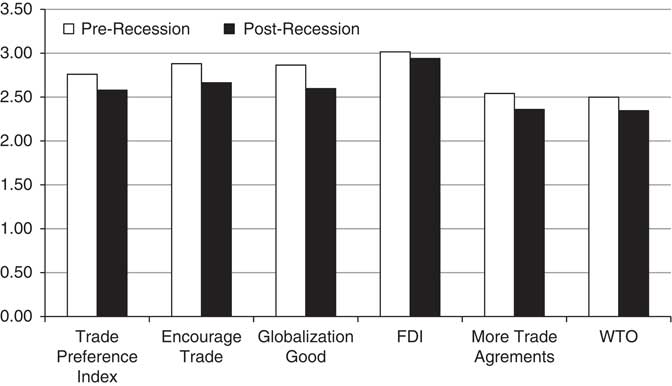
As shown in Figure 1, whether we compare the five survey items that comprise Support for Trade individually or combine them into an index, the conclusion is the same: Americans became less supportive of international trade during the recession. All of these comparisons suggest a modest but statistically significant decline in support for foreign commerce from 2007 to 2009.
Pre-recession and post-recession support for international trade Note: all questions were measured on four-point agree–disagree scales, with higher scores associated with more support for trade. Pre-recession data were gathered in the summer of 2007 and post-recession data were gathered in the summer of 2009. Sample sizes from left to right were 921, 911, 913, 909, 898 and 887. All differences between pre-recession and post-recession means were statistically significant (p<0.01).

For the purposes of the following analysis, the extremely high inter-correlations among these five items led us to combine them into a single, highly reliable index. This approach is preferable to repeated analyses of individual items, because single items may produce idiosyncratic results.Footnote 50 By combining multiple measures, extraneous content is cancelled out, thus producing both a more reliable measure of the general underlying construct of interest and multivariate results that do not depend on a particular framing of questions about trade preferences.
Explanations for Changes in Support for Trade
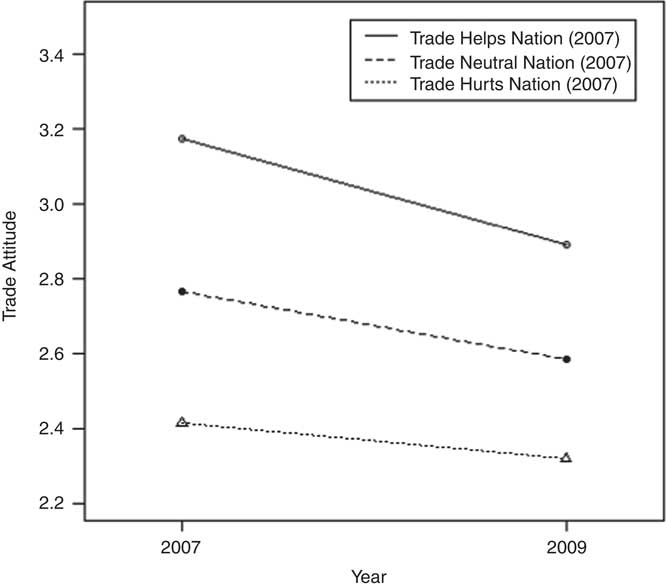
Why did Americans become more protectionist during the Great Recession? In Figure 2, we examine the possibility that the recession simply intensified the public’s already negative views of trade due to the obvious need for economic improvement during the downturn. In order to test this hypothesis, we evaluate the impact of the recession on the trade preferences of those who believed trade was either helping or hurting the economy in 2007. Our expectation is that those who believed trade was hurting the economy should experience a decline in support for trade as a result of the recession, whereas those who believed trade was beneficial should exhibit a rise in support for trade.
Change in mean support for trade, by pre-recession beliefs about whether trade helps or hurts the US economy Note: in 2007, 43 per cent of a representative national sample thought trade helped the nation’s economy, 52 per cent thought trade hurt the nation’s economy, and 5 per cent did not believe it affected the economy one way or the other. The extent of decline in trade preferences during the recession was statistically indistinguishable across these three categories.

However, as illustrated in Figure 2, those who felt that trade was hurting the economy in 2007 were no more likely to display a growing opposition to trade over the course of the recession than were those who believed trade was helping the economy. The latter group should logically become more pro-trade in the face of an economic crisis, and yet both groups grew less supportive of trade. Clearly, the increased opposition to trade did not represent a desire to improve the economy based on what these individuals believed would be good for it. Contrary to our prediction, regardless of whether one believed trade to be a help or a hindrance to the US economy, Americans became more hostile toward trade from 2007 to 2009, indicating that the rise in protectionism was not due to the intensification of pre-existing preferences during the economic crisis.
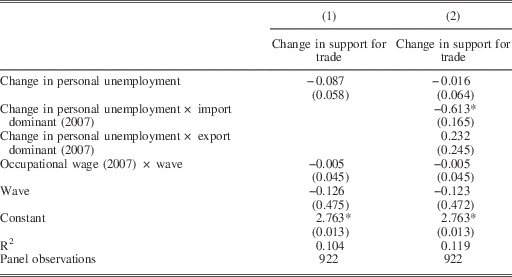
Was rising unemployment the engine of trade opposition? To address this possibility, we estimated a fixed-effects regression using trade preferences in 2007 and 2009 as the dependent variable, and including personal employment status in 2007 and 2009 as the predictor. This technique allows us to examine how change over time in each independent variable affects change in trade preferences, while simultaneously taking into account the statistical dependencies among measures gathered from the same person at multiple points in time.
The import or export dominance of one’s industry of employment was largely stable for our sample of respondents, so they cannot, by themselves, explain change over time in trade preferences. Moreover, the overall effects of job loss could mask two divergent reactions – one toward greater support for trade in export-dominant industries and the other toward greater opposition in import-dominant industries. Thus we also include the interactions between change in personal unemployment and whether respondents worked in import-dominant or export-dominant industries (where the coefficient of Personal Unemployment then refers to individuals working in non-traded industries). Likewise, we include the interaction between Wave and occupational wage in 2007.
As shown in Model 1 of Table 1, losing a job during the recession did not by itself stimulate greater opposition to trade. However, as shown in Model 2, the effects of unemployment on change in trade attitudes vary across industries. The estimated coefficient of the interaction between change in unemployment and import dominance is negative, statistically significant and large. It is important to interpret these results cautiously, since a relatively small number of survey respondents lost their jobs during the Great Recession. Nonetheless, support for trade among people who became unemployed and worked in import-dominant industries fell by roughly 0.60 on our four-point index of trade preferences relative to people who worked in non-traded industries and lost their jobs. This figure rises to almost 0.85 when comparing workers in import-dominant and export-dominant industries who lost jobs during the recession. Thus, consistent with our extension of the political economy approach, the sharpest decline in support for trade due to job loss is registered by individuals who worked in industries that were adversely affected by trade. In contrast, occupational wage, our proxy for workers’ skill level, had no effect on the change in trade preferences and did not condition the impact of losing a job. Consequently, we do not include occupational wage in subsequent models.
The Impact of Rising Unemployment on Change in Support for Trade

Note: fixed effects regression coefficients with standard errors in parentheses. *p<0.01.
Next, we evaluate the hypotheses that mounting trade opposition represents a shift in priorities toward domestic and away from international affairs, and that rising ethnocentrism during economic hard times likewise promotes protectionist views. In order for changing attitudes toward international involvement or ethnocentrism to account for increasing opposition to trade during the recession, these indicators would need to have shifted in a direction consistent with anti-trade views. In other words, Ethnocentrism should increase during the recession and support for Active Involvement in World Affairs should decline.
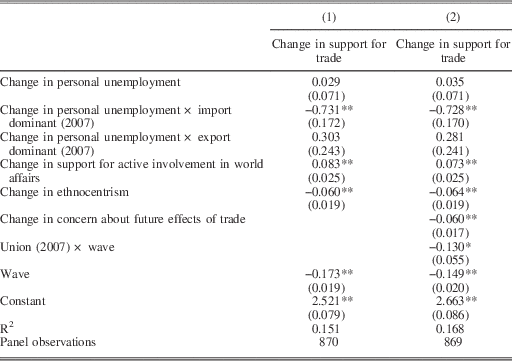
Active Involvement in World Affairs was indeed significantly lower after the recession than in 2007 (p<0.01), although support for overseas involvement has been deteriorating for many decades in the United States, presumably for reasons other than the most recent recession.Footnote 51 Also as predicted, the mean level of Ethnocentrism in 2009 was somewhat higher than in 2007, although this change was only marginally significant (p=0.07). Regardless, in Table 2 we address the possibility that rising opposition to Active Involvement in World Affairs and growing Ethnocentrism contribute to changes in trade preferences. In Model 1 of Table 2, we add the change in both Ethnocentrism and Active Involvement in World Affairs to Model 2 of Table 1. Both variables have a statistically significant influence on change in Support for Trade. Increased Ethnocentrism and decreased public support for Active Involvement in World Affairs both generated heightened opposition to trade.
The Impact of Changes in Ethnocentrism, in Active Involvement in World Affairs, and in Concern about Trade’s Future Impact on Change in Support for Trade

Note: fixed effects regression coefficients with standard errors in parentheses. The sample used to generate these estimates is somewhat smaller than is used to generate the estimates in Table 1 because some respondents refused to answer items on ethnocentrism. *p<0.05, **p<0.01.
Finally, we address the hypothesis that recessions, like other major disasters, increase generalized anxiety, thus indirectly promoting anti-trade preferences. Based on a paired t-test, workers were significantly more concerned about the future effects of trade after the recession than before its onset (p<0.001). Moreover, as shown in Model 2 of Table 2, increased concern about the future stimulated greater opposition to trade. The coefficients of Active Involvement in World Affairs and Ethnocentrism remain largely unchanged, but Concern about Future Effects of Trade also has a statistically significant effect on change in Support for Trade. Interestingly, concern about the future increased, even though the Great Recession was officially over by our 2009 wave. Equally, these more fully specified models in Table 2 continue to indicate that people who lost their jobs after working in import-dominant industries expressed greater hostility to trade over the course of the recession than their counterparts who worked in non-traded and export-dominant industries.
Further, as demonstrated by the negative and statistically significant coefficient of Union (2007) × Wave, union members were especially likely to experience declining support for trade during the recession. As a stable characteristic of individuals, union membership by itself cannot explain individual change over time. However, when coupled with our knowledge that unions actively sought to connect job loss during the recession to trade through their communications, this interaction suggests that these union efforts were successful. In combination, these results are consistent with the idea that both generalized anxiety and adverse personal experience drive increased protectionism during recessions.
To get a sense of the relative size of the effects of ethnocentrism, support for involvement in world affairs and concern about trade’s future impact, we generated predicted values for a model in which all of the continuous independent variables were held at their means and the dichotomous variables were evaluated at their modes. Individuals who experienced the largest increase in ethnocentrism exhibited a 0.65 reduction in predicted support for trade compared to those who experienced the largest decrease in ethnocentrism. The predicted support for trade, however, declined by only 0.01 among those who exhibited the average increase in ethnocentrism (0.05). People whose support for engaging in world affairs fell the most during the recession experienced a 0.47 drop in predicted support for trade compared to people whose support for engaging in world affairs increased the most. But the average decline in support for active involvement abroad (0.07) yielded only a 0.01 decline in trade support, almost precisely the same as for ethnocentrism.
The most pronounced effect on trade preferences was the increase in concern about the future effects of trade. Respondents who exhibited the greatest rise in generalized anxiety about these future effects experienced a 0.36 reduction in predicted support for trade compared to those with the minimum change in anxiety. Moreover, because the average change in this variable (0.18) was greater than that of the other variables, its average impact on trade preferences is quite high. Individuals whose anxiety increased by the average amount still declined by roughly 0.12 in support for trade.
The impact of losing a job for individuals working in import-dominant industries was also large. Both in our sample and in the American workforce, however, most people are not employed in such industries, and only a small fraction of those who were employed in these sectors at the recession’s onset lost their jobs. Consequently, the average impact on changes in trade preferences for our sample as a whole was very small (−0.01). Despite the spike in unemployment during the Great Recession, most of its impact on trade preferences was carried by its psychological effects on the general population.
FURTHER CONSIDERATIONS
Before exploring the implications of our findings, we briefly review the strengths and weaknesses of the evidence presented in this study. By utilizing panel data that captures change over time in both trade preferences and its potential causes, we provide insight into whether economic downturns produce rising opposition to trade even when trade is not seen as the ostensible cause of the recession. Individual-level panel data offer tremendous advantages in examining changes in opinion over time relative to approaches using aggregate temporal or cross-sectional data. Most importantly, this approach helps exclude the possibility that spurious individual differences account for changes in trade preferences. Moreover, the statistical approach we have used – fixed-effects regression – generates conservative standard errors and accounts for dependencies that occur due to multiple observations per respondent.
It is, of course, possible that other changes took place during this two-year period that we have not identified. The average change over time in trade preferences due to all other causes is captured by Wave. Nonetheless, we examined a number of other possibilities. For example, changes in local economic circumstances might prompt changes in trade preferences, particularly if downturns occur in localities marked by import-dominant industries. Using local census data matched to individual respondents, however, we found no evidence of such an impact. Scheve and Slaughter’s cross-sectional work suggests that such effects may be evident among homeowners in areas with a heavy concentration of comparative-disadvantage industries.Footnote 52 However, using a measure of self-reported homeownership, we found no evidence that changes in homeownership drove declining support for trade. Nor did we find that those who owned homes in 2007, before the recession began, declined in support for trade at a greater rate than those who were not homeowners. Likewise, we found no evidence that declining family incomes led to decreased support for trade. Although there are certain to be other possible sources of individual change, we were unable to find evidence supporting any sources suggested in past research on trade attitudes.
In addition, we examined the possibility that the mechanism of change is different from what we have proposed. For example, instead of changes in ethnocentrism or isolationism driving changes in trade attitudes, it is possible that the recession simply activated existing attitudes, which in turn changed trade support. We analyzed the activation hypothesis for those with initially high levels of ethnocentrism and those who were highly opposed to involvement in international affairs. Through the interaction between the 2007 level of each of these two variables and Wave, we were able to test whether it was activation rather than the recession’s effects on these variables that influenced trade support. Neither of these two interactions was statistically significant, indicating that more ethnocentric individuals in 2007 were no more likely to become anti-trade than less ethnocentric individuals, and those opposed to active involvement in world affairs in 2007 were no more likely than those in favor of it to exhibit a change in support for trade during the downturn. Thus, activation does not appear to have been an important mechanism of change. Equally, we found no evidence that the interactions between Wave and either party identification or liberal versus conservative ideology influenced change in attitudes toward trade. Instead, it was change over time in people’s support for active involvement in global affairs, ethnocentrism and concern about the future that precipitated a decline in trade support.
Conclusions based on panel data provide a relatively strong basis for internal validity, particularly when reverse causality is highly implausible. But the external validity of analyses based on such data can be jeopardized by unrepresentative samples stemming from panel attrition or poor response rates. Attrition is inevitable with panel data, but it is not inherently problematic. Selective attrition, however, could threaten the generalizability of findings. In 2009, we were able to re-interview just under half of our 2007 respondents. Of the initial respondents who were not re-interviewed, many were no longer eligible to participate in our survey because GfK rolls individuals on and off of their panel in order to avoid professionalized survey respondents. Of the 1,312 individuals who were still eligible to be re-interviewed in 2009, about 70 per cent participated, which is a very high co-operation rate.
In addition, there was no evidence of selective attrition in our panel. To assess whether the attrition that occurred was random or systematic, we estimated a logit model of whether a person who participated in the 2007 wave was unavailable or declined to participate in the 2009 wave, using demographic variables as predictors. As shown in Appendix B, none of these variables affects attrition from the sample. People were equally likely to fall out of the sample regardless of their education, age, sex, race, ethnicity and union membership. In addition, neither unemployment nor a respondent’s industry of employment influenced attrition. In short, attrition from the sample appears to be random and thus poses no concerns about sample quality.
To determine the extent to which our sample is representative of the American workforce, Appendix C presents the demographic characteristics of our first and second wave samples and compares them to the characteristics of workers in the Current Population Surveys (CPS), a widely used instrument for assessing demographic features of the United States. Given that both the CPS and our study rely on sample-based estimates that include margins of error, the demographics shown in Appendix C are remarkably similar. Only with respect to formal education does our sample appear to be somewhat unrepresentative: our respondents tend to be better educated than the general US working population, as measured by the CPS.
To further address this issue, we re-estimated our models after weighting the data to more accurately represent the entire population of US workers. As shown in Appendix D, the use of survey weights had little bearing on our findings. All previously significant results remain significant, with very similar effect sizes. The only exception is the estimated effect of ethnocentrism in Table 2. In Model 1, the coefficient shifts from −0.06 in the unweighted analysis to −0.04 in the weighted analysis. In Model 2, it changes from −0.06 to −0.05. Despite these minor changes, the estimated coefficients of Ethnocentrism are no longer statistically significant in Table 2 due to the tendency for weighted data to generate larger standard errors than unweighted data. However, in no case did weighting cause a substantive change in our findings.
Our panel-based evidence is particularly noteworthy because previous arguments about the factors analyzed in this study have rested exclusively on cross-sectional models, thus making it difficult to establish causal claims.Footnote 53 By using fixed-effects regression, we eliminated the possibility that stable spurious individual differences are responsible for the patterns we observed. Instead, change over time in these variables goes hand in hand with change in trade preferences. Given the sudden onset of the recession, there is little likelihood of reverse causation for any of the variables we have addressed.
Finally, some previous research calls into question the extent to which citizens hold meaningful opinions on trade.Footnote 54 Contrary to that concern, in our five-item index of trade attitudes, very few respondents selected ‘don’t know’ responses or refused to answer even one of the five questions. The highest percentage of such responses was 3 per cent, in reaction to a question about the WTO. For the other four items, only about 1 per cent failed to register an opinion. We suspect the reason for this is that we asked primarily about general attitudes toward trade, rather than about opinions related to specific trade agreements, such as Guisinger did in her study of American attitudes toward the Central America Free Trade Agreement.Footnote 55 Moreover, by using a multi-item index, we produced a highly reliable measure that did not rest on the particulars of any single survey question. While we would not go so far as to claim that Americans are well informed about trade policies (indeed, Americans are not well informed about most complex issues), they nonetheless have a clear sense of where they stand on trade more generally.
CONCLUSION
This study is the first effort to assess whether and why hard times affect mass trade preferences. Among the many concerns raised by the Great Recession was that it would stimulate support for protectionism. Our results show that these concerns were not misplaced. On average, Americans did become more hostile to free trade between the recession’s onset and its conclusion.
We identified two main sources of this mounting hostility. First, it was an outgrowth of adverse personal experiences. Unemployment promoted a sharp dip in support for trade among people working in import-dominant industries. This effect was sizable for individuals who lost their jobs within those industries, but because there were relatively few such individuals, the net overall impact on the population’s trade preferences was relatively small. Although the Ricardo-Viner model does not make predictions about over-time change in trade preferences, our extension of those ideas shows more promise in predicting change in trade attitudes than in predicting such attitudes at any particular point in time.Footnote 56 In contrast, we find no support for the idea that skill level drives changes in trade preferences. Moreover, because other possible indicators of skill level similarly do not change over time, they cannot be responsible for changing trade attitudes.Footnote 57
Secondly, and perhaps most importantly, our results suggest that changing views of trade are less a conscious re-evaluation of trade’s merits than an anxiety-based emotional reaction. As with many types of disasters, the Great Recession produced anxiety throughout society, and people responded with increased anxiety and concern about the future. Unfortunately, their protective impulses do not necessarily create reactions that might be deemed internally logical, that is, ways that might help them or the economy.
Small impacts on trade preferences were also caused by heightened resentment toward racial and ethnic out-groups, and increased opposition to active international involvement of all kinds. However, the largest and most notable effect stemmed from increased anxiety about trade’s future impact. Consistent with studies of the influence of recessions on risk aversion, and the impact of risk aversion on trade preferences, we find that increased concern about trade’s possible future impact generated increased opposition to trade. Thus the primary source of heightened opposition to trade was anxiety about its future effects. The shift did not occur because trade adversely affected most individuals. Instead, trade became a scapegoat for people’s anxieties about the future.
To what extent are these material and non-material influences on trade support generalizable beyond the context of the Great Recession? Evidence of the politicization of personal economic experience when forming policy preferences is especially interesting in light of the litany of studies that have failed to find such effects from job loss and economic self-interest more generally. Past studies have suggested that citizens often either do not understand the connection between a given public policy and their self-interest, or blame lay-offs on themselves rather than on government.Footnote 58
We suspect that our evidence contradicts much of this earlier work because of the larger context in which people lost jobs during the Great Recession. If unemployment is extremely high, and it is thus well known that many people share this problem, individuals will be more likely to connect their personal experience to government policy. After all, it is implausible that everyone who lost a job during a massive recession was personally to blame.Footnote 59 Mass unemployment is likely to have provided a jolt that led people to pay greater attention to their industry’s interests. So even if trade was not believed to be the initial cause of their unemployment, people in import-dominant industries logically became more anti-trade because their prospects of re-employment were known to be negatively affected by trade. Thus, the generalizability of our findings regarding unemployment is likely to be limited to the unique context of the Great Recession or downturns of a similarly large magnitude.
In contrast, the non-material effects on trade preferences that we document should be highly generalizable. Because people did not attribute this particular recession to trade, a similar downturn in a context that could conceivably be connected to overseas commerce might have even stronger effects on trade support. Although anxiety can be triggered by specific events, its consequences tend to be more diffuse and need not be logically connected to its cause. Even when those concerns are logical, they are based on anxiety about the future rather than past experience. Further, the generalizability of these effects may extend beyond the anxiety created by economic downturns. Terrorist attacks, for example, have been shown to produce a similar turning inward, although the effects on trade in this case have not been directly examined. Because the impulse to turn inward in response to anxiety is a basic human tendency, the generalizability of this kind of impact is likely to be widespread in response to societal-level anxiety-producing events of all kinds.
It is useful to consider whether our results are likely to hold across other countries. In some respects, the United States is a special case because the recession started in that country and had far more serious consequences for the United States and Europe than for most of the developing world. That the latter countries experienced much less economic damage and associated anxiety as a result of the recession may help to explain why support for trade actually increased during this episode in some emerging economies.Footnote 60
In principle, however, the arguments we have tested should apply to individuals in any country that experiences a profound economic shock or concurrent widespread anxiety about the future. How governments respond to such shocks depends on a host of factors, including a country’s position in the global system, domestic institutions and interest group politics.Footnote 61 How individuals in different countries respond to shocks is an issue that has not been addressed adequately, and that merits further research.Footnote 62
Overall, our findings have largely undesirable implications for democratic accountability by means of public opinion. The fact that the public effectively misattributed responsibility for the Great Recession is puzzling despite the conventional wisdom that predicted it. Americans soured on trade during the recession, even though they knew trade was not the root of the problem. A mechanism of accountability is obvious when those hurt by a given policy are the ones who become more opposed to it. In this case, however, although virtually no one blamed trade for the recession, the mass public nonetheless shifted its trade preferences in a negative direction.
Opinions differ on whether mass opinion affects US trade policy. Some argue that public opinion is irrelevant because trade is not sufficiently salient to the public, although increasing globalization has made it a salient issue in the context of recent US elections. Others suggest that Americans simply do not know enough about trade to have opinions on this matterFootnote 63 and to discipline their leaders accordingly. At the same time, both popular accountsFootnote 64 and some academic work suggest that public opinion on trade has consequences for trade policy, at least within democratic systems of government in which politicians depend on voters in order to remain in power.Footnote 65 As Cowhey argues, ‘any account of trade politics has to consider voter sentiment, and the life experiences that shape them’.Footnote 66
There are many policies one could logically blame for the events leading to the Great Recession, but trade policies are not among them. Nonetheless, an increasingly anti-trade American public has made it more difficult for government officials to enact policies that might benefit the American labor market by expanding exports. Increased public opposition may help to explain why both Barack Obama and Hillary Clinton expressed opposition to NAFTA and other free trade agreements during the 2008 Democratic primary elections; why trade deals that the Bush Administration concluded with South Korea, Columbia and Panama did not yield congressional approval until 2011, three years after Obama took office; and why many members of Congress have fiercely opposed the Obama Administration’s efforts to negotiate the Trans-Pacific Partnership (TPP) and the Transatlantic Trade and Investment Partnership (TTIP). Further, some have observed a proliferation of lower-profile impediments to open markets cropping up with increasing frequency.Footnote 67
Politicians are now well aware that they can capitalize on the public’s anti-trade views when courting voters. The many protectionist China-bashing ads broadcast during the 2012 presidential campaigns by both Republican and Democratic candidates provide further such evidence. And, as noted with respect to the 2014 midterm elections, ‘Economic nationalism [is] an easy sell on the campaign stump: and, once pledged to that cause in November, candidates will not vote for the opposite in Congress.’Footnote 68 As a result, public pressure on elected officials may be misdirected, and will constrain the government’s ability to craft appropriate solutions to the economic downturn. Moreover, as one editorial writer recently opined, ‘The greatest risk of all is that the political momentum in America, having swung against free trade, will be hard to reverse.’Footnote 69