INTRODUCTION
Children acquire knowledge of their native language through a process comprising several different aspects. These aspects include (i) knowing the type of structure necessary for expressing a particular meaning, and (ii) learning how to map the grammatical functions embedded in syntax. This includes the use of subject and object for semantically expressing the thematic roles of agent and patient. The learner must resolve language-specific structures that involve unsystematic mapping between grammatical functions and thematic roles. For example, English-speaking children need to know that passive structures are used to express causality with particular emphasis on the patient. This understanding of emphasis on the patient allows children to map the patient as the subject in a passive structure. Through this process English-speaking children may come to realize that word-order cues are useful in identifying the agent–patient relationship with respect to the subject and object. By contrast, German-speaking children may rely on case-marker cues to identify the agent–patient relationship (Dittmar, Abbot-Smith, Lieven &Tomasello, Reference Dittmar, Abbot-Smith, Lieven and Tomasello2008). English-speaking children may also recognize the use of a limited set of case-marked pronouns (e.g., I–me, he–him, she–her) in making subject–object distinctions. To be competent in using these structures, children must be equipped with the forms of syntactic abstractions that underlie productive usage.
Developmental psycholinguists, however, disagree on how and when children form syntactic abstractions during first language learning. They especially differ on the existence of an innate endowment. This includes innate linking rules, which may help young children link agents to subjects and patients to objects. The two areas of debate are the early abstraction account and the usage-based account. The early abstraction account examines whether linking rules facilitate young children's abstraction of syntax (e.g., Fisher, Reference Fisher1996, Reference Fisher2002b; Fisher, Gertner, Scott & Yuan, Reference Fisher, Gertner, Scott and Yuan2010; Lee & Naigles, Reference Lee and Naigles2008; Naigles, Reference Naigles1990; Naigles & Kako, Reference Naigles and Kako1993; Pinker, Reference Pinker1989; Yuan & Fisher, Reference Yuan and Fisher2009; Yuan, Fisher & Snedeker, Reference Yuan, Fisher and Snedeker2012), while the usage-based account examines whether young children's abstraction of syntax is gradually formed through the accumulation of linguistic experience with no facilitation from innate knowledge (e.g., Abbot-Smith, Lieven & Tomasello, Reference Abbot-Smith, Lieven and Tomasello2008; Dittmar et al., Reference Dittmar, Abbot-Smith, Lieven and Tomasello2008, Reference Dittmar, Abbot-Smith, Lieven and Tomasello2011; Noble, Rowland & Pine, Reference Noble, Rowland and Pine2011; Savage, Lieven, Theakston & Tomasello, Reference Savage, Lieven, Theakston and Tomasello2003).
Regardless of the above contentions, developmental psycholinguists generally agree that at three years of age English-speaking children have fully grown syntactic representation. This is evidenced by English-speaking three-year-olds and younger children being able to demonstrate productive knowledge using a range of structures, such as Subject Verb Object (SVO) structures, truncated passives, passives, and dative alternations in elicited production measures (Abbot-Smith et al., Reference Abbot-Smith, Lieven and Tomasello2008; Brooks & Tomasello, Reference Brooks and Tomasello1999; Chan, Lieven & Tomasello, Reference Chan, Lieven and Tomasello2009; Conwell & Demuth, Reference Conwell and Demuth2007; Israel, Johnson & Brooks, 2000).
Nevertheless, across language groups, it is still not clear whether children of this age have fully grown syntactic representation or if such a representation can be applied to a range of syntactic structures. This study investigates these issues in young learners of Mandarin Chinese. That is, whether Mandarin-speaking three-year-olds have productive knowledge that can be applied to a range of syntactic structures such as SVO and ba constructions. Due to these two constructions being able to alternate with one another, it is possible to design an experiment where the alternation allows us to see if Mandarin-speaking three-year-olds can demonstrate rule-based behavior.
We used the simplest version of the Mandarin SVO–ba alternation (see (1) and (2) below) to investigate the productive knowledge and rule-based behavior of Mandarin-speaking three-year-olds. In (1), the SVO construction consists of the subject xiaogou ‘little dog’, the verb compound baozhu ‘tightly hug’, the -le ‘ASP’, and the object xiaomao ‘little cat’. In (2), the ba construction, with an SOV word order, consists of the subject xiaogou ‘little dog’, the ba ‘BA’, the object xiaomao ‘little cat’, the verb compound baozhu ‘tightly hug’ and the -le ‘ASP’.
(1) Xiaogou baozhu -le xiaomao. (SVO construction)
little dog hug-tight -le little cat
‘A little dog tightly hugged a little cat.’
(2) Xiaogou ba xiamao baozhu -le. (ba construction (SOV))
little dog ba little cat hug-tight -le
‘A little dog tightly hugged a little cat.’
For SVO and ba constructions to alternate with each other in Mandarin, the sentences must satisfy the following requirements: [+telic] and [+perfective] (cf. Huang & Yang, Reference Huang and Yang2004; Li, Reference Li, Liang and Sybesma1993; Li & Bowerman, Reference Li and Bowerman1998). The [+telic] requirement is usually satisfied by the verb or the verb compound that denotes an end state in both constructions, and the [+perfective] is usually satisfied by the perfective marker -le in Mandarin. In other words, if the sentences do not meet the matching requirements of [+telic] and [+perfective], SVO and ba constructions cannot alternate.
A survey of the literature indicates that the extent of productive knowledge among Mandarin-speaking three-year-olds is still undetermined. At first glance, recent studies suggest that Mandarin-speaking children have demonstrated productive knowledge of the SVO structure in both the intermodal preferential looking paradigm (IPLP) (Candan, Kuntay, Yeh, Cheung, Wagner & Naigles, Reference Candan, Kuntay, Yeh, Cheung, Wagner and Naigles2012) and act-out measures (Chan et al., Reference Chan, Lieven and Tomasello2009; Lee & Naigles, Reference Lee and Naigles2008) by the age of three. However, Chan et al. (Reference Chan, Lieven and Tomasello2009) and Lee and Naigles (Reference Lee and Naigles2008) disagree regarding how children form such productive knowledge and whether the syntactic representation that underlies productive knowledge is facilitated by innate knowledge or formed through the accumulation of experience. This debate was mentioned earlier and is resurrected here in the case of young Mandarin learners. Chan et al. (Reference Chan, Lieven and Tomasello2009) found that two-and-half-year-olds were able to identify a subject through the use of novel verbs and act-out measures when the semantic cues of animacy and word order worked as a coalition to indicate the subject. In this case, the subject is animate and occurs in the first part of a sentence (e.g., The horse tams the telephone (sentence presented in Cantonese/Chinese)). However, in cases where the animacy cue was neutralized by having an animate subject and object in SVO constructed sentences (e.g., The turtle meeks the bee), it was found that young Mandarin-speaking children could only identify the subject after the age of three and a half (learners demonstrated their productive ability using novel verbs). This study suggests that the syntactic knowledge of Mandarin-speaking children is not sufficiently robust between the ages of two and three-and-a-half. The formation of this knowledge was heavily influenced by the input characteristics to which the Mandarin-speaking children were exposed. Since cue validity, which is the product of cue availability (when the cue is available) and cue reliability (when the cue reliably indicates a certain function) in the input for the word order (·30) in Mandarin (Chan et al., Reference Chan, Lieven and Tomasello2009), is low in relation to signal the agent, Mandarin-speaking children take longer to construct abstract representations of SVO structures, particularly when the animacy cue in presented sentences is neutralized.
On the other hand, Lee and Naigles (Reference Lee and Naigles2008) reported that Mandarin-speaking two- and three-year-olds can enact transitivity based on the number of nouns in heard sentences with familiar motion verbs if both nouns are animate. When these young children heard an intransitive verb such as qu ‘go’ in an NVN frame, e.g., xiaozhuqushizi ‘The pig goes the lion’, children tended to extend causative meaning to this verb. The children enacted The pig goes the lion as The pig makes the lion go. By contrast, when these young children heard a transitive verb such as dai ‘bring’ in an NV frame, e.g., xiaogoudai ‘The dog brings’, an absence of a post-verbal NP led them to extend non-causative meaning to this transitive verb. The children enacted The dog brings by letting the dog move without any other object as the patient of bring. The way in which the children acted out meaning conformed with the number of nouns being the cue to meaning. This suggests that these children had productive knowledge that complied with the syntactic frames they were required to enact. This result raises interesting questions vis-à-vis the debate over the innate account of language learning versus the usage-based account. The reliability cue for an absent post-verbal NP (the NV frame indicating an intransitive verb) is quite low (0·41) compared to the reliability of an NVN frame indicating transitive verbs (·83). However, the strength with which Mandarin-speaking two- and three-year-olds complied with heard frames in act-out tasks suggested that cueing strength during input is not the only factor affecting very young children's demonstration of productive knowledge. These results are hard to explain using a pure usage-based account to describe the formation of a young child's productive knowledge. In fact, the results suggest that young children may be equipped with the innate theta-criterion principle suggested by Chomsky (Reference Chomsky1981), whereby two-participant relationships tend to surface with two NPs while a one-participant relationship tends to surface with only one NP. Further, the results suggest that Mandarin-speaking two- and three-year-olds have a robust productive knowledge even when both nouns in the NVN frame (SVO structure) are animate.
In light of the above debates (see also Fisher, Reference Fisher2002b), Abbot-Smith et al. (Reference Abbot-Smith, Lieven and Tomasello2008) argued that young children's syntactic representation can be weak but still abstract. As a result, young children can employ weak but abstract representations of syntax to successfully demonstrate their productive knowledge by performing tasks that do not require too many cognitive resources (e.g., demonstrating comprehension by acting out structures). If we want to provide evidence that Mandarin-speaking three-year-olds can demonstrate productive knowledge based on a strong and abstract representation, we need to show that Mandarin-speaking three-year-olds can exhibit abstraction of syntax in production. Also, we need to show that Mandarin-speaking children can demonstrate productive rule-like behavior, as Brooks and Tomasello (Reference Brooks and Tomasello1999) demonstrated for the active–passive alternation and Conwell and Demuth (Reference Conwell and Demuth2007) did for the dative alternation using novel verbs in production tasks.
Brooks and Tomasello (Reference Brooks and Tomasello1999) presented two novel verbs (meek and tam), one in the active construction and one in the passive construction, to each child in their Study 2. For each novel verb, they first trained each child with around 100 utterances for the novel verb and then elicited production post training. At the same time, they also introduced the usage of the novel verb under different discourse pressure using mismatching comments for the verb. For instance, if children were trained with the novel verb tam in the passive construction (e.g., The car is going to get tammed by Mickey Mouse), they introduced mismatching comments for the passive construction regarding the agent (e.g., Look at what the Mickey Mouse [the agent] is doing) to encourage the children to use the novel verb creatively (i.e., in the active construction). After training, the experimenters used three types of exclamations and neutral questions at random to focus on: (i) the agent: Look at what the [agent] is doing!; (ii) the patient: Look what's happening to [patient]!; and (iii) neutrality: What happened? The goal of this exercise was to elicit child utterances. The same children were then trained with another novel verb, meek, in the active construction and responses elicited. English-speaking children were able to use the novel verb productively (i.e., they used the novel verb in constructions with which it had never previously been presented): 40% of the three-year-old children used an active-introduced verb in a passive construction and 35% used a passive-introduced verb in an active transitive construction. This ability is termed ‘syntactic productivity’. The children's syntactic productivity also complied with discourse pressure. This means that the majority of their passive production came in response to neutral or patient-focused questions rather than to agent-focused questions. In sum, English-speaking three-year-olds exhibited syntactic productivity when they heard two verbs presented in two different constructions in which the type of elicitation question influenced learner's demonstration of different degrees of syntactic productivity.
Cowell and Demuth (2007) used a similar design in which each English-speaking three-year-olds heard two novel verbs presented in prepositional dative and double object constructions, respectively. They also found that children exhibited syntactic productivity in the dative alternation. English-speaking three-year-olds demonstrated abstract knowledge of rules in active–passive and dative alternations because they used identical verbs in different constructions. Thus, if young children have acquired abstract and strong representations at that age, they must be able to demonstrate this knowledge with not only SVO constructions but also with other constructions using novel verbs (Noble et al., Reference Noble, Rowland and Pine2011) or with a certain syntactic structure across a range of different verbs (Fisher, Reference Fisher2002a). Evidence of this indicates that a young child's syntactic behavior is not lexically dependent.
Using novel verbs to investigate young children's productive knowledge avoids certain problems. For example, when young children try to demonstrate their productive knowledge in tasks with familiar verbs, one cannot be sure whether the demonstration is a productive process based on their mapping systems or merely a response to the semantic content of the verb. This can be exemplified by familiar verbs such as push and eat being used to investigate productive knowledge. In these cases, it is difficult to determine (among the two possibilities within a sentence) how a child assesses the relationship between agent–patient and subject–object. The first possibility is that it is based on their verb-specific knowledge of push being a two-participant predicate requiring a pusher and a pushee, with the pusher preceding the verb and the pushee following the verb. The second possibility is that it is based on a complete understanding of the general mapping of the verb. In short, one cannot tell how productive a young child's knowledge really is.
However, a number of researchers in this area have argued that novel verb paradigms, particularly when used in production tasks, place a heavy processing burden on young children. This may prevent children from demonstrating syntactic productivity (Naigles, Reference Naigles2002). To allow for this, past studies of structural priming in English-speaking three-year-olds (Bencini & Valian, Reference Bencini and Valian2008; Chang, Dell & Bock, 2006; Fisher, Reference Fisher2002b; Shimpi, Gamez, Huttenlocher & Vasilyeva, Reference Shimpi, Gamez, Huttenlocher and Vasilyeva2007) have investigated not only young children's productive knowledge with known verbs (thereby reducing processing load concerns), but also their productive knowledge across a range of lexical verbs. Structural priming is a form of repetition of syntax in language production. Structurally primed learners have the ability to consistently use a priming structure (e.g., the passive construction: The car was pushed by Mickey Mouse) in a different context (e.g., A tiger hit a king) in a manner that is compatible with the active or passive construction in subsequent production. This, however, is dependent on the prime and target: (i) not sharing a chain that forms a discourse; (ii) not generating the same pragmatic and semantic inferences; or (iii) not overlapping in any content words (Bock, Reference Bock1986). In the above examples, the priming sentence is The car was pushed by Mickey Mouse, while the subsequent content (which allows examination of the prime) is called the target. A reliable demonstration of structural priming among young children also signals a young child's abstraction-of-rules capability because they can use different structures with the same verb.
Therefore, though earlier studies have suggested that young children have productive knowledge with the SVO construction across a range of familiar verbs placed in ungrammatical sentences (Lee & Naigles, Reference Lee and Naigles2008) in act-out measures, it remains unclear whether young Mandarin-speaking children have productive knowledge with this construction in production. Furthermore, it is not clear whether they can extend their knowledge to other constructions or demonstrate an abstract rule in alternation (i.e., produce different constructions with the same verbs as young English-speaking learners could with active–passive and dative alternations in production studies). This study investigates three-year-olds' productive knowledge with Mandarin's SVO–ba construction alternation using studies of syntactic productivity with novel verbs and studies of structural priming with known verbs.
Issues remain on whether young Mandarin-speaking children have productive knowledge with the ba construction. Mandarin-speaking children start to produce the ba construction when they approach their second birthday (Cheung, Reference Cheung1992; Erbaugh, Reference Erbaugh1982; Lee, Reference Lee, Huang and Li1996; Yang & Xiao, Reference Yang and Xiao2008). Yang and Xiao (Reference Yang and Xiao2008) observed a girl named Ke at the age of one year and four months producing ba constructions that did not follow adult models; i.e., she could produce the ba construction productively at the age of two. Chang (Reference Chang, Kao and Hoosain1986) reported that Mandarin-speaking three-year-olds could correctly use a ba-marking NP as a cue to identify the agent as the non-ba-marked NP in NP-[BA NP]-VP framed constructions 75% of the time. Li (Reference Li, Liang and Sybesma1993) and Li and Bowerman (Reference Li and Bowerman1998) found that Mandarin-speaking three-year-olds correctly produced the ba construction in the appropriate (grammatical) frame. Further, 90% of the ba constructions contained a complex verb phrase generally denoting a resultative state and the perfective marker -le (other studies regarding ba construction in learners other than three-year-olds can be referenced in Lee, Reference Lee, Huang and Li1996). Chang's (Reference Chang, Kao and Hoosain1986), Li's (Reference Li, Liang and Sybesma1993), and Li and Bowerman's (Reference Li and Bowerman1998) studies suggested that Mandarin-speaking three-year-olds used the ba construction correctly. As Yang and Xiao's (Reference Yang and Xiao2008) study of Ke's production of ba construction is a case study, the generalization of such a conclusion incurs great challenges. In Chang (Reference Chang, Kao and Hoosain1986), Li (Reference Li, Liang and Sybesma1993), and Li and Bowerman (Reference Li and Bowerman1998), Mandarin-speaking three-year-olds could have demonstrated their knowledge merely by exploiting their verb-specific knowledge (e.g., knowing that a particular verb is always associated with ba or that certain NPs before BA-NP-VP are always the subject/agent). Furthermore, the fact that these children could produce and comprehend the ba construction with a high degree of accuracy, or use ba-NP as a cue to identify the non-ba-marked NP as the agent with familiar verbs, does not necessarily mean they have formed an abstract rule that allows the SVO construction and the ba construction to alternate.
On the other hand, researchers have reported that the input frequency between SVO and ba constructions is relatively unbalanced (i.e., 92% for the SVO construction and between 6% and 8% for the ba construction in adult production; Sun & Givon, Reference Sun and Givon1985; Wei, Reference Wei1989). On the basis of Wei's (Reference Wei1989) report, the cue availability of the (S)OV word order is 12·31% and the cue reliability (i.e., when the (S)OV word order is in the ba construction) is 2·41%, which means that cue validity for the ba construction is 12·31%*2·41% = ·002966, which is much lower than the cue validity of the English truncated passive (0·036; Gordon & Chafetz, Reference Gordon and Chafetz1990: 235). If a weak form of the usage-based hypothesis is adopted, whereby young children's demonstration of productive knowledge of syntax corresponds to the relative strength of cues from input, then Mandarin-speaking three-year-olds should be less likely to demonstrate syntactic productivity and structural priming in production. At most, their pattern of production should mimic that of English-speaking three-year-olds' structural priming with the active–passive alternation, in which the effect of active construction is greater than that of passive construction (Bencini & Valian, Reference Bencini and Valian2008; Shimpi et al., Reference Shimpi, Gamez, Huttenlocher and Vasilyeva2007). In other words, even if Mandarin-speaking three-year-olds can demonstrate productive knowledge in syntactic productivity and structural priming, they will use the SVO construction predominantly, or the effect of the SVO construction will be much stronger than that of the ba construction as a result of the ba construction's low cue validity.
In sum, questions remain as to whether Mandarin-speaking three-year-olds have an abstract and strong representation of language that can be applied to a range of Mandarin syntactic constructions in production tasks. Using the SVO–ba alternation in syntactic productivity and structural priming tasks provides Mandarin-speaking three-year-olds with an appropriate context for demonstrating strong productive knowledge with this syntactic rule among the two alternations, and also allows for the investigation of how productive knowledge interacts with input characteristics.
The following two experiments investigate the use of syntax abstractions in the linguistic production of Mandarin-speaking three-year-old children. Specifically, the studies are designed to answer the following questions:
Experiment 1: Can children exhibit syntactic productivity in response to transitive SVO–ba alternations with novel verbs?
Experiment 2: Can children exhibit the same structural priming in response to transitive SVO–ba alternations as occurred in the corresponding English real-verb studies?
EXPERIMENT 1: SYNTACTIC PRODUCTIVITY IN MANDARIN-SPEAKING THREE-YEAR-OLDS
In this experiment, each child heard two novel verbs, one embedded in an SVO construction and the other in a ba construction. If Mandarin-speaking three-year-olds are able to demonstrate syntactic productivity, they should be able to produce novel verbs in the unheard structure; i.e., they should be able to produce a novel verb in the ba construction when they hear this novel verb presented in the SVO construction. Given the findings of novel-verb studies by Brooks and Tomasello (Reference Brooks and Tomasello1999) and Conwell and Demuth (Reference Conwell and Demuth2007), in which English-speaking three-year-olds exhibited syntactic productivity in the active–passive alternation and dative alternation, having young children in the present study hear two novel verbs presented in two alternating SVO–ba constructions seemed to be a good starting point for demonstrating syntactic productivity. If they do have abstract and strong representations for productive knowledge with syntactic rules, they should be able to demonstrate syntactic productivity with the SVO–ba alternation in elicited production.
Method
Participants
Sixteen children were recruited from nine daycare centers and preschools in Taipei, Taiwan. Their ages ranged from 2;11 to 3;6, for an average of 3;2 (SD = 0·68). There were eight boys and eight girls. Fourteen of the sixteen children were Mandarin–Taiwanese bilingual speakers with no language difficulties. Ten additional children were tested, but their data were dropped for one or both of the following reasons: (i) they exclusively produced incomplete sentences (i.e., animal names) (7 children) or no sentence at all (1 child); (ii) the caregiver intervened or gave additional help during the experiment (2 children). This ‘drop rate’ is similar to that found in other recent behavioral studies of the acquisition of verb–argument constructions in English-speaking three-year-olds (Conwell & Demuth, Reference Conwell and Demuth2007).
The children who remained in the study were required to speak Mandarin at their daycare center or preschool. They spoke Mandarin predominantly at home as well. However, the eight bilingual speakers who lived with their grandparents were exposed to Southern Taiwanese Min at home. Their parents reported that although the children rarely spoke Taiwanese, they seemed to have no difficulty understanding their grandparents' simple Taiwanese utterances. Many of the children stopped using Southern Taiwanese Min after they entered daycare or preschool, even if they had spoken it beforehand. Southern Taiwan Min has a corresponding structure of the ba construction, namely the ka construction. It shares most syntactic and semantic properties with the Mandarin ba construction (Huang, Li & Li, Reference Huang, Li and Li2009). This similarity suggests that Mandarin-speaking children in Taiwan do not have to deal with conflicting information across these two languages.
Design and materials
The tasks were games adapted from those used in studies by Brooks and Tomasello (Reference Brooks and Tomasello1999) and Conwell and Demuth (Reference Conwell and Demuth2007). Twenty-two toy animals familiar to the children were prepared for the warm-up phase of the experiment. There were two novel objects upon which the children were to place the toy animals.
The first of the tasks made use of a crescent-shaped body with a handle; the body had several holes in it, and the handle had limited space for the toys. In the game, which the experimenter and the child played together, a toy animal was placed on the handle, which was manipulated to scoop the toy animal into the air and let it fall to the floor. All the children adapted quickly to the task, but none could name the action they performed. The novel verb assigned to the action was fo, and the event was called the ‘scoop event’.
The second task made use of a platform that had four legs and was built with Lego blocks. It resembled a stool or small table. For the game, the experimenter and child placed a toy animal on the platform and then launched it by lifting the supporting legs, letting the toy fall to the floor. Again, all the children quickly learned the task but none could name the action they performed. The novel verb for the action was pya, and the event was called the ‘table event’.
There were two blocks in the design. In each block there were the following major phases: a verb-learning and verb–argument phase, an elicitation phase, and a tell-your-mom-what-you-just-did phase. The order of the two novel verbs and the two constructions was fully counterbalanced across children in the following way: if one verb was modeled with the SVO construction, the other was modeled with the S ba OV construction, creating four possibilities: (i) SVO-fo and ba-pya; (ii) ba-fo and SVO-pya; (iii) SVO-pya and ba-fo; and (iv) ba-pya and SVO-fo. With such a design, half of the children received the ‘ba-first’ order and half the ‘SVO-first’ order.
All the children received a booklet of stickers or a small book as a reward for their participation.
Procedure
The child, accompanied by a teacher or parent, was seated at a table and invited to participate by the experimenter. After the child agreed, the experimenter laid out the toy animals and the two novel objects on the table.
The experimenter then asked the child to name the animals. If the child assigned the wrong name to an animal, the experimenter continued to use that name for it throughout the experiment. The naming was initiated by the children themselves because the experimenter asked them to find companions (the toy animals) for the game. Most of the children could name twelve to seventeen of the toy animals. When the children stopped naming the animals, probably because they were uncertain about what to call the unnamed ones, the experimenter told them that they should start to play with the animals they had named.
Next, the experimenter demonstrated the action by using the novel object chosen by the child for the first game (Toy X) and position (Position Y). First, the experimenter said to the child Kanwozenmezou ‘See what I am going to do’; Naqi X ‘Take X’; Fanzai Y ‘Put here’; Ranhozhiyanzuo ‘Then, do this’. Then the experimenter said, Ni nengzuowoganggangzuodedongzuo ma? ‘Can you do what I just did?’ The experimenter was careful not to use the ba construction for the instructions. The construction of the elicitations bore no relation to the experimental structures; i.e., there was no bias for the agent-focused question Ni ganggang dui X-animal zuoleshenme? ‘What did you just do to the X-animal?’ in eliciting an SVO vs. a ba construction. The child was then asked to imitate the action the experimenter demonstrated, after which the experimenter said Ni zhedaoniganggangzuo de zhigedongzuoyougemingzi ma? Ta jiaozuofo/pya. Ni neng gen woshuofo/pya ma? ‘Do you know there is a name for the action you just performed? It's called fo/pya. Can you say fo/pya for me?’
After uttering the novel verb, the children were asked to play with any toy animal they wished, along with the chosen novel object. As soon as the child finished playing the game, the experimenter asked the agent-focused question Ni ganggang dui X-animal zuoleshenme? ‘What did you do to the toy animal?’, to elicit the child's production. These elicitation questions are neither biased towards the SVO nor towards the ba construction. After each question, regardless of how the child responded, the experimenter described the action the child had just performed, this time with a full sentence. If the child was in the SVO condition (SVO word order), the experimenter uttered the sentence Ni ganggangfo/pyazou le xiungxiung ‘You just fo/pya-ed away the small bear’. If the child was in the S ba OV condition, the experimenter uttered the sentence Ni ganggangbaxiungxiungfo/pyazou le ‘You just fo/pya-ed away the small bear’ (SOV word order).
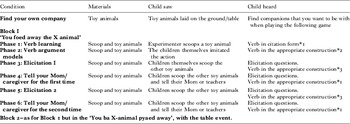
Next, the experimenter asked the child to play with another toy animal. The children were given the opportunity to complete eight trials, after each of which they were prompted by the agent-focused question. After the fourth and eighth trials, they were asked to tell the teacher or the parent what they just did to the toy animal. Because the children were expected to produce at least one utterance after each trial, the expected number of utterances for each novel verb was eight. After the children finished the first eight trials (the first novel verb paired with the first novel object), the other verb pair and novel object were substituted for the second eight trials. The procedures and questions were the same as before. The new pair of novel verbs was presented in the other argument structure. Table 1 presents the order of experimental block events for a particular child in Experiment 1.
Order of experimental block events for a particular child in Experiment 1

Most of the children did not produce utterances until after the third trial. It should be noted that some of them did not use the target verb at all in response to some elicitation opportunities. Others gave up to three responses (complete sentences) to each elicitation opportunity. These repetitions were coded separately. For example, if a child responded three times to the SVO structure with the novel target verb, the three sentences were coded as separate utterances. The average number of utterances for each verb was 6·66 per child (SD = 1·61). More specifically, the average number of utterances for the verb fo was 6·81 (SD = 1·88), and the average number of utterances for the verb pya was 6·5 (SD = 1·27).
Scoring
All of the children's utterances that contained a novel verb were transcribed for subsequent analysis. To be counted as demonstrating an SVO construction, the utterance had to be a sentence consisting of a verb, and an object, and with or without the resulting compound zou ‘away’. To be counted as demonstrating a ba construction, the sentence had to have a ba marker, an object, and a verb, in that order and with or without the resulting compound zou ‘away’. For neither construction was it necessary for the sentence to have a subject. Chan et al. (Reference Chan, Lieven and Tomasello2009) and Lee and Naigles (Reference Lee and Naigles2008) have pointed out that Mandarin is a language that allows pervasive ellipsis. However, subject ellipsis still allows the coders to code the sentences as an SVO or a ba construction. The arrangement of the words had to conform to the order required for a given construction. If the utterance was produced in a ba-like construction without a -le, it was still counted as a ba construction, for syntactic productivity should not be narrowly computed from the total of complete sentences. More than two-thirds of the utterances (168/213) consisted of the novel verb plus the word le with or without the real word zou.
Data from one-fourth of the children were given to two trained assistants for independent coding. Their agreement was 98%.
RESULTS
There were 213 codable utterances that ranged from 9 to 17 per child (Mean = 13·31, SD = 2·05). The total number of codable utterances in the ba condition was 116 (Mean = 7·25, SD = 3·83 per child), and the total number of codable utterances in the SVO condition was 97 (Mean = 6·06, SD = 2·41per child).
Table 2 presents the average number of productive utterances that children produced as an SVO construction and as a ba construction, and the percentage of children who produced these productive utterances in each experimental condition; i.e., the percentage of children who exhibited syntactic productivity. Six of the sixteen children (38% of the children) contributed to 31 productive utterances of the ba constructions out of a total 97 utterances (31·96%; Mean = 1·94 per child, SD = 2·95) when the novel verbs were introduced in the SVO construction. On the other hand, thirteen of the sixteen children (81%) contributed to 46 productive utterances of the SVO construction out of a total 116 utterances (40%; Mean = 2·88 per child, SD = 2·03) when the novel verbs were introduced in the ba construction. Thus, over one-third of the children produced at least one ba construction, and over three-quarters did so with the SVO construction.
Average numbers and standard deviation of productive utterances and percentage of children who produced them in the two experimental conditions (N = 16)

note: Percentages indicate the percentage of children who produced at least one utterance of a given type.
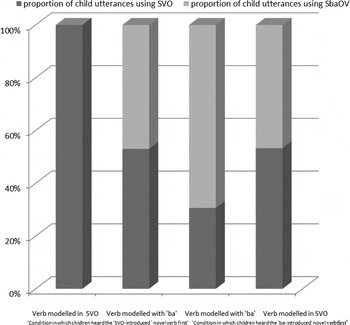
A closer look at the data indicated that the order of the conditions exerted an influence on the children's productivity. Figure 1 consists of two pairs of bars. These bars display the percentages of the children's production of utterances on the basis of the order of the presentation of the two structures with the novel verbs. The left pair indicates the percentages of utterances when the SVO was presented first and the ba construction was presented second, while the right pair indicates the percentages of utterances when the ba construction was presented first and SVO was presented second. Children produced 104 utterances in total when under SVO-first and ba-second conditions. The left pair in Figure 1 indicates that when the novel verb was first presented in the SVO construction, all 38 utterances of the children were SVO. When the second verb was provided in the ba construction, 35 out of 66 utterances (53·03%) conformed to the presented ba construction, while 31 utterances (46·97%) were novel SVO constructions.
The left pair: percentages of utterances when SVO was presented in the first block and ba in the second block; the right pair: percentages of utterances when ba was presented in the first block and SVO in the second block.

The right pair in Figure 1 shows that when the ba construction was first presented, children produced 34 utterances (69·39%) out of 49 total utterances, which conformed to the presented ba construction, while 15 utterances (30·61%) were novel SVO structures. When the second verb was presented in the SVO construction, out of 59 total utterances, 28 utterances (47·46%) conformed to the presented SVO construction, but 31 utterances (52·54%) were novel ba constructions. Two clarifications are in order. First, the six children who produced ba constructions when taught the verbs in SVO constructions were all in the ba-first condition. Thus, 6/8 (75%) produced productive ba constructions in that condition, whereas 0 did so in the ba-second condition. Second, although these children's predominant use of SVO constructions when the novel verb was taught in the SVO-first condition conforms to the usage-based approach, children's demonstration of the ba constructions (compared with chance; t (14) = 10·98, p < ·001) in the ba-first condition suggests that these children already possessed a representation of the ba construction and can use it when the context is appropriate. Their usage of the ba construction did not reflect its low cue validity from input, which runs counter to the prediction of the usage-based approach. Therefore, 75% of these children used ba constructions productively when the novel verb was taught in the SVO construction, leading to different levels of syntactic productivity when the order of the presentations of the two sentence types differs.
To investigate the effect of the order of the presentation of the two sentence types on the productive utterances in the SVO and ba conditions, a two-way mixed Analysis of variance between groups (ANOVA) was conducted, with structure (SVO vs. ba) as the within-participants variable, and order (first vs. second) as the between-participants variable; i.e., SVO constructions in ‘ba’-first and ‘ba’-second, and ba constructions in the SVO-first and SVO-second with the proportion of productive utterances as the dependent variable. There was a significant effect on structure (F(1,14) = 32·17, p < ·001, η 2 = 0·697); a significant main effect on order (F(1,14) = 5·55, p = ·034, η 2 = 0·284); and a significant structure by order interaction (F(1,14) = 9·47, p = ·008, η 2 = 0·403). In addition, an independent t-test was conducted to investigate whether productive usage in the second blocks (‘ba’-second and ‘SVO’-second) differs. The independent variable is the structure (SVO vs. ba construction) in the second block, and the dependent variable is the productive utterances produced by each child in these two blocks. No statistical difference was obtained on the productive usage of these two structures in the second block (t (14) = 1·03, p = .314). These significant main effects suggest that the children produced more productive utterances when the novel verbs were presented in the ba construction than when the novel verbs were presented in the SVO constructions, and they produced more productive utterances in the second block than in the first block. The absence of the effect between the two second blocks indicates that children produced productive utterances similarly in the second block. The significant interaction indicates that performance in the blocks was not affected equally in the two presentation conditions. When the event was modeled in the SVO construction, more productive usage of the ba construction was uttered in the second block than in the first block. By contrast, when the event was presented in the ba construction, children produced productive SVO constructions similarly in both blocks.
DISCUSSION
The overall results were: (i) productivity was greater in the second block, as a result of priming; (ii) a similar magnitude of productivity was obtained in the second block between the two constructions; (iii) an abstract rule for the SVO–ba alternation was applied; and (iv) the default structure (SVO) was produced even in the absence of priming (i.e., in the first block when only ba was presented), and it was produced more frequently than the ba construction. This effect suggested that SVO could be considered the default structure for a bounded transitive event.
When Mandarin-speaking three-year-olds heard two novel verbs presented in two different structures, they started to exhibit syntactic productivity. Mandarin-speaking three-year-olds make use of abstract syntactic rules that connect SVO and ba structures in terms of meaning equivalence. The finding in the present experiment is consistent with those from other structural priming studies using English novel verbs and known verbs with three-year-olds (Bencini & Valian, Reference Bencini and Valian2008; Brooks & Tomasello, Reference Brooks and Tomasello1999; Conwell & Demuth, Reference Conwell and Demuth2007; Shimpi et al., Reference Shimpi, Gamez, Huttenlocher and Vasilyeva2007). The syntactic productivity obtained in this case can be considered a form of structural priming that involves implicit learning, and has been shown to persist through ten production trials (Bock & Griffin, Reference Bock and Griffin2000; Huttenlocher, Vasilyeva & Shimpi, Reference Huttenlocher, Vasilyeva and Shimpi2004) or longer than one week (Savage, Lieven, Theakston & Tomasello, Reference Savage, Lieven, Theakston and Tomasello2006).
In contrast to Brooks and Tomasello's (Reference Brooks and Tomasello1999) claim that three-year-olds require multiple presentations of unfamiliar verbs (at least 64 to 100 presentations each in their training phase) before they can produce passive structures and exhibit syntactic productivity, Mandarin three-year-olds in the present study needed only eight presentations for syntactic productivity to occur. This result might be related to the canonical one-to-one mapping of the relation between the number of nouns and the role of the participant in the event (Pinker, Reference Pinker1989). The children quickly applied this early-acquired syntactic bootstrapping (Yuan et al., Reference Yuan, Fisher and Snedeker2012) to constrain the verb meaning.
Although the agent-focused question was supposed to elicit both constructions equally, it may have had a stronger tendency to elicit the SVO construction on the basis of post-analysis (as indicated in Figure 1), and therefore the SVO construction was predominant in the block when it was first presented, and a few instances of the SVO construction occurred even when the novel verb was first presented using a ba construction. It reflects Mandarin-speaking three-year-olds' input regularities; i.e., the SVO construction is much more frequent than the ba construction (Candan et al., Reference Candan, Kuntay, Yeh, Cheung, Wagner and Naigles2012; Lee & Naigles, Reference Lee and Naigles2005; Sun & Givon, Reference Sun and Givon1985; Wei, Reference Wei1989). This is further indication of the SVO construction being the default and predominant construction to describe transitive events.
It is true that the predominance of the SVO construction in young children's production suggests the important effect of input on further integration of their representations. The purpose of this predominance in children, as in adults, is to create an optimal fit to the processing environment (Abbot-Smith et al., Reference Abbot-Smith, Lieven and Tomasello2008; Chan et al., Reference Chan, Lieven and Tomasello2009; Dittmar et al., Reference Dittmar, Abbot-Smith, Lieven and Tomasello2008). Nevertheless, these results indicate that Mandarin-speaking three-year-olds have a productive command of the ba construction. As a result, Mandarin-speaking three-year-olds can override the predominant input regularities that tempt them to produce the SVO construction. As a result, they can produce the ba construction productively with a similar magnitude of syntactic productivity/structural priming between the SVO and ba construction being obtained when the cue validity of the ba-construction (0·003) is very low from input.
EXPERIMENT 2: STRUCTURAL PRIMING IN MANDARIN-SPEAKING THREE-YEAR-OLDS
The key finding of Experiment 1, stronger syntactic productivity in the second block, was attributed to continuation of the structural priming effect from the first block (Bencini & Valian, Reference Bencini and Valian2008; Bock & Griffin, Reference Bock and Griffin2000; Savage et al., Reference Savage, Lieven, Theakston and Tomasello2006; Snedeker & Thothathiri, Reference Snedeker, Thothathiri, Sekerina, Fernández and Clahsen2008). Consistent with Chang et al. (Reference Chang, Dell and Bock2006) and Fisher (Reference Fisher2002b), structural priming in this case is interpreted as indicating a sufficiently abstract representation of language production syntax in language acquisition, because structural priming occurs independent of lexical overlap (i.e., it is verb general). However, the findings from Experiment 1, as well as from previous studies (Bencini & Valian, Reference Bencini and Valian2008; Shimpi et al., Reference Shimpi, Gamez, Huttenlocher and Vasilyeva2007), all involved strong design in terms of structural priming in child language acquisition. The strong design, which these studies have adopted, involved the manipulation of multiple presentations of a single structure with no fillers. Kaschak and Borreggine (Reference Kaschak and Borreggine2008) have reported that multiple presentations of a single structure with no fillers would lead to a boost in structural priming in adult language acquisition, which is consistent with Snedeker and Thothathiri's (Reference Snedeker, Thothathiri, Sekerina, Fernández and Clahsen2008) doubt about child language acquisition. Snedeker and Thothathiri (Reference Snedeker, Thothathiri, Sekerina, Fernández and Clahsen2008) hypothesize that if children heard multiple presentations of a single structure, the effect on structural priming in children would be boosted, as in adults, which is supported by current findings in structural priming among five-year-olds (Hsu, in press). As a result, children's demonstration of syntactic productivity may be derived from their engagement in learning during the task, and therefore an abstract but weak representation suffices. This is in contrast to an abstract but strong representation of syntax in production. If it is the case that three-year-olds already possess a strong and abstract syntactic representation that leads to structural priming in production, then a strong design involving blocks of multiple presentations of a single structure would not be necessary. Experiment 2 tests the strength of this ability using a weaker design than is customarily employed in studies of child language acquisition. Thus, a within-participants design with fillers but no blocking was employed to test structural priming in three-year-old Mandarin children. The results were compared with those of the control group in which no structural priming was available.
Method
Participants
The original sample for the structural priming conditions consisted of twenty-four three-year-old children recruited from three kindergartens in Taipei, Taiwan. Two of these children were dropped from the analyses because they made no scorable responses during the experiment. This left a final sample of 22 children (10 boys and 12 girls). Their ages ranged from 2;11 to 3;6 (Mean = 3;1, SD = 0·52). All had similar socioeconomic status in that their parents were middle-class Taiwanese. Another twenty-two Mandarin-speaking three-year-olds (mean age = 3;1, SD = 0·46) who did not participate in the structural priming conditions and had comparable socioeconomic status with the children in the structural priming conditions were tested in a no-priming task.
All the children had Mandarin Chinese as their dominant tongue, but twenty-five also spoke Taiwanese. They interacted primarily in Mandarin Chinese with their teachers in school and with family members at home. The parents of the bilingual children reported in the background questionnaire that their children interacted with their grandparents in simple Taiwanese and had little difficulty understanding Taiwanese.
Materials and tasks
In terms of priming conditions, there were sixteen animations for the SVO–ba transitive alternations. The events represented in the animations could be described using either an SVO or S ba OV construction. The animations were created with Adobe Flash Player 9. Half of them were used by the experimenter for her own descriptions and the other half were used by the children to describe the events depicted in the animations. For example, an animation that showed a cat catching a mouse could be described using the SVO construction outlined in (1) or the ba construction outlined in (2) in the ‘Introduction’. All the experimental animations that the children saw were compatible with both structures. Since this is a structural priming task, the noun phrases and the lexical verb did not overlap between prime and target. A full list of the prime and target sentences can be seen in the ‘Appendix’.
Because the SVO construction and the ba construction can alternate with each other when the event is resultative, all the animations denoted clear endpoints to assure that the animation was describing a resultative event. It is usually necessary that the verb phrase in a ba construction be complex because Mandarin usually requires a resultative element in addition to the verb to show the resultative state.
The eight intransitive animation pairs each had a single actor performing a self-initiated action such as dancing or jumping. The intransitive/filler sentences associated with the animations were interspersed with sentences representing the SVO or ba structure and served as fillers in the list.
Two lists of sixteen animations were constructed to counterbalance the design. Each of the eight animations used by the experimenter was preceded by a priming sentence that was paired with either the SVO or ba construction in the same alternation in the two lists. For example, if a transitive animation was paired with an SVO-structured priming sentence in List 1, it was paired with a ba-structured priming sentence in List 2. Half of the children were given List 1 and half List 2. For each trial, the experimenter uttered a prime sentence accompanied by its corresponding animation. The child then described a different animation of the same structural type, allowing for argument structure alternation. The pairings of the animations with the prime sentences were fixed across trials, but the sentences were counterbalanced within each list. The intransitive filler trials (intransitive prime + animation with self-initiated action) were always followed immediately by a transitive test trial.
The formal trials were preceded by four pairs of practice trials. For these trials, four dative animations were employed illustrating transfer events that could be described using a dative structure. For instance, an animation showed a monkey throwing a book to a rabbit, denoting a transfer event. Eight identical target animations to those used for structural priming were used in the control group.
Procedure
The teachers allowed the experimenter to use a room in the kindergarten to interact with the children, who were tested individually. When the children came to the room, the experimenter first asked them whether they wanted to join the experimenter in playing a game, which the experimenter briefly described. When the children said yes, the session began.
The experimenter told the children that they would take turns with the experimenter in describing the animations. It was explained that they should repeat their description of the experimenter's animation before describing their own animation. For each trial, including practice and formal trials, children heard the sentence that was uttered by the experimenter, repeated the experimenter's utterance, and heard themselves describe their own animation.
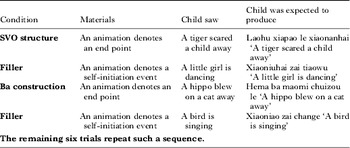
In the practice trials, the experimenter asked the child for the name of the actor in Mandarin, such as Zheshishei? ‘Who is it?’ or Na zhiyige you shishei? ‘This one, who is it?’ What the actor was doing was also presented in Mandarin. For example, Zheyigedongzuoshisheme? ‘What is this action called?’ The experimenter then asked Zhigedonghua li fasheng le shemeshi? ‘What happened in the animation?’ After the experimenter finished describing her own practice animation, the experimenter asked the children to repeat the sentence they had just uttered; the children then described their own animation. This dialogue-like activity continued until the end of four pairs of practice trials. Then the identical dialogue-like activity was applied to the eight pairs of formal trials until these eight trials were exhausted. The order of the first two test trials and filler trials is outlined in Table 3.
Order of filler and experimental events for the first two trials within a particular child in Experiment 2

For the control group, the additional twenty-two three-year-olds saw the identical eight target animations that were used in the structural priming condition, but were allowed to describe the animations without any priming.
Coding and scoring
The animation descriptions were coded according to syntactic structures. A sentence was coded as an SVO construction if it contained a subject, a verb or a verb compound that denotes telicity, an object, and a perfective marker -le, in that order. It was coded as an S ba OV construction if it contained a subject, a ba marker, an object, a verb or verb compound that denotes telicity, and a perfective marker -le in that order. It was coded as a ba construction if its elements conformed to the order S ba OV. Specifically, a construction with an SVO word order is included when it can alternate with a ba construction. That is, native speakers have no difficulty paraphrasing a ba construction counterpart. One thing to be noted: in this experiment, the subject of both constructions needs to be present to be counted as an SVO or ba utterance for subsequent analysis, unlike the scoring procedures in Experiment 1, where an SVO or ba utterance allows the subject to be dropped.
Under structural priming conditions, trials were excluded if children did the following: (i) repeat the experimenter's utterances incorrectly the first time they were asked to do so, before describing the target animation; and (ii) repeat the experimenter's verb to describe the animation immediately following description. Sentences that did not pass the exclusion tests were coded as ‘other’. This coding resulted in 67 utterances that were not included for further analysis.
Under control conditions, children produced 149 ‘other’ responses, such as using the NP conjunction structure with a single verb, using the verb with no -le, using the progressive aspect instead of the resultative aspect, or producing only animal names. Children produced many SVO constructions that cannot alternate with the ba construction; for example, the progressive structure, neutral SVO with no -le, and so on.
The data from six of the twenty-two children for each experiment were randomly selected and given to two graduate assistants for independent coding using the coding scheme above. Their agreement was 97%and 98%, respectively, for each condition. Any inconsistency was resolved by the author.
Following the standard procedures described by Bock (Reference Bock1986), the proportion of target structures that involved structural alteration was calculated. For instance, if a child produced four SVO constructions, two ba constructions, and two other constructions, the proportion of ba constructions would be 0·33 (because the other structure was omitted). Likewise, for item analysis, if an animation was described with five SVO constructions, five ba constructions, and twelve other constructions in a given cell of the design, the proportion of SVO constructions would be 0·5 (5/10) for purposes of comparison with the size of the effect in adults.
RESULTS
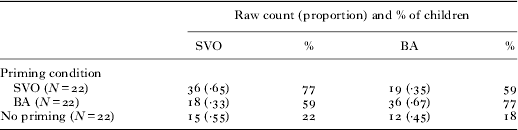
Twenty-two children in the priming-condition group (95%) produced at least one SVO or ba construction under the priming condition (Mean = 4·95, SD = 2·20). The raw utterances that include both constructions for each child under the priming condition are: 5, 6, 3, 7, 1, 6, 6, 4, 6, 5, 6, 5, 5, 0, 2, 7, 3, 7, 8, 8, 7, 2. By contrast, under the control condition, only five children (23%) produced at least one SVO or ba construction (Mean = 1·23, SD = 2·37). The raw utterances that include both constructions for each child in this condition are: 7, 7, 5, 5, 3, for the five children who produced at least one construction. The remaining seventeen children (77%) did not produce any construction related utterances. Table 4 displays the raw numbers of SVO construction and ba construction target completions for the two structures. The proportions of completions that follow Bock's (Reference Bock1986) analysis are given in parentheses. In the SVO construction priming condition, seventeen children (77%) produced 36 SVO constructions (Mean = 1·59, SD = 1·30), while thirteen children (59%) produced 19 alternate constructions (Mean = 0·86, SD = 0·87). Twelve children (55%) produced more SVO constructions than ba constructions. Under the ba construction priming condition, seventeen children (77%) produced 36 ba constructions (Mean = 1·64, SD = 1·19), while thirteen children produced 18 alternate constructions (Mean = 0·82, SD = 0·83). Thirteen children (59%) produced more ba constructions than SVO constructions. Among the control group, the children produced 27 utterances in total (Mean = 1·23, SD = 2·37). Five children (22%) produced 15 SVO constructions (Mean = 0·63, SD = 1·25), while four children (18%) produced 12 ba constructions (Mean = 0·54, SD = 1·15).
Raw count (proportion) of completions of an SVO construction and a ba construction in the SVO priming, ba-construction priming and no priming conditions and percentage of children who produced them in the three conditions
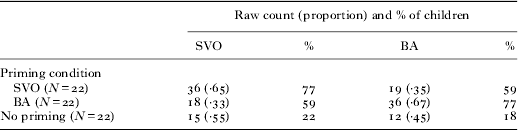
The results in Table 4 indicate that reliable priming occurred with both constructions under structural priming conditions. After the Mandarin-speaking three-year-olds repeated the primes uttered by the experimenter, they tended to use these same structures to describe animations. Specifically, they tended to produce more SVO constructions than ba constructions after repeating an SVO prime. The incidence of SVO transitives was 30% greater than ba constructions in the SVO priming condition. This proportion was calculated by subtracting the proportion of SVO transitives from the proportion of ba constructions in the SVO prime condition. The proportional difference is the priming effect. The children also tended to produce ba constructions more often than the SVO construction after repeating the ba construction prime. Thus, the incidence of the ba construction was 34% greater than the SVO structure in the ba construction priming condition. The following statistical analyses first investigated the relation among order, bilingualism, and structural priming effects in the two construction priming conditions, the magnitude of structural priming effects between the two constructions, and then the effects of structural priming against the control condition.
For statistical analysis under priming conditions, SVO construction and ba construction responses were first analyzed separately using two mixed three-way ANOVAs for the SVO and ba construction priming conditions. In this case, the independent variables were order (SVO first vs. ba construction first), bilingualism (monolingual vs. bilingual), and the priming structures (target vs. alternative structure). The dependent variable was the proportions of primed structures vs. the alternative structures (primed and non-primed). The primed structure in the SVO condition was SVO construction and the non-primed structure was the ba construction, while the primed structure in the ba condition was the ba construction and the non-primed structure was the SVO construction. These two structures were then compared to see whether there was any priming difference between the two types of structures, using a mixed two-way ANOVA where the independent variables were the priming conditions (SVO condition vs. ba construction condition) and the priming structures (target vs. alternative). The dependent variable was the proportion of the primed structures vs. that of the non-primed structure. The analysis offers a comparison between the proportion of primed and non-primed structures in the SVO condition. This is defined as the proportions of SVO and ba constructions and the proportions of primed and non-primed structures in the ba construction.
The analysis of SVO structure revealed the main effect of priming (F 1(1,18) = 6·052, p = ·024; F 2(1,7) = 6·86, p = ·034; η 2=0·252; 95% CI for the difference was (0·321, 0·504)). The remaining main effects of order and bilingualism; two-way interaction effects between priming and order and between priming and bilingualism; and the three-way interaction among priming, order, and bilingualism were not significant (all ps > ·05). Mandarin-speaking three-year-olds exhibited reliable structural priming in the SVO construction in production-to-production.
The analysis of the ba construction also revealed the main effect of priming (F 1(1,18) = 4·94, p = ·038; F 2(1,7) = 8·62, p = ·022; η 2 = 0·215 ; 95% CI for the difference was (0·313, 0·504)). The remaining main effects of order and bilingualism; the two-way interaction effects between priming and order and between priming and bilingualism; and the three-way interaction among priming, order, and bilingualism were not significant (all ps > ·05). Mandarin-speaking three-year-olds exhibited reliable structural priming in the ba construction in production-to-production.
The comparison of priming effects between SVO structures and ba construction revealed a significant priming effect (F 1(1,42) = 12·15, p = ·001; F 2(1,14) = 14·82, p = ·002; η 2 = 0·224; 95% CI for the difference was (0·349, 0·469)). Nevertheless, no significant effects were found between the structure and the interaction between priming and structure. The results suggested that Mandarin-speaking three-year-olds exhibited structural priming of SVO structure and the ba construction to a similar magnitude.
To test the effects of structural priming with respect to the control group, two separate one-way ANOVAs tests allow us to investigate effects among immediate structural priming, delayed structural priming (children not being immediately primed under priming conditions but getting primed in subsequent production),Footnote 1 and no priming condition. The independent variables for the analyses were three conditions (immediate priming, delayed priming, and no priming). The dependent variables are the proportion of the SVO construction produced by each child in the SVO priming condition and in the control group, and the proportion of the ba construction produced by each child in the ba construction priming condition and in the control group. The analysis for SVO construction revealed a significant effect (F (2) = 38·58, η 2 = 0·636). Therefore, a Tukey HSD post-hoc comparison was applied to examine effects between conditions. The results indicate that more SVO utterances were produced from children in the immediate priming condition than those in the delayed priming condition or in the control condition (both ps < ·001). No such difference was obtained from children in the delayed condition and in the control condition (p > ·05). The analysis for the ba construction revealed a similar pattern. The analysis for the ba construction also indicated a significant effect for comparison purposes (F (2) = 73·76, η 2 = 0·772). The results indicate that more utterances of the ba construction were produced from children in the immediate priming condition than those in the delayed priming condition or in the control condition (both ps < ·001). Again, no such difference was obtained from the children in the delayed condition and in the control condition (p > ·05). Mandarin-speaking three-year-olds exhibited reliable structural priming but did not demonstrate any delayed structural priming effect.
DISCUSSION
In the present study, a weakened, adult-like manipulation was employed to investigate structural priming. Robust structural priming by Mandarin-speaking three-year-olds with weakened manipulation decreases the possibility that a young child's structural priming is derived from a weak syntactic representation or from engagement in learning that leads to boosting effects. Instead it is derived from a strong and abstract representation of language production syntax (cf. Bencini & Valian, Reference Bencini and Valian2008; Shimpi et al., Reference Shimpi, Gamez, Huttenlocher and Vasilyeva2007). Chang et al. (Reference Chang, Dell and Bock2006) argued that structural priming occurs in language production when abstract syntactic representation occurs in response to input. When comparisons are made with the control group, the relative absence of delayed priming may be due to the context of this study, which does not allow an appropriate number of trials for it to occur. The issue, therefore, of whether Mandarin-speaking children can exhibit delayed structural priming is still open.
The fact that Mandarin-speaking children used a neutral SVO (see ‘Coding and scoring’ section) to describe an event reflects input consisting of an unbalanced distribution of SVO constructions and ba constructions (Candan et al., Reference Candan, Kuntay, Yeh, Cheung, Wagner and Naigles2012; Lee & Naigles, Reference Lee and Naigles2005; Sun & Givon, Reference Sun and Givon1985; Wei, Reference Wei1989).The SVO structure was the predominant structure in the language input sessions. Nevertheless, the similarity in the magnitude of effects vis-à-vis structural priming between the SVO and ba constructions suggests that children's demonstration of productive knowledge is not always determined by input characteristics, as cue validity of ba constructions is low. These results provide strong evidence that Mandarin-speaking three-year-olds form a general rule to allow the SVO–ba alternation, and their linguistic representation was abstract and strong enough to give them good command of this rule, even when they rarely used these constructions in production, as the control group indicated.
GENERAL DISCUSSION AND CONCLUSIONS
The present study provides helpful evidence to resolve some of the issues mentioned in the ‘Introduction’. Mandarin-speaking three-year-olds have a strong and abstract syntactic representation that allows them to demonstrate productive knowledge (i.e., rule behavior that is independent across verbs in production tasks even when the semantic cues such as animacy do not favor this demonstration). Mandarin-speaking three-year-olds as well as English- and German-speaking three-year-olds are able to demonstrate robust productive knowledge with syntax in production tasks (Chan et al., Reference Chan, Lieven and Tomasello2009).
Earlier findings of productive knowledge with Mandarin SVO constructions using enactments from comprehension (Lee & Naigles, Reference Lee and Naigles2008) may allow the possibility that Mandarin-speaking three-year-olds possess only an abstract but weak representation (Abbot-Smith et al., Reference Abbot-Smith, Lieven and Tomasello2008). These three-year-olds' demonstration of syntactic productivity and structural priming in the current study vindicate the case that Mandarin-speaking three-year-olds employ a strong and abstract syntactic representation.
On the one hand, the results also indicate that input characteristics play a significant role in a young child's formation of productive knowledge, as indicated by the young children's production of SVO constructions. When circumstances require young children to exhibit their default preference structure in production, they tend to follow distributional regularities in input. This is evidenced in the situation where the novel verb was presented in the SVO construction in the first block of Experiment 1 and neutral SVO constructions were produced in the control group of Experiment 2.
On the other hand, Mandarin-speaking three-year-olds' demonstration of syntactic productivity and structural priming suggests that input/usage cannot be the only factor that determines their demonstrations of productive knowledge. As mentioned, cue validity of the ba construction is quite low in Mandarin-speaking three-year-olds' input (Candan et al., Reference Candan, Kuntay, Yeh, Cheung, Wagner and Naigles2012; Lee & Naigles, Reference Lee and Naigles2005; Sun & Givon, Reference Sun and Givon1985; Wei, Reference Wei1989), and they thus exhibit stronger syntactic productivity of the predominant SVO construction. However, the absence of significant effects between SVO and ba constructions with respect to syntactic productivity in the second block of experiments and to structural priming runs counter to the predictions of the usage-based account.
Although both English passive construction and Mandarin ba construction are infrequent in young children's input, children's acquisition of the ba construction seems to be facilitated by innate biases that are greater than those for passive construction acquisition. Fisher and colleagues (Fisher, Reference Fisher1996; Gertner & Fisher, Reference Gertner and Fisher2012; Gertner, Fisher & Eisengart, Reference Gertner, Fisher and Eisengart2006; Naigles, Reference Naigles1990; Yuan et al., Reference Yuan, Fisher and Snedeker2012) proposed that children as young as 1;9 can employ syntactic knowledge, such as the number of nouns and word order, to construct a partial syntactic representation that guides sentence interpretation and promotes rapid verb learning. This is called syntactic bootstrapping. We suggest that Mandarin-speaking children begin with an unlearned bias toward one-to-one mapping to align nouns with participant roles. Such verb-general alignments reduce hypothesis space of the interpretations and constrain the construals of the sentence to the transitive/causal interpretation of the event. A word order bias which treats first-mentioned noun as agent and second-mentioned noun as patient, plus the alignment of nouns and participant roles through the unlearned bias towards one-to-one mapping, facilitates young children's construction of partial syntactic representations such as [NP1-Agent, V-transitive/causal, NP2-Patient]. Such a verb-general syntactic representation not only promotes young children's learning of the novel verbs in the SVO construction but also leads them to commit errors when learning the passive construction and conjoined-subject intransitive constructions (Bates & MacWhinney, Reference Bates, MacWhinney, Wanner and Gleitman1982; Gertner & Fisher, Reference Gertner and Fisher2012; Slobin & Bever, Reference Slobin and Bever1982). Embedded with such a partial syntactic representation, young Mandarin-speaking children can make a quick and correct initial interpretation of the ba construction consisting of [NP1-Agent, NP2-Patient, V-transitive/causal]. This promotes subsequent learning in a verb-general way. In addition, Li and Bowerman (Reference Li and Bowerman1998; following Slobin, Reference Slobin and Slobin1985) proposed that Mandarin-speaking children, as well as other children in other languages, are innately equipped with privileged semantic notions such as ‘result’. This allows them to pay particular attention to the grammatical morphemes such as -le and ba, and their associated content words such as the verb or verb compound. Such mapping between the grammatical morphemes of result and associated content words help it to fulfill the partial syntactic representation they need for syntactic bootstrapping to occur. As a result, it is relatively easier for Mandarin-speaking children to acquire the ba construction than for English-speaking children to acquire the passive construction when input of both structures is infrequent. An appropriate task that includes structural priming, syntactic productivity, employment of syntactic bootstrapping, and the notion of privileged semantics in children for the two alternative structures (SVO construction and the ba construction) may also play a role in understanding young learners' syntactic productivity. Evidence from both within and across languages suggests that in addition to input characteristics, children's innate endowment/biases and the demands of tasks (Dittmar et al., Reference Dittmar, Abbot-Smith, Lieven and Tomasello2008, Reference Dittmar, Abbot-Smith, Lieven and Tomasello2011) play a crucial role in the ability of young children to demonstrate productive knowledge in language. This is in keeping with predictions from the early-generalization account given in Fisher (Reference Fisher2002b).
There is no doubt that input characteristics play a significant role in young learner acquisition of linguistic representations. Nevertheless, when and how young children can transcend input and demonstrate productive knowledge is an interesting and worthy question for future study.
APPENDIX
Prime animation for the SVO–ba alternation
(1) Laoyingzhuazou-le xiaoji./Laoyingbaxiaojizhuazou-le.
Eagle catch-go-le chicken/Eagle BA chicken catch-go-le
‘An eagle caught the chicken.’
(2) Laohubanzhu-le eyu. / Laohubaeyubanzhu -le.
Tiger tie-live -le alligator Tiger BA alligator tie-live -le
‘A tiger tied an alligator tight.’
(3) Qinwachidiao -le wunzi. / Qinwanbawunzichidiao -le.
Frog eat-fall -le mosquito Frog BA mosquito eat-fall -le
‘A frog ate a mosquito.’
(4) Xiaoxiungyaozou -le houzi. / Xiaoxiungbahouziyaozou -le.
Bear bite-go -le monkey Bear BA monkey bite-go -le
‘A bear bit a monkey and left.’
(5) Qiedahuai -le jiqiren. / Qiebajiqirendahuai -le.
Penguin hit-bad -le robot Penguin BA robot hit-bad -le
‘A penguin crashed a robot.’
(6) Yazituizou -le baie. / Yazibabaietuizou -le.
Duck push-go -le goose Duck BA goose push-go -le
‘A duck pushed a goose away.’
(7) Houzichueifan -le qie. / Houzichueifan -le qie.
Monkey blow-turn -le penguin Monkey blow-turn -le penguin
‘A monkey blew the penguin and the penguin turned around.’
(8) Mayitaizou -le chongchong. / Mayibachongchongtaizou -le.
Ant lift-go -le caterpillar Ant BA caterpillar lift-go -le
‘Ants moved a caterpillar away.’
Eliciting animations for the SVO–ba alternation
(1) Laohuxiapao -le xiaonanhai./Laohubaxiaonanhaixiapao -le.
Tiger scare-run -le little-boy/Tiger BA little-boy scare-run -le
‘A tiger scared a little boy (away).’
(2) Xiaoxiungtidao -le xiaogou./Xiaoxiungbaxiaogoutizdao -le.
Little-bear kick-fall -le little-dog Little-bear BA little-dog kick-fall -le
‘A bear kicked a dog and the dog fell down.’
(3) Xiaogoutuozou -le xiaobaitu./Xiaogoubaxiabaitutuozou -le.
Little-dog tow-go -le little-rabbit/Little-dog BA little-rabbit tow-go -le
‘A dog pulled a rabbit away.’
(4) Xiaotuzilazhu -le xiaoniao./Xiaotuzibaxiaoniaolazhu-le.
Little-rabbit pull-hold -le little-bird/Little-rabbit BA little-bird pull-hold -le
‘A rabbit pulled on a bird and the bird could not fly away.’
(5) Hemachueifei -le maomi./Hemabamaomichueifei-le.
Hippo blow-fly -le cat/Hippo BA cat blow-fly -le
‘A hippo blew on a cat and the cat soared away.’
(6) Qiechiwan -le yu./Qiebayuchiwan -le.
Penguin eat-finish -le fish/ Penguin BA fish eat-finish -le
‘A penguin ate a fish.’
(7) Laoyieyiedashang leyan./Laoyieyiebayandashang -le.
Old-grandpa hit-hurt -le sheep/Old-grandpa BA sheep hit-hurt -le
‘An old man hit and hurt the sheep.’
(8) Chanzinlucaisi -le chong./Chanzinlubachongcaisi -le.
Giraffe stamp-die -le worm/Giraffe BA worm stamp-die -le
‘A giraffe stomped on a worm/caterpillar and the worm/caterpillar died.’