According to the Center for Research on Epidemiology of Disasters (CRED), the number of people affected by natural disasters has climbed from 100 million to 700 million in the past 50 years.Reference Sherrieb, Norris and Galea 1 In the last 15 years, disasters have affected billions of people, resulting in 1.2 million deaths and approximately $1.7 trillion in damage worldwide. During the same period in the United States, disasters have affected 21.5 million people generating economic losses of $565 billion, not including man-made disasters such as terrorist attacks and mass shootings.Reference Sherrieb, Norris and Galea 1
After the 2004–2005 Avian flu epidemic, the World Health Organization required all members to develop pandemic influenza preparedness plans. During the 2009 H1N1 pandemic influenza, these were activated. Large-scale natural disasters such as Hurricanes Katrina (2005), Irene (2011), and Sandy (2012) have indicated shortcomings in disaster preparedness and response coordination, yet other incidents like the Boston Marathon bombings have shown strengths in specific areas such as hospital preparedness and response.Reference Ablah, Konda and Konda 2 Additionally, events such as the West Africa Ebola outbreak exposed a need for emergency responses that are coordinated at an international level. These events have influenced the way governments analyze, prepare for, and respond to emergencies 3 and demonstrate the need for coordination among public health and other governmental agencies during large-scale emergencies.
The Centers for Disease Control and Prevention (CDC) and the Federal Emergency Management Agency (FEMA) have published guidelines and planning documents to comply with the Homeland Security Act (2002) and the Pandemic and All-Hazards Preparedness Act (2006). These acts mark the beginning of a process to define emergency preparedness capabilities guiding local preparedness actions and assess the impact of grant allocations. Local governments are responsible for emergency preparedness and response, which places communities at the center of disaster mitigation strategies. To reflect this, guidelines are developed on the basis of a whole community approach. This means including communities’ stakeholders in their local emergency planning, reflecting their context and local capabilities. 4 Therefore, communities are both the target of governmental intervention and an instrument to improve preparedness 5 through the development of community resilience. 6 Building resilience means improving existing community institutions, assets, and networks and leveraging individuals, businesses, and organizations to act effectively before, during, and after a disaster strikes. 4
Community resilience has become important not only as a concept describing specific characteristics of communities who respond to emergencies, but also as a specific public policy objective: mitigate the impact of emergencies and disasters. As a governmental planning principle, building community resilience has a deep influence on the formulation of policies designed to strengthen emergency planning and management. However, its definition and assessment has been a matter of academic debate with low levels of agreement on specific issues, such as how to measure resilience, its association with vulnerability (a lack of resource availability and limited redundancy) and preparedness, and how to enhance it.Reference Sherrieb, Norris and Galea 1 , Reference Ainuddin and Routray 7 - Reference Rose and Krausmann 22 Strengthening resilience becomes a critical task for mitigating the impact of disasters. Policy-makers ought to develop a common language to understand the meaning of resilience and recognize elements affecting it. The multidimensional and multi-level nature of resilience poses a challenge for formulating and implementing emergency preparedness policies. The diversity of elements composing a community resilience capacity are not always actionable through policies formulated in and by emergency management professionals. In some cases, it is critical to coordinate with other areas of government and recognize different timelines for policy outcomes. The following article presents a systematic literature review analyzing quantitative metrics of community resilience. Existing metrics are the milestone for designing instruments to assess resilience, formulating and monitoring emergency preparedness policies, and improving the design of grant allocation formulas.
METHODS
This systematic literature review summarized quantitative methods designed to assess community resilience. The review was not limited to public health preparedness; it included other fields such as geography, environmental sciences, and homeland security. It was guided by a main research objective: to assess the components, expected outcomes, and measurement techniques used in quantitative studies assessing community resilience.
A research protocol was developed based on guidelines for systematic literature reviews by the Institute of Medicine and recent updates according to the Patient-Centered Outcomes Research Institute. These relax some of the Institute of Medicine standards (eg, dual screening and data extraction is desirable but fact checking might be sufficient).Reference Kellermann and Peleg 23
Key words to identify potential articles were defined and classified in 2 groups. General terms included “community resilience,” “preparedness,” “emergency,” “disaster,” “evaluation,” “public health,” “hazard,” “terrorism,” “capabilities,” “natural,” and “readiness.” The second set of key words reflected evaluation criteria or types of measurements. These comprised “measurement,” “performance,” “quality,” “indicator,” “assessment,” “validation,” “effectiveness,” “strategies,” “criterion,” “validity,” “index,” and “regression.” Both sets of key words were validated with librarians from the University at Albany with expertise in public administration and public health and 2 public health and emergency preparedness experts.
The following bibliographic databases were used for the search: Public Administration Abstracts (EBSCOhost; EBSCO, Ipswich, MA), PAIS International/Pais Archive and MEDLINE (via EBSCO; via PubMed [National Library of Medicine, Bethesda, MD]), and government documents databases (eg, GPO catalog of US government publications, National Archives database). Google Scholar (Google Inc, Mountain View, CA) was used to control for omissions, but was not reviewed in a systematic fashion, because its listing system relegates newer, less cited material. Key words included the truncation symbol (*) to ensure a variety of references. Combinations of general terms were performed by using OR and controlling for the descriptors associated with the key word in each particular database. After an exhaustive first round of searching, and consequent collection of articles, a research assistant replicated the search by use of the same key words and controls to control for omitted articles.
Following Institute of Medicine standards, articles were selected for inclusion in the literature review in 4 steps. 24 First, titles and abstracts were screened by use of a set of exclusion criteria. Excluded articles included qualitative studies or studies from psychology on individuals’ resilience such as adolescents or veterans, grant allocation reports or gray literature, articles prior to 2002, and studies presenting tools to assess disasters’ magnitude. Second, the full text of selected articles, documents, and reports were screened for eligibility and data extraction on the basis of the inclusion criteria. To be included, articles had to be published after 2002, rely on quantitative or mixed methods approaches, and identify community resilience or emergency preparedness capabilities as the outcome measure. Additionally, they had to be set in a determined geographic area around the world, such as a country, a region, or a village. Research studies had to be original and contain detailed information on their methods, such as composite indicators or econometric models, and mention of data sources, such as an original survey or census data.
To minimize subjectivity or selection bias, to be included articles must have met all prespecified inclusion criteria and no exclusion criteria. The selected articles were screened in full text including in-text citations, identifying articles omitted during the databases search. After this process was completed, a final count of eligible articles was set. Finally, each of the included articles was considered to the full extent and revised according to their compliance with the research question.
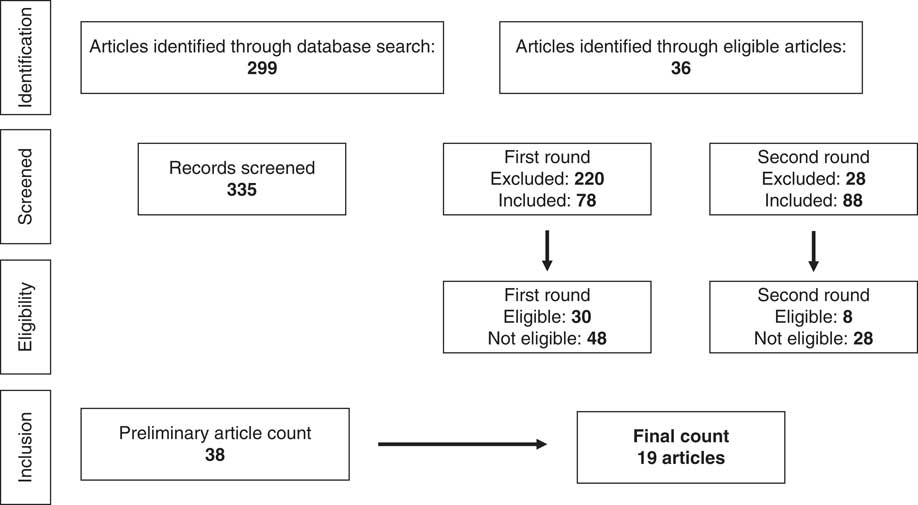
As a result of this strategy, 299 articles were initially identified. Thirty-six additional articles were identified through in-text citations. As a result, 335 articles were screened. In the first round of screening, 220 articles were excluded and 78 articles were included for eligibility assessment. Common reasons for exclusion were, first, lack of compliance with the selected outcome: community resilience. For example, articles analyzing individual resilience based on psychometric scales were excluded. Second, the use of assessment tools not based on quantitative approaches, such as checklists and content matrixes, was a reason for exclusion.
The second round that served as a mechanism to control the screening process resulted in 28 excluded and 88 included articles. After performing the eligibility assessment based on the preestablished protocol, 76 articles were deemed not eligible. The preliminary count included 38 articles. Ineligible articles mentioned an assessment tool without a detailed description of its dimensions and development methodology. After careful revision of the articles, between theoretical frameworks and instruments, only 19 fulfilled the requirements and were relevant to the research question. These articles included a detailed description of a conceptual framework underlying the development of the assessment tool, a description of community resilience dimensions and the operationalization of variables, and explicitly identified internal and external validity checks of the instruments. Figure 1 shows a simplified version of the article selection process.
Article Screening and Selection. Adapted from Institute of Medicine guidelines.

RESULTS
The study of community resilience and the development of instruments for its assessment is in its early stages, yet it is possible to discuss a set of common themes. These refer to the fields and disciplines developing the instruments, the characteristics of the underlying theoretical frameworks, the dimensions describing resilience and their operationalization, and the definition of community.
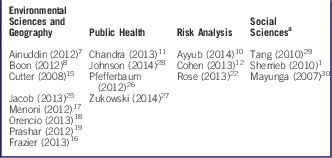
Forty-four percent of the articles were published in geography and environmental sciences,Reference Ainuddin and Routray 7 - Reference Boon 9 , Reference Cutter, Burton and Emrich 14 , Reference Frazier, Thompson and Dezzani 16 - Reference Prashar, Shaw and Takeuchi 19 , Reference Jacob, Weeks and Blount 25 22% in public health,Reference Chandra, Williams and Plough 11 , Reference Pfefferbaum, Neas and Pfefferbaum 26 - Reference Johnson, Clará and Gambhir 28 16% in risk analysis,Reference Ayyub 10 , Reference Cohen, Leykin and Lahad 12 , Reference Rose and Krausmann 22 and 16% in social sciences journalsReference Sherrieb, Norris and Galea 1 , Reference Tang 29 , Reference Mayunga 30 (Table 1).
Instruments and Models for Assessing Community Resilience: Authors by Field

a Public Administration.
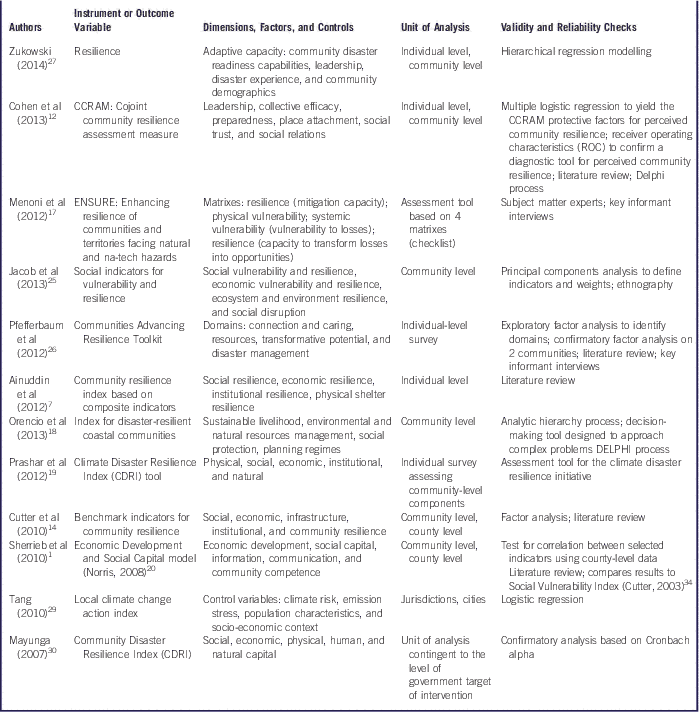
The theoretical and methodological development was divided into 2 periods. The first period, 2002-2010, was predominantly theoretical with milestone articles that set the basis for definitions and frameworks.Reference Norris, Stevens and Pfefferbaum 20 , Reference Mayunga 30 - Reference Bruneau, Chang and Eguchi 33 The second period started in 2010 with the publication of the first set of instruments,Reference Sherrieb, Norris and Galea 1 , Reference Cutter, Burton and Emrich 14 indexes in both cases, generating the benchmark for methodologies and data sources. Since these articles, several indexes have been published, being the most common methodology to assess community resilience, yet there are studies relying on statistical analysis to observe its determinants (Table 2).Reference Sherrieb, Norris and Galea 1 , Reference Ainuddin and Routray 7 , Reference Cohen, Leykin and Lahad 12 , Reference Cutter, Burton and Emrich 14 , Reference Menoni, Molinari and Parker 17 - Reference Prashar, Shaw and Takeuchi 19 , Reference Jacob, Weeks and Blount 25 - Reference Zukowski 27 , Reference Tang 29 , Reference Mayunga 30
Community Resilience: Common Metrics and Dimensions, Different Units of Analysis

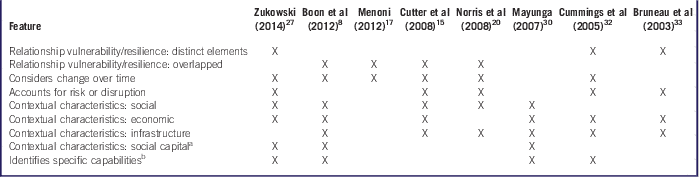
The theoretical frameworks, developed during the first period, are critical to understanding the posterior selection of dimensions and indicators to operationalize community resilience (Table 3). First, the frameworks set the association between resilience, vulnerability, and preparedness. Where 50% of the frameworks looked at these 2 elements as independent concepts,Reference Zukowski 27 , Reference Cumming, Barnes and Perz 32 , Reference Bruneau, Chang and Eguchi 33 the other half considered them as a continuum, 2 sides of the same coin.Reference Boon, Cottrell and King 8 , Reference Cutter, Barnes and Berry 15 , Reference Menoni, Molinari and Parker 17 , Reference Norris, Stevens and Pfefferbaum 20 Second, community resilience was described as either dynamic, meaning it evolves through time based on the community characteristics and the impact of the events,Reference Sherrieb, Norris and Galea 1 , Reference Boon, Cottrell and King 8 , Reference Menoni, Molinari and Parker 17 , Reference Norris, Stevens and Pfefferbaum 20 , Reference Cutter and Finch 31 or static, portraying a community’s emergency mitigation capability.Reference Mayunga 30 , Reference Bruneau, Chang and Eguchi 33 Finally, even though resilience measures the capability to mitigate the impact of a disaster, few frameworks incorporated considerations of risk.Reference Cutter, Barnes and Berry 15 , Reference Zukowski 27 , Reference Cumming, Barnes and Perz 32 , Reference Bruneau, Chang and Eguchi 33 Besides these differences, frameworks shared the dimensions that describe resilience, having an impact on the methodological approaches.
Theoretical Frameworks: Differences in the Association Between Resilience, Vulnerability, and Preparedness

a Social capital, eg, community organizations, social trust.
b Capabilities, eg, hospital capacity, electric and water infrastructure.
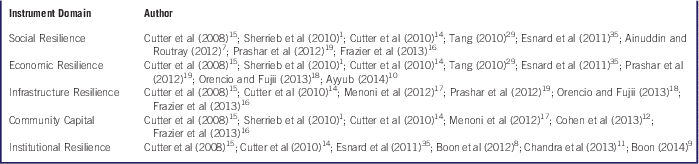
Instruments for measuring community resilience shared dimensions and their consequent operationalization. Five dimensions were identified across the literature: social, economic, institutional, infrastructure resilience, and community capital (Table 4). The characterization of these dimensions was consistent across instruments. Social resilience included indicators of educational equity and the identification of traditionally vulnerable populations.Reference Sherrieb, Norris and Galea 1 , Reference Ainuddin and Routray 7 , Reference Cutter, Burton and Emrich 14 , Reference Frazier, Thompson and Dezzani 16 , Reference Prashar, Shaw and Takeuchi 19 , Reference Tang 29 , Reference Esnard, Sapat and Mitsova 35 Economic resilience was operationalized through measures of employment, income inequality, housing, and industry characterization.Reference Sherrieb, Norris and Galea 1 , Reference Ainuddin and Routray 7 , Reference Ayyub 10 , Reference Cutter, Burton and Emrich 14 , Reference Cutter, Barnes and Berry 15 , Reference Orencio and Fujii 18 , Reference Prashar, Shaw and Takeuchi 19 , Reference Tang 29 , Reference Esnard, Sapat and Mitsova 35 Urban vulnerability, housing codes, utility systems redundancy, and sheltering capacity operationalized infrastructure resilience.Reference Ayyub 10 , Reference Cutter, Burton and Emrich 14 - Reference Prashar, Shaw and Takeuchi 19 , Reference Esnard, Sapat and Mitsova 35 Community capital accounted for community ties, networks, and sense of place attachment.Reference Sherrieb, Norris and Galea 1 , Reference Boon 9 , Reference Cohen, Leykin and Lahad 12 , Reference Cutter, Burton and Emrich 14 - Reference Menoni, Molinari and Parker 17 Finally, institutional resilience encompassed indicators for emergency services integration, first responders’ training, and emergency management capabilities.Reference Boon, Cottrell and King 8 , Reference Boon 9 , Reference Chandra, Williams and Plough 11 , Reference Cutter, Burton and Emrich 14 , Reference Cutter, Barnes and Berry 15 , Reference Esnard, Sapat and Mitsova 35
Instrument Domains by Author

Some of the instruments relied on internal validity and reliability checks. Internal validity checks were conducted through confirmatory factor and principal components analysis, which served in some cases as a weights selection strategy.Reference Jacob, Weeks and Blount 25 , Reference Pfefferbaum, Neas and Pfefferbaum 26 Reviewed instruments, selected and identified indicators on the basis of literature reviewsReference Sherrieb, Norris and Galea 1 , Reference Cutter, Burton and Emrich 14 , Reference Pfefferbaum, Neas and Pfefferbaum 26 and confirmed through qualitative studies such as case studiesReference Jacob, Weeks and Blount 25 and subject matter expert panels.Reference Orencio and Fujii 18
Even though all studies referred to community resilience, what the concept actually accounted for varied from study to study, specifically in the selection of the unit of analysis. Some studies identified communities with a specific geographic unit,Reference Cutter, Burton and Emrich 14 , Reference Orencio and Fujii 18 , Reference Jacob, Weeks and Blount 25 , Reference Tang 29 but the types of units were not consistent across studies. Communities were characterized as counties, towns, and even small villages. In other cases, communities were described on the basis of characteristics of individuals and households.Reference Ainuddin and Routray 7 , Reference Prashar, Shaw and Takeuchi 19 , Reference Pfefferbaum, Neas and Pfefferbaum 26 Nevertheless, some studies turned this challenge into an opportunity for a more accurate description of community, including these 2 levels of analysis as complements reflecting characteristics of communities at the aggregated and the individual levels.Reference Cohen, Leykin and Lahad 12 , Reference Zukowski 27
DISCUSSION
Federal guidelines have turned their attention to communities as a target of policy interventions. Community resilience is both a policy goal and a strategy in emergency preparedness.Reference Ainuddin and Routray 7 Arriving at a clear definition and a widely accepted instrument to characterize and measure resilience is the first step for developing mechanisms to evaluate and monitor policy interventions and the effectiveness of resource allocation. This study conducted a systematic literature review on the quantitative metrics used to assess community resilience, relying on a protocol based on public health systematic review guidelines. Three main considerations resulted from this community resilience metrics literature review: a lack of agreement on the association between resilience, vulnerability, and preparedness; the multidimensional nature of the concept; and the multiple levels affecting the development of resilience.
First, the lack of agreement about the association between resilience, vulnerability, and preparedness is not detrimental for the development of theoretical frameworks and measurement instruments. Although consideration of the continuum of resilience to vulnerability consolidates the indicators characterizing the continuum, thinking about these 2 concepts as independent measures presents a challenge to associate indicators with one or the other. Nevertheless, this contributes to the identification of dimensions and indicators describing a complex construct. It does not limit but enriches the advance of the field.
Second, the multidimensional nature of the concept posits 2 challenges: defining dimensions that actually have an impact on the community disaster mitigation capability and choosing indicators that are replicable across geographic units. For example, because emergency preparedness programs are implemented at the state level, there is a challenge in selecting indicators for which data are available in different states. Moreover, although all instruments identify these dimensions of resilience, not all of them describe how they are operationalized, which generates a limitation in the advance of the field that could be overcome by reporting these metrics. In addition, because current indexes were developed within the fields of environmental sciences and geography, they do not fully account for other areas linked to resilience, specifically, those associated with public health and hospital preparedness. Responding to public health emergencies, such as the 2015 West Africa Ebola outbreak, or the 2016 Zika outbreak in Latin America, requires high levels of community involvement. Including a dimension reflecting public health preparedness capabilities will strengthen the instruments, making them applicable to a wider set of disasters including, for example, terrorist attacks.
Finally, the theoretical frameworks conceptualizing resilience and the studies carrying out measurement with the instruments do not share a common unit of analysis. This has 2 consequences. First, the field has not agreed on what constitutes a community. In other words, are communities defined by a geographic boundary? If so, which is the adequate limit? Counties and towns are the predominant unit of analysis, but there are important variations in their extensions and their population size. Consequently, these may require additional methodological considerations to reduce the bias indexes appear to have toward areas with larger populations. Second, Mayunga asserts that “the unit of analysis should be chosen based on where local decisions are nested, that is where community mitigation measures and risk reduction strategies are directed.”Reference Mayunga 30 Emergency preparedness and mitigations strategies are formulated at the federal and state levels; however, consistently, the whole-community approach guiding emergency preparedness is implemented at the local level in counties and towns. In recent years, under the assumption that these increase a community’s disaster mitigation capabilities, governments have promoted household and individual preparedness. These policies targeting the household level ought to be reflected in the methods being used to assess resilience, because individuals’ preparedness plays a critical role during mitigation phases. Recent studies include individual- and community-level assessments; develop methodologies in 2 steps, including individuals’ perception of preparedness and resilience; and include characteristics of the built environment and the community.Reference Cohen, Leykin and Lahad 12 , Reference Prashar, Shaw and Takeuchi 19 Data on geographical units have been publicly available through governmental agencies for several years now, but data on the individual level have only been available through novel surveysReference Ainuddin and Routray 7 , Reference Prashar, Shaw and Takeuchi 19 , Reference Pfefferbaum, Neas and Pfefferbaum 26 and only in recent years through the US Census Bureau. 36 The availability of these data allows for the development of instruments that may account for characteristics of aggregated geographical units and household and individual preparedness.
CONCLUSIONS
This systematic literature review arrived at 3 conclusions. First, public health emergency preparedness is moving forward in developing metrics of community resilience by translating frameworks, methodologies, and indicators from other fields. This not only contributes to the development of public health emergency preparedness capabilities, but also to the entire emergency management field, promoting more complex analyses and methodological tools valuable across disciplines. Second, the lack of agreement on the association between resilience, vulnerability, and preparedness is not a challenge but an opportunity for informed theoretical discussions, expanding the application of these types of metrics. Finally, the identification of components of resilience both at the community and at the household level provides a more accurate description, consistent with governmental approaches to emergency preparedness and response.
Implications for Policy and Practice
Methodological approaches and instruments to assess community resilience are becoming consistent across disciplines. Measuring community resilience is not a task for environmental sciences and geography only. Professionals in public administration, homeland security, and public health now require these metrics. Academia provided a tool responding to a longstanding practical demand: how to analyze, evaluate, and monitor community characteristics affecting emergency preparedness, response, and mitigation. A single widely accepted metric of community resilience has several implications.
The impact on policy evaluation is the most visible. First, it creates a mechanism to assess communities’ benchmark conditionsReference Cutter, Burton and Emrich 14 for a series of dimensions, identifying strengths and weaknesses. Community metrics are multidimensional; analyzing its dimensions and indicators not only increases our description of emergency mitigation, but also contributes to our understanding of conditions in other areas, such as education, community participation, and economic development. For example, interventions to reduce education inequality by increasing college enrollment have an indirect impact on community resilience. Careful observation of the components of resilience allows us to detect areas where policy interventions are overlapping, informing decisions on resource allocation. However, it is critical to remain skeptical and aware of variations. Policy-makers ought to distinguish interventions with short-term versus long-term impacts. As resources become scarce, directing resources to unattended areas where impacts are expected in the short term may increase intervention effectiveness.
Second, a unified metric of community resilience allows for comparison across counties, states, and geographic regions. This has 2 consequences. On the one hand, it provides a mechanism to evaluate and monitor policy interventions and improve grant allocation designs. The whole community focuses on local actors, networks, and individuals, but states are ultimately responsible for implementing disaster preparedness policies. An instrument describing resilience that is applicable to multiple levels and units of analysis may increase coordination among local, state, and federal agencies. On the other hand, a common indicator of resilience may identify communities applying innovative approaches, turning them into best practices, but keeping in mind differences across communities. An analysis of best practices without considering their implementation context is incomplete. A metric of resilience structures the definition of profiles of successful implementations. It is not only about what worked, but where and how.
The increasing consensus about the dimensions describing resilience and their operationalization has a deep impact on current and future applied research: it identifies gaps in data availability. The applicability and quality of these instruments assessing resilience is limited by the access to data accurately describing resilience components. Recognizing that multiple disciplines share approaches and conceptualizations of resilience generates an opportunity to reconcile multiple data sources and data collection efforts. Additionally, increasing data quality will improve the usability of this metric.
To summarize, a single metric of community resilience accepted across disciplines would provide guidance for collecting data that accurately characterizes resilience. It would contextualize best practices in emergency preparedness, response, and mitigation, helping policy-makers learn from these experiences rather than repeat them, and it would provide an instrument to evaluate, monitor, and improve policies and resource allocation.
Acknowledgments
I would like to thank Erika Martin, Patricia Strach, and Brian Nussbaum for their comments on early drafts; Rick Mathews, Edward Waltz, and Mary Riley-Jacome for sharing their expertise on public health emergency preparedness; Richard Irvin and Sue Kaczor, librarians at University at Albany; Megan Ross for her superb research assistance; and the reviewers for their thoughtful comments.