Introduction
The genus Cladonia P. Browne is a large and variable genus of lichenized ascomycetes that are mainly terrestrial on soil, decaying wood or at the base of trees. The genus, comprising more than 400 species distributed world-wide, has been divided into seven taxonomic sections (Ahti Reference Ahti2000) based on morphological characters. Previous phylogenetic studies using morphological characters showed low resolution among the morphological forms within the genus (Hyvönen et al. Reference Hyvönen, Ahti, Stenroos and Gowan1995; Stenroos et al. Reference Stenroos, Ahti and Hyvönen1997). Recent phylogenetic work based on nucleotide characters shows more resolution (Piercey-Normore & DePriest Reference Piercey-Normore and DePriest2001; Stenroos et al. Reference Stenroos, Hyvönen, Myllys, Thell and Ahti2002). The extensive work by Stenroos et al. (Reference Stenroos, Hyvönen, Myllys, Thell and Ahti2002; see also Guo & Kashiwadani Reference Guo and Kashiwadani2004) included representative members of all sections of the genus Cladonia. Cladonia section Cladonia contains a number of species complexes with different levels of morphological and chemical variability. Within section Cladonia, the Cladonia gracilis species complex and its allies are highly variable in morphology but have a low level of variation in secondary compounds. Ahti (Reference Ahti1980) included seven species in the group but up to 23 species may belong here. More recently, Stenroos et al. (Reference Stenroos, Hyvönen, Myllys, Thell and Ahti2002) and Guo & Kashiwadani (Reference Guo and Kashiwadani2004) treated it provisionally as “subgroup Graciles”.
Morphological features are more similar between some members of the Cladonia gracilis species complex and species outside the complex, than they are between subspecies within the complex. For example, C. gracilis subsp. turbinata and C. phyllophora have similar podetial morphology often containing broad shallow scyphi and large brown apothecia. However, C. gracilis subsp. turbinata and C. gracilis subsp. elongata are very different in appearance where C. gracilis subsp. elongata has very narrow scyphi or none at all. Overlapping morphological features of C. gracilis subsp. turbinata and C. phyllophora may suggest that these species intergrade in nature (Ahti Reference Ahti1980) making them difficult to distinguish. Cladonia gracilis subsp. elongata is superficially similar to C. maxima, an ally of the C. gracilis group. Both species contain a smooth podetial cortex, and they may have blunt podetia or they may produce small cups. The difference is that C. maxima has a yellowing podetial base and C. gracilis subsp. elongata has a blackening podetial base (Ahti Reference Ahti1980).
A more distantly related species, C. multiformis, is placed in a different taxonomic section (Ascyphiferae) than C. gracilis (section Cladonia, Ahti Reference Ahti2000). One of the diagnostic features of C. multiformis is the perforated shallow cup, but at least two morphological forms of C. multiformis may exist; one with shallow cups and one without cups containing funnelled branches in a cetrarioid growth form (see photograph in Hinds & Hinds Reference Hinds and Hinds2007). Both growth forms may exist on the same podetium or they may be found separately. The use of different growth forms in classification is presumably artificial (Stenroos & DePriest Reference Stenroos and DePriest1998) and may be influenced by environmental conditions or reflect developmental stages in the lichen.
Similarly, the production of secondary compounds in lichens is thought to be influenced by environmental and developmental conditions (Hawksworth Reference Hawksworth, Brown, Hawksworth and Bailey1976; Leuckert et al. Reference Leuckert, Ahmadjian, Culberson and Johnson1990; Culberson & Armaleo Reference Culberson and Armaleo1992; Stocker-Wörgötter Reference Stocker-Wörgötter2001). The taxonomic value of lichen secondary compounds is not well understood as they are known to vary qualitatively and quantitatively within species and populations (Culberson et al. Reference Culberson, Culberson and Johnson1988) and are thought to undergo convergent evolution (Culberson Reference Culberson1986; Gowan Reference Gowan1989). Most species and subspecies in the C. gracilis group and its allies contain a single secondary compound, fumarprotocetraric acid, and some taxa secondarily produce atranorin (Ahti Reference Ahti1980). These secondary compounds are polyketides, which are produced by a multidomain polyketide synthase (PKS) encoded by a series of genes and arranged in clusters on the chromosome (Keller & Hohn Reference Keller and Hohn1997; Schümann & Hertwech Reference Schümann and Hertwech2006 and references therein; Shwab & Keller Reference Shwab and Keller2008). The ketostynthase (KS) region of the PKS gene has previously produced phylogenetic resolution between species and genera in studies such as those within the Parmeliaceae (Opanowicz et al. Reference Opanowicz, Blaha and Grube2005), Lecanora and related genera (Grube & Blaha Reference Grube and Blaha2003) and Pertusaria and related genera (Schmitt et al. Reference Schmitt, Martin, Kautz and Lumbsch2005). Another phylogenetic marker, the ITS rDNA, is a standard among species level phylogenies (DePriest Reference DePriest2004), and is often used to reflect evolution of the species. The ITS2 rRNA secondary structure is also becoming an effective tool for inferring phylogenetic histories (Coleman Reference Coleman2003; Müller et al. Reference Müller, Philippi, Dandekar, Schultz and Wolf2007).
The objectives of this study were 1) to determine whether the C. gracilis species complex forms a monophyletic group based on nucleotide sequences, 2) to determine whether morphological similarity between C. phyllophora and C. gracilis subsp. turbinata and between C. maxima and C. gracilis subsp. elongata is supported by genetic similarity, and 3) to evaluate the utility of a PKS gene for phylogenetic studies among closely related species.
Methods
Taxon sampling
All seven members of the C. gracilis group according to the taxonomic revision by Ahti (Reference Ahti1980) were included in this study. Three of the seven allies were available only from GenBank accessions. Three members of the C. gracilis species complex and one member from each of the C. cornuta and C. ecmocyna complexes were included. Other species, such as Cladonia ochrochlora, C. coniocraea, C. phyllophora (section Cladonia) and C. multiformis (section Ascyphiferae), were also included (Table 1). These taxa were chosen because they present morphological difficulties with members of the C. gracilis group. The assigned outgroup taxa (for the ITS rDNA only) were Cladia aggregata and Pycnothelia papillaria as members of the family Cladoniaceae but outside the genus Cladonia. The annotation for the PKS gene translation is based on C. foliacea (EF363873).
List of taxa, collection source, and accession numbers (Acc.) for the DNA sequences deposited in NCBI GenBank.

* FU = fumarprotocetraric acid, AT = atranorin
Thin layer chromatography and isolation of genomic DNA
Secondary metabolites were extracted from podetial tissue 1·5–2 centimetres in length. Podetia were examined under a dissecting microscope and contaminating debris was removed. Vouchers are deposited in the cryptogamic division of the University of Manitoba Herbarium (WIN). A TLC protocol was modified from Culberson (Reference Culberson1972) using solvent A (toluene 180ml: dioxane 45ml: glacial acetic acid 5ml) and solvent C (toluene 200ml: glacial acetic acid 20ml). The CTAB (hexadecytrimethylammonium bromide) DNA extraction protocol was modified from Grube et al. (Reference Grube, DePriest, Gargas and Hafellner1995) and performed on the same piece of thallus tissue that was used for TLC. This ensured that the podetium that produced the polyketide was the same podetium producing the DNA sequence in the analysis.
DNA amplification and sequencing
The fungal ITS gene (ITS1, ITS2 and the 5.8S) of the nuclear ribosomal DNA (nrDNA) and a portion of the ketosynthase (KS) domain of the polyketide synthase (PKS) gene were amplified by the Polymerase Chain Reaction (PCR). The DNA was amplified in 50 μl PCR reactions consisting of 10–50 ng of DNA, PCR buffer [50 mM KCl; 100 mM Tris-HCl (pH 8·3)], 2·0 mM MgCl2, 200 μM of each dNTP, 0·5 μM of each primer, and 2 units of Taq DNA polymerase (Invitrogen, Burlington, ON, Canada). The ITS1, 5.8S, and ITS2 rDNA were amplified using the fungal specific primer 1780F-5′ (5′- CTGCGGAAGGATCATTAATGAG-3′) (Piercey-Normore & DePriest Reference Piercey-Normore and DePriest2001) and universal primer ITS4-3′ (5′-TCCTCCGCTTATTGATATGC-3′) (White et al. Reference White, Bruns, Lee, Taylor, Innis, Gelfand, Sninsky and White1990). All amplifications of the ITS gene were performed on a Techne Genius thermal cycler (Fisher Sci, Nepean, ON, Canada) using a touchdown PCR cycle with initial denaturation of the DNA at 94°C for 5 min; then 36 cycles with denaturation at 94°C for 1 minute, annealing at 60°C for two cycles (×2), 58°C (×2), 56°C (×2), 54°C (×30) for 1 min and extension at 72°C for 1·5 min; followed by 4°C hold for infinity. Initial amplification of a portion of the KS domain was accomplished using the LC1 (5′-GATCCIAGITTTTTTAATATG-3′) and LC2C (5′-GTICCIGTICCGTGCATTTC-3′) (Bingle et al. Reference Bingle, Simpson and Lazarus1999) degenerate primer pair. Because these primers often amplified multiple products, a set of non-degenerate nested primers were designed to amplify a single product. The new primers were PKS1-F (5′-TACGAAGCCCTAGAAATGGC-3′) and PKS2-R (5′-ACGTTTGGCAGTTTCCTGTC-3′). The amplification conditions were an initial denaturation of DNA at 94°C for 1 min; then 30 cycles with denaturation set at 94°C for 1 min, annealing at 58°C for 1 min and extension at 72°C for 1 min; followed by 4°C hold for infinity.
Eight identical 50 μl reactions were pooled to produce 400 μl of PCR product for sequencing. To purify, the DNA was precipitated by adding 0·2 volumes of 5M NaCl and 2·5 volumes of 100% ethanol, centrifuged at 13 000 rpm, and the pellet washed with 300 μl of cold 80% ethanol. The pellet was resuspended in 20 μl sterile distilled water, which was loaded on an agarose gel for electrophoresis and excision of the band. The gel blocks were frozen overnight at −20°C, crushed between a folded piece of parafilm, and the liquid from the thawing gel mass was pipetted into a 1·5 ml centrifuge tube. The DNA was precipitated again and resuspended in 20 μl sterile distilled water. To quantify the DNA, intensities of electrophoresced bands were compared with that of a known quantity using a 1 kb plus DNA ladder (Invitrogen, Burlington, ON, Canada). Results were visualized using an AlphaImager 2200 transilluminator (Alpha Innotech, Fisher Scientific, Nepean, ON, Canada).
For DNA sequencing, cycle sequencing reactions were performed using a Biometra T-Gradient thermal cycler (Fisher Sci, Nepean, ON, Canada) using BigDye ver. 3.1 and sequenced on a 3130 Genetic Analyzer (Applied Biosystems, Foster City, CA, USA) according to manufacturer's directions. Sequences were edited using Sequencher v. 4.8 (Gene Codes Corporation, Ann Arbor, MI, USA) and manually aligned using Se-Al v. 1.0 (Rambaut Reference Rambaut2001). DNA sequencing was done using PCR primers, but when the ITS rDNA showed ambiguous base calling, the sample was sequenced again using primers that anneal to the 5.8S region ITS2-3′ (5′- GCTGCGTTCTTCATCGATGC-3′) and ITS3-5′ (5′-GCATCGATGAAGAACGCAGC-3′) (White et al. Reference White, Bruns, Lee, Taylor, Innis, Gelfand, Sninsky and White1990).
Data analyses
Phylogenetic analysis using Maximum Parsimony (MP) was performed in PAUP 4.0 (Swofford Reference Swofford2003) using a heuristic search with 1000 replicates of random addition of taxa, tree-bisection-reconnection (TBR) branch swapping, MulTrees off, and saving no more than 1000 trees in each replicate. Bootstrap values were determined by using 1000 bootstrap replicates (Felsenstein Reference Felsenstein1985) with simple addition of taxa and TBR branch swapping. Bootstrap values greater than 70 are recorded on the phylogeny. Bayesian analysis, in MrBayes v3.1.2 (Huelsenbeck et al. Reference Huelsenbeck, Ronquist, Nielsen and Bollback2001; Ronquist & Huelsenbeck Reference Ronquist and Huelsenbeck2003), was performed using 2 400 000 generations for the ITS rDNA and 1 000 000 generations for the PKS analysis. A six-parameter GTR (General Time Reversible) model was applied with a gamma shaped parameter and proportion of invariable sites uniformly distributed. This was the best model estimated with Modeltest 3.7 (Posada & Crandall Reference Posada and Crandall1998) that was available in MrBayes. Both runs converged on similar likelihood values and were terminated when the standard deviation of split frequencies fell below 0·01. Posterior probability values greater than 95 are reported on the phylogeny. The Kishino-Hasagawa test (Kishino and Hasagawa Reference Kishino and Hasagawa1989) was performed on the ITS and PKS data sets.
Haplotype networks were performed in TCS (Clement et al. Reference Clement, Posada and Crandall2000) using the criteria that all gaps were treated as missing data and the probability of parsimony was set at 90%. One data set was used for the ITS rDNA which excluded three taxa; RK1021, MN5485, and MN6065, because the sequences contained large numbers of ambiguous positions. All taxa were included in the PKS data set.
RNA folding of the ITS2 was done using the mfold web server (Zuker Reference Zuker2003; http://mfold.bioinfo.rpi.edu/cgi-bin/rna-form1.cgi). If more than one fold was produced by the mfold program, the final fold was based on comparisons with previously published ITS2 folds (http://its2.bioapps.biozentrum.uni-wuerzburg.de/cgi-bin/index.pl?about), maximization of the hydrogen bonding forming solid stems, and the largest negative delta g value (free energy). The ITS2 was folded and used in the phylogenetic comparisons because more information is available for ITS2 models (Coleman Reference Coleman2003; Müller et al. Reference Müller, Philippi, Dandekar, Schultz and Wolf2007; http://its2.bioapps.biozentrum.uni-wuerzburg.de/cgi-bin/index.pl?about) than for ITS1.
Results
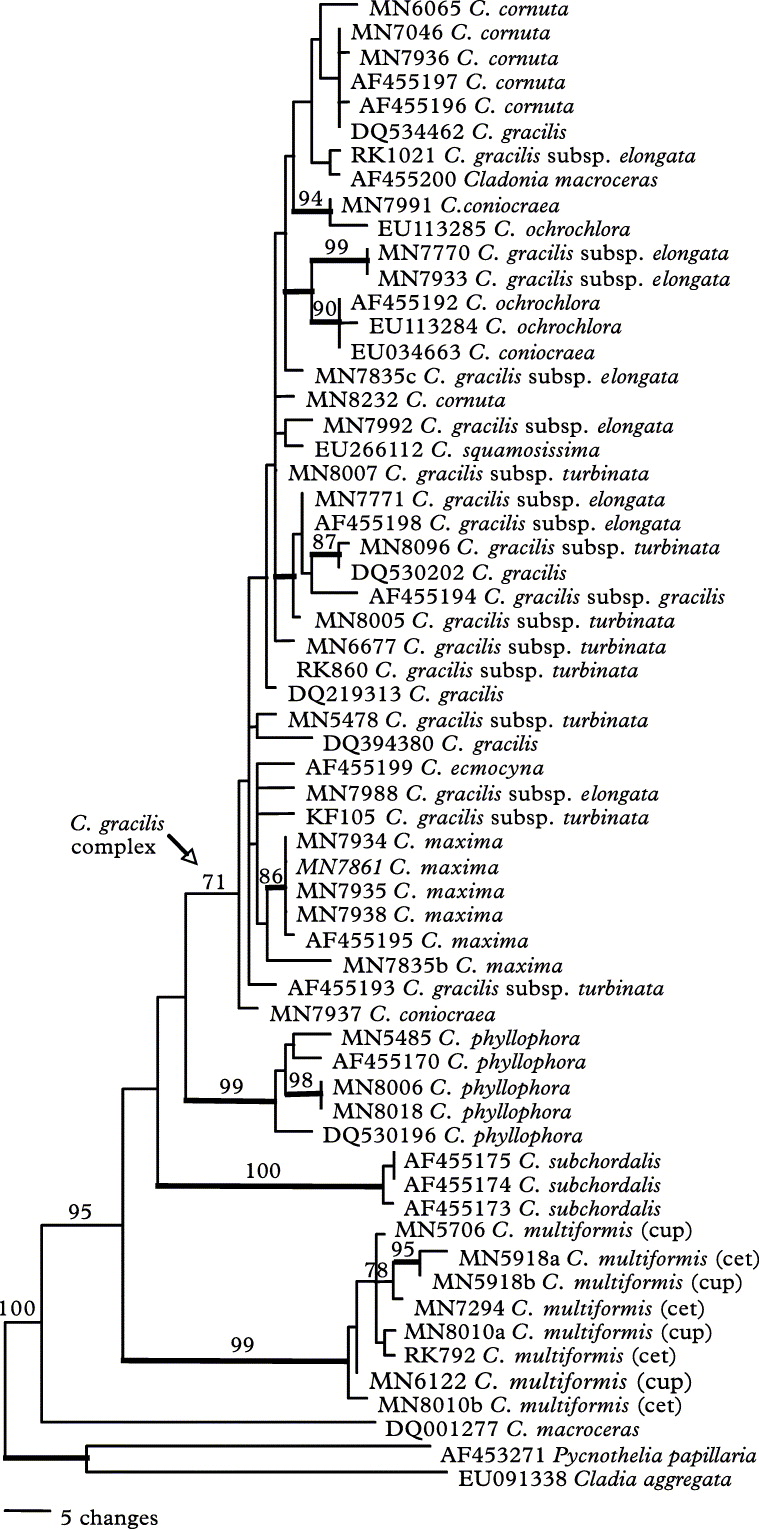
The ITS rDNA phylogeny was made up of 36 sequences from this study and 25 sequences from GenBank (Fig. 1), and produced 269 MP trees with a length of 356 steps. The alignment consisted of 622 characters with 115 of them being phylogenetically informative. The CI was 0·7444 and the RI 0·8613. Cladonia multiformis (section Ascyphiferae) is the most distantly placed species from members of section Cladonia and forms a highly supported clade. Within section Cladonia, C. subchordalis is more basal than C. phyllophora and the C. gracilis group, which form terminal sister clades. These form monophyletic clades with high levels of support. The C. gracilis complex forms a derived clade with bootstrap support of 71% and includes C. coniocraea, C. ochrochlora and C. cornuta. Members of Cladonia maxima form a group within the C. gracilis clade.
Phylogenetic hypothesis of Cladonia gracilis species complex and allies. One of 269 MP trees based on ITS rDNA sequences. Numbers above the branches are bootstrap values greater than 70%, and thick lines are lineages supported by more than 95% posterior probability. “Cet” refers to the cetrarioid and “cup” refers to the cup-forming growth forms of C. multiformis. The outgroup was designated as Pycnothelia papillaria and Cladia aggregata.

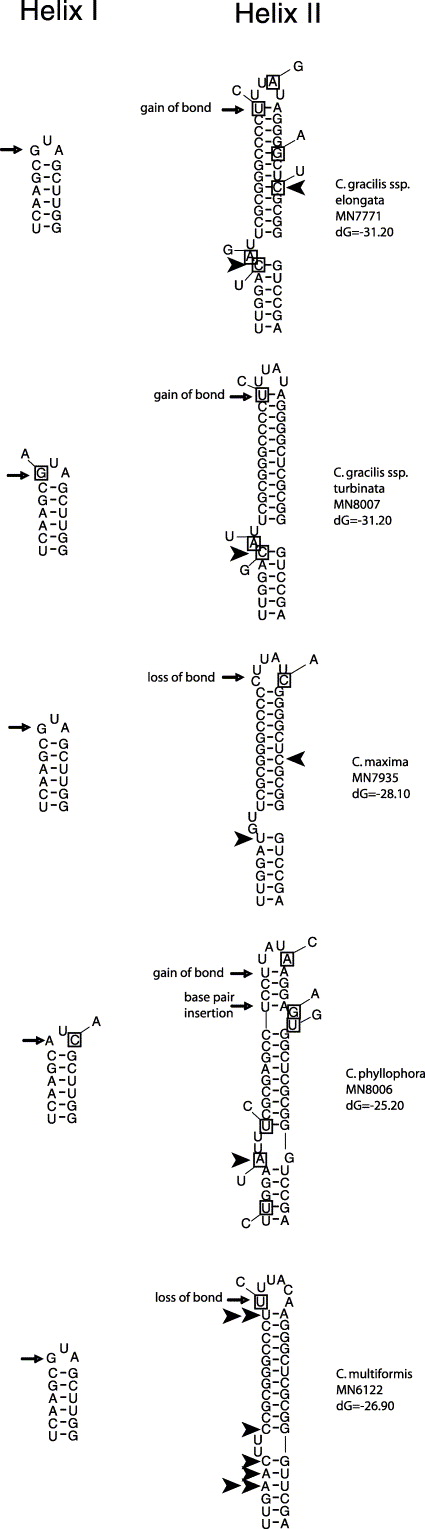
The model for the ITS2 RNA secondary structure for C. gracilis and allies contains three helices around an open single stranded region (not shown). Helix I in the model shows a single substitution in the terminal bulge that varies among the five taxa (Fig. 2). Helix II is more variable than the other helices. Helix II in C. gracilis subsp. turbinata and C. gracilis subsp. elongata is almost identical except for substitutions within the species (open boxes). The difference between C. gracilis subsp. turbinata and C. phyllophora is a Compensatory Base Change (CBC) in the lower stem of helix II, a full base pair insertion in the upper stem, and two single base insertions on the 5′ side of the stem in C. phyllophora. The difference between C. gracilis subsp. elongata and C. maxima is two CBCs and the loss of a bond in the terminal bulge. Two double CBCs and two single CBCs separate C. multiformis and C. maxima. Cladonia multiformis and C. phyllophora are separated by one double CBC, three single CBCs, and the loss of a bond at the terminal bulge. Cladonia multiformis differs from the other species by having three single CBCs and two double CBCs. Helix III is less variable than the other helices and is identical in C. gracilis subsp. elongata and C. gracilis subsp. turbinata. Cladonia maxima contains a substitution and loss of a bond in the lower stem creating a bulge, and one CBC in the upper stem. The helix III in C. phyllophora is identical to that of C. gracilis subsp. elongata and C. gracilis subsp. turbinata.
Helices I and II of the secondary structure model of ITS2 rRNA representing five species of Cladonia gracilis and allies in this study. Changes are indicated on the structures as solid arrow heads representing CBC between species; open boxes connected to a substitution represent substitutions within species only; solid arrows indicate other changes as indicated. Species name, collection number of the folded sequence, and the dG of the fold are placed to the right of the folds.

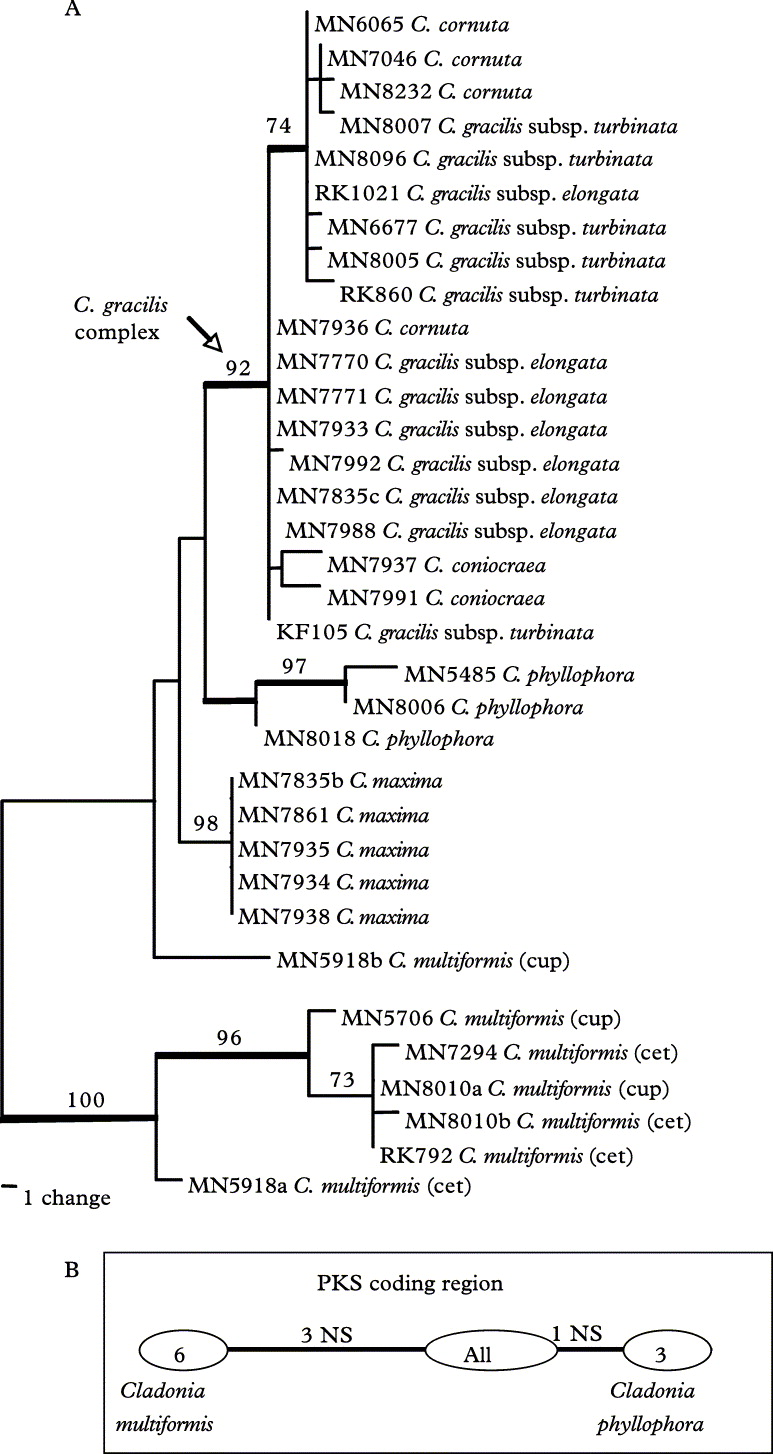
The midpoint rooted phylogeny based on the KS region of the PKS gene contains 35 samples from this study (Fig. 3A), and produced 12 MP trees with length of 104 steps. The alignment consists of 407 characters with 61 of these being phylogenetically informative. The CI is 0·8161 and the RI is 0·9521. The clade representing the C. gracilis species complex is highly supported with 92% bootstrap and greater than 95% posterior probability. Cladonia multiformis is not monophyletic as one member (5918b) falls outside the clade. Cladonia maxima and C. phyllophora are each monophyletic with bootstrap support of 98% and a posterior probability greater than 95%, respectively. Cladonia maxima falls outside the C. gracilis clade with high bootstrap support at 92%.
A, One of 12 most parsimonious trees showing the phylogenetic hypothesis for the C. gracilis complex and allies based on a portion of the KS region in the PKS gene. Numbers above the branches are bootstrap values greater than 70%, and thick lines are lineages supported by more than 95% posterior probability. “Cet” refers to the cetrarioid and “cup” refers to the cup-forming growth forms of C. multiformis. The tree is midpoint rooted; B, hand-drawn haplotype network of the amino acid sequence showing non-synonymous changes between species.

After the 50bp insertion in the coding region of the KS domain was removed, the region was translated to an amino acid sequence. Four non-synonymous changes were present in the translated coding region. These non-synonymous changes separated C. multiformis and C. phyllophora from all other species (Fig. 3B).
An incongruence test was performed on the PKS and the ITS data sets to determine whether the data sets produced topologies that were significantly different from one another. The Kishino-Hasagawa (KH) test showed that six of the ten trees from the PKS data produced an evolutionary history that was not significantly different from that of the ITS, but the remaining four PKS trees differed from the ITS topology in the placement of C. maxima and C. phyllophora. Substitutions in six positions of the PKS alignment were responsible for C. phyllophora being placed outside C. maxima. However, homoplastic substitutions in two positions placed C. maxima outside C. phyllophora in the four significantly different PKS trees.
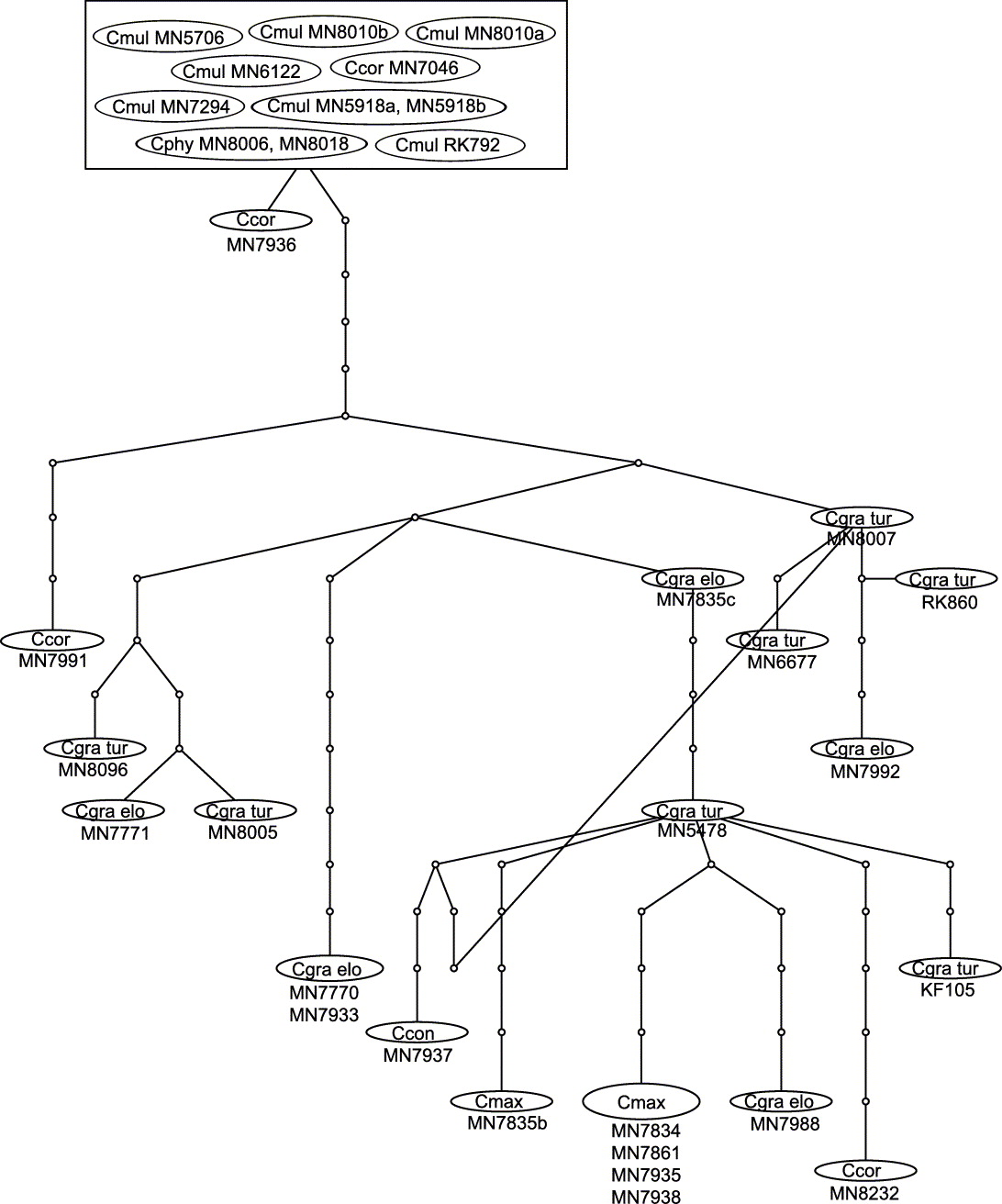
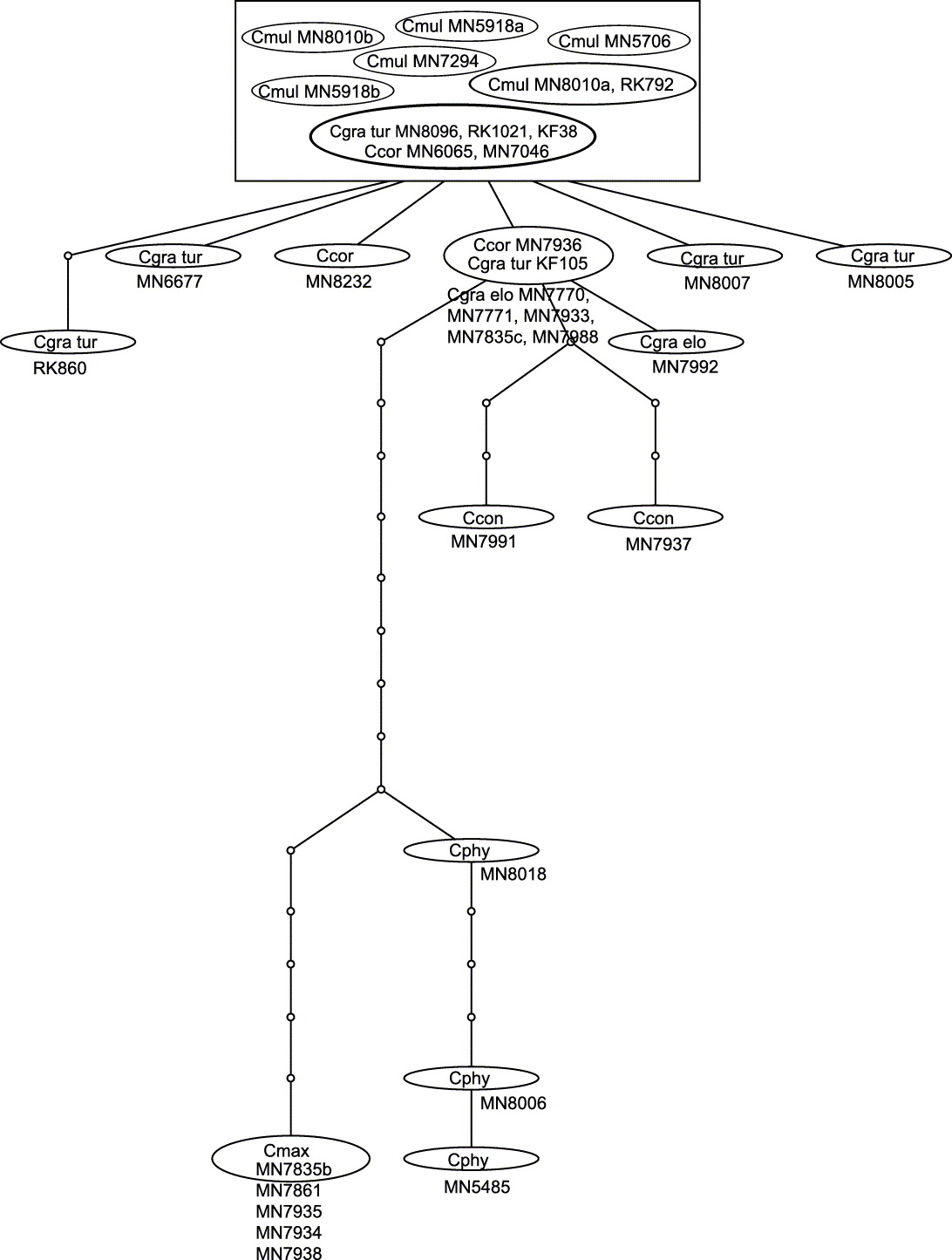
The ITS haplotype network produced 27 haplotypes (represented by collection numbers) from 33 taxa (three taxa were removed from the analysis because of large amounts of missing data) and the maximum number of connection steps at 90% probability was 15 steps (Fig. 4). The ITS network showed a taxonomic pattern similar to that of the PKS but the ITS network contained secondary connections within the network. The haplotype network based on the PKS nucleotide sequence produced 20 haplotypes (represented by collection numbers) in 35 taxa and the maximum number of connection steps at 90% probability was 12 steps (Fig. 5). The networks showed no geographic pattern but they are in agreement with the general taxonomic pattern shown in the phylogenetic trees. Both networks place C. multiformis (Cmul) in an ancestral position and C. maxima (Cmax) in a derived position. The networks differ in the placement of C. phyllophora (Cphy), which is ancestral in the ITS and derived in the PKS network.
Haplotype networks of Cladonia gracilis complex and allies based on nucleotide sequences of ITS rDNA (except Cgra tur RK1021, Cphy MN5485, and Ccor MN6065). Sample names for derived haplotypes are enclosed in oval spaces and those for ancestral haplotypes are enclosed in boxes. Sample names are represented by the first letter of the genus and the first three letters of the species epithet. The number of changes between haplotypes is represented by lines.

Haplotype networks of Cladonia gracilis complex and allies based on nucleotide sequences of KS region of the PKS gene. See legend for Fig. 4 for further explanation.

All samples used in this study produced fumarprotocetraric acid and a small number (five samples) produced atranorin. These samples did not cluster together in either tree and were unresolved in the PKS tree.
Discussion
Speciation of C. gracilis and allies
Monophyly of the Cladonia gracilis complex can be supported by phylogenetic analyses for both ITS and PKS data sets if allied species (C. coniocraea and C. ochrochlora) are included in the complex. Cladonia ochrochlora was previously confirmed as a member of the complex by Stenroos et al. (Reference Stenroos, Hyvönen, Myllys, Thell and Ahti2002). Cladonia coniocraea is now also a confirmed member of the complex using both ITS and PKS loci. These two species are difficult to distinguish using morphological characters. Other species previously included in the C. gracilis complex by Ahti (Reference Ahti1980) are Cladonia macroceras, C. maxima, C. squamosissima, C. subchordalis, C. cornuta, C. ecmocyna and C. gracilis. The inclusion of five of these species is supported by this study. Cladonia subchordalis clearly falls outside the clade labelled as C. gracilis complex. The presence of three CBCs, a seven-base insert and a shift in the base pairing of the lower stem of helix II (data not shown) support C. subchordalis forming a separate biological species Additional support for monophyly of the C. gracilis clade is the absence of CBCs in helices of the ITS2 secondary structure from members within the complex, suggesting that these members may interbreed (Coleman Reference Coleman2003; Müller et al. Reference Müller, Philippi, Dandekar, Schultz and Wolf2007). Alternatively, recent speciation may be occurring among taxa within the C. gracilis clade resulting in low support for separation of morphological species.
The ancestral haplotype was hypothesized to be C. multiformis and most members of the C. gracilis complex are derived based on the frequency of haplotypes. Haplotype frequencies are thought to correlate with age under a neutral coalescent theory (Castelloe & Templeton Reference Castolloe and Templeton1994) where the highest frequency of haplotypes are considered the most ancestral forms. This is in agreement with the phylogenetic hypothesis where members of the C. gracilis complex show low levels of resolution suggesting a recent speciation. The distance between C. multiformis and C. phyllophora with the C. gracilis complex was also supported by the PKS amino acid sequence of the coding region, but with C. multiformis more distant than C. phyllophora.
The haplotype network for the ITS region produced a genealogical pattern corresponding loosely with a taxonomic rather than a geographic pattern. A geographic pattern might be more evident from a uniparentally inherited plastid rather than from nuclear loci where recombination occurs. The distinct geographic pattern produced by mitochondrial loci in ungulates was not supported by nuclear loci (Schaschl et al. Reference Schaschl, Kaulfus, Hammer and Suchentrunk2003), which was interpreted to result from sexual reproduction or balanced polymorphism. The retention of multiple alleles (as in balanced polymorphism) might be an argument in this study in favour of convergence of cup forms from ancestral lineages that do not express the cup-forming phenotype. The alleles required for cup formation must be retained within the ancestral lineage to be expressed under specific environmental conditions or during developmental stages. In addition, the lack of correspondence between geographic origin and pattern in the haplotype network may also be caused by small sample size, since small samples may be prone to sampling artifacts. Sexual reproduction and recombination may contribute to the absence of a geographic variation since the morphological species in this study have not been shown to be reproductively isolated.
Evolution of cup morphology
Despite the morphological similarities between C. maxima and C. gracilis subsp. elongata, and between C. phyllophora and C. gracilis subsp. turbinata, both allies, C. maxima and C. phyllophora form phylogenetic species separate from the morphologically similar members of the C. gracilis complex in this study. This is supported by a number of CBCs and other changes in the ITS2 secondary structures (Fig. 2) suggesting these species are reproductively isolated from the C. gracilis complex (Coleman Reference Coleman2003; Müller et al. Reference Müller, Philippi, Dandekar, Schultz and Wolf2007). The evolution of cup-forming morphologies in C. phyllophora and C. maxima, distinct from the cup-formers in the C. gracilis complex, suggests that evolution of the cup form is converging and that it may serve as an important function for these species. Polyphyly among cup-forming species was also present in studies by Stenroos et al. (Reference Stenroos, Hyvönen, Myllys, Thell and Ahti2002) and Beiggi & Piercey-Normore (Reference Beiggi and Piercey-Normore2007). Other examples of convergent evolution include growth forms in the Cladoniaceae (Stenroos & DePriest Reference Stenroos and DePriest1998), ascomatal type in higher fungi (Grube & Hawksworth Reference Grube and Hawksworth2007; Hawksworth & LaGreca Reference Hawksworth and LaGreca2007), and the mazaediate “pin lichens” from the Caliciales (Tibell Reference Tibell1998). One function suggested for the cup in sorediate lichens is dispersal of propagules by rainwater. This splash cup mechanism of dispersal is known to occur in plants (Brodie Reference Brodie1951; Nakanishi Reference Nakanishi2004), and it has also been described for sorediate dispersal in Cladonia chlorophaea (Bailey Reference Bailey1966). However, none of the cup forming species in this study produce propagules, eliminating sorediate dispersal as a possible function. Another function for a non-sorediate cup may be to retain water near the developing apothecia. This would prolong development time for asci and spores when the surrounding air dries, perhaps allowing asci to reach maturity, since the amount of precipitation is thought to influence spore production (Verseghy Reference Verseghy1965). A slower rate of thallus dehydration by water retention may also induce ascal release of spores aiding spore dispersal. In most of these species the cup is closed allowing water to accumulate near the developing apothecia on the cup margin. However, the cup in C. multiformis is perforated allowing water to escape into the hollow podetium thus perhaps capturing a larger amount of water for an even longer retention and slower rate of dehydration. The two morphological forms of Cladonia multiformis in this study are a cetrarioid form with funnelled extensions from the cup margin, and a cup-forming morphology without the extensions. One hypothesis is that the apothecia-bearing cups are the ‘mature’ podetia and the funnel shaped cetrarioid forms are immature forms. The funnel shaped cetrarioid forms that grow from the cup margins may direct water toward the cups for prolonged development of the apothecia. More ecological research is required to study the function and correlation of cup forms with specific habitat parameters.
Two morphological forms of C. multiformis from the same herbarium packet were represented by MN8010a and MN8010b; and from the same individual podetium by MN5918a and MN5918b. The ITS variation between 8010a and 8010b (seven differences) suggests they were different individuals growing side by side in a non-clonal fashion. This may reflect a different growth strategy by C. multifomis than by C. subtenuis where clonal growth was hypothesized in a single patch of C. subtenuis (Beard & DePriest Reference Beard and DePriest1996). The ITS sequences of samples MN5918a and MN5918b were identical (no differences) suggesting the single podetium is made of a single fungal genotype. The non-zero branch lengths in Fig. 1 are the result of problems associated with large amounts of missing data (Kearney & Clark Reference Kearney and Clark2003; Wiens Reference Wiens2006), but the ITS haplotype network placed the two samples as the same haplotype (Fig. 3A).
The utility of the PKS gene as a phylogenetic marker
The PKS gene is less variable than the ITS with approximately half the number of phylogenetically informative characters and higher CI and RI indices, but it provided strong support for the clades inferred to be reproductively isolated by CBC in the ITS2 secondary structure. The disagreement between the PKS and ITS trees indicated by the KH test is predominantly at the position of the clade containing five members of Cladonia maxima. Low resolution in one set of trees, as with the ITS in this study, may account for the incongruence. Other explanations may also account for this apparent discrepancy. 1) Fungal chimera may exist where two or more fungal strains make up a single podetium. Armaleo & Clerc (Reference Armaleo and Clerc1991) demonstrated fungal chimera in photosymbiodemes. Alternatively, a single podetium may consist of more than one fungal strain. 2) Recombination and sexual reproduction may occur among these species suggesting they may not be separate biological species. Culberson et al. (Reference Culberson, Culberson and Johnson1988) found that C. merochlorophaea and C. grayi were interbreeding but were reproductively isolated from C. cryptochlorophaea, implying that morphologically similar chemospecies may be either interbreeding or reproductively isolated. 3) Paralogous genes for each of the ITS rDNA and the PKS may be possible. Multiple copies of the ITS rDNA were suspected in individual Symbiodinium genomes (Reimer et al. Reference Reimer, Takishita, Ono, Maruyama and Tsukahara2006). Different ITS copies may exist with incomplete concerted evolution. Although paralogs of PKS genes have been reported; three copies for some members of the Parmeliaceae (Opanowicz et al. Reference Opanowicz, Blaha and Grube2005) and as many as 14 copies suggested for Cladonia grayi (D. Armaleo, pers. comm.), the nucleotide sequences of paralogs show larger differences than are present in this study.
In conclusion, this study has corroborated previously untested hypotheses. Monophyly of the C. gracilis species complex is supported with the inclusion of Cladonia coniocraea and C. ochrochlora. When additional taxa are examined, the C. gracilis complex may contain a larger number of species and subspecies than is currently hypothesized. Convergent evolution of cup morphology may explain differences between morphological and genetic variation in the phylogenetic trees. The ecological significance of the cup morphology needs to be examined further. The phylogenetic position of C. maxima may be argued based on the ITS, but it may form a species separate from the C. gracilis species complex. Cladonia phyllophora and C. multiformis form monophyletic groups with support for morphological and biological species. The KS region is less variable than that of the ITS rDNA, but it verified clades of species and was in agreement with changes in the ITS2 RNA model, supporting the use of the PKS gene as a phylogenetic marker for this group of lichens.
We thank Rhonda Kotelko for providing samples, H. Hernandez (Manitoba Conservation) for kindly providing collecting permit number 20429, and Parks Canada for permit number WAP-2005-498. Funding was provided by Natural Sciences and Engineering Research Council of Canada (NSERC).