Third-degree (complete) and high-grade, second-degree atrioventricular block, although rare in paediatrics, can occur due to immune-mediated antibodies and inflammation, infection, post-surgical complication, or inherited genetic mutations, or be idiopathic. Reference Baruteau, Pass and Thambo1 Acquired complete and high-grade heart block can occur in all ages following Lyme disease and meningococcal meningitis, and is often reversible. Reference Etherington, Salmon and Ratcliffe2–Reference Morriss, Gillette and Barrett4 Streptococcus pneumoniae is associated with adverse cardiac events primarily in adults, but not complete or high-grade heart block. Reference Brown, Millett, Quint and Orihuela5 Few reports describe S. pneumoniae causing paediatric cardiac disease. We describe an adolescent with S. pneumoniae meningitis and high-grade heart block requiring transvenous pacing and eventual permanent pacemaker implantation.
Case report
A 14-year-old with a remote history of seizures, and no history of arrhythmia presented to the emergency department with 24 hours of new severe headaches. Patient endorsed vision changes but was otherwise asymptomatic. Pertinent findings included fever (39.6ºC), positive Brudzinski sign, delayed capillary refill, white blood cell count (19.2 K/mcL), c-reactive protein (3.5 mg/dl), procalcitonin (0.58 ng/ml), and head CT showing paranasal sinus disease.
In the emergency department, two episodes of loss of consciousness occurred. The first episode was notable for the abrupt development of high-grade heart block with no escape mechanism (only P waves present) and pulselessness lasting 5–10 seconds, which spontaneously resolved. The second episode involved high-grade atrioventricular block, a poor ventricular escape rate of 20–30 beats per minute, and hypotension. Epinephrine resulted in a wide complex tachycardia then conversion to sinus rhythm. The subsequent emergency department course was notable for intermittent episodes of transient, abrupt high-grade heart block without loss of consciousness or clinical deterioration.
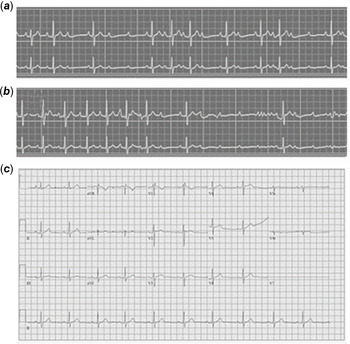
Upon Cardiac ICU arrival, the frequency of intermittent high-grade heart block (Fig 1a–b) increased resulting in pulselessness and hypotension requiring cardiopulmonary resuscitation. Resuscitation lasted < 30 seconds before the return of sinus conduction (Fig 1c). Intubation and emergent bedside temporary transvenous pacing wire placement via the right internal jugular vein ensued. Temporary pacing was used for ventricular backup rate during recurrent high-grade heart block episodes. Troponin was mildly elevated (0.19 ng/ml). Workup for viral infection and Borrelia burgdorferi was negative. Cerebral spinal fluid later revealed S. pneumoniae for which appropriate antibiotic therapy was given while blood cultures remained no growth. Within 3 days, temporary pacemaker usage decreased and sinus rhythm predominated. Investigation revealed that her prior seizure diagnosis was based on atypical loss of consciousness episodes of unclear aetiology with normal electroencephalograms in the past. Antiepileptics had been discontinued prior to this hospitalisation without the return of seizure activity. A normal electroencephalogram was obtained while she was in the Cardiac ICU. Upon completion of treatment for meningitis, the patient continued to have rare episodes of high-grade heart block. Consideration was given to extended observation sans intervention either inpatient on telemetry and/or outpatient with a loop recorder. However, due to her uncertain history of seizure/syncopal episodes, now clinically significant high-grade heart block presenting as acute, cardiogenic shock, and parental preference, a dual-chamber permanent pacemaker was inserted on hospital day 12 to ensure atrioventricular synchrony and adequate cardiac output.
Telemetry and electrocardiogram tracings. (a–b) Telemetry tracings of intermittent high-grade heart block upon Cardiac ICU arrival. (c) Baseline electrocardiogram after antibiotic treatment demonstrates sinus rhythm with first-degree atrioventricular block.

At 1.5-year follow-up, the patient is asymptomatic without interval syncopal episodes or seizures nor return visits to the emergency department. While there has been no clinical syncope, the episodes were rare prior to intervention and it is difficult to discern what, if any, role long-term pacing has played in the asymptomatic clinical picture. On pacemaker interrogation, there is rare ventricular pacing, approximately 2% of the time, without notable progression of pacing percentages over time. Device electrogram storage does not allow for the recording of routine pacing events and long-term ambulatory monitoring has not been performed to delineate whether this is related to intermittent high-grade heart block. The device also demonstrates frequent rate drop interventions secondary to atrial rate drop consistent with transient sinus node pauses. Electrogram recordings demonstrate abrupt sinus rate slowing with atrial pacing intervention and intact atrioventricular conduction during the episodes.
Discussion
Discriminating the aetiology for contemporaneous meningitis and high-grade heart block is a unique, time-sensitive challenge. This case presents intriguing questions: Was there a true seizure disorder? Was high-grade heart block occurring intermittently in the past and now manifesting again? Was S. pneumoniae meningitis the primary cause of developing high-grade heart block, or were the two unrelated?
Diagnosis of unwitnessed clinical seizures is often difficult due to vague symptoms, non-specific history from caregivers, and often normal baseline electroencephalogram. Reference Chadwick and Smith6 This patient’s previous seizure episodes were not captured by electroencephalogram, relied on parental description, and occurred during poorly defined circumstances such as illness or stress. Thus, the neurologist prescribed antiepileptic treatment was for presumed rather than definitive seizures. That being said, diagnosis in this fashion is not unusual, and it is reasonable to attribute the history of syncopal episodes to a seizure disorder.
Alternatively, it is unlikely, but possible, the previous syncopal events were not seizures but rather were unrecognised high-grade heart block or sinus pause episodes with haemodynamic instability. However, these events were not entirely consistent with high-grade heart block given the occasional association with vocalisations, stiffening, and emesis, and possible relationship to antiepileptic non-compliance and dehydration. As such, it is less likely undiagnosed high-grade heart block masqueraded as seizure-like episodes. It is this uncertainty and the parents’ risk tolerance that contributed to the timing of pacemaker implantation. While pacemaker complications, such as venous thrombosis, lead issues, and inadvertent pacing, are non-zero, it was not possible to be assured that high-grade heart block was not the cause of her syncopal events, was definitively due to meningitis, and would not recur. Furthermore, even if the previous syncopal events were not high-grade heart block, but rather sinus bradycardia due to transient sinus node dysfunction as observed on pacemaker interrogations, both symptomatic high-grade heart block and bradycardia are class I indications for pacemaker implantation irrespective of their frequency. Reference Kusumoto, Schoenfeld and Barrett7 Additionally, while meningitis can cause elevated intracranial pressure and increased vagal tone, the patient had a normal head CT and high-grade heart block not vagal-mediated bradycardia or junctional rhythm. Furthermore, the patient also did not have other neurologic disease whether encephalitis, mass lesion, or anatomic abnormality to be implicated in increased vagal tone, and seizure is not associated with high-grade heart block. While the patient has had no further clinical episodes of syncope, the rarity of the episodes prior to intervention makes it difficult to discern what impact, if any, the pacemaker is playing.
Careful thought was given to the timing of pacemaker placement due to the patient having a known infection. Only the cerebrospinal fluid grew S. pneumoniae while the blood cultures remained negative. After almost 2 weeks of appropriate antibiotic treatment and resolution of meningitis symptoms, primarily photophobia, headache, and neck rigidity, it was felt that there would be a low risk of pacemaker infection after implantation.
With the high-grade heart block diagnosis established, the potential for S. pneumoniae infection to be causative must be explored. While direct damage associated with S. pneumoniae endocarditis has been described, it was felt unlikely to be the mechanism of the disease given the transient nature of the high-grade heart block, which is resolved with treatment. Reference Shenoy, Beno and Brissac8 S. pneumoniae can cause arrhythmias by two additional mechanisms. The bacterial cell wall acts a platelet-activating factor mimetic. Reference Brown, Millett, Quint and Orihuela5 This results in the release of inflammatory factors and cytokines that can be arrhythmogenic. The second mechanism entails S. pneumoniae translocating into the myocardium and forming microlesions. If microlesions are formed in the conduction system, then high-grade atrioventricular block can occur. Reference Brown, Mann and Gao9 Given return to predominantly sinus rhythm occurred after 3 days of antibiotics, an arrhythmogenic, inflammatory state or early stage microlesion formation are possible mechanisms in this patient.
While the aetiology of the patient’s high-grade heart block cannot be definitively ascertained, we speculate it was likely secondary to S. pneumoniae meningitis. De novo high-grade heart block in an adolescent is uncommon and the history of syncopal episodes appears to be more consistent with seizures than recurrent high-grade heart block. This presentation is unique as S. pneumoniae is typically associated with cardiac events, such as arrhythmia, in adults, not paediatrics. Reference Brown, Millett, Quint and Orihuela5 Additionally, unlike Neisseria meningitidis, S. pneumoniae meningitis has not previously been reported to be associated with high-grade heart block in paediatrics.
Conclusion
Awareness that arrhythmias, such as heart block, can have both primary cardiac and secondary aetiologies is prudent. Our patient appears to be a unique case of the latter; high-grade heart block is likely due to S. pneumoniae meningitis.
Acknowledgements
None.
Financial support
This research received no specific grant from any funding agency, commercial or not-for-profit sectors. Kenneth E. Mah receives funding for studies not related to this manuscript from the National Science Foundation (SBIR Phase I 2028008).
Conflicts of interest
None.
Ethical standards
This case does not involve human and/or animal experimentation. Permission was granted by the subject patient or their respective parent(s) or guardian to publish this case report.
Social Media Synopsis
High-grade, 2nd-degree atrioventricular block requiring permanent pacemaker placement can have primary cardiac and secondary aetiologies such as Streptococcus pneumoniae meningitis. @CincyChildrens @CincyKidsHeart.