Long-term experience with bilingualism has been shown to affect a range of cognitive and linguistic abilities across the lifespan. The general finding is that linguistic processing becomes more effortful, including reduced vocabulary in each language for both children (Bialystok, Luk, Peets & Yang, Reference Bialystok, Luk, Peets and Yang2010) and adults (Bialystok & Luk, Reference Bialystok and Luk2012) and slower word retrieval (Kroll, Bobb & Hoshino, Reference Kroll, Bobb and Hoshino2014). However, aspects of cognitive processing, in particular executive control, become enhanced by bilingualism (review in Bialystok, Craik, Green & Gollan, Reference Bialystok, Craik, Green and Gollan2009). Converging evidence for improvement in executive control in bilinguals has been reported from studies of infants (e.g., Kovacs & Mehler, Reference Kovacs and Mehler2009; Singh, Fu, Rahman, Hameed, Sanmugam, Agarwai, Jiang, Chong, Meaney & Rifkin-Graboi Reference Singh, Fu, Rahman, Hameed, Sanmugam, Agarwal, Jiang, Chong, Meaney and Rifkin-Graboi2014), children (e.g., Wimmer & Marx, Reference Wimmer and Marx2014; Yang, Yang & Lust, Reference Yang, Yang and Lust2011), young adults (e.g., Costa, Hernandez & Sebastián-Gallés, Reference Costa, Hernandez and Sebastián-Gallés2008; Prior & MacWhinney, Reference Prior and MacWhinney2010), and older adults (e.g., Gold, Kim, Johnson, Kryscio & Smith, Reference Gold, Kim, Johnson, Kryscio and Smith2013; Salvatierra & Rosselli, Reference Salvatierra and Rosselli2010). Considered broadly, executive control encompasses the management of processes responsible for working memory, reasoning, task switching, planning and problem solving. These processes continue to be important throughout life and crucially are the first to decline with cognitive aging, making them a central focus for research on cognitive change with age (see, for example, Cepeda, Kramer & Gonzalez de Sather, Reference Cepeda, Kramer and Gonzalez de Sather2001; Craik & Bialystok, Reference Craik and Bialystok2006). Therefore, factors that influence the development or functioning of the executive control system have consequences for lifelong cognitive ability.
In contrast to bilingualism, Attention-Deficit/Hyperactivity Disorder (ADHD) is associated with a weakened executive control system (Barkley, Reference Barkley2006; Cepeda, Cepeda & Kramer, Reference Cepeda, Cepeda and Kramer2000; Hervey, Epstein & Curry, Reference Hervey, Epstein and Curry2004; King, Colla, Brass, Heuser & von Cramon, Reference King, Colla, Brass, Heuser and von Cramon2007; Kramer, Cepeda & Cepeda, Reference Kramer, Cepeda and Cepeda2001; Mathers, Reference Mathers2006; Sonuga-Barke, Reference Sonuga-Barke2003; Sonuga-Barke, Bitsakou & Thompson, Reference Sonuga-Barke, Bitsakou and Thompson2010). ADHD is characterized by symptoms of inattention, impulsivity, and hyperactivity (American Psychiatric Association, 2013). These symptoms arise in childhood and typically persist into adulthood (Barkley, Reference Barkley1990; Barkley, Fischer, Smallish & Fletcher, Reference Barkley, Fischer, Smallish and Fletcher2002). Deficits on executive control tasks for children and adults with ADHD have been well documented (Barkley, Reference Barkley2006; Nigg, Stavro, Ettenhofer, Hambrick, Miller & Henderson, Reference Nigg, Stavro, Ettenhofer, Hambrick, Miller and Henderson2005a). However, Willcutt and colleagues (Willcutt, Doyle, Nigg, Faraone & Pennington, Reference Willcutt, Doyle, Nigg, Faraone and Pennington2005) concluded from a meta-analysis that executive function weaknesses are one of several markers that comprise the overall neuropsychological etiology of ADHD and are not the single necessary and sufficient cause of ADHD in all individuals. Regarding language ability, ADHD is associated with poor linguistic functioning (Bellani, Moretti, Perlini & Brambilla, Reference Bellani, Moretti, Perlini and Brambilla2011), as is frequently the case for bilingualism.
The two experiences, therefore, have similar effects on measures of language proficiency but opposite effects on the executive control system. For language proficiency, both bilingualism and ADHD are associated with reduced vocabulary, although the reasons for those effects are likely different. For bilingualism, in addition to lower vocabulary in each language, less frequent use of each language may lead to reduced automaticity in lexical access (Gollan, Montoya, Cera & Sandoval, Reference Gollan, Montoya, Cera and Sandoval2008). Similarly, individuals with ADHD generally demonstrate lower vocabulary scores than comparable individuals without ADHD (McGee, Williams, Bradhsaw, Chapel, Robins & Silva, Reference McGee, Williams, Bradshaw, Chapel, Robins and Silva1985; Mathers, Reference Mathers2006; Bruce, Thernlund & Nettelbladt, Reference Bruce, Thernlund and Nettelbladt2006; Schoechlin & Engel, Reference Schoechlin and Engel2005), although these results are not always found (Weyandt & Willis, Reference Weyandt and Willis1994; Kim & Kaiser, Reference Kim and Kaiser2000; McInnes, Humphries, Hogg-Johnson & Tannock, Reference McInnes, Humphries, Hogg-Johnson and Tannock2003). These patterns are important because of the central role of language proficiency in most tests of cognitive function. Therefore, it is necessary to accompany assessments of cognitive function with information about language proficiency. What is not known is whether the effects of these experiences on language proficiency are additive: Do bilinguals with ADHD show larger verbal deficits than comparable monolinguals?
The effect of each of these experiences on executive control is different in both direction and probable cause. For bilingualism, the reason for the enhancement of executive control is generally traced to the need to manage two jointly activated representational systems (Kroll, Dussias, Bogulski & Valdes-Kroff, Reference Kroll, Dussias, Bogulski, Valdes-Kroff and Ross2012), a task that bilinguals likely achieve by recruiting domain-general mechanisms of attention (Green, Reference Green1998). Sustained use of these processes for managing attention to two languages, even to ambient languages in infancy, improves their functioning. For ADHD, the reason for the deficits in executive control is generally traced to impaired function of the frontal lobe (Arnsten & Rubia, Reference Arnsten and Rubia2012; Spencer, Biederman, Wilens & Faraone, Reference Spencer, Biederman, Wilens and Faraone2002), the region most responsible for regulating executive control (Stuss & Benson, Reference Stuss and Benson1986). The results of a meta-analysis of neural evidence from several fMRI studies are consistent with the behavioral studies on executive function performance in ADHD. Participants with ADHD show hypoactivation in the frontoparietal network and the ventral attentional network that are implicated in executive function and attention, respectively (Cortese, Kelly, Chabernaud, Proal, Di Martino, Milham & Castellanos, Reference Cortese, Kelly, Chabernaud, Proal, Di Martino, Milham and Castellanos2012). Thus, in addition to differences in impact, there are differences in the putative mechanism by which changes in executive control occur. What happens when these experiences are combined? Do the benefits of bilingualism compensate for the deficits of ADHD and bring bilingual individuals with ADHD to a higher level than monolinguals with ADHD? Or do difficulties inherent to ADHD prevent bilingualism from elevating these processes, and possibly result in lower performance by bilingual individuals with ADHD than monolinguals with ADHD because of additional burdens on attention?
A difficulty in comparing the effects of bilingualism and ADHD on executive control is in the variability associated with the results in both cases. Neither bilingualism nor ADHD has a clear linear relation to executive control outcomes. This should not be surprising given the diversity inherent in descriptions of bilingualism and ADHD and the complexity involved in notions of executive control. For bilingualism, some studies (Bialystok, Martin & Viswanathan, Reference Bialystok, Martin and Viswanathan2005; Paap & Greenberg, Reference Paap and Greenberg2013) or specific conditions of studies (Bialystok, Reference Bialystok2006; Costa, Hernandez, Costa-Faidella & Sebastián-Gallés, Reference Costa, Hernandez, Costa-Faidella and Sebastián-Gallés2009) do not report better performance by bilinguals. Moreover, the precise component of executive control that is most important in explaining differences in performance for bilinguals is a matter of debate (see, for example, Hilchey & Klein, Reference Hilchey and Klein2011). Similarly for ADHD, there is variability in the behavioral results from executive control tasks as well as variation in the interpretation of the affected components (Nigg, Willcutt, Doyle & Sonuga-Barke, Reference Nigg, Willcutt, Doyle and Sonuga-Barke2005b). In a meta-analytic review, the deficits most often observed came from measures of response inhibition, vigilance, working memory, and planning (Willcutt et al., Reference Willcutt, Doyle, Nigg, Faraone and Pennington2005). Therefore, the broad similarities in the effects of these experiences may mask important differences in the specific aspects of executive control that are targeted by each or the existence of other factors that interact with each experience and sometimes lead to no observable effect.
Because of differences in the reasons why each experience may impact executive control, and variation in details of the effects usually found, different tasks are most likely to reveal the impact of each experience, making a direct comparison problematic. For bilinguals, tasks that involve the suppression of attention to unwanted representations or require resolution of conflict from irrelevant stimuli (cf. management of attention to jointly activated non-target language) are most likely to produce differences between language groups. For individuals with ADHD, tasks that require the direct suppression or inhibition of behavior, particularly under time constraints (cf. control over hyperactivity or inattentiveness) more closely approximate the central feature of the executive control difficulties for these individuals.
Two tasks capture these differences in performance between monolinguals and bilinguals and between individuals with and without ADHD. The first, the flanker task, assesses interference suppression (Eriksen & Eriksen, Reference Eriksen and Eriksen1974). The basic task requires participants to quickly respond to a centrally positioned target flanker stimulus which is surrounded by flanking distractor stimuli. The distractor stimuli can either be pointing in the same direction as the target stimulus (congruent) or in the opposite direction (incongruent). Interference suppression is required to avoid attending to the distracting information so focus can be placed on the relevant but competing information. Studies using this task have shown better performance by bilinguals than monolinguals (Costa et al., Reference Costa, Hernandez and Sebastián-Gallés2008; Luk, de Sa & Bialystok, Reference Luk, de Sa and Bialystok2011), although only some experimental manipulations show this effect. Bilingual advantages for this task have also been reported for children (Yang et al., Reference Yang, Yang and Lust2011). Similarly, both children and adults with ADHD have shown poorer performance than their non-ADHD counterparts on the flanker task. Typically-developing children are better able than children with ADHD to avoid attending to the interfering stimuli (Vaidya, Bunge, Dudukovic, Zalecki, Elliott & Gabrieli, Reference Vaidya, Bunge, Dudukovic, Zalecki, Elliott and Gabrieli2005), and healthy young adults produce faster RTs than comparable adults with ADHD on both congruent and incongruent trials (McLoughlin, Albrecht, Banschewski, Rothenberger, Brandeis, Asherson & Kuntsi, Reference McLoughlin, Albrecht, Banaschewski, Rothenberger, Brandeis, Asherson and Kuntsi2009).
The second task, the stop-signal task, requires participants to withhold a response. The task is difficult because in most cases the response has already been initiated by the task stimuli, so that response must be interrupted to respond correctly. The original task indicates stop trials by means of a tone which signals that the participant must withhold the response after stimulus presentation. Increasing the delay between the stimulus onset and the tone, called the stop-signal delay (SSD), makes it more difficult to withhold the response (Logan, Reference Logan, Dagenbach and Carr1994). Typically, the SSD is dynamically changed to keep accuracy at approximately 50%. The relevant variable, therefore, is the stop-signal reaction time (SSRT), calculated as the difference between the SSD and a point on the RT distribution for trials in which the participant is required to give a response. Shorter SSRT indicates better response inhibition.
The stop-signal task is typically performed more poorly by individuals with ADHD (Schecklmann, Ehlis, Plichta, Dresler, Heine, Boreatti-Hummer, Romanos, Jacob, Pauli & Fallgatter, Reference Schecklmann, Ehlis, Plichta, Dresler, Heine, Boreatti-Hummer and Fallgatter2013; Bekker, Overtoom, Kenemans, Kooij, De Noord, Buitelaar & Verbaten, Reference Bekker, Overtoom, Kenemans, Kooij, De Noord, Buitelaar and Verbaten2005; Wodushek & Neumann, Reference Wodushek and Neuman2003; MacLaren, Taukulis & Best, Reference MacLaren, Taukulis and Best2007) than by those in a non-clinical population. A consistent finding is that individuals with ADHD are slower to inhibit responses (Nigg et al., Reference Nigg, Willcutt, Doyle and Sonuga-Barke2005b; Lijffijt, Kenemans, Verbaten & van Engeland, Reference Lijffijt, Kenemans, Verbaten and van Engeland2005; Nigg, Carr, Martel & Henderson, Reference Nigg, Carr, Martel, Henderson, Gorfein and MacLeod2007; Alderson, Rapport & Kofler, Reference Alderson, Rapport and Kofler2007; de Zeeuw, Aaronoudse-Moens, Bijlhout, Konig, Post Uiterweer, Papanikolau, Hoogenraad, Imandt, De Been, Sergeant & Oosterlaan, Reference de Zeeuw, Aaronoudse-Moens, Bijlhout, Konig, Post Uiterweer, Papanikolau, Hoogenraad, Imandt, De Been, Sergeant and Oosterlaan2008, Alderson, Rapport, Sarver & Kofler, Reference Alderson, Rapport, Sarver and Kofler2008; Lipshyc & Schachar, 2010) and demonstrate larger SSRTs than controls (Bekker et al., Reference Bekker, Overtoom, Kenemans, Kooij, De Noord, Buitelaar and Verbaten2005; Epstein, Langberg, Rosen, Graham, Narad, Anotnini, Brinkman, Froehlich, Simon & Altaye, Reference Epstein, Langberg, Rosen, Graham, Narad, Antonini, Brinkman, Froehlich, Simon and Altaye2011). In their meta-analysis, Willcutt et al. (Reference Willcutt, Doyle, Nigg, Faraone and Pennington2005) claimed that group differences in SSRT are the most consistent finding in research comparing participants with and without ADHD.
To our knowledge only two studies have used the stop-signal task to compare performance between monolinguals and bilinguals. In a study by Colzato, Bajo, van den Wildenberg, Paolieri, Nieuwenhuis, La Heij & Homel (Reference Colzato, Bajo, van den Wildenberg, Paolieri, Nieuwenhuis, La Heij and Hommel2008), participants saw green arrows that pointed left or right and responded by indicating the direction the arrow was facing. On some trials, the arrow turned red after stimulus onset, signaling a stop trial. There was no difference between monolinguals and bilinguals in their performance on this task. In the second study, Rodriguez-Pujadas, Sanjuan, Fuentes, Ventura-Campos, Barros-Loscertales & Avila (Reference Rodriguez-Pujadas, Sanjuan, Fuentes, Ventura-Campos, Barros-Loscertales and Avila2014) presented a stop-signal task to participants while fMRI was recorded. Like Colzato and colleagues, there was no behavioral difference between the two language groups but the fMRI results showed that monolinguals activated the anterior cingulate cortex (ACC) significantly more than bilinguals. Reduced ACC activation has been reported in previous studies and interpreted as more efficient conflict processing by bilinguals (Abutalebi, Della Rosa, Green, Hernandez, Scifo, Keim & Costa, Reference Abutalebi, Della Rosa, Green, Hernandez, Scifo, Keim and Costa2012; Gold et al., Reference Gold, Kim, Johnson, Kryscio and Smith2013).
The purpose of the present study was to investigate the relation between bilingualism and ADHD on language proficiency and executive control. For language proficiency, the question was to determine whether the combination of bilingualism and ADHD produces larger vocabulary deficits than are found for each individually. For executive control, the question was to determine whether bilingualism compensates for difficulties in executive control in ADHD or whether ADHD prevents the advantage of bilingualism on executive control from appearing. Both bilingualism (Grosjean, Reference Grosjean1982) and ADHD are prevalent life experiences (Barbaresi, Colligan, Weaver, Voigt, Killian & Katusic, Reference Barbaresi, Colligan, Weaver, Voigt, Killian and Katusic2013; Willcutt, Reference Willcutt2012) and each has the opposite effect on the executive control system, so the question is important.
One study to date has attempted to address this question. Mor, Yitzhaki-Amsalem, and Prior (Reference Mor, Yitzhaki-Amsalem and Prior2014) administered four executive control tasks to young adults who they classified as monolingual or bilingual and ADHD or non-ADHD. Their results showed poorest performance among those classified as bilingual with ADHD. However, none of their participants was monolingual as everyone knew both English and Hebrew but differed in their exposure to Hebrew. All participants had completed the Psychometric Entrance Test required for admission to university in Israel. In the “monolingual” group, the mean score for the Hebrew test was 126.6 and for the English test was 125.1, scores consistent with high bilingual proficiency. Similarly, their bilingual group was actually trilingual in that they also spoke a third language, generally Russian, possibly creating further group differences. Therefore, it remains an open question whether a comparison of well-matched monolingual and bilingual individuals who are clearly classified as such will shed light on this question.
Method
Participants
A total of 203 young adult participants who were enrolled in undergraduate university programs were tested. Of these, 35 were removed for the following reasons: data collection error (1), could not be definitively classified by language group due to not meeting strict criteria (17), color blindness (1), could not be classified by ADHD status due to either being self-diagnosed or having had a formal diagnosis in childhood but no or mild current symptoms (16). Because of the exploratory nature of the research, it was important to use strict criteria to assign participants to the groups. Details of the criteria for language group assignment are explained in the Method section (see Language and Social Background Questionnaire). For classification as ADHD, participants who reported a previous diagnosis of ADHD but had a T-score of less than 50 on the ADHD Index measure of the CAARS-S:L were deemed to have no or very mild symptoms and were removed from the analyses. A T-score of 50 represents an average score that can be interpreted as typical (CAARS-S:L; Conners, Erhardt & Sparrow, Reference Conners, Erhardt and Sparrow1999). Thus, the final number of subjects in the study was 168 (94 females, M age = 21.6 years, SD = 3.4; 74 males, M age = 21.9 years, SD = 3.5). They were classified into one of four groups: English monolinguals with no reported history of an ADHD diagnosis (n = 44), bilinguals with no reported history of an ADHD diagnosis (n = 45), English monolinguals who reported having had a clinical diagnosis of ADHD (n = 38), and bilinguals who reported a clinical diagnosis of ADHD (n = 41).
Participants were recruited either through an undergraduate participant pool, for which they obtained course credit, or ads posted on campus, in which case they were paid $25 for their participation. Participants in the ADHD groups reported having been diagnosed by a physician, psychiatrist, or clinical psychologist. Fourteen participants in the monolingual ADHD group and 15 participants in the bilingual ADHD group had a history of taking medication for ADHD symptoms but were instructed to refrain from taking medication 24 hours prior to the experiment.
Background measures
Language and Social Background Questionnaire (LSBQ)
A Language and Social Background Questionnaire (LSBQ; Luk & Bialystok, Reference Luk and Bialystok2013) was given to all participants to assess language proficiency and language experience. The questionnaire was completed as an interview with the experimenter. Participants were considered to be monolingual if they did not list a second language in which they rated their speaking or comprehension abilities as higher than 20 (on a scale from 0 to 100), used only English in their everyday lives, and were not currently studying a second language. Participants listing a second language with ability scores higher than 20 were potentially bilingual subject to further questions. These included how well they spoke English and their other language (not well, well, very well, or native-like), how often they used each language (daily, weekly, or monthly), in which context(s) they used their language (home, school, or community), the age at which they learned each language, and how they learned each language (home, school, or both). For questions regarding language use, bilingual participants were asked to indicate the percentage of time they used English in the home and outside the home. Participants were also asked to rate their proficiency in both their first and second languages for speaking, comprehension, reading, and writing abilities using a similar scale, with 0 being no proficiency and 100 being native-like proficiency. If they reported having a second language in which they scored above 20 (and therefore potentially bilingual) but less than 50 on any of the proficiency rating scales they were further questioned and excluded from the study if they could not be clearly classified as monolingual or bilingual.
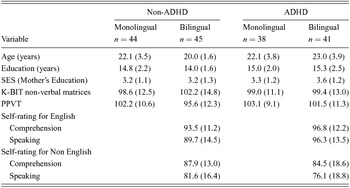
Details about age, years of education, socioeconomic status as measured by mother's education level, and language proficiency ratings are presented in Table 1. All bilinguals reported speaking both languages on a daily basis. The non-English languages of the bilinguals included Arabic (n = 2), Bengali (1), Cantonese (10), Farsi (7), French (11), Gujarati (3), Hakka (2), Hebrew (5), Hindi (5), Hungarian (1), Italian (2), Korean (4), Laotian (1), Macedonian (1), Malaysian (1), Mandarin (5), Persian (1), Polish (1), Punjabi (4), Russian (7), Spanish (5), Swahili (1), Tamil (3), Teochew (1), Turkish (1), Twi (2), Urdu (9), Yoruba (1). Thirteen participants in the bilingual non-ADHD group and 8 in the bilingual ADHD group reported speaking more than two languages, but the proportion of multilinguals in the two bilingual groups was not significantly different, Χ 2 = 1.02, n.s., ruling out an influence of third-language knowledge. Twenty-five participants in the bilingual non-ADHD group and 20 in the bilingual ADHD group reported that English was their second language, again with no difference between groups in these distributions, Χ 2 < 1.
Mean Score and Standard Deviation of Background Measures for Whole Sample.

Peabody Picture Vocabulary Test (PPVT)
The Peabody Picture Vocabulary Test-III Form B (PPVT-III; Dunn & Dunn, Reference Dunn and Dunn1997) is a standardized test used to measure receptive vocabulary in English. Participants were shown a page with four pictures. The researcher verbally cued the participant with a word, and the participant responded by selecting the image that best represented that word. Standard scores were computed from raw scores using age-referenced norms.
Kaufman Brief Intelligence Test (K-BIT-2) – Nonverbal Scale Matrices
Nonverbal intelligence was measured using the Matrices subtest of the Kaufman Brief Intelligence Test, Second Edition (K-BIT-2; Kaufman & Kaufman, Reference Kaufman and Kaufman2004). The test was administered according to standard user guidelines. Participants were shown a matrix of pictures that had an embedded pattern with one piece of the pattern missing. They were to select from a set of possible pieces to correctly complete the pattern. Raw scores were converted to standard scores using age-referenced norms.
Connors’ Adult ADHD Rating Scales – Self-Report: Long Version (CAARS-S:L)
The CAARS-S:L (CAARS-S:L; Conners et al., Reference Conners, Erhardt and Sparrow1999) is used for the assessment of ADHD symptoms and consists of 65 items divided into eight subscales: Inattention/Memory Problems, Hyperactivity/Restlessness, Impulsivity/Emotional Liability, Problems with Self-Concept, DSM-IV Inattentive Symptoms, DSM-IV Hyperactive-Impulsive Symptoms, DSM-IV ADHD Symptoms Total, and the ADHD Index. Raw scores on the subscales were converted to a standardized t-score based on age and gender.
Barkley Adult ADHD Rating Scale-IV (BAARS-IV)
The Current Symptoms Scale, a component of the BAARS-IV, is a measure for assessing ADHD symptoms and domains of impairment directly linked to DSM-IV diagnostic criteria. The questions are divided into two subscales: inattention and hyperactivity. Questions are presented in a Likert-item self-report rating scale (scores for each question range from 0 to 3, 0 being never or rarely and 3 being very often).
Executive Control Tasks
Flanker Task
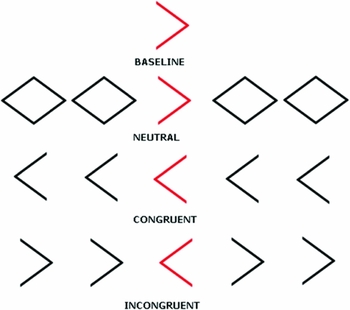
The flanker task requires inhibition of interference from distracting stimuli. The task was performed on a computer and included three conditions. In the baseline condition, a single red chevron was presented in the middle of a white screen. Participants placed their index fingers on two mouse buttons positioned on each side of the monitor and indicated the direction in which the chevron was pointing by clicking on the corresponding mouse. This is the simplest condition and was included to control for response speed. In the remaining two conditions, the display contained a row of five chevrons with the red target stimulus presented in one of the three middle positions surrounded by black-colored distractor flankers. The instructions were to respond to the red target and ignore the black stimuli. In the neutral condition, the target chevron was flanked by four diamond shapes. This condition was included to control for stimulus complexity. This display is similar to that used in the crucial mixed condition but there is no conflict. The mixed trial condition is the relevant one and consisted of congruent trials in which the four flanking chevrons pointed in the same direction as the target, and incongruent trials in which they pointed in the opposite direction (see Figure 1). This is the most difficult condition and represents the standard flanker task. The conditions were arranged in a sandwich design, with the similar conditions at each end collapsed to control for practice effects. Thus five blocks were presented in the following order: baseline, neutral, mixed, neutral, baseline. The baseline and neutral blocks consisted of 24 trials each, and the mixed block consisted of 48 trials including 24 congruent and 24 incongruent. Each block was preceded by a practice session containing 6 trials in which feedback was given.
Depiction of the four conditions in flanker task.

Each trial began with a blank screen which was present for 250 ms, followed by the stimulus. The trial terminated upon response or after 2000 ms had elapsed. For analyses of accuracy and RT, data were collapsed across the two repetition blocks for the baseline and neutral conditions to create mean scores for those conditions.
Stop-signal Task
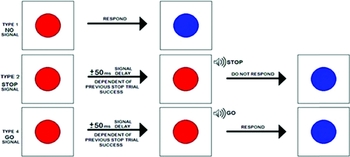
The stop-signal task, illustrated in Figure 2, consisted of 6 blocks (Blackwell, Chatham, Wiseheart & Munakata, Reference Blackwell, Chatham, Wiseheart and Munakata2014; Cepeda, Blackwell & Munakata, Reference Cepeda, Blackwell and Munakata2013). Participants sat in front of a computer screen on which they saw a blue or red circle. The instruction was to press ‘F’ for a blue circle and ‘J’ for a red circle on a standard keyboard. In the first block, control, participants were asked to respond as quickly and accurately as possible to the color of the circle. For the subsequent 5 blocks, trials were accompanied by one of two recorded verbal prompts (“go”, “stop”) or no prompt at all. When they heard the “go” prompt or no prompt, they were required to make the appropriate response; when they heard the “stop” prompt, they were instructed to refrain from responding. Both “go” and “stop” signals were presented after the stimulus. The control block consisted of 16 trials. This was followed by 5 blocks containing 48 random-order trials consisting of no-signal (50%), go signal (25%), and stop signal (25%). No-signal and go-signal trials were analyzed together as the measure of go trials.
Schematic of stop-signal task. For presentation purposes only, red circles indicate present trials and blue circles indicate the subsequent trial. During experimental blocks, these colors are randomly set. Three types of trials occur in the task: No-signal trials have no audio stimulus; Go-signal trials have the audio signal “go”; Stop-signal trials have the audio signal “stop” prompting the participant to refrain from responding to the stimulus presented.

A staircase mechanism was used to dynamically adjust the delay between the stimulus presentation and the stop signal. Successful stop trials were followed by a 50 ms increase in the delay before the “stop” signal on the next stop trial, increasing task difficulty. Similarly, failure to stop led to a decrease of 50 ms in the “stop” signal interval. These adjustments were made on the basis of maintaining stop accuracy at about 50%.
Stop-signal reaction time (SSRT) was calculated as the difference between the estimated finishing time of the stop process (estimated RT for responding to the stimulus if the response had not been stopped) and the stop-signal delay (SSD). The estimated finishing time was determined by taking the i th percentile of the go trial distribution, in which ‘i’ corresponds to the percentage of successfully stopped trials and subtracting the mean stop-signal delay from that RT (Ridderinkhof, Band & Logan, Reference Ridderinkhof, Band and Logan1999). A smaller SSRT indicates better ability to stop when required and better performance on the task.
Results
Background measures, ADHD status, and language proficiency
Background measures and reports of language proficiency are presented in Table 1. One-way ANOVAs comparing the two bilingual groups showed that ADHD bilinguals rated themselves higher than non-ADHD bilinguals on English speaking proficiency, F (1,67) = 4.81, p = .03, ηp 2 = .05. There was no difference between the groups in proficiency ratings for speaking the non-English language, or in comprehension ratings for either language, all Fs < 1.72. Thus, for these groups at least, there was no self-reported evidence of additional burden on language proficiency for bilingual individuals with ADHD, indicating that in our sample of university students, ADHD can be associated with high verbal functioning.
A two-way ANOVA for ADHD status and language group on PPVT-III scores showed a main effect of language group, F (1,163) = 6.55, p = .01, ηp 2 = .04, with higher vocabulary scores for monolinguals than bilinguals, consistent with previous literature (Bialystok & Luk, Reference Bialystok and Luk2012). In addition, there was a main effect of ADHD status, F (1,163) = 4.09, p < .05, ηp 2 = .03, indicating higher scores for the ADHD group than the controls (contrary to existing literature), and no interaction of language group and ADHD status, F (1,163) = 2.19, ns. This difference parallels the higher English proficiency ratings produced by ADHD bilinguals than by their non-ADHD counterparts. A two-way ANOVA for K-BIT-2 Matrices standard scores showed no significant difference between ADHD status groups, language groups, or their interaction, all Fs < 1.08.
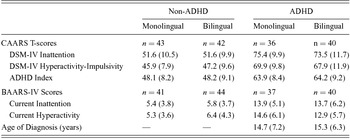
Mean scores and standard deviations from the two ADHD assessments are presented in Table 2. Two-way ANOVAs for language group and ADHD status were conducted for each measure. For the CAARS-S:L subscales, there was a main effect of ADHD status, with participants in the ADHD groups attaining higher scores than those in the non-ADHD groups on the inattention subscale, F(1,157) = 127.30, p < .0001, ηp 2 = .45, the hyperactivity subscale, F(1,157) = 127.58, p <.0001, ηp 2 = .45, and the ADHD Index measure, F (1,157) = 71.23, p < .0001, ηp 2 = .31, in all cases indicating more severe symptoms. There were no effects of language group on any of these measures, Fs < 1, and no interactions of language group and ADHD status for inattention or ADHD index, Fs < 1.24, but the interaction of ADHD status and language group was more substantial although still not significant for hyperactivity, F (1, 157) = 2.76, p = .09, with bilinguals showing less hyperactivity than monolinguals.
Mean Score and Standard Deviation for ADHD Characteristics for Whole Sample.

Results from the BAARS-IV showed a similar pattern: ADHD participants scored higher than non-ADHD participants on the inattention subscale, F(1,158) = 91.14, p < .0001, ηp 2 = .37, and hyperactivity subscale, F(1,158) = 71.22, p < .0001, ηp 2 = .31, with no effect of language group, Fs < 1. There was no status by language interaction for inattention, F < 1, but the interaction was significant for hyperactivity, F(1,158) = 6.95, p < .01. ηp 2 = .04. For both language groups, hyperactivity scores were significantly higher for ADHD participants than non-ADHD participants, ps < .0001, but for the ADHD participants, monolinguals obtained higher hyperactivity scores than bilinguals, F (1, 76) = 3.91, p < .05, with no difference between language groups for non-ADHD participants, F (1, 76) = 2.03, n.s. Thus, in both scales, ADHD bilinguals showed less hyperactivity than their monolingual counterparts. Finally, a one-way ANOVA for the two ADHD groups showed no difference between the monolinguals and bilinguals in age of diagnosis, F < 1.
Executive Control Tasks
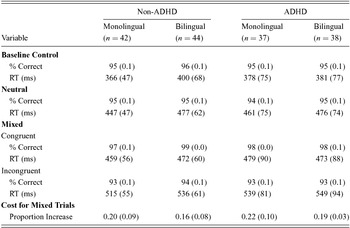
Mean accuracy and RT in the flanker task are presented in Table 3. Participants with an accuracy of less than 70% on any condition were removed from analysis. Trials with RTs shorter than 100 ms or greater than 1500 ms were removed. Based on these restrictions, 7 participants were excluded from the analyses. Only correct responses were included in the RT analyses. Accuracy rates were at ceiling for all conditions (> 93%) and were not analyzed further.
Flanker RTs in ms (SD) and Accuracy Rates by Language Group and ADHD Status.

Two-way repeated-measures ANOVAs for ADHD and language group were performed on each of the baseline and neutral RTs. For baseline RT, there was no effect for language group although monolinguals responded somewhat faster, F(1,157) = 3.44, p = .07, no effect of ADHD status, F < 1, and no interaction, F (1, 157) = 2.11, ns. For neutral RTs there was an effect of language group, F(1,157) = 4.79, p < .03, ηp 2 = .03, in which monolinguals responded faster than bilinguals, and no effect of ADHD status or interaction effect, Fs < 1. For the mixed block condition, a three-way repeated-measures ANOVA for ADHD status, language group, and congruency showed an effect of congruency, F(1,143) = 58.52, p < .0001, ηp 2 = .80, with faster RTs for congruent trials, and no effect of ADHD status, F < 1, language group, F(1,143) = 1.50, ns, or their interaction, Fs < 1.
Since monolinguals were faster than bilinguals on control and neutral conditions but there were no group differences in the mixed condition, it might be that the bilinguals were coping better with the additional demands of that condition than the monolinguals. Therefore, a proportion score was computed to represent the cost of performing the mixed condition relative to the simple baseline condition for each participant. The score was calculated as the RT difference between the mixed (average of congruent and incongruent) and control (average of baseline and neutral) conditions divided by the RT of the control conditions. These cost scores are shown in Table 3 as proportion increase for mixed block. A two-way repeated measures showed a main effect of language group, F(1,161) = 5.90, p < .01, ηp 2 = .04, with smaller cost for bilinguals, a main effect of ADHD status, F(1,161) = 3.96, p < .05, ηp 2 = .02, with smaller cost for non-ADHD participants, and no interaction, F < 1. Thus, once speed of processing was considered, both bilingual and non-ADHD participants coped better with the increased demands of the mixed condition than did their counterparts.
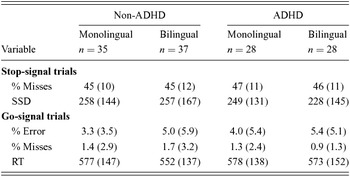
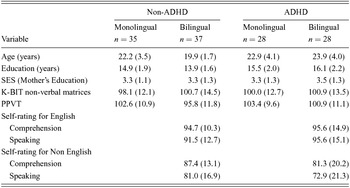
In the stop-signal task, 7 monolingual, 8 bilingual, 9 monolingual ADHD and 10 bilingual ADHD participants were excluded to comply with standard protocol for this task, so to assure that the smaller sample remained comparable across groups for the background measures, these were recalculated for the participants who contributed data to the stop-signal analyses. The background measures for the stop-signal subsample are reported in the Appendix Table A1. Statistical analyses of these measures were the same as those found for the whole sample and so are not reported here. The stop-signal data are presented in Table 4. Participants who had error rates above 30% on go-signal choice RT or who failed to respond (misses) on more than 30% of go-signal trials were excluded from analyses. Because the protocol required that the dynamic adjustment of SSD maintained stop-signal accuracy at about 50%, participants who obtained an accuracy rate of less than 15% or greater than 85% on this variable were removed from analysis. This procedure resulted in the removal of 40 participants distributed evenly across the groups, and a sample size for this task of 128 participants.
Stop-signal Task Accuracy Rates and RT Group Means in ms (SD) by ADHD Status and Language Group.

Two-way repeated-measures ANOVAs with language group and ADHD status were performed on stop-signal misses, all Fs < 1, SSD, all Fs < 1, go-signal errors, Fs < 1, go-signal misses, Fs < 1.8, and go-signal RT, Fs < 1, indicating no significant differences among groups for any of these measures. Verbal “go” prompts were included in the design to control for potential semantic processing effects (Blackwell et al., Reference Blackwell, Chatham, Wiseheart and Munakata2014; Cepeda et al., Reference Cepeda, Blackwell and Munakata2013) but there were no differences between prompted and non-prompted go trials, so data were collapsed across those conditions.
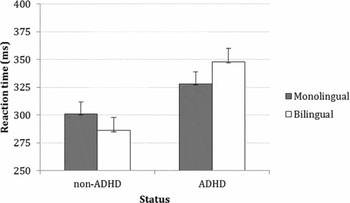
The main variable, SSRT, reflects the ability to stop a response after it has been initiated. The mean RTs and SEMs are displayed in Figure 3. A two-way repeated-measures ANOVA with language group and ADHD status showed a main effect of ADHD status, F(1,127) = 11.30, p < .001, ηp 2 = .09, in which participants in the ADHD groups were slower than non-ADHD participants, and an interaction of ADHD status and language group, F(1,127) = 4.04, p < .05, ηp 2 = .04. The interaction reflects a difference in the degree of effect of ADHD for each of the language groups. For monolinguals, the difference between status groups was significant, F (1, 61) = 4.16, p < .05, ηp 2 = .05, with a small effect size, but for bilinguals, the difference between status groups showed a larger difference, F (1, 63) = 9.53, p < .003, ηp 2 = .13. Thus, ADHD interfered with performance in both language groups but the burden of an attention disorder was more problematic for the bilinguals. Within ADHD status, the effect of bilingualism was not significant, Fs < 1.07.
Group means (SEM) for Go-signal SSRT for the Stop-signal task.

Discussion
The purpose of this study was to investigate whether bilingualism and ADHD status interact in determining performance on language proficiency and executive control tasks. Language proficiency is central to all cognitive performance, and executive control is an essential basis of cognitive ability, especially in older age. Although both bilingualism and ADHD have been shown to decrease language proficiency relative to the appropriate control, these experiences generally have opposite effects on executive control. For language proficiency, it was unknown whether these experiences would compound the vocabulary deficit associated with each alone. For executive control, it was unknown whether the benefits of bilingualism would compensate for difficulty associated with ADHD or whether the executive control difficulties of ADHD would prevent the emergence of advantages associated with bilingualism.
Participants were recruited from the undergraduate population of a large university, so all participants were clearly successful in their daily lives. For this reason, the participants with ADHD in this study might represent a group of unusually high functioning individuals. The literature on college students with ADHD is relatively recent, but there has been some evidence to suggest that these students are commensurate with their non-ADHD college peers on measures of neuropsychological functioning (Weyandt & DuPaul, Reference Weyandt and Dupaul2006) and that students with ADHD who attend college receive greater family support than non-ADHD peers (Wilmhurst, Peele & Wilmhurst, 2011). Consistent with these findings, the measure of fluid intelligence used in the present study, the K-BIT Matrices, showed no difference among participants in the four groups.
In support of this description of a high functioning group of ADHD participants, the language proficiency scores for ADHD participants were significantly higher than those in the non-ADHD group, p < .05. In contrast, the bilingual participants in both ADHD status groups obtained significantly lower vocabulary scores in English than did the monolinguals, consistent with previous literature (Bialystok & Luk, Reference Bialystok and Luk2012). Therefore, the ADHD group was a highly competent group of individuals who were matched with the non-ADHD participants on both fluid intelligence and linguistic variables. Minimally, these results show that there is no inevitability about ADHD being associated with poorer vocabulary than is found for similar individuals who do not have a diagnosis of ADHD, and there is no evidence that vocabulary levels for individuals with ADHD are further burdened by bilingualism. An unexpected result was that on both measures of ADHD symptoms, bilingual participants with ADHD showed less hyperactivity than the monolinguals, even though they were significantly higher than non-ADHD individuals on these measures. The possibility of different ADHD symptomatology for monolinguals and bilinguals should be pursued in further research.
The two executive control tasks produced different results. The flanker task was very simple for all participants as indicated by the high accuracy (overall accuracy = 95.0%) and fast RTs (overall RT = 464 ms), results that are consistent with this literature. Moreover, in studies that only report reaction times on mixed blocks, there is often no performance difference between monolingual and bilingual participants (cf. Paap & Greenberg, Reference Paap and Greenberg2013). However, controlling for individual differences in response speed by calculating additional cost as a function of the speed on the control and neutral conditions showed that both the bilinguals and the non-ADHD participants found the mixed condition to be less taxing. Calculating the cost scores on the basis of only the neutral trials (and excluding the baseline trials) shows even larger benefits for bilinguals but no effect for ADHD participants. Therefore, using these more subtle variables, both bilingualism and non-ADHD status was associated with less effortful performance on the flanker task.
The absence of larger behavioral group differences is most likely a reflection of how easy the task was for all participants. Studies using middle-aged adults (Emmorey, Luk, Pyers & Bialystok, Reference Emmorey, Luk, Pyers and Bialystok2008) or a more difficult task (Bialystok, Reference Bialystok2006), both of which slow down reaction time, reveal overall faster performance by bilinguals than monolinguals. Moreover, studies using neuroimaging data from fMRI (Luk, Anderson, Craik, Grady & Bialystok, Reference Luk, Anderson, Craik, Grady and Bialystok2010) and ERP (Kousaie & Phillips, Reference Kousaie and Phillips2012) have found different patterns of activation in monolingual and bilingual young adults performing a flanker task even when behavioral performance was equivalent. These task features might also explain why there were no overall RT differences on this task by the two ADHD status groups.
In the stop-signal task, ADHD participants attained significantly higher SSRTs, reflecting slower inhibitory processing when responding to a stimulus requiring them to abort a response. There was also a significant interaction between ADHD status and language group. The combination of bilingualism and ADHD particularly compromised performance for this group, suggesting not only that bilingualism failed to compensate for ADHD-related deficits, but also that ADHD was a more serious condition for bilinguals, perhaps because of the constant increased demands already placed on the executive control system by bilingualism. Although there was a numerical trend for bilinguals to outperform monolinguals in the non-clinical groups and perform more poorly than monolinguals in the ADHD group, these contrasts were not significant.
These results can be compared with those from a study of another experience that is associated with poor vocabulary and poor executive control, namely, low socioeconomic status (SES). Like ADHD, children raised in low SES environments perform more poorly than higher SES children on tests of language proficiency and executive control, but unlike ADHD the probable cause of those differences is more environmental than biological. Calvo and Bialystok (Reference Calvo and Bialystok2014) compared monolingual and bilingual children who were higher or lower SES on language measures and executive function tasks. Unlike the present results, the results showed two main effects with no interactions; specifically, both bilingualism and low SES led to reduced vocabulary, but bilingualism and higher SES led to enhanced executive control. Thus, the combination of bilingualism and SES did not change the effect of either factor. Our interpretation is that bilinguals in a low SES situation need to overcome the disadvantaged environment, and when they do, they achieve better executive control outcomes than monolingual children in low SES environments. Unlike ADHD, their executive control systems are intact and can profit from the stimulating control processing that is part of bilingualism.
In sum, the results of the present study show that the combination of bilingualism and ADHD have different effects on language and executive control outcomes. For language proficiency, there is no evidence for an additive effect from ADHD and bilingualism, but for the stop signal executive control task, the combination appears to increase the difficulty in performing the task. Notably, however, there was no statistical difference between monolinguals and bilinguals with ADHD on this task, even though ADHD was more disruptive to bilinguals than monolinguals compared to their non-ADHD counterparts. In that sense, the combination of ADHD and bilingualism was not strictly harmful. However, above these results is the more important fact that all of these participants were pursuing higher education, obtained equal scores on an intelligence test, and were generally successful in their lives.
Mean Score and Standard Deviation of Participant Background Measures for the Stop-signal Task Sample.