1 Introduction
Voiceless nasal consonants are relatively uncommon in the world's languages. For example, only 12 out of 307 languages that have one or more nasals in the UCLA Phonological Segment Inventory Database (UPSID) have voiceless nasals (Maddieson Reference Maddieson2009 [1984]: 61, 235–239). Overall, voiceless nasals in the UPSID sample do not occur unless the language has their voiced counterparts (Maddieson Reference Maddieson2009 [1984]: 14). Voiceless nasal consonants are mostly found in languages of Southeast Asia (Tibeto-Burman, Hmong-Mien, Tai-Kadai, Mon-Khmer), and they appear to be particularly widely represented in Tibeto-Burman languages. Voiceless nasal consonants occur in five distinct subgroups of Tibeto-Burman (Matisoff Reference Matisoff2003: 37):
(i) Lolo-Burmese (e.g. Burmese, Nuosu Yi, Lahu, Achang)
(ii) Qiangic (e.g. Pumi, Xumi, Queyu)
(iii) Bodish (Kham Tibetic languagesFootnote 1)
(iv) Nungish (Anong)
(v) Kuki-Chin (e.g. Mongsen Ao, Angami)
Notably, the four former subgroups overlap in their distribution in Southwest China, making that area possibly the densest constellation of languages with voiceless nasals in the world. In addition to voiceless nasals, Tibeto-Burman languages of Southwest China of the Lolo-Burmese and Qiangic subgroups – and also including Na languages held to be transitional between Lolo-Burmese and Qiangic (Bradley Reference Bradley and Bradley1997: 37) – have one more sound that is described as associated with nasalization. That voiceless sound, which is produced with an open glottis, is variously transcribed in phonological descriptions of the languages where it is attested as /h/ or / /. The former notation (/h/) is used in languages that have contrastive oral and nasal vowels (such as Naxi, Michaud Reference Michaud2006, Reference Michaud2008; or Xumi, Chirkova & Chen Reference Chirkova and Chen2013a, Reference Chirkova and Chenb; Chirkova, Chen & Kocjančic Antolík Reference Chirkova, Chen and Antolík2013). The latter notation (//) is adopted in those languages that only have oral vowels (such as Lisu, Bradley Reference Bradley, Thurgood and LaPolla2003 and Bradley et al. Reference Bradley, Hope, Fish and Bradley2006; or Lizu, Chirkova Reference Chirkova, Thurgood and LaPolla2016). Given that both /h/ and // refer to one and the same type of sound, for simplicity we use the symbol /H/ as a cover symbol for both notations. In monosyllabic words beginning with /H/, the entire syllable including the initial consonant is described as perceptually nasalized. The association between /H/ and nasalization is generally analyzed in these phonological studies as secondary nasalization resulting from an affinity between the phonetic features of glottality and nasality. In the field of Tibeto-Burman studies, this phenomenon is known under the name of ‘rhinoglottophilia’, a term coined by James Matisoff (Reference Matisoff1973: 20–21; Reference Matisoff1975). A plausible phonetic explanation for that association, as proposed by John Ohala (e.g. Reference Ohala and Ferguson1975, Reference Ohala and Lass1980; Ohala & Ohala Reference Ohala, Ohala, Huffman and Krakow1993), is as follows (cited from Ohala & Ohala Reference Ohala, Ohala, Huffman and Krakow1993: 240–241):
(i) High airflow segments like voiceless fricatives . . . require for their production a greater than normal glottal opening [. . .].
(ii) This greater than normal glottal opening may spread via assimilation to the margins of adjacent vowels, even though these vowels may remain completely voiced.
(iii) This slightly open glottis creates acoustic effects due to some coupling between the oral and the subglottal cavities that mimic the effects of coupling of the oral and nasal cavities, i.e. lowered amplitude and increased bandwidth of F1.
(iv) Vowels that sound nasal to listeners, even though they are not physiologically nasal, can be reinterpreted and produced as nasal.
Ohala's phonetic explanation of the association between high airflow segments and vowel nasalization is plausible, but, as yet, has not been instrumentally tested in relation to the sound /H/ in Tibeto-Burman languages of Southwest China. Pending such instrumental investigation, the perceptual nature of the association between glottality and nasality in /H/ remains assumed rather than demonstrated.
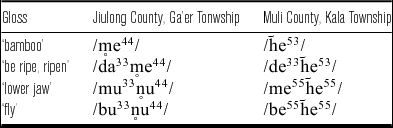
Recent language documentation and research on languages of Southwest China provides evidence that at least in some languages, voiceless nasals and /H/ may be related. That is suggested by (a) dialectal alternations between voiceless nasals, on the one hand, and /H/, on the other hand (as in various dialects of the Lizu language, see Table 1), and (b) diachronic comparative evidence (as in the case of the Lizu, Ersu, and Duoxu languages, Chirkova & Handel Reference Chirkova and Handel2013).
Dialectal alternations between the voiceless nasals / / and /
 /, on the one hand, and //, on the other hand, in two dialects of the Lizu language (based on Huang Reference Huang1987 and firsthand fieldwork data).

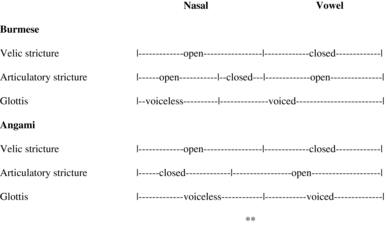
These data warrant an analysis of the phonetic motivation of this dialectal and diachronic variation. A complicating circumstance is that the phonetic characteristics of neither /H/ nor voiceless nasals have been comprehensively and systematically studied. While /H/ has never been subjected to detailed phonetic investigation, voiceless nasals, even though they are attested in a broader range of languages than /H/, are also little studied and understood. Instrumental phonetic studies of voiceless nasals in Tibeto-Burman languages have so far been focused on Burmese (Ladefoged Reference Ladefoged1971: 11; Dantsuji Reference Dantsuji1984, Reference Dantsuji1986), and, to a lesser extent, on two languages of the Kuki-Chin group: Mizo and (Khonoma) Angami (Bhaskararao & Ladefoged Reference Bhaskararao and Ladefoged1991, Blankenship et al. Reference Blankenship, Ladefoged, Bhaskararao and Chase1993, Blankenship Reference Blankenship1994). The results of these studies suggest that voiceless nasals typically consist of two parts: (a) a period characterized by both nasal and oral airflow, and (b) a period characterized only by nasal airflow. Both possible orderings of the two parts are attested, yielding the following two subtypes of voiceless nasals (Bhaskararao & Ladefoged Reference Bhaskararao and Ladefoged1991):
(i) Voiceless nasals in Burmese and Mizo represent one subtype, in which voiceless nasals begin with a period, characterized by both nasal and oral airflow, and end in a period, characterized only by nasal airflow. The former part is voiceless, whereas the latter part is voiced. The nasal airflow continues for a short time into the vowel before the velic stricture is closed.
(ii) Voiceless nasals in Angami constitute another subtype, in which voiceless nasals begin with a period characterized only by nasal airflow, and end in a period, characterized by both nasal and oral airflow. These voiceless nasals remain voiceless throughout the nasal articulation and even beyond the release (the vowel may be only partly voiced at the beginning). The continuous nasal airflow persists into the following vowel. This subtype of voiceless nasals is also known as ‘aspirated voiceless nasals’ for they are characterized by the same timing relationship between oral and glottal articulations as that seen in aspirated stops. More specifically, the glottal opening gesture begins only after the oral closure is completed, and the peak opening occurs at or after the oral release (Ladefoged & Maddieson Reference Ladefoged and Maddieson1996: 115–116). However, in contrast to aspirates stops, where the air after a complete closure of the articulators is released orally, there is continuous nasal airflow after a complete closure of the articulators in aspirated voiceless nasals. Figure 1 illustrates the two types of voiceless nasals.
Figure 1Structure of the two types of voiceless nasals, as represented by Burmese and Angami. ** indicates the aspirated portion. Cited from Blankenship et al. (Reference Blankenship, Ladefoged, Bhaskararao and Chase1993: 134).


Of the two subtypes of voiceless nasals, the former subtype (represented by Burmese) is held to be representative of all distinctive voiceless nasals (Ladefoged Reference Ladefoged1971: 11; Ohala Reference Ohala and Ferguson1975, Reference Ohala and MacNeilage1983; Ohala & Ohala Reference Ohala, Ohala, Huffman and Krakow1993: 232–233). This is because in that subtype, the period, characterized only by nasal airflow, is voiced and adjacent to the vowel. That voiced period can ‘help to distinguish one voiceless nasal from another by making the place of articulation more apparent. This is because the voiced offglide from the nasal into the vowel displays formant transitions that are characteristic of each place of articulation’ (Ladefoged & Maddieson Reference Ladefoged and Maddieson1996: 113, see also Ladefoged Reference Ladefoged1971: 11; Dantsuji Reference Dantsuji1984, Reference Dantsuji1986; Bhaskararao & Ladefoged Reference Bhaskararao and Ladefoged1991). In the latter subtype (aspirated voiceless nasals), in words spoken in isolation, which are entirely voiceless, there is no voiced offglide into the vowel that could display formant transitions that are characteristic of each place of articulation. For that reason, Blankenship et al. (Reference Blankenship, Ladefoged, Bhaskararao and Chase1993: 138–139) conclude that it remains unclear how voiceless nasals of that subtype are distinguished from each other in that context. In connected speech, on the other hand, when a word beginning with a voiceless nasal is preceded by a vowel, voicing from that vowel extends into the voiceless nasal. As a result, voiceless nasals become partially voiced, and formant transitions from the vowel into the nasal give a distinct cue as to the place of articulation (Blankenship et al. Reference Blankenship, Ladefoged, Bhaskararao and Chase1993: 136–137). To conclude this brief overview, the few existing instrumental studies suggest that voiceless nasals are diverse, yielding little certainty regarding their precise phonetic characteristics as a type of sound.
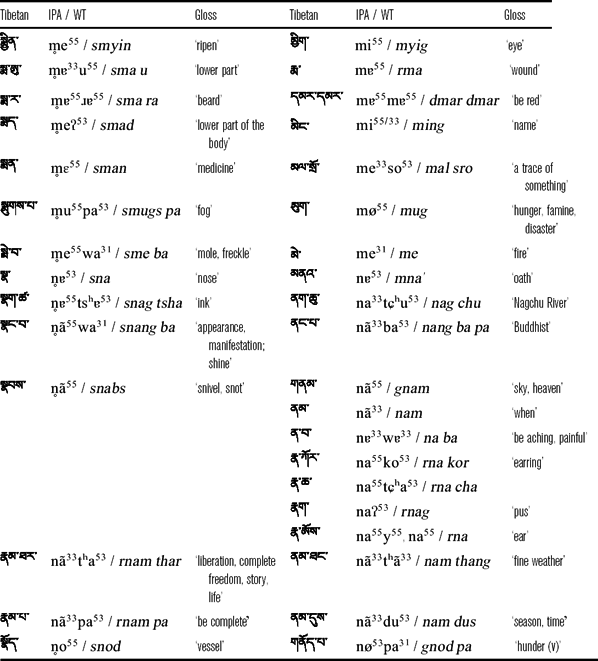
In this study we provide acoustic and aerodynamic data from one speaker of Xumi, a Tibeto-Burman language of Southwest China that combines in its phonemic inventory a set of phonemic voiceless nasal consonants (//, //) and the sound /H/ associated with nasalization. The Xumi language (ISO-639 code sxg, also known as Shixing or Shuhi) is spoken by Xumi Tibetans, an ethnic group of ca. 1,800 people who reside along the banks of the Shuiluo river in Muli Tibetan Autonomous County (Written Tibetan (hereafter WT) smi li rang skyong rdzong) of Sichuan Province in the People's Republic of China (PRC). For reasons that will be explained below, we collected data from one visiting speaker. In full recognition of its limitations in terms of the number of speakers, our study provides new data on voiceless nasal sounds //, //, /H/, which have implications for synchronic and diachronic research on Tibeto-Burman languages. We provide a synchronic description of Xumi //, //, and /H/ as compared to their voiced counterparts, respectively, /m/, /n/, and /ɦ/; and we explore similarities and differences between //, //, on the one hand, and /H/, on the other hand. We describe Xumi //, // with reference to the voiceless nasals //, // in Burmese and Kham Tibetan. (Note that in addition to // and //, both Burmese and Kham Tibetic languages also have alveolopalatal and velar voiceless nasals (/ / and //). These are not taken into account in our analysis for they have no equivalents in the Xumi variety of our consultant.) This is done for two reasons. First, Burmese voiceless nasals are the best described type of voiceless nasals, and held to be representative of all contrastive (phonemic) voiceless nasals. Second, voiceless nasals in Kham Tibetic languages, which are close linguistic neighbors of Xumi, represent an important regional feature of that group of dialects (e.g. Gesang & Gesang Reference Jumian and Yangjing2002: 74). They are of relevance to our Xumi case, because many Xumi words with voiceless nasals are borrowings from Kham Tibetan (e.g. ‘medicine’: WT sman, Kham Tibetan (Litang) /ɛ55/, Xumi /ɛ55/). For each of the three languages, we provide a comprehensive description of the target phonemes by incorporating (a) all phonological environments in which these target phonemes occur, and (b) as many words with the target phonemes as possible within the constraint of using familiar words. To make our data and analysis more comparable to those in previous instrumental studies of voiceless nasals, our description is based on:
(i) acoustic measurements: total duration of the target phonemes and the duration of the voiced period (if present) during the target phonemes; and
(ii) aerodynamic measurements: structure, conforming to or deviating from the two subtypes of voiceless nasals established in previous research (see Figure 1).
Our study (a) contributes to a better understanding of voiceless nasals as a type of sound; (b) provides a first-ever instrumental description (acoustic and aerodynamic) of the voiceless nasal sound /H/ associated with nasalization, as attested in a number of Tibeto-Burman languages of Southwest China; and (c) suggests a possible phonetic basis for the observed dialectal and diachronic variation between voiceless nasals and /H/ in some Tibeto-Burman languages (such as Lizu, see Table 1). All audio and video files and textgrids related to this study are made available at the COllections de COrpus Oraux Numériques (COCOON, the French National Center for Scientific Research) for further exploration (https://cocoon.huma-num.fr/exist/crdo/meta2/crdo-COLLECTION_CHK_ART).
The remainder of the paper is structured as follows. Section 2 presents the methodology of the study. Section 3 summarizes results for the voiceless nasals // and // in Xumi, Burmese, and Tibetan. Section 4 outlines results for Xumi /H/ and its voiced counterpart at the same place of articulation /ɦ/. That section also compares the general characteristics of these segments with those of voiceless nasals. Section 5 concludes the paper with a discussion of obtained results and possible future research directions.
2 Methodology
2.1 Languages
The three languages analyzed in this study (Xumi, Burmese, Kham Tibetan (hereafter, Tibetan)) are typologically similar. They are tonal;Footnote 2 words are monosyllabic of the type (C)(C)(G)V, where C is a consonant, G is a glide, V is a vowel nucleus, and brackets indicate optional constituents. All three languages have both oral and nasal vowels. Both types of vowels can be in the same syllable with nasals in the three languages, but only nasal vowels co-occur with /H/ and /ɦ/ in Xumi. Phonological outlines of the three languages can be found in Huang & Renzeng (Reference Huang, Wangmu, Qingxia, Bufan, Ailan, Wangmu and Juhuang1991), Watkins (Reference Watkins2001), Chirkova et al. (Reference Chirkova, Chen and Antolík2013), and Atshogs (Reference Atshogs2018).Footnote 3
2.2 Speakers
Our Xumi data were recorded with one male Xumi speaker, a lifelong resident of Muli Tibetan Autonomous County, Sichuan Province, PRC. He had worked as a language consultant in the past. With Xumi as his native language, he was also a fluent speaker of other local languages of Muli County, with which Xumi is in close contact, namely, Southwest Mandarin, (Kami) Tibetan, and Pumi. He was 60 at the time of the recordings, which took place during his visit to France. Integration of more Xumi speakers into this study was not possible given restrictions for non-Chinese nationals to conduct fieldwork in situ. We acknowledge the limitations of relying on the data from one speaker only. The reported results need to be confirmed with a larger number of speakers and substantiated in future work.
Our Burmese speakers included three adult female native speakers of standard Burmese, as spoken in Yangon, Myanmar. They were in their thirties at the time of the recordings and working and living in France. One Burmese speaker was a linguist and had worked as a language consultant in the past. All three Burmese speakers were also fluent in English, and two speakers were also fluent in French.
Our Tibetan speakers included three adult male native speakers of Litang Tibetan (that is, the Tibetic variety spoken in Litang County, WT lithang rdzong, in Sichuan Province, PRC). There were in their thirties at the time of the recordings and visiting in France. All three Tibetan speakers were proficient in Mandarin Chinese, and one speaker had also some knowledge of English. They have not worked as language consultants in the past. One Tibetan speaker had to be excluded because of insufficient literacy level in Tibetan. As it proved to be impossible to find more Tibetan speakers of exactly the same variety as recorded with the other two speakers, data from only two Tibetan speakers were analyzed. All speakers recorded for this study received financial recompense for their time.
2.3 Materials
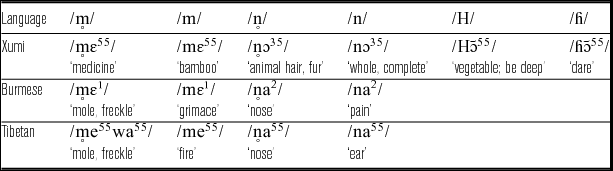
We collected three corpora, which contained minimal and/or near-minimal pairs of words contrasting the voiceless nasals //, // and their voiced counterparts (respectively, /m/, /n/). The Xumi corpus also contained minimal and near minimal pairs of words contrasting /H/ and /ɦ/. Table 2 provides some illustrative examples:
Examples of minimal or near minimal pairs with voiceless and voiced nasals in Xumi, Burmese, and Tibetan, and with /H/ and /ɦ/ in Xumi.

We recorded the selected words in isolation (following a pause) and in sentences (in which words with the target phonemes were preceded by a vowel). Each word or sentence was recorded with an average of three repetitions in a row. The speakers saw the materials on printouts in Chinese orthography for the Xumi corpus, Burmese orthography for the Burmese corpus, and Tibetan orthography for the Tibetan corpus.
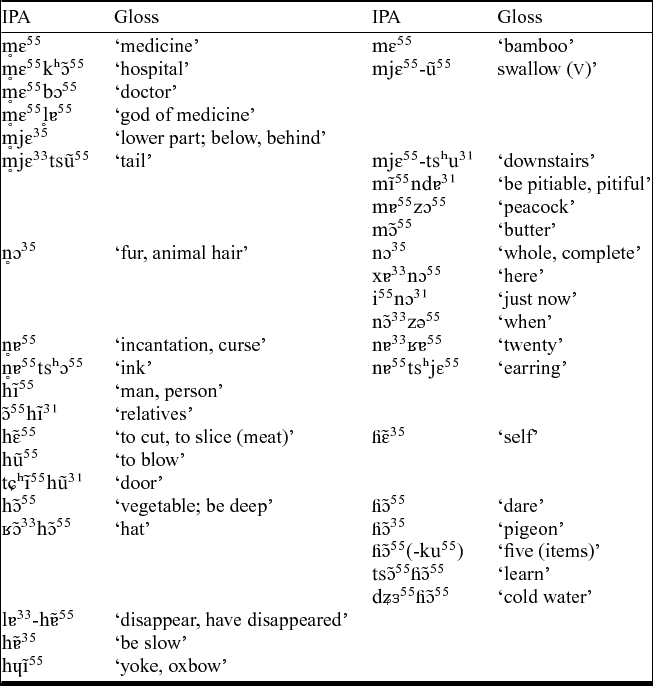
The Xumi corpus was not intended for the study of nasals and contained mainly acoustic recordings (a sound archive for a textbook of conversational Xumi, Chirkova & Duoding Reference Chirkova2013), but it also included acoustic and aerodynamic recordings of words in isolation for words with nasal consonants. The total number of Xumi words with // and // is six, and the total number of Xumi words with /H/ is 10. For words occurring in sentences, the Xumi corpus contains six words with //, nine words with /H/, but no words with // (see Table B1 in Appendix B).
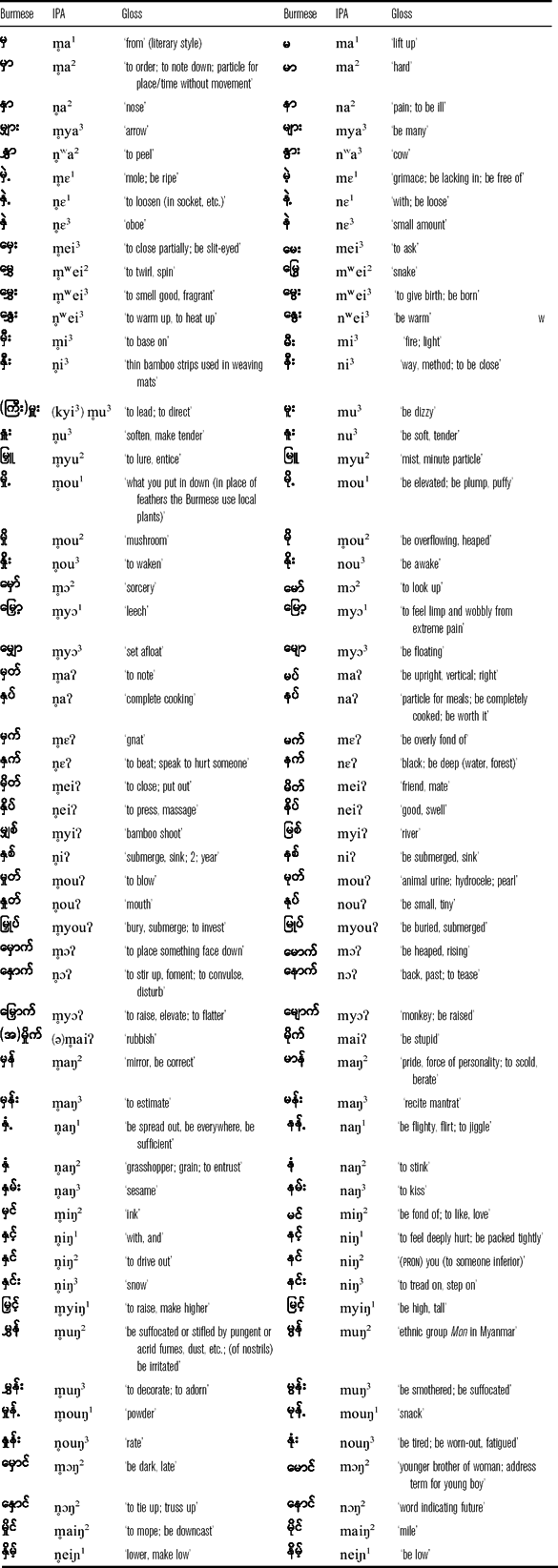
Burmese and Tibetan corpora were designed for the specific purpose of analyzing voiceless nasals in these two languages. These corpora focused on the realization of words with voiceless nasals in frame sentences and included aerodynamic, acoustic, and video data recordings. The total number of Burmese words with // and // in our Burmese corpus (based on Okell Reference Okell1969: 42, 206–208) is 56 (not distinguishing between homophonous roots). The total number of Tibetan words with // and // in our Tibetan corpus is 14 (based on voiced–voiceless nasal pairs in the existing descriptions of Kham Tibetic languages, e.g. Gesang Reference Jumian1989, Atshogs Reference Atshogs2018) (see appendix Tables B2 and B3).
2.4 Instrumentation
Recordings were made in a sound-proof room. Acoustic and aerodynamic recordings were made separately. A simultaneous high quality recording of audio and aerodynamic signals was not possible, because acoustic signal is modified by resonances due to the aerodynamic oral mask used by the aerodynamic system EVA2.
For the acoustic data, our recordings are based on synchronous audio, electroglottography (EGG), and video signals. The acoustic signal was recorded using an AKG C520 headset microphone connected to a multichannel recording device (Digidesign 003 Rack + Factory Pro Mixer 12U) and linked up to a Mac computer. The recording process was monitored by the Pro Tools LE software v7.4 at a sampling rate of 48000 Hz and 16 Bits. The electroglottography (EGG) signal was recorded with a Glottal Enterprises two-channel electroglottograph (model EGG2) at a sampling rate of 25000 Hz. The video signal was recorded using a Sony Exmor camcorder at a sampling rate of 25 Hz.
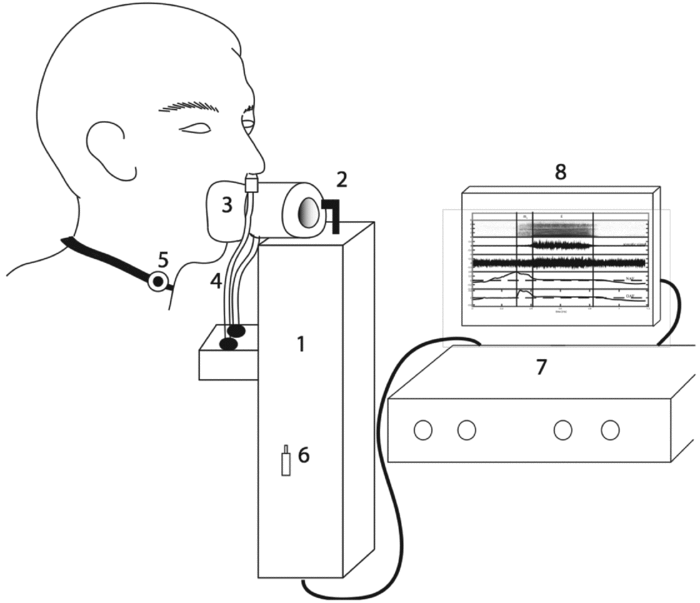
Our aerodynamic analysis is based on synchronous audio, EGG, nasal and oral airflow signals. The nasal airflow (NAF) and oral airflow (OAF) signals were recorded with a Workstation EVA2 at a sampling rate of 6250 Hz (Teston & Ghio Reference Teston and Ghio2002). Figure 2 depicts the equipment setup used for aerodynamic recordings.
Recording equipment used for aerodynamic analysis. 1: Mouthpiece, 2: Microphone, 3: Soft rubber mask and Oral Flow pressure transducer, 4: Nasal Air flow transducer, 5: Electroglottograph (EGG), 6: Subglottal Pressure, 7: EVA2 Workstation, 8: Computer.

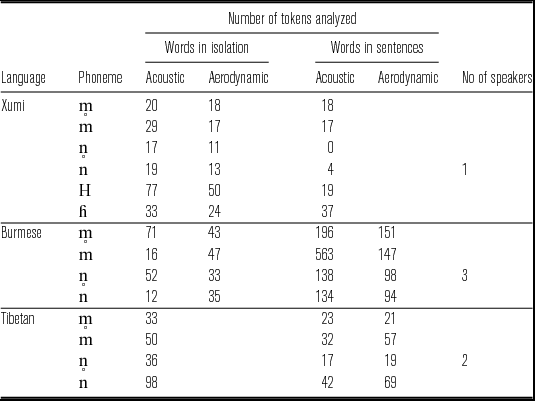
Table 3 summarizes the number of tokens analyzed per phoneme, instrumentation and the number of speakers per language.
Language, phonemes, number of tokens analyzed, instrumentation, number of speakers. ‘Acoustic’ = synchronous audio, electroglottographic (EGG), and video signals; ‘aerodynamic’ = synchronous audio, EGG, nasal, and oral airflow signals.

2.5 Labeling, segmentation, and measurements
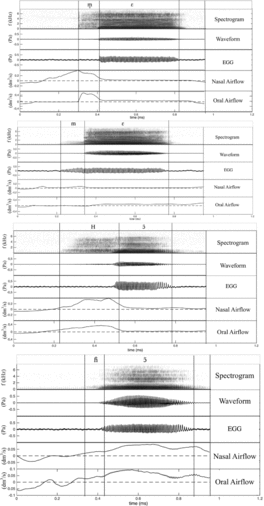
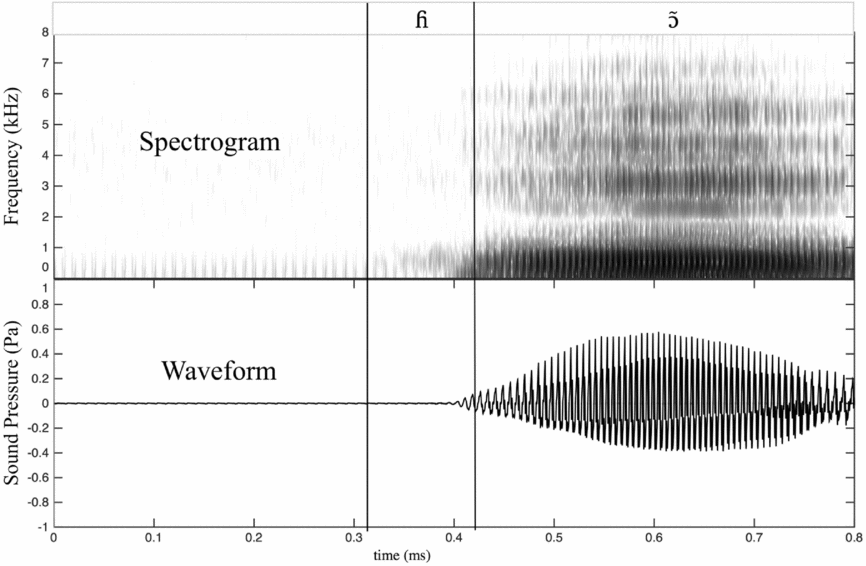
Signals for the pairs of voiceless and voiced nasals in Xumi, Burmese, and Tibetan, and for the pairs of /H/ and /ɦ/ in Xumi were segmented and annotated in Praat (Boersma & Weenink Reference Boersma and Weenink2014), using a combination of acoustic and aerodynamic cues, as illustrated in Figure 3. For words in isolation (target segment in word-initial position), the boundary between silence and the beginning of the phoneme was identified as onset of nasal murmur or of low-amplitude frication noise in the waveform. The boundary between the target phoneme and the following vowel was defined as onset of F2 in the vowel. For voiced and voiceless fricatives and also fricative-like portions of voiceless nasals in Xumi and Tibetan, the consonant–vowel boundary was defined as offset of clear frication noise and onset of F2 in the vowel. (See Figure 3a for a zoomed-in view of the boundary between the voiced glottal fricative and a vowel.) The beginning of the voiced period of the target phoneme was identified on the basis of EGG signal as the beginning of vocal fold vibrations. Nasal flow signals were used as an indication of the lowering of the velum, whereas absence of oral airflow was used as an indication of a complete closure in the vocal tract during the production of the nasal segment.
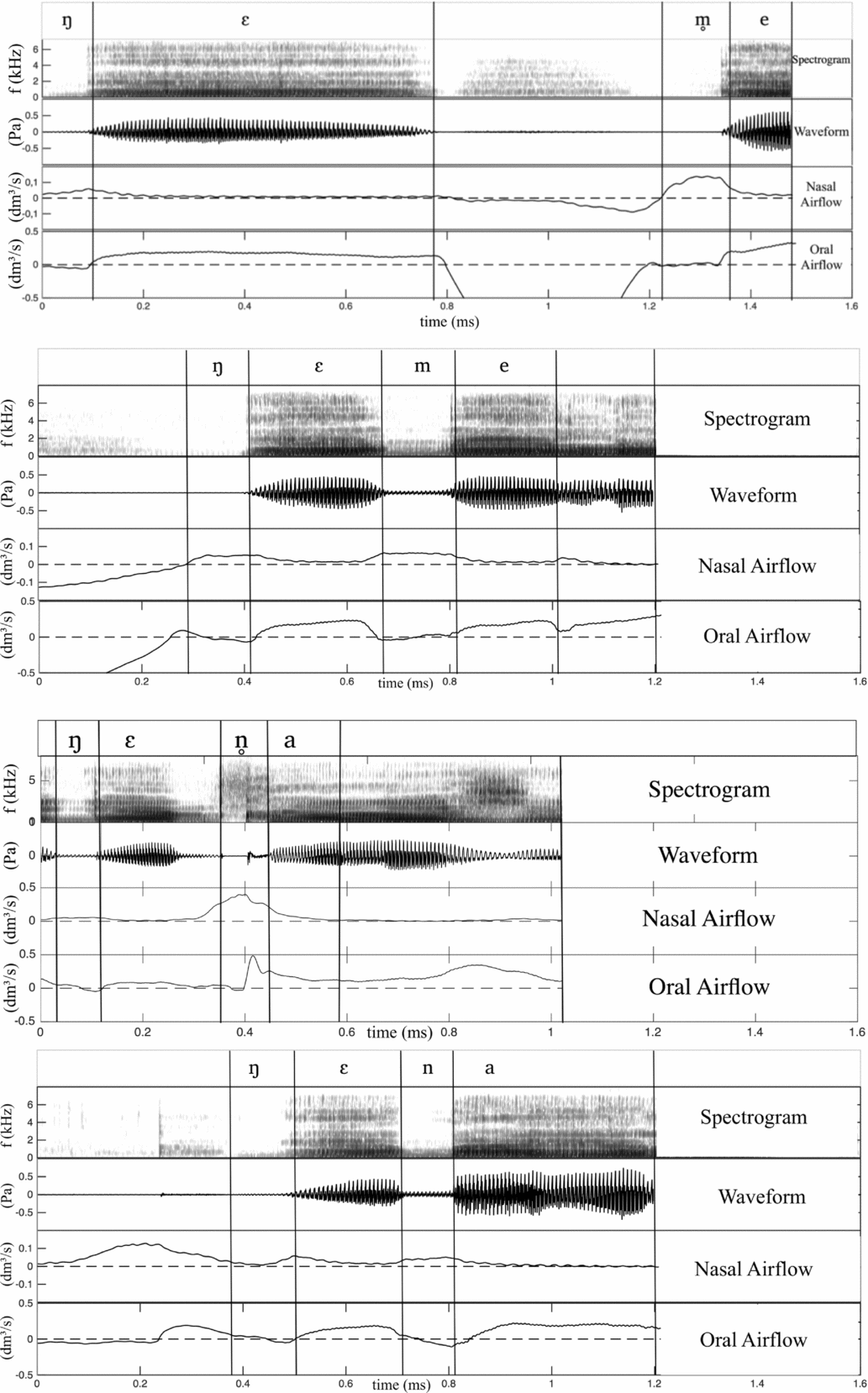
Spectrograms, waveforms, electroglottographic (EGG) signals, nasal airflow, oral airflow for the Xumi words /ɛ55/ ‘medicine’ (top panel), /mɛ55/ ‘bamboo’ (second from top), /H 55/ ‘vegetable; be deep’ (third from top), and /ɦ55/ ‘dare’ (bottom panel).

A zoomed-in view of the consonant–vowel boundary in the Xumi word /ɦ55/ ‘dare’.

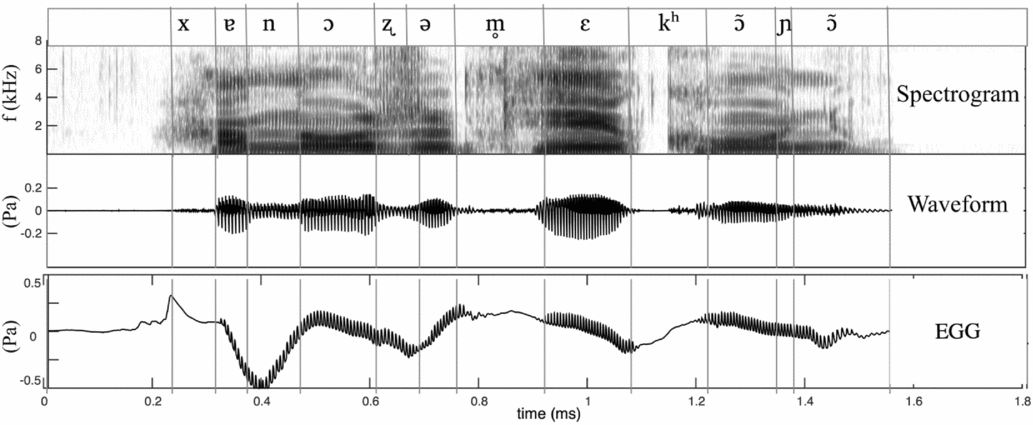
For words in sentences, the boundary between the beginning of the target phoneme and the preceding vowel was defined as offset of F2 in the vowel preceding the target phoneme. The boundary between the end of the target phoneme and the following vowel was defined as onset of F2 of the vowel following the target phoneme, similar to words in isolation. This is illustrated in Figure 4 in relation to the Xumi phoneme //.
Spectrogram, waveform, and electroglottographic (EGG) signal for the Xumi sentence /xɐ33nɔ33=ʐə55 ɛ55kʰ55 ɲ31/ this.loc=top medicine.house cop ‘This is a hospital.’.

The voicing rate (in %) of the target phoneme was calculated by multiplying the duration of the voiced period by 100 and then dividing it by the total duration of the target phoneme. The maxima and minima for the nasal and oral airflow were calculated automatically using a script in Matlab. The statistical tests used in this study were based on the variance analysis ANOVA with a significance level of p < .001.
3 Voiceless nasal consonants // and // in Xumi, Burmese, and Tibetan
3.1 Acoustic measurements: Duration and voicing rate
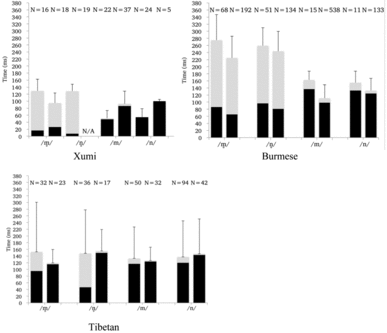
Figure 5 summarizes results per phoneme in the three languages. The figure demonstrates that voiceless nasals in the three languages consist of voiceless and voiced parts. The statistical analysis indicates that in Xumi, there is no significant difference in the duration of voiceless nasals in words spoken in isolation as compared to words occurring in sentences (F(1,109) = 1005, p = .3183). Similarly, there is no significant difference in the voicing rate of voiceless nasals in these two contexts (F(1,109) = .094, p = .759). At the same time, there is a significant difference between the duration of voiceless nasals as compared to their voiced counterparts (F(1,99) = 51.36, p < .001). More specifically, voiceless nasals are longer (116 ms > 68 ms). There is also a significant difference in the voicing rate between voiceless and voiced nasals (F(1,99) = 489, p < .001); the voicing rate of voiceless nasals is considerably lower than that of voiceless nasals (16% vs. 94%).
Mean duration and mean voicing period in voiceless and voiced nasals in Xumi, Burmese, and Tibetan (in ms). Each bar is split into voiceless phases (grey) and voiced phases (black). Each phoneme is represented by two bars: the left bar stands for words spoken in isolation, the right bar stands for the same words occurring in sentences. The data for Xumi // are only from words in isolation. Error bars represent standard deviation of the mean value. The number of tokens is given above each bar.

In Burmese, voiceless nasals spoken in words spoken in isolation have a longer duration than when occurring in words placed in frame sentences (249 ms vs. 154 ms; F(1,1139) = 217, p < .001). Furthermore, the duration appears to differ significantly depending on the speaker (F(2,1138) = 17, p < .001). Overall, Burmese voiceless nasals are significantly longer than their voiced counterparts (242 ms > 117 ms; F(1,1139) = 1590, p < .001). Also, they have a significantly lower voicing rate than their voiced counterparts (33% vs. 89%; F(1,1140) = 8061, p < .001).
Finally, in Tibetan, there is no significant difference in the duration of voiceless nasals depending on the context (words occurring in isolation or placed in the frame sentence; F(1,329) = 2.159, p = .143). The voicing rate of voiceless nasals in words spoken in isolation is significantly higher than that of voiced nasals (F(1,329) = 80, p < .001). By contrast, we observe no significant difference in the voicing rate of voiceless and voiced nasals in words placed in the frame sentence. Put differently, Tibetan voiceless nasals occurring in sentences are almost entirely voiced (/m/ > /n/ > // > //; 98% > 97% > 97% > 96%).
3.2 Aerodynamic measurements: Structure of voiceless nasals
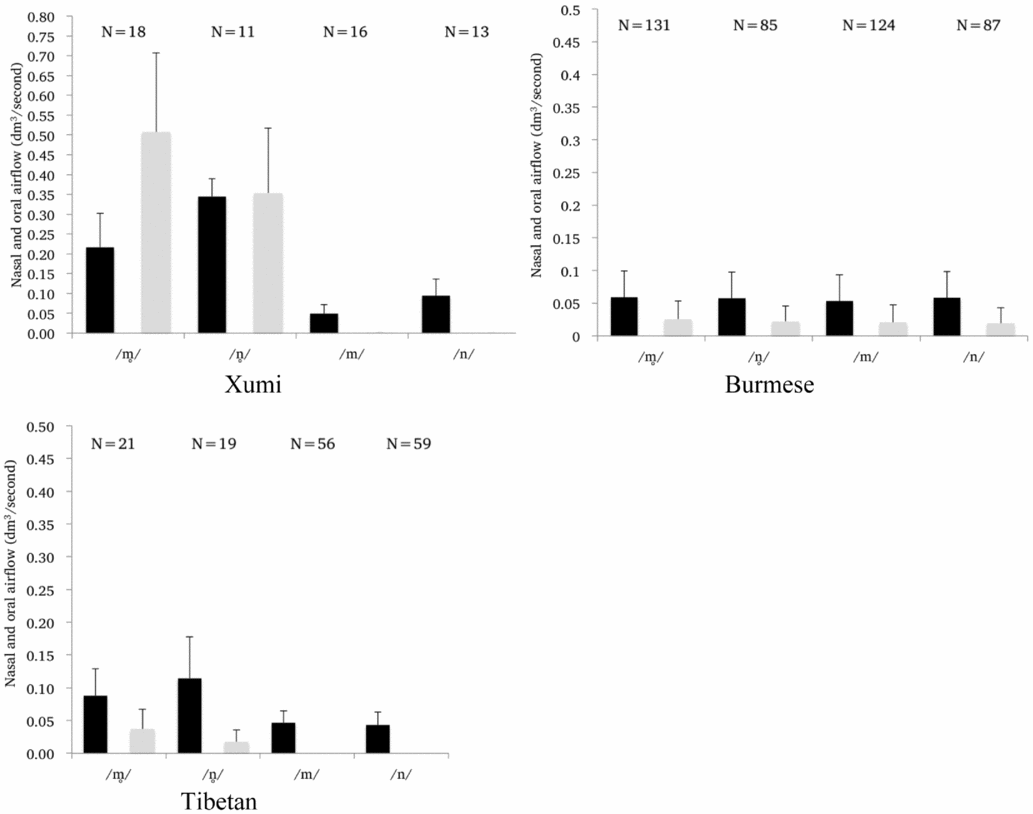
Figure 6 presents mean nasal and oral airflow in the three languages. It demonstrates that during the production of voiceless nasals in the three languages, there is both nasal and oral airflow. Notably, both nasal and oral airflow volume for the voiceless nasals in Xumi are very high as compared to their voiced counterparts (nasal airflow: F(1,56) = 102, p < .001; oral airflow: F(1,56) = 98, p < .001). In addition, nasal airflow volume for the voiceless nasals in Xumi is significantly higher than that of voiceless nasals in Tibetan and Burmese (Xumi vs. Tibetan: F(1,67) = 81, p < .001; Xumi vs. Burmese: F(1,243), p < .001).Footnote 4 On the other hand, Burmese has comparable nasal and oral airflow volumes for voiceless and voiced nasals (F(3,423) = 0.565, p = .637). Finally, Tibetan voiceless nasals have considerably higher levels of nasal airflow than their voiced counterparts 0.101 dm3 > 0.045 dm3; F(1,163) = 98, p < .001).
Mean nasal and oral airflow in Xumi, Burmese, and Tibetan (in dm3 per second). Each phoneme is represented by two bars: the left, black bar stands for nasal airflow, the right, grey bar stands for oral airflow. Error bars represent standard deviation of the mean value. The number of tokens is given above each bar.

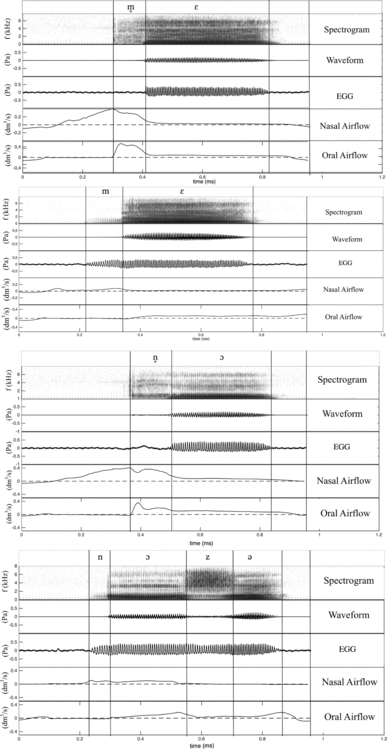
Mean oral and nasal airflow data point to differences in structure of the voiceless nasals in the three languages. In Xumi, voiceless nasals begin with a period of brief voiceless closure, characterized by the presence of nasal flow and the absence of oral flow. The velum starts to open before the noise appears, and the oral tract is completely closed during the opening phase of the velum. Then oral flow starts, while nasal flow continues, albeit at a progressively diminished rate. Voicing begins with the following vowel, while air is still flowing out through the nose. Xumi voiceless nasals can hence be phonetically described as [] and []. In terms of their structure, Xumi voiceless nasals correspond to the voiceless aspirated nasals subtype of voiceless nasals, as described for Angami. Xumi voiced nasals, on the other hand, are characterized by the presence of nasal flow and the absence of oral flow for the entire duration of the segment. They are therefore characteristic (modal voiced) nasals. Figure 7 provides illustrative examples.
Spectrograms, waveforms, and electroglottographic (EGG) signals, nasal airflow, oral airflow for the Xumi words /ɛ55/ ‘medicine’ (top panel), /mɛ55/ ‘bamboo’ (second from top), /ɔ35/ ‘animal hair, fur’ (third from top), and /nɔ33zə55/ ‘when’ (bottom panel).

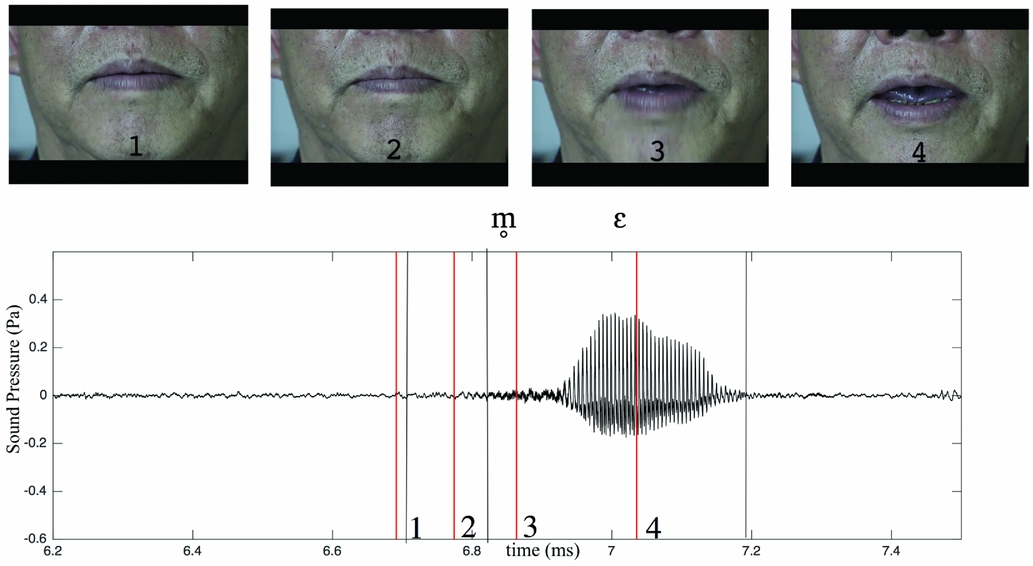
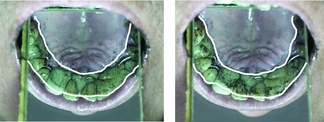
The duration of closure in Xumi voiceless nasals is very brief and hard to perceive for non-native speakers. For that reason, Xumi voiceless nasals impressionistically sound more like fricatives than stops. In order to confirm that // and // in Xumi are in actual fact characterized by a (brief) period of complete closure of the articulators for a portion of their duration, we carried out video and static palatography recordings of the same words with voiceless nasals as the displays of oral and nasal airflow in Figure 7. Figures 8 and 9 present the results, confirming complete closure for a portion of the duration in both // and //.
Four frames from a video recording of the Xumi word /ɛ55/ ‘medicine’ demonstrating the time course of lip gestures during the articulation of this word. 1: Before the beginning of //, 2: beginning of //, 3: beginning of /ɛ/, 4: middle of /ɛ/.

Palatograms of the Xumi phonemes // in the word /ɔ35/ ‘animal hair, fur’ (left) and /n/ in the word /nɔ35/ ‘whole, complete’ (right).

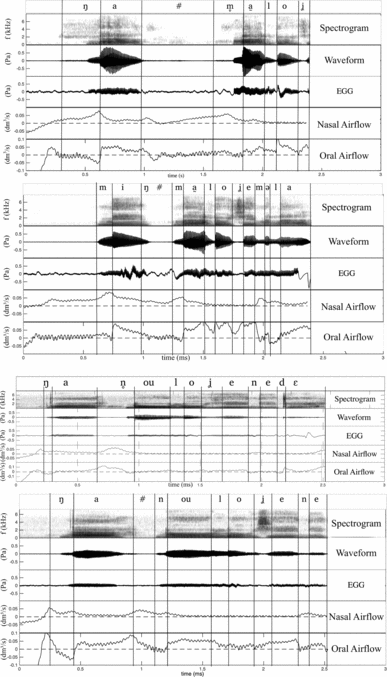
Aerodynamic records of Burmese voiceless nasals show that they have a different structure. Voiceless nasals in Burmese begin with a voiceless period, characterized by the presence of both nasal and oral flow. They end with a voiced period with a continuing nasal flow, and no oral flow. The latter, voiced, part is therefore identical to a regular voiced nasal. The nasal flow ceases at the beginning of the following vowel. This is illustrated in Figure 10.
Spectrograms, waveforms, and electroglottographic (EGG) signals, nasal airflow, and oral aiflow for the Burmese words /a1/ ‘from’ in the sentence /ŋa2 a1 lo1 ʝe3 ne2 dɛ2/ ‘I am writing “from”.’ (top panel); /ma1/ ‘hard’ in the sentence /miŋ3 ma1 lo1 ʝe3 mə la3/ ‘Will you write “hard”?’ (second from top); /ou3/ ‘waken’ in the sentence /ŋa2 ou3 lo1 ʝe3 ne2 dɛ2/ ‘I am writing “waken”.’ (third from top); and /nou3/ ‘be awake’ in the sentence /ŋa2 nou3 lo1 ʝe3 ne2 dɛ2/ ‘I am writing “be awake”.’ (bottom panel); # stands for a pause.

Due to their clear composition of a voiceless part followed by a voiced part (as can be observed on the basis of the EGG signal in Figure 10), voiceless nasals in Burmese give an auditory impression of preaspirated modal voiced nasals (phonetically [m] and [n]), and they are often described as such in reference grammars of Burmese (e.g. Okell Reference Okell1969: 9).
The structure of Tibetan voiceless nasals in our corpus is similar to that of voiceless aspirated nasals in Xumi. Tibetan voiceless nasals begin with a (voiceless) closure, characterized by nasal flow and no oral flow. Then oral flow starts, while nasal flow continues at a slightly diminished rate. The nasal flow continues throughout the following vowel. This is illustrated in Figure 11 (note that the phonemes // and /ŋ/ in the two top panels, respectively, are preceded by an expiratory pause followed by inspiration).
Spectrograms, waveforms, nasal airflow, oral airflow for the Tibetan words /e55wa55/ ‘mole, freckle’ (top panel), /me55/ ‘fire’ (second from top), /a55/ ‘nose’ (third from top), and /na55/ ‘ear’ (bottom panel).

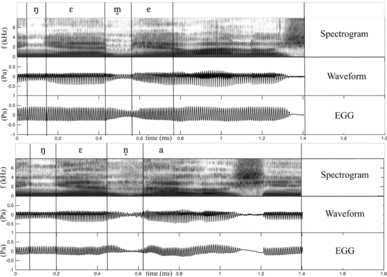
As shown in Figure 5 above, the duration of the voiced period in Tibetan voiceless nasals in rapid speech tempo is typically lengthened as compared to that in Tibetan voiceless nasals in words spoken in isolation. As a result, in connected speech, voiceless nasals acquire voicing at the nasal–vowel boundary and can be phonetically described as [] and []. This is illustrated in Figure 12 in relation to the Tibetan words /e55wa55/ ‘mole, freckle’ and /a55/ ‘nose’.
4 Xumi /H/ and /ɦ/
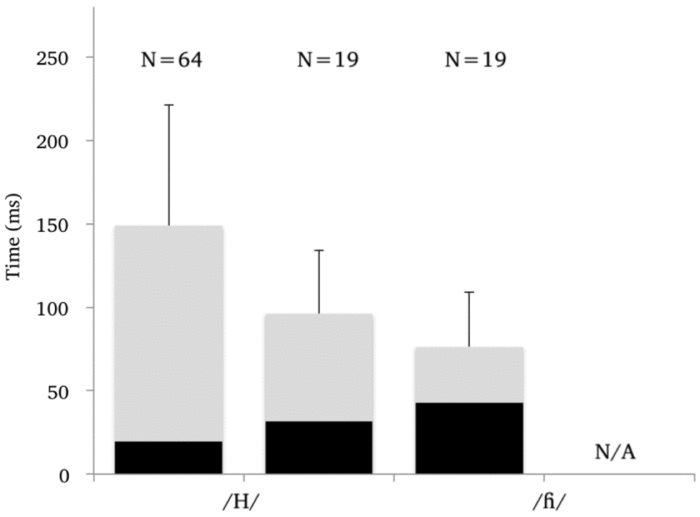
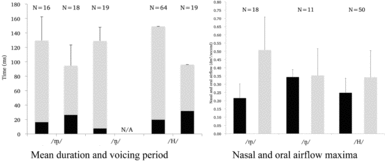
Xumi /H/ and /ɦ/ have been described as occurring only before nasal vowels and corresponding to two phonological consonants (Huang & Renzeng Reference Huang, Wangmu, Qingxia, Bufan, Ailan, Wangmu and Juhuang1991, Chirkova & Chen Reference Chirkova and Chen2013b, Chirkova et al. Reference Chirkova, Chen and Antolík2013). The difference between /H/ and /ɦ/ is rather subtle to non-native ears. Minimal pairs suggest more voicing and slightly shorter duration of /ɦ/, as compared to /H/. This is confirmed by our measurements in relation to words spoken in isolation, see Figure 13.
Spectrograms, waveforms, and electroglottographic (EGG) signals for the Tibetan sentences /ŋɛ55 e55wa55 lɔ wuɕin/ ‘I said “mole, freckle”.’ (top panel) and /ŋɛ55 a55 lɔ wuɕin/ ‘I said “nose”.’ (bottom panel) in rapid speech.

Mean duration and voicing period in /H/ and /ɦ/ in Xumi (in ms). Each bar is split into voiceless phases (grey) and voiced phases (black). /H/ is represented by two bars: the bar on the left stands for words spoken in isolation, the bar on the right stands for the same words occurring in sentences. The data for /ɦ/ are only from words in isolation. Error bars represent standard deviation of the mean value. The number of tokens is given above each bar.

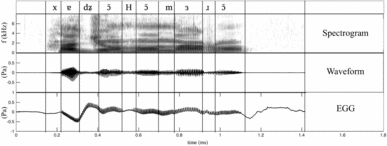
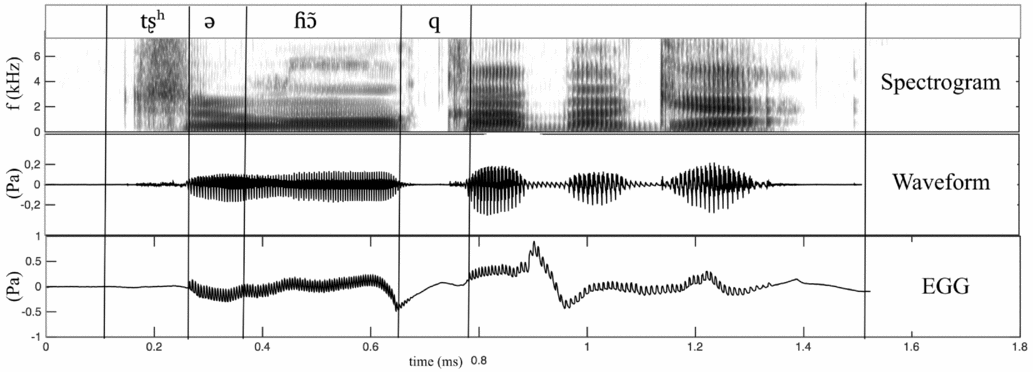
The statistical analysis indicates that for /H/, there is a significant difference in the duration and the voicing rate depending on the context (words spoken in isolation vs. words occurring in sentences, respectively, F(1,64) = 49, p < .001; F(1,64) = 10, p < .001). More specifically, the duration of /H/ in sentences, where /H/ is preceded by a vowel, has a tendency to decrease, whereas its voicing rate in the same context has a tendency to increase (see also Figure 14). On the other hand, /ɦ/ in that context is completely voiced (see Figure 15).
Spectrogram, waveform, and electroglottographic (EGG) signal for the Xumi sentence /xɐ55 dʑ33H55 mɜ33ɹ55/ this house tall ‘This house is tall.’.

Spectrogram, waveform, and electroglottographic (EGG) signal for the Xumi sentence /tʂʰə55 ɦ55qɐ31 bɜ33 ɡjɛ51/ money fifty make VOL.Q ‘Will you sell it for 50 yuan?’.

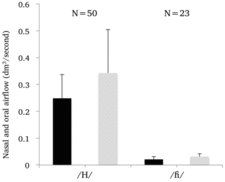
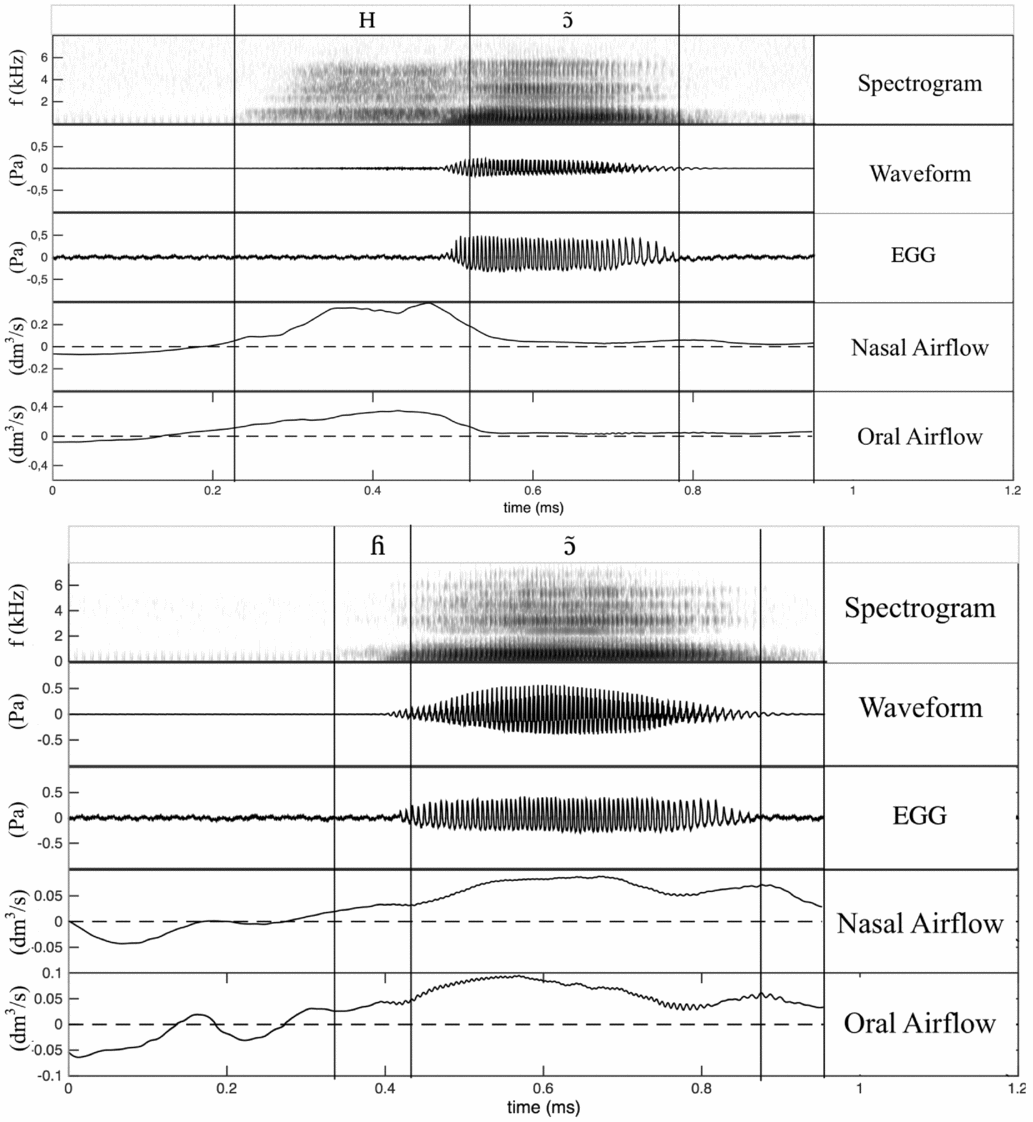
Aerodynamic measures show that /H/ is characterized by significant amounts of nasal and oral flow, which culminate in an airflow peak roughly in the second part of the segment whereas there is comparatively little nasal and oral flow in /ɦ/. This is illustrated in Figure 16.
Nasal and oral airflow maxima for /H/ and /ɦ/ in Xumi (in dm3 per second). Each phoneme is represented by two bars: the left, black bar stands for nasal airflow, the right, grey bar stands for oral airflow. Error bars represent standard deviation of the mean value. The number of tokens is given above each bar.

Figure 17 demonstrates that there is noticeably less nasal airflow throughout the vowel following /H/ than throughout the vowel following /ɦ/. Given these flow records, the difference between the two monosyllables could be described as having a voiceless, nasal initial and an oral vowel (nasalized by coarticulation) in ‘vegetable; to be deep’, i.e. /ɔ/, and a voiced, oral initial and a nasal vowel in ‘dare’, i.e. /ɦ/.
Spectrograms, waveforms, electroglottographic (EGG) signals, nasal airflow, and oral airflow for the Xumi words /H55/ ‘vegetable; to be deep’ (top panel) and /ɦ55/ ‘dare’ (bottom panel).

We note that in terms of duration, voicing rate, and elevated nasal and oral airflow rates, /H/ [] may be comparable to Xumi // [] and // [], as detailed in Figure 18. This tendency needs to be confirmed in future studies involving more speakers.
Mean duration and voicing period (in ms, left) and nasal and oral airflow maxima (in dm3 per second, right) in //, //, and /H/ in Xumi. In the left graph, each bar is split into voiceless phases (grey) and voiced phases (black). // and /H/ are represented by two bars: the bar on the left stands for words spoken in isolation, the bar on the right stands for the same words occurring in sentences. The data for // are only from words in isolation. In the right graph, each phoneme is represented by two bars: the left, black bar stands for nasal airflow, the right, grey bar stands for oral airflow. Error bars represent standard deviation of the mean value. The number of tokens is given above each bar.

5 Discussion and conclusion
5.1 Phonetic characteristics of voiceless nasals
One of the three main goals of our study was to contribute to a better understanding of voiceless nasals as a type of sound. Our study presented new instrumental data and analysis of voiceless nasal consonants in three Tibeto-Burman languages (Xumi, Burmese, Tibetan). Of these, voiceless nasals in Xumi and Tibetan, to our knowledge, have not been previously examined using instrumental techniques. Furthermore, voiceless nasals in Burmese are discussed on the basis of a larger corpus and a more diverse range of instrumental measurements than in previous studies. We examined // and // in Xumi, Burmese, and Tibetan in terms of total duration, duration of the voiced period, and oral and nasal airflow maxima. Our results corroborate the existence of two distinct subtypes of voiceless nasals, as proposed in Bhaskararao & Ladefoged (Reference Bhaskararao and Ladefoged1991):
(i) Preaspirated nasals: those beginning with a voiceless period characterized by nasal and oral airflow and ending in a voiced period characterized only by nasal airflow (as in Burmese and Mizo).
(ii) Voiceless aspirated nasals: those beginning with a voiceless period characterized only by nasal airflow and ending in a partially voiced period characterized by simultaneous nasal and oral airflow (as in Xumi, Kham Tibetic varieties, Angami).Footnote 5
Of the two types of voiceless nasals, voiceless aspirated nasals appear to be more common, at least among Tibeto-Burman languages. In Southwest China, in addition to various Kham Tibetic varieties and Xumi, this type is also represented by voiceless nasals in some Qiangic languages (such as Lizu and Pumi) (see Lizu examples in Table 1 above; an example in Pumi includes /ĩ55/ ‘medicine’). This preliminary conclusion is based on kinesthetic sensations during the imitation of these sounds. If confirmed by instrumental investigation, that would suggest that voiceless nasals of the former type, as represented by Burmese, may not be representative of all distinctive voiceless nasals, as held presently (e.g. Ladefoged Reference Ladefoged1971:11; Ohala Reference Ohala and Ferguson1975, Reference Ohala and MacNeilage1983; Ohala & Ohala Reference Ohala, Ohala, Huffman and Krakow1993: 232–233).
Our results for Burmese voiceless nasals generally correspond to those previously reported in Bhaskararao & Ladefoged (Reference Bhaskararao and Ladefoged1991: 82) and based on data from three male speakers and three female speakers of Standard Burmese. The mean duration of voiceless nasals reported for female speakers is 221 ms for // and 233 ms for //. For male speakers, it is 193 ms for // and 176 ms for //. The average voicing rate reported in Bhaskararao & Ladefoged (Reference Bhaskararao and Ladefoged1991) is slightly lower than in our data: 26% for // and 11% for // for female speakers, and 28% for // and 26% for // for male speakers. The discrepancy in the results for the voicing rate is likely to be due to differences in measurement procedures. Those in Bhaskararao & Ladefoged (Reference Bhaskararao and Ladefoged1991) are based on a combination of acoustic and aerodynamic measures (onset and offset of voicing, the onset of oral airflow when there is also nasal airflow). Our measurements, on the other hand, are based on electroglottography data (see Section 2.4 above), allowing for greater accuracy in identifying the beginning of the voiced period. Overall, both our present data and those in Bhaskararao & Ladefoged show that in voiceless nasals in Burmese, the duration of the voiced period amounts to approximately one third of the total duration of the nasal, and that the voiced closure period is located at the nasal–vowel boundary, where the acoustic cues that specify nasal place of articulation are argued to be located (Kurowski & Blumstein Reference Kurowski and Blumstein1987, Reference Kurowski, Blumstein, Huffman and Krakow1993; Harrington Reference Harrington1994; Narayan Reference Narayan2008). Burmese voiceless nasals are further characterized by volumes of nasal and oral airflow that are comparable to those in voiced nasals (with slightly higher levels of nasal airflow in voiceless nasals).
In contrast, in Xumi and Tibetan, there is no significant difference in the duration of voiceless nasals depending on the context (words occurring in isolation and words occurring in sentences). On the other hand, voiceless nasals in these two languages differ markedly in their voicing rate. The duration of the voicing period ranges from a very brief, relatively inaudible and voiceless period of closure in Xumi to duration and voicing rate that are comparable to those in voiced nasals in Tibetan. Put differently, Xumi voiceless nasals are almost devoiced, whereas Tibetan voiceless nasals occurring in sentences are almost entirely voiced.
In Xumi, voiceless nasals appear to differ from their voiced counterparts by elevated rates of both nasal and oral airflow. In Tibetan, voiceless nasals have higher rates of nasal flow than voiced nasals. We hypothesize that that may be one way for the speakers to differentiate between voiceless and voiced nasals in the context of potential neutralization of the voicing contrast.
In Burmese, voicing at the offset of the consonant has been argued to be helpful in distinguishing place of articulation among voiceless nasals (Ladefoged Reference Ladefoged1971: 11; Ohala Reference Ohala and Ferguson1975; Dantsuji Reference Dantsuji1984, Reference Dantsuji1986). The same strategy may also apply to our Tibetan data, where in words said in the frame sentence, voiceless nasals acquire voicing at the nasal–vowel boundary. By contrast, in the case of Xumi, where, similar to Angami, the closure period is voiceless and located at the very beginning of the segment, differences in spectrum that might result from the closure are likely difficult to hear. In their investigation of Angami voiceless nasals, Blankenship et al. (Reference Blankenship, Ladefoged, Bhaskararao and Chase1993: 138–139) examine the following four aspects of the acoustic signal that could serve as cues to place of articulation: (a) the spectral pattern during the nasal portion, (b) the frequencies of peaks in the spectrum at the time the nasal is released, (c) the frequencies of peaks in the spectrum during the voiceless portion, and (d) timing of voice onset after the nasal release. They conclude that no single factor among those tested appears to distinguish // and //, ‘although the frequency of F2 at the nasal release might adequately differentiate them if there were more data’ (Blankenship 1993: 139). A systematic exploration of this possibility was not possible on the basis of our Xumi data for we had no examples of // in sentences to compare with //. For that reason, this issue must await further investigation. We note that in addition to formant transitions from the vowel into the nasal, Xumi is likely to resort to additional cues, possibly including visual cues for the place of articulation, specifically, a visible lip closure in [m] and, to an extent, even a visible tongue tip closure in [n] (see Johnson, DiCanio & MacKenzie Reference Johnson, DiCanio and MacKenzie2007).Footnote 6
To conclude, our results confirm previous findings in Bhaskararao & Ladefoged (Reference Bhaskararao and Ladefoged1991) and Ladefoged & Maddieson (Reference Ladefoged and Maddieson1996) that voiceless nasals are a highly diverse type of sound with notable differences in the relative duration and voicing of the two constituting periods of the voiceless nasal, and volumes of nasal and oral airflow.
5.2 Phonetic characteristics of Xumi /H/
Our second main goal was to provide a description of the voiceless sound /H/ associated with nasalization. While reported in a number of Tibeto-Burman languages of Southwest China, this sound has not been previously studied instrumentally. We demonstrate that in Xumi, /H/ or [] is a physiologically nasal segment, characterized by a lowering of the velum. Put differently, the association between nasality and glottality in [] in Xumi is not secondary. This means that an explanation for that association in Xumi in terms of rhinoglottophilia (as in Chirkova et al. Reference Chirkova, Chen and Antolík2013) is not suitable. This further suggests that it may be necessary to re-examine other reported cases of rhinoglottophia in Tibeto-Burman languages (such as Lahu or Lisu) using instrumental techniques in order to refine their synchronic phonetic description and diachronic analysis.
The presented data and findings contribute to the phonetic debate about nasalized fricatives in natural languages (Ohala Reference Ohala and Ferguson1975, Ohala & Ohala Reference Ohala, Ohala, Huffman and Krakow1993; see Shosted Reference Shosted2006, Reference Shosted2007 for a detailed discussion). That is because Xumi [] is at the same time demonstrably a fricative (given the acoustic signal and the high oral flow rate) and a physiologically nasal segment, whose production requires speakers to open the velum (as demonstrated presently). There is a general claim on aerodynamic grounds against the existence of nasalized fricatives due to the incompatibility of nasalization and oral obstruency (Ohala Reference Ohala and Ferguson1975: 300; Ohala & Ohala Reference Ohala, Ohala, Huffman and Krakow1993; Ohala & Solé Reference Ohala, Solé, Fuchs, Toda and Zygis2010: 60–61). However, this claim applies exclusively to obstruents articulated in front of the point of velic opening (that is, buccal obstruents). Hence, glottal fricatives, whose place of articulation is farther back than the velum, such as Xumi [], should pose no aerodynamic conflict with nasalization. At the same time, while physiologically possible, glottal nasalization is argued not to be adopted in any language due to problems with perceptibility (e.g. Ohala Reference Ohala and Ferguson1975: 301; Shosted Reference Shosted2006: 20). That is because, in perceptual terms, the position of the velum during /h/ is held to be irrelevant (Shosted Reference Shosted2006: 16 fn. 19). For that reason, allophonic variation of the type [h]~[] is argued to be widespread and practically unnoticeable (Ohala & Solé Reference Ohala, Solé, Fuchs, Toda and Zygis2010: 61, see also the phonetic explanation for the affinity between glottality and nasality, as cited in the introduction, Ohala & Ohala Reference Ohala, Ohala, Huffman and Krakow1993: 240–241). In contrast to these observations, our data suggest that Xumi [] is saliently different from both oral fricatives in Xumi (e.g. /xɔ55/ ‘cooked rice, food’ versus /ɔ55/ ‘be deep; vegetable’), and from the phonetically nasalized glottal fricative [] in other languages, as in American English. An instrumental study of the utterance ‘Are you home, papa?’ in Warren & Dubois (Reference Warren and Dubois1964: 63) suggests that during the production of [h], there is a relatively small degree of nasal flow during which the velopharyngeal orifice increased in size at a rate of approximately 0.16 mm2/ms. To compare, the velopharyngeal aperture during the production of [m] rose to about 0.80 mm2/ms. By contrast, Xumi [] is characterized by considerably higher volume of nasal airflow which is also higher than that in Xumi modal nasals (see Figure 6 above), creating the percept of nasalization in the adjacent vowel. Elevated oral and nasal airflow may possibly be a hallmark of Xumi [], differentiating it from other fricatives. Naturally, further investigations are needed in a larger number of speakers and in a larger number of languages in order to confirm these preliminary observations.
5.3 Variation between voiceless nasals and []
Our third goal was to comment on a possible relationship between voiceless nasals and [], as attested in some Tibeto-Burman languages (e.g. in Lizu, see Table 1 above). Our data suggest that in terms of duration, voicing rate, and nasal and oral flow rates, Xumi voiceless nasals may be comparable to Xumi []. One difference between the two types of segments ([] versus [] and []) obviously lies in the absence of an oral constriction in []. We hypothesize that when the period of oral constriction is very brief and entirely devoiced (as in Xumi [] and []), cues for the place of articulation may become weakened. Consequently, when oral constriction becomes too weak to be perceptually useful, it may disappear, leaving the velic lowering gesture as the only remaining gesture. In that way, an alternation between voiceless nasals and [] may become possible, and [] and [] may change to []. Voiceless nasals in Tibeto-Burman languages generally develop from the Proto-Tibeto-Burman (PTB) cluster *sN- (a combination of *s- with a nasal root-initial) (Matisoff Reference Matisoff2003: 37). Examples include: ‘blow’: PTB *s-mut, Burmese /ouʔ/ [mouʔ] and ‘be ripe’: PTB *s-min, Burmese /ɛ1/ [m ] (PTB forms cited from Matisoff Reference Matisoff2003). Hence, it has been proposed that, in historical terms, the voiceless + voiced (= fricative + sonorant) realization of voiceless nasals of the Burmese subtype may be understood as a continuation of the same phonetic features found in the *sN clusters that give rise to them: a sequence of voiceless fricative + voiced sonorant (Ohala & Ohala Reference Ohala, Ohala, Huffman and Krakow1993: 232–233). Interestingly, the same *sN clusters also give rise to (a) voiceless aspirated nasals, in which the order of the two constituting parts of the voiceless nasal is reversed, as in ‘be ripe’: PTB *s-min, Tibetan /i55/ [ĩ55] WT smyin; and (b) [], as in ‘blow’: PTB *s-mut, Xumi /u55/ and ‘be ripe’: PTB *s-min, Lizu /da33e44 ~ de33e53/. These examples suggest that voiceless nasals and [] may exemplify different stages of nasal devoicing in clusters consisting of a voiceless segment followed by a nasal. An analysis of voiceless nasals and [] in different languages as possibly representing different stages of the same pathway of change may also offer an explanation for the high variability of voiceless nasals as a type of sound (as discussed above). Naturally, future research is needed to clarify relevant diachronic developments (see Chirkova & Handel Reference Chirkova and Handel2013 for a preliminary discussion).
Finally, the origins of Xumi /ɦ/ include PTB *ŋ and rhymes with nasal codas, as in /ɦ55 (-ku55)/ ‘five (items)’, PTB *ŋa; /ɦ55/ ‘dare’, PTB *s-wam or *hwam. Related developments are likely due to the acoustic and visual similarity of velar nasals and nasalized vowels, as discussed in Ohala (Reference Ohala and Ferguson1975), Ohala & Ohala (Reference Ohala, Ohala, Huffman and Krakow1993: 234–235), Johnson et al. (Reference Johnson, DiCanio and MacKenzie2007).
5.4 Conclusion
The preliminary findings reported in this study provide new data on voiceless nasal sounds. More specifically, they contribute to our knowledge of voiceless nasal consonants, provide a preliminary exploration of the voiceless nasal glottal fricative, and explore the relationship between these two types of sound. The interpretation of some results reported in the present study requires verification and refinement based on a larger number of speakers, and larger and more varied corpora. Most importantly, our Xumi results need to be improved by using more speakers and examining aerodynamic recordings of words with target phonemes embedded in frame sentences. Further research also needs to address (a) the role of formant transitions from the vowel to the consonant in Xumi and Tibetan in differentiating voiceless nasals at different places of articulation, as well as (b) the potential for an interaction between tone and voice quality in the three languages under investigation. While preliminary, the present analysis hopefully furthers our knowledge on voiceless nasals and []. As the densest constellation of languages with voiceless nasals in the world, Southwest China is one promising area to continue the exploration of their acoustic properties.
Acknowledgements
We would like to thank our Xumi, Burmese, and Tibetan language consultants Lurong Duoding 鲁绒多丁, San San Hnin Tun, Thae Thinzar Oo, Hla Myat San, Kunya Tenphel Lobsang and Dhula Tsang Lobsang for their patience and assistance. We are grateful to San San Hnin Tun, Françoise Robin, Camille Simon, Clemence Henry for their help with Burmese and Tibetan corpora and recordings of Burmese and Tibetan speakers; and to Jacqueline Vaissière, John Ohala, Shinji Maeda, Zev Handel, the two anonymous reviewers of this journal, and the journal's Editor Amalia Arvaniti for helpful comments and suggestions on earlier drafts. The original collection of data reported here was supported by the research and documentation projects ‘What defines Qiang-ness? Towards a phylogenetic assessment of the Southern Qiangic languages of Muli’ (ANR-07-JCJC-0063) and ‘Ersu and Xumi: Comparative and Cross-Varietal Documentation of Highly Endangered Languages of South-West China’ (ELDP, the Endangered Languages Documentation Programme, grant number MDP0257). Analysis of the data was partially funded by the research center Centre de Recherches Linguistiques sur l'Asie Orientale (CRLAO) of CNRS and by a public grant overseen by the French National Research Agency (ANR) as part of the program ‘Investissements d'Avenir’ (reference: ANR-10-LABX-0083).
Appendix A. Abbreviations
Abbreviations follow the Leipzig Glossing Rules (http://www.eva.mpg.de/lingua/resources/glossing-rules.php). 1, 2 = first, second person; cop = copula; ego = egophoric; erg = ergative; fut = future; loc = locative; pfv = perfective; prog = progressive; q = question; sfp = sentence-final particle; sg = singular; top = topic marker; vol = volition; σ = standard deviation; N = number of tokens measured.
Appendix B. Corpora containing the examined phonemes in the three languages
Xumi.

Burmese.

Frame sentences

Tibetan.

Frame sentence
The first line below is a phonetic transcription; the second line is a transcription in standard written Tibetan orthography.