Violence and elections are not strangers to one another: party armed wings clash, party supporters riot, incumbents target opposition parties, and insurgents attack politicians.Footnote 1 Political scientists have explored when and how violence erupts, the ways in which politicians coerce, and the consequences of violence for outcomes such as electoral results. Yet this research often focuses on how mainstream political actors engage with elections and violence. Armed actors themselves generally are given little agency, instead being primarily portrayed as manipulated and controlled by elites.
We argue instead that armed groups pursue a surprisingly diverse array of electoral strategies. Some groups choose nonparticipation, ignoring electoral politics or not trying to shift the balance of electoral outcomes. But many—perhaps most—armed groups seek to use electoral politics.Footnote 2 We identify four distinct strategies of electoral participation by armed groups. They differ along two dimensions: first, directness, i.e. whether or not armed groups run their own candidates in elections; and, second, openness, i.e. whether or not armed groups make public, official statements expressing electoral positions. These strategies include openly fusing bullets and ballots to form an armed political party, covertly controlling a political wing that stands candidates in elections, overtly targeting particular parties or politicians, and secretly providing resources to distinct political parties.
After laying out this new typology, we explore why groups pursue different strategies. These insights are based on theory-building case studies covering broad geographical and temporal scope. Groups that expect to do relatively well in elections and see opportunities to shift policy in their direction by doing so pursue direct participation. Governments vary, however, in their tolerance of overt, direct participation. When open involvement is blocked, groups that see advantages from direct participation choose to build formally distinct party structures that they nevertheless control; this covert direct participation seeks to evade legal bans and popular backlash.
Groups that do not expect to do well in elections, by contrast, tend to pursue indirect methods of involvement, by backing or targeting specific parties, politicians, and even voters that they do not control. They hope to change electoral outcomes to favor existing political actors, based on the closeness of their policy preferences to these actors in mainstream politics. They tend to covertly support parties to avoid sanctions and repression that would undermine both the armed group and the party. Armed groups are more likely to overtly target parties and politicians who oppose the group’s goals, since opposition to a party is not likely to trigger the same counterproductive response that open support for a party would.
What explains nonparticipation? Groups choose not to participate through any of these strategies when political cleavages, or elections themselves, do not provide an opening for advancing a group’s goals. As a result, ideologically radical groups and marginal peripheral actors are most likely to ignore electoral politics or indiscriminately target the entire electoral system, rather than trying to tilt the playing field in a particular direction. Such targeting can be hugely consequential, but has a different significance than efforts to “game” electoral politics.
Ours is a concept- and theory-building article that does not claim to provide causally identified tests. However, we use examples intentionally chosen from different contexts, within the scope conditions we identify, to show that the concepts can broadly be operationalized and to provide illustrative evidence of the mechanisms identified in the argument. We show that electoral strategies can be distinguished from one another and from nonparticipation. Here we lay the basis for future systematic empirical research on both the causes and consequences of armed group electoral participation.
Existing Work on Elections and Violence
Research on elections and violence has expanded rapidly in recent years, providing many insights, but it has mainly focused on the use of violence by existing political parties. New work has begun to examine particular types of armed group electoral participation,Footnote 3 but we argue that researchers have not yet explored the distinctive ways that armed groups can get involved in electoral politics.
First, there is rich literature on violence around elections. This work examines violence both before and after elections, which often includes violent protests, violence against supporters of one side or another at the polls, and even more generalized communal violence.Footnote 4 Most of these studies focus on politicians’ decisions on how to manipulate or use violent actors. This research also involves discussions of state repression around elections, whether directly or through non-state proxies.Footnote 5 McAdam and Tarrow have argued that this work can further include the interaction of “contentious politics” and electoral campaigns.Footnote 6
Second, a subset of these studies addresses the decision by preexisting electoral parties to develop their own armed wings or to cultivate links with violent actors.Footnote 7 These cases, such as the Awami National Party in Bangladesh and the KANU in Kenya, obviously deserve attention, but they continue to focus on party and national political elites’ decisions to manipulate, unleash, or crack down on armed groups.
A third strand of research provides more agency to armed groups as they engage with elections. It studies peace deals and the subsequent transformation of combatants into peaceful political parties.Footnote 8 For instance, the Farabundo Martí National Liberation Front in El Salvador, the Maoists in Nepal, Renamo in Mozambique, the Revolutionary Front for an Independent East Timor, and the Uganda National Liberation Army transitioned from war-fighting organizations into purely electoral actors embedded within mainstream politics.
Is Armed Group Electoral Participation a Separate Phenomenon?
In many studies, electoral participation is framed as part of a process that inevitably produces moderation such that participating groups stop using violence. For example, Marina Ottaway writes that “there is ample evidence that participation in an electoral process forces any party, regardless of ideology, to moderate its position if it wants to attract voters in large numbers and avoid a backlash.”Footnote 9 If that were the case, the logic of electoral participation could be very similar to that of peace deals and rebel-to-party transitions.
Using new data from Matanock,Footnote 10 we find that a significant number of armed groups use electoral and armed strategies simultaneously for long periods, and that many of them never moderate in the sense of ending their armed attacks. These data only measure what we call “direct” participation: armed groups standing candidates eligible under the state’s rules in elections, either through their own party or a publicly-identified party wing.Footnote 11 They encompass overt and some covert direct participation, but not indirect participation, for which data are not currently available.Footnote 12 These data code a set of groups as “compet[ing] against the government without a peace agreement in place” and “typically actively attack[ing] during the electoral process,” in contrast to those that participate following a signed settlement or a win after which only the victor participates. Just over one-fifth of the groups that participate directly do so in this way, suggesting that this is an important phenomenon.Footnote 13
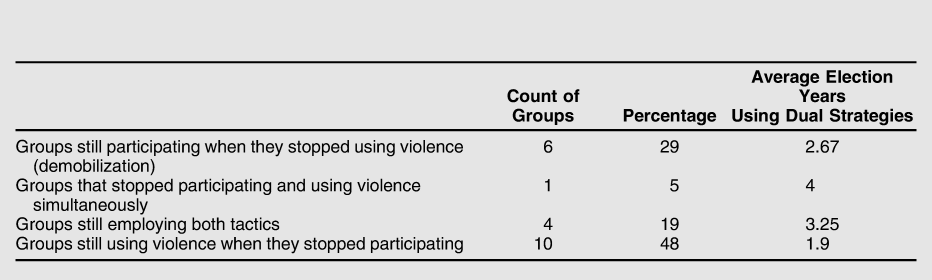
We do not find evidence that electoral participation is a waystation to demobilization. Across the twenty-one cases of violent participation, we find that demobilization eventually occurred in a handful of these cases (6), one group stopped using both tactics at the same time, and another handful of cases still used both tactics at the end of the period examined and so could demobilize at some point (4); refer to table 1. What is most striking across all of the groups in these sets, however, is that they continued to use violence while participating for 2.67, 4, and 3.25 election years, respectively. Most of these elections are between four and six years apart, so these groups are often operating simultaneous electoral and armed campaigns for 15 to 20 years on average.
Outcomes of rebel groups that directly participate in elections

Among these are the Provisional Irish Republican Army (PIRA), which began participating through its armed wing, Sinn Fein, in 1983 but did not sign onto a settlement until 1998, and Hezbollah, which has been participating in elections since 1992 without any sign of moving toward demobilization. The dominant trajectory, however, among groups using direct participation, is continuous armed campaigns that outlast the use of electoral strategies (10). These include groups like the Revolutionary Armed Forces of Colombia (FARC), which participated briefly in the 1980s but soon returned to conflict. We cannot treat electoral strategies as a straightforward waystation on the path to a peace deal; rather than being a solution to conflict, electoral strategies are often another means of waging war.
Scope Conditions
If armed actors are not simply the pawns of politicians, and they do not solely participate as a path to a settlement, how do they navigate elections? There are excellent studies of specific cases,Footnote 14 but little overarching conceptual and theoretical development around this question. Seeking to develop a systematic understanding of armed group electoral participation, we limit the study within several scope conditions. First, we focus on groups that begin as actors with coercive capacity that continue to be armed as they engage with elections. Some may abandon arms over time, but are armed at the time of initial electoral involvement. We pursue this focus for several reasons: a significant subset of armed groups conduct simultaneous violent and electoral campaigns; these armed groups likely follow a different logic than those that have agreed to participate as part of a peace settlement; and we know much less about these armed groups than those that pursue elections after demobilization. Our case examples also focus on the choices of armed groups rather than the choices of existing political parties because these choices are at least plausibly theoretically distinct.Footnote 15 Our groups originate outside the electoral arena, and face the choice of how to engage with it. This represents a fairly clear break from the traditional focus on political party choices about using violence, or rebel choices about transforming into peaceful participants.
Second, we keep our focus on groups that at least formally avow a political goal. We define “armed actors” broadly as nongovernmental entities using extra-legal violence to achieve political aims related to the state or its governance. The groups can be pro-state militias, but they must not be initially formed by the government. Many criminal actors become involved in electoral politics, ranging from assassinating candidates to funding politicians. Some of our arguments may apply to them (especially in the domain of indirect strategies), but the political and legal positions of criminal actors are often radically different than politically-oriented armed groups.Footnote 16
Finally, we only examine contexts in which we might expect electoral politics to actually matter for making policy. If elections are irrelevant to policy outcomes, there is little reason for armed groups to try to affect them. We therefore include democratic and “competitive authoritarian” elections in our universe of cases: in the latter, the regime may create advantages for itself in electoral competition, including by “abus[ing] state resources, deny[ing] the opposition adequate media coverage, harass[ing] opposition candidates and their supporters, and in some cases manipulate[ing] electoral results,” but it is “unable to eliminate [elections] or reduce them to a mere façade.”Footnote 17 This differs from full authoritarianism (or “‘pseudodemocracies,’ ‘virtual democracies,’ and ‘electoral authoritarian’ regimes).”Footnote 18 We thus include some elections outside of purely free-and-fair contests, but domestic actors must expect that party participation in electoral politics can plausibly change policy directly.
Conceptualizing Electoral Strategies
All armed groups in these electoral systems are forced to consider the consequences of elections. This section identifies five strategies armed groups can pursue in the context of elections. We provide case illustrations to show that electoral strategies can be operationalized across contexts, and distinguished from both one another and nonparticipation.
Nonparticipation. The first strategy is nonparticipation. Groups that do not participate entirely ignore elections or indiscriminately target them as a component of their military campaign against the state as a whole. Targeting and boycotts to broadly delegitimize the political system fall into this category because they do not discriminate among political parties, even if these actions occur around elections. Violence driven by military dynamics, or violence that is part of a total assault on mainstream politics, while it may affect the electoral process, does not meet our conceptualization of an electoral participation strategy. Nonparticipation can be hugely important, often aimed at shaking the political foundations of a government, but it differs from efforts to manipulate electoral results.
Examples of nonparticipation are widespread, and they contrast with cases of participation. In the 1987 and 1988 run-up to the presidential election, for instance, the Janatha Vimukthi Peramuna (JVP) in Sri Lanka targeted one party (the United National Party) over its competitors, trying to undermine the ruling center-right while opening possible bargains with leftist parties like the Sri Lanka Freedom Party (SLFP). In contrast, around the 1989 parliamentary elections, as the JVP grew more ambitious and radically revolutionary and the conflict escalated, it shifted toward targeting all parties. The armed group’s strategy changed from overt indirect participation (trying to undermine the right), a strategy we describe later, to nonparticipation (attacking all parties). Another example is the Afghan Taliban, which, in 2010, pushed for a total boycott of the national elections in Afghanistan, threatening violence against voters.Footnote 19 There is no indication that they hoped to tilt the playing field toward or away from any particular party; instead, they sought to generally undermine the government.
Participation. Many groups—and based on our wide examination of cases, we suspect most groups—instead choose to seek to influence elections’ outcome through some type of participation. Even anti-systemic armed groups can assess which politicians and parties are more or less likely to oppose them and their preferred policies. Groups with less radical goals are likely to see opportunities for both conflict and cooperation with mainstream electoral actors. Groups may want to defeat hardline political parties that oppose concessions, bolster politicians friendly to their goals, gain influence within mainstream politics without having to demobilize, and take advantage of the patronage available to political parties. This approach is far broader than scholars have previously conceptualized.Footnote 20 The variation is also more subtle than existing empirical measures of armed group participation have captured: directly and overtly deploying candidates as part of an armed group-linked political party is the easiest to observe, but only one extreme of a much broader spectrum.
We identify four distinct strategies of armed group participation: Overt Direct, Covert Direct, Overt Indirect, and Covert Indirect. Overt strategies involve official statements and expressed electoral positions made publicly by armed groups. Covert strategies are pursued without public statements about support for or opposition to a political party. Even if there is a clear pattern of group behavior, or it is widely believed that a group is trying to influence an election, its decision to remain publicly silent is politically consequential. There is an important difference between knowledge and acknowledgment.Footnote 21 In our context, for example, public acknowledgment of party support by an armed group more readily drives legal sanctions and shifts in public opinion, while rumors, conjectures, and allegations do not.
Direct participation involves an armed group standing candidates in elections and engaging in electoral politics. Indirect involvement refers to armed actors targeting or supporting a distinct political party or candidate with the armed group’s resources, personnel, and/or violence. In either case, they can then use overt or covert tactics, and vice versa.
The combination of overtness and directness provides four distinct armed group electoral strategies that compose the typology of participation:
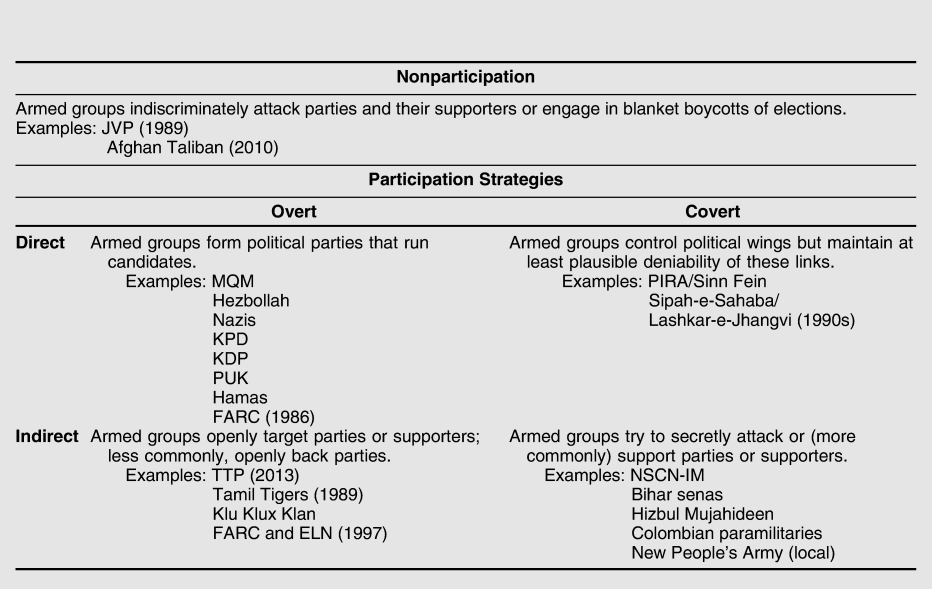
Overt direct strategies. Overt direct strategies are pursued when groups openly run candidates and claim status as a formal political party. Though likely not the most common form of participation, as we theorize later, there are a number of prominent examples of this strategy. The FARC and the Patriotic Union in 1980s Colombia,Footnote 22 Hezbollah in Lebanon,Footnote 23 Hamas in the Palestinian territories in 2006,Footnote 24 the Iron Guard in Romania’s 1931 and 1937 elections,Footnote 25 the two main Kurdish parties in post-2003 Iraq,Footnote 26 Mussolini’s National Fascist Party in early 1920s Italy,Footnote 27 the Pathet Lao/Lao Patriotic Front in 1958 Laos,Footnote 28 and both the Nazis and Communists in 1920s–1930s Germany,Footnote 29 are other examples of this unambiguous combination of electoral and violent politics. Leaders openly, publicly merge armed and unarmed politics together.
Covert direct strategies. Covert direct strategies involve an armed group controlling a formal political party while refusing to publicly acknowledge this organizational fusion. They can even falsely claim that an armed wing is a separate organization from a political wing, intentionally cultivating ambiguity and misinformation about the connection. We suspect this strategy will not be common, and is hard to measure regardless. But there are well known examples of this strategy, including the PIRA and Sinn Fein, which we discuss below. The Basque terrorist group Basque Homeland and Liberty (ETA) and political parties, including Batasuna, in Spain had this relationship. The Sipah-e-Sahaba Pakistan (SSP) and its armed wing, the Lashkar-e-Jhangvi were also closely linked together, yet tried to maintain a degree of public separation in 1990s Pakistani Punjab as the SSP pursued electoral power within Punjab’s party system.Footnote 30
Overt indirect strategies. Overt indirect strategies involve armed groups urging support for a distinct party or directing attacks against a party and its supporters. We argue later that this is most commonly a means of opposing a disliked party or politicians, but in rarer cases it can be a form of support. We have identified a number of cases across a wide range of contexts to demonstrate that this strategy exists. In the 1990s, National Conference (NC) cadres were systematically targeted by Kashmiri militants in an effort to break the pro-Delhi NC’s organizational network. The JVP insurgency in Sri Lanka, as noted earlier, in its early days rhetorically and physically targeted those in the United National Party (UNP) as a way of framing itself as a political force. It avoided, in that period, attacking government security forces, instead focusing on UNP party workers and candidates.Footnote 31 The Ku Klux Klan in the 1920s United States openly opposed (and backed) candidates for American elections.Footnote 32
Covert indirect strategies. Covert indirect strategies involve secretly attacking or (more commonly) supporting mainstream parties and candidates. Unlike overt indirect strategies, we argue that covert indirect strategies are most likely to be used in support of a mainstream party or candidate. Covertness is useful because it can avoid triggering the de-legitimization or legal bans that would accompany overt support for a mainstream party by an illegal armed group. These cases can be very difficult to identify because they are intended to be secret. Nonetheless, we can identify plausible historical examples. For instance, the Tamil Tigers tacitly supported candidates linked to the Eelam Revolutionary Organisation of Students (EROS) in the 1989 Sri Lankan elections, and in the 2001 election it tolerated the Tamil National Alliance (TNA). It has also been alleged that the Hizbul Mujahideen supported the People’s Democratic Party (PDP) in south Kashmir in the 2002 elections.Footnote 33 At the local level, the Communist insurgents of the New People’s Army in the Philippines have sometimes thrown their weight behind particular candidates.Footnote 34 The caste armies of 1990s Bihar in north India “cross[ed] the thin line between illegal political movements and officially organized formal democratic politics,”Footnote 35 murkily backing candidates and parties as a complement to their strategies of violence: “it is common knowledge everywhere in Bihar that that Ranvir Sena operat[ed] as a ‘surrogate political arm’ of many politicians from various political parties.”Footnote 36
Table 2 shows the four forms of armed group electoral involvement, and provides examples within each cell. It is easy to find examples of Overt Direct, Overt Indirect, and Covert Indirect strategies; fewer Covert Direct cases present themselves, but they do exist. This conceptualization helps us understand the remarkably diverse ways in which electoral armed groups can seek to involve themselves in elections; many groups participate in shaping electoral processes and outcomes without actually running candidates.
Typology of electoral strategies

Theorizing Electoral Strategies
We now explore why strategies are chosen. Our empirical strategy for this theory development relies on case studies, from across countries and time, of each type.Footnote 37 This is an exercise in creating theory, not testing it, so we do not presume to be proving causal effects. Indeed, the theory emerged in dialogue with case study research on Colombia, Northern Ireland, India, Sri Lanka, and Pakistan in particular. However, we show that our concepts and variables can be identified and measured across cases, generate theoretical intuitions about armed group participation, and provide a plausibility probe using diverse case illustrations. Future research can more systematically expand on this starting point.
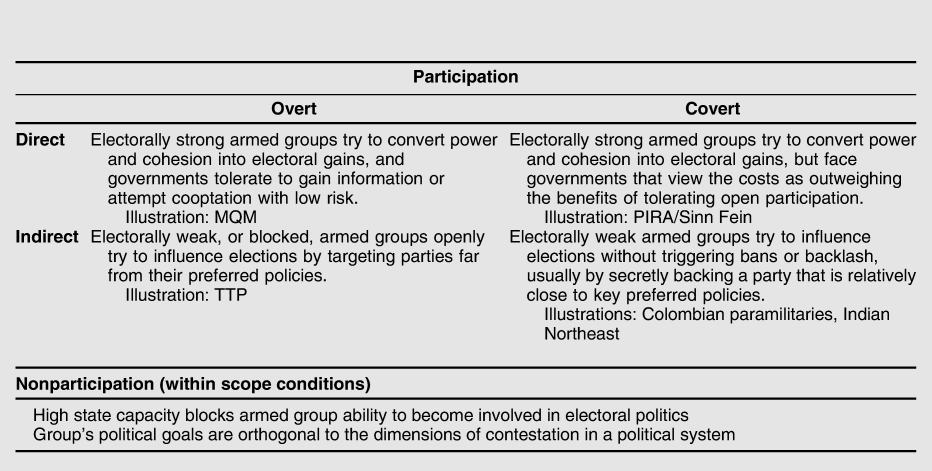
We start with a static world in which an armed group is deciding on an initial strategy, and then explore change over time in a separate section. We argue that three basic variables explain how these strategies play out: group expectations of electoral success relative to military capacity, government willingness to accept overt involvement of the armed group in mainstream politics, and the alignment of political parties with the armed group’s political goals (see Table 3).
Explaining electoral strategies of participation

Explaining Varieties of Direct Participation
We first seek to understand choices among direct participation, and then consider why groups might choose nonparticipation (within our scope conditions). Groups try to determine which strategy best serves their political interests, while facing constraints by the government and the existing party landscape.
We begin with direct electoral strategies. We expect that “strong” groups—those that expect to do at least as well in shaping policy via the ballot box as they are currently faring on the battlefield—will prefer to concurrently run their own candidates and fight. We identify groups that expect to do worse by adding a direct electoral strategy relative to using a purely violent strategy as “weak.”
Strength is a function of organizational cohesion and the existence of a social base that both supports the group and its direct involvement in elections. Many strong groups have networks and formalized institutions that provide detailed information, discipline, and grounding in local societies.Footnote 38 These can make groups confident that they can do well in elections by providing the resources and votes needed to run a successful campaign in which their organizational power is converted into electoral results.
In many cases, groups that expect to secure a sizable share of power running candidates will also be reasonably effective at military operations. But there are some exceptions. For example, a highly violent terrorist group with little civilian base may be better at conducting attacks than recruiting votes. We expect groups that expect to do worse in the polls than in the conflict to not pursue direct strategies, even if they are relatively militarily capable. There are few reasons to pursue direct electoral testing if there is little chance of creating political change within mainstream politics. Moreover, there is also typically a minimal threshold of ballot box strength needed to secure sufficient seats, votes, and influence to shift policy in a desired direction. Groups that have little expected electoral power—whether militarily effective or not—will not have incentives to pursue direct participation. Many groups will therefore shy away from direct involvement because of their low odds of achieving success through this path.
Group expectations of electoral success can encourage direct participation. However, government policy shapes which of these groups are allowed to openly engage in direct participation and which must instead pursue the covert direct trajectory. Governments decide whether to tolerate, or even encourage, armed actors to form their own political parties based on their calculations about whether the government’s interests are better served by having the group inside the political mainstream rather than on the outside.Footnote 39
Overt. Allowing open direct participation can sometimes be beneficial for a government. First, it may provide information to governments about the relative strength of armed groups, including a specific understanding of the group’s supporters, strongholds, and organizational capabilities. This information may provide valuable insights about where to target programs and engage in future military repression. Such information can, for instance, help the government decide whether to seek a power-sharing deal instead of continuing to pursue victory. While simple bargaining theory suggests that fighting may reveal capabilities, such as power and aspects of resolve,Footnote 40 many rebel groups are already asymmetrically weaker than the state, and it is not always clear which groups have the support to keep fighting effectively over time.Footnote 41 Running candidates can therefore reveal valuable new information, creating incentives for governments to sometimes allow this form of electoral involvement.Footnote 42
Second, governments may value open direct involvement as a possible pathway toward some form of cooptation, either leading to demobilization or the group acting as an “intra-systemic” player operating within mainstream politics.Footnote 43 In contemporary Pakistan, for instance, the military is clearly supporting the “mainstreaming” of the Lashkar-e-Taiba’s political front, apparently in an effort to integrate this group into electoral politics.Footnote 44 A government may hope that bringing an armed group into the system will give it incentives to prioritize stability.
Third, contextual factors can drive variation in the perceived threat from this type of participation for the government. For example, if the number of seats that an armed group can win is relatively limited—such as a group seeking territorial control in a small region with few supporters outside that area—the government may be more inclined to allow it to participate in order to better understand its support in that region while not risking radical, unwelcome shifts in the balance of power. Initial evidence is consistent with this intuition, as open direct participation is most commonly found among secessionist rebel and terrorist groups.Footnote 45 Only in contexts with little risk that an armed group could take over the government or drastically shift the balance of power do we expect that the government will tolerate overt participation.
A case of overt direct participation that illustrates this logic is Pakistan’s MQM in Karachi. The MQM’s roots are in the All-Pakistan Mohajir Students Organization (APMSO), which formed in the violent campus politics of the late 1970s.Footnote 46 The dictatorship of Zia-ul-Haq transitioned to controlled elections in 1985. The armed APMSO pursued the electoral path, through the MQM, from 1987, as a way to carve out influence against its local rivals and because the political changes of the 1970s had politicized ethnicity in Sindh.Footnote 47 As a cohesive, disciplined organization drawing on a newly mobilized constituency, the APMSO/MQM could be confident in its ability to generate electoral power.
Zia’s government was open to the new MQM because it provided a useful tool of division in Karachi and mostly avoided unacceptably radical policies, in contrast to Baloch and Bengali insurgent groups in previous decades.Footnote 48 The MQM was careful about how it articulated its political demands, making ethno-linguistic and reformist demands that could operate within mainstream distributive politics, rather than a full-scale push for secession.Footnote 49 Moreover, its reach was relatively limited, as it primarily competed in Karachi and Hyderabad. When the MQM did step over the Pakistan Army’s acceptable “red lines,” military crackdowns followed.Footnote 50 The MQM simultaneously maintained its armed wing – violence was useful for attacking rivals, protecting its members, moving into new territory, building lucrative extortion rackets, and gaining leverage over the government.
Covert. When the government does not foresee sufficient benefits from allowing an armed actor to participate, however, we expect that it will refuse to tolerate overt direct participation. It will then ban or legally target parties and candidates openly and unambiguously controlled by the armed group. Armed groups that expect to do well from direct participation turn to a covert strategy when blocked from overt participation. To be covert, the group simply needs to publicly disavow a connection, even as the group controls the party organization. This claim rests on the distinction between knowledge and acknowledgment:Footnote 51 the latter has greater direct impact on legal repression and public opinion than the former. Acknowledgment can lead to bans and backlash, while even tenuous deniability holds at bay, or at least limits, such reactions.Footnote 52 This is likely to be rare, since it is difficult to simultaneously control a party and disavow it, especially in the face of a skeptical state apparatus. However, we need more empirical research across cases to uncover the actual incidence of the strategy, and we are able to find several important examples.
We expect governments to ban armed groups that they see as threatening to take an unacceptable share of power if allowed to pursue overt involvement. Strong and threatening groups, blocked from overt direct participation, will instead take over existing parties or create party wings that are formally distinct, allowing them to legally and rhetorically distinguish themselves from the actual armed group. Direct control without public acknowledgement is very challenging, requiring a high level of organizational discipline and a leadership skilled at balancing conflicting incentives. The group must, of course, still expect to make electoral gains to make this worthwhile. Formal separation can satisfy laws about armed group involvement in elections and signal a willingness to abide by the rules of the electoral game to the government.Footnote 53
A case that illustrates this covert, direct electoral strategy is the relationship between the PIRA and Sinn Fein in Northern Ireland in the 1980s and 1990s. There is no doubt that the two were in reality formally fused, with key Sinn Fein leaders sitting on the PIRA’s Army Council, but the two publicly denied this linkage. This case suggests possible conditions leading to covert direct participation. The Sinn Fein electoral experiment allowed the group to explore mainstream politics, and the British were willing to let it go forward to assess the group’s support and to evaluate possible cooptation, so long as the link remained deniable.
The PIRA pursued direct participation as it gained confidence in its ability to generate electoral support. In 1980, PIRA leadership instructed members to oppose participation at the Sinn Fein annual convention because, if the party did participate, it might be “humiliated,” which would provide propaganda for the British in the fight against the PIRA.Footnote 54 By 1982, however, Sinn Fein was running candidates in the Assembly election. What changed? The group leadership cites a sudden shift in their perceptions of their social support within the Catholic community, as the hunger strike movement revealed more social support than they had expected.Footnote 55 One of the most popular strikers, Robert “Bobby” Sands, ran in the 1981 by-election for a Westminster seat vacated due to the incumbent’s death, and, when he won, PIRA members proposed an official change to allow participation in elections.Footnote 56 Dáithí Ó Conaill and Gerry Adams, vice-presidents of Sinn Fein and leaders of the PIRA, both endorsed contesting national Assembly elections in 1982.Footnote 57 The proposal passed in 1981, and five Sinn Fein candidates ran in and won elections in the next year, with about 10% of the overall vote and 34% of the Catholic vote.Footnote 58
Why did the government allow Sinn Fein to run? In this case, the British government would have faced problems blocking a party that was not technically an armed group; moreover, there were benefits to toleration for this covert participation similar to those described for overt participation. Most groups linked to political violence in Northern Ireland, including Sinn Fein for a brief time, were blocked at points during the “Troubles.” As Sinn Fein moved toward participation, tolerating it denied its supporters “a mild sense of martyrdom.”Footnote 59 Sands’ win was widely attributed to his personal popularity and not any popularity of the group,Footnote 60 and so, after his win, the government only banned political prisoners as candidates; after Sinn Fein candidates won in 1982, the government limited its gains through media restrictions.Footnote 61 But it remained open to continued electoral participation by Sinn Fein as long as the legal separation from the PIRA continued. The theory, then, matches some of the reasons for tolerance with overt direct participation: reports vary to some extent about Sinn Fein’s electoral support, and Prime Minister Margaret Thatcher reportedly believed that the group’s political wing would enter one election, fail to obtain support, and return to a strategy of solely violence, but, even if they were wrong, the losses would have been limited to seats in just one territory and those losses would provide more information about the group.
Explaining Varieties of Indirect Participation
We expect weak groups, with little expectation of electoral success compared to their fighting capacity, to dominate indirect participation. These organizations lack organizational cohesion, a support base for direct electoral involvement, or both. Some groups may be organizationally cohesive but reliant on a limited popular base (such as highly militaristic groups), while others draw on substantial popular support but are challenged by internal factions that would split or revolt if leaders pursue the electoral path.Footnote 62 Even groups strong on one dimension, but weak on another, will face strong incentives to avoid risking direct involvement for fear of failing at the ballot box or being ruptured by internal dissent.
Weak groups pursue indirect participation in an effort to influence policy choices and tilt the electoral playing field. The effectiveness of indirect participation is likely to be more limited (though often still consequential) than direct participation. Incentives will almost never be perfectly aligned between an armed group and the political party/candidate it supports, and the latter will necessarily perform the campaigning and governing tasks that actually produce desired changes. Armed actors will thus have less control over these processes than with direct participation. Nevertheless, these relationships can still produce real benefits, and create important permeability between electoral and armed politics.Footnote 63 Similarly, targeting of parties and politicians is a very blunt tool with no guarantee of success although it can offer the possibility of creating changes in the outcomes.
The choice of how armed actors will participate indirectly—covert or overt—hinges on the nature of the mainstream parties running in an election (which can also produce nonparticipation, as discussed later). Covert indirect participation is most likely to occur in support of a political party. This support requires a political party that shares some overlapping aims with the armed group. Such a party simply may not exist, especially for more radical organizations. When it does, however, covert support allows an armed actor to provide backing without triggering legal bans or public opinion backlash against the party or dissension within the armed group over electoral involvement. Overt indirect participation, by contrast, tends to occur when an armed group differentially targets a party or set of parties for attacks to undermine them in elections. These are parties seen as most threatening and thus needing to be destroyed or weakened. They are usually either hardline ideological opponents of an armed group or regional parties that advance a peaceful, rival alternative to the armed group’s violence. Overtness does not carry the same risks and costs when it comes to attacking a party as it does to supporting a party. The two indirect strategies are not mutually exclusive, since a group can covertly back one party while overtly attacking another, but they are distinct, and each can occur without the other.
There are some cases in which covert indirect strategies instead oppose a group (murky assassination campaigns, for instance) and overt indirect strategies support a group (right-wing militias’ backing of rightist parties in Weimar Germany), but we expect the general tendencies to map onto the support/opposition distinction. Future research can unpack when cases occur that do not align with this expectation.
Covert. Indirect covert support tends to be used to support parties that are advancing political goals broadly aligned with those of the armed group. Secret backing is intended to help the party succeed in elections and pursue policies that would help the group’s cause. Cadres and money are deployed to help the favored party around elections. For instance, a separatist armed group may secretly back a pro-autonomy party because it believes the party can act as a useful stalking horse within mainstream politics or as one way of testing whether autonomist claims can receive a fair hearing in the mainstream electoral arena. An armed group may also funnel funds to a party that works to overturn extradition or domestic punishment for crimes related to political violence. Covertness is necessary to avoid legal bans and other backlash toward the supported party, as well as to shield the armed group from accusations of betrayal and selling out from within its ranks and support base. This form of participation can be used to pursue a policy goal without causing a loss of face at the polls, legal and public backlash, or internal splintering.
Despite the opacity and ambiguity intrinsic to this strategy, there are cases of indirect covert support that suggest the plausibility of this argument. In Colombia, right-wing paramilitaries have used indirect covert participation at different points in time, reflecting both logics of deniable support for and opposition to “mainstream” candidates/parties. In the late 1990s, right-wing paramilitaries began to conduct systematic campaigns of demobilization and coercion—including “terrorizing voters to vote in particular ways, terrorizing them to stay away from the polls so they could stuff ballots, voting instead of citizens by confiscating their identity cards, terrorizing politicians so that they would not run against their preferred candidates, and manipulating subsequent vote totals electronically”—to assist right-wing parties with which they were aligned.Footnote 64
The ballot stuffing, vote stealing, and vote total manipulations in Colombia were only part of the supportive participation by the paramilitaries seeking to affect elections. Politicians could spend less in these districts, funneling cash transfers instead directly to paramilitaries in some cases, according to detailed data on promises made in local fora by the former president.Footnote 65 In fact, the paramilitaries formalized their policy on such participation, including through discussion at a 2001 meeting, although they kept it secret.Footnote 66 In 2002, new third parties emerged that were linked to these groups, and, eventually in 2009, dozens of politicians were arrested for this activity.Footnote 67
We see similar dynamics in Northeast India. Bhaumik reports that the National Socialist Council of Nagaland-Isak-Muivah (NSCN-IM) supported the Democratic Alliance of Nagaland coalition in 2003 and 2008 state elections: “NSCN guerrillas visited villages, asking Nagas to vote for the DAN coalition or face the consequences.”Footnote 68 In neighboring Manipur, the Governor in 1993 accused “mainstream parties” of being backed by, and linked to, insurgent groups.Footnote 69 There have been accusations of militants’ support for/opposition to mainstream politics in Tripura as well.Footnote 70 While internal discussions by these groups are not available, the strategy makes sense in this context. The Indian government has made it clear that it will aggressively block insurgent groups from forming or even indirectly controlling legal political wings without first disarming. Many civilians and fighters in these conflict zones view electoral politics as a corrupt sham.Footnote 71 Openly embracing parliamentary politics would be a dangerous strategy for many armed groups in the Northeast, opening them to charges of selling out.
Overt. Overt indirect participation, by contrast, tends to be aimed at undermining parties that are seen as serious political threats to the armed group’s interest. By killing and intimidating politicians and supporters, the goal is to weaken a party’s ability to compete electorally. Overtness is more attractive when opposing than supporting because there will be no legal sanction against a party, or public backlash from appalled voters, resulting from an armed group announcing its targeting of a party. Publicity can signal to the group’s supporters to oppose, or even autonomously attack, the targeted party. This strategy may also have the added benefit of potentially coercing preemptive changes that alter the electoral field such as discouraging turnout or encouraging displacement from areas likely to be targeted.Footnote 72
Parties that are seen as hardline ideological opponents of a particular group and regional parties that are loyal to the state are most likely to be targeted in this way by armed groups. These actors may have local support and access to political power that pose a severe threat to the armed group’s policy goals. There may be some cases of overt indirect support for a party, but this is likely only in cases where there would be little legal or public backlash against a party as a result of an armed group openly supporting it.Footnote 73
A classic example of overt indirect participation in an election was the behavior of the Tehrik-i-Taliban Pakistan (TTP) in Pakistan’s 2013 general election. The TTP was a radical anti-systemic party. It was ideologically opposed to elections to begin with, and would not have been allowed to run as an armed political party. The lack of direct electoral participation is no surprise given this combination of structure and agency. Yet the TTP was not indifferent to electoral outcomes, since some rulers and ruling coalitions appeared more likely to seriously resist its aims than others. The TTP vigorously opposed the Awami National Party, the MQM, and the Pakistan People’s Party (PPP).Footnote 74 Each represented an ideological obstacle to its Islamizing agenda. The ANP stood for a Pashtun nationalism; the MQM advanced a strongly anti-TTP, secular agenda in Karachi, a city with a large and growing Pashtun population, and the PPP is traditionally the most leftist and secular of the major parties.Footnote 75 The TTP publicly warned against attending these parties’ rallies and aggressively targeted them.Footnote 76
The TTP, despite its distaste for electoral politics, also sought to shift the electoral balance toward Nawaz Sharif’s Pakistan Muslim League-Nawaz (PML-N) and Imran Khan’s Pakistan Tehreek-e-Insaf, which were largely allowed to operate as usual by the TTP.Footnote 77 While there is a potential dimension of covert indirect participation, in the form of allegations of a possible secret deal between the PML-N and TTP,Footnote 78 the TTP targeting of the ANP, MQM, and PPP’s rallies, workers, and candidates was clear and consistent.Footnote 79 This was a violent campaign trying to tip the electoral balance against particularly dangerous parties, without necessarily actively supporting its mainstream rivals.
Explaining Nonparticipation
Sometimes groups ignore elections or target all electoral actors as part of their campaign against the state. If the elections are expected to be at least somewhat competitive (i.e. occur within our scope conditions), such behavior would be considered nonparticipation. It is essential to empirically distinguish nonparticipation from electoral strategies and to explore why groups might pursue this approach. We focus on discrimination in targeting/support strategy. Direct participation is relatively easy to distinguish from nonparticipation, but indirect strategies can be more difficult. If there is clear evidence that armed actors are trying to differentially allocate their violence or support across mainstream political actors, this is suggestive of an electoral strategy.
Nonparticipation can occur for two broad reasons. First, it may be an involuntary outcome on the part of the group if the state is so strong that it can detect and block any links between an armed actor and a political party. This is possible and may occur in extremely high-capacity contexts, but is difficult to achieve in most of the contexts where we see substantial armed group activity. Footnote 80
Second, armed groups themselves may decide to avoid participation, even if it is a possibility. This is likely when the elections do not involve cleavages that would create a space in the party system for an armed group’s candidates or the political system lacks parties advancing political demands that are relevant to an armed group. If the group’s political goals are orthogonal to the main dimensions of contestation in a political system, there is no reason for a group to directly deploy candidates, indirectly try to influence policy, or tilt the electoral playing field.
This will be most common in two situtations. The first is with highly radical armed groups that have no plausible allies or path forward in mainstream politics. For a group seeking to build a theocracy, undermining the mainstream center-right party, for instance, would only yield a mainstream center-left ruling government equally committed to blocking theocracy. This was the logic of the JVP’s 1989 turn to total war against the entire Sri Lankan political spectrum: there were no truly revolutionary parties in mainstream politics, and so the entire system needed to be overthrown. Al-Qaeda in Iraq/Islamic State (AQI/IS) in Iraq did not try to bolster support for Sunni parties against Shia parties in Iraqi elections because Sunni parties were relatively moderate and unlikely to pursue the overhaul of the system that the group deemed essential to its cause. Instead, it spent many of its resources targeting as many political candidates as it could, from various parties, as part of a purely military strategy.
Similarly, peripheral groups pursuing political causes entirely irrelevant to national political competition have little incentive to try to participate. These groups can, of course, provoke policy changes by the system as a whole, such as an overreaction to an attack that results in the termination of rights and, potentially then, broader uprising—but these are common armed tactics, not participation campaigns.Footnote 81 We expect such groups to boycott, ignore, or indiscriminately target parties and supporters in electoral politics. Even during democratic periods in Thailand, electoral politics in the Deep South did not have any plausible odds of changing national policy or electoral outcomes in Thailand’s highly centralized political system; elections were a tool of cooptation and patronage in the region.Footnote 82 There is no reason to expect insurgents in the Deep South to view involvement in elections as buying them anything, and there is little indication of sustained electoral participation by these groups. Similarly, in West Papua, some pro-independence forces have urged election boycotts and rejected involvement in mainstream politics.Footnote 83
Understanding Change over Time
Groups can change their approach to electoral politics over time. This is a very complicated phenomenon, and here we can only lay the basis for more sophisticated future work.
There are three primary mechanisms that can drive changes, with each based on one of the core variables from the posited theory. First, armed groups can grow more or less optimistic about their expected electoral strength.Footnote 84 Unsuccessful electoral bids, new information from within group networks about lower than expected popularity, and attacks from other actors that undermine electoral campaigning can lead to a retreat from direct participation toward indirect strategies (for example, attacks by paramilitaries on the FARC’s political party in the 1980s in Colombia).Footnote 85 New shocks that produce more electoral success, newly visible pro-election sentiment among a group’s social base, clear shifts in the electorate or civil society toward positions that match the armed group’s aims, and leadership changes can lead toward direct participation (for instance, Bobby Sands’ win, as well as the turnout at other hunger strikers’ funerals, indicated strong support for the PIRA/Sinn Fein). Shifts in institutions and voting rules can lead groups to have a greater shot at representation, or limit their ability to turn their support base into votes. If covert direct participation goes well, there may be incentives for a group to move into a more open strategy, or even potentially to demobilize and embrace electoral politics (as eventually happened in the case of the PIRA/Sinn Fein, although only after 15 years); if it goes poorly, there should be a move into indirect or no participation in the wake of a failed experiment.
Second, changes in government threat perceptions can open or close toleration for different strategies of participation.Footnote 86 This could be due to updated information about the armed group’s intentions and strength, new governments or regimes coming to power with different standards of acceptability, or shifts in public opinion about allowing a group to stand in elections in any way. The politics of government strategy toward armed groups are sometimes quite set—allowing for no tolerance, for example—but other times are fluid. Different political incentives and calculations among ruling elites may open space for overt direct strategies that were previously closed, or force groups to pursue covert direct strategies after previously pursuing overt direct involvement. Israel and Fatah, for instance, found Hamas’ 2006 electoral victory as sufficiently threatening to prevent any Hamas involvement in future elections—to the point of not holding elections.Footnote 87
Third, we can see shifts in the nature of party systems and the ideological positioning of parties. Fluctuation in what parties and candidates stand for will shift how armed groups engage with them. The rise of new party enemies and rivals can lead a group to engage in overt indirect strategies to undermine or destroy them; similarly, sympathetic new candidates may become objects of covert, indirect support to bolster their chances on the electoral playing field. For instance, in India, the rise of the Asom Gana Parishad (AGP) in the mid-1980s was a boost for the United Liberation Front of Asom (ULFA) because the former also advanced separatist goals, and so the ULFA supported the AGP through the 1990s.Footnote 88 The AGP eventually distanced itself from ULFA, however, and the armed group again focused exclusively on insurgent operations.
Future Research and Policy Considerations
Elections are a hugely important means of determining who holds political power—including in contexts of civil war and “armed politics.”Footnote 89 Armed actors are often forced to decide how to deal with the parties, candidates, and electoral processes that determine who will control government policy. Even groups that are ideologically hostile to democracy cannot ignore the stakes of electoral competition, and many see opportunities to advance their interests through mainstream politics. There is a fascinating spectrum of armed group relationships to the electoral arena. This article has conceptualized these strategies and begun to theorize their roots, opening a new research agenda on how democratic practice works in the absence of a state monopoly of violence.
Understanding how armed groups choose electoral strategies has the potential to contribute to several important debates. First, it will help political scientists think more carefully about the links between violence, on the one hand, and regular politics, on the other. Conflict and elections often are not distinct, especially in the contemporary developing world,Footnote 90 but also in advanced industrial democracies.Footnote 91 Recent work suggests that the majority of elections are contentious, and that many involve violence or its threat, producing this institutional co-evolution over time.Footnote 92
Second, studying the blending of violence and voting will advance our thinking about whether these tactics truly are substitutes, and whether groups see them as such.Footnote 93 It could further develop our understanding of how conflict affects democratization, and how democratization affects conflict.Footnote 94
Third, examining elections in this context will contribute to the study of strategies that armed actors use beyond violence. Armed groups can provide public or club goods and engage in local governance,Footnote 95 but they do much more than this. Understanding why groups make electoral choices is important in its own right, and it may also inform their armed campaigns.Footnote 96
There are several important directions for future research. First, we need extensive new empirical research to systematically measure the varieties of armed group involvement in elections. This is a major, and daunting, task because of the subtleties and ambiguities that accompany several of the strategies: indirect and covert strategies are particularly difficult to measure. This approach would build on complementarities between case-specific work and cross-context comparisons.
Second, there are subtleties to electoral strategies that we have not fully explored. Some armed groups may pursue overt involvement as a way of trying to hide their more maximal aims; in turn, governments may strategically try to coopt, expose, or infiltrate these actors by allowing participation. Furthermore, we have identified some cases of change in strategy over time, and the learning and adaptation that accompany these changes deserve further study.
Third, the role of participation and public opinion in driving these dynamics demands further research. While we have mixed evidence on exposure to violence and electoral participation such as voting,Footnote 97 we do not know enough about how citizens form attitudes toward armed groups participating in various ways in elections.Footnote 98 Governments try to evaluate how their constituents feel about armed group electoral participation, shaping their responses, and armed groups do the same.Footnote 99 Unobtrusive survey measures, during and after conflict, may be useful in such studies.Footnote 100 Understanding citizen attitudes about armed group electoral participation is a fascinating area for future work.
Fourth, and perhaps most importantly moving forward, we have not systematically considered the consequences of these strategies. Key issues at stake include how successful armed groups are at achieving their goals, the implications of different strategies for how resources are distributed, who wins elections, and what happens to armed groups after participating. At the broadest level, future work needs to assess the implications for governance and democratic stability of armed groups becoming involved in elections: it leads to cooptation and order in some contexts, but escalating violence and disorder in others.
This article offers several insights into managing militarized electoral contexts. In Afghanistan, Iraq, and Lebanon, for instance, many parties are linked to armed groups, and understanding how this may affect stability in these developing electoral systems is crucial. Strong armed groups have the greatest capacity to undermine political order, but also potentially the strongest incentives to pursue electoral involvement because of the benefits they may be able to reap. Carefully structuring their incentives, and constraints, is essential for managing such organizations. International and domestic pressure can be applied to governments to help shape the response.
Yet it is important to also keep in mind that even overt direct participation is no panacea for producing peace; instead, many groups continue to use violence even while being deeply engaged in electoral politics. Policymakers and analysts should not expect a straightforward path from electoral involvement to demobilization; instead, they should anticipate a continuing blending of ballots and bullets. Understanding the electoral strategies of armed groups can clarify what they are doing, and when and how states should seek to change their incentives.
Elections are a particularly important domain in which we need to move past the standard focus on formal institutions to understand how a variety of actors, including armed groups, try to shape the allocation of power. Precisely because electoral politics can have incredibly high stakes, armed groups have good reasons to become involved in trying to tilt their outcomes toward or away from particular politicians and parties. The boundaries between normal and armed politics are porous, and neither sphere can be properly understood without the other.Footnote 101