


Introduction
Cognitive-behavioural therapy (CBT) has demonstrated efficacy in treating the major anxiety disorder diagnoses (for a meta-analysis see Hofmann and Smits, Reference Hofmann and Smits2008). These treatments have arisen from first specifying a cognitive-behavioural model explaining the maintenance mechanisms and then developing and evaluating diagnosis-specific cognitive-behavioural protocols to address the putative maintaining mechanisms (Clark, Reference Clark2004). Such protocols have been developed with reference to patients fitting the diagnostic criteria of a specific anxiety disorder, rather than for patients with more than one anxiety disorder. This is a significant limitation since 40–80% of patients with an anxiety disorder meet criteria for two or more anxiety disorders (Brown, Campbell, Lehman, Grisham and Mancill, Reference Brown, Campbell, Lehman, Grisham and Mancill2001; Kessler, Chiu, Delmer and Walters, Reference Kessler, Chiu, Delmer and Walters2005). There is evidence to suggest that diagnosis-specific protocols are not being delivered in routine care as frequently or optimally as might be ideal (Baker, McFall and Shoham, Reference Baker, McFall and Shoham2009; Stobie, Taylor, Quigley, Ewing and Salkovskis, Reference Stobie, Taylor, Quigley, Ewing and Salkovskis2007) and clinicians’ attempts to address the high level of co-occurrence amongst disorders may be a partial explanation for this (Shafran et al., Reference Shafran, Clark, Fairburn, Arntz, Barlow and Ehlers2009). Collectively, the results of studies investigating the impact of diagnosis-specific CBT on comorbid anxiety disorders would suggest that approximately half of patients will achieve remission of co-occurring diagnoses following treatment (Norton et al., Reference Norton, Barrera, Mathew, Chamberlain, Szafranski and Reddy2013). This indicates that, despite being beneficial, many patients will continue to present with high levels of co-occurring anxiety disorder symptoms following diagnosis-specific CBT for their primary difficulty. Although a clinically intuitive response to co-occurring anxiety disorders is to administer sequential interventions to address the difficulties concurrently or in turn, findings suggest that adopting this approach may negatively impact upon efficacy as compared to an equivalent duration of a single diagnosis-specific treatments (e.g. Craske et al., Reference Craske, Farchione, Allen, Barrios, Stoyanova and Rose2007).
In response to the limitations of single disorder-specific approaches, researchers have begun exploring transdiagnostic CBT approaches to anxiety disorders that aim to address co-occurring anxiety disorders by identifying and reversing common maintaining mechanisms. The rationale for this approach is lent weight by the fact that many of the cognitive, behavioural and affective processes hypothesized to contribute to the maintenance of anxiety occur across diagnostic categories (Harvey, Watkins, Mansell and Shafran, Reference Harvey, Watkins, Mansell and Shafran2004) and there is evidence to suggest that anxiety disorders may have a common core pathology (Clark and Watson, Reference Clark and Watson1991; Barlow, Allen and Choate, Reference Barlow, Allen and Choate2004). Indeed, if diagnostic categories represent variations in a general syndrome, with common maintaining mechanisms, then treatments addressing the commonalities may demonstrate greater efficiency and effectiveness in treating co-occurring anxiety disorders than diagnosis-specific approaches (McEvoy and Nathan, Reference McEvoy and Nathan2007).
A number of attempts to address multiple co-occurring anxiety disorders are underway; these have reported good clinical outcomes in treating patients’ primary anxiety disorder along with significant reductions in symptoms of secondary anxiety disorders. These approaches include the “unified protocol” developed by Barlow and colleagues (Barlow et al., Reference Barlow, Allen and Choate2004; Farchione et al., Reference Farchione, Fairholme, Ellard, Boisseau, Thompson-Hollands and Carl2012), “transdiagnostic” group CBT protocols (Arch et al., Reference Arch, Ayers, Baker, Almklov, Dean and Craske2013; Norton et al., Reference Norton, Barrera, Mathew, Chamberlain, Szafranski and Reddy2013) and internet-delivered transdiagnostic CBT interventions (Johnston, Titov, Andrews, Dear and Spence, Reference Johnston, Titov, Andrews, Dear and Spence2013). A number of these interventions incorporate the treatment of mood as well as anxiety disorders, with the rationale that mood disorders may share a core pathology with anxiety disorders (Barlow et al., Reference Barlow, Allen and Choate2004) and frequently co-occur (Brown et al., Reference Brown, Campbell, Lehman, Grisham and Mancill2001). However, the commonalities in maintenance processes and shared intervention strategies across diagnosis-specific interventions for anxiety disorders have arguably yet to be established across mood disorders. A limitation of both these approaches is that they do not incorporate the specific interventions developed within evidence-based diagnosis-specific approaches, for example, manipulating self-focused attention in the treatment of social phobia (Clark et al., Reference Clark, Hackmann, McManus, Fennell, Gray and Waddington2006) or identifying and modifying cognitive distortions in trauma memories in the treatment of PTSD (Ehlers et al., Reference Ehlers, Clark, Hackmann, McManus, Fennell and Herbert2003). Ideally, a transdiagnostic approach would address the common maintaining mechanisms across anxiety disorders, whilst also incorporating those specific to a given anxiety disorder. Such an approach should therefore aim to achieve a balance between adopting a standardized approach across patients, whilst ensuring that the intervention remains personalized to the extent where it can address the idiosyncratic presenting difficulties of a given individual (Craske, Reference Craske2012). This approach has been successfully utilized in the treatment of eating disorders (Fairburn, Cooper and Shafran, Reference Fairburn, Cooper and Shafran2003). Within this approach the intervention is guided by a single conceptual model, key transdiagnostic maintenance processes are addressed by core treatment modules, and optional modules are delivered according to individual need.
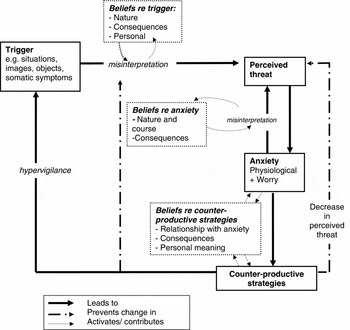
The primary aim of the study was to advance the evidence-base for treating co-occurring anxiety disorders by evaluating a treatment protocol for conceptualizing and treating co-occurring anxiety disorders transdiagnostically, in individuals with two or more anxiety disorders. The treatment protocol (Shafran, McManus, Cooper and Clark, Reference Shafran, McManus, Cooper and Clark2008) was based on a transdiagnostic model of the maintenance of anxiety disorders (McManus and Shafran, Reference McManus, Shafran, Whittington and Grey2014) shown below (see Figure 1). The study aimed to evaluate the efficacy of this transdiagnostic CBT protocol against whether it was effective in:
Transdiagnostic cognitive behavioural model of anxiety disorders

1. Ameliorating anxiety disorder diagnoses (DSM-IV-TR Axis-I disorders; APA, 2000) for patients with co-occurring anxiety disorders.
2. Producing clinically significant and reliable reductions in pathology as measured by standardized measures of anxiety, depression and general functioning.
Method
Design
The study utilized an A-B case-series methodology (Barlow and Hersen, Reference Barlow and Hersen1984) with stability of participant symptoms assessed weekly for a 4-week period prior to beginning treatment.
Participants
Following NHS ethical approval participants were recruited by advertising the study in the local NHS Psychological Therapies service and on the website of a local CBT centre. Inclusion criteria were: (i) meeting DSM-IV-TR criteria for at least two anxiety disorders; (ii) aged 18–70; (iii) fluent in English; (iv) agreement to keep any psychotropic medication at a stable dose for the duration of the study. Exclusion criteria were the presence of: (i) psychotic symptoms; (ii) active risk of suicide or deliberate self-harm; (iii) substance dependence.
Ten people made contact regarding the study and four were excluded for not meeting DSM-IV-TR criteria for at least two anxiety disorders. The remaining six participants were included in the study.
Measures
Diagnoses
The Structured Clinical Interview for DSM-IV Axis I disorders (SCID-I; First, Spitzer, Gibbon and Benjamin, Reference First, Spitzer, Gibbon and Benjamin1997) was administered by an independent assessor, who was not involved in delivering the intervention to establish participant diagnoses. The SCID-I is a structured diagnostic interview with demonstrated reliability (κ = 0.65–0.83, Lobbestael, Leurgans and Arntz, Reference Lobbestael, Leurgans and Arntz2011) for anxiety disorder diagnoses. The reliability of diagnostic assessment was established by a second independent assessor re-rating a random selection of 50% of assessment sessions, with 100% agreement on diagnoses. Assessors also rated the distress and interference caused by the anxiety disorders on a scale from 0 = Not at all to 10 = Extremely. Reliability of ratings between assessors was calculated using Intra-class Correlation Coefficients (two-way random-effects with absolute agreement on single measures) and was ICC = .98 p < .001, for both distress and interference ratings.
General measures
Standard measures were selected based on their use within the evaluation of diagnosis-specific and transdiagnostic CBT interventions (e.g. Clark et al., Reference Clark, Hackmann, McManus, Fennell, Gray and Waddington2006; Farchione et al., Reference Farchione, Fairholme, Ellard, Boisseau, Thompson-Hollands and Carl2012) and their use within NHS outpatient settings. The measures, which all have good psychometric properties, were: The Beck Anxiety Inventory (BAI; Beck, Epstein, Brown and Steer, Reference Beck, Epstein, Brown and Steer1988), The Beck Depression Inventory (BDIII; Beck, Steer and Brown, Reference Beck, Steer and Brown1996), The Clinical Outcomes in Routine Evaluation– Outcome Measure (COREOM: Evans et al., Reference Evans, Mellor-Clark, Margison, Barkham, Audin and Connel2000).
Diagnosis-specific measures
In addition to the above general measures, standard diagnosis-specific measures were used to assess the severity of symptoms for each of the specific anxiety disorders. Each of the measures has good psychometric properties and has been used to assess symptomatic change across treatment for each relevant disorder. These were: a) The Obsessive-compulsive Inventory- Revised (OCI-R; Foa et al., Reference Foa, Huppert, Leiberg, Langner, Kichic and Hajcak2002); b) The Social Phobia and Anxiety Inventory (SPAI; Turner, Biedel, Dancu and Stanley, Reference Turner, Beidel, Dancu and Stanley1989); c) The Panic Disorder Severity Scale-Self-report (PDSS-SR; Houck, Spiegel, Shear and Rucci, Reference Houck, Spiegel, Shear and Rucci2002); d) The Penn State Worry Questionnaire (PSWQ; Meyer, Miller, Metzger and Borkovec, Reference Meyer, Miller, Metzger and Borkovec1990).
Assessment schedule and procedure
The assessment schedule had six phases:
1. Pre-baseline assessment;
2. Weekly completion of self-report measures during a 4-week no-treatment baseline period;
3. Post-baseline/preintervention assessment;
4. Completion of self-report assessments at each treatment session;
5. Postintervention assessment;
6. 3-month follow-up assessment.
Treatment overview
All treatment sessions were delivered in an individual format by the second author (GC) with close supervision from the first and last authors (FM and RS). For an in-depth discussion of the treatment protocol see McManus and Shafran (Reference McManus, Shafran, Whittington and Grey2014). The intervention components comprised of core and optional modules that were based on current empirically validated cognitive-behavioural theory and treatment protocols (e.g. NICE, 2011, 2013). All interventions involved the utilization of core modules that were designed to address common processes across anxiety disorders (Harvey et al., Reference Harvey, Watkins, Mansell and Shafran2004) and common components across evidence-based diagnosis-specific approaches. Specifically, core modules focus on the conceptual links between the patient's anxiety disorders and the commonalities between diagnosis-specific approaches to anxiety disorders (e.g. misinterpretations of anxiety sensations as dangerous, the use of safety seeking behaviours to manage threat) and include: individualized transdiagnostic formulation; psychoeducation and information gathering to normalize symptoms; addressing avoidance and counter-productive safety strategies; addressing misinterpretations of danger (using verbal and behavioural techniques); modifying cognitive biases; and relapse-prevention planning. Optional modules were also employed selectively according to the nature of the difficulties identified within the individual's formulation. Optional modules address processes considered diagnosis-specific or idiosyncratic and include: attenuating low self-esteem; problem-solving; addressing self-focused attention; addressing intrusive memories; and addressing meta-cognitive beliefs. The intervention is distinct from other transdiagnostic approaches such as those of Barlow as (i) it focuses exclusively on the maintenance of anxiety disorders, (ii) it has optional modules as well as core modules, (iii) it does not have a specific emphasis on interoceptive and situation-based emotion focused exposure or on increasing present-focused emotion awareness.
Participants began treatment at different time points over the course of 3 months. The intervention was intended to be delivered over 12 one-hour treatment sessions according to the following schedule: the first six sessions were twice a week, the following four sessions weekly, and the last two sessions fortnightly, creating a 12-session, 11-week intervention. However, the protocol was designed to meet the idiosyncratic needs of the individual patient and so allowed extra sessions if any aspect of the patient's presenting diagnoses was not fully addressed within 12-sessions. Similarly, if it was not possible to schedule sessions according to the planned 11-week schedule (due to participants’ availability to attend sessions), then treatment duration was extended. The schedule of sessions reflects the structure and length of existing evidence-based diagnosis-specific treatments.
Data analysis
A number of approaches have been suggested for identifying observable and clinically meaningful effects within single case research (Borckardt et al., Reference Borckardt, Nash, Murphy, Moore, Shaw and O’Neil2008). This study utilized two of the most widely reported methods, the assessment of the graphical display of change over time (Parsonson and Baer, Reference Parsonson, Baer, Kratochwill and Levin1992), and the more conservative method of identification of statistically reliable and clinically significant change (Jacobson and Truax, Reference Jacobson and Truax1991). Pairing these methods allows the evaluation of whether observed changes are clinically meaningful and establishing whether significant change can be attributed to the intervention or to a general trend in participant scores. Whether each participant achieved reliable change was assessed by calculating a reliable change index (RCI) and clinically significant change (CSC) cut-off for each measure (Evans, Margison and Barkham, Reference Evans, Margison and Barkham1998). CSC cut-off points were calculated under criterion C (Evans et al., Reference Evans, Margison and Barkham1998), which reflects the minimum movement away from the clinical mean and towards the mean of a non-clinical population to be confident of a clinically significant change – i.e. where criterion C falls midway between the two population means. For measures that were completed by four or more participants (BAI, BDI, CORE, SPAI-SP, PSWQ) clinical means and SDs from the current study were used to calculate the RCI and CSC criterion, with published clinical means utilized to calculate these criterion for the remaining questionnaires (PDSS-SR, OCI-R).
Results
Participant characteristics
Six Caucasian participants (four female) participated in the case series. All participants reported the onset of their anxiety difficulties to be more than 5 years previously, indicating that their difficulties were long-standing and unlikely to be subject to spontaneous remission (Bruce et al., Reference Bruce, Yonkers, Otto, Eisen, Weisberg and Pagano2005). Participants’ mean age was 34.33 years (SD = 5.72, range 26–41). All participants were married apart from P6. All participants had been educated to degree level and all were employed apart from P2 who was a student and P5 who was unemployed. At the preintervention assessment participants met criteria for a mean of 3.17 (SD = 0.98) DSM-IV-TR Axis I diagnoses, the details of which can be seen in Table 1. None had previously received CBT, but three (P2, P3, P4) had received a previous psychological intervention (counseling or Jungian psychoanalysis) that had not focused on their anxiety disorders. Participants three and four were already taking antidepressant medication prior to joining the trial (Sertraline 100mg and Fluoxetine 20mg respectively) and remained on this dose throughout their participation in the study. One participant (P2) discontinued treatment after six sessions, citing relationship difficulties and work commitments as the reason for being unable to schedule further appointments.
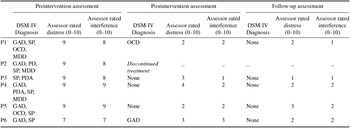
Participants’ DSM-IV Axis I diagnoses at preintervention, postintervention and 3-month follow-up

Notes: GAD = generalized anxiety disorder; OCD = obsessive-compulsive disorder; SP = social phobia; PD = panic disorder without agoraphobia; PDA = panic disorder with agoraphobia; MDD = major depressive disorder; (-) = data not collected
Stability of pre-treatment baseline
There were no changes in participants’ diagnoses, as assessed by the SCID, across the 4-week baseline period. Similarly, Wilcoxen tests comparing scores from the beginning and end of the baseline period showed no significant change on the BAI Z = −0.21, p = .83, BDI Z = −0.31, p = .75 or CORE Z = −0.52, p = .60 across all participants (N = 6).
Postintervention outcomes
Change in diagnoses
Table 1 shows participants’ diagnoses, and the distress and interference ratings at preintervention, postintervention and follow-up assessments. For participants who completed treatment (n = 5) the mean number of diagnoses reduced from 3.00 (SD = 1.00) at the preintervention assessment to 0.40 (SD = 0.55) at the postintervention assessment and by the 3-month follow-up assessment no participants met criteria for any diagnosis. For participants who completed treatment, there were also significant reductions in the preintervention and follow-up assessor ratings of “distress” (means [SD] 8.60 [0.89] vs. 2.8 [0.83] z = -2.03, p = 0.04) and “interference” (means [SD] 8.20 [0.84] vs. 2.0 [0.72] z = -2.12, p = 0.03).
Changes in standardized measures of anxiety, depression and general functioning
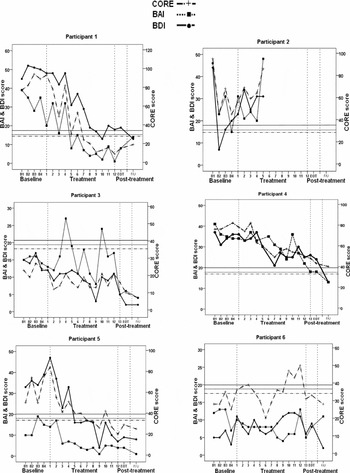
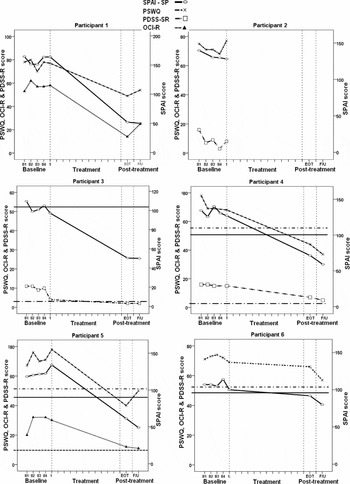
Visual analysis
Participants’ baseline, pre- and postintervention, and follow-up scores are shown graphically in Figures 2 and 3. All participants for whom there are postintervention data displayed generally stable baselines across global and diagnosis-specific measures. Four of these five participants (P1, P3, P4, P5) show a pattern of decreasing scores on general and diagnosis specific measures across treatment, with gains being maintained or improved upon at follow-up. The fifth treatment completing participant, P6, shows less clear decreases in general or diagnosis-specific measures, despite no longer meeting criteria for any diagnosis by follow-up. This may be partially explained by the fact that his preintervention questionnaire scores would be considered of relatively low clinical severity, making it harder to detect change. P2 (who did not complete treatment) demonstrated base-line decreases and postbaseline increases in symptoms prior to drop-out. She attributed this change in symptoms to temporary relief from increasing situational pressures (described above) that ultimately led to her discontinuing treatment.
Participants’ scores on BAI, BDI & CORE during baseline, intervention and follow-up Notes: The horizontal lines represent the clinical cut-off scores. Scores on the CORE questionnaire are represented on the right-hand Y-Axis.B1-B4 = Baseline measurement 1–4; EOT = End of treatment assessment; F/U = Follow-up assessment; BAI = Beck Anxiety Inventory; BDI = Beck Depression Inventory; CORE = The Clinical Outcomes in Routine Evaluation– Outcome Measure

Participants’ scores on diagnosis-specific measure during baseline, intervention and at follow-up Notes: The horizontal lines represent the clinical cut-off scores. Scores on the SPAI questionnaire are represented on the right-hand Y-Axis. B1-B4 = Baseline measurement 1–4; EOT = End of treatment assessment; F/U = Follow-up assessment. SPAI = Social Phobia and Anxiety Inventory; PSWQ = Penn State Worry Questionnaire; PDSS-SR = Panic Disorder Severity Index; OCI = Obsessive Compulsive Inventory.

Clinically significant change (CSC) and reliable change (RC)
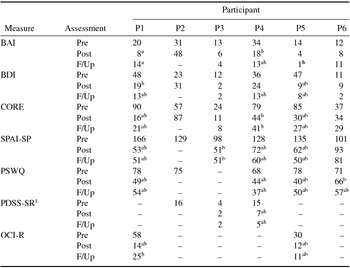
Individual participants’ scores on self-report measures at the preintervention (i.e. postbaseline), postintervention and follow-up assessments can be seen in Table 2. P1 achieved CSC and RC on the BDI, CORE, SPAI-SP and PSWQ by follow-up. P1 also achieved CSC on the BAI and CSC and RC on the OCR-R at the postintervention assessment but slipped back slightly on this measure at follow-up so no longer met criteria for CSC. P2 demonstrated RC and CSC during the baseline period only for her scores to return to prebaseline levels prior to drop-out. P3 scored below the CSC cut-off at preassessment so could not meet CSC criteria for any measure. However, P3 did show RC on the SPAI-SP at postintervention and follow-up and scores on all measures were reduced to non-clinical levels. P4 showed RC and CSC on the BAI, BDI, SPAI-SP, PSWQ and PDSS-SR at follow-up and RC on the CORE (missing the criteria for CSC on this measure by less than one point). P5 achieved RC and CSC on the BDI, CORE, SPAI-SP, PSWQ and OCI-R at postintervention and follow-up assessments, and RC on the BAI at follow-up. P6 scored below the cut-off for CSC all but one (PSWQ) measure at the preintervention assessment so could not achieve CSC on most measures, but P6 did achieve RC and CSC on the PSWQ by follow-up, and scores on other measures were reduced.
Participants’ self-report questionnaire scores at preintervention, postintervention and follow-up with clinically significant change (Criterion C)1 and reliable change

aClinically significant change; b Reliable change
1 Clinically significant change is only noted for those participants that scored above the cut-off for Criterion C at pre-intervention
BAI = Beck Anxiety Inventory; BDI = Beck Depression Inventory-II; CORE = Clinical Outcomes in Routine Evaluation- Outcome Measure; SPAI-SP = Social Phobia and Anxiety Inventory – Social Phobia subscale;PSWQ = Penn State Worry Questionnaire; PDSS-SR = Panic Disorder Severity Scale – Self-report;OCI-R = Obsessive-compulsive Inventory – Revised
Discussion
This study describes a preliminary investigation of a transdiagnostic CBT approach to co-occurring anxiety disorders, using a single-case experimental design. Six participants, with a range of anxiety disorder diagnoses and severities participated, five of whom completed treatment. The intervention was effective in ameliorating participants’ diagnoses, and in significantly reducing the distress and impairment associated with the anxiety disorder diagnoses, for the five participants that completed treatment. In addition, scores on a range of global and diagnosis-specific self-report measures were reduced following the intervention. Consistent with trials of diagnosis-specific CBT treatment for anxiety (Hofmann and Smits, Reference Hofmann and Smits2008) treatment gains were largely maintained at 3-month follow-up. In contrast to the general pattern of positive response to the treatment, it is worth noting that one participant (P2) discontinued treatment after receiving no benefit.
Spontaneous recovery from GAD, social phobia, panic disorder and OCD would not be predicted by epidemiological research (Bruce et al., Reference Bruce, Yonkers, Otto, Eisen, Weisberg and Pagano2005), nor by the fact that the participants’ difficulties had been present for a number of years prior to participating in this study, or by their demonstrating little change across the 4-week baseline period. Additionally, it is interesting to note that participants showed significant improvements in depression, with three participants achieving reliable and clinically significant change on the BDI (P1, P4, P5), and no longer meeting criteria for Major Depressive Disorder at postintervention or follow-up. It is notable that this intervention for anxiety disorders also works for MDD, a finding shared with disorder-specific treatments for anxiety that result in significant improvement in depression (e.g. Clark et al., Reference Clark, Hackmann, McManus, Fennell, Gray and Waddington2006). There are a number of possible explanations for this outcome: the treatment may be targeting shared maintaining mechanisms, there may be a generalization of skills, or the depression may have been secondary to participants’ anxiety (i.e. associated with the functional impairment caused by anxiety symptoms). Whilst it has been argued that there is a common core pathology amongst anxiety and mood disorders (e.g. Craske [Reference Craske2012]; Barlow et al., [Reference Barlow, Allen and Choate2004]) the transdiagnostic model and protocol was developed to understand and reverse those maintenance processes involved in the perception of threat. An area for future research may be whether the impact on co-occurring mood disorders can be better understood and whether the transdiagnostic protocol can be updated to be able to address such presentations.
The findings must be interpreted within the study's limitations. The generalizability of the findings is limited by the small sample and the lack of a control group. The nature of the A-B case series methodology means that treatment effects may be attributable to non-specific factors (e.g. impact of assessment procedure, non-specific therapeutic effects) and cannot necessarily be ascribed to the purported active-ingredients of treatment (Barlow and Hersen, Reference Barlow and Hersen1984). Similarly, lack of data regarding the timing and content of previous psychological intervention that participants had received means that the potential impact of this on treatment outcome is unknown. The lack of a comparison to an alternative evidence-based intervention means that it cannot be determined what benefit the transdiagnostic model and protocol created, over and above generic or diagnosis-specific CBT interventions. Additionally, whilst the assessments and reliability checks were carried out by individuals who were not involved in the delivery or supervision of the intervention, it was not possible to blind the assessors to the stage of assessment. Consequently, the possibility of overestimating treatment effects exists. A further consideration in interpreting the results is that the general symptom measures utilized (e.g. BAI) may not equitably detect change across anxiety disorder diagnoses (Cox, Cohen, Direnfeld and Swinson, Reference Cox, Cohen, Direnfeld and Swinson1996). Finally, the treatment being delivered by only one therapist also limits generalizability. However, the fact that the intervention was carried out by a relatively inexperienced therapist, with patients from NHS referral pathways, suggests that the protocol may be able to generalize to outpatient clinical settings and be disseminated to relatively novice clinicians.
Collectively the results provide a provisional indication that the transdiagnostic CBT intervention can successfully treat co-occurring anxiety disorders, bringing about significant symptomatic change as well as effecting change in diagnostic status, with treatment gains being maintained or improved upon in the 3 months following treatment. Thus the results of this study provide provisional validation of a transdiagnostic CBT protocol for treating co-occurring anxiety disorder.
Acknowledgments
Gavin Clark completed the research as partial fulfillment of the requirements for his Doctorate in Clinical Psychology at the University of Oxford whilst employed by Oxford Health NHS Foundation Trust. The authors are grateful to Dr Michele Lee for assisting with the assessment of participants and for the helpful comments of the reviewers of the manuscript.



Comments
No Comments have been published for this article.