The elk, Cervus canadensis (Erxleben) (Artiodactyla: Cervidae), is the second largest species of deer in North America. An estimated 1.18–1.22 million individual elk are currently distributed across North America (Kohl et al. Reference Kohl, Cleveland, Ellis, Halseth, Merkle, Proffitt, McNew, Dahlgren and Beck2023). In Canada, approximately 84 000 of the species range from Ontario to British Columbia and as far north as the Yukon, which represents the northern extent of their continental range (Government of Yukon 2016; Kohl et al. Reference Kohl, Cleveland, Ellis, Halseth, Merkle, Proffitt, McNew, Dahlgren and Beck2023).
Ectoparasites such as biting lice, mites, and ticks are regularly reported on elk in North America (Hopkins Reference Hopkins1960; Worley Reference Worley, Boyce and Hayden-Wing1979; Kistner Reference Kistner, Thomas and Toweill1982; Leo et al. Reference Leo, Samuel, Pybus and Sperling2014). Among the sucking lice known to infest elk, Solenopotes ferrisi (Fahrenholz) (Psocodea: Linognathidae) was reported in Wyoming, United States of America (Samuel et al. Reference Samuel, Welch and Smith1991), and Alberta, Canada (Spencer Reference Spencer1966). Specimens of Solenopotes burmeisteri (Fahrenholz) (Psocodea: Linognathidae) found on a young elk in Colorado, United States of America, in 1981 are archived at the Frost Entomological Museum, Pennsylvania State University (University Park, Pennsylvania, United States of America; Frost Entomological Museum 2025). Solenopotes burmeisteri is unlikely to have serious effects on the health of the host, but infestations may cause skin irritation (Charleston Reference Charleston1980).
In the Yukon, hides from elk and other wild ungulates that have been harvested or otherwise found dead are submitted to the Animal Health Unit (Department of Environment, Government of Yukon, Whitehorse, Yukon) for examination for the presence of winter ticks, Dermacentor albipictus (Packard) (Ixodida: Ixodidae). This examination also permits the detection of other ectoparasites of interest, such as the recent first report in the Yukon of Tricholipeurus lipeuroides (Mégnin) (Psocodea: Trichodectidae) infesting mule deer, Odocoileus hemionus (Artiodactyla: Cervidae) (Henaff et al. Reference Henaff, Galloway, Chenery and Harms2024). Here, we provide the first report of the louse, S. burmeisteri, on elk in Canada.
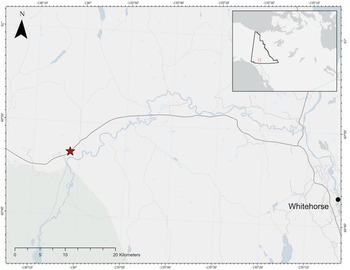
An adult female elk was killed in a collision with a vehicle on 24 February 2024 on the Alaska Highway, the main road crossing the Yukon Territory (60.78048° N, 136.03328° W; Fig. 1). Due to the damage caused to the hide during the collision, the whole hide could not be collected. An approximately 20-cm × 20-cm piece of hide from an unspecified area of the body was submitted to the Animal Health Unit on 26 February 2024. The piece of hide was kept chilled before examination and was examined on 27 February 2024. We used a standard line transect method for surveying ectoparasites on hides (Sine et al. Reference Sine, Morris and Knupp2009), as described by Chenery et al. (Reference Chenery, Henaff, Magnusson, Harms, Mandrak and Molnár2022), with the following modifications: the hide piece was laid on a flat surface, and ticks were counted along seven transects spaced approximately 2.5 cm apart and extending the length of the hide piece.
Location of the elk–vehicle collision (red star) where the piece of hide infested with Solenopotes burmeisteri was collected in February 2024. The inset map shows the where the larger map with its segment of the Alaska Highway is located within the Yukon Territory, Canada.

During the examination, one nymph of the winter tick, D. albipictus, was observed. In addition to the tick, 12 unidentified lice were found and placed in 70% ethanol. The lice were subsequently identified as S. burmeisteri, based on descriptions and figures in Kim and Weisser (Reference Kim and Weisser1974) and Palma (Reference Palma2017, figs. 200 and 201) and on morphological characteristics of the lice, including the thoracic sternal plate being more than twice as long as wide and long, and the abdomen being elliptically shaped and more than twice the length of the head and thorax. Perhaps the most immediately obvious character is the small number of setae on the abdomen. Combined, these characters are consistent with descriptions of S. burmeisteri. The lice were processed and mounted on six slides (2♂; 9♀; 1 nymph; see Richards Reference Richards1964). Three slides (1♂; 4♀; 1 nymph) were deposited in the J.B. Wallis/R.E. Roughley Museum of Entomology (Department of Entomology, University of Manitoba, Winnipeg, Manitoba, Canada), and three slides (1♂; 5♀) were deposited in the Animal Health Unit of the Department of Environment, Government of Yukon (Whitehorse).
Sucking lice are often specific to their host and infest only one or a limited range of closely related hosts (Charleston Reference Charleston1980). Solenopotes burmeisteri has previously been observed infesting red deer, Cervus elaphus Linnaeus (Artiodactyla: Cervidae), in Switzerland (Bouvier Reference Bouvier1956), Holland (van den Broek and Jansen Reference van den Broek and Jansen1964), the former Czechoslovakia (Smetana Reference Smetana1965), Germany (Kim and Weisser Reference Kim and Weisser1974), Poland (Kadulski Reference Kadulski1975), the United Kingdom (Thompson Reference Thompson1976), France (Degeilh et al. Reference Degeilh, Doby and Beaucournu1994), Norway (Handeland et al. Reference Handeland, Qviller, Vikøren, Viljugrein, Lillehaug and Davidson2013), and New Zealand (Andrews Reference Andrews1964; Charleston Reference Charleston1980). Sika deer, Cervus nippon Temminck (Artiodactyla: Cervidae), have also been reported as a host for this parasite in Switzerland (Bouvier Reference Bouvier1956), the former Czechoslovakia (Smetana Reference Smetana1965), Poland (Kadulski Reference Kadulski1975), and the United Kingdom (Thompson Reference Thompson1976). Palma (Reference Palma2017) reported an example of possible host-switching from red deer to northern white-tailed deer, Odocoileus virginianus (Zimmermann) (Artiodactyla: Cervidae), in New Zealand. Roe deer, Capreolus capreolus (Linnaeus) (Artiodactyla: Cervidae), have been identified as a potential host in Croatia (Richter Reference Richter1959) and the former Czechoslovakia (Smetana Reference Smetana1965), but those reports have not been confirmed.
Despite the wide distribution of S. burmeisteri on red deer in Europe and New Zealand, the only previous indication of its presence in North America is a specimen deposited in the Frost Entomological Museum, Pennsylvania State University, collected from a young elk in Colorado, United States of America, in 1981, as determined by K.C. Kim (Frost Entomological Museum 2025). Consequently, the Yukon record is, to our knowledge, the first of this parasite in Canada on any cervid species.
Elk were widely distributed across North America thousands of years ago, including in the Yukon, where they were present at the end of the Pleistocene but extirpated approximately 1500 years ago (Guthrie Reference Guthrie1966). The elk population in the territory today is the result of intentional reintroduction, which ultimately gave rise to relatively distinct herds in the Takhini Valley and Braeburn areas. Small numbers of elk are also occasionally observed in southeastern Yukon, where expanding populations in British Columbia are likely extending their range northwards. The Takhini Valley herd currently comprises approximately 200 individuals, and the Braeburn herd numbers approximately 60 individuals (Government of Yukon 2016). Given the location of the collision, the individual found infested with lice was likely from the Takhini Valley herd. This herd is composed of descendants of individuals relocated from Elk Island National Park, Alberta, Canada, and from Yukon game farms, which, beginning in the early 1980s, occasionally imported breeding and slaughter stock from ranches and farms in southern Canada and the United States of America (Leo et al. Reference Leo, Samuel, Pybus and Sperling2014; Government of Yukon 2016; Robert Florkiewicz, personal communication). It is unlikely that these lice were transferred from another species to the elk locally. Ancestors of the lice found on the hide may have arrived in the territory on elk translocated to the Yukon during or sometime after their initial reintroduction in 1951, and the species of louse may have been present but undetected in the Yukon for decades. This should be no surprise, given the findings of Mertins et al. (Reference Mertins, Mortenson, Bernatowicz and Briggs Hall2011), who found a widespread, but previously undetected, distribution of the chewing louse, Bovicola tibialis (Piaget) (Psocodea: Trichodectidae), infesting cervids other than its primary host, the introduced European fallow deer, Dama dama (Linnaeus) (Artiodactyla: Cervidae). However, Mertins et al. (Reference Mertins, Mortenson, Bernatowicz and Briggs Hall2011) concluded that records on cervids other than fallow deer could be traced to direct or likely contact with the primary host. A widespread survey of ectoparasites on elk in other regions of North America may yield similar results for S. burmeisteri.
No louse-associated clinical signs were reported for the animal described here. Since the identification of S. burmeisteri, 13 elk hides have been examined, and no additional sucking lice have been found. As ectoparasite surveillance on ungulates continues in the Yukon, any other species of parasitic lice will be further investigated and identified. We anticipate the potential occurrence of Solenopotes ferrisi (Fahrenholz) (Psocodea: Linognathidae) (Durden and Musser Reference Durden and Musser1994) and perhaps Bovicola concavifrons (Hopkins) and Bovicola longicornis (Nitzsch) (Psocodea: Trichodectidae) (Price et al. Reference Price, Hellenthal, Palma, Price, Hellenthal, Palma, Johnson and Clayton2003).
Acknowledgements
T.D.G. thanks the Department of Entomology and the Faculty of Agricultural and Food Sciences at the University of Manitoba, Winnipeg, Manitoba, Canada, for their continued support. The authors thank Laura D. Porturas for making records of S. burmeisteri available from the Frost Entomological Museum, Department of Entomology, Pennsylvania State University, University Park, Pennsylvania, United States of America, and Robert Florkiewicz for generously providing additional historical context and background information.
Competing interests
The authors declare there are no competing interests in the publication of this article.