Introduction
Scholarly interest in real wages in the past has recently revived, due in large part to the research agenda established by Jean-Luiten van Zanden and Robert Allen.Footnote 1 This trend has been reinforced by significant contributions from a number of scholars.Footnote 2 Curiously enough, however, Spanish America does not yet have a presence in this literature that accords with its historical relevance either in the global picture of real wages or in the ‘Great Divergence’ debate.Footnote 3 Hence, the main goal of this paper is to contribute to the opening of the ‘black box’ represented by living standards in Bourbon America. We thus study wages over the eighteenth and early nineteenth centuries.Footnote 4
Our interest in analysing labourers’ living standards also responds to the influential ideas of Stanley Engerman and Kenneth Sokoloff, and Daron Acemoğlu et al.Footnote 5 They jointly offer an image of early modern Latin America's institutional framework as based on ‘extractive’ institutions intended ‘to force the local population to work in mines and plantations’, and resulting in extreme ‘inequality in wealth and human capital [that] came to characterize much of Spanish America’.Footnote 6 ‘Extractive’ institutions and high inequality would be detrimental for economic growth and therefore explain the ‘reversal of fortune’ and the ‘divergent paths of development’ that divided the destiny of the former European colonies in America into basically two groups: the United States and Canada versus the rest.Footnote 7
Studying the living standards of commoners in Bourbon America proves to be an appropriate test for these neo-institutional hypotheses. One of the goals of this paper consists of assessing the consistency between the available empirical evidence and the pessimistic inferences about living standards which are logically derived from a view based on the notions of intense labour extraction and extreme inequality.
Mainstream views on living standards in Bourbon America tend to underestimate the importance of wage labour. Lyman Johnson's words are interesting in this respect: ‘Little attention has been paid to wage labor in the history of colonial Spanish America. Yet across the empire, wage labor was increasingly important in urban manufacturing and the service sector and in mining from the mid seventeenth century.’Footnote 8
This lack of attention is most surprising with regard to mining, since it was a leading economic activity in the principal territories of the Spanish monarchy in America (in the Andes and New Spain) and was dominated by forced labour much less than is commonly assumed.Footnote 9 It is also probably not generally recognised that Spanish America was a relatively urbanised region by the international standards of the pre-industrial era, especially in those areas that played central roles in the empire politically or economically. Cities were, in the words of Susan Socolow and Lyman Johnson, ‘clearly a pivotal factor in the development of colonial Latin America’.Footnote 10 By 1800, according to Paul Bairoch, ‘it was the most urbanised continent’.Footnote 11
Wage labour was also present, more commonly than is generally supposed, in rural areas.Footnote 12 A labour market appeared soon after the conquest.Footnote 13 Even those authors that emphasise the extension over time and space of varied forms of coerced labour (encomienda, repartimiento, mita and debt peonage) acknowledge their coexistence with wage labour and its increasing role as an effective means for recruiting workers.Footnote 14 Moreover, the payment of wages was so widespread in Spanish America after the second half of the sixteenth century as to become an inseparable part of most forms of coerced labour, whether by law or by everyday practice. Wages were used by some employers ‘to lure indigenous workers away from the employers to whom they had been assigned by repartimiento’.Footnote 15 Around 1800, wage labour was important even in plantation zones,Footnote 16 and was probably dominant in the Spanish American economy as a whole as a result of a long evolutionary process leading from bondage to market forces.Footnote 17
It is very often forgotten that markets for factors – land, labour and capital – appeared in America precisely after 1492, since they were non-existent in pre-Columbian economies. Certainly, ‘extractive institutions’ did exist in Bourbon America, but they were neither ubiquitous nor permanent in the centuries between conquest and independence. On the contrary, they always functioned alongside, and interacted with, genuine ‘institutions of private property’, not to mention those of communitarian character.Footnote 18 While the ‘private property’ institutions – in other words, labour markets – expanded increasingly across time and space in Spanish America, those of extractive nature tended to contract and even to disappear, if unevenly. In other words, persistence did not prevent the early nineteenth-century institutional framework from being significantly different from that of the late sixteenth century. Thus, wages also matter for a proper understanding of the economic history of this region of the world.
An important novelty of our approach to living standards is that it consists of studying not only wages but also heights. This biological measure of welfare has gained acceptance among social scientists over recent decades. Nonetheless, evidence on the eighteenth and early nineteenth centuries is scarce for Spanish America.Footnote 19 Thus it is clearly necessary to widen our knowledge on the levels and the trends in height in pre-independence Spanish America and, by doing so, to fill a gap in information compared with other parts of the world. To do this, we have built a relatively large database of heights.
When the black box of both economic and biological living standards is opened, even if partially, it turns out that wages (nominal or real) were not so low and heights were not so short as to support the pessimistic view embodied in the neo-institutional literature. A first ‘optimistic’ revision of mainstream views on economic and biological welfare in Bourbon America appeared in our earlier work.Footnote 20 However, Allen at al. later argued that ‘the Latin American colonies [were] among the least developed countries’.Footnote 21 This difference in views responds mainly to the distinct methodological approach chosen by these authors, as the discussion in the next section will show. More recently, optimism has been, at least to some extent, shared by Arroyo et al.Footnote 22 They basically follow Allen's methodology, albeit with some changes in the basket of consumption which explain why their results are not inconsistent with those previously obtained by us. Neither Allen et al. nor Arroyo et al. analyse biological welfare.
Our international comparative approach suggests that, in terms of living standards, the ‘Great Divergence’ in some parts of Spanish America owes much to post-independence developments. From this it follows that currently available estimates of GDP per capita for most developed territories in Spanish America by the early nineteenth century might be biased downwards.Footnote 23 Some indications of this could already be inferred from the initial exploration of the issue undertaken in our earlier work.Footnote 24 This conclusion seems to have been accepted in toto by Arroyo et al.Footnote 25
It is therefore our contention that important aspects of the mainstream, ‘pessimistic’ view of the economic history of Spanish America from conquest to independence need a revision in depth. This revision has already been partially initiated by some authors.Footnote 26
Whether our alternative, rather optimistic view, even though it should be treated as conditional because of the inter-territorial heterogeneity that characterised Spanish America, turns out to be robust to the extension of the sample in terms of time and space or to changes in methodology remains to be seen. Nonetheless, the evidence presented in this paper seems to be far from insubstantial or irrelevant.
Wages
In this section, wages of unskilled workers (mostly urban and agricultural labourers) are presented first in terms of grams of silver per working day. Using unskilled workers’ wages to study living standards has become conventional in the literature, and besides, it responds to the (unproven) assumption of extreme inequality in Spanish America. Thus only the least privileged wage earners are considered: this excludes slaves but not other forms of coerced labour, such as mitayos in Potosí. We proceed by analysing real wages, which are defined as the purchasing power parity of silver wages in terms of the most popular grain and meat consumed by commoners (corn and beef in New Spain, wheat and mutton in Istanbul, rice in Asia and so on). We have also estimated the purchasing power of wages in terms of a colonial good: sugar. Using these three products permits us to explore the consumption possibilities offered by silver wages along the range of income-price elasticities. While grain was widely consumed by commoners in most parts of the world, meat was hardly present in their daily diet; sugar was even rarer and might be considered a delicacy. Our approach, then, estimates the purchasing power of wages in terms of calories, proteins and luxury goods. We present these estimates both synchronically, extending the comparison between a number of Spanish American cases and the rest of the world at the beginning of the nineteenth century as widely as possible, and then diachronically, showing their evolution in Bogotá, Mexico City and Potosí throughout the eighteenth century alongside those at the top (London and southern England) and the bottom (Milan) of the distribution of real wages in Western Europe. We thus depart from the standard methodology, which would involve designing a basket of consumption, calculating its cost and using it, along with nominal wages, to estimate welfare ratios over several centuries.Footnote 27
We disagree with applying the customary methodology to early modern Spanish America for several reasons. First, the approach we adopt here does not need any assumptions as a starting point. In contrast, Allen et al. base their approach on two debatable premises: the uniformity of consumption patterns across most of the world, and within Spanish America.Footnote 28 That a certain similarity existed is probably true, but the differences were far from negligible and are overlooked when only a basic, standard basket is specified. The economic circumstances and cultural practices influencing consumer decisions were extremely diverse in Spanish America. In spite of some degree of market integration and cultural exchange within the region, differences in nutritional traditions and the availability of staple food between Mesoamerica (maize, squash and beans) and the Andes (potato, quinoa and charqui), or between the Southern Cone (wheat and beef) and the Caribbean (rice, beans and dried beef), were significant among commoners as well as elites. They were presumably larger than in other parts of the world that were more homogeneous in terms of geography and culture, like Europe and East Asia. For obvious geographical reasons, sizable differences within Spanish America are also apparent in terms of the need for protection against the weather (clothing, fuel and so on), not to mention those between parts of North America and many other areas in the remainder of the continent.
Second, the Columbian exchange could hardly have left Spanish America unaffected. The diffusion of the new species that expanded food supplies so dramatically was uneven across time and space. However, by the time of independence, the original pre-Columbian diets of the different territories had experienced more or less deep changes throughout the whole social spectrum. The transformation of the original patterns of consumption was reinforced by the opening of those territories to long-distance intra-continental and intercontinental trade. Good examples of the joint effects of diffusion and commerce are cocoa and sugar – the two goods were complementary and widely consumed by all social classes in New Spain.Footnote 29 Consumption of ‘low-price’ cocoa by the ‘poor’ was made possible by imports from Guayaquil.Footnote 30 But this was not only in New Spain and cocoa-producing areas. Humboldt observed a ‘great consumption of sugar in Spanish America, even among the least well-off’.Footnote 31 He also pointed out that in ‘the Spanish colonies chocolate is considered not a luxury but a basic foodstuff’.Footnote 32 In addition, changes in relative prices, such as grain to meat or sugar to grain, produce different substitution effects in each country, which cannot be captured by using very long-term, fixed consumption baskets.Footnote 33 Thus, particularly in Spanish America, the very idea of an immutable consumption basket over three centuries seems inconsistent with a substantial body of evidence.Footnote 34
Third, the approach chosen by Allen et al., and therefore by Arroyo et al., is very data-demanding. Since the available information on early modern Spanish American prices and wages is still clearly incomplete, different procedures for filling in a plethora of blanks (regressions, interpolations, averages, assumptions on the behaviour of markets for goods and their prices, and so on) have to be applied repeatedly. While nominal wages in pre-industrial economies exhibit low short-run volatility and weak or no trend, the prices of grain and other staples experience intense fluctuations from year to year as well as long-term change. This contrast between wages and prices is evident in Spanish America.Footnote 35 Intervention to compensate for missing data might be acceptable within some limits in the case of wages, but not in that of prices.Footnote 36 Thus, we have decided to follow a version of the strategy initially defended by Allen himself when confronted with the poor quality of Asian data: ‘In view of the weakness of the price data for other commodities, it might be better to relate wages to the basic cost of a calorie implied by bread and rice rather than to the broader cost of living.’Footnote 37
Fourth, the ‘universal’ consumption basket estimated by Allen et al.Footnote 38 clearly contrasts with specific patterns of consumption found in Spanish America, for example in Arequipa (Peru), Buenos Aires and Santiago.Footnote 39 Differences between the simple (four items) and ‘quasi-vegetarian’ food component of the former and the diversity and relative sophistication of the latter are significant.Footnote 40 Arroyo et al. propose a more accurate approach, since they distinguish between ‘meat eaters’ (Argentina and Chile) and ‘others’ (Bolivia, Colombia, Mexico and Peru). The consumption basket of the ‘others’ is assumed to include much more meat than in Europe (35 kilos per capita versus 5 kilos). Nevertheless, all indications, at least for New Spain and Colombia, suggest that meat consumption might be even higher.Footnote 41 As for alcohol, habits in some American territories do not fit with the claim by Allen et al. that it was ‘seldom enjoyed’.Footnote 42 Thus an excessively simple, ‘sober’ basket, consisting of maize, beans/peas, meat and butter, fails to capture an important aspect of the complex reality of food consumption in Bourbon Spanish America.Footnote 43
Fifth, the methodological choice made by Allen et al. and Arroyo et al. is based on some arguable assumptions, especially during a period lasting three centuries, regarding the size of the average family (fixed without further elaboration at four members of unknown ages) and the number of working days a year (arbitrarily taken to be 250). In fact, ‘average’ family size changed in response to economic conditions and evolved over the family's life cycle. Ethnicity also influenced family size. Moreover, it was not uncommon for women and children to contribute to family subsistence, but this was not evenly distributed over time or across space. The construction of an international estimate for the number of working days a year does not properly fit with the variety of labour practices existing in different economic sectors (urban, rural and mining) and the likely changes over the long term. Moreover, the increasing substitution of free for coerced labour probably influenced the number of days worked per year in Spanish America.
For these reasons, our estimate of real wages yields straightforward, intuitive results which, as will be seen, turn out to offer a less pessimistic view of living standards in Bourbon America than that of Allen et al. but are consistent with that of Arroyo, when reinforced by evidence on biological welfare. Nonetheless, in this paper, as in our earlier work, one may observe important regional differences. Arroyo et al. also found such variations.
One more methodological observation is worth considering. The wage levels reported in some sources might well not be those effectively paid to workers. This is particularly true if wage rates are taken from administrative sources in regulated labour markets or from very general references. Thus, in eighteenth-century Potosí, both mingas (free workers) and mitayos (coerced workers, albeit wage earners) effectively increased their earnings by working longer hours than those established by custom for the former and by law for the latter.Footnote 44 At the same time, the inhabitants of Potosí, including the mitayos and their families, had free access to the mines during the weekends to extract and process minerals. This practice was known as kajcheo and might have contributed substantially to raising the incomes of an indeterminate, albeit not unimportant, sector of Potosí's permanent and temporary population.Footnote 45 On the other hand, mitayos might be helped by their families’ unpaid work when they were assigned excessive labour obligations.Footnote 46 In New Spain the partido, a variable share of the minerals extracted by some miners during the working day, was an integral and significant component, though not one registered in the available sources, of their earnings.Footnote 47 Moreover, the importance of partidos was such that miners ‘in many regions were practically partners of their patrons’.Footnote 48 The attempts to reduce or eliminate partidos were a constant source of labour conflicts in New Spain's mining centres.Footnote 49
As for economic sectors other than mining, cash payments to important segments of the wage labour force (rural and urban labourers) were frequently supplemented with other payments in kind of indeterminate and variable magnitude.Footnote 50 Thus, when working with the nominal daily wages in Bourbon America that may be found in many primary and secondary sources, or monthly and yearly incomes for that matter, it is necessary to ascertain whether they were complemented with payments in kind, or access to land for cultivation or stock-raising, or the opportunity to extract minerals. If not, the nominal wage recorded would be closer to a minimum than a maximum.
Wages in the Early Nineteenth Century
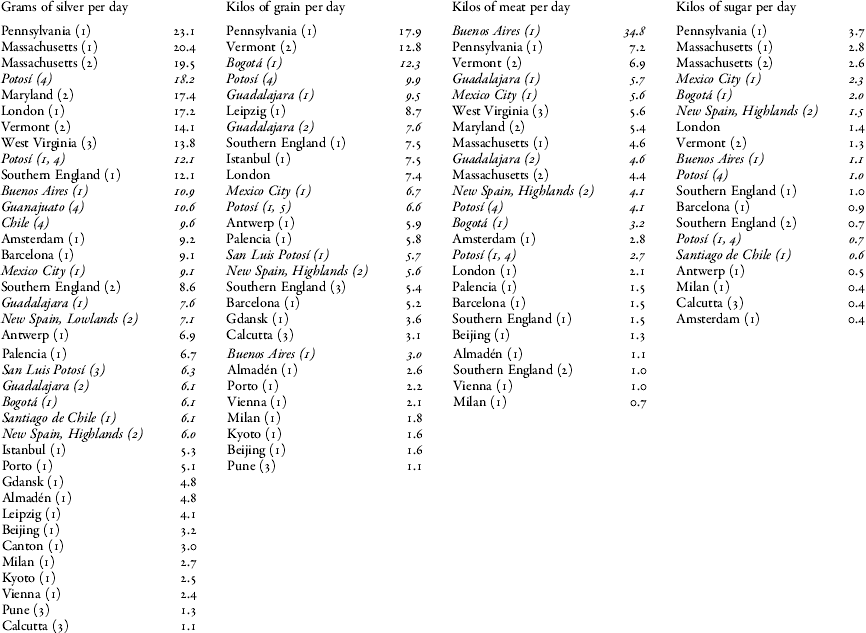
Table 1 shows daily monetary wages, the average of the available data for the 1800s, in terms of grams of silver for a sample of cases across the world, excluding Africa. Where possible, real wages, estimated as their purchasing power in terms of kilos of grain, meat and sugar for the same years, are also depicted.
Nominal and Real Wages by the Early Nineteenth Century, Selected Locations

Note: locations in Latin America in italics.
Legend: (1) urban; (2) rural; (3) unspecified; (4) qualified miner; (5) unqualified miner, mitayo.
Monetary wages
As expected, and confirming a fact well known since at least the times of Adam Smith, silver wages were substantially higher in the United States and England than in other parts of the world, and much lower in Asia than elsewhere. Less expected was perhaps to find Spanish American wages at medium to high levels. In contrast to many views of mining in the post-Columbian period, unskilled miners were well paid by international standards, even in the case of mitayos (Potosí (1, 5) in Table 1). The wages of rural and urban labourers in Spanish America surpassed those in southern, central and eastern Europe and Asia, with the exception of certain Spanish provinces.
Grain wages
One might expect silver wages in Spanish America to be at medium to high levels from an international perspective, given that it was a silver-producing region. Nonetheless, their purchasing power in terms of grain compares even more favourably with cases elsewhere in the world. In fact, in relative terms, ‘grain wages’ are higher than silver wages (see Table 1). This improvement in relative positions does not seem to be caused by any selection bias (although the samples do not match each other exactly because of data availability problems), since it is true for most Spanish American territories (New Spain, New Granada and Upper Peru).Footnote 51 Buenos Aires should be considered an exception due to particular temporary circumstances.Footnote 52 Our findings suggest, at least as far as the main component of the pre-industrial diet is concerned, that prices in Spanish America by the early nineteenth century (Potosí excepted, in part because of high transport costs) were not generally higher than in other parts of the world, in spite of the region's abundant silver production.
Had the silver wages in some European countries been deflated by prices of rye, a rather inferior cereal, instead of wheat, the picture emerging from Table 1 would be slightly, but not significantly, different, since rye was usually about one-third cheaper than wheat. In any event, it seems clear that Spanish American silver wages provided a comparatively decent standard of living in terms of calories. Even in the worst, exceptional case of Buenos Aires, they permitted the wage earner to acquire at least 3 kilos of wheat (some 10,000 calories) a day (see Table 1). Thus, while our findings do not support revisionist statements about Eastern living standards, they suggest that pre-independence Spanish America was closer to the most developed Western countries than to other parts of the world, in spite of the significant differences that existed between those territories at the top (Bogotá) and, with the exception of Buenos Aires, those at the bottom of the distribution (San Luís Potosí and the highlands of New Spain).
We do not regard the claim that ‘the gap between the “silver wage” and the “grain wage” can hence be used as an indicator of the level of development’ as a statement that can be confirmed.Footnote 53 This is probably due to the inclusion of the Americas, where silver and grain wages both tend to be relatively high in the sample. On the contrary, we find a positive correlation between silver wages and grain wages within our worldwide sample. This correlation increases when only the American sub-sample is considered.
Meat wages
This analysis should also take into account the possible objection that grain wages may not provide sufficient evidence regarding living standards and physical welfare. We therefore estimate the purchasing power of wages in terms of meat, a superior good and a rich source of animal proteins, which was scarcely present in the pre-industrial diet of most of the world's population.
As Table 1 shows, meat wages in Spanish America, especially in Argentina, were high to very high, comparable to those in North America and clearly ahead of Europe, let alone, presumably, Asia. Even in the worst of cases, that of the Potosí mitayos, who were clearly worse off in this respect than other Spanish Americans, the meat wage compares favourably with that of most Europeans. The main explanation behind this somewhat surprising finding is that meat was relatively inexpensive in many parts of Spanish America.Footnote 54 Only in Potosí are prices above the sample average.
Thus, in contrast to the general pre-industrial picture (North America excepted), meat could form an important part of the diet of commoners in Spanish America. This was well known for Argentina, and would hold true even if our source might underestimate the price of meat in early nineteenth-century Buenos Aires. More surprising is the high level of meat consumption that Quiroz found in Mexico City: an estimated 142 kilos per capita in 1767, including beef, pork and poultry, though not animal proteins that were obtained through hunting and fishing.Footnote 55 This is quite a lot by any standard of that era!Footnote 56 While the pre-Columbian population had limited and uneven access to animal proteins, the new economic system that followed the conquest made meat consumption much easier and more widespread, at least in towns, by combining the adoption of previously non-existent species (cattle, sheep, goats and pigs) with the regulation and support of the market for meat. Meat became a popular product consumed on a regular basis even by the indigenous population.Footnote 57 Even if the contribution that poultry made to the total consumption of meat in Mexico City (almost 20 per cent) is subtracted, New York still lags far behind. This comparison highlights the impressive consumption of meat by inhabitants of Mexico City, almost twice as much as North Americans, not to mention Europeans, and is consistent with the picture shown in Figure 1. However, meat consumption might have decreased by the late eighteenth century. Humboldt estimated total meat consumption at 189 pounds (85 kilos) per capita in 1791 – a substantial fall indeed, but still far higher than the norm in Europe and other parts of the world.Footnote 58 And it was not only Mexico City's inhabitants and urban and rural labourers in New Spain in the early nineteenth century who could consume meat on this scale. In the 1760s miners at Real del Monte were able to buy relatively large amounts of meat with just a part of their daily silver wage.Footnote 59 Moreover, the case of New Spain seems not to be the exception but rather the rule within Spanish America, as the meat wages in Table 1 clearly show. In the case of Chile, Quiroz shows comparatively meat-intensive consumption patterns in Santiago.Footnote 60
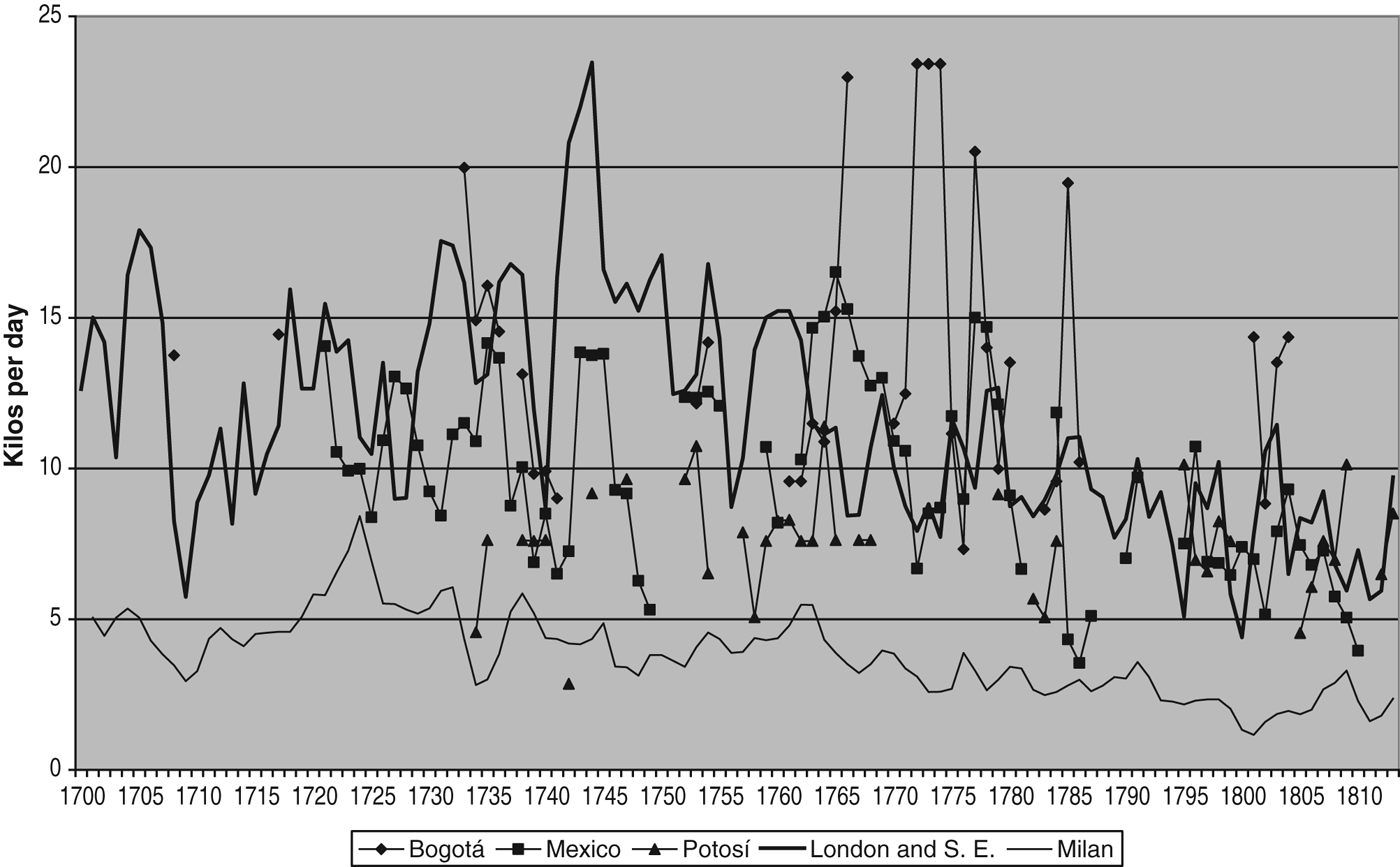
Grain Wages in London and Southern England, Milan, Bogotá, Mexico City and Potosí, 1700–1813

Thus, a certain similarity across the Americas in terms of meat consumption emerges from Table 1. This is probably due to a basic likeness in factor endowments there – abundant land and scarce labour – which contrasts markedly with those of most of Europe and Asia. It reflects an important advantage in living conditions, such as the possibility of consuming animal proteins. Relatively high meat wages suggest that, as opposed to Europe and, a fortiori, Asia, access to this superior good was not such a clear indication of status in some parts of Spanish America. Long after meat became more and more scarce in common people's diet in most parts of the world, the United States being an exception, many Spanish American labourers could still consume it in significant quantities.Footnote 61
Sugar wages
In terms of wages measured by the price of sugar – a proxy for those luxury goods resulting from the Columbian exchange and a rich source of calories as well – conditions in Spanish America were similar, or in some cases better, than in more developed parts of the world (see Table 1).Footnote 62 If, as asserted by Jonathan Hersh and Hans Voth, European living standards improved through gains from new goods like sugar, chocolate and tobacco, Spanish American labourers seem to have significantly – and probably earlier, albeit unevenly – benefited from this outcome.Footnote 63 An increase in economic welfare resulted from relatively low prices for sugar, again with the exception of Potosí.
Summarising, therefore, the empirical evidence does not seem to support the conclusion, in terms of international comparisons, that Spanish American urban and rural labourers and unskilled miners suffered from low real wages in the early nineteenth century, despite significant inter-territorial differences. Rather, the contrary turns out to be true, especially in terms of luxury or quasi-luxury goods such as sugar and meat.
Real Wages over the Bourbon Period
This section provides a comparison of real wages for unskilled workers in Spanish America (Bogotá, Mexico City and Potosí) and Europe (London and southern England, and Milan) over the Bourbon period.Footnote 64 Thus, we first check for the robustness of our estimates when the time span is significantly expanded, and, second, test the pessimistic hypothesis regarding the evolution of real wages and living standards of Spanish American labourers that predominates in the specialised literature on the Bourbon period.
Grain wages between 1700 and 1813 are depicted in Figure 1, which suggests that grain wages were significantly lower in Milan than in the other cases, and also followed a downward trend after the 1760s.Footnote 65 As anticipated, grain wages were much higher in London and southern England, but they shared a similar falling trend that started even earlier. This trend was also experienced in Bogotá and Mexico City, but not in Potosí, where they remained basically constant. From the 1760s onwards, grain wages in Bogotá were frequently far above those in London and southern England. This was not the case in Mexico City during the first half of the eighteenth century. Afterwards, the Mexican and the English series shared a downward trend and their levels converged. Thus, grain wages in Bourbon Spanish America were generally at similar levels to, and occasionally higher than, those in the richest European country and, with the exception of Potosí, registered a comparable falling trend during the final decades before independence.
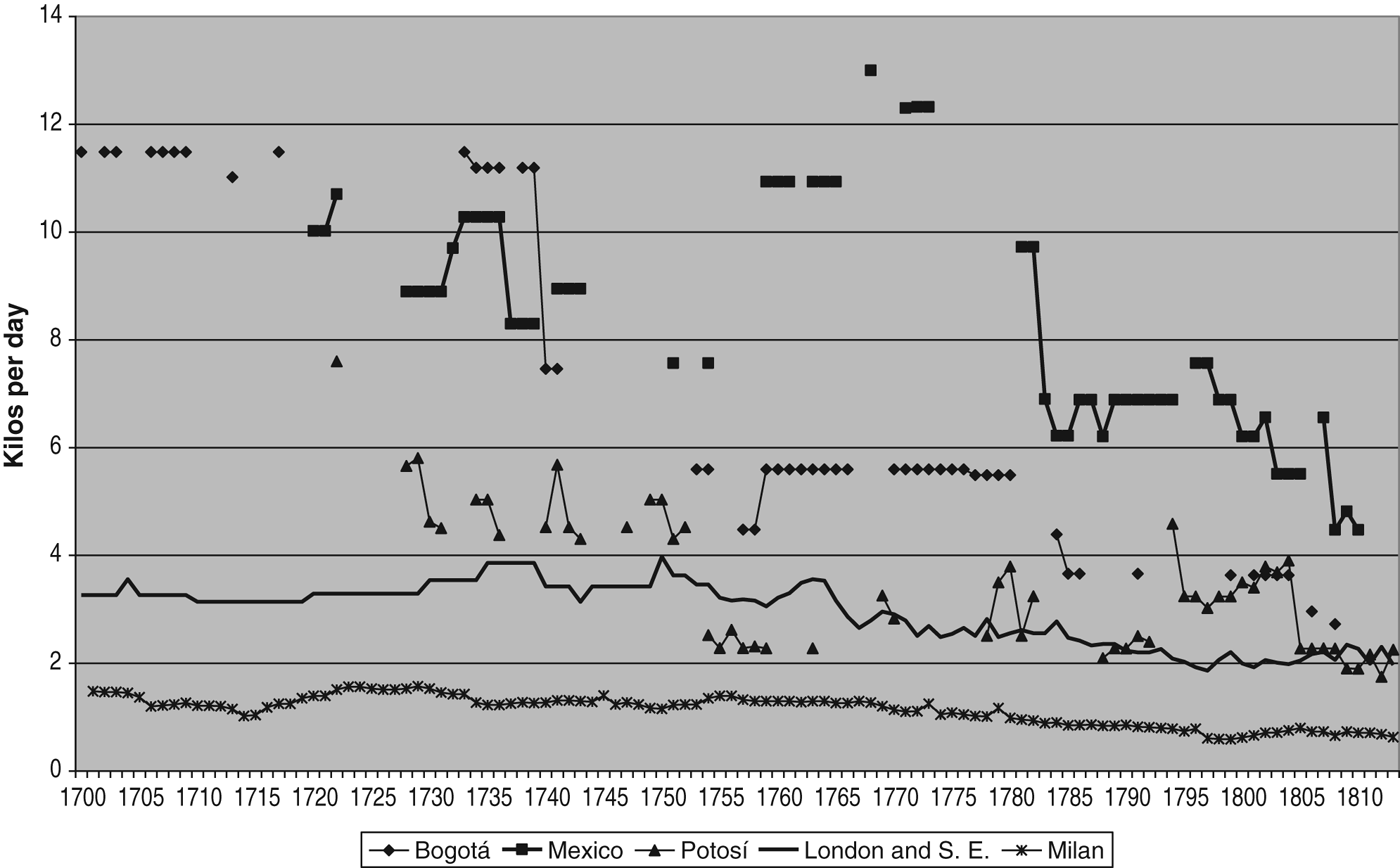
Figure 2 shows meat wages between 1700 and 1810. During the first half of the eighteenth century, meat wages in Spanish America were higher than in Europe. The difference was especially significant in Mexico City and Bogotá. In all cases, during the second half of the eighteenth and the early nineteenth centuries in Spanish America, meat wages decreased sooner (Bogotá and Potosí) or later (Mexico City). This fall also took place in Europe. On the other hand, at the end of this period the meat wages of Mexicans remained above those of people in London and southern England, while in the three Spanish American cities they were still much higher than in Milan.
Meat Wages in London and Southern England, Milan, Bogotá, Mexico City and Potosí, 1700–1813

Summarising, grain and meat wages in Spanish America do not seem to have been lower than in the most developed European country. In both cases, as well as in Milan, they deteriorated over the late eighteenth and early nineteenth centuries, Potosí being an exception. Thus, the worsening of living standards in some Spanish American territories during the late Bourbon period was all but exceptional in the West, excluding parts of the United States like Massachusetts, but not Maryland.Footnote 66
No inconsistencies seem to arise between the synchronic and diachronic exercises performed in this section. They coincide in suggesting that there seems to be room for some optimism regarding the real wages of Spanish American labourers during the Bourbon period, and that the ‘Great Divergence’ in Spanish American real wages, as opposed to what happened in the East, is rather a nineteenth-century phenomenon.Footnote 67
Heights
This section presents evidence on heights, again adopting an international comparative perspective. Our hand-collected data for northern and south-eastern areas of New Spain and the Captaincy-General of Venezuela (Maracaibo, hereinafter Venezuela), come from archival sources: filiaciones and militia muster rolls.Footnote 68 In the face of increasing military threats during the second half of the eighteenth century, militias were created as auxiliary forces of the regular army. They were composed of adult males living in a certain city or region, selected on a random basis.Footnote 69 Excluded from conscription were those suffering from serious physical handicaps, public servants, European traders, some highly skilled individuals, and slaves. Militias comprised all ethnic groups but Indians. The minimum height requirement remained unchanged at 5 feet.Footnote 70 Thus, we have been able to build a database consisting initially of almost 6,000 observations. After the necessary adjustments to take account of age and truncation, this has been reduced to 2,564. It may still be considered a fairly representative sample of generations born between 1730 and 1780 in those territories.
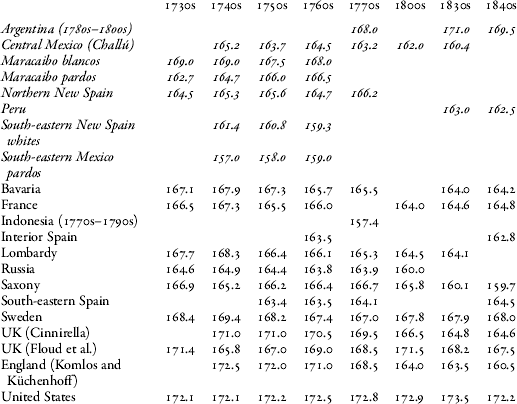
Average Height of Adult Males in Selected Countries and Regions (Cohorts Born from the 1730s to the 1840s)
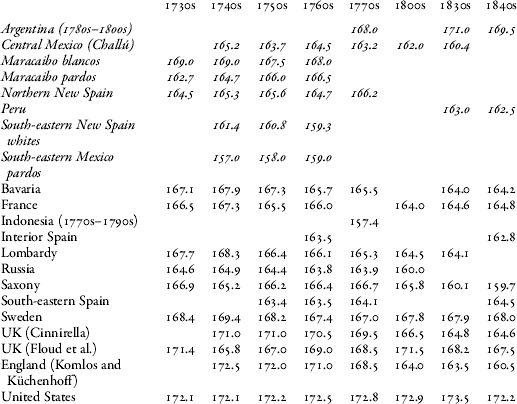
Note: locations in Latin America in italics.
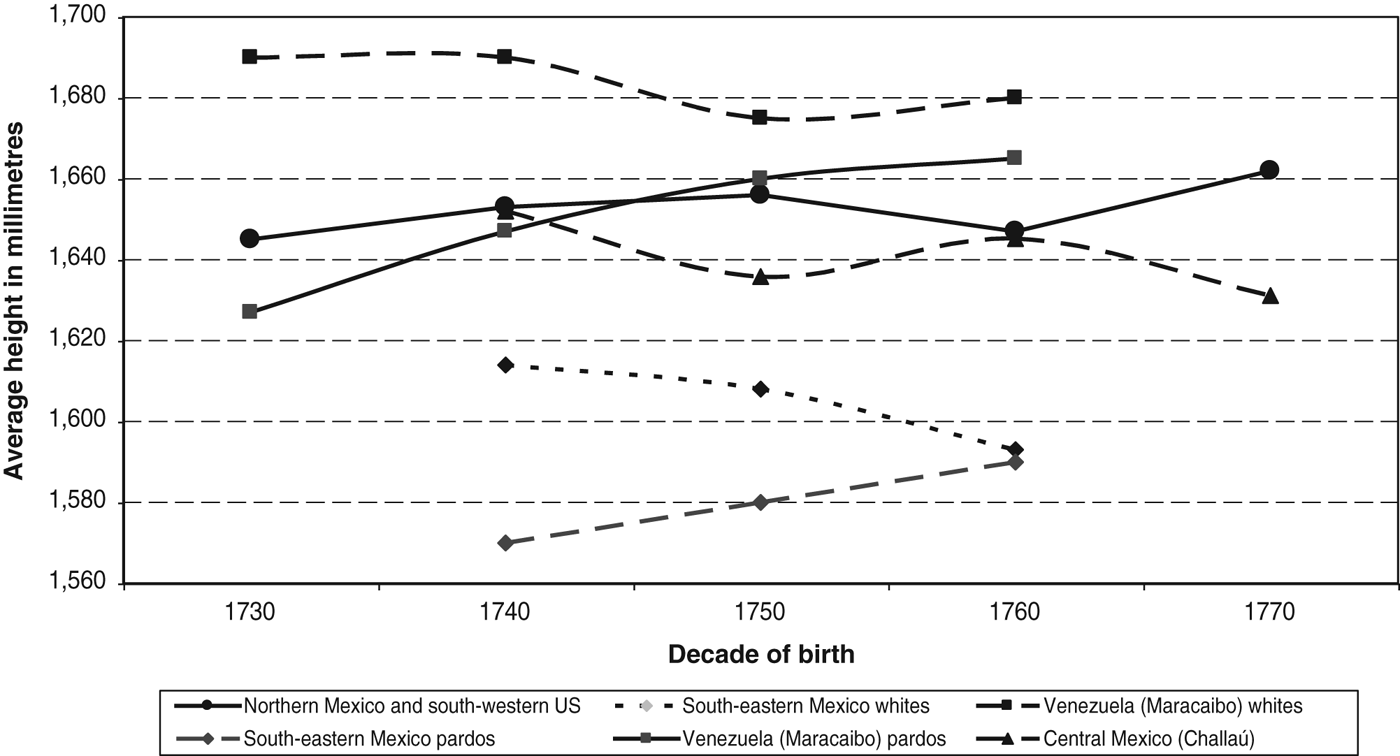
By the mid-eighteenth century, men in northern New Spain appear within the medium range of the international sample for the eighteenth century. They were taller than in some European countries, as well as Asia. Our finding of relatively high heights for them contrasts with the poor health index, the two lowest in a sample of 65 archaeological sites across the Americas over the last seven millennia, that Steckel et al. estimated for pre-Spanish indigenous populations of New Mexico.Footnote 71Blancos (whites) from Venezuela were even rather tall by Western standards of the period. According to Challú's estimates, central Mexico would lie within the mid-low range of countries shown in Table 2, at a similar level to Spain.Footnote 72 Blancos from south-eastern New Spain were clearly short, albeit taller than Indonesian slaves born between the 1770s and 1790s (157.4 cm) and Japanese of the Edo-Tokugawa Era (159.2 or 157.2 cm, depending on the calculation formula).Footnote 73 However, the heights found in south-eastern New Spain may also be found in less developed European countries and regions at some point during the eighteenth and nineteenth centuries (for example, Russia or Limousin and Orléans in France).Footnote 74 Moreover, it is doubtful that the sample of blancos is genetically comparable to that of northern and central New Spain. We suspect that south-eastern blancos actually had an important indigenous ethnic component. The fact that the indigenous population of Yucatán and Campeche was mainly comprised of Mayas, a population that has historically been one of the shortest in the globe, might affect the comparison.Footnote 75 Mayans of ninth-century Copán also exhibit one of the lowest health index values in the American sample analysed by Steckel et al.Footnote 76 In contrast to men in south-eastern New Spain, Argentines born in the final two decades of the eighteenth century turn out to be among the tallest populations in the world at approximately 168 cm, after conversion to a system based on the Paris foot.Footnote 77 This finding is consistent with estimates by Salvatore, Baten et al. and Baten for the 1820s onwards (see Table 2).Footnote 78 By 1810, Peruvians were not that tall, but nor were they shorter than some Europeans.Footnote 79
Pardos from Maracaibo were relatively tall, while those from south-eastern New Spain are among the shortest human group in our sample. However, pardos from Campeche and Yucatán were not shorter than the inhabitants of some regions in pre-twentieth-century Europe either (see note 76). A racial gap certainly existed in Bourbon Spanish America, as shown by the difference in height between blancos and pardos, but it evolved in a particular way during the central decades of the century, falling in Venezuela and narrowing until it practically disappeared in south-eastern New Spain. In any case, this racial gap is substantially smaller than the gap found in England by John Komlos between the two extreme poles of the social spectrum, similar to that observed between slaves and free whites in the United States but higher than in nineteenth-century Brazil and Peru.Footnote 80
Confirming findings in health over the past seven millennia by Steckel et al., a relatively high variance in height is found across Spanish American territories.Footnote 81 This probably reflects substantial differences in income and productivity between territories, similar to those shown in all available estimates for the early nineteenth century.Footnote 82 Within New Spain a north–south gradient may be observed, with Challú's estimates for central New Spain lying between ours for the northern and south-eastern regions of the viceroyalty.Footnote 83
It is difficult to observe a clear trend in our data. However, they do not suggest any ‘Great Decline’ in heights starting before the mid-eighteenth century, as concluded by Challú for central New Spain.Footnote 84
Average Height of Adult Males in Northern and South-Eastern New Spain and Maracaibo, 1730s–1770s

We accept that, in parallel with similar trends observed in most European countries by Komlos and Baten, and Komlos and Küchenhoff, some decline in heights might have taken place in late eighteenth- and early nineteenth-century New Spain.Footnote 85 A certain fall in physical statures at the end of the eighteenth century is consistent with the fall in real wages observable in Figures 1 and 2. Nonetheless, as Challú claims, the ‘declining trend over the second half of the eighteenth century was nothing exceptional in international perspective’.Footnote 86 Moreover, if we fully accept the decline estimated by this author (approximately 2.5 cm between the 1740s and the 1790s), it turns out to be not that ‘great’ since, according to Komlos and Küchenoff, the fall in heights of adult men between the eighteenth-century peak and trough was similar or higher in most European countries (ranging from 0.4 cm per decade in Saxony to 1.8 in Bavaria).Footnote 87
Our findings for New Spain may be placed in a pluri-secular perspective in an attempt to assess the long-term effects on material welfare resulting from the dramatic changes, probably unparalleled in human history, which occurred in the Americas after 1492. Bio-archaeological research has produced some evidence, though limited, that generally offers a rather pessimistic view of late pre-Columbian physical living standards.Footnote 88 According to Márquez et al., two conclusions may be drawn from previous research on statures in pre-Hispanic Mesoamerica: ‘First, the existence of a northeast to southwest gradient in average stature … and second, a trend toward diminishing height over time.’Footnote 89 Our findings are consistent with the long-lasting gradient observed across Mesoamerican regions. They also seem to support the hypothesis that the trend toward diminishing height was interrupted somewhat or reversed in certain areas at some point after 1492, since eighteenth-century inhabitants of central New Spain, not to mention northern New Spain, were taller than most Mesoamericans of the late pre-Columbian period. Whether this hypothesis will prove correct is to be seen. If it were confirmed, explanations would need to be found. Increased access to animal proteins might be an important factor, but neither a higher level of productivity of the whole economy nor lesser economic inequality in Mexican society after 1521 should be overlooked. We agree with John Coatsworth that the introduction of new crops and, especially, new animals, facilitated by the demographic catastrophe of the indigenous population, brought about substantial gains in the productivity of the domestic-use agricultural sector in Mesoamerica during the first century of Spanish rule.Footnote 90 Those gains might well have been more long-lasting than Coatsworth claims, especially in central and northern New Spain, and they were probably even bigger than assumed if the symptoms of crisis in the economy of the late Mexica Empire (overpopulation, famines, extra mortality) mentioned by Knight and Semo are taken into account.Footnote 91 On the other hand, living conditions in post-classic central Mesoamerica were harsh even if only ‘because the Basin of Mexico is not an easy environment to live in with the pre-Spanish technology’.Footnote 92 Moreover, Steckel's view on health and nutrition in pre-Columbian America is rather pessimistic and may help us to see the post-Columbian period in a new light.Footnote 93 Regarding inequality, Steckel finds anthropometric evidence which points to an extremely unequal distribution of work effort and access to food in highly stratified pre-Columbian societies in Central America.
In our interpretation, data and inferences from the anthropometric approach to biological well-being in Spanish America from a very long-term perspective do not seem to support the notion of a ‘reversal of fortune’ in New Spain after 1520.Footnote 94 The transfer of Western technology (cranes, crafts, mills and so on), the increasing availability of draught animals and a growing presence of proteins in the diet ought to have reduced the biological stress suffered by pre-Columbian populations in Mesoamerica.
Useful as it is, however, our approach to the study of the biological welfare of Spanish American common people presents some of the limitations that may affect the literature on anthropometric history more broadly: a lack of information on the female population; the unknown degree of influence of genetics on heights; missing data for sections of the population studied; and estimating with truncated distributions due to minimum height requirements for militia service. In spite of these problems, this is a first step towards placing Bourbon America in the international picture of living standards from a double comparative perspective (wages and heights).
Final Remarks
This paper presents a partial revision of some widespread assumptions regarding the economic history of Bourbon Spanish America. By doing so, it shares some basic characteristics with a small, albeit expanding literature.Footnote 95 This emergent revisionism departs from the very pessimistic judgements about Spanish America's economic performance from conquest to independence that permeate mainstream scholarship.
By studying wages of unskilled workers and physical statures in Bourbon Spanish America from an international comparative perspective, this paper attempts to widen the geographical scope, limited so far to Europe and Asia, of the ongoing debate on living standards and economic growth over the long run.
In general, contrary to Allen et al., our results do not support the idea of low living standards among wage earners in Bourbon Spanish America.Footnote 96 The purchasing power of wages in Bourbon Spanish America, not only in terms of grain but also for superior goods (meat and sugar), was similar to or, not infrequently, higher than in many parts of the world, including most of Europe. Asian wages and living standards lagged behind those in Spanish America. A declining trend in real wages at the end of the Bourbon period can be observed in Spanish America as well as in Europe. These conclusions are basically consistent with the overall picture offered by our analysis of heights: Spanish Americans of the central decades of the eighteenth century enjoyed a relatively high biological living standard, except in south-eastern New Spain. This consistency is reassuring and results from an unusual double approach to living standards: complementing the study of wages with that of heights.
Our findings are relevant regarding a growing literature that finds colonial origins for some contemporary economic problems – slow growth and inequality – in Iberian America. As opposed to Asia, our international comparison of living standards suggests that the ‘Great Divergence’ in important parts of Spanish America is principally a post-independence phenomenon. In fact, results presented in this paper, as well as in our earlier work,Footnote 97 cast some doubts on the accuracy of the figures for GDP per capita estimated by Coatsworth and Maddison for the late pre-independence period, which might be biased downward.Footnote 98 Regarding inequality, this paper does not imply – and nor do others such as Coatsworth and Williamson claim – that, in opposition to Engerman and Sokoloff, it has colonial origins.Footnote 99 Comparatively medium to high wages and biological living standards do not fit well with the idea of extreme inequality. Especially telling in this respect is the case of miners in New Spain and Upper Peru, supposedly the epitome of colonial exploitation.Footnote 100 Labour was not only, or mainly, obtained through ‘extractive institutions’, but instead, during the Bourbon period, resulted increasingly from an institution of ‘private property’ that did not exist before 1492: a market for wage labour.
We are aware of the limitations of this first attempt at studying economic and biological living standards jointly in Bourbon America. The next step in this research will therefore consist of broadening the database of wages, prices and heights in order to check whether our results prove to be robust to changes in the period and geographic scope of the sample. Further research is also needed to explain levels, trends and sub-continental differences in living standards in Spanish America before and after independence.