Introduction
The ladybird beetle Coccinella septempunctata L. (Coleoptera: Coccinellidae) is considered to be an important biocontrol agent for soft-bodied insects such as aphids, white flies, jassids and small lepidopterous larvae (Victor, Reference Victor1997; Zhu & Park, Reference Zhu and Park2005; Sarwar & Saqib, Reference Sarwar and Saqib2010; Lucas et al., Reference Lucas, Gagne and Coderre2013; Mahyoub et al., Reference Mahyoub, Mangoud, Ghamdi and Ghramh2013; Ugine & Losey, Reference Ugine and Losey2014; Skouras et al., Reference Skouras, Margaritopoulos, Zarpas and Tsitsipis2015). Deligeorgidis et al. (Reference Deligeorgidis, Ipsilandis, Vaiopoulou, Kaltsoudas and Sidiropoulos2005) also reported in his findings that C. septempunctata is a good biocontrol source for thrips and whiteflies in greenhouse crops. Both C. septempunctata adults and larvae are known primarily as predators of aphid but they also prey many other pests such as soft scales, mealybugs, spiders and mites (Rizvi et al., Reference Rizvi, Hussain, Ali, Rajput and Ahmed1994). The beetle has been increasingly used to control soft-bodied insects. However, due to the impact of climate and farming operations, it is often difficult to maintain sufficient level of natural supply of the beetles to control pests effectively (Sun & Wan, Reference Sun and Wan1999; Zhang et al., Reference Zhang, Chen and Li2014). Therefore, it is necessary to artificially rear them as supplement predator for effective field control of pests. Currently, lady beetles are reared mainly using aphids as food. This method is costly and time-consuming for the mass production of the insect (Ashraf et al., Reference Ashraf, Ishtiaq, Asif and Ayub2010; Bonte et al., Reference Bonte, Samih and Clercq2010). Furthermore, a natural prey diet is unable to support the beetles’ population to sustain year-round because environmental conditions may limit the prey supply and the need to rear prey. Therefore, successful and continuous mass rearing of ladybug at a commercial level is important for this purpose, which requires the availability of artificial diets.
Studies on artificial diets for lady beetles were initiated in the 1950s; Smirnoff (Reference Smirnoff1958) reported a prey powder-based artificial diet that successfully reared a variety of predatory ladybugs. Later on, non-prey compositions and non-insect source components were studied for the diet for various species of lady beetles (Sighinolfi et al., Reference Sighinolfi, Febvay, Dindo, Rey and Pageaux2008; Zhang et al., Reference Zhang, Li, Zhang and Wang2008; Ashraf et al., Reference Ashraf, Ishtiaq, Asif and Ayub2010; Sarwar & Saqib, Reference Sarwar and Saqib2010; Yazdani & Zarabi, Reference Yazdani and Zarabi2011; Tan et al., Reference Tan, Zhao, Wang and Zhang2015). However, compared with prey powder-based artificial diets, these diets are inferior with regard to the weight gain, pupation rate and eclosion rate. In particular, low fecundity has been a bottleneck limiting the use of artificial diets for lady beetle (Sun & Wan, Reference Sun and Wan1999).
Orthogonal design, a fractional factorial design approach, is often used to design experiments with multiple-level factors (Oles, Reference Oles1993). Orthogonal design involves the selection of representative combinations of factors and levels for laboratory experiments and can also be used to aid the design of an improved artificial diet for an insect based on the combination of ingredients (Wu & Leung, Reference Wu and Leung2011a). We tested 15 components identified from the most successful lady beetle artificial diets (Venkatesan et al., Reference Venkatesan, Jalali and Singh1998; Guo & Wan, Reference Guo and Wan2001; Wang et al., Reference Wang, Chen, Zhang, Wang and Yang2008; Ashraf et al., Reference Ashraf, Ishtiaq, Asif and Ayub2010; Sarwar & Saqib, Reference Sarwar and Saqib2010; Lü et al., Reference Lü, Liu, Jia and Han2015) and a new (pumpkin) component using an orthogonal design. The aim of this study was to identify key diet factors affecting reproduction of the lady beetle adult and develop an improved diet formulation for mass production of eggs, increasing hatching rate and adults of survival rate.
Materials and methods
Experimental insects
The C. septempunctata adults used in experiments were reared from eggs obtained from a collection of 300 adults from the experimental fields of Guizhou Provincial Academy of Agricultural Sciences, Guiyang, China. The adults were fed on the Aphis craccivora in six cages (49 × 35 × 30 cm) to produce egg masses on shrinking paper. The egg masses were collected three times a day and transferred onto filter paper moistened with distilled water in a 9 cm diameter Petri dish. Distilled water was added to the filter paper once every day. Newly hatched larvae were transferred into cages (49 × 35 × 30 cm) to feed on A. craccivora till pupation, and newly emerged (<24 h old) C. septempunctata adults were used in all tests. A. craccivora was maintained on horsebean plants in the laboratory.
Optimization of artificial diet by using an orthogonal design
The optimization experiments were performed using 16 ingredients. The ingredients were pork liver (A), infant formula (B), sucrose (C), olive oil (D), yolk (E), corn oil (F), yeast powder (G), cholesterol (H), casein (I), casein hydrolysate (J), vitamin powder (K), 65% juvenile hormone III (L), protein powder (M), vitamin E (N), honey (O) and pumpkin (P). The infant formula (B) is a kind of milks for new born baby, contains protein, 16.40 g; fat, 19.00 g; carbohydrates 56.20 g; nicotinamide, 4.00 mg; vitamin A, 0.52 mg; vitamin B1, 0.55 mg; vitamin B2, 0.80 mg; vitamin B5, 2.80 mg; vitamin B6, 0.38 mg; vitamin C, 42.00 mg; calcium, 525.00 mg; magnesium, 30.00 mg; iron, 6.08 mg; zinc, 2.80 mg; and sodium, 120.00 mg per 100 g1. Vitamin powder (K) contains vitamin A, 1.03 g; vitamin B1, 3.13 g; vitamin B2, 3.13 g; vitamin B6, 0.31 g; vitamin C, 31.25 g; vitamin E, 6.25 g; nicotinamide, 9.38 g; inositol, 31.25 g; calcium pantothenate, 3.13 g; and lysine, 15.63 g per kg. Protein powder (M) contains protein, 75.00 g; fat, 4.50 g; carbohydrate, 15.50 g; sodium, 0.19 g per 100 g. The pumpkin is rich in carbohydrates, vitamins, protein and amino acids, especially, in many microelements, such as potassium, magnesium, calcium, zinc and iron. These natural contents are easier to uptake and utilize by ladybird beetles than the chemicals (Kim et al., Reference Kim, Kim, Kim, Choi and Lee2012; Xiong et al., Reference Xiong, Chen, Mou and Zhou2013).
An L16 (216) orthogonal array method was used for the improved composition of artificial diet of C. septempunctata. The orthogonal design was employed to assign the 16 factors (ingredients, A–P) at two levels (concentrations, 1–2) (table 1), with 16 tests carried out according to the matrix given in table 2. Fifteen ingredients were selected by referring the previous reports. The pumpkin was used as a new ingredient. Each row of the orthogonal array is a specific set of factor levels to be tested. The level 1 was based on the averaged level reported previously, while the level 2 was a 50% increase of level 1.
Factors (i.e., ingredients) and levels (i.e., concentrations) in an orthogonal design for optimizing of an artificial diet for Coccinella septempunctata (1 litre).

Orthogonal design for two levels of 16 factors used for artificial diets optimization (1 litre).

T1–T16 denote 16 treatments of the orthogonal design.
Preparation of artificial diets
Pork liver and pumpkin were purchased from the local markets. The pork liver was grinded into pasta with a tissue triturator and the peeled pumpkin was steamed and then grinded as well. The ingredients were weighted and mixed, and then added to 600 ml sterile water containing 12 g molten agar at 40–50 °C, and blended for 3 min to generate a homogeneous and semi-solid diet mixture. The mixture was cooled to room temperature and stored in refrigerator at a 4 °C.
Feeding with artificial diet and aphis
The newly emerged adults were sexed and paired, 50 pairs for a treatment were obtained within a single day. In both the orthogonal array design trial and the follow-up validation experiment comparing the optimized diet against an aphid diet, each pair was placed in a 500 ml plastic jar where the semi-solid of artificial diet (2 × 5 × 5 mm) was supplied on a small piece of plastic strip at the bottom. The pair was provided daily with fresh artificial diet, absorbent cotton with distilled water and shrinking paper. Egg masses laid on paper were collected three times a day and transferred onto filter paper moistened with distilled water in a 9 cm diameter Petri dish. For feeding with A. craccivora, freshly collected aphids (roughly 500 individuals) were added to each jar daily through the nylon netting, which served as the lid of the containers.
Experimental conditions
The experiment was conducted in a climate chamber at a controlled temperature of 25 ± 1 °C and relative humidity of 70 ± 5% with a 14 : 10 light : dark regime.
Biological parameters assessed
Female adults, both upon newly emerging and after feeding on a treatment for 10 days, were starved for 24 h before being anesthetized with CO2 and weighted using an electronic balance (Sartorius BSA124S, Sartorius Group, Beijing, China). The survival rates of the females were recorded on the 50th day after eclosion. The preoviposition period and number of oviposited eggs were determined by daily checking the oviposited eggs. Egg hatching rate was determined by counting the number of first instar larvae hatched 4 days after oviposition in a subset of egg masses.
Statistical analysis
Range analysis was used to indicate the effect of each factor and determine the theoretically optimal level of the various factors. Range (R j) is the difference between the highest and the lowest mean values of examinational index for different factors (Deng et al., Reference Deng, Gao, Huang and Liu2012). R j is the absolute value of the difference between the mean values of Y jk (e.g., weight gain) for levels 1 and 2, with means calculated across treatments with the same level k (=1, 2) for factor j (=A, B, C, D, E, F, G, H, I, J, K, L, M, N, O, P). The optimal level for each factor is indicated by the largest value of Y jk, and a larger R j value indicates greater biological significance of the factor (Cui et al., Reference Cui, Shi, Li and Wang2009; Wu & Leung, Reference Wu and Leung2011b).
Ranges (R) was calculated using Microsoft Excel. We analyzed the differences in the weight, survival, preoviposition period, fecundity and hatch rate in the orthogonal experiments to confirm the optimal diet ingredients and their related proportions using variance and range analysis. The differences in each biological character were compared using a one-way analysis of variance (ANOVA) among of C. septempunctata fed with the improved artificial diet and aphis (SAS version 8.0). The ANOVA was run with the improved diet and aphis as independent factors, to compare the differences in weight, survival, preoviposition period, fecundity and hatch rate.
Results
Feeding outcomes of orthogonal array design
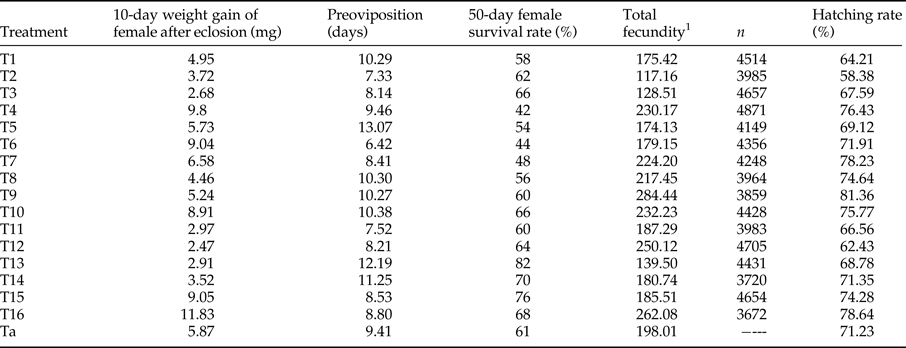
Results of the artificial diet feeding test are shown in table 3. Ten days after feeding, the treatment T16 gave the greatest weight gain, where the insects gained 11.83 mg per female adult, T12 generated the lowest weight gain with 2.47 mg per insect. The 50-day survival rate was the highest (81.67%) in the treatment T13 and lowest (41.63%) with T4. Eggs were produced in all 16 treatments. However, the treatment T6 had the shortest preoviposition period (6.4 days) and T5 had the longest (13.1 days). The treatment T9 generated the highest amount of eggs per female (284.4 eggs), while T2 was the lowest (117.2 eggs). The T9 gave the highest hatching rate (81.36%), while the T2 was the lowest (58.38%).
Feeding results of Coccinella septempunctata in 16 treatments of the orthogonal design.

T1–T16 denote 16 treatments of the orthogonal design
Ta is the average of the 16 treatments tested.
n means the amount of eggs with hatching rate.
1 Average number eggs per fertile female in the 50 days.
Analysis for key factors
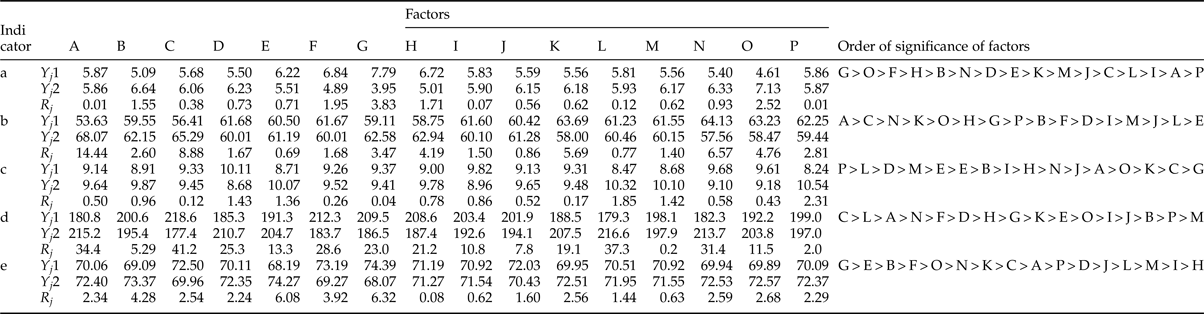
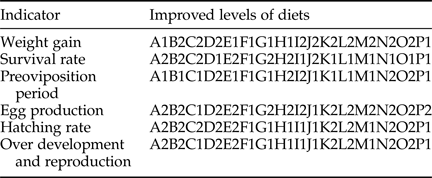
The mean values of Y jk and R j for the range analysis are shown in table 4. As larger R j values indicate a stronger impact of the considered factor at different levels (Wu & Leung, Reference Wu and Leung2011a), the importance of each factor in decreasing order was shown in table 4. The diet theoretically yielding the highest weight gain, survival rate, preoviposition, total fecundity, hatching rate based on the Y jk values of each factor were constituted in table 5. Based on the above results, the improved diet formulas best composition for C. septempunctata was (A2B2C1D2E2F1G1H1I1J1K2L2M1N2O2P1) 210 g pork liver, 30 g infant formula, 60 g sucrose, 6 ml olive oil, 30 g yolk, 4 ml corn oil, 10 g yeast powder, 1 g cholesterol, 10 g casein, 10 g casein hydrolysate, 3 g vitamin powder, 9 µl 65% juvenile hormone III, 6 g protein powder, 1.5 ml vitamin E, 15 g honey and 20 g pumpkin l−1.
Range analysis of artificial diet for Coccinella septempunctata tested in the orthogonal design experiment.

a, 10-day weight gain of females after eclosion (mg); b, 50-day survival rate (%); c, preoviposition (day); d, total fecundity (no. egg/female); e, hatching rate (%).
Improved levels of diet components in the artificial diet for Coccinella septempunctata (1 litre).

Validation of the improved formulas
To validate the improved formulas, the development and reproduction of C. septempunctata adults were compared by feeding them with the diet and aphis (table 6). The 10-day weight gain of adults reared on the diet was 1.41 mg lower than on aphis; there was a significant difference (F = 7.3010, P = 0.0077). Fifty-day survival rate was lower on the diet than on aphis; however, there was no significant difference (F = 0.3330, P = 0.2830). The preoviposition period was significantly shorter for C. septempunctata fed on the diet than on aphids (F = 0.3110, P = 0.0100). The total fecundity of aphis-fed C. septempunctata was higher than that of the diet-fed C. septempunctata (F = 0.0070, P = 0.0001), while their hatch rate was similar (F = 9.1170, P = 0.5149). Nevertheless, the improved formulas was a remarkable improvement over the formulas in table 3, particularly for fecundity, which had a nearly 60% increase compared with the treatment T9 from unmodified formulas listed in table 3.
Comparison of development and reproduction of Coccinella septempunctata fed with the improved artificial diet and aphis.

Values are mean ± SE. Figures labeled with the same letters in the columns are not significantly different at P = 0.05 by one-way ANOVA and Fisher’ s Least Significant Difference (LSD) test.
Percentages of egg hatch rate were transformed using arcsine transformation before analysis.
1 Average number eggs per fertile female in the 50 days. n means the amount of eggs with hatching rate.
Discussion
The five parameters: weight gain, survival rate, preoviposition, fecundity and hatch rate of artificial improved diet fed beetles were 167.46, 114.75, 96.71, 228.93 and 102.78% compared with the averaged values (Ta) of 16 treatments (table 3). The survival rate and hatch rate of improved diet-fed beetles were similar to aphid-fed ones. The adult weight gain over 10 days period and fecundity of improved diet-fed beetles were 87.46% (11.24 mg) and 62.70% (453 eggs) of aphid-fed ones. In addition, the preoviposition period of diet-fed beetles was shorter than these aphid-fed ones (table 6). However, Gong et al. (Reference Gong, Zhai, Wei and Zhang1980) fed adult of C. septempunctata with diet could be survived for 2 months, but they were unable to lay eggs. Sarwar & Saqib, (Reference Sarwar and Saqib2010) fed adult of C. septempunctata with diet laid 18 eggs in life. The Harmonia axyridis could be reared from the first instar larvae to fully reproductive adults on a pork liver-based artificial diet; however, adult laid 47 eggs for 10 days only, and the preoviposition for 13.50 days (Sighinolfi et al., Reference Sighinolfi, Febvay, Dindo, Rey and Pageaux2008).
Components and their contents in diet are critical to meet the nutrition demand of insect. Therefore, diet components need to be investigated at different contents for their effect on the growth and development of C. septempunctata to develop an improved diet composition. The outcomes of this study suggested that the orthogonal array design is an efficiency method to develop a good artificial diet for feeding C. septempunctata. Our study revealed that (1) yeast powder and honey were the main ingredients in the diet affecting weight gain; (2) pork liver and sucrose were the primary ingredients affecting survival rate; (3) juvenile hormone and pumpkin were the major ingredients affecting preoviposition period; (4) juvenile hormone, sucrose and pork liver were the important ingredients that impact on the fecundity; and (5) yeast powder and yolk were the main ingredients affecting hatching rate of adult C. septempunctata.
The addition of yeast powder in diet is mainly to increase the content of free amino acids. Chen et al. (Reference Chen, Qin and Shem1989) found that yeast powder added to basal diet reduced the growth period of larvae, increased the larval pupation rate and adult body weight. However, if yeast powder was doubled in amount, feeding effect decreased, suggesting that excessive amino acids in artificial diets may disrupt the balance with nitrogenous compounds and other nutrients. Our study showed that 50% (level 2) increase in diet at level 1 reduced the weight gain, egg production and hatching rate.
In our study, the weight gain and fecundity of C. septempunctata were significantly increased when honey content was increased in the diet (level 2). Fu & Chen (Reference Fu and Chen1982) showed that adding honey and sucrose to liver-based diet promoted feeding, shorten the preoviposition and increased the weight gain. It is likely because that honey contains sucrose that promotes feeding and specific nutritional amino acids.
Pork liver is the main component of the artificial diet. It is rich in protein, cholesterol and minerals. In our study, the pig liver had an important role in improving the survival rate and oviposition rate, indicating that the nutrient components in the liver are easy to be digested and absorbed by the insect. However, casein hydrolysate, protein powder, casein and cholesterol were added in the formula that did not impact the biological parameters of the insect, which may be due to poor absorption and overdosed.
The juvenile hormone plays an important role in the preoviposition and egg production. Vitellogenesis in the lady beetle, C. septempunctata is controlled by juvenile hormone, when immature females were reared on an artificial diet, they were characterized by hypertrophy of the fat bodies and slow development of the ovaries, vitellogenin synthesis in the fat body remained at a very low level throughout adult development (Zhai et al., Reference Zhai, Zhang and Gong1987). Chen et al. (Reference Chen, Qin, Fan and Li1984) and Gong et al. (Reference Gong, Zhai, Wei and Zhang1980) added juvenile hormone to the pork liver diet and found that the component improved the egg production and weight, and reduced preoviposition period. The increased contents of juvenile hormone also raised the fecundity of C. septempunctata in this study.
Egg yolk was functionally important for the preoviposition, fecundity and hatching rate, while pumpkin shortened the preoviposition stage of the insect, although further work is needed to confirm these results. Earlier studies have shown that addition of vitamin E to pig liver- and sucrose-based diets could promote the reproduction of the ladybird beetle. Lipids could improve food utilization efficiency and conversion rate, leading to shorter preoviposition period and increased egg production (Gong et al., Reference Gong, Zhai, Wei and Zhang1980; Fu & Chen, Reference Fu and Chen1982; Chen et al., Reference Chen, Qin, Fan and Li1984). The olive oil in the artificial diet seemed to have a phago-stimulating effect on the adult beetles, and the rate of food conversion was the highest (Chen et al., Reference Chen, Qin, Fan and Li1984). In addition, the addition of milk powder had certain influence on the biological parameters of the insect, probably due to supplementary nutrition from trace elements in milk powder. Vitamin C powder had a certain effect on survival rate and fecundity.
These findings indicate that the insect has different requirements for nutrients and content for different biological parameters. Over 16 treatments of range settings, the contents of 16 factors were increased by 50% over the averaged values of previous reports. The increased contents of milk and honey could result in increasing the body weight; while corn oil, yeast powder and cholesterol result in decreasing the body weight. The liver and sugar could increase the adult survival rate; while vitamins C and E could reduce the adult survival rate. The juvenile hormone, liver, olive oil and vitamin E could increase the fecundity; while the sucrose could reduce the fecundity. The milk and chicken egg could increase the hatching rate; while the yeast could reduce the hatching rate. These results demonstrated that the contents of milk, honey, olive oil, liver, juvenile hormone, vitamin E and chicken egg should be increased; while the contents of corn, oil, yeast powder, cholesterol, vitamin C, pumpkin and sucrose should not be increased. In addition, the contents of casein, casein hydrolysate and protein powder did not affect the biological performances significantly; we suspected that C. septempunctata had a low uptake rate of these two ingredients.
In conclusion, the diet we developed here is suitable for rearing C. septempunctata. The diet-fed C. septempunctata adults had the improved survival rate, fecundity and shortened preoviposition period compared with the previous reports (Sun & Wan, Reference Sun and Wan1999; Sighinolfi et al., Reference Sighinolfi, Febvay, Dindo, Rey and Pageaux2008; Ashraf et al., Reference Ashraf, Ishtiaq, Asif and Ayub2010; Yazdani & Zarabi, Reference Yazdani and Zarabi2011; Lü et al., Reference Lü, Liu, Jia and Han2015). The reported diets contained the natural preys, such as aphids, pupae of wasp or eggs of rice moth (Corcyra cephalonica molitor) (Sun & Wan, Reference Sun and Wan1999; Wang et al., Reference Wang, Chen, Zhang, Wang and Yang2008; Rojas et al., Reference Rojas, Morales-Ramos and Riddick2016). The diet we developed is free of such preys, which can save a lot of cost for maintaining these prey(s). Furthermore, the cooking process of the diet is relatively simple and quick. However, the diet-fed adults showed a reduced fecundity, survival rate and egg hatching rate compared with the aphid-fed ones. This diet is not doing well for the C. septempunctata larvae. The survival rate and pupation rate of diet-fed larvae were largely lower than these aphid-fed larvae. Thus, we are working on the improving adult diet and developing larval diet.
ACKNOWLEDGEMENTS
This project was founded by Agricultural Science and Technology Research Projects, Guizhou Province (grant no: Qian 2012–3042); Agricultural Science and Technology Research Projects, Guizhou Province (grant no: Qian 2015-3014-1); Guizhou Scientific Research Institutions-Enterprise Service Project (grant no: Qian 2015-4012).