

Introduction
One of the most studied areas in Japanese politics concerns the ability of its oft-ruling political leviathan, the Liberal Democratic Party (LDP), to pull the purse strings of government in a bid to enhance its electoral prospects and maintain its grip on policy-making. While the strategy of using pork-barrel politics as a ploy in industrialized democracies is not uncommon, Japan seemingly receives more attention than others.
Elevated amounts of pork-barrel spending coupled with Japan's slight legislative turnover spurred a dense and extant literature of empirical research examining expenditures for a multitude of outlays including, but not limited to, the general account budget (Cowhey and McCubbins, Reference Cowhey and McCubbins1995), specific accounts within the general account including the Ministry of Agriculture, Forests and Fisheries (Thies, Reference Thies1998) and the Ministry of Construction (Kohno and Nishizawa, Reference Kohno and Nishizawa1990).Footnote 1 In addition, these studies also extend to frequent stop-gap and disaster relief spending packages, colloquially called supplementary budgets (Patterson and Beason, Reference Patterson and Beason2001). But more recently, scholars of Japanese politics have shifted their interest away from these larger and less targeted outlays like the general account budget and supplementary budgets and turned toward intergovernmental transfers. Intergovernmental transfers refer to funds transferred from the central government to prefectural and local governments for the initiation of public works projects and equalization transfers meant to ensure that each government receives the needed resources to provide a minimal level of services to the local populace. This shift in scholarly interest toward intergovernmental transfers in Japan is the result of three advantages that elude to traditional budgetary studies, especially the fiscal relations between the central, prefectural, and municipal governments. First, budgetary studies often substantiate a broad connection between pork barrel and electoral politics, but rarely a specific connection. Second, data regarding intergovernmental transfers to prefectural and local governments are readily accessible. Third, there is widely accepted critique that there is lack of literature that connects local and prefectural policy to national politics (Horiuchi, Reference Horiuchi2009),Footnote 2 and although there has been some progress in this area (Horiuchi, Reference Horiuchi2005; Jain, Reference Jain2006) this progress has been relatively slow and piecemeal.
Regardless of whether local or prefectural governments receive these funds, the bureaucratically administered financial index plays a specific and apolitical role in the distribution and allocation of these transfers. The trend in the literature is a description of the financial index, and associating it with equalization of funds across governments and that local economic indicators are overwhelming determinants of the index. As a result, it is not surprising that most empirical models of fiscal transfers include the financial index on the right-hand side of the equation as it is one of the strongest predictors of fiscal transfers received by both municipal and prefectural governments. But what is particularly interesting is that few studies shed light on how the index is calculated. This trend began with Reed's (Reference Reed1986) work on prefectural policy, when referring to bureaucratic influence on financial aid to prefectural governments Reed concluded: ‘In Japan, as in France, the pattern of distribution of favors depends on bureaucratic channels; rather than political ones’. At the heart of this conclusion is that Japan's public finance bureaucracy plays a considerable role in the determination of the magnitude of prefectural financial assistance. This observation aside, one of the first empirical studies of political influence on prefectural financial assistance does not even include the financial index in the determination of fiscal transfers and relies on numerous political variables (Meyer and Naka, Reference Meyer and Naka1998, Reference Meyer and Naka1999).
However, this exclusion of the financial index in studies of the allocation and determination of transfers is an aberration rather than a trend. In one of the more prominent examples of English-language research on fiscal transfers, Horiuchi and Saito (Reference Horiuchi and Saito2003) make the case that the reorganization of local governments (and subsequent removal of representation bias) resulted in an equalization in the totals of per capita transfers. This strongly implies that there is an inherent political logic driving intergovernmental transfers. In doing so, they include the financial index as a covariate of per capita transfers and provide the following definition:
The municipality fiscal strength index . . . controls the effect of formulaic portions of transfers. Roughly speaking, it indicates the fraction of a municipality's fiscal demand that can be financed by its local taxes. Since the central government developed this index for the purpose of determining the amount of general (i.e., formulaic) subsidies to each municipality, there is no doubt that the coefficient is negative and highly significant. Footnote 3
Then, they add more specificity by noting that it is the three-year average of a municipality's standard fiscal revenues and demands. While it is not central to their argument, there is no empirical verification of this fact and an examination of the literature uncovered no empirical investigation of the financial index. Therefore, this research asks the question: what determines the financial index? Based on the close connection between the decision-making apparatus of the Ministry of Finance, the Office of Home Affairs, and the LDP, this research extends Horiuchi and Saito's (Reference Horiuchi and Saito2003) assertion not only that politics influences the magnitude and distribution of fiscal transfers, but that this same argument holds true for the financial index. As a result, this research contributes to the literature in two ways. First, it presents the first empirical analysis of the financial index and demonstrates that there is a previously unseen political dynamic in its determination. Second, it confirms and extends the findings of principal–agent theories that place emphasis on political rather than bureaucratic actors in the policy-making process and extends the findings of principal–agent theories that place emphasis on political rather than bureaucratic actors in the policy-making process.
An introduction to intergovernmental transfers in postwar Japan
Like most democracies, the infrastructure of Japanese governance consists of a network of governments that tirelessly, but not always efficiently, provides needed services and fulfills governmental obligations to Japan's 127 million inhabitants. Not surprisingly, because Japan's population is large and its landmass covered with almost every type of geography, Japan's central government in Tokyo cannot provide all these services by itself. Like most developed democracies, much of the burden for the services coordinated by the central government falls on local and prefectural governments.
Undoubtedly, the costs associated with providing these services is not slight. Luckily for these inferior governments, Japan's central government provides enough financial resources because of its ability to collect revenue and provide the necessary financial backing to guarantee a level of service for all of Japan's population. Additionally, similar to other populous democracies, citizens who interact with one of Japan's over 3,000 governments more regularly do so, not at the central government in Tokyo, but at a citizen's prefectural, local, or ward offices. While the central government in Tokyo remains unparalleled in its ability to collect revenue, local and prefectural governments regularly carry the burden of the demand for essential and worthwhile government services. To ensure that government services can be provided to the multitudes of Japanese who depend on the services provided by prefectural and other local governments, the national government in Tokyo serves as a clearinghouse for financial aid and support to prefectural governments through intergovernmental transfers. However, while the importance of these fiscal transfers is certainly not in doubt, the story behind these transfers is less than clear cut.
Although this research remains focused on the politics of intergovernmental transfers in the postwar era, the system of intergovernmental transfers predates the occupation of Japan following World War II. Prior to the conclusion of World War II, Japan utilized a program called the Local Distribution Tax. This system, although relatively crude and unsophisticated compared to the contemporary system, would eventually morph into the larger and more adequately financed system of intergovernmental transfers in postwar Japan. Under this Local Distribution Tax System, the central government collected local taxes and redistributed them to the prefectural governments that needed the funds (Mochida, Reference Mochida2008). However, as it was not as complex as the current iteration of intergovernmental transfers, the central government determined the yearly amount of funds within the general accounts with year-to-year fluctuations that often sparked tension between the central government (specifically the Ministry of Finance) and prefectural governments as they competed over the same revenue streams. Adding to the centralized nature, before the occupation, the public did not elect prefectural governors with the central government appointing governors.Footnote 4 As a result, these governors served as little more than agents of the central government as opposed to quasi-independent entities that worked in concert with the central government.Footnote 5 However, the occupation along with new political leaders in Japan fresh off the highly centralized government of the past did not wish to see a return to that style of governance and began a process of decentralization. This new policy on intergovernmental relations and interactions required a loosening of prefectural fiscal policy-making.Footnote 6 In the hope of making the transition as efficient and painless as possible, the Occupation and the transitional Japanese authorities extended an invitation to Columbia University Economist, Carl Shoup, to study and propose the best course of action for the decentralization of the public finance system. When his studies were completed, he offered a series of reforms to overhaul the local finance system, which the government and the occupation implemented.
At first, all interested parties welcomed the reforms as these policies and procedures were a welcome respite from centralized government control over prefectural finances. However, optimism regarding the success of these reforms quickly turned into disappointment as some prefectures were unable to fulfill basic government operations, like hiring police officers, teachers, and firefighters. In addition, the number of prefectures experiencing fiscal shortfalls was not static, but increasing. By 1951, 15 prefectures were in deficit, by 1954 the number of deficit prefectures had ballooned to 35.Footnote 7 As a result, many prefectures began requesting more funds from the central government to keep their balance sheets afloat. At this point, the central government faced a difficult decision. It could allow prefectural governments to borrow funds in order to meet its obligations through bond issuance or it could return to the centralized public finance system with some amendments to allow for some prefectural fiscal policy autonomy while preventing these governments from entering into a deficit. In the end, the central government chose the latter and ameliorated many of the financial exigencies encountered under the Shoup reforms.
However, two interesting dynamics occurred from the return to a more centralized local finance system. First, it guaranteed and permanently enshrined considerable tension between two central government ministries, the Ministry of Home Affairs and the Ministry of Finance. As Campbell (Reference Campbell1980) and Ishi (Reference Ishi1996) make clear, one of the primary functions of the Ministry of Finance was (and is) fiscal restraint. In contrast, the Ministry of Home Affairs, and mainly the Local Finance Bureau, mostly represented the wishes, desires, and interests of the prefectural governments. As a result, the leanings of the Ministry of Home Affairs were often diametrically opposed to the proclivities of the Ministry of Finance so that it was labeled, the ‘opposition party inside the government’ (Mochida, Reference Mochida2001). Secondly, the reversal from the Shoup Reforms and the turn back toward a centralized public finance system left intergovernmental transfers susceptible to the maneuverings of national party organizations, individual members of the Diet, and local politicians, including prefectural governors.
While much of the history and development of intergovernmental transfers in the 1960s and 1970s dealt with the seesaw between centralization and solvency and decentralization and insolvency, it is not the only sole factor in their history. Intergovernmental transfers also faced considerable pressure from outside economic shocks that greatly influenced the availability of intergovernmental transfers. The Oil Shocks of 1973 and 1979 and the eventual slowdown of the Japanese economy in the late 1970s and early 1980s led the central government to reduce the amount of spending on intergovernmental transfers, and it began placing more of the burden on prefectural governments.Footnote 8 Although the ad hoc Council on Administrative Reform (known as Rinchō) became mostly noted for its attention to cutting national spending and reform of the policies and procedures governing general account budgeting, Prime Minister Nakasone also made it his goal to reform the relationship between central and local governments. While these procedures led to reductions in the amounts of intergovernmental transfers in the short term, many at the Ministry of Home Affairs, encouraged by prefectural assemblies and governors, advocated not for reductions in intergovernmental transfers, but increases. The Ministry of Finance with the backing of Prime Minister Nakasone and other leading members of the LDP were not able to curb transfers in the medium term because Japan experienced a second period of economic growth and expansion in the mid 1980s.
However, in the previous period of economic growth and expansion, Japan's grew via a booming export-oriented economy. As a result, the increased spending on these programs were not overly problematic as the economic growth was stable and unlikely to revert back to the levels of economic growth and vitality seen prior to the 1960s. But, the second period of growth in the mid 1980s was not based on export-oriented growth or fundamental changes that could be sustained, but on a stock and land bubble. And when the bubble burst, local governments were often left picking up the pieces of overspending with the central government also being hamstrung by the amount of funds it could provide.
Electoral incentives, bureaucratic dominance, and intergovernmental transfers
In the year prior to the fiscal year, prefectural governments begin to formulate requests from the central government in two different areas. The first area concerns the financing of a basic level of public services by prefectural governments to their constituents. Based on revenue and expenditures projections detailing the costs of providing these services, prefectural governments formally submit budget requests to the Ministry of Home Affairs. The second area is a submission of project proposals that the prefectural governments cannot complete without the assistance of the central government. This includes public works and projects that fall outside the purview of essential prefectural government operations.
However, there is a great deal of difference between these two different portions of intergovernmental transfers. As per the Local Finance Law (and longstanding Ministry of Finance policy), inferior governments may not issue bonds for operating expenses without the approval of the Ministry. Compounding this, the Ministry of Finance only infrequently approves requests for bond issuance for operating expenses. To add to the restrictions placed on local governments by the Ministry of Finance, bonds issuance for public works projects must receive approval from the Ministry of Finance. As a result, local bonds may be issued in the pursuit of public works projects, but the Ministry of Finance could either approve or deny the original request for funds and/or the request for permission to float a bond for the project (Ishi, Reference Ishi1996, Reference Ishi2000). And although the Ministry of Finance approves substantially more bonds for public works, it remains an obstacle to obtaining fiscal independence from the central government.
As a result, the ability of local governments to raise funds independently from their own local taxes (which only constitute a small portion of the funds compared to the central government) is considerably limited and requires prefectural and other inferior governments dependence on financial assistance from the central government. After these requests for funds are presented to the Ministry of Home Affairs, it makes a formal budgetary request to the Ministry of Finance in accordance under the ordinary budgetary request structure.Footnote 9
Part and parcel of the prior discussion implies that politics plays a role in the determination of intergovernmental transfers.Footnote 10 However, the same cannot be said of the financial index. Reflecting this, no study even asserts that politics influences the financial index. In fact, public finance studies (Mochida, Reference Mochida2001, Reference Mochida2008) occasionally contradict each other with some indicating that the Ministry of Home Affairs controls the calculation of the financial index while others speculate that the Ministry of Finance holds the final decision on the index.Footnote 11 However, it is exceedingly difficult to find literature that suggests the financial index is susceptible to political influence. Nevertheless, the literature on policy-making indicates that as policy relevance to voters increases, the LDP focuses its attention more acutely. As a result, we may expect the LDP to influence the index to its political betterment.
Based on the history of the literature on postwar policy-making, it is reasonable to conclude that individual ministries hold an unmistakable grip on policy-making. Although not the first to heap considerable credit on the civil service for postwar policy-making and Japan's economic miracle, the most prominent and forceful went so far to claim that in Japan, ‘politicians reign, while bureaucrats rule (Johnson, Reference Johnson1982)’. . In fact, throughout the 1970s and 1980s it became increasingly difficult to find literature that posited anything other than the overwhelming concurrence that Japan's civil service held responsibility for most public policy. However, strangely enough, as Japan's economy and its economic miracle began to shows its first cracks and crevasses, some did not share the acceptance and reverence for the Bureaucratic Dominance Thesis and its academic influence began to wane. In its place was considerable emphasis on political institutions, political actors, and incentives. And although this shift showed itself quite starkly in Japan politics, the remainder of comparative politics underwent a similar, but less pronounced shift. At first, this shift in the study of Japanese politics remained rather muted, vague, and only hinted at a role for the LDP in policy-making, with any interest in the LDP focusing on its attempts to compensate voters who had begun to revisit their decision to support the LDP (Calder, Reference Calder1988). However, as time progressed, criticism of the Bureaucratic Dominance Thesis did not subside, but grew. In fact, in addition to empirical studies that showed the LDP as an important player in the policy-making process, formal models of policy-making found that the LDP not only plays a role in policy-making, but stakes out an important and consequential position (Ramseyer and Rosenbluth, Reference Ramseyer and Rosenbluth1993).
Based on this shift in the role of political actors in the policy-making process, the financial index and intergovernmental transfers should arouse interest from the LDP as intergovernmental transfers make an immediate impact on individual citizens and contribute to the quality of life for voters by helping the funding of schools, police officers, and other local projects. Indeed as Horiuchi and Saito (Reference Horiuchi and Saito2003) point out, the LDP used intergovernmental transfers to aid its political prospects, so the hypothesis that the LDP also has a role in the determination of an important mechanism that influences which prefectures receive more than others.
The financial index consist of the ratio of Standard Revenues to Standard Fiscal Needs, with the latter being the most convenient component to manipulate for political purposes. Standard Financial Needs is the product of the Unit Cost, the Measurement Unit and the Modification Coefficient. The first two refer to an annually determined figure by the Ministry of Finance that considers the costs associated with completing the project (overhead). Ostensibly, information regarding the Measurement Unit is compiled by the Ministry of Home Affairs, but more specifically, the Local Finance Bureau. Following this determination, this information is passed on to the Ministry of Finance. The modification coefficient is an amorphous component meant to alleviate unforeseen financial stress of prefectural governments and specific prefectural government hardships.
In the process, there are two potential pressure points where the LDP can influence this process.Footnote 12 It could attempt to influence the Unit Cost at the Ministry of Home Affairs by working on new variables that would raise the standard financial need and lower the official financial index. However, as mentioned in the overview of the history of the intergovernmental transfers, the Ministry of Home Affairs (especially the Local Finance Bureau) earned the moniker, ‘‘the opposition party in government’’. As a result, it is unlikely that the LDP attempts to manipulate standard financial need through the Unit Cost at the Ministry of Home Affairs. More likely, the LDP influences the financial index by raising the level of standard financial need through the modification coefficient determined by the Ministry of Finance. One of the reasons for this is institutional; the Ministry of Finance is the last agency in the budgetary process, ensuring that the LDP receives its desired outcome. The second reason is more practical; the LDP is less likely to run into pushback from the Ministry of Finance as many high-ranking civil servants eventually become LDP politicians or seek the LDP party label.
As a result, two competing explanations of the financial index warrant empirical investigation. The first contends that individual ministries, notably the Local Finance Bureau inside the Ministry of Home Affairs and the Ministry of Finance, determine the financial index with a formula based on economic indicators that are free from political influence or free to the point that any influence is only marginal, superficial, and insignificant. Alternatively, as a result of the strong political incentives provided by intergovernmental transfers, the LDP influences not only intergovernmental transfers, but also the financial index in pursuit of targeting certain politically relevant prefectures.
Research design
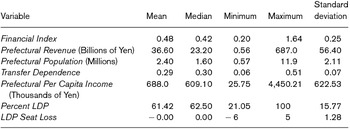
To determine the role of political influence in the determination of the financial index, the empirical analysis consists of Japan's 47 (46 until 1972 with the return of Okinawa to Japanese authority) prefectural governments from the era of LDP single party dominance, 1958–1993. During this time, the LDP held single party control over policy-making and this allows for a thorough empirical analysis of the changes and trends while keeping the party in power as the invariant.Footnote 13 As a result, the data structure exemplifies a time-series cross-sectional method, with the prefectures serving as the sectional unit and the election period serving as the temporal unit. An explanation of the reasoning for using electoral periods rather than years is discussed in detail in the section describing the independent variables. For reference purposes, basic summary statistics of the dependent variable and other independent variables are presented in Table 1.
Summary statistics

Dependent variable
As it is the source of the empirical question under investigation, the dependent variable estimated in the forthcoming models is the published Financial Index. The financial index data are found in Todōfuken Keizai Shisū Hyō, and in the most general of terms, if a prefectural government receives a score of 1 or higher, it is deemed largely self-sufficient and receives much less in financial support from the central government. However, very few prefectures received a score of 1 or higher. For the overwhelming majority of cases, high-scoring prefectures exhibit a relatively large population and extensive business and industrial sectors that mitigate the need for fiscal transfers of a considerable magnitude.Footnote 14 From 1958 to 1993, the financial index ranged from 0.15 at its nadir and reached its zenith at 1.67. As a general trend, most prefectures received scores in between 0 and 1 with the mean standing at 0.5 and the standard deviation registering at 0.3.
Independent variables
The first set of variables included in the empirical model are measures of prefectural economic vitality and need. If the financial index acts as an apolitical equalization mechanism, it should track closely with the measures of economic vitality for that prefecture. Prefectural Government Revenue is the first of these variables and originates from the Chihō Zaisei Tōkei Nenpō (Annual Statistics of Local Government Finances). It should be expected that Prefectural Government Revenue should show a positive and statistically significant relationship with the financial index. Additionally, because the reporting of prefectural revenue includes all revenue received by prefectural governments, including intergovernmental transfers, the empirical models include Prefectural Transfer Dependence; defined as the proportion of transfers that comprise prefectural revenue.
Although it receives less relative less attention and fanfare than prefectural revenue and transfer dependence, Prefectural Population should also exert pressure on the financial index. Normally, larger populations exert considerable fiscal pressure on prefectural governments; as a result, the model includes prefectural population. However, the influence of prefectural population could exert the opposite effect. Prefectures with large populations allow for a broader tax base that may mollify the need for financial support from the central government. In addition, prefectural population also plays a role in the political influence on the financial index. For a considerable amount of time, the LDP received widespread support from rural areas with limited ability to efficiently tax prefectures as the primary means of funding the prefectural governments. Consequently, prefectural population also serves as a control variable for the well-known rural bias of the LDP (Thies, Reference Thies1998). The prefectural population data originate from two different sources. For the years 1957–1974, the data originate from Kanketsu Showa Kokusei Sōran (Complete Showa-period Census Data Statistics) and from 1975 to 1993, they originate from Chihō Zaisei Tōkei Nenpō (Annual Statistics of Local Government Finances). Additionally, measures of prefectural wealth should also influence the determination of the financial index. Although prefecture revenue should move in relative tandem with the economic well-being of a prefecture, the empirical model must account for the wealth of a prefecture. As a result, prefectural per capita income is included in the estimation of the models and originates from Kenmin-Keizai Keisan-Nenpō (Annual Statistics of Prefecture Economy).
The electoral data serve as the main explanatory variable and result from a reorganizing and restructuring of Reed's (Reference Reed1992) collection of district election results. In the first election after Japan had regained its sovereignty from Allied forces, political parties and individual candidates contested lower house legislative elections in 46 prefectures prior to the return of Okinawa to Japanese control in 1972 and 47 prefectures thereafter. Elections were contested at the sub-prefectural level with districts with magnitudes that ranged from two at the minimum and standing at six in the maximum.Footnote 15 Winners of seats were decided via Japan's well-known and controversial Single Nontransferable Vote with Multimember Districts, where parties controlled the party label.Footnote 16 On average, district magnitudes for these subnational electoral districts stood just above 3.5 and prefectural district magnitudes numbered about ten. However, by the time the LDP finally lost its electoral stranglehold on the government in 1993, resulting in a massive coalition government requiring almost every party other than the LDP, the average district magnitude inched closer to 4 and prefectural district magnitude slightly increased to 10.93.
However, two data incongruities in the data exist. The first incongruity exists between the reporting of prefectural financial index scores and electoral data. Because elections occur at the district rather than the prefectural level, the electoral data have been modified to match the unit of analysis for the electoral, economic, and financial index data. While under ideal circumstances there would be financial index scores for each electoral district, this is not possible. Second, there is also a temporal incongruity between the financial index (as well as the economic variables) and electoral data. As Japan operates under a parliamentary system, elections occur at irregular intervals while economic data are collected at regular intervals. As a result, all economic data are aggregate to the years following the prior election, but up until the year before the election.Footnote 17
The empirical models use two different political variables to measure and estimate the influence of politics in the financial index. The first is Percent LDP, which is calculated by taking the percentage of seats held by the LDP in the lower house of the national legislature from each prefecture. Its measures the local strength of the LDP, and its inclusion in the empirical models relates political influence to the determination of the financial index. As a result, if politics influences the financial index, it should reveal itself in both the direction and significance of the coefficients of the estimated model. If so, it leads credence to the contention that similar to other outlays, politics drives even portions of formulaic financial aid to prefectures. The second political variable included in the empirical model is Prefectural LDP Seat Loss. It discretely measures the difference in prefectural seats held by the LDP from the prior election. For example, consider Aichi prefecture in the postwar period. In 1958, Aichi prefecture had five electoral districts. Districts 1–5 had a magnitude of five, four, three, four, and three respectively. This means that as a whole, Aichi prefecture had a district magnitude of 19. In 1958, 11 of the 19 seats were held by the LDP. In 1960, the prefectural district magnitude did not change, but the LDP gained one seat from 1958. As a result, for Prefectural LDP Seat Loss, the value of Aichi for Election Period 3 (1960 Election) is +1. However, in Election Period 4 (1963 Election), the LDP lost a seat and, as a result, Prefectural LDP Seat Loss for Election Period 4 for Aichi Prefecture is –1. Ostensibly, the main purpose of including this variable involves determining whether the short-term political prospects of the LDP influence the financial index, but it also serves as a robustness check on the change in the percentage of LDP prefectural seats held and to ensure that any consequential empirical findings are not the product of a singular measurement of political influence.
Estimation technique
As prominently suggested by De Boef and Keele (Reference De Boef and Keele2008), at the outset we should define the empirical model as simply as possible and then add constraints and alterations as needed for technical and substantive concerns. First, consider the following simple and elementary time-series cross-sectional model
 $$\begin{equation*}
{Y_{i,t}} = {X_i}_{,t}\beta + {Z_i}_{,t}\lambda + {\epsilon _i}_{,t};i = 1,...,N;t = 1,...,T
\end{equation*}$$
where Y i, t represents the financial index for prefecture i in election period t; Xi , t represents a vector of independent variables representing formulaic components that should influence the financial index as a fiscal equalization measure for each prefecture i in election period t; β represents a vector of multiplicative coefficients that relate Xi , t to the dependent variable, Y i, t . Zi , t represents an independent variable that measures the LDP's electoral support within prefecture i in election period t. λ represents a vector of multiplicative coefficients that relate Zi,t to the dependent variable, Yi , t .
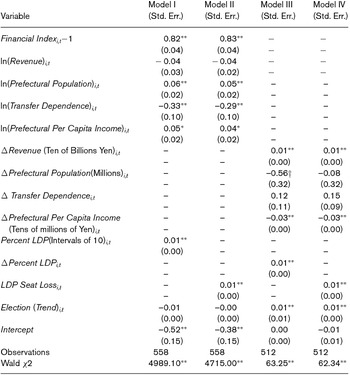
For the sake of robust empirical analysis, the model contains four estimations. The first set, presented as Models I and II in Table 2, estimate the financial index in its reported form. Based on the nature of several of the variables included in the empirical model, several of the independent variables should undergo a logarithmic transformation. Normally, logarithmic transformations find use when a variable violates the normality assumption of the classic linear regression model (CLRM). This is present for multiple variables in Models I and II, including the economic indicators that partially determine the financial index because only positive values of the indicator are possible. Additionally, logarithmic transformations also aid in reducing the orders of magnitude between small and larger prefectures. As a result, the independent variables Prefectural Government Revenue, Prefectural Population, and Prefectural Per Capita Income are estimated using logs.
Influences on financial index and Marginal financial index

Notes: Significance levels: † : 10% * : 5% ** : 1%
Finally, as a result of the possibility of serial correlation in the financial index, Models I and II estimate the model with the inclusion of a lagged dependent variable.Footnote 18 The difference between Models I and II shows itself in the variable used to measure LDP electoral support. In Model I, the percent LDP serves as the political influence variable whereas LDP election-to-election seat loss serves this role in Model II. Models I and II utilize the following functional form
 $$\begin{equation*}
\begin{array}{@{}l@{}} {\it Financial\ Inde}{x_i}_{,t} = \alpha + {\beta _1}{\it Financial\ Inde}{x_i}_{,t - 1} + {\beta _2}ln{\left( {\it {Revenue}} \right)_i}_{,t}\\ \,\,\,\, +\, {\beta _3}ln{\left( {\it Prefectural\ Population} \right)_i}_{,t} + {\beta _4}{\it Transfer\ Dependenc}{e_i}_{,t}\\ \,\,\,\, +\, {\beta _5}ln{\left( {\it Prefectural\ Per\ Capita\ Income} \right)_i}_{,t} + {\beta _6}{\it LDP\ Electoral\ Suppor}{t_i}_{,t}\\ \,\,\,\, +\, {\beta _7}{\it Election\ Counte}{r_i}_{,t} + {\epsilon _i} \end{array}
\end{equation*}$$
In addition to Models I and II, Table 2 also presents Models III and IV. The latter depart from the former by estimating election-to-election change in the financial index with election-to-election changes in the same independent variables. Similarly to Models I and II, Models III and IV depart from each other as a result of estimating Model III using Prefectural Percent LDP and estimating Model IV with LDP Seat Loss as the measure of LDP electoral support. The other notable departure from Models I and II involves the removal of logarithmic transformations from several independent variables. This results from the fact that the previously transformed independent variables do not require transformation because theoretically these variables are no longer left censored.Footnote 19 As a result, Models III and IV utilize the following functional form
 $$\begin{equation*}
\begin{array}{@{}l@{}} \Delta {\it Financial\ Index}_{i,t} = \alpha + \beta_{1}\Delta {\it Revenue}_{i,t} + \beta_{2}\Delta {\it Prefectural\ Population}_{i,t}\\ \,\,\,\, +\, \beta_{3}\Delta {\it Transfer Dependence}_{i,t} + \beta_{4}\Delta {\it Prefectural\ Per\ Capita\ Income}_{i,t}\\ \,\,\,\, +\, \beta_{5}\Delta {\it LDP\ Electoral\ Support}_{i,t} + \beta_{6}{\it Election\ Counter}_{i,t} + {\epsilon _i} \end{array}
\end{equation*}$$
Results
First, in Models I and II, there is little surprise about the direction and importance of economic factors in the determination of the financial index bar one. The coefficients for the logged values of Prefectural Revenue are not statistically significant. This discrepancy from previous empirical work likely originates from the fact that Transfer Dependence is also included in the model. Not surprisingly, dependence on funds from the central government likely results in lower scores on the financial index. The statistical insignificance of the Prefectural Revenue variable likely stems from the inclusion of several variables, Prefectural Population, Transfer Dependence, and Prefectural Per Capita Income, that ostensibly measure Prefectural Government fiscal capacity. However, the other variables measuring fiscal capacity of prefectural governments conform to other empirical examinations of intergovernmental transfers and the financial index. As Prefectural Population increases, the financial index increases which signifies less of a need for financial aid from the central government. Likewise, coefficient estimates of Prefectural Per Capita Income are positive and significant. This conforms not only to the empirical evidence in the literature, but also to the logic that the financial index, in part, measures fiscal capacity.
Where these estimates register disagreement with previous literature is the finding that both the percentage of seats held by the LDP and LDP Seat Loss/Gain exerts a positive and statistically significant influence on the financial index. For each 10% gain in the percentage of prefectural seats held by the LDP and additional seat gain, the financial index increases by 0.01. Although this does not seem like a significant increase for political influence, two things should be noted: first, that the financial index should show no political influence; second, that the coefficient is not strong because of the inclusion of two of the dimensions of LDP support, rural areas (measured by logged population), and wealth (measured in Prefectural Per Capita Income). Nevertheless, political support of the LDP exerts an influence on the financial index.Footnote 20
Models III and IV show some contradictions when compared with the hypothesized relationship between fiscal capacity and the financial index. Most notably is the impact of changes in the prefectural population on changes in the financial index. In Models I and II these coefficients are positive and significant, but in Model III, the coefficient is slightly statistically significant and negative. In addition, Model IV gives non-significant and negative estimates. The other estimates that depart from Models I and II are prefectural per capita income. In both Models III and IV, the differences in per capita income estimate as a negative and statistically significant coefficient. As a result, an increase in a prefecture's per capita income exerts a downward pressure on the financial index. However, this difference can be explained by the fact that change in revenue tracks closely with prefectural per capita income.
However, changes in the financial index show a similar connection with changes in political influence. In Model III, the ∆Prefectural Percent LDP estimate mirrors that of Models I and II with an increase of 0.01 in the financial index for each 10% change in the percent of prefectural seats held by the LDP. Model IV confirms that the influence of politics on change in the financial index from election to election. LDP Seat Loss shows the same coefficient, direction, and level of statistical significance. For each seat gained by the LDP, there is a 0.01 change in the financial index. While these results seem slight, it bears noting that the average value of ∆financial index is 0.003. As a result, the increase of 0.01 in both cases is quite a substantial result. While Models I–IV provide empirical evidence for the claim that politics influences the financial index, on a substantial level, it also provides some interesting insights on Japanese Politics more generally.
Discussion
The empirical results speak to two of the more vibrant and contentious debates on postwar Japanese politics. The first involves the debate on distributive benefits in Japan. As Scheiner (Reference Scheiner2006) succinctly characterizes almost two generations of literature on distributive politics in Japan, ‘Japanese politicians, voters, and journalists argued that the Liberal Democratic Party (LDP) was able to maintain the support of a specific set of constituents who relied greatly on the subsidies it provided’. To be sure, Scheiner's observation is not without its support as a great deal of empirical work signals the same trend and pattern in Japanese politics. However, this analysis of the financial index seems to indicate a different pattern. As prefectures’ electoral support for the LDP increased or experienced positive change, the financial index increased. However, the financial index uses a scale where larger scores should result in less financial assistance from the central government. If the LDP used intergovernmental transfers to reward its supporters, the political coefficients should show a negative relationship with the financial index.
Additionally, if this traditional view of the LDP and distributive politics is accepted, the LDP Seat Loss/Gain coefficients should show a negative relationship. The positive and significant LDP Seat Gain/Loss indicates that as the LDP increased its support from the previous election cycle, the financial index increased resulting in less financial assistance from the central government. Although this comes from a singular expenditure item, it is worth noting that intergovernmental transfers may not follow the same political logic of the LDP on other expenditure items found in the literature.
Second, the finding that the LDP influences the financial index provides a counterargument to the claim that politicians and parties are inconsequential to Japan's economic policy-making process. Although the validity of the claim, using almost every analytical tools including formal and empirical modeling, that civil service superiority has experienced a precipitous decline, the political influence on the financial index exposes a serious flaw in such a claim. The financial index is supposedly apolitical with the civil service holding primacy; politics nevertheless influences its determination. The finding that politics influences policy in postwar Japan has undergone quite a trajectory; from multiple accounts rejecting even the notion that politics matter in policy-making (Johnson, Reference Johnson1975, Reference Johnson1982; Pempel, Reference Pempel1978) to a vague inference that politics influence policy-making (Calder, Reference Calder1988; Kohno and Nishizawa, Reference Kohno and Nishizawa1990; Patterson, Reference Patterson1994), to a view that politics have a role in policy and are considered the singular purview of the civil service (Beason and Weinstein, Reference Beason and Weinstein1996), and also have a role in the calculation of bureaucratic mechanisms for equalization of fiscal resources for prefectural governments.
However, two questions are left unanswered regarding the financial index. First, what explains the influence of politics on the financial index? Does the LDP actively instruct the civil service to alter the financial index enhance their political prospects? Although it is conjecture, the LDP giving instructions to make alterations to the financial index seems slightly far-fetched. It seems more likely that alterations in the financial index originate from informal instruction. Civil servants involved in the crafting of the financial index likely do so in accordance with the wishes of the LDP, but those wishes are not formally dictated. This explanation for the political influence on the financial index finds its support in Ramseyer and Rosenbluth's (Reference Ramseyer and Rosenbluth1993) contention that civil servants can only implement policies of their choosing so long as the costs of LDP interceding do not outweigh the difference in the chosen policy and legislature's ideal point.
The second question centers on the discrepancy between the findings within the literature on intergovernmental transfers. Why do some studies show that the LDP rewards supporters with intergovernmental transfers while others show a more complex targeting strategy? The findings herein support the idea that the LDP uses intergovernmental transfers in a targeted rather than in a more paternalistic and tribalistic manner. This point of view is highlighted in Horiuchi and Saito's (Reference Horiuchi and Saito2003) work regarding overrepresented districts and intergovernmental transfers. As overrepresented districts went by the wayside, the transfers seemed to equalize. This points to a targeted strategy in the LDP to use intergovernmental transfers. However, the findings here and in Horiuchi and Saito (Reference Horiuchi and Saito2003) clash with other empirical works regarding these transfers. Of most consequence is Hirano's (Reference Hirano2006) findings that higher amounts of subsidies found their way to the hometowns of LDP politicians. While no clear-cut explanation exists, it supports the fact that intergovernmental transfers in postwar Japan represent an area of research ripe for analysts to cull.
Conclusion
Scholars have paid closer attention to Japan's system of intergovernmental transfers in a multitude of institutional contexts and this shift is apparent for many analytical reasons. But, even with this development, understanding one of the most important influences in intergovernmental transfers, the financial index, remains relatively elusive. As a result, this research asked the question: what factors influence the financial index? More specifically, based on the LDP's well-documented reputation for pulling the purse strings of government to enhance its electoral prospects, does political support play a role in the determination of the financial index?
In short, the second question can be answered in the affirmative. However, it is important to note that it works in conjunction with a majority of the literature on intergovernmental transfers in Japan. The percentage of LDP members in a given prefecture has a positive and statistically significant effect on the financial index. In addition, a prefecture's population and its per capita income also exerts upward pressure on the financial index. Conversely, a prefecture's dependence on funds based on the amount of transfers received as a proportion of total prefectural revenue and the sequential measurement of elections in the postwar period exerts a downward pressure on the financial index.
These findings have several important implications for the understanding of not only the financial index, but also, more generally, of intergovernmental transfers. First, the positive and significant nature of the coefficient on percent LDP indicates that prefectural governments receive higher scores on the financial index. Since higher scores indicate less need for financial assistance from the central government, prefectures with more LDP representation receive lower amounts of intergovernmental transfers. This is particularly perplexing given the fact that a large portion of the empirical literature concludes that the LDP rewards its supporters and punishes its opponents. More interestingly, the empirical model accounts for the most influential geographic and demographic factors that often drive either LDP support or that of the opposition and nevertheless, electoral support for the LDP still plays a role in the determination of the financial index. But other than the variable measuring LDP electoral support, the other variables move in the direction predicted and hypothesized. As a result, the introduction of an electoral support variable is important in future research regarding intergovernmental transfers in postwar Japan.
About the authors
Taylor C. McMichael is Program Director and Senior Lecturer of Political science at the University of Texas of the Permian Basin. His research focuses on Japanese Politics, Distributive Politics and Quantitative Methodology. His current work focuses on the political determinants of intergovernmental transfers in postwar Japan.