INTRODUCTION
In tropical forests, almost 80% of plant species have fleshy fruits, and their dispersal often occurs in multiple steps involving more than one dispersal agent (Pizo et al. Reference PIZO, GUIMARÃES and OLIVEIRA2005a, Vander Wall et al. Reference VANDER WALL, KUHN, BECK and ECK2005). Fleshy fruits may reach the forest floor by falling directly from the mother tree or after being manipulated by frugivores (Christianini & Oliveira Reference CHRISTIANINI and OLIVEIRA2010). The high diversity and abundance of diaspores (i.e. the unit of dispersal) and also of ground-dwelling ants, make interactions especially common in lowland rain forest (Pizo & Oliveira Reference PIZO and OLIVEIRA2000), so that the chance of secondary dispersal by ants is high. In most cases where seed dispersal by animals occurs in more than one step, the first phase has the principal benefit of avoiding seed predation and colonizing new environments, while the second usually results in the directed dispersal of the diaspore (Vander Wall & Longland Reference VANDER WALL and LONGLAND2004), causing a disproportionately positive effect on the recruitment of new individuals into the population (Wenny Reference WENNY2001).
In contrast to myrmecochory syndromes, the majority of ant–diaspore interactions in tropical forests are opportunistic, usually involving generalist ant species and non-myrmecochorous diaspores (Bernstein Reference BERNSTEIN1975, Levey & Byrne Reference LEVEY and BYRNE1993). Although ant–diaspore interactions occur frequently, ant activity as secondary-dispersal agents of tropical plant species will often depend on the morpho-chemical characteristics of the diaspores, and interactions do not always culminate in the removal of seeds (Christianini et al. Reference CHRISTIANINI, MAYHÉ-NUNES and OLIVEIRA2012). According to some studies, ants show a preference for diaspores rich in lipids (Guimarães & Cogni Reference GUIMARÃES and COGNI2002, Pizo & Oliveira Reference PIZO and OLIVEIRA2001), which are also the principal nutrients in elaiosomes of myrmecochorous diaspores (Beattie Reference BEATTIE1985). Besides lipid concentration, diaspore mass may also be a key factor in determining whether or not ants remove diaspores, with capacity to remove limited by the body size of the ant (Ness et al. Reference NESS, BRONSTEIN, ANDERSEN and HOLLAND2004, Pfeiffer et al. Reference PFEIFFER, NAIS and LINSENMAIR2006).
Once on the forest floor, non-myrmecochorous diaspores become susceptible to interactions with the leaf-litter ant community (Christianini & Oliveira Reference CHRISTIANINI and OLIVEIRA2010, Pizo et al. Reference PIZO, PASSOS, OLIVEIRA, Forget, Lambert, Hulme and Vander Wall2005b), which may contribute to their rapid removal, increasing their survival probability (Hughes & Westoby Reference HUGHES and WESTOBY1990). The longer a fleshy diaspore remains on the forest floor, the more susceptible it is to predation by rodents and understorey birds (Mendoza & Dirzo Reference MENDOZA and DIRZO2007). The interaction between ants and diaspores may be crucial to the phase preceding plant recruitment. However, understanding when and how ant behaviour influences seed dispersal of non-myrmecochorous diaspores continues to present a challenge (Christianini et al. Reference CHRISTIANINI, MAYHÉ-NUNES and OLIVEIRA2012, Manzaneda & Rey Reference MANZANEDA and REY2009, Rowles & O'Dowd Reference ROWLES and O'DOWD2009).
Evaluating the behaviour ants exhibit toward fleshy fruits on the forest floor will help understand the role these invertebrates play in determining the final fate of seeds in rain-forest ecosystems. In the present work, we examined diaspore persistence on the forest floor using seven plant species that differed in the morpho-chemical characteristics of their diaspores, and we predicted that (1) ant–diaspore interactions decrease short-term diaspore persistence on the forest floor, (2) ants remove diaspores on the forest floor at a faster rate than vertebrates, (3) specific diaspore morpho-chemical characteristics such as size and lipid concentration influence the probability of removal by ants.
METHODS
Study area
Field experiments were conducted from October 2009 to September 2010, at Una Biological Reserve, municipality of Una, southern Bahia, Brazil (15°11′00″S, 39°10′30″W). Climate of the region is Af, tropical rain-forest climate, according to Köppen's classification (Mori & Boom Reference MORI and BOOM1983). Average precipitation is 2000 mm y−1 without marked seasonality and mean annual temperature is 24 °C (Mori & Boom Reference MORI and BOOM1983). The dominant vegetation type at Una Biological Reserve is classified as lowland tropical moist forest (Oliveira-Filho & Fontes Reference OLIVEIRA-FILHO and FONTES2000), with low fertility soil and a dominance of the palm Euterpe edulis (Thomas et al. Reference THOMAS, JARDIM, FIASCHI, AMORIM, Prado, Landau, de Moura, Pinto, Fonseca and Alger2003). The tree and shrub genera Myrcia, Psychotria and Miconia contribute the most to the plant diversity of the area (Amorim et al. Reference AMORIM, THOMAS, JARDIM and Thomas2008). The floristic composition of Una Reserve shows similarities at the generic level with the coastal forests of south-eastern Brazil, as well as with the Amazonian biome (Amorim et al. Reference AMORIM, THOMAS, JARDIM and Thomas2008). The landscape of the Reserve is composed of a mosaic of forest remnants in different successional stages and abandoned cocoa plantations, with 50% of the remnants in advanced stages of succession (Cassano et al. Reference CASSANO, DELABIE, FARIA and BEDE2009).
Study species
We selected seven plant species primarily dispersed by vertebrates, mainly birds: Byrsonima sericea DC. (Malpighiaceae), Euterpe edulis Mart. (Arecaceae), Henriettea succosa (Aubl.) DC. (Melastomataceae), Miconia prasina (Sw.) DC. (Melastomataceae), Pera glabrata (Schott) Baill. (Euphorbiaceae), Psychotria sp. (Rubiaceae) and Tapirira guianensis Aubl. (Anacardiaceae). Plant species were chosen from among those with the highest ant–plant interaction frequency in an a priori census of ant–plant interactions in the study area (Santana et al., unpubl. data) and to represent the range of variation in diaspore traits, insofar as these can be perceived visually. Morphological and chemical characters of diaspores were analysed a posteriori. Mature fruits were collected directly from the tree and/or under the parent tree immediately after falling, from at least three individuals of each of the seven study species. Both removal and diaspore persistence experiments were carried out during the fruiting season of each plant species.
Ant–diaspore interaction surveys: short-term diaspore persistence
We conducted an experiment to evaluate the influence of ants on the short-term persistence of diaspores of our seven plant study species. Plant species of interest were widely distributed and abundant on our study site, so we were not restricted in the placement of our experiment within the forest. Experiments were conducted on a transect set up on a 2-km, previously established, trail through secondary forest on our study site. We established a sample station by placing five diaspores of one plant species on a 5 × 5-cm sheet of white filter paper on the ground, spaced every 10 m, for 50–100 m, depending on diaspore species availability. Based on previous studies, we concluded that 10-m intervals would guarantee independent discoveries by different colonies for most ant communities (Byrne & Levey Reference BYRNE and LEVEY1993, Kaspari Reference KASPARI1996). To avoid vertebrate interference during sampling, diaspores were protected by a wire cage (20 × 20 × 10 cm, 1.5-cm mesh) closed on the top and sides (Roberts & Heithaus Reference ROBERTS and HEITHAUS1986) and staked to the ground. Number of sample stations per plant species was 10 with the exception of B. sericea and Psychotria sp. that had five sample stations given the limited number of diaspores available. Diaspores were set out 1 h before observations began to allow worker ants from colonies differing distances away a more equal chance of discovering the diaspores. Observations at sample stations started at 13h00, lasted 5 min, and occurred every 2 h for 24 h continuously, for a total of 12, 5-min observations per station. Ant behaviour was classified into two categories: either the ant consumed the fleshy part of the diaspore in situ (seed cleaning) or the ant removed the diaspore from the area (at least 20 cm away from the sample station; the area within a 3-m radius was searched). During each observation period, we counted the number of diaspores completely cleaned by ants (e.g. lacking the fleshy portion) or missing from each sample station. We did not replace diaspores removed from sample stations during the experiment. When possible, we followed ants carrying diaspores until they disappeared into the litter or reached their nest and measured the distance of diaspore dispersal. Ant specimens were collected for further identification. To evaluate the short-term persistence of diaspores on the forest floor, we performed survival analysis for each species studied using the Kaplan–Meier method and Log-Rank test to compare differences between survival curves. We used each station as a sample unit and considered the removal of at least one diaspore as an event. The analyses were performed in the software SPSS version 9.0. We used chi-square tests to assess whether ant behaviour (seed cleaning or diaspore removal) differed among species of diaspore. Ant and plant vouchers were identified and deposited in the collection of the Myrmecology Laboratory at the Centro de Pesquisas do Cacau and in the Herbarium at the Centro de Pesquisas do Cacau, respectively.
Diaspore removal: ants versus vertebrates
We used exclusion experiments to investigate how ants and vertebrates differentially affected diaspore removal. We established 5–14 sampling stations, depending upon fruit availability of each plant species, every 25 m along a transect 1 km away from and parallel to the 2-km transect described above. Each sampling station included a pair of treatments, placed 20 cm apart, that excluded either ants or vertebrates. Within each treatment, we placed 10 diaspores of one plant species so that we examined diaspore removal for each study species separately. For vertebrate-exclusion treatments, diaspores on filter paper were protected by a wire cage (20 × 20 × 10 cm, 1.5-cm mesh), closed on the top and sides (Roberts & Heithaus Reference ROBERTS and HEITHAUS1986) and staked to the ground, allowing access only to ants and other small invertebrates. Others invertebrates with access to diaspores in cages were unable to remove them because of diaspore size (pers. obs.). For ant-exclusion treatments, diaspores were placed on transparent plastic dishes and an insect-trapping glue (Tanglefoot©) was applied around the border of the dish, allowing access to only vertebrates (Hughes & Westoby Reference HUGHES and WESTOBY1990). We tested the effect of Tanglefoot glue on vertebrate behaviour prior to this experiment and found it did not affect vertebrate behaviour at sample stations. After 24 h, we counted the number of diaspores missing at each sampling station. Diaspores that were moved more than 20 cm or found to be no longer present in the area (3-m search radius around each pair of stations) were counted as removed from the sampling station. Data from experiments interrupted by rain were ignored and the experiment was repeated. We compared difference of diaspore removal after 24 h in vertebrate- and ant-exclusion treatments of each plant species using Wilcoxon paired-sample tests, due to non-normality of data distributions. Analyses were performed using MASS package in R statistical environment. Ants interacting with diaspores in vertebrate exclusion treatments were collected for further identification.
Diaspore removal by ants and morpho-chemical traits
We measured diaspore length, width (mm), and mass (g) to assess morphological differences among study species. For chemical analysis of diaspores of B. sericea, E. edulis, P. glabrata and Psychotria sp., we collected diaspores from fruiting plants and separated the fleshy part of the diaspores from the seeds for analysis. Specimens were frozen until analysis began in the laboratory with a lyophilization process. Per cent composition of lipids, total sugar (carbohydrate) and protein were determined using methods described in Nogueira & Souza (Reference NOGUEIRA and SOUZA2005). For chemical analysis of H. succosa and M. prasina diaspores, we used previously freeze-dried material collected from diaspores in the study area (Catenacci et al. Reference CATENACCI, DE VLEESCHOUWER and NOGUEIRA-FILHO2009) and then followed the same procedures described above. The chemical composition of diaspores of T. guianensis was obtained from Cazetta et al. (Reference CAZETTA, GALETTI, REZENDE and SCHAEFER2012).
We related the number of diaspores removed by ants from the experiments described above with diaspore mass and nutrient concentration using stepwise linear regression (backward procedure). Correlations between predictor variables were tested before regressions and full models included only uncorrelated predictors. To ensure linearity, diaspore mass was logarithmically transformed. We examined the relationship between ant removal and the most important predictor variables, after removing effects of other potential predictors, using partial regression plots. Analyses were performed using MASS package in the R statistical software environment.
RESULTS
Ant–diaspore interaction surveys: short-term diaspore persistence
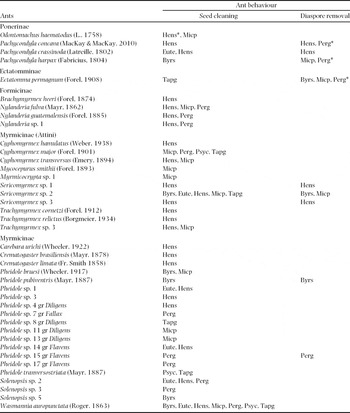
We recorded 332 ant–diaspore interactions with the seven plant species examined during our surveys. Of all interactions, approximately 26% occurred with H. succosa diaspores, followed by P. glabrata (21%), M. prasina (15%), B. sericea (13%), E. edulis (12%), T. guianensis (8%) and Psychotria sp. (5%). We recorded 40 ant species from four subfamilies interacting with diaspores. Ants from the subfamily Myrmicinae made up 77.5% of recorded interactions, with approximately 35% (11 of 31) of these from the fungus-cultivating tribe Attini. Ants from the subfamilies Formicinae, Ponerinae and Ectatomminae made up the 22.5% remaining ant species we observed (Appendix 1). The number of ant species that interacted with diaspores of each plant species ranged from three species interacting with Psychotria sp. to 24 with H. succosa.
Ant behaviour in diaspore interactions varied significantly among plant species studied (n = 332, χ2 = 29.0, df = 6, P < 0.001). Most interactions resulted in ants consuming the fleshy part of the fruit in place (seed cleaning, 81.0%), but the rest of the interactions (almost 20%) resulted in removal of diaspores from the area. Ant activity around the diaspores was continuous during the 24-h period of our experiments. At some sampling stations, interaction with diaspores of plant species was dominated exclusively by one ant species. For example, interactions with B. sericea diaspores were dominated by the ant Pheidole bruesi, those with H. succosa was dominated by the ant Sericomyrmex sp. 3, and those with M. prasina was dominated by Wasmannia auropunctata. Diaspores of H. succosa and M. prasina attracted the highest species diversity of ants, especially non-leaf-cutting fungus-cultivators. Most diaspore removal by ants occurred with P. glabrata, B. sericea and M. prasina diaspores, in decreasing order of frequency. Although ants were unable to remove H. succosa diaspores because of their mass, we observed small Myrmicinae and Ponerinae ants removing its tiny seeds (~0.001 g). In only three observations was it possible to follow the ant to the location where it deposited the diaspore and in these cases dispersal distance varied from 63 to 90 cm from the sampling station.
Poneromorph ant species (e.g. Ectatomminae and Ponerinae) were responsible for most diaspore removal. Workers of this group have among the largest body sizes of ants present in the study area. They are principally carnivorous, generalist predators that usually forage alone (Fowler et al. Reference FOWLER, FORTI, BRANDÃO, DELABIE, VASCONCELOS, Panizzi and Parra1991). Ants of the subfamily Myrmicinae acted mainly as seed cleaners and removal events were rare. The exploitation of diaspores by myrmicines usually occurred in groups which had been recruited by workers. Some species of this subfamily were capable of removing diaspores of up to 0.54 g (e.g. B. sericea) after recruitment of more workers from their colony.
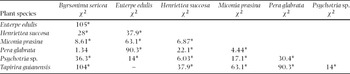
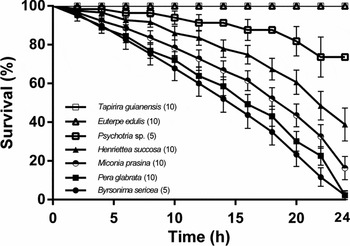
The short-term persistence time (≤ 24 h) of diaspores on the forest floor varied significantly among plant species studied (Log Rank, χ2 = 212, df = 6, P < 0.0001). Pairwise comparisons showed that P. glabrata and B. sericea exhibited no significant statistical difference in persistence, with 33% and 20% of persistence respectively. Diaspores of E. edulis and T. guianensis having 100% of short-term persistence on forest floor after 24 h, also showed no difference in pairwise comparisons (Table 1). All other pairwise comparisons showed significant differences in persistence percentages. Diaspores of P. glabrata, B. sericea and M. prasina were removed most frequently during systematic sampling, and showed the lowest short-term persistence percentages on the forest floor (Figure 1).
Pairwise comparisons of diaspore survival curves for the seven species evaluated on Atlantic forest, north-east Brazil. * P < 0.05.

Survival curves with errors bars of the seven species involved in ant–diaspore interactions on the Atlantic forest, north-east Brazil. The number of sampling stations for each species is indicated in parentheses. Zero marks the beginning of the experiment, with 5-min observations made every 2 h for 24 h.

Diaspore removal: ants versus vertebrates
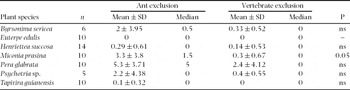
Diaspores were removed in both ant- and vertebrate-exclusion treatments (Table 2). Ants removed more diaspores than vertebrates, for most plant species studied, but the proportion of diaspores removed was only significantly higher for M. prasina diaspores. Both ants and vertebrates removed greater numbers of P. glabrata diaspores than those of any other species. During observations of T. guianensis and P. glabrata, vertebrates predated some diaspores in the ant-exclusion treatment, but no other diaspore predation was observed.
Comparison of diaspore removal from vertebrate- and ant-exclusion treatments on the Atlantic forest floor, north-east Brazil. For each plant species, 10 diaspores were set out per treatment and counted after 24 h. n = number of sampling stations and number of diaspores removed are presented by mean ± SD and the median. Wilcoxon paired-sample tests were performed, ns = non-significant values considered for P > 0.05.

Diaspore removal by ants and morpho-chemical traits
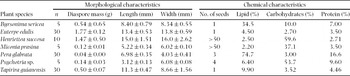
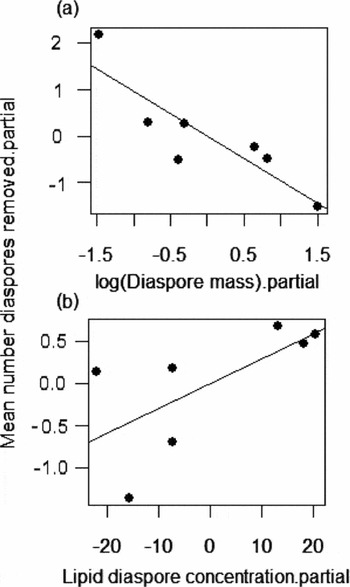
Diaspore morpho-chemical characteristics varied among plant species studied. Diaspore mass varied between 0.04 g for P. glabrata and 1.77 g for E. edulis (Table 3). Chemical composition of fleshy parts of diaspores varied greatly among species (Table 3). Diaspores of P. glabrata were richest in lipids, while those of H. succosa were richest in carbohydrates. Euterpe edulis and T. guianensis diaspores contained the lowest concentration of lipids, carbohydrates and proteins. Carbohydrate concentration was not related to the mean number of diaspores removed. The model that best explained the relationship between mean number of diaspores removed and their morpho-chemical properties included diaspore mass and lipid concentration (y = 0.32−1.05 log(mass) + 0.02 lipid; n = 7, F 2,4 = 19.2, P = 0.008, r 2 = 0.90). The partial regression showed that the relationship between diaspore removal and diaspore mass was stronger (Figure 2a; R2 = 0.71, P = 0.01) than the relationship between removal and lipid concentration (Figure 2b; R2 = 0.32, P = 0.1). Per cent protein concentration was not included in regression models, since it was positively correlated with per cent lipid concentration (r = 0.87, P < 0.001).
Morphological and chemical characteristics of diaspores of seven plant species involved in interactions with ants on Atlantic forest, north-east Brazil. Morphological characteristics values are represented by mean ± SD, and (n) means the number of diaspores analysed. Chemical analyses of lipid, carbohydrate and protein were made from dried processed material.

Partial regressions showing the mean number of diaspores removed against diaspore mass (a) and diaspore lipid concentration (b). Each point represents one of the seven studied species on the Atlantic forest floor, north-east Brazil. The partial effects of diaspore mass (a) and diaspore lipid concentration (b) exclude the effects of other variables included in the model. The values can be negative and represent the residuals from the multiple regression model. Mean number of diaspores removed ranges between 0 and 5.3; diaspore mass ranges between 0.04 and 1.77 and diaspore lipid concentration ranges between 2.16 and 74.71.

DISCUSSION
Our study showed that interactions between ants and diaspores available on the forest floor may differ greatly among plant species. According to our results, plant species benefited from ant–diaspore interactions mainly through seed-cleaning behaviour. Although it occurred less frequently than seed cleaning, diaspore removal by ants was important in reducing their short-term persistence on the forest floor. Our results confirmed that ants are the principal removers of diaspores on the forest floor in environments like our study area (Byrne & Levey Reference BYRNE and LEVEY1993, Christianini & Oliveira Reference CHRISTIANINI and OLIVEIRA2010, Roberts & Heithaus Reference ROBERTS and HEITHAUS1986). Moreover, morpho-chemical characteristics of diaspores are important predictors of whether interactions with ants result in diaspore removal.
Diaspore chemical composition and ant guild are important in predicting the nature of ant–diaspore interactions, as previous studies (Christianini et al. Reference CHRISTIANINI, MAYHÉ-NUNES and OLIVEIRA2012, Passos & Oliveira Reference PASSOS and OLIVEIRA2003) and our data confirm. Small omnivorous ants of the subfamily Myrmicinae, apart from being the most abundant ants on the forest floor of tropical forests (Hölldobler & Wilson Reference HÖLLDOBLER and WILSON1990), are also responsible for exploiting the majority of diaspore resources on the forest floor (Leal et al. Reference LEAL, WIRTH and TABARELLI2007, Levey & Byrne Reference LEVEY and BYRNE1993, Pizo & Oliveira Reference PIZO and OLIVEIRA2000). Fungus-cultivating ants of the tribe Attini (Myrmicinae) are also very frequently in ant–diaspore interactions. In this study, we found a higher diversity of attine ants interacting with diaspores, compared with diversity levels detected by other studies from tropical environments. The diaspores most frequently visited by fungivorous ants were H. succosa and M. prasina, both rich in carbohydrates, consistent with previous studies (Christianini et al. Reference CHRISTIANINI, MAYHÉ-NUNES and OLIVEIRA2012, Passos & Oliveira Reference PASSOS and OLIVEIRA2003). We believe that fungus-farming, non-leaf-cutting ants (Mehdiabadi & Schultz Reference MEHDIABADI and SCHULTZ2010; e.g. species of Sericomyrmex, Trachymyrmex) may be important dispersal agents of non-myrmecochorous diaspores in the Atlantic forest (Passos & Oliveira Reference PASSOS and OLIVEIRA2002, Pizo & Oliveira Reference PIZO and OLIVEIRA2000). Diaspores rich in lipids and proteins tend to be preferred by generalist predatory poneromorphs, since these compounds are similar to what they encounter in their prey (Guimarães & Cogni Reference GUIMARÃES and COGNI2002, Passos & Oliveira Reference PASSOS and OLIVEIRA2003, Pizo & Oliveira Reference PIZO and OLIVEIRA2001).
The majority of diaspores that remain on the forest floor while retaining their fleshy parts die as a result of fungal attack (Augspurger & Kelly Reference AUGSPURGER and KELLY1984). Because of this, even if seeds are not removed, seed cleaning by ants may diminish the chance of attack by fungi and pathogens and increase the chance of germination (Christianini & Oliveira Reference CHRISTIANINI and OLIVEIRA2009, Horvitz Reference HORVITZ1981, Ohkawara & Akino Reference OHKAWARA and AKINO2004, Pizo et al. Reference PIZO, PASSOS, OLIVEIRA, Forget, Lambert, Hulme and Vander Wall2005b). In our study, ant activity focused mainly on cleaning fleshy parts from diaspores. In fact, most ant species were unable to carry the diaspore of the studied species due to the small body size of worker ants (Pfeiffer et al. Reference PFEIFFER, NAIS and LINSENMAIR2006). The removal of the tiny seeds from Melastomataceae diaspores by small myrmicinae ants may actually be considered seed predation, rather than seed removal, since some ants of this subfamily are granivorous (e.g. Pheidole; Andersen et al. Reference ANDERSEN, AZCA and COWIE2000, Kaspari Reference KASPARI1996). However, even seed removal by granivorous ants may benefit plant recruitment since not all seeds carried by these ants are predated (Milesi & Casenave Reference MILESI and CASENAVE2004, Wilby & Shachak Reference WILBY and SHACHAK2000). The events of diaspore removal by ants observed in our surveys were less frequent than those of seed cleaning by ants. However, removal by ants may be essential in reducing diaspore persistence time in soil (Christianini & Oliveira Reference CHRISTIANINI and OLIVEIRA2009, Servigne & Detrain Reference SERVIGNE and DETRAIN2008). Due to their capacity to carry medium-sized to large diaspores, as well as their habit of foraging long distances from their nest, ants of the genus Pachycondyla are probably the most important seed dispersal agents in tropical forests (Guimarães & Cogni Reference GUIMARÃES and COGNI2002, Passos & Oliveira Reference PASSOS and OLIVEIRA2002, Zhou et al. Reference ZHOU, CHEN and CHEN2007).
After mature fruits fall to the forest floor, the chance of dispersal away from the parent plant begins to decrease with time, while the chance that seeds will rot or be attacked by fungus increases (Augspurger Reference AUGSPURGER, Burdon and Leather1990, Cipollini & Levey Reference CIPOLLINI and LEVEY1997). We observed that ants play an important role in reducing short-term persistence of the diaspores (< 24 h), especially for those with high concentrations of primary compounds. These diaspores high in lipids and carbohydrates concentrations are usually quickly removed and often possess proportionately lower concentrations of secondary compounds, which can protect diaspores from attack by pathogens or fungus (Cazetta et al. Reference CAZETTA, SCHAEFER and GALETTI2008, Schupp et al. Reference SCHUPP, JORDANO and GÓMEZ2010). On the other hand, diaspores with low concentrations of primary compounds (e.g. E. edulis and T. guianensis), seem to persist for much longer on the ground. Even though these diaspores may become involved in ant interactions, the result may be neutral (Wenny Reference WENNY2001) or even negative for seed recruitment, when ant interactions impede the action of other potential dispersal agents (Christianini et al. Reference CHRISTIANINI, MAYHÉ-NUNES and OLIVEIRA2012). Carbohydrates are one of the most important nutritional components in ant diets (Bernstein Reference BERNSTEIN1975, Cresswell & Osborne Reference CRESSWELL and OSBORNE2004, Fowler et al. Reference FOWLER, FORTI, BRANDÃO, DELABIE, VASCONCELOS, Panizzi and Parra1991) and some studies show that diaspores rich in carbohydrates benefit more from ant interactions than do other diaspores (Dalling et al. Reference DALLING, SWAINE and GARWOOD1998, Farji-Brener Reference FARJI-BRENER2000). We found that diaspores of H. succosa and M. prasina, rich in carbohydrates, attracted the greatest number of ant species during interaction surveys, although we found no relation between carbohydrate concentration and number of diaspores removed. Diaspores of Psychotria sp. are also rich in carbohydrates. However, they were less frequently observed to interact with ants in our study. Psychotria species often possess high concentrations of secondary compounds, which help them avoid predation by pathogens and increase their persistence on the mother plant (Cazetta et al. Reference CAZETTA, SCHAEFER and GALETTI2008), but also make them less attractive and somewhat toxic to potential dispersers (Tang et al. Reference TANG, CORLETT and HYDE2005).
Ants compete for diaspores with rodents and ground-dwelling birds, the principal predators of diaspores on the forest floor (Mendoza & Dirzo Reference MENDOZA and DIRZO2007). Removal of diaspores by ants may decrease the chance of diaspore predation (Hughes & Westoby Reference HUGHES and WESTOBY1990, Servigne & Detrain Reference SERVIGNE and DETRAIN2008). Small diaspores have a greater chance of benefiting from removal by ants than do medium-sized to large diaspores > 0.9 g (Edwards et al. Reference EDWARDS, DUNLOP and RODGERSON2006, Manzaneda et al. Reference MANZANEDA, REY and ALCÁNTARA2009, Pizo & Oliveira Reference PIZO and OLIVEIRA2001). Even at short distances, dispersal decreases aggregation of seeds and may influence the maintenance of local plant populations, principally in plant species where seeds do not need to break dormancy to recruit (Beaumont et al. Reference BEAUMONT, MACKAY and WHALEN2009, Gorb & Gorb Reference GORB and GORB1999, Ness et al. Reference NESS, BRONSTEIN, ANDERSEN and HOLLAND2004). Our results show that diaspore mass is the most influential factor determining diaspore removal by ants. Yet, considering diaspores of comparable mass, it is likely that the probability of removal by ants should increase for those presenting higher lipid concentrations (Edwards et al. Reference EDWARDS, DUNLOP and RODGERSON2006, Ness et al. Reference NESS, BRONSTEIN, ANDERSEN and HOLLAND2004, Pizo & Oliveira Reference PIZO and OLIVEIRA2001). As occurs in ant-mediated dispersal, the presence of an aril, a structure similar to the elaiosome, increases the probability of non-myrmecochorous dispersal by ants (Christianini et al. Reference CHRISTIANINI, MAYHÉ-NUNES and OLIVEIRA2007, Pizo & Oliveira Reference PIZO and OLIVEIRA2001).
Our study indicates that ants may play a disproportionately important role as secondary dispersers in tropical forests, dispersing diaspores with particular morphological and chemical characteristics. Ants are especially important in furthering complementary dispersal of small diaspores, rich in lipids (Byrne & Levey Reference BYRNE and LEVEY1993, Christianini et al. Reference CHRISTIANINI, MAYHÉ-NUNES and OLIVEIRA2007). To our knowledge, ours is the first study to analyse the influence of ant–diaspore interactions on the short-term persistence of diaspores on the forest floor. Our survey methods, observing ant–diaspore interactions every 2 h for 24 h sequentially, allowed us to explore ant activity continuously and record nocturnal species more accurately. Although our relatively short observation period of 24 h cautions us against making overly broad inferences, our results show that diaspores of low nutritional quality are less likely to be involved in ant interactions.
ACKNOWLEDGEMENTS
The authors acknowledge the support given by the Laboratory of Myrmecology UESC-CEPLAC, the Herbarium CEPEC-CEPLAC, and the Laboratory of Toxicology CEPEC-CEPLAC; particular thanks to J. R. Maia, J. Abade and S. M de Souza. Sincere thanks to the Chico Mendes Institute and its staff at the Una Biological Reserve for research permission and logistical help during field work. We thank C. Gatto, T. Pereira and V. Moura for their help in fieldwork and C. Gatto and C. Bechtoldt for useful comments on earlier drafts of this manuscript. This study is part of the Master's dissertation of F.D.S. at the Programa de Pós-Graduação em Ecologia e Conservação da Biodiversidade of UESC and received financial support from Brazil's National Council for Scientific and Technological Development (Conselho Nacional de Desenvolvimento Científico e Tecnológico–CNPq), project number PRONEX SECTI-FAPESB/CNPq 0011/2009. J.H.C.D. also received a research grant from CNPq.
Interactions between diaspore and ant species during persistence time surveys on Atlantic forest floor, north-east Brazil. Plant species were separated into behaviour categories. Fruit names: Byrsonima sericea = Byrs; Euterpe edulis = Eute; Henriettea succosa = Hens; Miconia prasina = Micp; Pera glabrata = Perg; Psychotria sp. = Psyc; Tapirira guianensis = Tapg; *indicates that an ant species was observed interacting with the diaspore, but not collected and this information was not used in data analyses.