For decades art discourse has tended to reduce the complexities of 1960s and 1970s Euro-American art to categories such as “conceptual art,” “minimalism,” or “performance.” The pedagogical training, art practice, and writing of Suzanne Lacy offer the perfect case study for arguing strongly against such rigid and narrow structures for understanding this highly volatile and dramatically political period of US and European contemporary art history. To frame this argument, I take a new look at the notion of the “dematerialization of art” during this period, developed by feminist art critic and curator Lucy Lippard, a friend and colleague of Lacy’s who was based in New York at the time.
Generally Lippard’s term “dematerialization” has itself been taken out of context, applied as a vague concept subtending conceptual art’s move away from painting and sculpture to less “material” and more idea-driven modes of expression. But in the 1973 book Dematerialization, and especially boldly in a new introduction written for a 1997 reprint of the book, Lippard stresses the social and political context of dematerialization. In the new introduction, she notes that “I’m often asked by younger students […] why I talk about Conceptual art in political terms when, looking back, most of it seems apolitical,” but justifies this attention to the social and political context of the work by noting the formalist models of dominant critics such as Clement Greenberg, which the artists were clearly reacting against; she suggests that, in contrast to the claims of autonomy in modernist formalism, dematerializing practices can be seen as radically political (Lippard Reference Lippard1997:xiii).Footnote 1 Lippard’s book also addresses embodied practices throughout, usefully reminding us of the interconnection of concept-driven and performance- and body-based practices at the time.
With Lacy’s early career as an example, I note that what Lippard identified as a dematerialization of art was underlaid by pedagogical innovations that transformed how and for whom art came to be made — innovations crystalized in sites such as the radically new California Institute of the Arts (CalArts) in Valencia in the 1970s, where maverick pedagogues such as Allan Kaprow and Judy Chicago taught. Both were key mentors and teachers of Suzanne Lacy before and at CalArts. Lacy’s training and subsequent innovations in art and performance, manifested directly in relation to the social sphere, epitomize the transformations of this period, and how these played out among students at CalArts.Footnote 2 Lacy’s training and her development of feminist social practice art at CalArts in the early 1970s offer a more complex view of the concept of dematerialized art practice, wherein processual modes of art-making activate bodies in relational exchanges in social space in ways that, not incidentally, put in motion explicit political effects (as Lippard points out, in strong contrast to the kinds of idealized and hermetically apolitical art experience Greenberg was promoting).
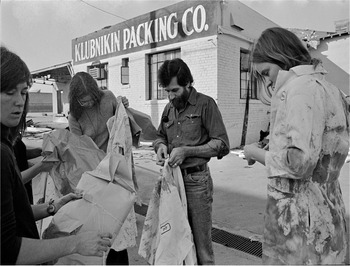
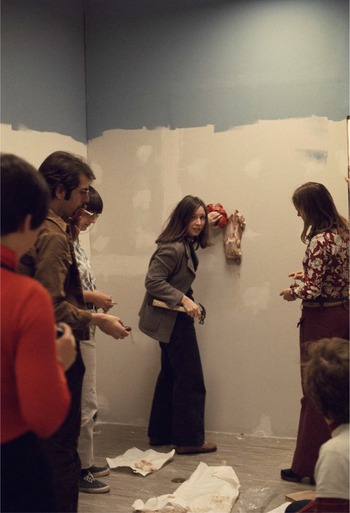
Suzanne Lacy (left) with Allan Kaprow (center) and fellow students. Suzanne Lacy, Maps, 1973. (Photo by Susan Mogul; courtesy of Suzanne Lacy Studio)

Lacy’s time as a student at CalArts also exemplifies how, in the US in particular, since the GI Bill made higher education more common and more specialized and professionalized after WWII, art schools became key sites for the development of discourses and artistic strategies driven by political ideals linked directly — usually via activist students’ bodies — to the protest movements. Dematerialization is linked to these political energies. Another more common version of the story of the broad move towards dematerialization is linked to pedagogy and begins with the hybrid time-based and conceptually driven practices of Black Mountain College. From the early 1950s, when John Cage taught there with Merce Cunningham, the curriculum was inspired by the radical pedagogical concepts in the work of American John Dewey and the German Bauhaus, as brought directly to the school by former Bauhaus teachers Anni Albers and Josef Albers.Footnote 3 The goal of Black Mountain pedagogy, in the words of the school’s cofounder, John Rice, was to “teach method, not content; to emphasize process, not results” (in Adamic Reference Adamic1936:519; see also Erickson Reference Erickson, Molesworth and Erickson2015:77). This reframed art as thought turned into actions, and these actions would take place in specific social spaces with particular engaged participants — bringing us back to the activist political context of the 1960s and 1970s. Furthermore, the link between Black Mountain and Lacy’s early career is relatively direct, passing through John Cage’s famous experimental music and mycology classes at the New School in New York City in the late 1950s — where Kaprow, along with a group of artists who went on to create Fluxus and Happenings, including George Brecht, Al Hansen, and Robert Whitman, studied with him (Kuhn Reference Kuhn2014).
As a composer teaching primarily visual artists, Cage had developed a pedagogical approach that expanded on the Black Mountain idea of art as a process or praxis that would eschew the material forms of the formalist practices heralded in the mainstream Euro-American art centers at the time (see Anderson Reference Anderson2018). Returning to Lippard’s attention to the political contexts for the dematerialization of art, it is important to assert that these methods, while not necessarily explicitly promoted as political (especially in the case of most of the white male artists), dovetailed with the political aspirations of younger generations of emerging artists in US art centers during the 1960s and 1970s. Dematerialization thus is a layered and complex phenomenon interrelated with pedagogy, politics, and the social scene. It took the rise of the second wave women’s movement — with the feminist art movement at its forefront — to put politics at the center of dematerialization, as Lacy’s early career and in fact the undercurrent of Lippard’s book both make clear.
Dematerialization and Social Practice
As noted, Lippard, one of the most astute critics of the period, picked up on the importance of this new way of making art already by the late 1960s, giving it seeming coherence via the term “dematerialization”; in this same period, Lippard had directly aligned herself with the activism of Art Workers’ Coalition, and by the early 1970s she was at the forefront of the feminist art movement (see Takac Reference Takac2018). Political and activist energies drive Lippard’s concept of dematerialization. While she herself refers to conceptualism frequently in Dematerialization, and notes the series of exhibitions of conceptual art that she curated — “Number Shows” — as foundational to the concept, throughout the book she in fact does not limit art practice to a singular category but includes many body-art/performance works. In this way, for Lippard dematerialization is a loose concept linking together works across media and sites, works that prioritize ideas over materials — even when materials are used — often putting the body or performative actions at the center of the work. Dematerialization extensively describes through examples a complex field of artistic practices and places them clearly within their specific political and social contexts as a way of understanding both what motivated the shift to so-called dematerialization and the specific strategies employed within their field of conceptually driven practices. She thus begins the new 1997 introduction by asserting that the “era of Conceptual art — which was also the era of the Civil Rights Movement, Vietnam, the Women’s Liberation Movement, and the counter culture” underlaid the artistic “escape attempts” motivating the move away from making objects as art (1997:vii).
Context is crucial for Lippard, and, in spite of the force of the term dematerialization, the materialities of dematerialized practices are in fact myriad in her descriptions. While Lippard arguably de facto conflates dematerialization with conceptual art, by conceptual art she seems to mean conceptually driven practices across media — including embodied and performance practices. As an artist then critic and curator who lived through this moment in New York, where some of the most radical experimentation was occurring, Lippard frames the discussion in terms of her lived experience, connecting to her own feminist activism, and expands the category by noting its “mediums” to include “video, performance, photography, narrative, text, actions,” thereby herself blurring boundaries between the otherwise discrete movements defined in subsequent art histories of the period, which have tended to reify and separate movements including “minimalism,” “performance art,” “land art” or “earthworks,” and “conceptual art,” as if they were not interconnected at the time (Lippard Reference Lippard1997:xi).Footnote 4
In spite of the care and directness with which Lippard contextualizes and interrelates these tendencies, many subsequently borrowing her term fail to assert the central importance of the period’s political upheavals — and particularly the rights movements — in motivating the shift towards process, the surfacing of the body, and an emphasis on conceptual issues. For this reason I have developed the term “conceptual body” to insistently remind us that much of the most cutting edge work from this period in fact directly deployed bodies not only as an extension of activism but also as driven by conceptual concerns. With the term conceptual body — epitomized by the practice of Suzanne Lacy — I mean to honor both the cross-media and politically contextualized, often explicitly activist, aspect of dematerialized art as Lippard describes it, stressing that artists turned to performance and their own bodies in this period strategically and as driven by political and conceptual concerns. (The fact that the artists foregrounding the materialities of their bodies were disproportionately often women, queers, or people of color proves my point about the importance of addressing rights and equity issues, activism, and political struggles in coming to an understanding of art from this period of US history.)Footnote 5
Artistic movement categorizations and formalist histories of contemporary art have been damaging to the understanding of the complexities of artistic production at this energized and volatile moment (the importance of more nuanced understandings of politics and history has become especially evident now not the least because of the parallels we are experiencing with the upheavals that persist from the Trump administration and with the ongoing global pandemic). We clearly need better models for examining interfaces between society and artists that might tell us more about how broad political concepts and strategies find their way into such boundary-breaking art practices. Having taught in an art school since 2014 it has become more and more clear to me that studying specific moments of art pedagogy when different approaches are explored might be a key way of doing this. To this end, again Suzanne Lacy becomes an ideal case study. Both of these frameworks — that of conceptual body/dematerialization and that of radical arts pedagogy — come together in Lacy’s social practice performance art and in pedagogy (both as a student and teacher). Lacy studied with two extremely influential figures in the development of new art pedagogies in the early 1970s at Fresno State College (now California State University, Fresno) and then at California Institute of the Arts (CalArts) in Valencia: Judy Chicago (at both campuses) and Allan Kaprow (at CalArts).Footnote 6 Lacy is also a key innovator of what is now called “social practice” art (art that directly engages audiences in the public sphere so as to spark social change — an extension of the dematerialized practices Lippard describes in her book). Her social practice performance art is directly linked to her feminism and her training in this earlier period of political urgency motivating the shift towards artists developing more public, embodied, and explicitly activist strategies.
Lacy has also long been a teacher (currently at my institution, University of Southern California’s Roski School of Art and Design) and art school administrator. Looking deeply into Lacy’s training in relation to the formation of her artistic concerns, her political and pedagogical interests, and her role in developing social practice yields a better understanding of the conceptual body and the turn towards dematerialization as driven by political concerns, which now arguably are dominant rather than marginal ways of articulating and understanding visual arts practices. This is not intended in any way to be exhaustive or to provide a simplistic causal explanation of the “origins” or final meaning of her work. Rather, I offer it as part of my lived experience of having worked with her (and, previously, Judy Chicago) and having researched and written on Lacy’s, Chicago’s, and Kaprow’s work with the ultimate goal of enriching our methods of historicizing this rich period of artistic practice and political agitation.
Activism, Pedagogy, and Art: Los Angeles c. 1970
From a white working-class family in California’s Central Valley, an area dominated by agriculture and small cities such as Fresno, Lacy studied zoological sciences at the University of California, Santa Barbara, as an undergraduate. She then did graduate work in psychology and took her first art classes with Chicago at Fresno State College. Neither of these universities is situated in a major city but at Fresno, like UCSB a public university, the political activism that roiled the campus when Lacy attended in the late 1960s and early 1970s is legendary. Faculty and students rebelled against a conservative administration and the slide of the university towards corporatization (quite a prescient complaint, given that this was early days in what is now an accomplished transformation of universities). The campus was activated by multiple strikes and public actions calling for academic freedom and protesting against police presence on campus, the administration’s antagonism to the new Ethnic Studies and Black Studies programs, and the lack of support for minority students in general (Pearl Reference Pearl2014).Footnote 7
This atmosphere of protest was pervasive. As Lacy put it to me, while she wasn’t directly involved in protests at Fresno State, “[i]t was impossible to be in a California university at that time without being somehow touched by race, class, gender issues,” noting that much of the campus agitation in a state as diverse as California was linked to the implementation of the 1965 Higher Education Act, part of President Johnson’s Great Society, which opened higher education to those formerly excluded (Lacy Reference Lacy2020). In the late 1960s, Lacy herself had been active in the US government’s AmeriCorps VISTA (Volunteers in Service to America) program, a volunteer agency focused on eliminating poverty. Lacy has noted that, due to her provincial background in the Central Valley, she was politically conservative until she became politicized towards left-wing causes through her work in VISTA (Lacy 1978–1982b:1).Footnote 8 The key takeaway here is that activism was a constant and visible component of youth society in the US at this time, and especially for those attending universities in parts of the US with diverse populations newly introduced to the possibility of higher education, such as Fresno State.
Part of my underlying argument is that the energies of these political movements — especially feminism, which tended to be dominated by white women and was (in part via Chicago’s efforts) quite visible at Fresno State and then at CalArts — were hugely powerful in redirecting artists away from highly hermetic practices oriented towards formal or abstract exploration. While male artists at CalArts in the early 1970s, such as Tom Knechtel and Lari Pittman, were not allowed to take classes in the famed Feminist Art Program that Chicago started at Fresno State and moved to CalArts, they have long noted their debt to its energies, which by all accounts were impossible to ignore. (Beyond CalArts, artists emerging at the time in Los Angeles, such as Paul McCarthy, have also noted the strong impact on their practice of feminist methods and ways of thinking.)Footnote 9 Living in a world energized by the youth, antiwar, and rights movements, young artists in art schools formed coalitions, sometimes institutionalizing them as official school units such as the Feminist Art Program; they also shifted strategies, framework, techniques, and media, moving towards personal themes, and using their bodies to provoke, explore, and change social relationships. Dematerialization is often connected to the forms of conceptual practice promoted in its West Coast versions by teachers such as John Baldessari and (from 1973 onward) Michael Asher at CalArts, but rarely is it acknowledged the degree to which its impulses were grounded in or at least connected to rights discourses.
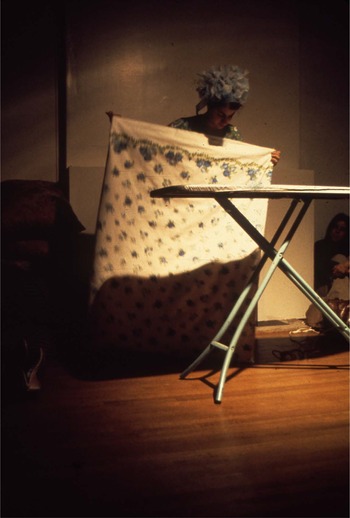
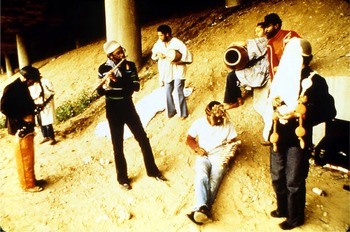
The nascent feminist art movement of the early 1970s exemplifies the way in which art students and emerging artists at the time were motivated by political concerns, which can thus be seen as having directly informed the conceptually driven motivations of dematerialized artistic practice. To cite three examples just in Los Angeles during the 1970s: feminist art students in the version of the Feminist Art Program at CalArts performed women’s tasks as public art works, as with Sandy Orgel’s Ironing performance (fig. 2), in the public 1972 Womanhouse project, a house near downtown Los Angeles that the students renovated, filled with feminist installations and performances, and opened to the public for a month (see Feminist Art Program 1972); in Senga Nengudi’s 1978 collaborative performance under a Los Angeles freeway, Ceremony for Freeway Fets (fig. 3), Black musicians, dancers, and artists evoked rituals and space-taking actions related to African culture (see Jones Reference Jones2017:192–211); the Chicanx art collective Asco, which produced a number of works such as the 1972 Walking Mural (in which they literally walked the streets of their neighborhood in East LA in costume, performing as a living mural and thus literalizing the dematerialization of this favored mode of Chicanx art practice), documenting the works through photographs by Asco member Harry Gamboa Jr. in pictures labeled “no movies,” gesturing ironically to the exclusionary, white-dominant film industry a few miles west (see Jones Reference Jones, Ondine Chavoya and Gonzalez2011).
Sandra Orgel, Ironing, 1972. Performance at the Feminist Art Program’s Womanhouse project, Los Angeles. (Photo courtesy of Suzanne Lacy Studio)

These works exemplify the importance of reframing contemporary art and the idea of dematerialization in relation to performance, process, and political issues key to this period, following the spirit of Lippard’s account rather than, as is very common, reducing the dematerialization argument to (more or less) conceptual art. The latter formula inevitably results in the erasure of the sophisticated and brilliant conceptually driven work by women and people of color during this period, reproducing yet again the limited histories of this period that privilege the work of white and male artists. By stressing the importance of social justice concerns as motivating factors underlying the interest in putting concept before medium, and in emphasizing process or performance over material result and moving beyond the art gallery system, we can understand the epistemic shift prompted by the move towards dematerialization in a more nuanced and, critically, a more historically accurate way. Suzanne Lacy’s practice as it developed after she left Fresno State and moved to CalArts — not incidentally, as noted, a school often in recent years lauded as one of the key sites for the development of conceptual art (albeit of a less “serious,” more wry and humorous, California variety than the canonical New York modes) offers a case in point of how these histories are enriched by looking at this more complex picture of pedagogy and political concerns.Footnote 10
Senga Nengudi, Ceremony for Freeway Fets, March 1978. Performance with David Hammons, Maren Hassinger, and other Members of Studio Z, an artists’ collective in Los Angeles. Supported by a CETA Art in Public Places Grant and by CalTrans. (Photo by Roderick “Quaku” Young; courtesy of Senga Nengudi)

The (Quintessential) California Art School c. 1970
California Institute for the Arts, founded by Walt and Roy Disney in Los Angeles in 1961 and moved to its current site in Valencia in 1970, was a key site for the dematerialization of art — the shift of art from object to process, from thing to concept or performative acts taking place over time. Consistently with innovative art schools from earlier in the 20th century — specifically the Bauhaus and Black Mountain College — CalArts (according to the history noted on its website) has sought from the beginning to “remove the walls separating the creative disciplines and encourage artists from different branches to mix and collaborate as a way of sparking new ideas and methods” (CalArts n.d.).Footnote 11 While the Disneys no doubt had a more commodified version of this mixing in mind, tied to the lucrative innovations in their segment of the entertainment industry (after all, animation and theme parks are derived from “hybrid” practices!), the leadership of the school by the late 1960s had other, far more radical and socially disruptive, goals.Footnote 12
The shift from art as the making of objects to art as process was driven at CalArts by radical pedagogy and practice, as institutionally implemented by visionary hires spearheaded by Provost Herbert Blau, President Robert W. Corrigan, and art school Dean Paul Brach around 1970 (see Sarbanes Reference Sarbanes2014).Footnote 13 Blau and Brach hired Allan Kaprow in 1969 and supported the hire of Judy Chicago with the goal of having her transfer her Feminist Art Program from Fresno State to CalArts in 1971, just after CalArts itself moved to its permanent home in Valencia (about 45 minutes north of Los Angeles) (see Sarbanes Reference Sarbanes2014).Footnote 14 The Feminist Art Program was thus, after being moved from Fresno State, revitalized at CalArts for one famous year (1971/72) under the guidance of Chicago and Miriam Schapiro, an important feminist abstract artist as well as Brach’s wife; it continued at CalArts after Chicago left, until 1974.Footnote 15
As noted, Lacy studied with both Kaprow and Chicago, who were arguably two of the most influential and charismatic teachers at the school in the early 1970s (with John Baldessari, who developed a legendary poststudio class, the third). Having first encountered the Feminist Art Program in Fresno, which was inspirational enough to prompt her to transfer her interests from zoology and psychology to the visual arts, Lacy moved to CalArts at the same time as Chicago. Lacy was not, however, officially part of the CalArts version of the Feminist Art Project, but instead signed up for the Women’s Design Program run by Sheila de Bretteville and became de Bretteville’s graduate assistant, helping the designer to implement some of the same techniques Chicago had developed in Fresno (see Wilding Reference Wilding, Broude and Garrard1994:47).Footnote 16 At the same time, Kaprow became her teacher and a key mentor starting in these early CalArts days and they continued to work together on projects organized by Lacy in the 1990s and following, until Kaprow’s death in 2006 (both, not incidentally, had remained in California while Chicago had moved to New Mexico around 1990).Footnote 17
The connections I am making here are not in themselves new, having been elaborated by Lacy in her own scholarship. With a 2013 theory/practice PhD from Robert Gordon University in Aberdeen, Scotland, and several influential books under her belt, Lacy in fact is herself a theorist and historian. She has often asserted the huge impact of Chicago and Kaprow on her practice, calling them “two teachers who shaped how I came to think about art” (Lacy Reference Lacy2013) and noting of these two very different artists and people, “I thought of them, humorously, as the passionate mother (Judy Chicago) and the affectionate, distant father (Allan)” (in Roth Reference Roth and Lacy2010:xvii). Elsewhere, in conversation with Kaprow, she attempts to sort out the relationships, interestingly in a fairly gendered manner, as follows: “I worked predominantly with you, Sheila and Judy at CalArts, and I would get the hot emotional stuff from Judy, and I would get […] the real art world formalist stuff from you” (Lacy 1978–1982a:11).
Given the highly charged experimental environment during Lacy’s time at CalArts, and the nature of her feminist social practice work, it is tempting to argue that the latter developed directly from the two radically different, yet in some ways overlapping, modes of art practice and pedagogy represented by Chicago and Kaprow — as if it has been produced out of a simple reductive formula, something like: Chicago + Kaprow (with a dash of de Bretteville) = Lacy. While not emphasizing pedagogy, Meiling Cheng thus has provocatively asserted: “Lacy’s own brand of new genre public art bears the imprints of two strains of redressive performance: the Judy Chicago school of feminist art that repudiates the patriarchal repression of female subjectivity and the Allan Kaprow school of an art/life continuum that objects to the modernist injunction for aesthetic autonomy” (Reference Cheng2002:99).Footnote 18 This formula suggests that Kaprow’s concept-driven, relational mode of performance plus Chicago’s radical feminist focus on the personal as political and foregrounding of personal content through form have resulted in Suzanne Lacy’s hugely influential development of explicitly political and socially engaged performances that came to define what, from the early 2000s, has come to be called social practice (see Jackson Reference Jackson2011).
While not strictly speaking untrue, and Cheng’s work is inspirational to my examination here, within the context I am exploring, I insist that this equation I facetiously note necessarily promotes a simplification of how pedagogy works, as well as (needless to say) of Lacy’s practice itself. It also misrepresents the historical picture and the way in which CalArts, along with other innovative art schools echoing back through the New School and Black Mountain College, changed the art world through radical pedagogy that encouraged dematerialized and activist approaches to making art in the public realm precisely through personal relationships between and among students and mentors. As Cheng herself elaborates across her erudite writings on performance art and interpretation, such equations do not adequately render the complexity of how pedagogy or nuanced personal relationships work (Lacy became friends with Chicago and Kaprow; Cheng and Lacy are dear friends; I consider myself among Chicago’s, Cheng’s, and Lacy’s friends, having known all of them for 20+ years — so this question of relationships is pertinent). Pedagogy is not just about lists of ideas being conveyed from one person to another; it is about relationships, personalities and how they mesh (or not) in the exchange of ideas about, in this case, what art is, should be, and can be. To this end, it is crucial to reintroduce historical texture but also affective relations to the formulaic understanding of how mentorship functions through teaching and example. I do this here both by examining Lacy’s relationships with Chicago and Kaprow, inasmuch as I have been able to recapture them through research and discussions with Lacy, but also by examining aspects of Lacy’s own practice and pedagogy (including her interest in the radical pedagogy of Paulo Freire) — which have been elaborated upon through years as an art teacher and art school dean (at California College of the Arts in Oakland from 1987 to 1997) and through her public art projects, all based on performative social practice methods. All of my analyses are colored by my own close relationship to Lacy, which developed over the years in the early to mid-1990s, first as I organized the exhibition Sexual Politics: Judy Chicago’s Dinner Party in Feminist Art History (1996) and then as we kept in touch through our mutual interest in performance and feminist art histories and now as colleagues at the Roski School of Art and Design at USC (see Jones Reference Jones1996).
In order fully to understand Lacy’s experience at CalArts it helps to know more about the school’s pedagogy in the 1970s. As I have already suggested about dematerialized methods in art production, the curriculum, ethos, and approach at CalArts were equally shaped by lived responses to or direct participation in the student, antiwar, and rights movements of the 1960s. Both art-making and pedagogy (per Lippard’s arguments) reconceptualized what art could be, not just in terms of subject matter or medium but in terms of the structures through which it is made and apprehended: art and the teaching of art both came to be seen and experienced as a process, an extension of activism, an activation of spectators. In this light it is interesting to note that CalArts was identified as an “institute” rather than a “school,” establishing itself as a community for mutual learning. A 1969/70 admissions bulletin states CalArts’s goals in egalitarian terms common to the time; as Janet Sarbanes quotes from the bulletin: “students [were] accepted as artists […] and encouraged in the independence this implies”; they were to be “collaborators” rather than passive recipients of knowledge (Sarbanes Reference Sarbanes2014; and see CalArts 1969?).
Kaprow and Chicago represent two influential poles of this radicalization. While, like most of his generation, he began his career as an abstract painter, Kaprow went on to coinvent Happenings with colleagues such as George Segal in the late 1950s and early 1960s in the New York area. The Happenings were one of the first official performance art modes in the Euro-American context to emerge since the more ad hoc performances produced by the early-20th-century avantgardes had petered out by 1920. He believed strongly in the concept of art as continuous with life, and argued that the artist might most fruitfully proceed by aiming to explore human experience in relation to bodily actions in the environment. In contrast, Chicago had begun her student and early career at UCLA and in Los Angeles among the overlapping groups of the so-called Finish Fetish and Light and Space artists (other than Chicago, a group of white men, some of whom, in the early 1960s publicly called themselves “The Studs”!). By the late 1960s Chicago, to counter this overt machismo, had developed (with input from Miriam Schapiro at CalArts) her concept of “central core” imagery. The basic tenet of the concept was that women’s biological experience, growing out of our genital anatomy, encouraged women artists to create images with circular (or “central core”) forms (Chicago and Schapiro Reference Chicago and Schapiro1973). The female body and women’s experience were key elements in Chicago’s practice, and — as she extensively outlines in her autobiographical writings — in her teaching (see esp. Chicago Reference Chicago1975).
While extremely different in their approach to teaching, their political interests, as well as their concepts of the relationships among the artist, her/his work, and the audience, both Chicago and Kaprow deployed performance strategies in the classroom and in their work as a way of putting the body directly into the field of art. Their versions of the conceptual body or dematerialized practices in the early 1970s were related to (and aimed at mobilizing or sensitizing) other bodies, other publics, and other sites, beyond those of the conventional art world.Footnote 19
Lacy’s working-class background and her studies in physical and then social sciences precluded direct knowledge of the art world until she gravitated to art programs. In fact, Lacy asserts that Kaprow and Chicago were “really my only contact with the [formal…] art world” in the early 1970s, setting the stage for her to build on their ideas to produce her particular brand of feminist social practice (Lacy ca. 1983:2).Footnote 20 Lacy has also asserted her debt to others she worked closely with at CalArts, including de Bretteville and art historians Deena Metzger and Arlene Raven, as well as fellow students such as Faith Wilding and Aviva Rahmani.Footnote 21 But Kaprow and Chicago were clearly Lacy’s most influential teachers; in Lacy’s own narrative, they helped shape her as an artist through their radical pedagogy and mentoring.
Lacy’s “Chicago-isms”
As Lacy herself describes Judy Chicago’s impact on her life and work, Chicago’s “combination of nascent and self-taught feminism, professional arts practice, and compassionate mentorship diverted me from pre-medicine [and from Fresno State] to the CalArts MFA program” (Lacy Reference Lacy2013).Footnote 22 As many collaborators, admirers, and competitors alike have noted, Chicago’s charisma and intensity are, indeed, mighty forces — as is her unwavering belief in women’s capacity to make groundbreaking art that likely will not follow the trends and structures and strategies of the male-dominated art world.Footnote 23 The impact of Chicago’s pedagogical innovations has been widespread and profound, enhanced by her general view of art as itself having an educational and openly political mandate. Chicago’s work is to this day explicit and directive, driven by overt political concerns.Footnote 24
Most notoriously and influentially, Chicago articulated a specific set of arguments about what constitutes women’s art — whatever the medium. As noted, in her own public presentations at the time, Chicago argued (in some cases in collaboration with CalArts colleague Miriam Schapiro) that in organizing their work women tend to deploy central core structures mimicking their anatomical/cultural experience, and that these forms could be redefined as empowering rather than degrading: “women artists have used the central cavity which defines them as women as the framework for an imagery which allows for the complete reversal of the way in which women are seen by the culture” (Chicago and Schapiro Reference Chicago and Schapiro1973:14). In relation to this belief, Chicago asserted that specific modes of teaching — drawing out personal experiences and urging students to use these experiences to organize their work in formally resonant ways — could bring to the fore these previously hidden or degraded internalized ideas women had about their capacities and experiences. By bringing these experiences to the conscious level, women could then express themselves clearly through the process of art-making. Given these emphases, it is not a surprise that many of the Fresno and CalArts students gravitated towards public performances, which could literally enact these retrieved experiences.
No teacher in a US art school had systematically attended to these issues relating to women artists’ experiences and linked them to creative strategies before. Chicago was one of the first to form a specific separatist program for women art students, intuiting the need for them to build confidence in a safe space (this insight was derived from her own experience in the early 1960s working in all-male class environments at UCLA). Already by 1970 Chicago had been exploring the difficulties many women (especially the working-class white women in Chicago’s classes at Fresno State) experienced in imagining themselves as artists — a difficulty she herself had had to overcome at UCLA. Beyond insisting on setting up a separate all-female class (at both the Fresno and CalArts versions of the Feminist Art Program), she focused on strategies to empower these women — involving the students in self-discovery through consciousness-raising sessions and working with them to find and fix up studio and gallery spaces themselves, encouraging them to develop carpentry and renovation skills to do so (see Chicago Reference Chicago1975:70–92). Beyond empowerment, this training also created and reinforced a sense of community, per Chicago, through the “bonding and identification” that would develop while performing shared tasks (in Harper Reference Harper1985:766).
Discovering women’s hesitations at accessing their feelings, and their insecurities around imagining themselves as serious thinkers and creators, Chicago began holding sessions where those present would express and explore common experiences. This morphed into a version of what Chicago called “modified consciousness raising” (1975:75). As someone who was not a mental health expert, Chicago took on the potentially dangerous role of guiding group analysis among the women and assisting in confidence-building. She ultimately sought this level of interaction in the classroom: “I wanted real interaction, and knowing that the students would test me to see if they could get me to play ‘teacher,’ […] I told them I was prepared to sit through the entire class time in silence if they didn’t want to participate, but I was not prepared to talk at them” (1975:76). This resonates with CalArts’ stated goals of empowering students in the classroom. And yet Chicago was to stay at the institution only a year, frustrated by frictions with other faculty (including Schapiro).
A similar emphasis on student-teacher interaction — itself arguably a version of the artist- audience interactions to come — was central to Kaprow’s practice and pedagogy. For both artists this interest related to their active involvement in performance. During her brief tenure at CalArts, Chicago focused on teaching performance, while Schapiro taught painting and drawing (which were always Chicago’s favored media). Both worked with students on the epic Womanhouse project, which was open to the public for a month in 1972 and included the aforementioned performances of domestic chores, such as Orgel’s Ironing (see Harper Reference Harper1985:763–64, 773). In Chicago’s view, women generally lacked the confidence to figure out how to make things unless through actions directly connected to chores considered “feminine” in the domestic sphere — hence the Ironing type performance. And so she guided them to set up and organize a group studio space for themselves by modifying a warehouse space (see Meyer Reference Meyer and James2003). Teaching skills, however, did not mean Chicago encouraged students to move towards narrow, mechanical versions of artmaking. She was adamant that, as she put it, “[t]here was no media restriction. They were free to paint, draw, write, make a film or do a performance” (1975:79). But because communication — drawing them out to tell stories about themselves — was a key strategy in her teaching, performative storytelling became the dominant method for generating ideas and performance. Also primary was directly engaging audiences.
Chicago has mused about this tendency particularly in relation to the power of performance to provide “the women with a way of reaching subject matter for art-making” and then communicating it to others (1975:87).Footnote 25 This tendency made sense in terms of Chicago’s strong encouragement for the women to access their feelings as a kind of emotional intelligence guiding them toward producing work that was not simply illustrative of aspects of the outside world. For Chicago, this led towards the expression of extreme emotions: “[p]erformance can be fueled by rage in a way painting and sculpture can’t” (in Roth Reference Roth, Loeffler and Tong1980:466).Footnote 26 Ultimately, then, Chicago’s focus on teaching the students to open themselves up to others and to interact (itself an echo of popular social scientific theories of social performance and interpersonal relations at the time) led to an emphasis on activating their interactive stories through performance.Footnote 27
In sum, Chicago was providing methods to encourage women, who previously had no art skills nor the confidence to explore or even identify their creativity, to enter the arena of artmaking by focusing on what she saw as their particular needs, interests, and largely untapped abilities. This was enabled by interactive pedagogical methods that in turn encouraged the women to make artworks that were performative if not explicitly performance art. Chicago instinctively mobilized these performative methods, which in turn opened art to audience engagement, dematerializing the artwork by redefining it as an active process. Works that literalized housework, as with the Ironing performance, compounded the political effects of this shift to process — merging highly over-determined domestic chores with the “high” aspirations of artmaking.
How far could this radical challenge to the male-dominated art world go? Here it is important to look a bit more closely at the limitations of this mobilization of women’s labor in Chicago’s pedagogy and the resulting practices. As the entire Womanhouse project (with its pink “flesh colored” Nurturant Kitchen and white female mannequins in various other installations within the house) made clear, how these performances resonated had to do with assumptions about women’s work that were sutured to particular class and ethnic identifications. Essentially these performances were about white middle-class female norms in the US, which had been rapidly shifting since Rosie the Riveter had entered the US workforce during WWII, with the resulting explosion in the 1970s of the second wave feminist movement. As with much mainstream US feminism in the 1970s, “women’s work” had a very limited valence in these terms, and yet mainstream culture persisted in limiting representations of the roles of white middle-class women to the private domestic sphere. Chicago’s students at Fresno State, including Lacy, however, were working or lower-middle-class white women. From a long line of rabbis herself, and with a Marxist secular father, Chicago had high standards of intellectual rigor, and her impatience towards the unworldly students at Fresno is, in fact, quite palpable when she describes working with them in her autobiography Through the Flower (1975:70–92). When the program moved to CalArts in 1971, aside from the women who came over from Fresno, most of the students were educationally privileged, middle class, but still white — albeit Chicago, Schapiro, and a number of the students in the Feminist Art Program, such as Mira Schor, were Jewish.Footnote 28 Chicago was not by and large addressing in her classes exclusions based on class, race, and ethnicity that were being actively foregrounded in US political and social life at this time
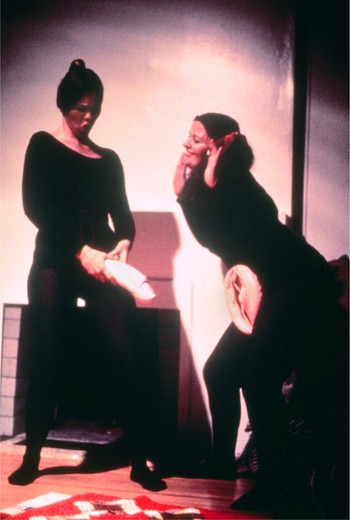
Interestingly, too, Chicago’s emphasis on interactive, performative pedagogies did not directly relate to most of her own work from the early 1970s, aside from her collaborative theatre piece with her CalArts students Wilding and Janice Lester, Cock and Cunt Play of 1972 (fig. 4), and her series of live “atmospheres,” which were on-site performative works involving colored pyrotechnics. Her sprayed acrylic core works of the early 1970s were not explicitly interactive or time-based; they were art objects, not performances. Rather than moving her own practice towards more time-based works or direct exchanges with audiences, by the mid- 1970s she had shifted entirely away from performance. Her major works from this time onward were discrete objects to be looked at rather than (as with Kaprow’s practice in the 1960s and 1970s) open to audience input. Chicago was moving from a mode of abstraction that was close to that of her male colleagues in the Southern California Finish Fetish movement towards highlighting her experiences of oppression with central core imagery, often accompanied by explicit texts — as with Rejection Quintet/Peeling Back of 1974. A large-scale Prismacolor drawing on paper with handwritten text, Peeling Back narrates Chicago’s own experiences of being oppressed in the male-dominated artworld, a direct assertion of her own “female experience” as legitimate content in visual art works, arguably pushing potential viewers towards precise meanings rather than interacting with them.
Judy Chicago, Cock and Cunt Play, 1970 script performed by Faith Wilding and Jan Lester at Womanhouse, 1972. (Photo by Lloyd Hamrol; courtesy of the Through the Flower Archives held at the Penn State University Archives).

In terms of interactive methods, however, it is interesting to note that Lacy herself explicitly identifies strands in Chicago’s pedagogical methods that Chicago herself has not acknowledged. In particular the energies surrounding California’s then-current human potential movement and, in Lacy’s words, “Freirian ideas of empowerment through education reform,” signaled a connection to Brazilian educator Paulo Freire, whose groundbreaking 1968 book Pedagogy of the Oppressed (published in English in 1970) argued that students should be cocreators of knowledge and not treated as empty vessels (Lacy Reference Lacy2013:ch.3; Freire [1968] Reference Freire and Ramos2000). While Chicago’s methods are certainly compatible with some of Freire’s strategies, it is likely that she developed them not by directly studying Freire (whose book, as noted, only came out in English in 1970, when Chicago was already teaching at Fresno State) but, as suggested by Lacy, instinctively in relation to the countercultural movements of the time, movements that stressed freeing the creative self through performative narration and enactment. For Lacy, what Chicago offered was specific and hugely valuable — a focus on “how oppression worked [for women] in their individual experience,” on developing skills to renovate and create, and on collaborative work among artists such that “relationality between women” became “a critical site for unlearning the destructive behavior between women in the service of a social goal of equity” (Lacy Reference Lacy2013:ch.3).
Notably, then, what Lacy foregrounds from this formative moment in her training within the early feminist art movement distances her from Chicago’s focus on object-making and on forms expressing “female experience.” Lacy argues that, most importantly, it was Chicago’s “foundation in pedagogy” as combined with the “social change activism” exploding across the Southern California landscape that “helped place the West Coast feminist art movement in the radical feminist […] camp and led to its focus on social change and public art practices” (Lacy Reference Lacy2013:ch.3).Footnote 29 The relationality between women and opening up to activist concerns drawn from personal experience staged in Chicago’s pedagogy thus clearly constitute the most important insights for Lacy. Lacy herself would immediately go on after her Fresno and CalArts experiences to collaborate with Chicago, de Bretteville, and Arlene Raven at the newly founded Feminist Studio Workshop at the Woman’s Building, where they would actualize their vision of activating through teaching and artmaking what Raven called a “sense of social justice,” a belief in the “possibility of social change,” and a goal of linking “our idiosyncratic experience to a possibility of cultural transformation in gender, racial, and class roles” (Raven Reference Raven and Lacy1995:164).Footnote 30
Lacy held a very different position from that of Chicago in relation to these struggles. Since her coming to political consciousness while an undergraduate at UCSB, Lacy had been adamant about addressing larger questions of inequity. For Lacy this explicitly included questions of class-based and racial exclusion; she shared an interest in broader questions of social justice with Arlene Raven as well as with Judy Baca and other colleagues from the days of the Woman’s Building.Footnote 31 Regardless of this awareness, the dominant forces in the Los Angeles feminist art movement often meant that women of color, such as Senga Nengudi, felt marginalized by most of the white feminists at the Woman’s Building, few of whom were struggling to raise children as she was.Footnote 32 But as far as Lacy was concerned, the civil rights and Chicano movements could not be ignored. This meant persistently working with and building community, drawing out personal experiences of oppression across gender/sex and ethnic and class lines, and generally being careful to attend to the complex intersectional ways in which oppression is experienced by women of color.
This attention to the larger frameworks of power in society, however, directly parallels Allan Kaprow’s far more abstracted but broad approach to making art in relation to social concerns. As Lacy puts it, “Raven, Kaprow, and other progressive educators of the time were deeply concerned with how their personal actions and their work fit ethically into a larger notion of society”; in this way, beyond the specific pedagogy of Chicago, as Lacy asserts, “questions of ethics pervaded the Los Angeles feminist art education programs. Even in the ‘classrooms’ of Kaprow’s individual performances — operating in this sense as mini-pedagogical moments, where individual experiences are reflected upon in group settings — feminists brought up the gender implications in the work they co-produced” (Lacy Reference Lacy2013:ch.3). She specifically noted to Kaprow the value she gained by studying with him and Chicago, because he represents “one way of thinking about art” in terms of aesthetics and form, and “Judy represents for me another way of thinking about art” (Lacy ca. 1983:4). Kaprow’s way firmly emphasized performance and the social sphere, as well as directly engaging audiences and publics beyond those of the art world.
Lacy’s “Kaprow-isms”
Judy Chicago’s example justified Lacy’s instinct to engage political (and specifically feminist) issues openly in her work via communicating personal experience (or soliciting others to do so). In a complementary way, Allan Kaprow’s pedagogy and art strategies, which stressed practice-based research, play, and engagement rather than a one-way knowledge exchange, turned her definitively towards structural or formal questions of spectatorship and spatial relations — and the role of the body in this matrix (see Allen Reference Allen2016). Lacy took on Kaprow’s concept of performance as a potential merging of art and life. As she said to Kaprow in 1983, “I think I probably learned that particular aspect of framing life actions as art from you” (Lacy Reference Lacy1983:1). Both teaching and artmaking were for Kaprow (and then Lacy) processes first and foremost involving the engagement of people in social space.Footnote 33
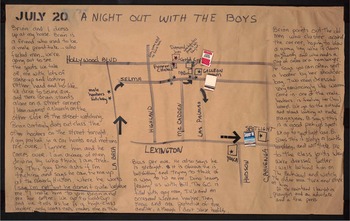
Performance for Kaprow and Lacy becomes a mode of art-making that articulates connectedness and political concerns in a way that is less direct than Chicago’s blunt mode of producing artworks to communicate political ideas, but equally sharp in effect: as Kaprow noted in the mid-1960s, “[a]rt politics is not only possible but necessary” (Reference Kaprow1964:36).Footnote 34 However, while Kaprow’s interest in embodied experience and human communication was his driving force, and he rarely acknowledged the specific identifications of his or other bodies in his work, the bodies and engagements in Lacy’s works were always specifically identified. For example, her piece Prostitution Notes of 1974 (fig. 5) involved her tracking, talking to, and mapping the lives of female prostitutes (“another world […] that lies just below the surface, if you know where to look”) through California cities (Reference Lacy, Frieling, Sanromán and Willsdon2019c:91). In such works, Lacy brought together the urgency of identity politics from feminism, broadened into an intersectional understanding of the role of race and class in defining female experience, with Kaprow’s foregrounding of social relationships as art. Prostitution Notes exists as notes and mapping devices on paper, but also in the effects of Lacy’s interactions with women sex workers in Los Angeles and elsewhere.
Suzanne Lacy, Prostitution Notes, 1974. (Photo courtesy of the Museum of Contemporary Art, Los Angeles and Suzanne Lacy Studio)

Kaprow is now often seen as a maverick among US artists rapidly moving away from modernism in the 1960s. Attending to experience, and acutely aware of the power structures at play in dominant art criticism — with formalist critics in the 1940s and ’50s such as Clement Greenberg demanding that artists strip away any strategies that did not strictly adhere to a discrete medium — Kaprow pioneered new ways of thinking about, making, interpreting, and teaching the visual arts.Footnote 35 Returning art to everyday experience and deflating the elitist pretensions of New York’s increasingly rarified art world, Kaprow sought to transform what art could be — and what could be art. It was this awareness of power differentials, and attention to the political and social nature of all cultural expression, that made Kaprow’s method speak to Lacy.
By 1969, Kaprow had moved to the West Coast and was dean of the art school at CalArts. On the CalArts faculty he joined Alison Knowles, Dick Higgins, and Nam June Paik, all from Fluxus and whose work foregrounded the performative, as well as Miriam Schapiro, John Baldessari, and other luminaries. In a 2011 interview Knowles said, “Kaprow was the thinking behind the school […He] had the vision of a school based on what artists wanted to do rather than what the school wanted them to do” (in Sarbanes Reference Sarbanes2014). In 1974 Kaprow moved to the art department at the University of California San Diego, where he taught until he retired in 1993.Footnote 36 Through his writing, visual art, teaching, and performances Kaprow had a profound impact on generations of artists since the late 1960s in the US and beyond.
Kaprow as pedagogue was extraordinary in the degree to which, as Karen Moss puts it, he “directly incorporated [his…] event-based performances into [his…] teaching in experimental education[al] contexts” (Reference Moss2016:2–3). From his own time as a student in the late 1940s onward, Kaprow’s ideas about teaching were shaped by educational theorist John Dewey, specifically through Dewey’s 1934 book, Art as Experience. Tracking through Kaprow’s annotations on Dewey’s pages, Jeff Kelley notes that Kaprow was particularly invested in Dewey’s insistence that pedagogy should reconnect art with everyday life in order to end the modernist idealization of aesthetics and the sequestering of art “from the currents of communal life” and daily experience (Kelley Reference Kelley1993:xii). Moss stresses Dewey’s importance to Kaprow in relation to his “rethinking of the primacy of the material and expressive qualities of art objects to further consider both the process and the experience of reception” (2016:28). These qualities are central to the synergy between Lacy and Kaprow from the 1970s onward.
As is well known, Kaprow also studied experimental music in the late 1950s in John Cage’s legendary classes at the New School, a key nurturing ground for the radical shift of art away from the static modernist formalist conception of art as object towards process, chance, and embodiment using different media that required attention to discrete ontological concerns. Building on his interest in Dewey’s notion of interactive education, particularly Dewey’s stress on the potentially fertile intersection of culture, experience, and social equity in the classroom, Kaprow applied Cage’s ideas of art and the everyday, insistently merging art with politics by engaging everyday people in humble spaces, devoting himself increasingly in the 1960s to teaching and collaborative projects. For example, just before arriving at CalArts, Kaprow worked on Project Other Ways, a major public effort engaging youth in Oakland with educator Herbert Kohl (The Pedagogical Impulse n.d.). Once at CalArts, Kaprow moved his practice towards modest performative exchanges — the intimacy of one-on-one encounters perhaps reflecting his exposure to the Feminist Art Program and his teaching experience at CalArts (Allen Reference Allen2016:7).
This conceptual emphasis on experience, interaction, and everyday life of course had already motivated Kaprow’s innovative turn towards Happenings in the late 1950s. This allowed for the elaboration of experiences between visitors and performers — literally deploying experience as, in Jeff Kelley’s words, the “medium of his practice,” grounding his work in “an interpretive interplay of body and mind, of doing and reflecting on what has happened” (1993:xiii, xiv). Art, for Kaprow, was a form of public thought.
Lacy and Kaprow worked directly together on several occasions, elaborating on art as a mobilization of thought, which for Lacy, via Chicago, was directly tied to political goals. They engaged in a series of dialogues in the late 1970s and early 1980s (several moderated by art historian Moira Roth) in which they directly discussed the role of form and formalism in relation to the power structures that define human experience in life and art. Here, Lacy notes of Kaprow, “you’re probably the only person […who] will engage on a […] straight formalist kind of shape and structure of things, and [who] can understand that content exists in work, and political intent exists in work,” a content that is formally expressed (Lacy ca. 1983:4).Footnote 37 If the link between art and politics for Chicago was asserted as being obvious and direct, with Chicago focusing on giving women artists permission to address their specific experiences through storytelling and aesthetic forms such as central core imagery, this connection for Kaprow was more oblique and formal (which today we might call “structural”) but, as Lacy suggests, its political significance was equally profound. The political potential of art for Kaprow had less to do with explicit content and more to do with the potential of art for activating an abstract set of structures — specifically relational connections between the artist and her or his audience.Footnote 38 This interest, in turn, was linked to the prevailing fascination in the social sciences in the US in the “presentation of self” as an ongoing performance in relation to others (an “interaction”). As Kaprow put it quite directly: “This work [I do] is in effecting others a model of human interaction” (Lacy 1978–1982b:19).Footnote 39 And of course these strategies, expanding on Dewey’s radical pedagogy, elaborated Kaprow’s own concept of (in his words) the “[e]ducation system as part of the political arena” (Lacy 1978–1982b:12).Footnote 40
Lacy herself has described in a nuanced way how she experienced Kaprow’s strategies as political, albeit much less directly so than Chicago’s. In her 2013 dissertation, Lacy connects Kaprow’s insights to feminist goals, noting how Kaprow as well as her art history teacher Arlene Raven were
deeply concerned with how their personal actions and their work fit ethically into a larger notion of society […Q]uestions of ethics pervaded the Los Angeles feminist art education programs. Even in the “classrooms” of Kaprow’s individual performances — operating in this sense as mini-pedagogical moments, where individual experiences are reflected upon in group settings — feminists brought up the gender implications in the work they co-produced.
(Lacy Reference Lacy2013:ch.3)More than 30 years earlier, in her dialogues with Kaprow, Lacy had more explicitly connected his strategic merging of art and life with her then-energetic feminist goal (linked directly to Chicago’s pedagogy) of empowering women and creating community, producing relational connections “of intense bonding” with a spiritual dimension, to “set that experience loose in the room,” binding women together to evoke an awareness of “the cycle of living and dying” for all women (Lacy Reference Lacy1983:5). Kaprow resists her references to the spiritual, returning the conversation (via his study of Zen Buddhism) to the “phenomenal world,” and noting his continuing interest in evoking “rudimentary activit[ies],” such as sweeping or brushing one’s teeth, which tie humans to this world and each other: “these moments are the very embodiment of reality” (Lacy Reference Lacy1983:5).Footnote 41 For Kaprow, action has its own ends; for Lacy, in contrast, because of her early work in activism and her experience with Chicago, Raven, and other feminists, any action must lead to politically (and spiritually) charged connections sparking progressive social change.Footnote 42
If not actively feminist in his work, Kaprow himself was sympathetic to feminism and its goals. By the 1970s, linked to his experience teaching maverick students such as Lacy, he explicitly promoted concerns central to feminism (such as connectedness and nonhierarchical social bonds). While Lacy often stresses Kaprow’s influence on the feminist artists working in Los Angeles at the time (she mentions Leslie Labowitz, Barbara T. Smith, Nancy Buchanan, Judy Baca, and others), she also makes clear that Kaprow shifted his own practice in relation to feminist students and colleagues (Lacy Reference Lacy2019b). As Kaprow himself asserted, he “benefited from” feminism; California performance art was all “directly affected by the feminist movement here” (in Lacy ca. 1983:18; and 1978–1982a:1).Footnote 43 And, in his 1974 Art in America article, “Education of the Un-Artist, Part III,” Kaprow confirms his support of feminist art by elaborating on what he called “situational models” of “commonplace environments, occurrences, and customs, often ready made” coming to the foreground. Notably he cites Sandra Orgel’s 1972 Ironing as an example, the previously mentioned work produced under Chicago’s tutelage for the Feminist Art Program’s Womanhouse project. In Kaprow’s Reference Kaprow1974 description, Orgel appeared in “washed-out” housewife clothing, set up an ironing board, and ironed a sheet for 10 minutes (in Kelley Reference Kelley1993:130, 133).Footnote 44 This kind of work perfectly exemplified what Kaprow was foregrounding in his teaching and writing at the time: performing everyday actions as art. In addition, in 1974, Kaprow was producing interactive, relational works exploring embodied relations and feelings between two people — most notably, Affect, produced with Vaughan Rachel (his wife at the time). A series of photographs “illustrating how to perform Affect” show him and Rachel standing face to face, sometimes both naked, in various different attitudes (embracing, etc.).Footnote 45 Such works continued Kaprow’s commitment to performance as nonnarrative and nontheatrical, asserting a conceptual version of the body, the ultimate materialized self, but in dematerialized ways. The “affect”-bearing and receiving body is abstracted yet specifically charged through such relational engagements.Footnote 46
Kaprow’s openness to and embrace of feminist goals is not surprising. He apparently attended “one of the very few consciousness raising groups for men” (in Lacy ca. 1983:18).Footnote 47 And, arguably, Kaprow’s deepest engagement with what art could be had begun with his challenge to the structure of the heroic male artist producing static objects for future viewing. After all, it was Kaprow who, even as he was developing Happenings, in his epochally influential and insightful 1958 essay “The Legacy of Jackson Pollock,” drew on the existentialist language of Harold Rosenberg to argue for a performative reading of Pollock’s painting as act (in a situation) rather than as a final product. This is another side of the shift to dematerialization: the opening of art to process fundamentally shifted the visual arts away from closed systems that positioned the implicitly male artist as authority and originator of the work of art with the “disinterested” (male) critic as its arbiter — systems that reinforced the exclusion of women, people of color, and queer people (see Jones Reference Jones1998). In this way, Kaprow’s famous rearticulation of Pollock as inaugurating art-as-process connects to 1960s–’70s feminist strategies of performing themselves as a direct challenge to the exclusions of formalist art, from Yoko Ono’s 1964–65 Cut Piece to Carolee Schneemann’s 1975 Interior Scroll. Kaprow’s willingness and ambition to open art to process effectively made him an early ally of feminist and other artists questioning power structures.
Lacy’s “Lacy-isms”Footnote 48
Lacy’s feminist social practice merges Chicago’s explicit feminist politics with Kaprow’s attention to opening the structures of art to change how art could work on the public stage. She consistently mobilized elements of Kaprow’s as well as Chicago’s methods across her practice and pedagogy, filtering them through her own interests, concerns, and embodied experience (see Phillips Reference Phillips2012). As Lacy herself put it, feminism was interested in opening art to women’s experiences via strategies such as those offered by Kaprow, which made the expansion of and connection with audience members possible (Lacy 1978–1982a:2). As well, while Lacy notes that Judy Chicago “retained an allegiance to the art exhibition space,” Kaprow “was instrumental […] in exploring the site of the work,” complementing his support for a “CR [consciousness raising] type foregrounding of the experience of individual participants” (2019b). Performance, encouraged by both Chicago and Kaprow but for different reasons and in different ways, allowed women to connect with and empower themselves: per Chicago, they could convey messages about their personal experiences directly to audiences; and audience members could participate in the formation of meaning and thus push farther the shift Kaprow had already promoted — an understanding of art as open to others, its meanings and value contingent. Lacy stresses that a feminist artist has to “begin thinking about how to make [her…] reality understood. That need created forms for broader audience participation in the work […T]he core of what I’d think of as political art [is…] people processing experience information and comparing and creating a group reality” (Lacy 1978–1982a:3, 6).
Lacy has been a teacher and administrator within art schools across California since the 1970s. She has studied pedagogical theories, noting in her own writing the lineage from Dewey that Kaprow shared with her in his classrooms at CalArts (Lacy Reference Lacy2013:ch.3).Footnote 49 She sees practice and pedagogy as intimately interrelated in Kaprow’s method (and, by extension, her own). She elaborated on Kaprow’s work with progressive educator Herbert Kohl in 1968 on Project Other Ways in Oakland, California, where local residents were taught how to encourage communication towards creative ends. This project, Lacy notes, drew on Freire’s theory of radical pedagogy, activating participants by doing away with traditional education (and art) structures that positioned students and spectators as passive.Footnote 50 Kaprow, she confirms, sought to empower his students as participants just as his Happenings at the time were seeking to do with spectators.Footnote 51
This concept of art as a form of teaching that reinforces communication and social bonds constituted a form of public activity that was at once “art” and “pedagogy,” a joining that Lacy has refined and expanded in her own practice. In fact, one could argue that it is the joining of practice and pedagogy that points to the particular power of Lacy’s version of social practice, which teaches by performatively meshing art and activism. From the beginning of her practice as an artist, Lacy understood that the insertion of bodies and objects into public spaces under the aegis of the aesthetic (that is, as integral to processual artworks) is one way of enacting a politics beyond traditional aesthetic frames; it is a way of using the materialities of the body (per Chicago’s notion of “female imagery”), but specifically as driven by “dematerialized” conceptual and political ideas putting creativity at the hinge of art and life (per Kaprow).
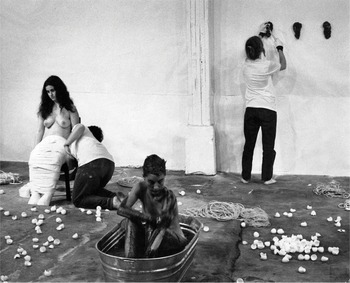
Fired up by the consciousness raising that joined like-minded people in social space via stories about their personal experience, Lacy, while at CalArts, began to make performances with collaborators in art spaces such as the 1972 Ablutions (fig. 6) with Judy Chicago and others. Lacy nailed kidneys to the wall (in a visceral reminder of the effects of violence on the body). While a tape played the voices of women recounting their stories of having been raped, Jan Lester slowly wrapped Sandra Orgel (who was otherwise naked) in bandages, and two other performers, including Shawnee Wollenman, bathed in galvanized metal tubs filled with blood, clay, and eggs (see Frieling et al. Reference Frieling, Sanromán and Willsdon2019:44).Footnote 52 As Lacy described Ablutions, it was “a work that involved both me and Aviva, brought the Happening type of aesthetic into the picture strongly” (2019b). Following Ablutions, for Kaprow’s class at CalArts in 1973, Lacy tapped into her experience studying zoology. Maps (fig. 7) had 10 participants traveling through Los Angeles following a set of instructions involving nailing sheep parts to a wall, arranged in an anatomically correct manner, dismantling them and carrying them in paper bags through a mental hospital, then meeting at a meatpacking shed to reassemble the animal organs and hang them on a fence (Lacy Reference Lacy1973).
Ablutions, 1972. Performance by Judy Chicago, Suzanne Lacy, Sandra Orgel, and Aviva Rahmani. Performers, from left: Sandra Orgel, Jan Lester, Shawnee Wollenman, Suzanne Lacy. (Photo courtesy Suzanne Lacy Studio)

Suzanne Lacy, Maps, 1973. From left: Susan Mogul, Stanley Fried, Vanalyne Green, and (facing camera) Bia Lowe. (Photo courtesy Suzanne Lacy Studio)

As a pair of works, Ablutions (with Chicago and others) and Maps (for Kaprow’s class) seem to perfectly narrate Lacy’s move from a feminist practice based on personal experiences and playing out in art spaces, to a performative practice driven by conceptual concerns and shared in public social spaces. And yet both mobilized bodies so as to explore power, violence, and how we navigate public and private domains.Footnote 53 These early works activated people in social spaces — reminding participants of the visceral nature of human experience by reconnecting them through actions involving the gross materialities (one can imagine the smell and the shivering gleam) of animal parts. Lacy’s conceptual body works developed as resolutely original social practice projects that activated flesh and bodies as materials paradoxically to dematerialize and politicize the artwork.
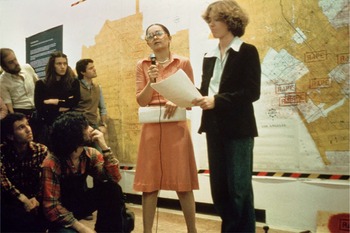
In fact, Maps planted a seed that Lacy was to harvest first in the 1974 Prostitution Notes and then, a few years later, in the 1977 Three Weeks in May (fig. 8), in which she traced rapes across Los Angeles — to that date ignored or downplayed by the police — with red stamps indicating “RAPE” on a map of the city. The map concept both documents a performative process of calling attention to literal urban sites of violence against women and provides an aesthetically powerful iconic visual image that, as an explicit feminist intervention, documents and calls attention to the situational specificity of these violations. The map looks like a dematerialized conceptual artwork, but is rigorously political because it is firmly connected to specific bodies in specific sites.
Suzanne Lacy (right), Three Weeks in May, 1977. (Photo courtesy Suzanne Lacy Studio)

By this signature 1977 moment, Lacy had developed a kind of situational and publicly minded feminist performance work in which politics and art are equally activated through aesthetic and performative means. She called it “new genre public art.” Lacy neatly theorizes this complex but coherent and sustained method in her important Reference Lacy1995 book, Mapping the Terrain: New Genre Public Art: “what exists in the space between the words public and art is an unknown relationship between artist and audience, a relationship that may itself become the artwork” (1995:20). In this articulation, Lacy keeps in play precisely the performative nature of the specific situational encounter and gives it political valence in terms of activist feminist goals. In Three Weeks in May this art encounter is linked via a manipulated map to the encounters between innocent women and rapists. Works such as Maps and Three Weeks in May may appear dematerialized, but they speak to deeply materialized forms of violence in relation to particular bodies.
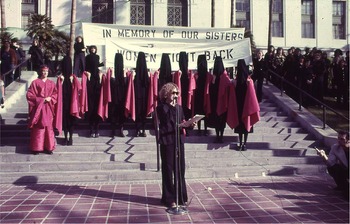
These two works exemplify Lacy’s first activation of the concept of new genre public art, which culminated in her collaborative work with Leslie Labowitz under the aegis of Ariadne, A Social Art Network. Most famously, Lacy worked directly with Labowitz on the 1977 piece In Mourning and In Rage (fig. 9), which expanded on the political critique of Three Weeks in May. In Mourning was a public performance event in protest of the lack of attention on the part of Los Angeles media and police to the escalating series of rapes being committed in the city by the so-called Hillside Strangler. The performance culminated in a “stand-in” with women dressed in black occupying the steps of the Los Angeles City Hall. This action is memorialized in an iconic series of photographs, a movie made from live footage of the event, and textual descriptions. The piece also innovated a social practice strategy of contacting the local media in advance to document the unfolding art actions, putting the political issue squarely into the public media sphere. Part of the art is the media coverage — another mode of making that is both materialized (literal bodies in space provoking the media) and dematerialized (fanning out over the airwaves as news coverage).
Suzanne Lacy and Leslie Labowitz, In Mourning and In Rage, 1977. (Photo by Maria Karras; courtesy of Suzanne Lacy Studio)

The performative social practice artworks and writings that continue to define Lacy’s career have repeatedly demonstrated precisely the way in which art is always already social and always already political, always already both material and dematerialized, whether or not these terms are put front and center in the works. This exemplifies a way of making art that is deeply feminist and political, that points to a shift in the 21st century with social practice now becoming a hugely central concept across art schools and practices. Lacy’s innovative activation of bonds of intimacy and connection (or on occasion antagonism) among collaborators and audience members has always been combined with explicit political content accessed through personal stories and/or specific bodies.
Lacy’s ambition — of producing, in her words, “an uneasy ambiguity of identity that sits astride both life and art” across her teaching, writing, and performative art practice — has clearly been fulfilled (Lacy Reference Lacy2013:ch.3). This is especially clear if we take as evidence her still-active career teaching and mentoring, the myriad students and community members she has profoundly affected, and the power of her ongoing social practice projects to reconnect communities divided by capitalism and nationalism. Connecting communities, and providing bridges to other communities, Lacy’s works move us towards a less violent and fragmented society. The early teachers at CalArts set Lacy on this path; the school’s legacy is due to their work in situating the conceptual body as a key intervention in art discourse and practice, teaching us all (in retrospect) just what practices that merge life with art, teaching with making, and bodies with politically driven concepts have to offer.