

Introduction
Disasters adversely affect the health of the elderly through direct and indirect impacts on their health and functional capacity.Reference Ardalan, Mazaheri, Rezaie, Naieni, Teimouri and Pourmalek1–Reference Sanders, Bowie and Bowie8 Indeed, the vulnerability of the elderly is increased by the destruction of the infrastructure that supports their ability to function independently in their communities. The aging of societies worldwide, specifically in countries most vulnerable to natural hazards, demands that more attention be paid to the specific needs of the elderly as part of preparedness for, mitigation of, responses to, and recovery from disasters.Reference Ardalan, Mazaheri, Rezaie, Naieni, Teimouri and Pourmalek1,Reference Fernandez, Byard, Lin and Barbera3
Iran, a Middle Eastern country with a population of 70 million, faces a high approximate risk profile for a variety of natural hazards and a rapidly aging population. It is projected that the proportion of elderly persons in the population in 2050 will be four times greater than the estimated proportion in 2000 (21.7% versus 5.2%).9
Functional capacity is an important indicator of health of the elderly.Reference Stuck, Walter, Nikolaous, la, Hohmann and Beck10 It is defined as the ability to carry out daily activities in a normal or accepted way.Reference Milán-Calenti, Pita-Fernández, González-Abraldes, Lorenzo, Fernández-Arruty and Maseda11 However, loss of this capacity affects the interaction of the elderly with the environment, and by limiting their activities, can restrict their social participation.12 The concepts of Activities of Daily Living (ADL) and Instrumental Activities of Daily Living (IADL) have been established to assess the functional capacity.12 Activities of Daily Living are defined as those activities essential for an independent life, such as bathing, dressing, eating, etc., while IADLs refer to the ability to negotiate the living environment by preparing foods, shopping, managing money, etc. Instrumental activities of daily living are more complex and require a higher level of autonomy and social interaction. Among the instruments for measuring functional capacity, the ADL Score constructed by Katz et al Reference Katz, Ford and Moskowitz13 and IADL Scores developed by Lawton and BrodyReference Lawton and Brody14 are the most popular and frequently referenced.
On 26 December 2003, Bam, in Kerman Province, southeastern Iran, was struck by an earthquake measuring 6.6 on the Richter scale. The Bam earthquake caused a wide-scale tragedy, killing >26,000 persons, injuring 30,000, and leaving >45,000 homeless.Reference Ardalan, Holakouie Naieni, Aflatounian, Nekouie, LaPorte and Noji15 It destroyed the ancient city of Bam and the Bam citadel, the world's largest dried clay structure. The effects of the Bam earthquake on the ADL and IADL of the elderly survivors are presented in this article, and the related determinants are explored. This study is part of a larger project to design an appropriate service package for addressing the health and healthcare needs of older people in disaster events.
Methods
In 2008, a cross-sectional survey was performed in the Bam earthquake-stricken area in Kerman Province of Iran. The area included the urban parts of Bam and Baravat, as well as their rural environs (including Khaje-Asgar, Kerk, Chehel-Tokhm, and Poshtrood). The study participants were 210 inhabitants who were ≥60 years old at the time of the earthquake and had not lived outside the stricken area for >3 months since the event. Thirty clusters were selected from the census household list available in the Bam District Health Centre, based on a systematic sampling design. Each cluster contained seven elders. The probability of total samples allocated to each target area was proportionate to the size of that area. Accordingly, 18 clusters (126 samples) were selected from Bam, eight clusters (56 samples) from Baravat, and four clusters (28 samples) from the rural environs. If a household included more than one eligible elder, one of them was selected randomly. A second or third call was made for the eligible respondents who were not at home at the time of interview. Six elders refused to participate in the study (97.1% response rate) and were replaced by next eligible samples, accordingly. Eighteen elders were not eligible to be included in the study as they had stayed >3 months outside the earthquake-stricken area with relatives.
A team of interviewers who had been trained and certified in the use of the questionnaire and study protocol interviewed the study participants. The survey instrument used a Farsi-language version of the scales for ADL and IADL, both of which have been validated in the Iranian contexts.Reference Habibi-Sula, Nikpour, Rezaie and Haghani16 The ADL scale included the functions of bathing, dressing, toileting, continence, transferring, and eating. The IADL scale involved telephone use, transportation, shopping, cooking, housekeeping, medication management, and budget management. Both use a three-point scale, scoring from 1 (dependent) to 3 (independent) to assess functional capacity for each activity. The maximum score for ADL and IADL scales are 18 and 21, respectively. Participants were asked about their ADL and IADL performance at three points in time: (1) one week prior to the earthquake; (2) two months after the earthquake; and (3) five years after the earthquake.
In addition to the assessment of functional capacity, the survey instrument included self-reported assessment of the following: (1) socio-demographic factors (age, gender, education, and living alone or with others (spouse, children, or relatives); (2) history of chronic diseases that needed regular medical attention or medication (e.g., hypertension, diabetes, arthritis, heart disease, stroke); (3) history of severe earthquake-related injury (defined by hospitalization or surgery due to the direct impact of the earthquake); and (4) difficulty in accessing basic relief items (shelter, water, and food) and medical services (medicine and visits to the medical team) after the earthquake.
Participants were provided with information about the study's objectives and the voluntary nature of participation, including the opportunity to withdraw at any time during the interview. All identifiable data were treated as confidential. The National Institute of Health Research (formerly the Institute of Public Health Research) at the Tehran University of Medical Sciences and University of Social Welfare and Rehabilitation approved the research protocol.
Data processing was performed using the survey commands (SVY) of the statistical package Stata 8.0 [2003, Stata Corporation, College Station, TX]. A complex survey design, with clusters considered as primary sampling units, was used. Study variables were described in terms of mean values, standard deviations, and absolute and relative frequencies. The ADL and IADL distribution among different levels of other variables were compared using the independent t-test and analysis of variance (ANOVA). The ADL and IADL scores of the participants were compared with subjects' own reported precedent functional capacity using the paired t-test. Multiple linear regression was used for assessing the adjusted association of ADL and IADL with other factors. A value of p <0.05 was considered statistically significant.
Results
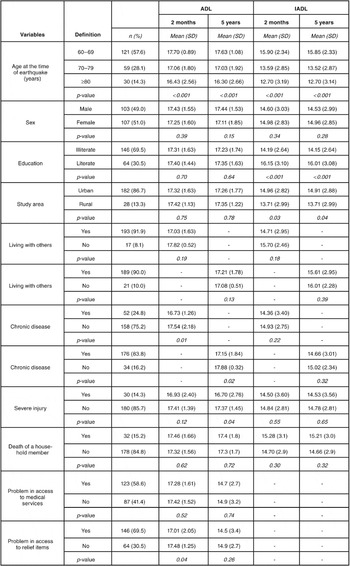
Among 210 total participants ranging in age from 60 to 90 years of age at the time of the Bam earthquake (corresponding to an age of 65–95 years at the time of the survey), with a mean (SD) age of 66.8 ±7.2 years, 51% (n = 107) were women, and 49% (n = 103) were men (Table 1). The majority of the participants were illiterate (146 persons, 69.5%); 182 persons (86.7%) were living in urban areas (60% in Bam and 26.7% in Baravat) and 28 persons (13.3%) in rural environs. Thirty participants (14.3%) had experienced severe injury and 32 persons (15.2%) had lost one of their household members due to the earthquake. Fifty-two persons (24.8%) had chronic disease at the time of the earthquake, while 176 participants had chronic diseases at the time of study (five years after the event). Among the respondents, 123 persons (58.6%) reported difficulty in accessing medical services and 146 persons (69.5%) expressed facing difficulties in access to relief items shortly after the earthquake. Most participants (87.6%) at the time of study lived in their own houses, but 16 (7.6%) were still living in connexes (small pre-fabricated structures for temporary living), two (1.0%) in rental houses and eight (3.8%) in the houses of relatives. The distribution of two-month and five-years ADL and IADL scores of elderly survivors of the Bam earthquake by study variables are in Table 1.
Distribution of two month and fi ve year post-event activities of daily living (ADL) and instrumental activities of daily living (IADL) scores of elderly survivors of the Bam earthquake, by study variables (n = 210)

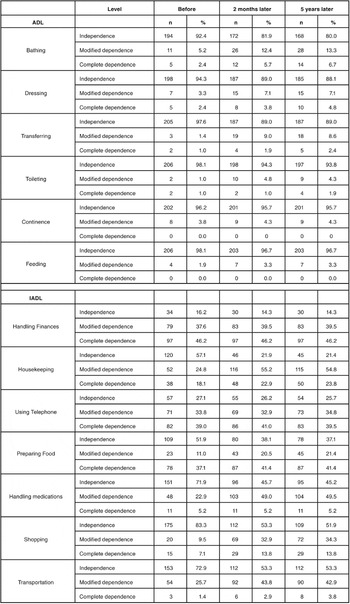
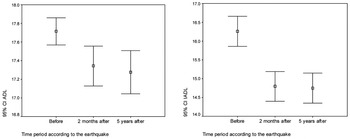
The mean values ±1 SD for the ADL scores of participants before the earthquake and two months and five years afterwards were 17.7 ±1.18, 17.3 ±1.67, and 17.3 ±1.7, respectively. At the time of study, bathing was the activity in which participants had the highest levels of dependency (modified or complete), followed by dressing, transferring, toileting, continence, and feeding in decreasing order of dependency (Table 2). The mean values ±1 SD for the IADL scores of the elderly survivors before the earthquake and two months and five years afterwards were 16.3 ±2.9, 14.8 ±2.9, and 14.8 ±2.9, respectively. Handling finances was the instrumental activity in which elders had the highest levels of dependency at the time of study, followed by housekeeping, using the telephone, preparing food, handling medication, shopping, and transportation (Table 2).
Activities of daily living (ADL) and instrumental activities of daily living (IADL) scores before, two months after, and fi ve years after the Bam earthquake, 26 December 2003 (n = 210)

Trends of elderly sample's ADL and IADL scores from before to two months and five years after the Bam earthquake are graphed in Figure 1. There were statistically significant decreases of functional capacity in ADL scores before and two months after the event revealed significant decreases of functional capacity (t = 4.22, df = 209, p <0.001). However, only a slight decline, that was not statistically significant, was observed between ADL scores two months and five years after the event (t = 1.91, df = 209, p = 0.06). A decreasing trend of IADL scores before and two months after the earthquake also was statistically significant (t = 10.62, df = 209, p<0.001). As with ADL, there was a slight decline that was not statistically significant in IADL scores between two months and five years after the event (t = 1.88, df = 209, p = 0.07).
Trends of elderly sample's activities of daily life (ADL) (left) and instrumental activities of daily life (IADL) (right) scores from before to two months and five years after Bam earthquake (CI = confidence interval)

More than half of the study participants (123 persons, 58.6%) had experienced problems in access to medical services within two months after the earthquake. Access to medical services were not found related to level of ADL or IADL (p = 0.52 and p = 0.74, respectively). More than two-thirds of the participants (69.9%) reported having experienced problems in receiving relief items two months after the earthquake, including shelter (57.1%), safe water (47.6%), and food (48.6%). Elderly survivors with lower functional capability in terms of ADL experienced more problems in access to relief items (p = 0.04), but no similar association was found for IADL (p = 0.26).
About half of the participants (107 persons, 51.0%) believed they were not given any priority by relief service providers compared to younger adults, for example, in long queues. However, 25 persons (11.9%) expressed having been given such priority at some time and the others (78 persons, 37.1%) said they were always treated with respect. No association was found between functional situation of the elders and priority in being provided services (p >0.05).
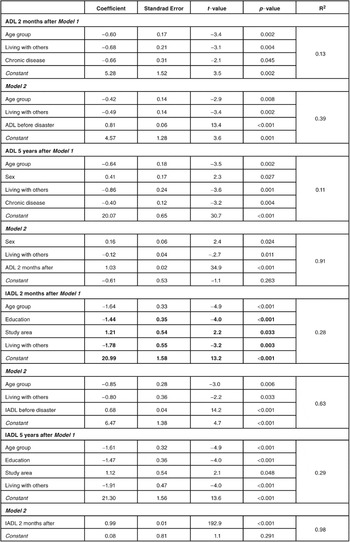
To determine the adjusted association of other factors with ADL and IADL scores at two months and five years after the earthquake, two models of multiple regression analysis were employed for each time period (Table 3). For each analysis, Model 1 included all eligible factors except ADL or IADL scores at the preceding time period, while Model 2 added the level of functional capacity at the preceding period. The reason for applying the two above-mentioned models was to correlate functional capacity at the preceding period with other factors. The statistically significant determinants (p <0.05) of functional capacity found in the first models included:
1 ADL scores at two months after the earthquake: age, living with others, and chronic diseases;
2 ADL scores at five years after the earthquake: age, gender, living with others, and chronic diseases; and
3 IADL scores at two months and five years after the earthquake: age, education, study area, and living with others.
The statistically significant determinants of functional capacity (p <0.05) found in the second models were:
1 ADL score at two months after the earthquake: age, living with others, and ADL before the earthquake;
2 ADL score at five years after the earthquake: gender, living with others, and ADL at 2 months after the earthquake;
3 IADL score at two months after the earthquake: age, living with others, and IADL before the earthquake; and
4 IADL score at five years after the earthquake: IADL at two months after the earthquake.
Regression models for determinants of activities of daily living (ADL) and instrumental activities of daily living (IADL) in elderly Bam earthquake survivors two months and fi ve years after earthquake

Discussion
The ADL and IADL have been understood to be “an important foundation for participation in the community”Reference Letts and Bosch17 which can affect elders' quality of life.Reference Stuck, Walter, Nikolaous, la, Hohmann and Beck10,Reference Habibi-Sula, Nikpour, Rezaie and Haghani16 Assessing functional capacities and designing interventions to improve them should be considered integral to disaster planning. This study revealed that the Bam earthquake adversely affected the functional performance of elders during a short period of time after the event. Despite the considerable extent of relief operations provided by national and international organizations, the geographic scope and seismologic magnitude of the event, as well as the massive extent of the damage to infrastructure in the affected communities caused all survivors to struggle to meet basic and health needs after the disaster.
This study shows that elderly survivors of the Bam earthquake were not given special priority in distribution of relief items or health services, nor was there any priority placed on providing the same to elders with diminished functional capacity as measured by ADL/IADL at the time of the event. Despite the esteemed position of the elderly in Iranian communities, the competition among survivors for services may have undermined this norm. In addition to worsening the health status of the elderly, this lack of consideration could have contributed to their feeling that their dignity was not respected.Reference Ardalan, Mazaheri, Rezaie, Naieni, Teimouri and Pourmalek1 Inadequate procedures for dealing with vulnerable groups (like the elderly) on the part of relief agencies could have exacerbated this problem.
KrauseReference Krause18 and Fernandez et al Reference Fernandez, Byard, Lin and Barbera3 believe that the health needs of the elderly can dissipate over time, perhaps due to psychological recovery. However, an improvement was not observed in this study, but a slight decline (not statistically significant) of functional capacity of elders from two months to five years after the earthquake was found. The possible explanation is that the earthquake caused considerable adverse effects shortly after the event, and that the immediate decline caused by the earthquake was comparable to the decline that would be caused by five years of aging. Although functional capacity was not measured at any point in time between two months and five years after the earthquake, it is expected that participants' functional capacity probably improved after the passage of time following the event, but then declined again because of aging. As another explanation, since elderly earthquake survivors who had died earlier were not studied, given the death of elders is related to poor functional capacity, it might lessen the difference between the functional capacity between two years and five years after the earthquake.
As proposed by Judge et al, the greater IADL dependence of elders in this study compared to ADL, in general, and the larger adverse effect of the earthquake on IADL compared to ADL, may be related to the greater interaction with the environment required by IADL.Reference Judge, Schechtman and Cress19 Further, the massive destruction of infrastructure may have made it more difficult for elders to negotiate the natural and built environment, resulting in a more circumscribed level of activity focused more on the home and immediate environs.
Unsurprisingly, increasing age was recognized as a strong determinant of decreasing functional dependence of elders in this study. As shown in the literature,Reference Fernandez, Byard, Lin and Barbera3,Reference Seidel, Jagger and Brayne20 functional capacity can deteriorate as elderly age. Their ability to walk, travel outside, eat, and use the telephone can be decreased, and their senses of vision, hearing, smell, taste, and touch can be diminished.
Millán-Calenti et al report controversial research papers on whether gender has any relation with the elders' functional status.Reference Milán-Calenti, Pita-Fernández, González-Abraldes, Lorenzo, Fernández-Arruty and Maseda11 This study shows that women had lower functional capacity, in general, than men in terms of ADL five years after the event, while no similar differences by gender were found for ADL at two months after the event or for IADL at either time period. Among the different activities of each index, at the time of study, women had more dependence than men in bathing, using the telephone, shopping and financial management, while they had less dependence in food preparation and housekeeping. It is concordant with Millán-Calenti et al who found that women traditionally have been more bounded to domestic activities while men have been more bounded to outside activities and financial management.Reference Milán-Calenti, Pita-Fernández, González-Abraldes, Lorenzo, Fernández-Arruty and Maseda11 The explanation for this gender discrepancy in functional status five years out that was not reported at the time of the earthquake is unclear and requires further investigation.
The correlation that was found between IADL and education may help interpretation of the data as this correlation also has been reported in other studies.Reference Jeong21 A study assessing those of Hispanic versus non-Hispanic ethnicity regarding their dependency in IADL, found education as a protective determinant in both ethnic categories.Reference Shetterly, Baxter, Morgenstern, Grigsby and Hamman22 Analysis of different items showed that illiterate elders were more dependent in using the telephone, transportation, shopping, and financial management, that is, in interactions with the wider society requiring more literacy as well as social skills.
Living with others (spouse, children, or relatives) was an important predictor of functional capacity, as both ADL and IADL scores were lower in those who were living with others. In other words, the elders who were living alone were more functionally independent. The correlation most likely is explained by the need for those elders with lower functional capacity to be cared for by others. In Iranian society, nursing home placement for elders with diminished functional capacity is not widely accepted. As such, living with family members is expected for these individuals.
Disasters may affect those with chronic disease more than healthy people.Reference Jeong21 This study found deterioration of ADL among those with chronic diseases, especially for bathing and dressing. While the overall IADL score did not show any difference between elders with and without chronic disease, different patterns were apparent for different activities, as people with chronic diseases were more dependent for shopping and transportation, but less dependent for managing their own medicine. Although surveyors did not ask about the severity of the illness; it is expected that the results would have been different for the people with more severe disease. Earthquake-related injury did not affect the short-term functional dependence of the elderly in this study, but affected the victims' ADL capacity over a longer period.
Shortly after the Bam Earthquake, the affected area was divided into several relief zones for the purpose of better service delivery.Reference Akbari, Asadilari, Montazeri, Aflatunian and Farshad23 In each zone, health centers run by the Ministry of Health and Medical Education (MOH&ME) along with field hospitals established by the Iranian Red Crescent Society (IRCS) and other countries were responsible for public health and medical services, all of which were provided free of charge. With the exception of active case-finding for communicable diseases and mental health support, almost all other services were based on passive service delivery, or self-referral of patients. The majority of elders in the current study reported problems accessing medical services with no difference related to their functional dependence. In other words, no priority was given to those with impaired functional status. According to a community-based needs assessment conducted by Ardalan et al three weeks after the earthquake, the people who were in need of medical services expressed obstacles in accessing those services, primarily due to problems with transportation.Reference Ardalan, Holakouie Naieni, Aflatounian, Nekouie, LaPorte and Noji15 This situation was pronounced especially amongst those with physical immobility and severe diseases. Health service providers and disaster management personnel must incorporate outreach approaches to assess the health status of the elderly who may have difficulty presenting for services precisely due to their functional impairment to help mitigate adverse impacts of disasters on the elderly, and that such approaches must be part of disaster preparedness training
Limitations
This study was limited by the use of self-reported versus observed ADL and IADL. In addition, the retrospective approach of the data collection for the time periods of before and shortly after the earthquake may raise the possibility of recall bias. While the earthquake was considered a memory aid, and the process of data collection showed that the respondents were well-oriented concerning events that happened around the time of the disaster, it is possible that five years later that elderly respondents, especially those who did not suffer a severe injury, may have difficulty recalling with precision differences in functional status immediately prior to and two months subsequent to the earthquake. In the future, prospective, longitudinal studies are needed to assess functional status of the elderly after earthquakes and other disasters.
The sample included elders who were still living five years after the earthquake, so elderly earthquake survivors who had died earlier were not studied. As it is expected that the death of elders is related to poor health status, the exclusion of persons who had died within the past five years post-earthquake, may have led to over-estimation bias in the findings and could be the reason of observing no difference between the functional capacity between two months and five years after the earthquake. Elders who had emigrated from the earthquake-stricken area to other cities or who were living in nursing homes also were not studied. Since placing elders in nursing homes is not well-accepted in Iranian culture, especially in a small town like Bam, it is assumed that this constitutes a small proportion of the elderly population. At the time of this study, only two elder-care centers were functioning in Bam, serving fewer than 100 elderly people. A study on the elders who have emigrated is recommended, as it is not known whether they have had better or worse functional status than do those who have stayed in Bam.
To make clearer associations between the earthquake and functional capacity of elders, the study design could be strengthened with applying a control population from a comparable city that is earthquake-prone, but has not experienced an earthquake like Bam. However, budgetary constraints prevented this comparison in the current study.
Social desirability bias is possible as elders may wish to report higher health status to preserve their dignity.Reference Tanida24 On the other hand, although the aim of the study was explained to the subjects, it is possible that some of the subjects may have reported lower levels of functional capacity in order to qualify for some relief advantages.
Conclusions
The Bam earthquake adversely affected the functional capacity of elders. Elders in Bam with decreased functional status at the time of the earthquake and those that suffered diminishment of their functional capacity due to the event itself were disadvantaged in obtaining relief assistance in terms of material and services. Relief and medical services providers did not take into account the health status and functional capacity of the elderly group when delivering services. The main risk factors for diminishing ADL in the elderly were low precedent ADL, aging, living with others, and having chronic diseases. Low precedent IADL, aging, lower education, living in rural areas, and living with others were risk factors for lower IADL. Disaster relief organizations must be sensitive to issues of age and assess the needs of the elderly continuously. In addition, strategies should be developed that identify and prioritize the elderly in disaster response using active case finding rather than passive service delivery.
Acknowledgements
This research has been co-funded by the Iranian Research Centre on Aging at the University of Social Welfare and Rehabilitation Sciences and the National Institute of Health Research (formerly Institute of Public Health Research) at Tehran University of Medical Sciences. The authors acknowledge Kerman University of Medical Sciences and the Bam Health Centre for their excellent support with the data collection.