Introduction
Transmastoid occlusion of the posterior semicircular canal was first described by Parnes and McClure, in 1990, for the surgical management of intractable benign paroxysmal positional vertigo (BPPV) in the setting of profound sensorineural hearing loss.Reference Parnes and McClure1 They and other authors have subsequently demonstrated excellent hearing outcomes in patients with normal pre-operative hearing.Reference Parnes and McClure2,Reference Kisilevsky, Bailie, Dutt and Rutka3 Minor et al. first reported the findings associated with symptomatic superior semicircular canal dehiscence in 1998, and later reported on five cases managed surgically by canal plugging or resurfacing, accessed via a middle cranial fossa approach.Reference Minor, Solomon, Zinreich and Zee4,Reference Minor5 Soon after, Brantberg et al. popularised superior semicircular canal plugging via the transmastoid approach, avoiding the morbidity of craniotomy and temporal lobe retraction.Reference Brantberg, Bergenius, Mendel, Witt, Tribukait and Ygge6 Further evolution in the management of superior semicircular canal dehiscence saw the introduction of the endoscopic-assisted middle cranial fossa approach, and transcanal or endaural approaches to the round window, which was reinforced with soft tissue (with or without oval window reinforcement).Reference Silverstein, Kartush, Parnes, Poe, Babu and Levenson7,Reference Peng and Shaia8
Transmastoid superior semicircular canal plugging was largely criticised initially on the grounds that: the dehiscent segment of the semicircular canal was not adequately visualised; the labyrinthine opening was more likely to cause sensorineural hearing loss, tinnitus and post-operative vertigo; and canal plugging precluded the use of the resurfacing technique in the future. Multiple subsequent studies, however, have confirmed that transmastoid canal occlusion in the context of BPPV or superior semicircular canal dehiscence is effective in providing vertigo relief while preserving hearing.Reference Wilms, Ernst and Mittmann9,Reference Shaia, Zappia, Bojrab, LaRouere, Sargent and Diaz10 There remains a paucity of quantifiable vestibular data in human subjects to support the subjective improvements reported.Reference Carey, Migliaccio and Minor11,Reference Ishai, Tsang and Rutka12
The traditional ‘gold standard’ in identifying peripheral vestibular deficits involved a magnetic scleral search coil technique. Available in only a few specialised centres, it was a cumbersome and impractical test that required the subject to wear a contact lens. Furthermore, it was time consuming and expensive, and had limited applicability in the acute setting. With the introduction of the equally accurate video head impulse test, by MacDougall et al. in 2009, the diagnosis of vestibular deficits was streamlined.Reference MacDougall, Weber, McGarvie, Halmagyi and Curthoys13
This report describes our approach to the objective quantification of vestibular function using the video head impulse test (ICS® Impulse by Otometrics) following canal plugging via a transmastoid approach.
Materials and methods
Patients
The two patients analysed both required functional labyrinthine surgery with canal occlusion.
The first patient was a 56-year-old lady with longstanding right-sided BPPV, who had proven unresponsive to numerous particle-repositioning procedures (Epley manoeuvres). She had normal pre-operative hearing in both ears.
The second patient was a 48-year-old lady with disequilibrium and pulsatile tinnitus in her left ear following a concussion in 2016. She described worsening of her symptoms on straining and coughing. On Weber testing, the 512 Hz tuning fork lateralised to the left ear. The fistula test, conducted by pneumatic otoscopy, was positive on the left side. A mild left-sided conductive hearing loss was noted on audiometry. Electrocochleography findings were abnormal on the left side, with an increased summating potential/action potential (‘SP/AP’) ratio of more than 0.3. High-resolution computed tomography scanning of the temporal bone demonstrated left-sided superior semicircular canal dehiscence and thinning of bone overlying the superior canal on the right side.
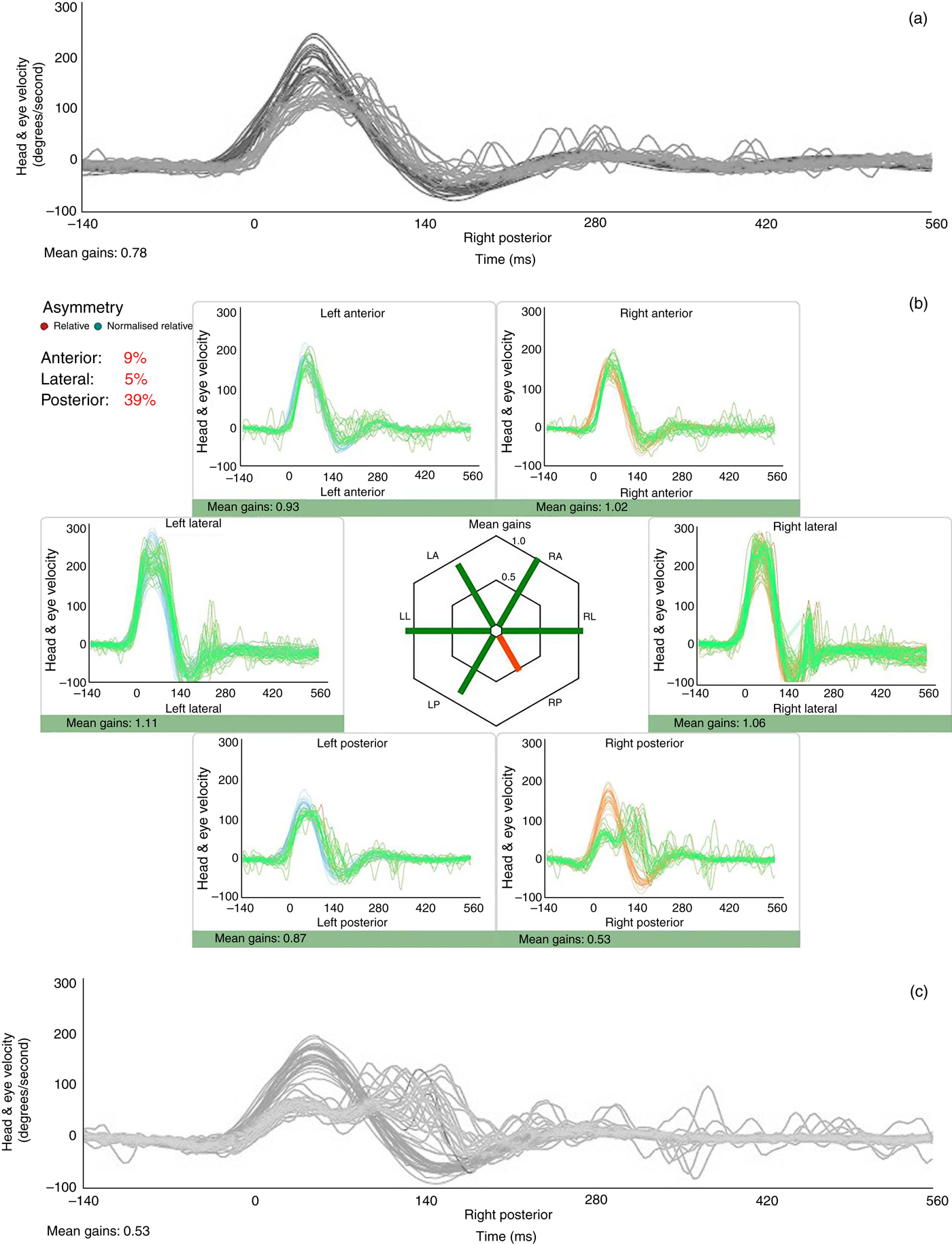
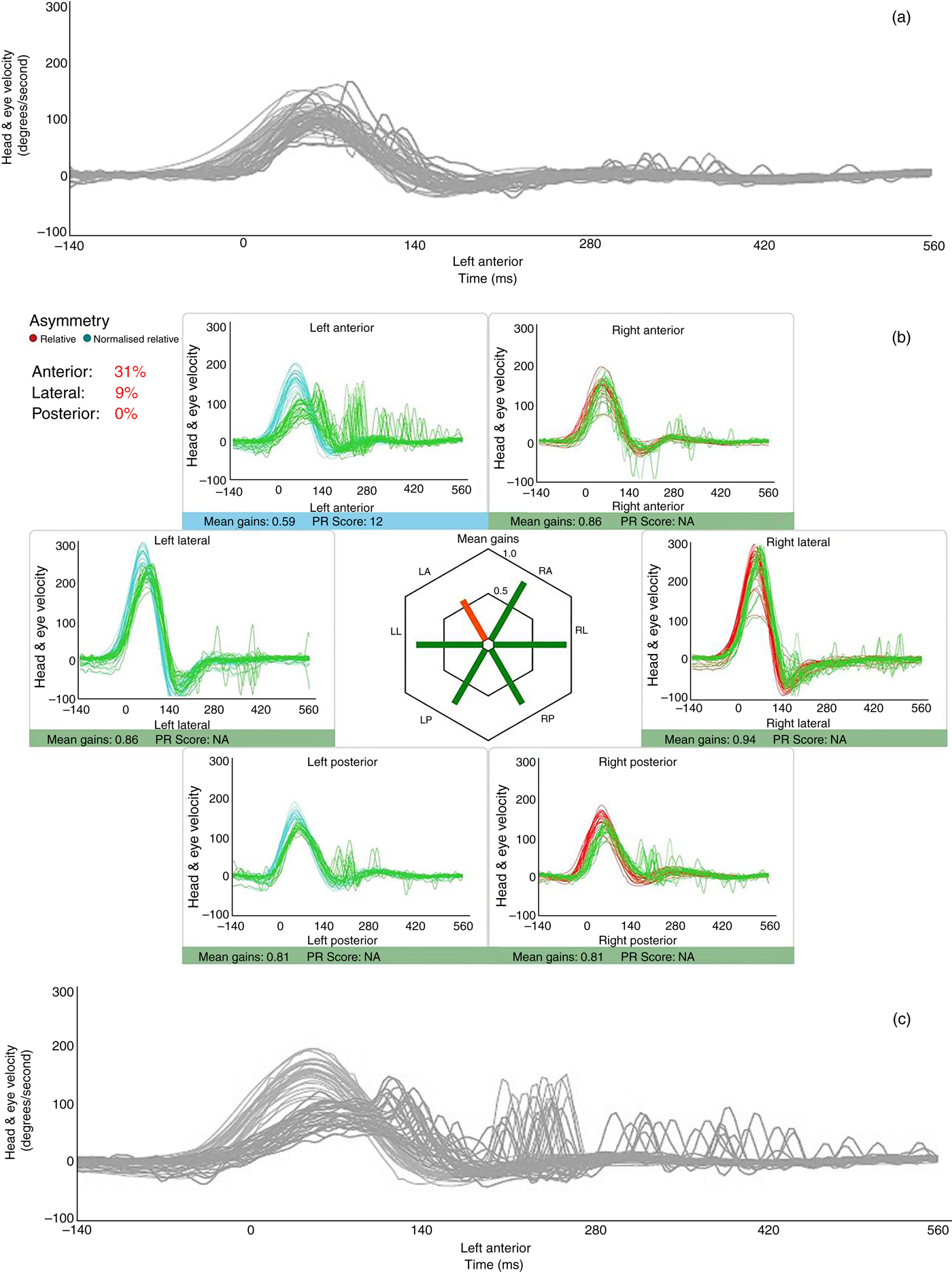
Both patients were scheduled for transmastoid canal occlusion surgery of the posterior or superior semicircular canal, respectively. Pre-operative vestibular function testing was performed using video head impulse testing. This demonstrated normal pre-operative vestibulo-ocular reflex function bilaterally, in all planes, for both patients (Figures 1 and 2). A left-sided ocular vestibular-evoked myogenic potential amplitude of 33 μV (threshold of 70 dB) was obtained in the second patient, providing further support for symptomatic superior semicircular canal dehiscence (ocular vestibular-evoked myogenic potential amplitude of 17.1 μV or more, with 100 per cent sensitivity and specificity for superior semicircular canal dehiscence). Right-sided ocular and cervical vestibular-evoked myogenic potential amplitudes and thresholds were normal.
(a) Pre- and (b & c) post-operative video head impulse test findings after transmastoid posterior canal occlusion for benign paroxysmal positional vertigo, showing isolated vestibulo-ocular reflex abnormality in the occluded canal. LA = left anterior; RA = right anterior; LL = left lateral; RL = right lateral; LP = left posterior; RP = right posterior

(a) Pre- and (b & c) post-operative video head impulse test findings after transmastoid superior canal occlusion for superior semicircular canal dehiscence, showing isolated vestibulo-ocular reflex abnormality in the occluded canal. LA = left anterior; RA = right anterior; LL = left lateral; RL = right lateral; LP = left posterior; RP = right posterior

Surgical technique
Canal occlusion was performed under general anaesthesia, with facial nerve monitoring via a post-auricular approach. Extended cortical mastoidectomy was performed to expose the dense endochondral bone of the otic capsule of the appropriate semicircular canal. With a small cutting burr, bone was thinned along the plane of the canal to expose the underlying membranous labyrinth (blue lining), taking care not to expose or breach dura mater or injure the facial nerve. A stapes pick was then used to fragment and remove the remaining thin layer of bone overlying the membranous labyrinth. Care was taken to avoid breaching the membranous labyrinth or suctioning over the exposed portion of the canal. Small cuttings of periosteum harvested from the mastoid bone were then placed into the semicircular canal lumen to achieve complete canal occlusion. Following canal occlusion, the semicircular canal was reinforced with temporalis fascia, bone pâté and fibrin sealant (Tisseel; Baxter International, Deerfield, Illinois, USA).
Post-operative assessment
Both patients underwent repeat audiometry and video head impulse testing at two to three months post-operatively.
Results
Both patients had marked subjective improvements in their symptoms post-operatively.
Post-operative hearing remained normal in the patient with BPPV. The conductive component to hearing loss slightly improved in the patient with superior semicircular canal dehiscence syndrome. Repeat video head impulse testing showed isolated abnormal vestibulo-ocular reflex responses in only the occluded posterior or superior canal. The vestibulo-ocular reflex remained normal in the other semicircular canals (Figures 1 and 2).
Discussion
Semicircular canal occlusion was initially described for the control of intractable BPPV of the posterior semicircular canal, and has subsequently been shown to cause minimal labyrinthine trauma while preserving hearing thresholds.Reference Kisilevsky, Bailie, Dutt and Rutka3
As part of their original series in 1998, Minor et al. described superior semicircular canal dehiscence syndrome, introducing a new inner-ear disorder that could be managed surgically.Reference Minor, Solomon, Zinreich and Zee4 Their approach initially involved resurfacing, which has evolved also to include plugging of the superior canal dehiscence via a middle fossa approach.Reference Ward, Carey and Minor14 The transmastoid approach soon followed, demonstrating equivalent results, but without the complications of craniotomy and temporal lobe retraction.Reference Agrawal and Parnes15
The surgical approach is generally determined by surgeon experience and patient anatomy (i.e. some surgeons favour the middle fossa approach in cases of a sclerotic mastoid, low-hanging tegmen or skull base defects requiring simultaneous reconstruction).Reference Ward, Carey and Minor14,Reference Agrawal and Parnes15 A recent systematic review on the matter reported that patients undergoing a middle fossa approach had more complicated post-operative courses (developing more serious complications, including sensorineural hearing loss and facial paralysis), required more revision surgery and had a longer post-operative course in hospital.Reference Vlastarakos, Proikas, Tavoulari, Kikidis, Maragoudakis and Nikolopoulos16
The theoretical advantage of resurfacing over plugging is that the dehiscence is protected from further erosion, preventing pulsatile transmissions from the brain and dura into the inner ear.Reference Vlastarakos, Proikas, Tavoulari, Kikidis, Maragoudakis and Nikolopoulos16 Resurfacing also has the advantage of allowing the physiological function of the canal to be maintained.Reference MacDougall, Weber, McGarvie, Halmagyi and Curthoys13 Despite these theoretical advantages, a meta-analysis comparing surgical options in superior semicircular canal dehiscence syndrome indicated better subjective patient outcomes with plugging than with capping or resurfacing.Reference Ziylan, Kinaci, Beynon and Kunst17
Although there are multiple reports in the literature commenting on the subjective improvement in symptoms and hearing outcomes following semicircular plugging in superior semicircular canal dehiscence syndrome, few discuss objective vestibular function post-operatively.Reference Ishai, Tsang and Rutka12
The value of electronystagmography in the assessment of post-operative vestibular function is subject to debate in posterior semicircular canal occlusion (minor changes in excitability difference between sides are more likely related to anatomical changes of the mastoid bone from surgery affecting thermal conductivity). In addition, it has limited utility in the pre- and post-operative assessment of patients with superior semicircular canal dehiscence syndrome.Reference Kisilevsky, Bailie, Dutt and Rutka3
Cervical vestibular-evoked myogenic potential thresholds and amplitude responses have been previously used as part of the diagnostic investigation of superior semicircular canal dehiscence syndrome (relative lower threshold and higher amplitude responses being noted). Post-operative studies have demonstrated that the surgical treatment of superior semicircular canal dehiscence by either plugging or resurfacing could raise or normalise cervical vestibular-evoked myogenic potential thresholds.Reference Fiorino, Barbieri, Pizzini and Beltramello18
Only one study has previously evaluated video head impulse testing as an objective measure of vestibular function post-operatively in patients with superior semicircular canal dehiscence syndrome following canal surgery.Reference Rodgers, Lin and Staeker19 In this study, the transmastoid resurfacing approach was compared with a middle fossa plugging approach. Post-operative video head impulse test gains were higher in the resurfacing group, as might be expected.
Video head impulse testing can be used to confirm change in dynamic function vestibulo-ocular reflex gain in an occluded canal. In our experience, despite these physiological changes, patients subjectively seem to demonstrate little in the way of symptoms (i.e. oscillopsia), even when bilateral occlusions are performed (i.e. for recalcitrant bilateral BPPV or bilateral symptomatic superior semicircular canal dehiscence syndrome).Reference Ishai, Tsang and Rutka12,Reference Carr and Rutka20 One suspects this is primarily the result of an element of central compensation, as well as the inherent redundancy in vertical canal function where unilateral occlusion has been performed, or the relative limited dynamic excursion comparatively seen in vertical versus horizontal head movements in bilateral canal occlusions.
We propose that the assessment of individual semicircular canal function using high velocity head impulse testing can reliably confirm the physiological effects of canal occlusion, even in the immediate (one-week) post-operative period,Reference Carr and Rutka20 and is a useful adjunct to evaluate vestibular function after canal occlusion.
Competing interests
None declared