Introduction
Hermit crabs are crustaceans that have a unique evolutionary life history (McLaughlin et al., Reference McLaughlin, Lemaitre and Sorhannus2007; Tsang et al., Reference Tsang, Chan, Ahyong and Chu2011) because of their singular morphology, presenting a non-calcified abdomen (Vance, Reference Vance1972; Kellogg, Reference Kellogg1976). This characteristic leads them to use empty gastropod shells for protection and shelter against predators and environmental pressures (Kellogg, Reference Kellogg1977). However, hermit crabs need to constantly change their shells in order to keep growing and thriving (Mesce, Reference Mesce1993; Sant'Anna et al., Reference Sant'Anna, Dominciano, Buozi and Turra2012), even though shell resources are often scarce in their environments (Kellogg, Reference Kellogg1976; Abrams, Reference Hazlet1981). Not only are they scarce but also often damaged, with the presence of epibionts and sub-optimal sizes and weights (Kuhlmann, Reference Kuhlmann1992; Buckley & Ebersole, Reference Buckley and Ebersole1994; Carlon & Ebersole, Reference Carlon and Ebersole1995; da Silva et al., Reference da Silva, Galli, Stanski, De Biasi, Davanso, Cobo and Castilho2018).
When searching for the best fitting shell, hermit crabs use different cues, such as past experiences the animals had with other shells, architecture in terms of spires, weight, condition, strength and size of the shells (Jackson & Elwood, Reference Jackson and Elwood1989; Turra & Leite, Reference Turra and Leite2003; Rotjan et al., Reference Rotjan, Blum and Lewis2004; Gorman et al., Reference Gorman, Barros and Turra2015; Ragagnin et al., Reference Ragagnin, Sant'Anna, Gorman, De Castro, Tschiptschin and Turra2016), as well as trying to determine whether heavier shells would cause changes in their energy expense (Osorno et al., Reference Osorno, Contreras-Garduño and Macías-Garcia2005). These cues help the animals choose shells that provide adequate protection and are light enough, yet bulky, to minimize energy expenditure during routine activities (Osorno et al., Reference Osorno, Fernández-Casillas and Rodríguez-Juárez1998; Ragagnin et al., Reference Ragagnin, Sant'Anna, Gorman, De Castro, Tschiptschin and Turra2016). Nevertheless, hermit crabs are not always able to find the best resources, with many individuals often occupying suboptimal shells.
Sexual size dimorphism has been seen in hermit crabs, with males usually being bigger than females (Turra & Leite, Reference Turra and Leite1999, Reference Turra and Leite2000; Argüelles et al., Reference Argüelles, Álvarez and Alcaraz2009). This sexual size dimorphism is often related to the shells' features and different energy allocation between males and females (Asakura, Reference Asakura1992). In these situations, males which reach bigger sizes are often found occupying larger shells (Markham, Reference Markham1968; Bertness, Reference Bertness1981a; Asakura, Reference Asakura1992).
Osorno et al. (Reference Osorno, Fernández-Casillas and Rodríguez-Juárez1998) described ‘in field’ natural aggressive shell competition between hermit crabs, indicating preferences toward certain types of shell, as previously demonstrated in laboratory conditions (Guillén & Osorno, Reference Guillén and Osorno1993). Furthermore, another adversity these animals face is their habitat, with most hermit crabs found inhabiting intertidal and sublittoral zones (de Melo, Reference de Melo1999; Nucci & Melo, Reference Nucci and Melo2011, Reference Nucci and Melo2015). Such regions are subjected to daily variations in abiotic characteristics, such as temperature and wave forces, in addition to containing many potential predators (Lunt et al., Reference Lunt, Reustle and Smee2017).
In order to live in these harsh places, hermit crabs present a locomotory circadian rhythm to mitigate potential negative effects (abiotic and biotic) of the environment. The circadian rhythm is related to the periods in which animals usually perform their daily activities (Palmer, Reference Palmer1971), with many crustaceans being more active during the night (Drzewina, Reference Drzewina1906; Palmer, Reference Palmer1971; Sokolowicz et al., Reference Sokolowicz, Ayres-Peres and Santos2007).
Part of these activities consists of foraging, with a great number of hermit crab species being omnivorous detritivores (Kunze & Anderson, Reference Kunze and Anderson1979; Hazlet, Reference Hazlet1981), and therefore having a potential for carbon sequestration in aquatic environments and contributing to the global carbon cycle (Anderson et al., Reference Anderson, Pond and Mayor2017). In Brazil however, some of the species are interesting for the aquarium industry because they feed on unwanted algae that grow in these aquariums. These animals are then taken from their natural environment to be commercialized (de Gurjão & Lotufo, Reference de Gurjão and Lotufo2018).
Among these species of hermit crabs, Clibanarius spp. are widely sold in the aquarium trade as a ‘cleaning crew’ (de Gurjão & Lotufo, Reference de Gurjão and Lotufo2018). Clibanarius antillensis Stimpson, 1859, a tropical hermit crab found on intertidal zones (Turra & Leite, Reference Turra and Leite1999; Chiussi et al., Reference Chiussi, Díaz, Rittschof and Forward2001), with a geographic distribution that comprises the Western Atlantic – Bermuda, Florida, Gulf of Mexico, Antilles, Panama, north of South America, and Brazil, in Atol das Rocas and from Ceará to Santa Catarina (Nucci & Melo, Reference Nucci and Melo2015), is one of these species.
Clibanarius antillensis has been the subject of several studies over the years, with most research focused on the south-eastern Brazilian coast, with Turra & Leite (Reference Turra and Leite1999) analysing its population structure and fecundity; Turra & Leite (Reference Turra and Leite2000) studying its population biology and growth associated with two sympatric species of hermit crabs; Turra (Reference Turra2004) investigating the function of intersex individuals in C. antillensis and two other intertidal hermit crab species; Floeter et al. (Reference Floeter, Nalesso, Rodrigues and Turra2000) and Turra & Leite (Reference Turra and Leite2002) studying its patterns of shell utilization and selection, and Gorman et al. (Reference Gorman, Barros and Turra2015) evaluating its tendencies to abandon or not, shells under different environmental stimuli. Chiussi et al. (Reference Chiussi, Díaz, Rittschof and Forward2001) studied its visual orientation and corresponding enhancement due to chemical cues in the National Park of Mochima, Venezuela, and de Gurjão & Lotufo, Reference de Gurjão and Lotufo2018 included Clibanarius spp. in an article about species exploited by the marine aquarium trade in Brazil.
Considering the use of Clibanarius spp. as ‘aquarium cleaners’ by the aquarium trade, and the non-existence of hermit crabs in Brazil's ‘Official National List for the Threatened Animal Species – Fishes and Aquatic Invertebrates’ made by the Ministry of Environment (de Gurjão & Lotufo, Reference de Gurjão and Lotufo2018), plus the fact that C. antillensis distribution meets its southern limit in the state of Santa Catarina, a faunistic transition zone that serves as a limit for several other crustaceans (Nucci & Melo, Reference Nucci and Melo2015). With hermit crabs at the limit of their distribution possibly being sensitive to environmental changes, being able to expand their distribution (Sanda et al., Reference Sanda, Hamasaki, Dan and Kitada2019), this study is focused on describing the population structure of C. antillensis in southern Brazil and studying its movement activity under laboratory conditions during night-time and daytime, while using two different shells. The study of walking patterns and circadian rhythm can provide knowledge of the animals' behaviour and how their shell choices influence their movement. This could generate information on how to maximize their movement in aquariums and which shells would be the best to supply for them to thrive in these environments.
Materials and methods
Sampling
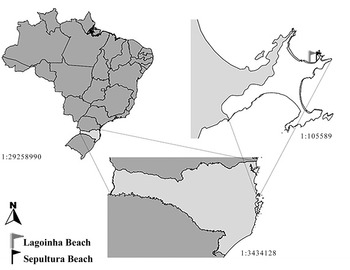
For the population structure analysis, the animals were sampled from Lagoinha Beach (27°08′43.75″S 48°28′49.17″W), in the municipality of Bombinhas, Santa Catarina, on the southern Brazilian coast. Samples were taken seasonally in May/August/October 2017 and March 2018 (autumn, winter, spring and summer, respectively). For the experiment regarding Clibanarius antillensis movement activity, the animals were collected from Sepultura Beach (27°08′28.67″S 48°28′41.41″W), also located in the municipality of Bombinhas, during October 2016 (Figure 1).
Lagoinha Beach (red flag) and Sepultura Beach (black flag), where C. antillensis specimens were sampled for the study of their population structure and movement patterns.

The hermit crabs were found under rocks, on algae beds, and on consolidated/unconsolidated substrates at low tide, and sampled through free diving active search. The Lagoinha Beach specimens were frozen, stored in plastic bags and later conserved in 70% ethanol for future analyses, while the Sepultura Beach specimens were stored in plastic bags filled with local water. All the sampled animals were transported to the ‘Aquatic Biology Laboratory’ at Universidade Estadual do Centro-Oeste (UNICENTRO).
Laboratory procedures and population structure
In the laboratory, Clibanarius antillensis specimens from Lagoinha Beach, which were used for population structure analysis, were carefully removed from their shells, with the aid of fine tweezers, and identified under a stereo microscope, according to Nucci & Melo's (Reference Nucci and Melo2015) specific taxonomic keys. Each individual was then measured regarding the cephalothoracic shield length (CSL), with the aid of a digital calliper (0.01 mm precision). The shells occupied by each hermit crab were identified according to Rios (Reference Rios2009).
They were classified as males (M), females (F), ovigerous females (OF) and intersex (IS), by observing the presence of gonopores on the coxae of the fifth pereopod (males), third pereopod (females) and both (intersex) (Turra, Reference Turra2004). The sex ratio was estimated by dividing the number of males by the number of females and the specimens were grouped into 0.4 mm size classes. In order to evaluate the sexual size dimorphism between demographic groups (males, females, ovigerous females and intersex), the CSL measures were log transformed and an ANOVA was performed, followed by a Tukey HSD post-hoc test. After performing the analyses, the collected hermit crabs were deposited in the Aquatic Biology Laboratory at the Center for Educational and Technological Development of Guarapuava (CEDETEG) of UNICENTRO.
Influence of different shells on movement activity
The hermit crabs and gastropod shells from Sepultura Beach were measured regarding the cephalothoracic shield length (CSL), width (CSW), and their shells were weighed with the aid of a precision analytical balance (0.001 g). The animals were used for the experiments regarding movement patterns during night-time and daytime, and for that, they were kept for 2 weeks in aquarium tanks (70 cm × 35 cm × 25 cm, ~61 litres) with shell gravel and rocks as substrate. The aquariums were linked through a rearing system with a skimmer biological filter (Gregati et al., Reference Gregati, Fransozo, López-Greco and Negreiros-Fransozo2010). Water quality was kept close to natural conditions: 35 salinity, 24°C (± 1°C) temperature, and 12-h dark/12-h light photoperiod. The hermit crabs were fed daily ad libitum with ornamental fish ration, nori algae and pieces of fish muscles.
In this experiment, we tested the Clibanarius antillensis exploratory behaviour with shells from two different species: Cerithium atratum (Born, 1778) and Agathistoma viridulum (Gmelin, 1791). These gastropod species were chosen based on the high number of hermit crabs found using their shells (see Results). We used 24 hermit crabs occupying A. viridulum and 24 occupying C. atratum. Both shells are commonly used by C. antillensis in natural environments (Turra & Leite, Reference Turra and Leite1999), however, they have different physical properties (Rios, Reference Rios2009), with A. viridulum being heavier than C. atratum, which is also less bulky.
After acclimatization, the animals were individually placed in plastic trays (16.5 cm × 24.5 cm × 7 cm) filled with 1 l of water from the original aquarium tank. Each observation tray had a sandpaper-chequered squared bottom (2 cm × 2 cm) to facilitate the measurement of hermit crabs movements. Each specimen was filmed for 24 h with a security camera (Sony® Infrared SO, 1400 lines, 811 × 508 pixels), placed 30 cm above the tray. During the daytime period, natural light was used as the light source, and for the night-time period, infrared Light-Emitting Diode (LED) lamps attached to the camera were used. The animals were not fed during the experiment (see Figure S1 for an image of the experiment).
The experiment was conducted in October 2016, with 24 hermit crabs occupying C. atratum shells and the other 24 occupying A. viridulum. The specimens using C. atratum shells presented a mean CSL size of 3.3 mm (±3.35 SD), a mean CSW of 2.46 mm (±0.12 SD), and the mean weight of the C. atratum shells was 1.48 g (± 0.19 SD). The specimens using A. viridulum shells had a mean CSL size of 4.56 mm (±0.57 SD), a mean CSW of 3.4 mm (±0.48 SD), and the mean weight of the A. viridulum shells was 3.96 g (± 0.17 SD). For each specimen, we measured the time they moved (in seconds) and the distance travelled in the tray (in cm), per shell between 10 a.m. to 2 p.m. (representing daytime) and 10 p.m. to 2 a.m. (representing night-time). A total of 28.800 s of video for each specimen were analysed, being 14.400 s filmed during daytime and 14.400 s, during night-time. The time the animals spent moving was measured with a timer, and the distance travelled was analysed with a 2 × 2 squared space in which the animals moved.
A linear model was employed to test if there is a difference between the distance travelled and the time of activity, separately, during the periods (day × night), considering the shell types (A. viridulum × C. atratum), and the interactions between variables (period × shell type). The shells' influence in the distance travelled and the time of activity were tested within each period (day and night) through an ANOVA. All performed analyses were run in R-environment (R-CORE TEAM, 2021).
Results
Population structure
A total of 613 specimens of Clibanarius antillensis were sampled from Lagoinha Beach: 343 males, 35 females, 190 ovigerous females and 45 intersex. The sex ratio for the species showed dominance for males (1.52:1). Ovigerous females were present in all seasons, however, they presented a peak of individuals in spring. Males were the most abundant demographic group in all seasons. Females and intersex were the less numerous groups, with females being more abundant than intersex only in the spring (Figure 2).
Abundance of each Clibanarius antillensis Stimpson, 1859 demographic group for each season sampled.

Considering the size classes, males were the only group that appeared in all size classes considered, being predominant in all of them, except for the 2.8–3.19 mm, in which ovigerous females were predominant. Ovigerous females only appeared in the 2.0–3.99 mm size classes. Females only appeared in the 1.6–3.2 size classes, always in small numbers. Intersex individuals were always in small numbers too, but appeared in the 2.0–5.2 size classes (Figure 3).
Distribution of Clibanarius antillensis Stimpson, 1859 demographic groups in size classes (0.4 mm).

Out of the 613 specimens, 63.13% were found occupying Cerithium atratum shells, 24.8% were found in Agathistoma viridulum shells, while the remaining used various types of shells. There were 146 males, 35 females, 190 ovigerous females and 16 intersex using C. atratum shells and 133 males and 19 intersex using A. viridulum shells. All the ovigerous females sampled used C. atratum shells (Table 1). Sexual size dimorphism was seen for C. antillensis (ANOVA, F = 49.09, P < 0.05). Only males × intersex did not differ (P > 0.05), all the other pairwise comparisons differed among themselves (P < 0.05), with males being bigger than the other demographic groups (Figure 4).
Boxplot indicating Clibanarius antillensis Stimpson, 1859 cephalothoracic shield length (log mm) variation. Line inside the box indicates the median, the box indicates the first and third quartiles, whiskers indicate minimum and maximum, and dots indicate outliers showing data variation. F, females; FO, ovigerous females; INTER, intersex; M, males.

Species of shells occupied by the specimens of Clibanarius antillensis sampled

Influence of different shells in movement activity
Considering the distance travelled, the model showed differences between the periods (P < 0.05) and between the shell type (P < 0.05) (Table 2, Figure 5). Regarding the time of activity, the model showed differences between periods (P < 0.05) and between the shell type (P < 0.05) (Figure 5, Table 3), with the animals being more active during the night and when occupying C. atratum shells. However, no interactions were found (P < 0.05) between the period and shell type for both models (time of activity and distance travelled). During daytime, both the distance travelled (ANOVA, F = 6.803, P < 0.05) and the time of activity (ANOVA, F = 5.443, P < 0.05) differed between the shell type used (Figure 6); and during night-time, again both the distance travelled (ANOVA, F = 4.174, P < 0.05) and the time of activity (ANOVA, F = 7.863, P < 0.05) differed between the shell type used (Figure 6). During both daytime and night-time, the animals walked more and for a longer period when using C. atratum shells. The average time of movement and distance walked are summarized in Tables 4 and 5.
Boxplot indicating the distance Clibanarius antillensis Stimpson, 1859 walked (cm). A: considering each period regarding the shell type. B: considering different shells regardless of the period of the day. Ca, Cerithium atratum (Born, 1778); Av, Agathistoma viridulum (Gmelin, 1791). The time Clibanarius antillensis Stimpson, 1859 spent moving (s) is also plotted. C: considering each period regarding the shell type. D: considering different shells regardless of the period of the day. Ca, Cerithium atratum (Born, 1778); Av, Agathistoma viridulum (Gmelin, 1791). Line inside the box indicates the median, the box indicates the first and third quartiles, whiskers indicate minimum and maximum, and dots indicate outliers showing data variation.

Clibanarius antillensis Stimpson, 1859 Boxplot indicating A: distance (cm) walked during daytime regarding the shell type. B: time (s) spent moving during daytime regarding the shell type. C: distance (cm) walked during night-time regarding the shell type. D: time (s) spent moving during night-time regarding the shell type. Line inside the box indicates the median, the box indicates the first and third quartiles, whiskers indicate minimum and maximum, and dots indicate outliers showing data variation.

Linear model estimates for period of activity and shell type

Linear model estimates for time spent moving and shell type

Mean (± Standard Deviation) time of movement (s) and distance travelled (cm) for Clibanarius antillensis using different shells: Cerithium atratum and Agathistoma viridulum

Mean (± Standard Deviation) movement time (s) and distance (cm) by Clibanarius antillensis in different shells (Cerithium atratum and Agathistoma viridulum) during daytime and night-time

Discussion
Population structure
All demographic groups were sampled across the four seasons, indicating a well-established population. The presence of ovigerous females in all four periods suggests continuous reproduction, however, an abundance peak of this group in spring indicates better conditions for breeding around this time of the year. This continuous but heterogeneous pattern of reproduction with a peak around the end of spring until summer has been observed for Clibanarius antillensis before (Turra & Leite, Reference Turra and Leite1999; Ribeiro et al., Reference Ribeiro, Cerqueira, Nunes and Braga2016).
Seasonal variation in planktonic productivity is an essential factor regulating breeding in marine organisms, with reproductive peaks generally associated with a higher availability of food (Sastry, Reference Sastry, Vernberg and Vernberg1983). This productivity has a bloom during spring, because of the higher temperatures around this time of the year, and the spawning events in coastal marine animals typically coincide with this period (Naylor, Reference Naylor2005; Castilho et al., Reference Castilho, Costa, Fransozo and Boschi2007). This could be why C. antillensis presents continuous reproduction with a peak around spring/summer.
The species presents intersex individuals, with gonopores on the coxae of both the third and fifth pereopods. Turra (Reference Turra2004) reported three congener species of Clibanarius with intersex individuals working as fertile males: C. antillensis, Clibanarius sclopetarius (Herbst, 1796) and Clibanarius vittatus (Bosc, 1801). In other decapods, intersex individuals have been reported as functional hermaphrodites for Parastacus nicoleti (Philippi, 1882) (Rudolph, Reference Rudolph1995), or non-functional hermaphrodites for Cherax quadricarinatus (von Martens, 1868), with the specimens being fertile males (Sagi et al., Reference Sagi, Khalaila, Barki, Hulata and Karplus1996), just like in Turra (Reference Turra2004). We did not, however, evaluate the animals' fertility in this study.
Ovigerous females had their peak around the 2.8–3.59 size classes, immediately disappearing in the subsequent size-classes, a possible indicator of senescence, an event in which there is a decline in survival and reproductive performance as the animal ages (Charlesworth, Reference Charlesworth1993). Considering C. antillensis' continuous reproduction, its gonads are constantly developing and draining throughout its life, with energy being shared for somatic growth and gonad development (Hartnoll, Reference Hartnoll and Abele1982, Reference Hartnoll and Wenner1985), but as the animal becomes older, it could become senescent.
The sex ratio was skewed for males (1.52:1), although it is skewed for females in most populational studies with the species (Turra & Leite, Reference Turra and Leite1999, Reference Turra and Leite2000; Turra et al., Reference Turra, Jacobucci, Araújo, Leite, Schram and von Vaupel Klein2000; Turra, Reference Turra2004). Argüelles et al. (Reference Argüelles, Álvarez and Alcaraz2009) found more males close to the shoreline, while ovigerous females were more abundant away from it, a possible explanation for the present sex ratio, considering the animals were sampled close to the coast.
The males also dominated the size classes, appearing in all of them, but being more frequent from the 2.8–3.19 size class onward, which makes them generally larger than females. This sexual dimorphism has already been shown in other studies with the species (Turra & Leite, Reference Turra and Leite1999; Argüelles et al., Reference Argüelles, Álvarez and Alcaraz2009). Studies with congener species suggested that this dimorphism could be due to higher energy allocation to reproduction in females when compared with males (Bertness, Reference Bertness1981a), or sexual selection, with larger males presenting higher mating success than the smaller ones (Harvey, Reference Harvey1990). Sexual dimorphism can also be seasonal and related to the size of the chelipeds and pleon, with animals allocating more or less energy on these features, depending on their breeding and non-breeding periods (Hamasaki et al., Reference Hamasaki, Osabe, Nishimoto, Dan and Kitada2020; Hamasaki & Dan, Reference Hamasaki and Dan2021). Despite C. antillensis not having a calcified abdomen, a possible seasonal sexual dimorphism should be evaluated in future research.
Regarding shell choice, individuals mainly occupied Cerithium atratum and Agathistoma viridulum gastropod shells, which were already reported as commonly used by C. antillensis (Leite et al., Reference Leite, Turra and Gandolfi1998; Floeter et al., Reference Floeter, Nalesso, Rodrigues and Turra2000; Turra & Leite, Reference Turra and Leite2002), but they also used another 14 types of shells. Some studies reported C. antillensis' plasticity toward shell use according to their availability in the environment (Leite et al., Reference Leite, Turra and Gandolfi1998; Argüelles et al., Reference Argüelles, Álvarez and Alcaraz2009; Silveira et al., Reference Silveira, Magri, Fransozo, Elias-da-Silva and Negreiros-Fransozo2017). Even though crab selection preference for shells can exist (Osorno et al., Reference Osorno, Fernández-Casillas and Rodríguez-Juárez1998, Reference Osorno, Contreras-Garduño and Macías-Garcia2005; Floeter et al., Reference Floeter, Nalesso, Rodrigues and Turra2000; Turra & Leite, Reference Turra and Leite2002; Sato & Jensen, Reference Sato and Jensen2005), hermit crabs also tend to use shells of the most abundant coexisting gastropods (Reese, Reference Reese1969; Wilber & Herrnkind, Reference Wilber and Herrnkind1982; Leite et al., Reference Leite, Turra and Gandolfi1998).
Movement pattern
Our experiment showed that shells can influence hermit crab activity. When using C. atratum shells, the animals walked more, in terms of time and distance, than when using A. viridulum shells, that are heavier. The hermit crabs in this study would likely use C. atratum shells, which are lighter and less bulky, despite the risks of mechanical injury (Osorno et al., Reference Osorno, Contreras-Garduño and Macías-Garcia2005), possibly because they would spend less energy and be able to walk longer distances for more time. Besides, these shells are more elongated, high spired and have a small aperture (Floeter et al., Reference Floeter, Nalesso, Rodrigues and Turra2000), making them possible effective water reservoirs, thus reducing thermal stress, and offering more protection against predators that may attack through the aperture (Bertness, Reference Bertness1981a, Reference Bertness1981b, Reference Bertness1982; Lively, Reference Lively1988; Floeter et al., Reference Floeter, Nalesso, Rodrigues and Turra2000).
The trade-off between the benefits in reproduction and growth and the costs of exposure to predation and desiccation, making the hermit crabs balance between their shell preferences, has already been reported (Osorno et al., Reference Osorno, Fernández-Casillas and Rodríguez-Juárez1998, Reference Osorno, Contreras-Garduño and Macías-Garcia2005; Ragagnin et al., Reference Ragagnin, Sant'Anna, Gorman, De Castro, Tschiptschin and Turra2016). While light and larger shells can improve growth and reproductive output allowing the animals to save energy (Osorno et al., Reference Osorno, Fernández-Casillas and Rodríguez-Juárez1998), heavier shells could be more difficult to break, conferring resistance, despite being a limiting factor for growth and movement (Osorno et al., Reference Osorno, Contreras-Garduño and Macías-Garcia2005).
Hermit crabs seem to be able to assess shell density and weight and often choose lighter shells with lower densities (Osorno et al., Reference Osorno, Fernández-Casillas and Rodríguez-Juárez1998; Ragagnin et al., Reference Ragagnin, Sant'Anna, Gorman, De Castro, Tschiptschin and Turra2016). The energy costs of carrying heavier shells could limit the animals' movement, therefore, C. atratum shells would improve mobility and exploratory behaviour for C. antillensis, by requiring less energy to be expended. Besides, the benefits of this type of shell for reproduction could be the reason why all the ovigerous females preferred it. However, the specimens using A. viridulum shells, which are heavier, were larger in both CSL and CSW. Whether it would be advantageous for the animals to be larger but have their movement affected or not, is something that could be explored in future studies.
Regarding the animals’ locomotory circadian rhythm, C. antillensis proved to be more active during the night, as demonstrated for this and another species of the genus (Hazlett, Reference Hazlett1966; Turra & Denadai, Reference Turra and Denadai2003), as well as other crustaceans (Drzewina, Reference Drzewina1906; Hazlett, Reference Hazlett1966; Palmer, Reference Palmer1971). By doing this, hermit crabs could be able to avoid potential visual predators, as they have already been reported as part of the diet of some of these animals (Kuhlmann, Reference Kuhlmann1992), that depend on light to hunt. Also, Clibanarius species often share the environment with other diogenid hermit crabs from the Calcinus genus (da Silva et al., Reference da Silva, Rodrigues, Lima, Cobo, Costa and Castilho2020, Reference da Silva, Rodrigues, Paluski, Vieira and Gregati2022; Kruesi et al., Reference Kruesi, Burciaga and Alcaraz2022), and it has recently been argued that a different temporal niche could be a way to avoid shell competition (Kruesi et al., Reference Kruesi, Burciaga and Alcaraz2022). In the same region of the present studies, C. antillensis coexists with Calcinus tibicen (Herbst, 1791), and even though the circadian rhythm of C. tibicen was not evaluated, this pattern found for C. antillensis could be a way to avoid such competition.
Considering that the species is one of the hermit crabs exploited by the marine aquarium trade in Brazil for feeding on undesired algae, therefore serving as ‘cleaners’ (de Gurjão & Lotufo, Reference de Gurjão and Lotufo2018), our results support that C. antillensis can be more useful for this function when occupying C. atratum shells compared with A. viridulum shells. In this circumstance, the animals are more active and move across more space in the aquarium, thus being able to feed on more algae. Knowing what shell fits this purpose best can mitigate the major issue that involves the aquaculture of hermit crabs: their need for a constant supply of shells (Calado et al., Reference Calado, Rhyne, Araújo and Narciso2003), which makes it non-viable.
Breeding specimens of C. antillensis along with C. atratum gastropods is something that could lessen the number of animals taken from the natural environment, as well as of other species of hermit crabs, minimizing the impacts that these actions have on the environment and its fauna.
Summary
The occupation of shells by the hermit crab Clibanarius antillensis in our study revealed the use of mainly two species of gastropod shells: Cerithium atratum and Agathistoma viridulum, two of the most abundant shells in the area, besides being commonly used by the species. Our results showing the animals were more active when using C. atratum shells and the ovigerous females’ absolute use of this shell, along with the knowledge of their nocturnal behaviour and population structure generates linked understanding of the biology of the species. This information may help with indicators for artificial breeding of Clibanarius antillensis that would lessen the impacts caused by the aquarium trade on fauna. Finally, the circadian rhythm observed is suggestive of a way this species might mitigate impacts of shell competition with other hermit crabs.
Supplementary material
The supplementary material for this article can be found at https://doi.org/10.1017/S0025315422000418
Acknowledgements
The authors are grateful to the UNICENTRO facilities, which allowed the experiments to happen and to Isabela Ribeiro Rocha de Moraes, for editing the figures. We would also like to thank the anonymous reviewers for their valuable suggestions to the manuscript.
Authors’ contribution
ArdS lead writing and data analysis, RAPS writing and data analysis, LMR and GBP data acquisition, sampling and manuscript conceptualization, RAG manuscript conceptualization, sampling and final revision.
Financial support
This study was supported by Pró-Reitoria de Pesquisa – USP (A.R.S., PRP – USP) and Coordenação de Aperfeiçoamento de Pessoal de Nível Superior (R.A.P.S., CAPES – PROEX grant number 88887.636676/2021-00), (G.B.P., CAPES).
Conflict of interest
The authors declare that there is no conflict of interest.
Ethical standards
The study was conducted under Brazilian ethical guidelines.