Endocavitary ultrasound probes are commonly used to assess the pelvis (eg, prostate or uterus) via the vagina or anus and are routinely contaminated with vaginal or rectal microbes that may also include human papilloma virus (HPV). As a result, these probes require cleaning followed by high-level disinfection after use.
A previous study reported that patients undergoing medical procedures with endocavitary probes may be exposed to HPV because high-level disinfectants (HLDs), including FDA-approved glutaraldehyde and ortho-phthalaldehyde (OPA), do not inactivate the virus. Reference Meyers, Ryndock, Conway, Meyers and Robison1 Although oxidizing agents, (eg, hypochlorite and peracetic acid [PAA]) were effective, Reference Meyers, Ryndock, Conway, Meyers and Robison1 many oxidizing agents (eg, hypochlorite) are not currently approved by the US Food and Drug Administration (FDA) for use as HLDs. Importantly, this study has not been corroborated. If these findings are correct, millions of patients are potentially exposed to HPV each year. Furthermore, if HPV, a nonenveloped virus, is resistant to glutaraldehyde/OPA, its resistance pattern is unique, and the data would be inconsistent with multiple papers demonstrating that glutaraldehyde/OPA inactivate nonenveloped viruses. Reference Rutala and Weber2
Methods
Meyers et al Reference Meyers, Ryndock, Conway, Meyers and Robison1 used infectious HPV particles isolated from organotypic raft cultures or recombinant quasivirus particles. We tried to reproduce these results using organotypic raft cultures to produce high amounts of infectious HPV16 particles using identical methods. Reference Meyers, Ryndock, Conway, Meyers and Robison1 Additional method details are available at https://spice.unc.edu/hpvinactsuppl/. The following disinfectants were used in this study: oxidizing agents (0.525% hypochlorite, Oxivir, Sporox, Oxycide, Resert and Steris PAA, plus the aldehydes CIDEX and CIDEX OPA (see Supplementary Table online at https://spice.unc.edu/hpvinactsuppl/).
Results
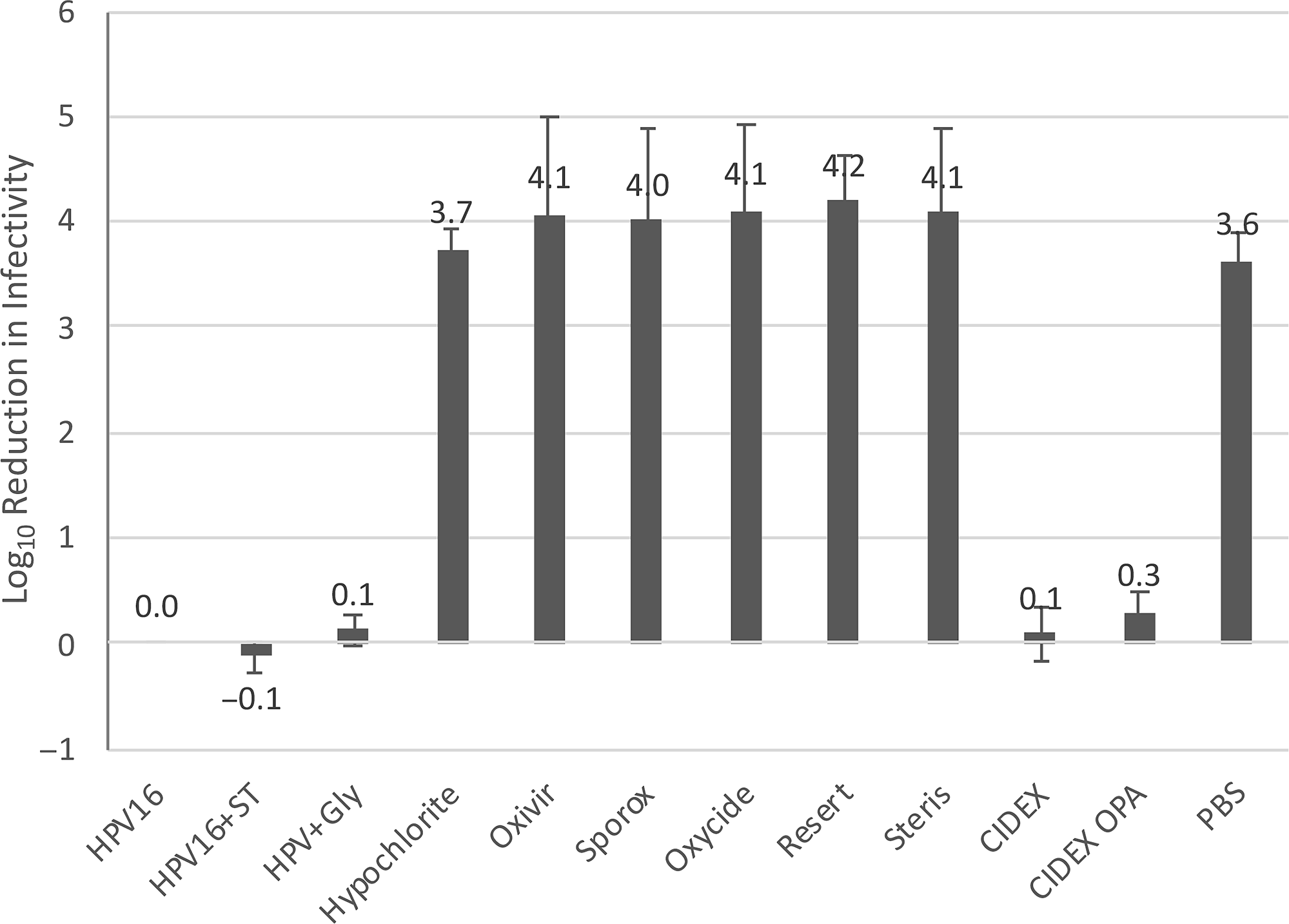
As shown in Figure 1, similar to Meyers et al, Reference Meyers, Ryndock, Conway, Meyers and Robison1 hypochlorite resulted in an ∼4-fold log10 reduction in HPV infectivity, with no effect observed for the aldehydes CIDEX OPA and CIDEX. Additionally, the oxidizing agents Oxivir, Sporox, Oxycide, Steris, and Resert, which were not tested by Meyers et al, also resulted in an ∼4-fold log10 reduction in HPV infectivity. The addition of neutralizers alone had no effect on infectivity.
CIDEX and CIDEX OPA do no inactivate crude viral preps (CVP) of HPV16. qRT-PCR for viral E1^E4 mRNA was performed 48 hours following mock infection PBS or infection with 1.75 ×10⁶ viral genome equivalents (VGE) of HPV16 CVP that were untreated or treated with the indicated disinfectants. Neutralizers included sodium thiosulfate (ST) and 7% glycine (Gly). Log10 reduction in infectivity was calculated as described previously. Reference Meyers, Ryndock, Conway, Meyers and Robison1 Shown in the average of at least 3 independent experiments. Error bars represent ± standard error of the mean.

Discussion
Our studies largely corroborate those of Meyers et al and suggest that oxidizing agents, but not aldehydes, are able to inactivate HPV. However, 2 recently published companion studies Reference Ozbun, Bondu and Patterson3,Reference Egawa, Shiraz and Crawford4 identified several limitations of the methodology followed by Meyers et al and our own that bring into question the validity of our results.
First, the HPV16 crude virus preps (CVPs) used in our assays do not meet common infection criteria of time-dependent viral gene expression and antibody neutralization. Reference Christensen, Dillner and Eklund5 In the first hours after infection, E1^E4 mRNA should be undetectable, with a significant increase occurring over 48 hours. Reference Ozbun6,Reference Culp and Christensen7 Like Meyers et al, Reference Meyers, Ryndock, Conway, Meyers and Robison1 we only measured E1^E4 mRNA levels at 48 hours after infection. Reference Meyers, Ryndock, Conway, Meyers and Robison1 Ozbun et al Reference Ozbun, Bondu and Patterson3 showed that relatively high E1^E4 mRNA levels were detected immediately after inoculation with CVPs from raft cultures, with E1^E4 signal significantly decreasing over 48 hours. Reference Ozbun, Bondu and Patterson3 In contrast, using refined (purified) HPV31 raft virus, E1^E4 levels were low at 0 hours after infection but significantly increased over 48 hours. These results raise the possibility that the E1^E4 signal from CVPs could be due to transfection of residual viral RNA rather than infection. In support of this, Ozbun et al Reference Ozbun, Bondu and Patterson3 showed that despite treatment of CVP stocks with the nuclease benzonase, treatment with RNaseA blocked the E1^E4 signal. This finding suggests that benzonase treatment is inefficient in eliminating RNA contamination in CVPs, possibly due to the presence of residual cell debris. Additionally, they showed that CVPs, but not refined raft virus, were largely resistant to neutralization with well-characterized L1 genotype-specific monoclonal antibodies and that OPA treatment of refined raft virus, refined xenograft-derived HPV11 and recombinant quasivirus particles were inactivated by the HLD ortho-phalaldehyde as well as hypochlorite. Reference Ozbun, Bondu and Patterson3
Using in vitro studies, Egawa et al Reference Egawa, Shiraz and Crawford4 showed that refined raft-derived HPV18 and HPV16 pseudovirus as well as mouse papillomavirus type 1 (MmuPV1) were inactivated by OPA, hydrogen peroxide, and hypochlorite. Additionally, in vivo studies demonstrated that treatment of MmuPV1 with OPA and hydrogen peroxide blocked lesion formation, supporting their in vitro results that aldehydes and oxidizing agents are effective at inactivating papillomaviruses. Reference Egawa, Shiraz and Crawford4 Importantly, they found that OPA, hydrogen peroxide and hypochlorite were also effective against virus in the presence of exofoliated squames on fomites. Reference Egawa, Shiraz and Crawford4
One proposed disinfection mechanism for aldehydes is the cross linking of lysine residues in viral capsid proteins. Residual viral RNA would not be impacted by treatment with HLDs containing aldehydes or by neutralizing antibodies. We did not test whether the E1^E4 signal from our CVPs was sensitive to RNaseA nor did we confirm that viral infectivity could be neutralized with L1 monoclonal antibodies. Additionally, we did not utilize refined virus in our studies to test the effectiveness of CIDEX and CIDEX OPA as done by Ozbun et al and Egawa et al. Characterization of the CVPs was not included in the Meyers et al Reference Meyers, Ryndock, Conway, Meyers and Robison1 study nor were results using refined virus.
Due to the limitations outlined above, coupled with the data presented in Ozbun et al and Egawa et al, Reference Ozbun, Bondu and Patterson3,Reference Egawa, Shiraz and Crawford4 we cannot rule out the possibility that the E1^E4 signal detected after treatment with the aldehydes CIDEX and CIDEX-OPA was due to viral RNA contamination of the CVP stocks. However, hypochlorite solutions as well as oxidizing agents containing hydrogen peroxide (Oxivir, Sporox, Oxycide, Steris, Resert) are effective neutralizers of RNA contamination as well as many viruses. Reference McDonnell and Russell8–Reference Fischer, Renevey, Thur, Hoffmann, Beer and Hoffmann10 This factor would explain why these oxidizing agents were effective at blocking the CVP E1^E4 signal. Based on the findings by Ozbun et al Reference Ozbun, Bondu and Patterson3 and Egawa et al, Reference Egawa, Shiraz and Crawford4 we believe that aldehydes (eg, OPA) as well as oxidizing agents are effective at inactivating HPV and can be used for reprocessing semicritical items.
Acknowledgments
Financial support
This study was supported by the CDC Prevention Epicenters Program (grant no. U54CK000483).
Conflicts of interest
The authors report no related conflicts of interest.