INTRODUCTION
Seabirds associate commonly with marine vertebrates, including whales, dolphins, pinnipeds, sharks and turtles, to feed on prey made available when these animals forage near the surface (Evans, Reference Evans1982; Au & Pitman, Reference Au and Pitman1986; Pitman & Balance, Reference Pitman and Balance1992; Pitman, Reference Pitman1993; Clua & Grosvalet, Reference Clua and Grosvalet2001; Hebshi et al., Reference Hebshi, Duffy and Hyrenbach2008; Vaughn et al., Reference Vaughn, Würsig, Shelton, Timm and Watson2008). These relationships may increase bird foraging efficiency and decrease energy expenditure (Dinsmore, Reference Dinsmore1973; Grubb, Reference Grubb1976). In some cases, the seabird and cetacean associations are probably opportunistic or incidental, and result from a concentration of shared prey (Evans, Reference Evans1982). But there is also evidence of commensally feeding relationships, in which birds benefit from feeding with dolphins, while dolphins are not affected negatively (Martin, Reference Martin1986). Martin (Reference Martin1986) reported that shearwaters (Puffinus sp.) feeding among herds of Atlantic spotted dolphins (Stenella frontalis) took mainly scraps or wounded fish, and only occasionally took whole, live prey. Seabirds have also been reported to feed on squid remains vomited by sperm whales (Physester macrocephalus, Clarke et al., Reference Clarke, Crow and Princep1981) and seabirds have fed directly on cetacean skin (Thomas, Reference Thomas1988; Rowntree et al., Reference Rowntree, McGuinness, Marshall, Payne, Sironi and Seger1998). Cetaceans at times make prey available to birds by driving and concentrating prey close to the ocean's surface, thus enhancing the foraging opportunities for surface feeding and shallow diving birds (Ashmole, Reference Ashmole, Farner, King and Parkes1971; Harrison, Reference Harrison1979; Martin, Reference Martin1986; Obst & Hunt, Reference Obst and Hunt1990; Vaughn et al., Reference Vaughn, Würsig, Shelton, Timm and Watson2008).
By contrast, other authors have examined the possibility that some baleen whales take advantage of seabird feeding activity (Pierotti, Reference Pierotti and Burger1988; Hoelzel et al., Reference Hoelzel, Dorsey and Stern1989; Anderwald et al., Reference Anderwald, Evans, Gygax and Hoelzel2011). Anderwald et al. (Reference Anderwald, Evans, Gygax and Hoelzel2011), indicate that the interaction between minke whales (Balaenoptera acutorostrata) and auks is best described by the pirate theory, with the whales stealing entire bait balls herded by auks.
Dusky dolphins, Lagenorynchus obscurus (Gray, Reference Gray1828) inhabit waters of the continental shelf and slope of Argentina, Chile and Peru in South America, and south-western Africa and New Zealand (Leatherwood & Reeves, Reference Leatherwood and Reeves1983; Crespo et al., Reference Crespo, Pedraza, Coscarella, Garcia, Dans, Iñiguez, Reyes, Koen Alonso, Schiavini and González1997). In Patagonia, Argentina, this species is a target of cetacean watching activities in Golfo Nuevo; an activity was recently regulated in the area (Disposition 004/10, Sub Secretaria de Turismo y Areas Protegidas). Dans et al. (Reference Dans, Crespo, Pedraza, Degrati and Garaffo2008, Reference Dans, Degrati, Pedraza and Crespo2012) showed that boats at times disrupt the normal sequence of dolphin behaviours in Golfo Nuevo, particularly during diurnal feeding activities.
Associations of seabirds and dusky dolphins were described in Admiralty Bay (New Zealand), where Vaughn et al. (Reference Vaughn, Würsig, Shelton, Timm and Watson2008) investigated how dolphins influence prey accessibility for seabirds that commonly feed with them. In addition, in Golfo San José (Argentina), Würsig & Würsig (Reference Würsig and Würsig1980) reported that dusky dolphins drove anchovies (Engraulis anchoita) to the surface where thousands of seabirds sometimes gathered to feed for hours. In Golfo Nuevo (Argentina) the presence of birds foraging with or following a group of dolphins was indicative of dolphin feeding behaviour (Degrati et al., Reference Degrati, Dans, Pedraza, Crespo and Garaffo2008, Reference Dans, Degrati, Pedraza and Crespo2012). Seabirds that were commonly observed were shearwaters (Puffinus gravis), kelp gulls (Larus dominicanus) and several species of terns (Sterna sp.). Seabirds that were occasionally observed were Magellanic penguins (Spheniscus magellanicicus), black-browed albatross (Diomedea melanophrys), two cormorant species: rock shags, imperial cormorants (Phalacrocórax magellanicicus and Phalacrocorax atriceps) and giant petrels (Macronectes giganteus). The importance of these feeding events to seabirds is not currently known.
The objective of this study was to describe seabird–dolphin associations. We investigated during what dolphin activities the birds were most commonly associated and the size of flock in relation to the number of dolphins in a group. We also quantified how frequently seabirds fed with dolphins or without them. Since seabirds may display different feeding strategies, we also investigated if benefits differ among seabird species.
MATERIALS AND METHODS
Study area
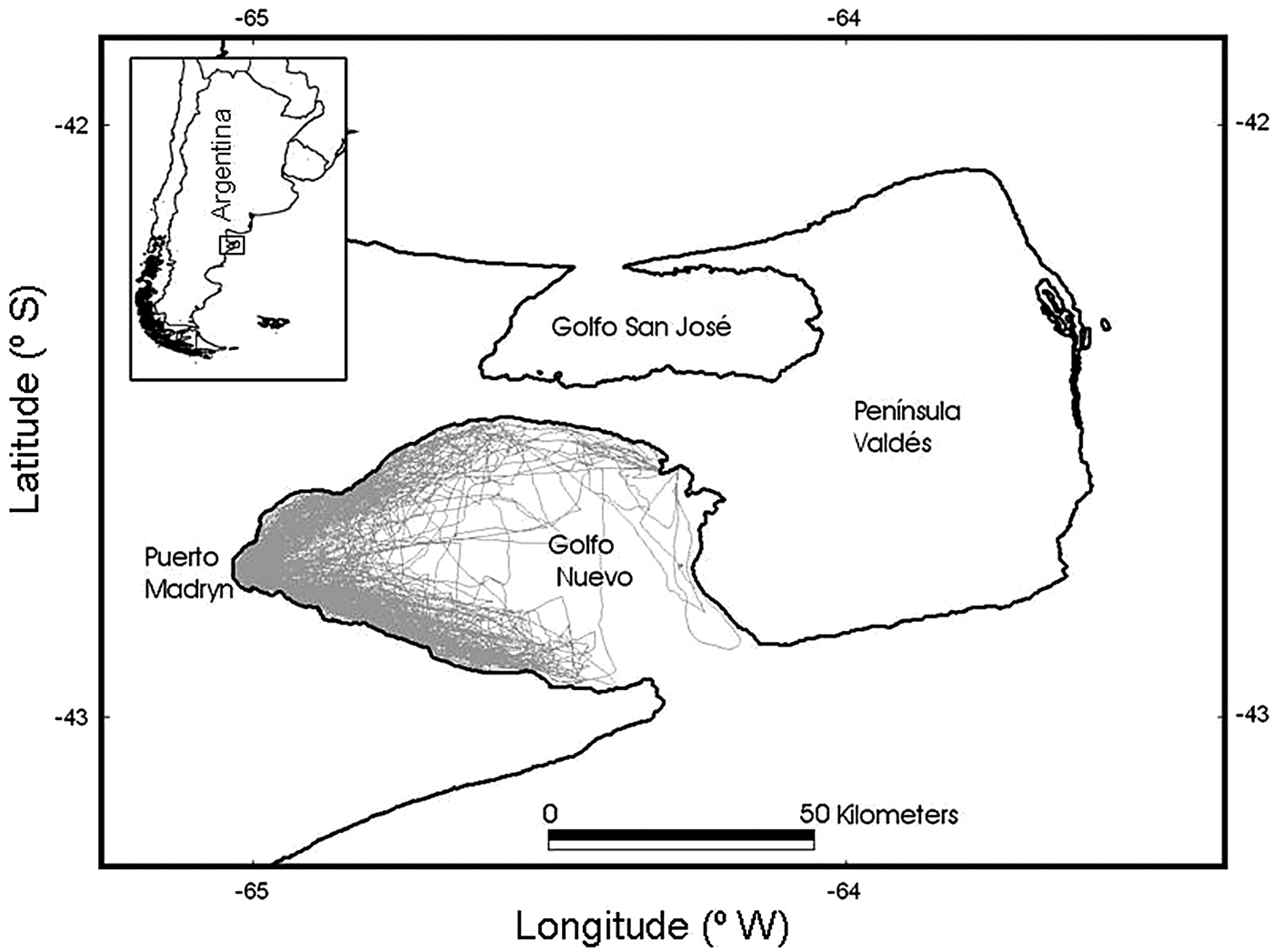
The study area consisted of a roughly 1600 km2 region in the western portion of Golfo Nuevo, Argentina (42°20′–42°50′S64°20′–65°00′W, Figure 1), in northern Patagonia, Argentina. It is surrounded by Península Valdés, a protected area that was declared a World Heritage Site by the United Nations Educational, Scientific, and Cultural Organization (UNESCO) in 1999. The gulf is a semi-closed basin approximately 70 km long and 60 km wide with a total area of 2500 km2. The average depth is 80 m with a maximum depth of 184 m (Mouzo et al., Reference Mouzo, Garza, Izquierdo and Zibecchi1978). The mouth of the gulf is 16 km wide. The gulf is connected to the Atlantic Ocean by shallow waters that have an average depth of 44 m (Mouzo et al., Reference Mouzo, Garza, Izquierdo and Zibecchi1978).
Map of the study area in Golfo Nuevo, Argentina. Grey lines show paths followed by the research boat.

Data collection and analyses
Data were collected during all seasons from 2001 to 2008. Surveys were carried out from either a 6 m fibreglass boat powered with a 50 hp outboard engine, a 7.2 m fibreglass boat powered with a 105 hp outboard engine or a 6 m fibreglass boat powered with a 90 hp outboard engine. The mean duration of trips was 5.5 h ± 1.30 SD (range = 1.30–9 h), with the duration of a given survey determined by sea and weather conditions (Beaufort Sea State ≤3).
A non-systematic search method was used to locate seabirds and dolphins, with a search speed of 10–12 knots. All groups of seabirds were recorded while driving along a transect. A seabird group was defined as an aggregation of >10 individuals of one or more species. Number, specific composition (proportion of individuals of each species), location and behaviour were recorded for each group. Seabird's behaviour was divided into three categories: feeding, resting and flying. Feeding was defined as seabirds swooping down to the water's surface from the air or looking down into the water and then submerging to capture the prey. Resting behaviour was defined as floating on the water's surface. Once information on a seabird group was collected, the transect was resumed.
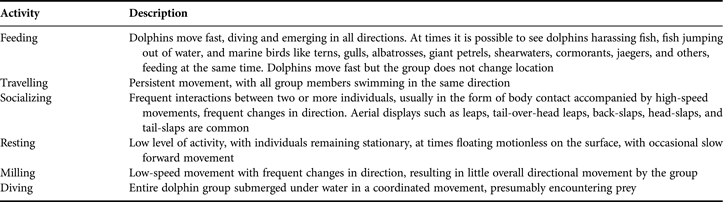
A group of dolphins was defined as any collection of individuals located in close proximity (<10 m) to one another (Smolker et al., Reference Smolker, Richards, Connor and Pepper1992). Once a dolphin group was detected, the transect was abandoned, and the group was followed for as long as possible. The group was observed continuously, and the predominant activity was recorded at 2 min intervals using an instantaneous sampling protocol (Altmann, Reference Altmann1974). Six predominant activities were identified (Table 1). These activities were defined to be mutually exclusive and, collectively, they described effectively the entire behavioural repertoire of the study animals. At the end of each interval the species and number of seabirds associated with dolphins were also registered.
Behavioural states or activities of dusky dolphin (Lagenorhynchus obscurus) groups in Golfo Nuevo.
For the analyses, each dolphin group-follow was considered an independent observation and only one group per day was considered. Because behaviour at consecutive 2 min intervals was not independent, the proportion of time spent in each of the six defined activities was calculated from each group-follow (for methodology details see Degrati et al., Reference Degrati, Dans, Pedraza, Crespo and Garaffo2008, Reference Degrati, Dans, Garaffo, Cabreira, Castro Machado and Crespo2012a). The number of seabirds was classified into four categories (<50, 50–100, 100–200 and >200) and from each seabird group, the category that was mainly recorded during the instantaneous sampling was assigned. Descriptive statistics and Chi-square tests were used to analyse the data. A Spearman correlation was used to examine the relationship between number of dolphins and number of associated seabirds. A significance level of α = 0.05 was used for all tests (Siegel & Castellan, Reference Siegel and Castellan1995; Conover, Reference Conover1999).
RESULTS
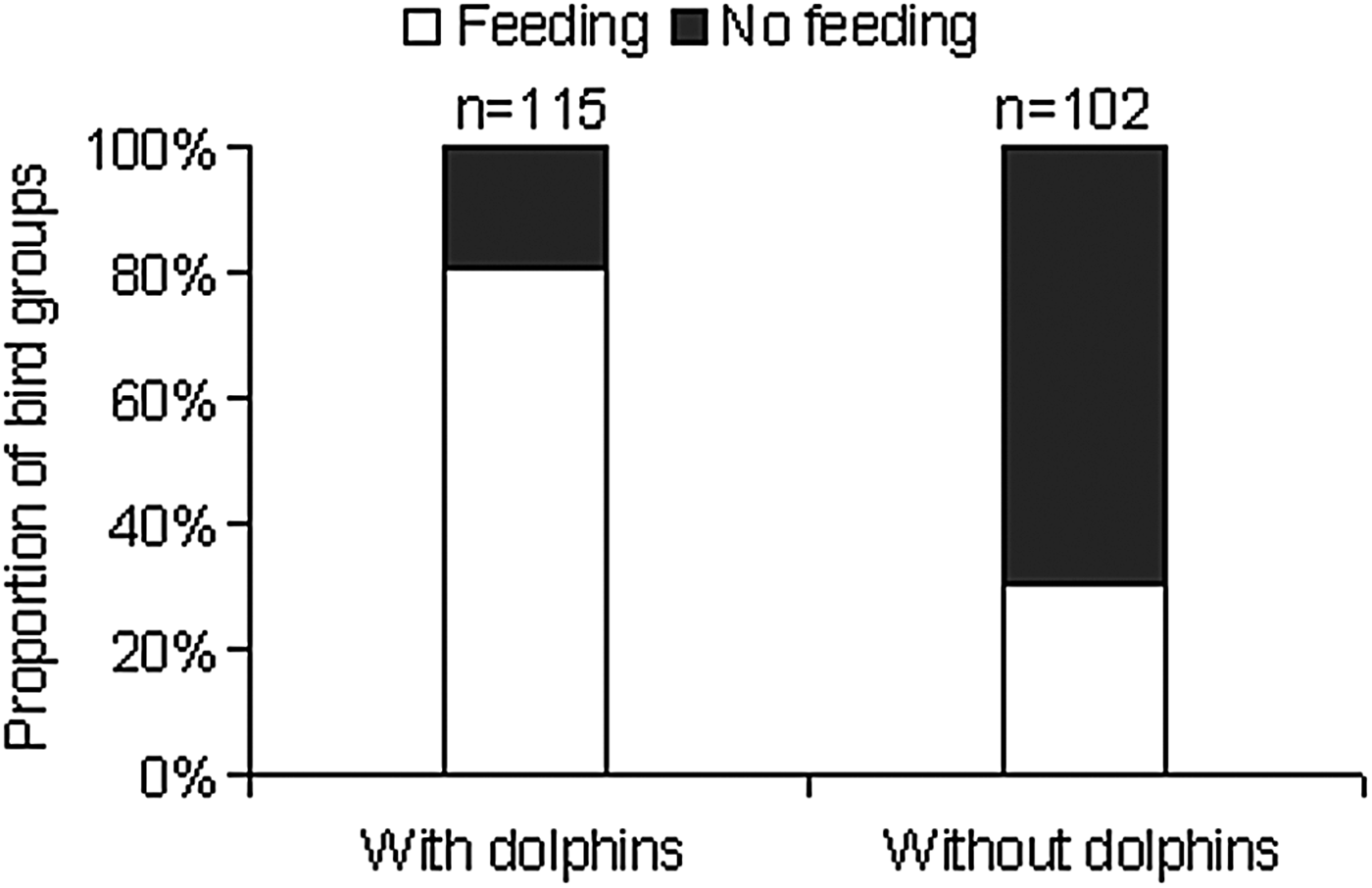
A total of 224 mixed groups of seabirds were encountered during this study, 115 of which were associated with dolphins (Figure 2). For some groups, behaviour or size of group could not be determined. In most of seabird–dolphin groups, seabirds were feeding (81%, χ12 equals 56.24, P < 0.001, Figure 2). On the other hand, only 30% of seabird groups not associated with dolphins were feeding, while most were resting (54%, Figure 2).
Proportion of seabird groups in feeding and non-feeding (other behaviour different to feeding) activity, recorded in association with dolphins or not.
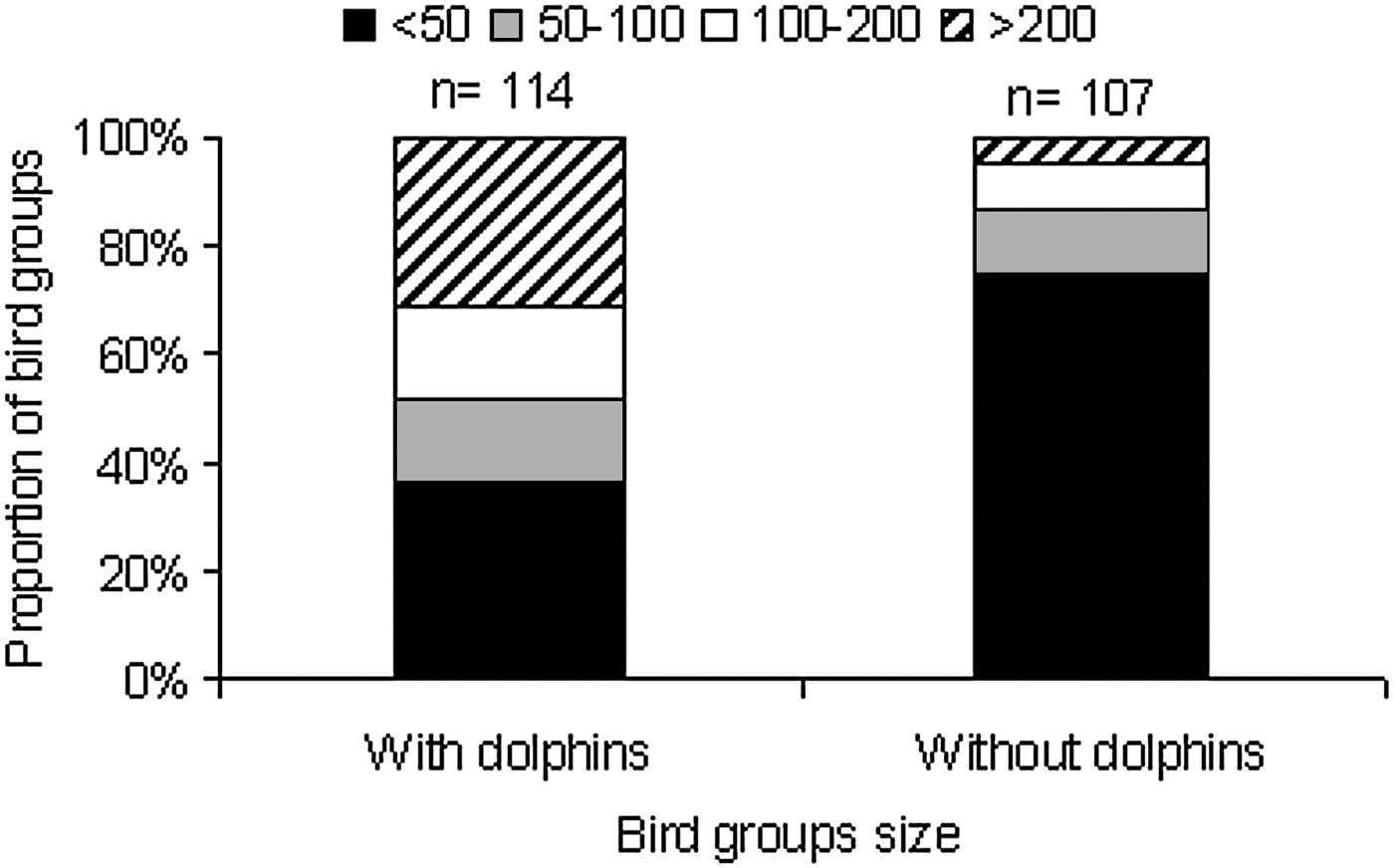
Groups of seabirds in association with dolphins were bigger than those that were not associated with dolphins (χ32 equals 39.20, P < 0.001, Figure 3). A correlation was found between the number of birds and the number of dolphins in the group (Spearman rank correlation r s = 0.54, N = 114, P < 0.001).
Proportion of seabird groups, classified by their size and recorded in association with dolphins or not.
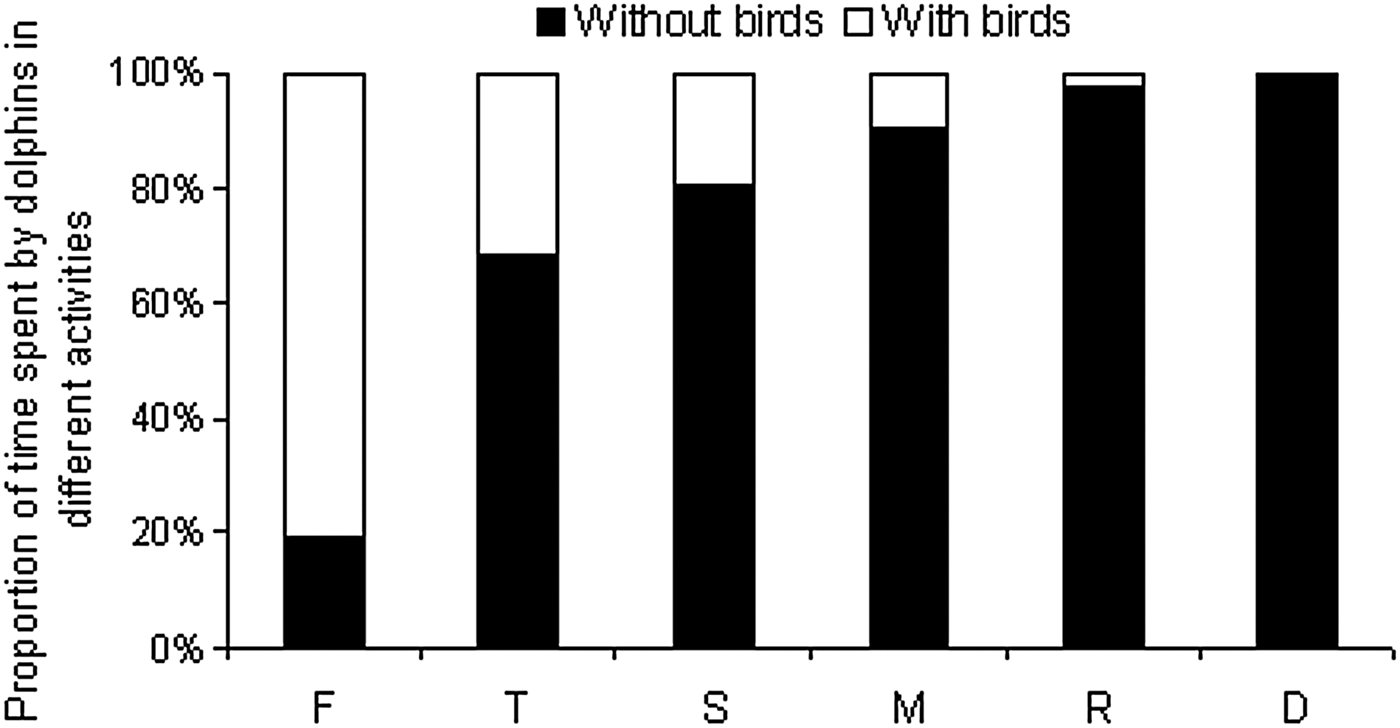
Birds mainly associated with dolphins when dolphins were feeding (Figure 4). Seabirds were never associated with dolphins when dolphins were diving.
Proportion of time spent by dolphins in different activities, with and without birds (N = 4921 two minute intervals). F, feeding; T, travelling; S, socializing; M, milling; R, resting; D, diving.
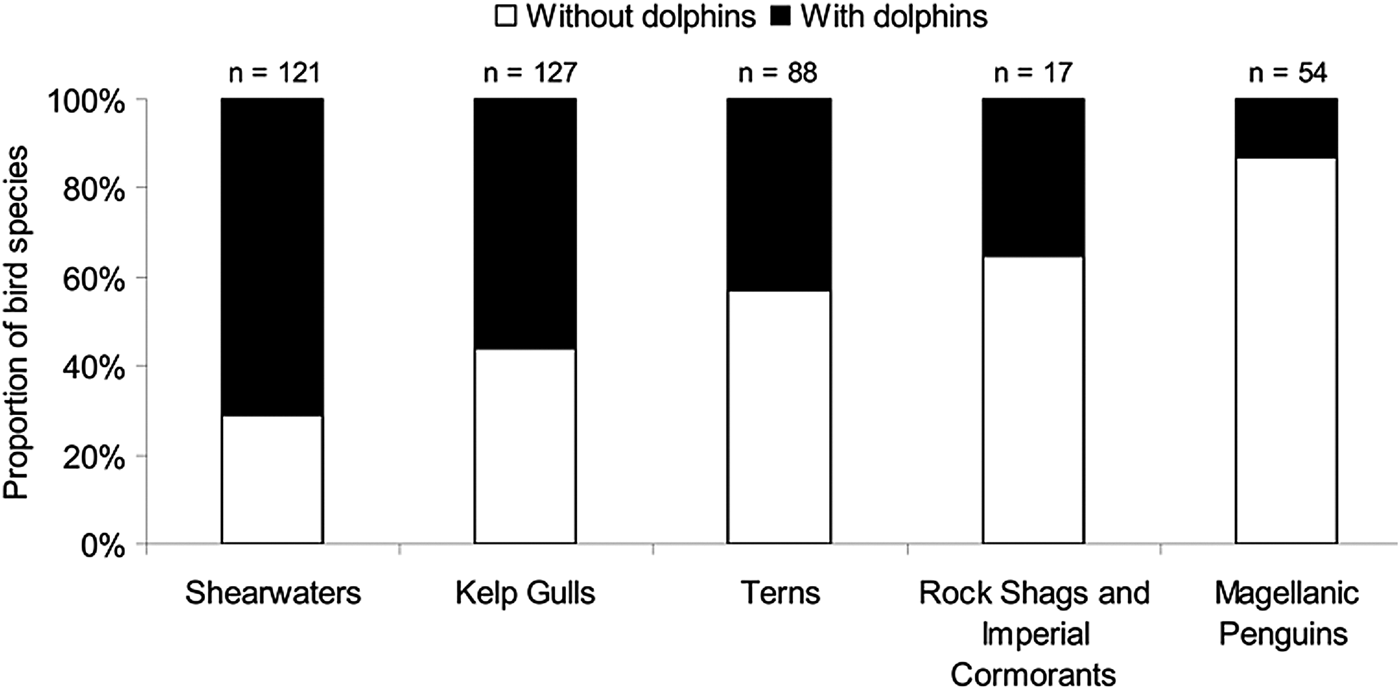
The species composition of bird flocks changed depending on if they were associated with dolphins or not (χ42 = 55.83, P < 0.001, Figure 5). Shearwaters and kelp gulls were mainly observed in flocks that were associated with dolphins, while Magellanic penguins and cormorants were generally not associated with dolphins.
Proportion of bird species present in the mixed flocks, observed in association with dolphins or not.
DISCUSSION
Dusky dolphins in Golfo Nuevo appeared to increase prey accessibility for some seabirds during their surface feeding tactics. The frequency with which shearwaters, kelp gulls and terns fed with dolphins suggests that feeding with dolphins is important to these apex predators. Groups of seabirds in association with dolphins were larger than those that were not associated with dolphins. In addition, larger dolphin groups had more associated seabirds. Additionally, previous studies of dusky dolphin behaviour show that longer feeding-bout durations are associated with larger dolphin groups (Vaughn et al., Reference Vaughn, Degrati, McFadden, Würsig and Würsig2010). Dolphin group size and duration of the feeding bout may be important for long-range detection by the birds as well as potential profitability for them. Larger dolphin groups probably are easier for birds to see at longer distances. Hovering seabirds are likely to be used as a cue to indicate a good foraging opportunity to other birds. Larger dolphin groups could be indicative of larger prey concentrations. A similar result was reported for gannets (Morus serrator) and shearwaters (Puffinus sp.) in association with dusky dolphins in New Zealand (Vaughn et al., Reference Vaughn, Würsig, Shelton, Timm and Watson2008) and for terns in association with Hector's dolphins (Bräger, Reference Bräger1998).
Shearwaters, kelp gulls and terns were associated with dolphins most often. Gulls and terns catch fish at the surface (dipping, surface plunging) (Duffy et al., Reference Duffy, Duffy and Wilson1984; Burger, Reference Burger1988; Gochfeld & Burger, Reference Gochfeld, Burger, Del Hoyo, Elliott and Sargatal1996). Thus, the herding behaviour of dolphins appeared to be most important for these species, since it may have made prey more accessible to them. In Bahía Engaño, three tern species were identified interacting with Commerson's dolphins (Cephalorhynchus commersonii). From the total number of groups with which the terns interacted, those engaged in feeding activities accounted for 72.53%, reaching a proportion of 84.62% when only the groups of dolphins engaged in cooperative feeding are considered (Coscarella et al., Reference Coscarella, Pedraza and Crespo2010). Although shearwaters dive deep to catch prey, dolphins may have also increased prey accessibility for these seabirds by decreasing how deeply they had to dive for prey (Vaughn et al., Reference Vaughn, Würsig, Shelton, Timm and Watson2008). Other factors also may influence prey accessibility for shearwaters. Dolphins may make it easier for birds to capture prey by increasing compaction of prey balls, or may make it easier for birds to initially locate prey (Vaughn et al., Reference Vaughn, Würsig, Shelton, Timm and Watson2008).
Penguins and cormorants appeared in lower proportions in the bird assemblages. There are no Magellanic penguin colonies inside Golfo Nuevo, and this gulf was not reported as a foraging area (Wilson et al., Reference Wilson, Scolaro, Gerrit, Laurenti, Kierspell, Gallelli and Upton1995; Stoke & Boersma, Reference Stokes and Boersma1999). Therefore, most of the penguins could be foraging outside the gulf, in open waters, and they were being part of the seabird–dolphin associations in a few occasions. Given that penguins do not fly, they probably did not benefit from dolphins by finding prey more easily. It is more likely that they co-occurred in the same area due to prey presence. Maybe penguins benefit also from the behaviour of dolphins in terms of finding more prey close to where dolphins are feeding.
Cormorants, in general, show a characteristic bottom diving pattern (Quintana et al., Reference Quintana, Morelli and Benedetti2002, Reference Quintana, Wilson and Yorio2007; Sapoznikow & Quintana, Reference Sapoznikow and Quintana2003). The rock shags breed in two colonies inside Golfo Nuevo but their diet consists mainly of benthic fish and invertebrates of small size and low energetic value (Malacalza et al., Reference Malacalza, Bertelotti and Poretti1997). Therefore, a low association of cormorant with dolphins is expected since their foraging behaviour and prey are different. The imperial cormorant consumes a significantly larger proportion of pelagic or demersal fish, such as anchovy, hake (Merluccious hubbsi) and silverside (Odontesthes sp.), than do rock shags (Punta et al., Reference Punta, Yorio and Herrera2003), but there are no breeding colonies inside the gulf (Frere et al., Reference Frere, Quintana and Gandini2005), so a low association of cormorants with feeding dolphins groups would be expected here.
Birds are associated with dolphins only during feeding at the surface; therefore feeding opportunities and potential benefits to seabirds will depend on delphinid feeding tactics. Behavioural analyses of dusky dolphins show that dolphins may use different feeding tactics (Degrati et al., Reference Degrati, Dans, Garaffo, Cabreira, Castro Machado and Crespo2012a, Reference Degrati, Dans, Garaffo and Crespob). During the warm season, dolphins mostly forage using a feeding–travelling sequence. However, in the cold season, a greater proportion of diving activity appeared and surface feeding decreased (Degrati et al., Reference Degrati, Dans, Garaffo, Cabreira, Castro Machado and Crespo2012a, Reference Degrati, Dans, Garaffo and Crespob). These strategies could be related to the abundance and distribution of dolphin's prey. Hydro-acoustic surveys of prey, in the study area showed that, in the cold season, anchovy schools are widely dispersed and deeper in the water column (Degrati et al., Reference Degrati, Dans, Garaffo, Cabreira, Castro Machado and Crespo2012a). Then, dolphins would need more time travelling longer distances between prey patches, and would spend more energy to carry the school to the surface. It is expected that, during the cold season, dolphins explore an alternative strategy allowing them to get the required energy at lower costs than using anchovies. Squid may be the target, as the second most important prey in their diet (Koen Alonso et al., 1998), while diving could be the strategy to catch them.
Our results are in concordance with previous assessments of the importance of surface predators to the foraging ecology of many species of seabirds (Au & Pitman, Reference Au and Pitman1986; Harrison & Seki, Reference Harrison, Seki and Croxall1987; Jaquemet et al., Reference Jaquemet, Le Corre and Weimerskirch2004; Hebshi et al., Reference Hebshi, Duffy and Hyrenbach2008; Vaughn et al., Reference Vaughn, Würsig, Shelton, Timm and Watson2008). The seabird–dolphin associations we observed may have assisted the seabirds in finding prey, but the associations gave no obvious benefit to dolphins. Hence, the association appears to be one of facultative commensalism. This type of feeding relationship was also described by Bräger (Reference Bräger1998) in his observations of seabirds associating with Hector's dolphins, and by Fox & Young (Reference Fox and Young2012), who found a commensal relationship between two apex predators, one terrestrial (wading birds) and one marine (strand-feeding dolphins). In this case, the foraging activities of the dolphins regularly allow individual birds to meet their energy requirements by providing access to normally inaccessible prey. In Patagonia, further studies on local seabird feeding habits, distribution and abundance will certainly add new pieces to the puzzle regarding the ecological aspects that drive the feeding associations between dusky dolphins and seabirds.
Finally, it is necessary to place the results of this study within a management and conservation context. Groups of dusky dolphins in Golfo Nuevo are subject to tourism activities and showed a short term response to dolphin-watching boats (Coscarella et al., Reference Coscarella, Dans, Crespo and Pedraza2003; Dans et al., Reference Dans, Crespo, Pedraza, Degrati and Garaffo2008, Reference Dans, Degrati, Pedraza and Crespo2012). These boats mainly located dolphin groups using seabirds as a cue for the presence of dolphins. The tourism trips may have not only interfered with dolphin feeding activity, but indirectly with the activity of associated seabirds. At present, Península Valdès constitutes a protected area with managed resources, and dolphin watching was recently regulated. However, the code of conduct does not include any management aspect that pertains to seabirds. Seabirds should also be considered within the management scheme of dolphin watching activities in Golfo Nuevo.
ACKNOWLEDGeMENTS
Logistic support was given by Centro Nacional Patagónico (CONICET). Fieldwork was assisted by Hydrosport SRL, J. Owen and volunteers from Universidad de la Patagonia (Argentina) and Universidad de la República (Uruguay). This work was carried out under permits of the Dirección de Fauna y Flora Silvestre and Secretaría de Turismo de la Provincia de Chubut. M.D. and G.V.G. were supported by a PhD Fellowship from Consejo Nacional de Investigaciones Científicas y Técnicas of Argentina. This work complies with the current laws of Argentina.
FINANCIAL SUPPORT
Financial support was received from Agencia Nacional de Promoción Científica y Tecnológica (PICT No. 01-4030, PICT Nos 11679 and 33934), CONICET (PID 320/99), Fundación BBVA BIOCON 04, Project PNUD ARG- 02/018 (B-B27), Fundación Vida Silvestre Argentina and Universidad de la Patagonia (PI 569 and 698).