Introduction
Miniatures constitute a scaled-down version of real artefacts (López Reference López2012), which, because of their small dimensions, apparently cannot be used for the same purposes as the objects of which they are copies. The miniaturization of objects exists on a global scale, so that the archaeological record of miniatures in different raw materials covers a large spatial, temporal and cultural spectrum (Aguirre Reference Aguirre2004; Carey Reference Carey2006; Cervantes et al. Reference Cervantes, Shimada, Häusler, Wagner and Wagner2011; Fladd & Barker Reference Fladd and Barker2019; Guerra Clará Reference González2014; Hermes Reference Hermes2003; Kiernan Reference Kiernan2015; López Bertrán & Vives Ferrándiz Reference López Bertrán and Vives Ferrándiz2015; Park Reference Park1998; Park & Mousseau Reference Park and Mousseau2003; Prous & Jácome Reference Prous, Jácome, Páez and De La Fuente2007; Uribe et al. Reference Uribe, Sanhueza and Bahamondes2007; Valdez et al. Reference Valdez, Jocelyn and Bettcher2006, among others). Small objects are frequent in ritual contexts, such as sanctuaries or burials, where they served as votive and mortuary offerings (Gabaldón Martínez Reference Gabaldón Martínez2004). Some have also been reported in domestic structures that were used as kitchens (Arévalo Ayala Reference Arévalo Ayala2011). In other cases, the miniatures show traces of pigments inside, suggesting they were used as receptacles for colouring substances (Aguirre Reference Aguirre2004; Arévalo Ayala Reference Arévalo Ayala2011; Hermes Reference Hermes2003).
In Mesoamerica and the Andean area, for example, the record of ceramic miniatures is widespread and they have been detected in large quantities. This is clearly highlighted at the Carranza site, where 426 miniature vessels were found in a structure corresponding to a temple, as well as at the Cihuatán site, where 70 ceramic miniatures were associated with the burial of a young woman. These small pieces from the post-classic period in El Salvador do not show traces of previous usage of a utilitarian type, such as soot, charred residue or pigments (Guerra Clará Reference Guerra Clará2014). On the north coast of Peru, at the Huaca Loro site, around 1200 miniatures were reported in elite tombs that corresponded to the Middle Sican period (900–1100 ad). These pieces were not decorated and were low in artistic and technological quality in comparison with the rest of these objects that were found as offerings (Cervantes et al. Reference Cervantes, Shimada, Häusler, Wagner and Wagner2011). It is common that several miniature vessels are part of the same funeral offering, such as at the Playa Grande site, which is associated with the Lima culture, where a burial was recovered along with a textile bag containing 11 miniature vessels. In another burial from the same site, six miniature vessels were recorded under the wings of a macaw located in a hole near the individual's head. All these miniatures had a rustic finish and had not been fired (Stumer Reference Stumer1953). On the central coast of Perú, the practice of accompanying burials with miniatures made of raw or lightly fired clay has been reported from the end of the Early Horizon or Early Intermediate period, including both adult and child burials, as well as individuals of diverse status (Barraza Lescano Reference Barraza Lescano2000).
In the Andean area of Argentina, miniatures are also frequent. Here, they were linked to the concepts of fertility, abundance and wellness (López Reference López2012). The archaeological, ethnographic and ethnohistorical information from this region associates these artifacts with ritual domestic contexts, shamanic activities, and in particular with mortuary ceremonies (Circosta Reference Circosta2015; López Reference López2012; López et al. Reference López, Acevedo, Mancini and Normando Cruz2014). As with the Mesoamerican and Andean cases in general, ceramic miniatures from the Argentinian northwest are also frequently reported in groups of several pieces in mortuary offerings. Yacobaccio et al. (Reference Yacobaccio, Madero, Malmierca and Reigadas1997–98), for example, documented the presence of 10 miniature vessels of various shapes in a funerary structure at the Hornillos 3 site, dating to 475±75 years bp, some of which contained coca leaves. López (Reference López2012) referred to the presence of very similar miniatures in funerary contexts in archaeological collections from various sites in the Quebrada de Humahuaca.
In the lowlands of the middle and lower Paraná River in northeastern Argentina, compared to the above-mentioned records and as will be seen in the section below, the miniature vessel record is generally much more scarce and sporadic. They have been reported in residential base-camps that are associated mainly with complex hunter-gatherer groups dating from at least one millennium before the present (e.g. Caggiano et al. Reference Caggiano, Flores, Méndez and Salceda1978; Ceruti Reference Ceruti2003; Reference Ceruti2017; Gaspary Reference Gaspary1950; González Reference González1947; Ottalagano Reference Ottalagano2013; Politis & Bonomo Reference Politis, Bonomo, Politis and Bonomo2019; Ruggeroni Reference Ruggeroni1975; Serrano Reference Serrano1946). Unlike all other pottery, which is highly fragmented, miniatures are usually found strikingly complete, even when they are objects of great fragility, thus constituting valuable reference material for the morphological reconstruction of normal-size vessels. In the local literature, miniatures have been considered to be children's toys or ceremonial artifacts (Gaspary Reference Gaspary1950; González Reference González1947; Serrano Reference Serrano1946). These interpretations, however, have not been explored methodically in this area. The objective of this work is to examine these functional hypotheses by analysing the observable and measurable variables in the archaeological record that are related to the level of artistic mastery, the traces of use and the context of discovery of the pieces. To do this, 24 miniatures from museum collections and our own excavations are analysed, some of which are unpublished or have had partial data published. The first systematic approach to the study of ceramic miniatures from the lowlands of the middle and lower Paraná River is carried out, which constitute a subject that has received marginal attention from regional archaeology. This preliminary analysis attempts to further our understanding of the roles that these pieces played in the complex hunter-gatherer groups that inhabited this area. Therefore, this paper is included in the current debate regarding the use of the miniature vessels, according to which they are evaluated as possible artifacts manufactured or used by children, small utility vessels, or ritual objects that symbolically replace the original pieces (see Baxter Reference Baxter2005; Carey Reference Carey2006; Kamp Reference Kamp2001; Langdon Reference Langdon, Grubbs and Parkin2013; Menon & Varma Reference Menon and Varma2011; Park Reference Park1998, among others).
Archaeological context and ceramic record
The miniatures from the Paraná River lowlands generally come from multi-purpose archaeological sites linked to the Goya-Malabrigo archaeological unit (sensu Ceruti Reference Ceruti2003). Their occupation of the area became more intense during the last millennium before present (Ceruti Reference Ceruti and Tarragó2000), a time at which the number of Goya-Malabrigo sites increased significantly on the regional record. This archaeological record was generated by complex hunter-gatherer groups whose food was based on the intake of fish, semi-aquatic mammals and deer, supplemented to a lesser extent with the consumption of wild, domestic and/or potentially manipulable plants, as evidenced by archaeofaunal, archaeobotanical and isotopic human studies (Bastourre Reference Bastourre2014; Bonomo et al. Reference Bonomo, Scabuzzo, Politis and Zucol2017; Ceruti & González Reference Ceruti and González2007; Colobig & Ottalagano Reference Colobig and Ottalagano2016; Colobig et al. Reference Colobig, Sánchez and Zucol2015; Mucciolo & Pérez Jimeno Reference Mucciolo and Pérez Jimeno2015; Ottalagano Reference Ottalagano2019a; Ottalagano & Loponte Reference Ottalagano and Loponte2017; Píccoli et al. Reference Píccoli, Martín and Barboza2017, among others).
Pottery vessels played an important role in aboriginal subsistence. Their use was strongly associated with processing and cooking food, including decorated vessels, which usually record traces of use, such as soot, charred residue and fatty acids, as well as plant micro-remains (Colobig & Ottalagano Reference Colobig and Ottalagano2016; Ottalagano Reference Ottalagano2013; Reference Ottalagano2019b). In the Goya-Malabrigo ceramic assemblages, hemispherical forms with simple contours predominate, although to a lesser extent there are also vessels with inflected and composite contours (sensu Shepard Reference Shepard1956). There are pots, bowls, basins, plates and cups. Around 20 per cent of the vessels are decorated. The most frequent decorative techniques are painting, incision and figurative modelling (Badano Reference Badano1940; Ceruti Reference Ceruti2003; Reference Ceruti2017; Ceruti et al. Reference Ceruti, Fontana, López and Vesco1980; Serrano Reference Serrano1946). The Goya-Malabrigo pottery style is well defined, including realistic and stylized zoomorphic and anthropomorphous appendages which have been interpreted as symbols of group identity in the context of increasing social complexity. The most representative birds in these ceramics belong to the Psittacidae family and in many cases they can be identified as macaws. Birds have had significant symbolic importance in regional ethnography and ethnohistory (Ottalagano Reference Ottalagano2013).
The Goya-Malabrigo style also includes a particular type of ceramic artifact: the so-called ‘bells’. This denomination is mentioned by Gaspary (Reference Gaspary1950) to refer to conical or cylindrical pieces without a base. They have very thick walls, which is why they are also known as ’thick pottery’, a name used by Serrano (Reference Serrano1929). The basal openings of the bells are generally wider than their upper orifices, constituting the ‘mouths’ of the pieces. They can also have minor, lateral or frontal holes. The presence of white paint on their external surfaces is frequent. In the Goya-Malabrigo contexts, they usually have a zoomorphic appendage (usually ornithomorphic) that represents the head of an animal. Some are two-headed, that is, with two identical contiguous zoomorphic appendages. Opposite the front appendage, there may also be a posterior appendage representing the caudal feathers of a bird. It is also common for wings to have been modelled on both sides (Ceruti Reference Ceruti2003; Ottalagano Reference Ottalagano2017). The functionality of the bells is currently under discussion, with some evidence suggesting a mortuary use (see summary in Loponte et al. Reference Loponte, Ottalagano, Pérez, Malec, Ramos, Bozzano, Iribarren, Pérez, Leiva, Domínguez, Alí and Acosta2019).
The regional record of pottery miniatures
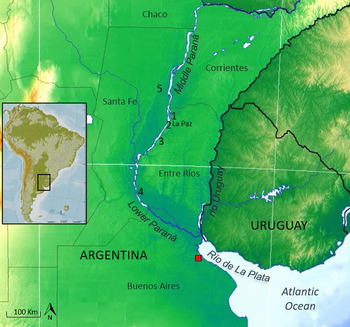
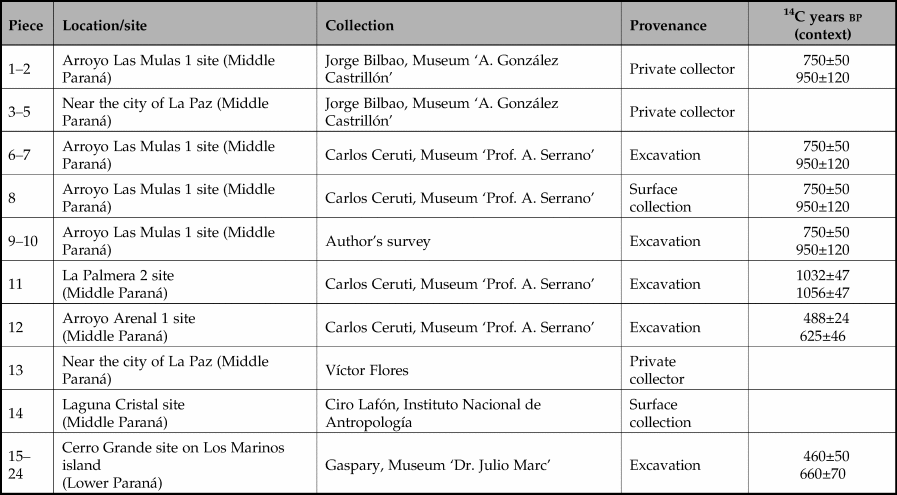
The record of miniature vessels in the lowlands of the middle and lower Paraná River is generally very scarce and sporadic. The Arroyo Las Mulas 1 and Cerro Grande sites on the island of Los Marinos (Fig. 1) tend to contain most of the known miniature vessels in this area. For the Arroyo Las Mulas site, Serrano (Reference Serrano1946) published seven miniatures, corresponding to five bowls, a pot and an ornithomorphic bell (see the chronology in Table 1). The author did not provide any contextual information about these findings, although he referred to the presence of numerous human remains during the excavation of the site, which were very fragmented and disordered:
During the excavation of zone A, we often encountered disordered and fragmented human remains, as if they were secondary inhumations. In this area, everything was mixed and disordered, archaeological material and human remains from a depth of 0.60 cm to 0.80 cm and 1 m. On the other hand, in zone B, the skeletons appeared to be buried as was first intended … (Serrano Reference Serrano1946, 114. Author's translation).
Ceruti (Reference Ceruti1980; Reference Ceruti1989; Reference Ceruti2003) also recovered complete and fragmented miniatures at the Arroyo Las Mulas 1, as well as at other nearby archaeological sites, such as Arroyo Arenal 1 and La Palmera 2 (Fig. 1), some of which will be analysed in detail in this work. Gaspary (Reference Gaspary1950) mentioned the finding of 10 mostly complete miniatures and a similar number of fragments in Cerro Grande on the island of Los Marinos, a site where the presence of primary and secondary burials has been recorded, as well as numerous human remains. The author included these small pieces as being part of grave goods. These miniatures will also be discussed in detail in this work.
Locations of the archaeological sites considered: (1) Arroyo Las Mulas 1; (2) Arroyo Arenal 1; (3) La Palmera 2; (4) Cerro Grande on the island of Los Marinos; (5) Laguna Cristal.

Origins of the pieces and their associated chronology. (Note: The chronology of the Arroyo Las Mulas 1 site was taken from Ceruti Reference Ceruti2003 and Cornero & Green Reference Cornero, Green and Orellano2017; that of the La Palmera 2 site from Ottalagano et al. Reference Ottalagano, Darigo, Pereyra, Brancatelli and Iannelli2015a; that of the Arroyo Arenal 1 site from Ottalagano Reference Ottalagano2016a; and that of the Cerro Grande site on Los Marinos island from Kozameh & Brunás Reference Kozameh and Brunás2013.)

Sporadic findings were also documented by other local researchers, at sites on both banks of the Paraná River. At the Cerro Grande site, González (Reference González1947) retrieved a miniature corresponding to a smooth pot 3 cm high and 4.3 cm in diameter, which did not offer any contextual data. At the Paraná Ibicuy 1 site (also called La Argentina), Caggiano et al. (Reference Caggiano, Flores, Méndez and Salceda1978) mentioned finding a coarse hemispherical miniature pot with a mouth 3.5 cm in diameter and 6 cm high. It was recovered from level III of the site, along with food remains, abundant ceramic fragments and some bone instruments. Ruggeroni (Reference Ruggeroni1975), at the Isla del Indio site, reported the presence of a small double-headed ornithomorphic bell 2 cm high and 3 cm long, but did not specify any links with human remains. At the Los Tres Cerros 1 site, dating from between 560±80 and 830±50 years bp, Politis and Bonomo (Reference Politis, Bonomo, Politis and Bonomo2019) recovered another zoomorphic miniature bell without reporting the context of their discovery. On analysing the collection excavated by Lothrop at the Arroyo Malo site, which is associated with a Guaraní context dating from 416±41 bp, Bonomo (Reference Bonomo2013) indicated the presence of a well-elaborated miniature 3.36 cm in diameter at the mouth and 7 cm high with unguiculated decoration. On reviewing the indigenous materials at the Santa Fe La Vieja site, Ceruti (Reference Ceruti, Carrara and De Grandis2006) published a miniature pot decorated with a line incision with abstract motifs.
Local interpretations regarding their use
In the local literature, the miniatures were first interpreted as being children's toys. According to Serrano (Reference Serrano1946; Reference Serrano1950), these small pieces would have been made by mothers for their children's games. González (Reference González1947) also shared this argument, based on the coarse aspect that characterizes most of the miniatures, as well as their lack of practical utility. In reference to a miniature vessel with unguiculated decoration, Bonomo (Reference Bonomo2013) interpreted the imprints of small nails as a result of their elaboration, totally or partially, by apprentice children.
Another interpretation gives these pieces a symbolic character. For Gaspary (Reference Gaspary1950), the miniatures would have been used in ceremonial or funeral contexts, as replacements for the original pieces. He considered that they could not have been toys, as the miniatures were associated with adult individuals of both sexes, but never in connection with the remains of children. The hypothesis about the miniatures’ funerary function, in particular for the miniature bells, gained strength with the narration of Sánchez Labrador (Reference Sánchez Labrador1910), who described the funerary customs of the Payaguá of the Gran Chaco, who occupied the basin of the Paraguay River, one of the main tributaries of the Paraná River. This eighteenth-century Jesuit missionary mentioned that the Payaguá had different types of vessels in their graves so that the deceased would have water and other comforts, some of which were in the shape of a bell without a base. His narration explained that the Indians placed two or three small vessels under the larger vessels, and that they had the same shape.
Sobre cada sepultura había una estera de enea (…), ponen sobre la estera unos cántaros de varias figuras y grandeza. Unos parecen campanas (…), y en lugar de asas, en unos hay como una hacha y en otros como una mano de almirez (…). Lo que no se puede penetrar es por qué debajo de los cántaros grandes había dos ó tres chicos de la misma forma; y, finalmente por qué en todas las sepulturas estaba un cántaro de éstos con tres agujeros, uno a un lado, otro en medio y otro en el fondo. Ofrecióse que dichos agujeros servían para que el espíritu metido en su tinaja, tenga sol, viento y comodidad para registrar lo que pasa por afuera y por dentro de las sepultura, cuando gustare vivir en retiro. (Sánchez Labrador Reference Sánchez Labrador1910, 93–4)
[On each grave there was a mat (…), they put some containers of various shapes and sizes onto the mat. Some looked like bells (…), and instead of handles, in some there was something like an axe and in others something like a pestle (…). What cannot be understood is why under the big containers there were two or three small containers of the same shape; and, finally, why in every grave there was one of these containers with three holes, one in one side, another in the middle and another in the bottom. These holes allowed the spirit in his jug to feel the sun and the wind, and to record in comfort what was happening outside and inside the grave, when he wanted to live in retreat]. (Author's translation)
Beyond the ethnohistorical information that can be taken as an initial hypothesis, and preliminary interpretations made by researchers in the area, so far there have been no systematic studies into the use of miniatures in the lowlands of the Paraná River.
Materials and methods
Twenty-four complete or mostly complete miniature vessels from the middle and lower basins of the Paraná River were considered, which had been obtained by private collectors and archaeological surveys (see Table 1). Pieces 6, 7, 8, 11 and 12 were recovered from systematic excavations carried out during the 1980s and 1990s by Ceruti (Reference Ceruti1989). Pieces 9 and 10 were recovered by the author in 2018 during fieldwork. Piece 14 was recovered by Lafón (Reference Lafón1971), although he never published it. Pieces 15 to 24 were obtained from the excavations carried out by Gaspary (Reference Gaspary1950). The miniatures analysed here are housed at the following institutions: the Regional Museum ‘Alicia González Castrillón’ (La Paz, Entre Ríos province); the Museum of Natural and Anthropological Sciences ‘Prof. Antonio Serrano’ (Paraná, Entre Ríos province); the Provincial Historical Museum ‘Dr. Julio Marc’ (Rosario, Santa Fe province); the Institute of Anthropology and Latin American Thought (Buenos Aires city). The chronology associated with these miniatures ranges between 488±24 and 1056±47 14C years bp. Table 1 summarizes the above-mentioned information.
First, a photographic record of the pieces was created, as many of them are unpublished or partially published. Ceruti (Reference Ceruti1980; Reference Ceruti2017) presented drawings of pieces 1, 2 and 7, together with their technical and dimensional details. The author of this study published photos of miniatures 6, 11 and 12, but did not address them specifically (Ottalagano Reference Ottalagano2013). Gaspary (Reference Gaspary1950) revealed limited dimensional data for pieces 15 to 24.
After that, the dimensional and morphological features were recorded. The types of the vessels’ contours were determined following the classification of Shepard (Reference Shepard1956), taking into account the terminal and angular points of the contours. The ceramic forms were classified according to the terminology of Balfet et al. (Reference Balfet, Fauvet-Berthelot and Monzón1983): a) a bowl is an open vessel with slightly diverging walls whose mouth diameter is 1.5–2.5 times its height; b) a basin is an unrestricted vessel with strongly divergent walls whose mouth diameter is 2.5–5 times its height; c) a cup is a container with mostly vertical walls whose height is greater than the mouth diameter; d) a pot is a restricted vessel, with or without a neck, whose mouth diameter is less than the maximum diameter. A fifth morphological category was also considered, in particular from the middle and lower Paraná basin, which is the bell artifact, as previously mentioned.
Likewise, attributes related to the appearance and treatment of the pieces’ surfaces were examined, as well as in relation to the decoration, following the criteria of the National Convention of Anthropology (1966), Gibson and Woods (Reference Gibson and Woods1997) and Rye (Reference Rye1981), among others. The data in relation to the vessels’ firing were taken from pieces that presented some previous fractures, where it was possible to observe the colour of the paste. Errors and irregularities in the manufacture and decoration of the pieces were identified, aspects that have been used to evaluate the skill of the potter and children's agency (Fladd & Barker Reference Fladd and Barker2019; Kamp Reference Kamp2001; Langdon Reference Langdon, Grubbs and Parkin2013; Menon & Varma Reference Menon and Varma2011; Park Reference Park2010, among others). The presence and localization of traces of use were recorded macroscopically, such as remnants of pigments, soot and organic residue that had adhered and absorbed (sensu Reber & Hart Reference Reber, Hart and Hart2008). Where the miniatures were recovered in stratigraphy, they deepened the context of their discovery.
Results
Morphology, dimensions and surface appearance
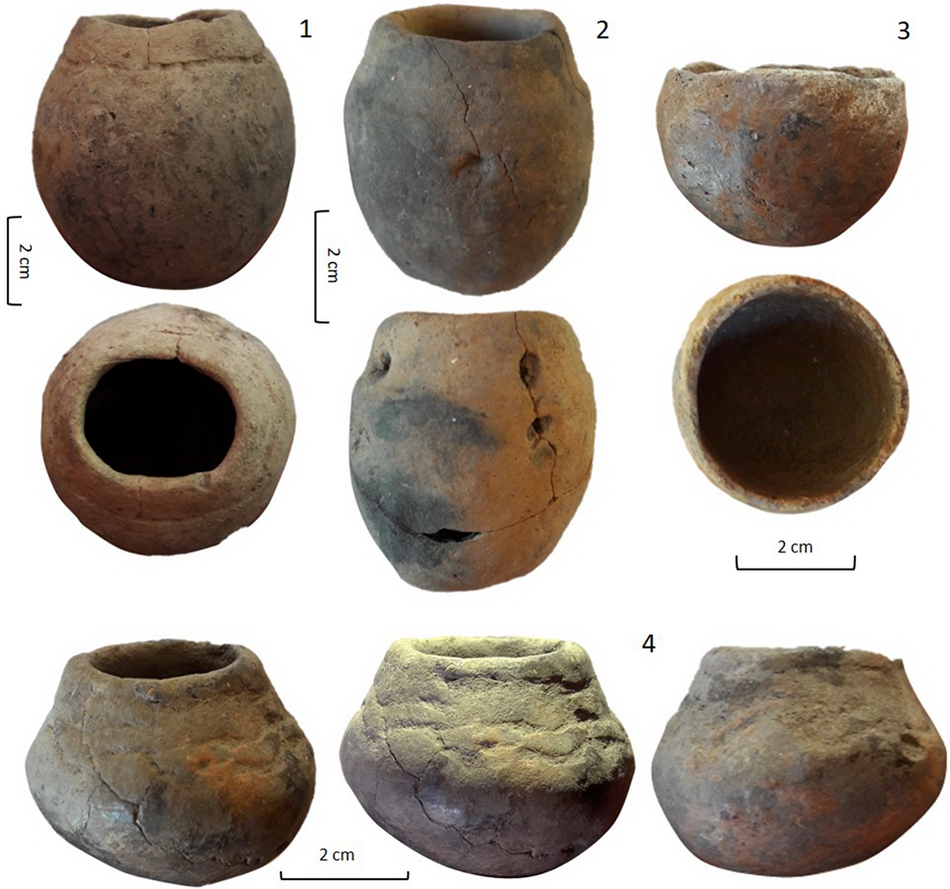
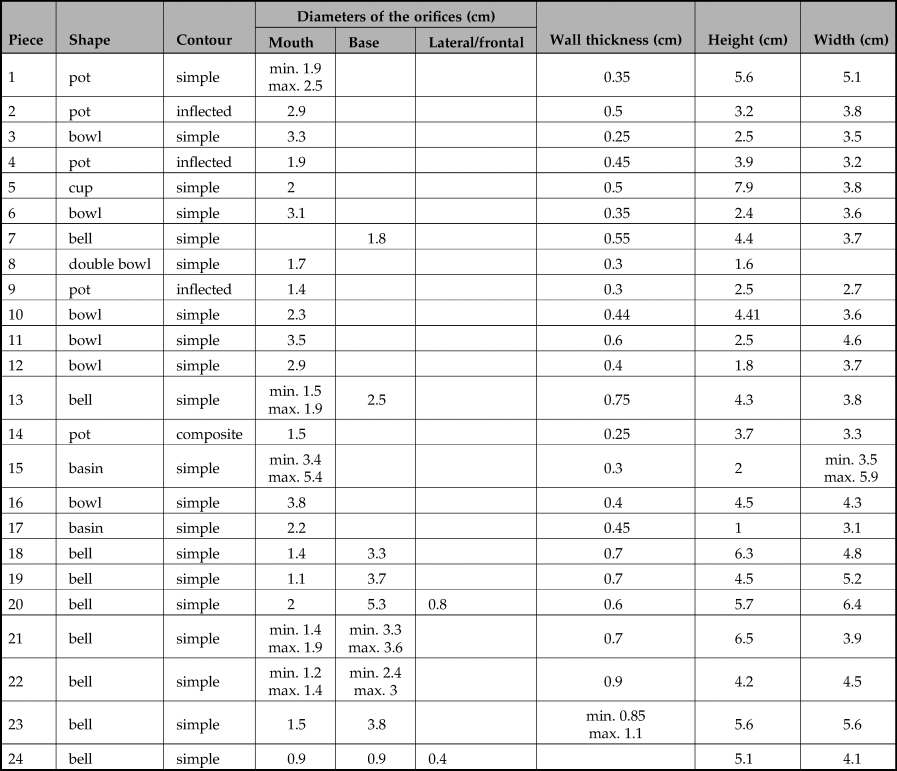
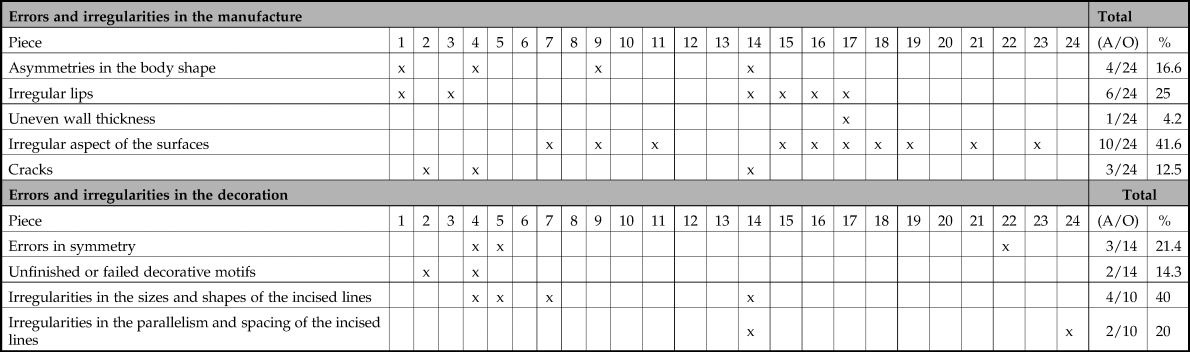
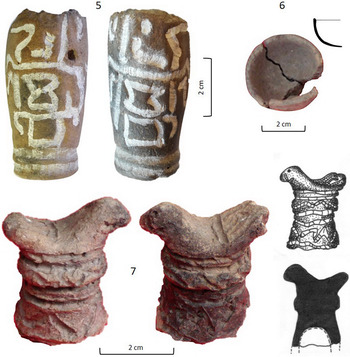
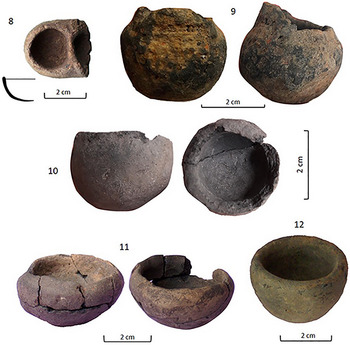
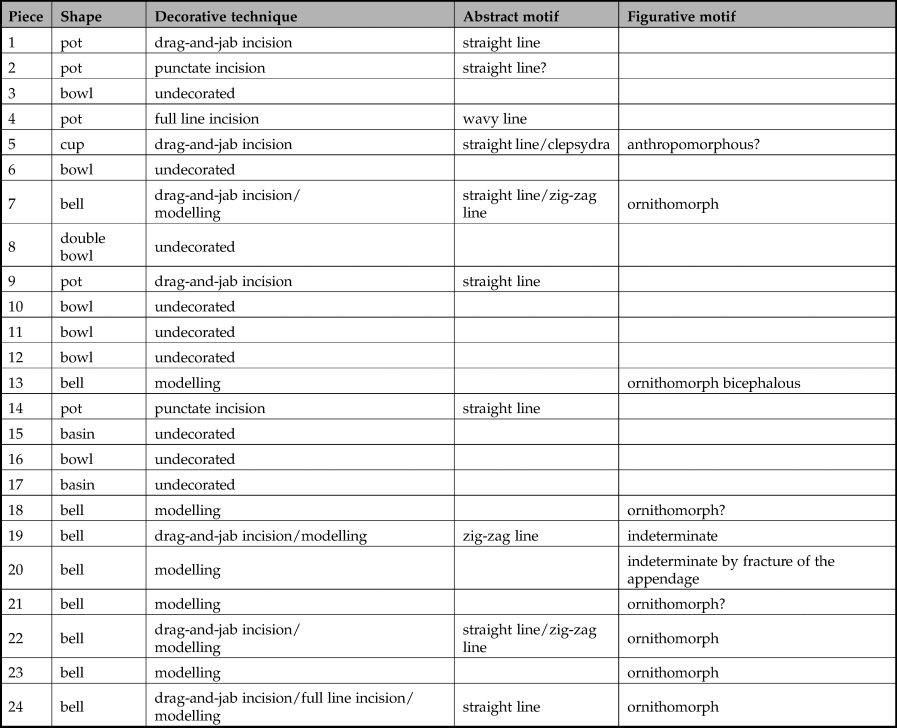
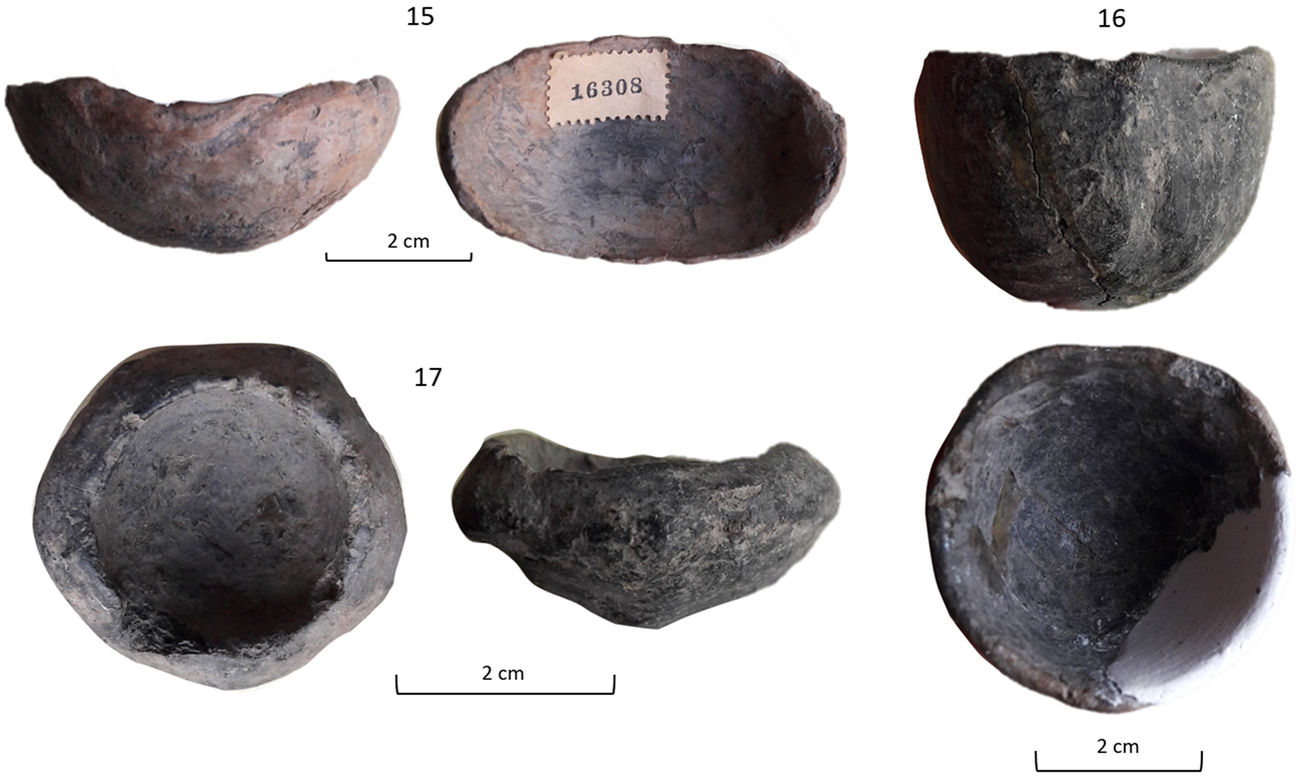
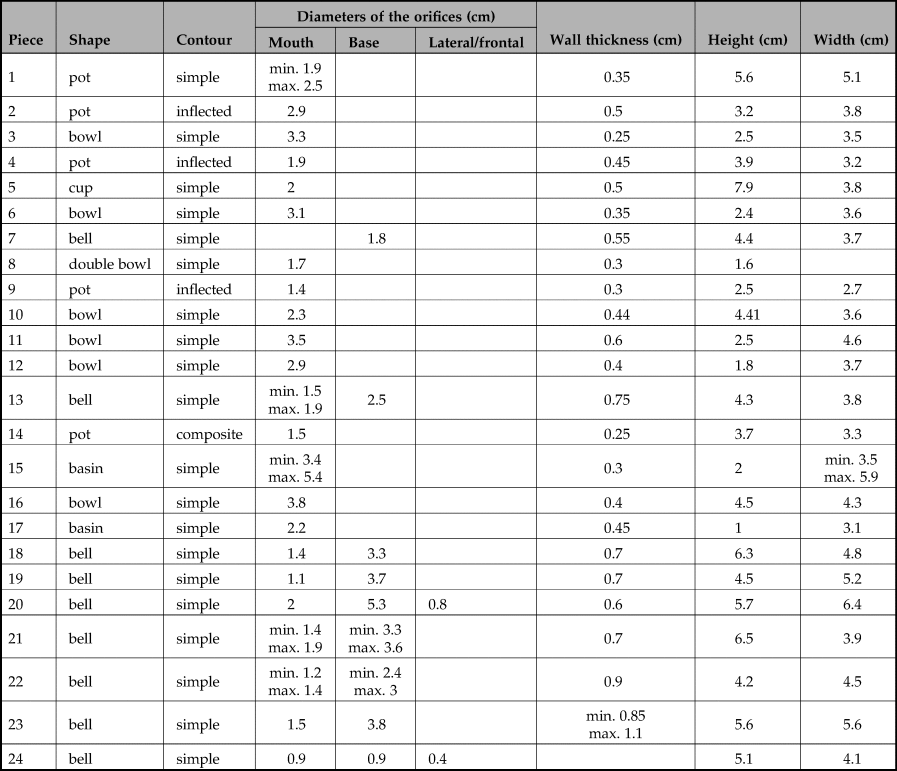
The typologies of the miniatures correspond to ‘bell’ artifacts (n = 9), bowls (n = 7), pots (n = 5), basins (n = 2) and cups (n = 1), which are forms that are usually registered in local assemblages (Badano Reference Badano1940; Ceruti Reference Ceruti2003; Reference Ceruti2017; Ceruti et al. Reference Ceruti, Fontana, López and Vesco1980; Ottalagano Reference Ottalagano2013; Serrano Reference Serrano1946). Piece 8 seems to correspond to a container with a double compartment (Fig. 4). The contours indicate mostly simple forms (n = 10), although inflected forms (n = 3) and a composite form (n = 1) can also be detected (sensu Shepard Reference Shepard1956), the latter exclusively in a restricted vessel (Table 2). Asymmetries can be observed in the bodies of some of the vessels, due to unequal pressure exerted during their manufacture (Figs. 2, 4 and 5; Table 3).
Pieces 1 to 4.

Shapes and dimensions of the pieces.
Deficiencies in the manufacture and decoration of the pieces. (Note: A/O = affected pieces/observed pieces. The percentages were calculated based on the total observed.

The mouth diameters of the restricted vessels range between 1.4 and 2.9 cm, while those of the open vessels range between 1.7 and 5.4 cm. The mouth diameters of the bells, on the other hand, vary between 1.1 and 2 cm (Table 2). Five pieces have oval mouth openings (pieces 1, 13, 15, 21, 22). In the case of piece 1, this feature is probably unintentional and was in response to deformations in the vessel's body during its modelling (Fig. 2). Some miniature bells have front or side holes, or they lack a top hole, as in piece 7 (Table 2; Fig. 3).
Pieces 5 to 7. On piece 5, the white paint is not original. (Drawing: from Ceruti Reference Ceruti1980.)

The pots, bowls, basins and cups register wall thicknesses that are proportionally thin to the size of the vessel, with an average thickness of 0.38 cm. The miniature bells, according to their bigger referents, are somewhat thicker, with an average of 0.76 cm (Table 2). The wall thicknesses are mostly homogeneous throughout, with no significant differences in different parts of the pieces, which for some authors is an indicator of children's agency (Fladd & Barker Reference Fladd and Barker2019; Langdon Reference Langdon, Grubbs and Parkin2013). The variability registered in the wall thickness of piece 24 (Table 2) is in response to a characteristic of the particular design of this piece, but it does not look as though it was due to the inexperience of the potter. The lips of the miniatures are convex and have irregularities (Table 3), as can be clearly seen in the pieces in Figure 6, which may suggest expedited elaboration.
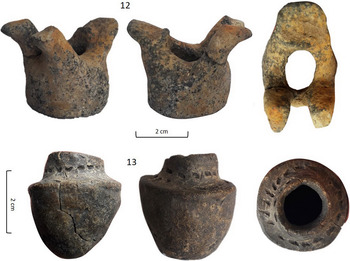
All the miniatures are well fired, in reducing conditions (n = 13) and partially oxidized (n = 2). The surfaces are smooth, with no visible signs of slip. Some have good superficial regularity (n = 14), while in others the surfaces are mostly irregular (n = 10) (Table 3). Pieces 9 and 13 show, respectively, partial surface spalling and erosion, due to post-depositional processes (Figs. 4 & 5). In some of the miniatures, surface cracks can be detected. These are orientated perpendicular to the vertical axes of the pieces (Table 3; Figs. 1 & 4), and may have formed during the drying and/or firing processes. Thin vessels, such as these miniatures, dry more quickly, thus creating stresses that cause cracks. Cracks are also frequent when pieces are exposed to heat without being completely dry or when the cooking temperatures rise and fall abruptly, which often happens during an open firing, and which is common in the ceramic artifacts of the region. The formation of cracks may also be related to a lack of technical knowledge, as their formation can be minimized with the correct kind of kneading that gives porosity to the paste, or with the use of non-plastic inclusions that make the clay shrink less when drying and increase the pieces’ resistance to thermal stress (Arnold Reference Arnold1985; Gibson & Woods Reference Gibson and Woods1997; Rye Reference Rye1981; Shepard Reference Shepard1956).
Pieces 8 to 12.

Pieces 13 and 14.

Decoration
Decoration is present in 58.3 per cent (n = 14) of the miniatures studied, and was only recorded in the bells and pots. The open vessels, such as bowls and basins, on the contrary, are plain. The following decorative techniques were recorded: drag-and-jab incision (n = 8); punctate incision (n = 2); full line incision (n = 2); and modelling (n = 9). There is no evidence of painted decoration (Table 4).
Decorative aspects of the pieces according to form.

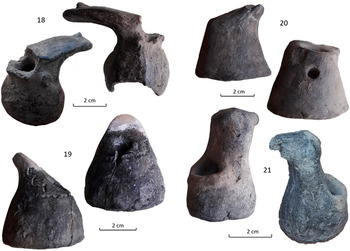
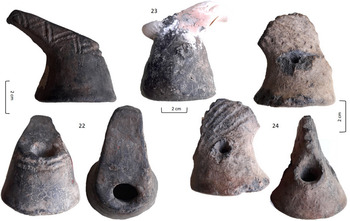
The bells are mainly decorated with stylized modelled figures which represent birds (Figs. 3, 5, 7 and 8). Piece 5 was decorated with a possible stylized human figure, full body. The head, represented as a square, is face down (Fig. 3). Except in this piece, incision techniques were used to elaborate abstract motifs, such as straight lines, zig-zag lines and wavy lines (Table 4). The potters’ mastery of decoration is variable. While some of the pieces show good precision in the execution of the incised and modelled designs (pieces 13, 18 and 22) (sensu Ottalagano Reference Ottalagano2010), in other cases some irregularities can be detected (Table 3), which could be related to underdeveloped motor skills (Langdon Reference Langdon, Grubbs and Parkin2013). Unfinished designs are also recorded, as can be seen in particular in pieces 2 and 4, where there is some discontinuity in the incised designs, so parts of the vessels’ bodies have no decoration. In piece 2, some not fully completed punctate incisions can also be noted (Fig. 2). In piece 5, some differences in the symmetry of the decorative designs in both halves of the body can be seen (Fig. 3).
Pieces 15 to 17.

Pieces 18 to 21.

Pieces 22 to 24.

Traces of use and context of discovery
The pieces do not show any traces of use that are visible at the macroscopic level, such as remnants of pigments, interior charred residue and external soot. The darkened areas that some of the miniatures present on their external surfaces may be explained as a result of firing the pieces during their manufacturing process, and do not constitute traces of use. Thus, episodes of cooking substances that were potentially contained in the containers should be discarded (cf. Reber & Hart Reference Reber, Hart and Hart2008; Rye Reference Rye1981).
Thirty-three per cent of the analysed pieces lack contextual information, either because they were recovered by amateurs (n = 6), or because they were collected from the surface (n = 2) (Table 1). With respect to the miniatures recovered from the excavation at the Cerro Grande site on Los Marinos island (Table 1), Gaspary (Reference Gaspary1950) mentioned their presence as part of funerary offerings for adult individuals of both sexes, but he did not provide specific details about the associations of each of the pieces in the site's archaeological record.
The remaining six miniatures were recovered from stratigraphy, and were obtained from the excavations carried out by Ceruti (Reference Ceruti1980) and a recent excavation carried out by the author of this study (pieces 6, 7, 9, 10, 11 and 12; Table 1). Piece 6 was recovered from quadrant 1 of the Arroyo Las Mulas 1 site at a depth of 0.20–0.30 m. With regard to its context, the following data are mentioned:
The remains of skeleton No. 5 are extracted, totally destroyed, and apparently primary. Among the indigenous ceramics, it is worth noting an almost complete miniature and a zoomorphic appendage painted red, which seems to represent a reptile. (Ceruti Reference Ceruti1980, 26, author's translation)
Thus, the available data indicate that piece 6 (a plain bowl) was associated with a burial. At the moment, there is no bioarchaeological analysis that allows us to specify the age and sex of the inhumed individual. It should be noted that Ceruti (Reference Ceruti1980, 75) also mentioned the discovery of a complete miniature plain vessel as a funerary offering in burial no. 8 at the Arroyo Las Mulas 1 site. This miniature piece could not be located, so it was not included in this analysis.
Piece 7 was recovered in sector D from a test pit, also at the same site at a depth of 0.60–0.70 m. In the immediately previous level (0.70–0.80 m) in the same sector, human remains belonging to burial no. 3 were recovered. Because it was recovered in a sieve, there is no information that specifies whether the miniature was linked to the human remains (Ceruti Reference Ceruti1980). Pieces 9 and 10 were also obtained from a recent test pit at Arroyo Las Mulas 1 (at depths of 0.20–0.30 m and 0.10–0.20 m, respectively) by the author of this paper. Very fragmented and disordered human remains were found at a depth between 0.10 and 0.50 m, while in the lower levels (between 0.50 and 0.70 m) what appeared to be a primary burial was found in a very poor state of preservation. These human remains are currently under analysis. Piece 11 was recovered from quadrant 5 of the La Palmera 2 site at a depth of 0.30–0.40 m. At a lower level in the same quadrant, at 0.40–0.50 m, a few isolated human remains were found (Ceruti Reference Ceruti1989). Finally, piece 12 was recovered from quadrant 3 of the Arroyo Arenal 1 site at a depth of 0.10–0.20 m. Along with the miniature, abundant fragments of pottery, faunal remains and lithic artifacts were detected, as well as three isolated human teeth (Ceruti Reference Ceruti1989).
Discussion of the role of miniatures within the study area
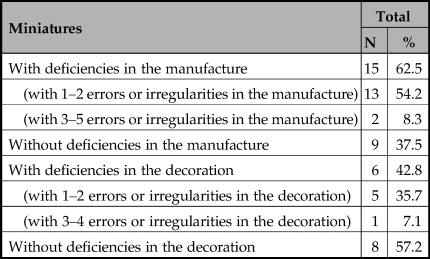
The analysis carried out indicates a certain variability in terms of the artisanal mastery with which the miniatures were elaborated. A part of the sample exhibits good technical and artistic skill, while in other cases there are some attributes that could suggest underdeveloped motor skills, a low level of technical knowledge or expedited elaboration. Around 43 per cent of the decorated pieces have asymmetries and errors in their decorations, while 62.5 per cent of the total sample have cracks and irregularities in the shapes of their bodies, lips or surfaces (Tables 3 & 5). These aspects, which are also common among miniatures from diverse archaeological contexts, have led them to be evaluated as potential children's toys (Carey Reference Carey2006; Fladd & Barker Reference Fladd and Barker2019; Prous & Jácome Reference Prous, Jácome, Páez and De La Fuente2007, among others), including the first referents of archaeology in the Paraná River Lowlands (González Reference González1947; Serrano Reference Serrano1946). Ethnographic information indicates that children tend to imitate the activities of adults, making small versions of useful artifacts. This would also be a form of teaching and learning for apprentice potters (Dennis Reference Dennis1940; Park Reference Park2010; Vidal & García Roselló Reference Vidal and García Roselló2009). The irregularities and asymmetries that many miniatures exhibit, however, may also be consistent with their expeditious manufacture by adults for their immediate use by children, as Park (Reference Park2010) points out. This indicates a difference between miniatures made by adults and used as toys, and miniatures produced by apprentices or children. Other authors also note an important conceptual distinction between artifacts made by adults specifically for children as toys, and artifacts used and adapted by children for play (Crawford & Lewis Reference Crawford and Lewis2009; Politis Reference Politis1998).
Number of pieces with and without deficiencies in manufacture and decoration. (Note: The percentages were calculated based on the total observed for each case.)

But, if we consider that ceramic miniatures are children's toys, why are they not detected more frequently in the regional archaeological record? In the lower Paraná, for example, there are numerous archaeological contexts of complex hunter-gatherers (which are not Goya-Malabrigo), who manufactured and intensively used pottery, which do not possess miniature records (Loponte Reference Loponte2008; Pérez Reference Pérez2016). On the other hand, the high degree of completeness among the miniatures recovered from the study area draws the attention. Although fragmented pieces have also been recorded, it is expected that toys used by children would have low durability, especially considering that they are fragile pieces, with very thin walls in most cases. This is especially striking, considering the highly fragmented state of the ceramic assemblages in the Lowlands of the Paraná River, where finding complete pieces is extremely rare (e.g. Badano Reference Badano1940; Ceruti et al. Reference Ceruti, Fontana, López and Vesco1980). It should also be noted that there are no records in the area of miniatures made of non-ceramic raw materials which have endured archaeologically, such as bony or lithic material.
In some ethnographic cases, the miniatures that are children's toys and those that were used in ceremonial contexts can be differentiated by the quality of manufacturing, which distinguishes the latter over the former (Park Reference Park1998). However, miniatures of low-quality manufacture are not always toys. In many archaeological cases, miniatures with a low level of artistic and technological mastery have been designated as funerary or votive offerings (Barraza Lescano Reference Barraza Lescano2000; Cervantes et al. Reference Cervantes, Shimada, Häusler, Wagner and Wagner2011; Uribe et al. Reference Uribe, Sanhueza and Bahamondes2007; Valdez et al. Reference Valdez, Jocelyn and Bettcher2006). For some authors, the expeditious elaboration exhibited by many pieces would justify the possibility that the miniatures were produced exclusively for a funerary purpose, as they had to be made in a hurry to accompany the deceased (Barraza Lescano Reference Barraza Lescano2000). Ritual use pottery also does not need to achieve the same technological quality as utilitarian pottery.
The replication of useful artifacts to be used as a mortuary accompaniment, as a symbolic replacement of the original pieces, is considered to be an important source of miniaturization (Borrero & Borrazzo Reference Borrero and Borrazzo2014; Park Reference Park1998). In the study area, the contextual information about the miniatures recovered from stratigraphy suggests that some of them were linked to burials and may have been grave goods. This constitutes, at the moment, the only available information in the Lowlands of the middle and lower Paraná River about the use of miniatures in a specific activity. Currently, there are no data that allow several pieces to be awarded to the same burial, as has happened in several archaeological cases (Cervantes et al. Reference Cervantes, Shimada, Häusler, Wagner and Wagner2011; Guerra Clará Reference Guerra Clará2014; Stumer Reference Stumer1953; Yacobaccio et al. Reference Yacobaccio, Madero, Malmierca and Reigadas1997–98). It should be noted that at many Goya-Malabrigo sites, the burials are poorly conserved and not clearly delimited due to the post-depositional process (Ceruti Reference Ceruti1991; Ottalagano Reference Ottalagano2013), so it is possible that there were more associations than those detected.
On the other hand, the studied pieces do not present traces of use at the macroscopic level, which indicates a utilitarian use; also, there are no visible remnants of pigments inside suggesting their use as receptacles for colouring substances, for example. These issues, however, should be studied in more depth through the contribution of archaeometric techniques, such as chromatography analysis for the determination of fatty acids, as well as using the X-ray diffraction technique, which will make it possible to evaluate possible organic and inorganic substances contained therein (work in progress).
Final remarks
Miniatures can be defined as small objects that have larger-size counterparts (Baxter Reference Baxter2005). Here, all of the analysed miniatures correspond to typical morphological classes of the regional ceramic record. These pieces constitute exact small-scale reproductions of artifacts that had utilitarian uses, such as pots, bowls, basins and cups, as well as artifacts that could have had a ritual use, such as bells (see discussion in Loponte et al. Reference Loponte, Ottalagano, Pérez, Malec, Ramos, Bozzano, Iribarren, Pérez, Leiva, Domínguez, Alí and Acosta2019). None of the pieces analysed here show traces of use macroscopically, such as pigments, adhesions or soot; hence, utilitarian use can be ruled out for the moment. Both smooth and decorated miniatures, with variable levels of artistic mastery, seem to have been used in some cases as burial offerings. No appreciable chronological variations can be observed, which, however, should be discussed in detail in the future based on a larger sample.
Some of the miniatures under study, in particular those that exhibit several errors and irregularities simultaneously, suggest less developed physical skills, which could be linked to children's work (Fladd & Barker Reference Fladd and Barker2019; Kamp Reference Kamp2001; Langdon Reference Langdon, Grubbs and Parkin2013; Menon & Varma Reference Menon and Varma2011). The observed deficiencies in manufacture and decoration could also have been related to improvised toys made by adults. According to Park (Reference Park2010), any serious attempt to differentiate these objects made by adults and used as toys, and miniatures produced by apprentices or children, will require a detailed comparative study of the entire range of artifacts from the sites.
Some of the other miniatures analysed here were relatively well made. Some have no deficiencies in their manufacture or decoration, and many have only one or two errors per piece (Tables 3 and 5). On the other hand, it is highly probable that the asymmetries observed in some of the designs were intentional, as other normal-size vessels recovered from the same archaeological sites where the miniatures were found commonly show asymmetric decorative motifs. Similarly, irregularities in incised motifs, in the aspects of surfaces, and in their shapes, as well as the presence of cracks, have all also been observed on several occasions in normal-size pottery from the same sites, not exclusively in miniature vessels. In fact, normal-size bells with noticeably irregular surfaces are commonly found (see Ottalagano Reference Ottalagano2010; Reference Ottalagano2013; Reference Ottalagano2016a,Reference Ottalaganob; Ottalagano et al. Reference Ottalagano, Brancatelli, Darigo, Iannelli and Pereyra2015b).
The results presented here tend to discuss the generally accepted dichotomous point of view, according to which miniatures are interpreted as objects that were manufactured or used by children for play, or as objects made by experienced potters for ritual use. Accordingly, miniature vessels used as toys should exhibit less-skilled work, while high levels of technical and artistic mastery are expected in ritual objects (Kamp Reference Kamp2001; Park Reference Park1998). Similar to the information presented here, there are many archaeological cases where poorly crafted miniatures performed a ritual function, as either votive or funeral offerings (Barraza Lescano Reference Barraza Lescano2000; Cervantes et al. Reference Cervantes, Shimada, Häusler, Wagner and Wagner2011; Uribe et al. Reference Uribe, Sanhueza and Bahamondes2007; Valdez et al. Reference Valdez, Jocelyn and Bettcher2006). Thus, when examining miniatures, it is important to consider not only the level of their artistic mastery, but also the traces of their use and the context of their discovery, in order to understand properly the roles that they developed and the ‘fluid and multiple biographies of use’ that they could have had (Crawford & Lewis Reference Crawford and Lewis2009, 12). Subsequent studies will thus allow new data to be added regarding the use and variability of these small ceramic pieces, which, as Segarra (Reference Segarra Crespo1997) commented, can be easily recognized as diverse objects just by incorporating a different dimension to the day-to-day one.
Acknowledgements
I would like to thank the staff and directors of the Museum ‘Alicia González Castrillón’ in La Paz, the Museum ‘Prof. Antonio Serrano’ in Paraná and the Museum ‘Dr. Julio Marc’ in Rosario, including Fabián Letieri for facilitating some of the pieces in the collection. A special thank you also to Carlos Ceruti for giving me the registered information, and to Daniel Loponte, Mario and Daniel Raspini, Víctor Flores, and to the municipality of La Paz, for all the help they provided during the fieldwork.