In the final days of the 2004 election, independent candidate Ralph Nader hardly resembled the same man who ran for president four years earlier. In 2000, Nader had catapulted himself from consumer activist to Green Party nominee, pledging to build a new progressive alternative to the Democratic and Republican parties. He raised $8.4 million, appeared on 44 state ballots, earned almost three million votes nationwide, and was widely blamed for Al Gore's defeat in Florida. Four years later, Nader had shed his Green Party affiliation, raised only $4.6 million, appeared on just 35 ballots, and earned a meager .38% of the popular vote. The controversial third party candidate who drew so much attention for his pivotal role in the 2000 election outcome had become a mere footnote by 2004.
This dynamic follows a more general trend of minor party candidates who make strong showings and then disappear (Rapoport and Stone 2005; Rosenstone, Behr, and Lazarus 1996). In this essay, I suggest that Nader's level of support was not the only thing that changed between the two elections. I demonstrate that Ralph Nader's motivations also changed between 2000 and 2004 as he responded to changes in his own electoral situation.
In 2000, many observers credited Nader with spoiling the election. Although Gore almost certainly would have won Florida, the Electoral College, and thus the election without Nader on the ballot (Burden 2003; Collett and Hansen 2002), complaints about spoiling unfortunately confound Nader's effect with his intent.1
It is also worth noting two countervailing forces that also shaped the outcome in 2000. Ballot irregularities in Florida contributed to a Bush victory (Wand et al. 2001) yet Pat Buchanan's candidacy cut into the Bush vote (Burden 2003).
But what of 2004? Elite opinion on why Nader ran in the 2004 campaign was almost as divided as it was four years earlier. Even after looking over his final campaign schedule, respected journalists drew wildly different inferences about his motivations. For example, Brian Faler of the Washington Post concluded that “the independent presidential candidate appears to be making little effort to woo swing state voters in the final hours of his campaign, spending most of his time away from the battleground states where Democrats fear he will hurt John F. Kerry.”2
Brian Faler, “Nader Hits Reds, Blues,” Washington Post, 2 November 2004, A4.
John W. Mashek, “Ego Drives Nader's Role as Spoiler, But Voters Wising Up,” Chicago Sun-Times, 16 October 2004, 19.
I evaluate the likelihood of these possible Nader strategies in the 2004 presidential campaign. First, the “vote maximization” strategy hypothesizes that Nader would target his resources in states with the largest populations to crank up his vote total. Vote maximizing could be viewed as a way to earn FEC matching funds or simply to build clout for his cause. Second, the “spoiler” strategy hypothesizes that Nader would focus on battleground states where he could have the most influence on the election's outcome. Spoiling would have been an obvious way to defeat John Kerry. But other reasons for a spoiler strategy include seeking leverage over the outcome to influence the major parties' platforms or to use the controversy to draw attention to his cause.
I suggest that these competing views should be treated as hypotheses to be tested empirically. One contribution of political science is the ability to offer social scientific arbitration of issues that otherwise would not be settled. Observers will continue to disagree about the desirability of Nader's candidacy, but as academic researchers we should be able to at least agree on basic facts about the nature of his campaign. Without clear evidence, both the vote maximization and spoiler hypotheses remain equally plausible.
To the degree that minor party candidates such as Nader are responsive to context, one might have reasonably expected his strategy to change. Having already been blamed for spoiling the 2000 election, Nader had little to lose in terms of reputation by shifting to a swing state strategy. Further, the goals he elaborated in 2000 were absent in 2004, when he ran as an independent rather than a Green and no longer spoke about winning 5% of the popular vote to earn federal matching funds to support party-building. Finally, having been discredited by many on the left, Nader lacked the critical financial support and celebrity endorsements that aided his effort in 2000. Pushed into a desperate situation with fewer resources, Nader might have been motivated to seek free media coverage in any way possible. Although controversial, targeting swing states would have been an easy way to make news. At the same time, being kept off the ballot in more states should have constrained Nader's strategy. The ability of Democrats and others to prevent Nader from appearing on the ballot in swing states such as Ohio and Pennsylvania should have made a spoiler strategy more difficult. However, none of the other 14 states where Nader was off the ballot were true battlegrounds, suggesting that ballot access limitations should have made Nader more, not less, likely to pursue a spoiler strategy.
Descriptive Evidence
To test these hypotheses, I analyze the personal campaign appearances that Nader made between Labor Day and Election Day of 2004. Candidate travel decisions are attractive to study because they are the most instrumental of all campaign resource allocation decisions and are good indicators of underlying strategies (Bartels 1985). Appearance data consequently have been employed by others to assess campaign strategies (e.g., Althaus, Nardulli, and Shaw 2002).
My dependent variable is a count of appearances in a state. I coded the state and the day for each of Nader's public appearances.4
My (Burden 2005) study of the 2000 campaign conducted a parallel analysis at the media market level. The smaller number of appearances in 2004 makes this lower level of aggregation impossible. In addition, my study included an analysis of campaign ad buys that cannot be repeated because Nader ran no television spots in 2004. Fortunately, the state, media market, and advertising analyses in my 2000 study all yielded similar findings.
Nader made 51 distinct state campaign stops in the final months of the 2004 campaign. Although this is coincidentally the same number of electoral units up for grabs in a presidential campaign, his appearances were far from equally distributed across the states. Aside from Florida, he made almost no appearances in the South, never stepping foot in Georgia, Tennessee, Virginia, or the Carolinas. Nader visited Florida six times in nine weeks, more visits than to any other state. Close behind was New York with five appearances and Ohio and Michigan with three each. Aside from New York, these were important swing states.
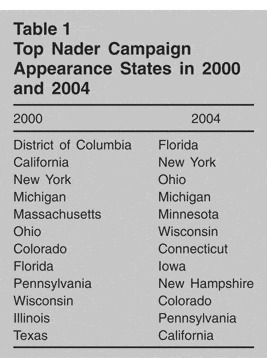
More complete evidence is found in Table 1, which displays the top states Nader visited in 2000 and 2004. In 2000, the top locales were heavily populated and largely Democratic states such as California, New York, and Massachusetts. Although Ohio and Florida make the list, so too do the District of Columbia and Texas while swing state New Hampshire is absent. This evidence is seemingly consistent with the finding that Nader was pursuing a vote-maximization strategy in 2000. The contrast with 2004 is sharp. Most of the top states in 2004 were battlegrounds, although the inclusion of New York and Connecticut complicates the picture.5
Connecticut is Nader's birthplace and might have seen more appearances for other reasons.
Top Nader Campaign Appearance States in 2000 and 2004

Multivariate Evidence
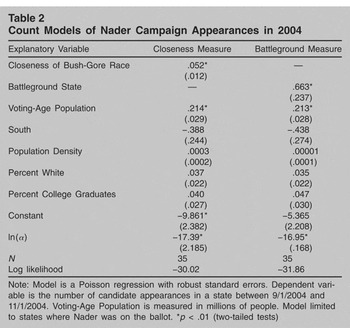
I conduct regression analyses of Nader's appearances by including several explanatory variables that operationalize the vote maximization and spoiler strategies. Because the dependent variable is a count of appearances in a state, I employ the Poisson regression model. Following earlier work, I use voting-age population as a rough proxy for the vote maximization strategy. To the degree that Nader sought to maximize his support, the size of the electorate in a state should have a positive influence on his appearances.6
Using the number of Democratic votes (cast for Al Gore in 2000 or John Kerry in 2004) yields similar results.
Adam Nagourney and Katharine Q. Seelye, “Bush and Kerry Focus Campaigns on 11 Key States,” New York Times, 24 October 2004, 1.
In addition to these main variables of interest, I control for several other possible factors included in Burden's study of the 2000 election. Included in the model are indicators for Southern states, a measure of population density, and the percentages of White and college-educated citizens in each state. I limit the analysis to the 34 states and Washington, D.C. where Nader was listed on the ballot in 2004 for an effective sample size of 35.
The results in Table 2 suggest that Nader was pursuing both strategies simultaneously in 2004. His personal appearances were driven by whether a state was “in play” and by the size of the electorate. The spoiler strategy is clear whether one uses the continuous measure of closeness or a simple dummy variable for battleground states. No other demographic factor seemed to matter beyond these two central considerations.8
It is possible that Nader focused on states that were both close and heavily populated. Unfortunately, an interaction term multiplying these two variables cannot be included in the model because it correlated with raw population at .99.
Count Models of Nader Campaign Appearances in 2004

These results are in sharp contrast to 2000. In 2000, closeness had no effect on Nader's strategy, despite many claims from Democrats that he purposely played spoiler that year. An identical model run on 2000 data shows that closeness had absolutely no effect (p = .35) while the size of the electorate variable was sizable, positive, and highly significant (p < .001). Nader was a spoiler in 2000, but it was an unintentional by-product of a razor-close presidential campaign, not the result of a purposeful effect to throw the election. In 2004—when his campaign had little influence on the election's outcome—the results here suggest that he was intentionally playing spoiler. This is a clear shift in strategy in response to a new electoral situation.
I should note that these results appear robust to specification and measurement choices. For example, including all 50 states and Washington, D.C. in the model rather than just those where Nader was on the ballot yields similar results. In fact, closeness has a slightly larger effect and most of the other variables show similar patterns as well. When the battleground dummy is used instead of closeness, its coefficient also increases a bit and population's effect remains constant. In addition, adding a measure of the prevalence of independents—who might be especially susceptible to targeting by a third party candidate because they lack party attachments—hardly alters the results. Including the percentage of independents reported in 2003 state exit polls actually increases the coefficients on the closeness and battleground variables.9
These data were provided by Gerald Wright and are drawn from CBS/New York Times exit polls.
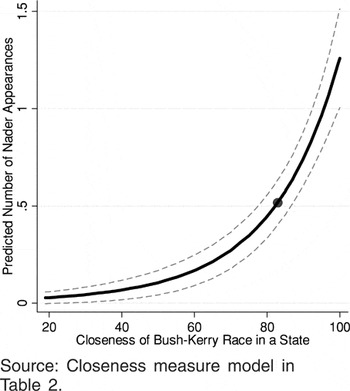
Returning to the main results, precisely what substantive effect does the spoiler result imply? In Figure 1, I use the coefficients in the left column of Table 2 to simulate the effect of closeness on Nader's campaign appearances in 2004. To do this, I use King, Tomz, and Wittenberg's (2000) Clarify software to simulate the predicted probability of a Nader appearance for a given level of closeness. This is shown by the thick black curve. I also simulate 95% confidence intervals around this prediction. These error bounds are indicated by gray dotted lines. The point indicates where the mean state falls on the curve.

Effect of Closeness on Nader Appearances in 2004
The figure clearly shows that as closeness increases, so does the expected number of Nader appearances. The curve becomes steeper at high levels of closeness, indicating that Nader was more sensitive to increases when the Bush-Kerry race was especially close. Looking at the vertical axis, the model predicts at least one appearance where the gap between Bush and Kerry fell below four points, as it did in states such as Wisconsin, Iowa, and New Hampshire.10
Note that the mean gap in the 35 states where Nader was on the ballot was 17 points or a closeness score of 83. Only the District of Columbia had a closeness score below 50.
Conclusion
In both 2000 and 2004, the most noteworthy minor party presidential candidate was Ralph Nader. But the two campaigns he waged could not have been more different. Not only did his performance sag in 2004, but his strategy expanded as the context he faced changed. Although many of Nader's substantive campaign themes were repeated in 2004, his resource allocation strategies were not. In 2000, Nader aimed at building a Green Party via the FEC's 5% rule rather than spoiling the election, but sadly failed at the former and unintentionally succeeded at the latter. In 2004, his strategy switched from vote maximization to spoiling, but he once again suffered failure, this time in affecting the outcome.11
Another way to judge minor party “success” is whether their presence altered the major parties' agendas. It is difficult to discern any lasting impact of Nader on government policy or the Democratic Party's platform. It is possible that Nader's message helped buoy Howard Dean's presidential campaign in 2003.
It remains unclear precisely why Nader's strategy switched from pure vote maximization to one focused on swing states as well. Several possibilities come to mind. One that is easily ruled out relates to resources. Nader's expanded 2004 strategy did not result from the campaign having more resources to spend. His campaign receipts fell by almost half between 2000 and 2004, his travel schedule contracted, and many of his highest profile supporters such as activist-filmmaker Michael Moore abandoned him the second time around.
Three other hypotheses mentioned at the outset of this paper are more plausible. First, Nader decided simply to fulfill the stereotype applied to him by the media in 2000. As long as most observers believed that he was purposely playing spoiler, why not do so? Four years of debate had not settled the matter for 2000, so there was no harm in visiting swing states disproportionately in 2004. Second, and related, Nader had more reasons to campaign in battleground states in 2004. His campaign was in a more precarious situation and needed the attention. With less money, fewer elite allies, and low expectations, the Nader campaign had to take extreme measures to make news. Giving a speech in Wisconsin or another battleground was one way to maximize free media exposure when paid media exposure was unaffordable. Nader's modest ad buys in 2000 reinforced his personal appearance strategies (Burden 2005), but his limited resources prohibited paid television advertising in 2004. As a result, earning media coverage by stirring up controversy might have been a second-best strategy for his struggling campaign. Finally, more restricted ballot access might have pushed Nader unwittingly toward a spoiler strategy. However, it is ironic that efforts to keep Nader off the ballot were most successful in non-battleground states where a spoiler strategy would not have affected the outcome anyway. As a result, the smaller pool of states where Nader appeared on the ballot in 2004 was skewed somewhat toward safe states. This makes his clear spoiler strategy all the more surprising.
The analysis presented here demonstrates at least one advantage that social science holds over journalism and punditry. The natural tendency of those observing politics is to infer a politician's intent from his effect on a process. Many were quick to assume that Nader had intended to spoil the 2000 election because Gore would have won without him on the ballot. These same observers assumed that Nader lost his interest in spoiling by 2004 since he had little influence on the outcome. Both of these views are incorrect. By translating these elite arguments into hypotheses about candidate motivation, this paper shows that Nader was in fact pursuing 5% of the vote in 2000 and only targeting swing states in 2004. It is a strange twist of electoral history that Nader failed at achieving his goals in both elections.
Author Bio
Barry C. Burden is professor of political science at the University of Wisconsin-Madison. He is the coauthor of Why American Split Their Tickets, editor of Uncertainty in American Politics, and author of the forthcoming book, Personal Roots of Representation. Burden has also authored numerous journal articles on electoral politics, Congress, and representation. He may be contacted at bcburden@wisc.edu.