Obstruction within the branch pulmonary arteries or systemic caval veins in the setting of palliated single-ventricle heart disease is associated with significant morbidity and mortality.Reference Dasi, Krishnankuttyrema and Kitajima1, Reference Fontan, Kirklin and Fernandez2 Such obstruction can lead to elevated central venous pressure, low cardiac output, peripheral edema, ascites, and life-threatening complications such as protein-losing enteropathy. Hence, these obstructions are usually aggressively treated whenever found. The etiology for such stenoses and obstructions varies. The left pulmonary artery is often compressed by a dilated ascending neo-aorta. Suture lines across the proximal pulmonary arteries often create areas of stenosis. As flow through the superior and total cavopulmonary connections is non-pulsatile, some researchers have theorised that these patients are at higher risk of thrombosis.Reference Khairy, Fernandes and Mayer3–Reference Rosenthal, Friedman, Kleinman, Kopf, Rosenfeld and Hellenbrand5
Transcatheter stent implantation to treat stenoses in these pathways has been shown to be a safe and effective alternative to surgical revision, and this therapy has gained popularity in many institutions as primary therapy to treat stenoses in these circulations.Reference Bhole, Wright and De Giovanni6–Reference Udink Ten Cate, Trieschmann and Germund12 However, once a stent has been implanted, either in the branch pulmonary arteries or in the superior or inferior caval vein, it raises the concern that the stent may become a nidus for thrombus formation. Many clinicians routinely treat single-ventricle patients with some form of thromboprophylaxis; however, studies have failed to demonstrate a significant difference in thrombus prevention between patients treated with aspirin alone when compared to patients treated with other more advanced anticoagulations, such as warfarin, heparin, or enoxaparin.Reference Monagle, Cochrane and Roberts4, Reference Alsaied, Alsidawi, Allen, Faircloth, Palumbo and Veldtman13–Reference Potter, Leong-Sit and Fernandes16 Currently, sparse data exist comparing thromboprophylaxis strategies in these circulations after stent implantation. We sought to describe the outcomes following stent implantation within the superior or total cavopulmonary connections, with a focus on the presence of in-stent thrombus or downstream thrombus in the pulmonary arteries. Our goal was particularly to compare cohorts who were treated with aspirin versus those treated with advanced anticoagulation. We hypothesised that there is no difference in the rate of thrombosis between aspirin and advanced anticoagulation treatments, despite the addition of a stent into non-pulsatile branch pulmonary arteries or the cavopulmonary connections.
Methods
We conducted a retrospective cohort study including all children who underwent stent implantation within the superior or total cavopulmonary connections from 2002 to 2015. We reviewed our institution’s cardiac catheterisation database for all patients undergoing stent implantation in the superior or total cavopulmonary connections and collected all diagnostic and interventional data from the time of intervention. Patients who underwent stent implantation within the branch pulmonary arteries, the superior or inferior caval vein, the Fontan baffle, or conduit itself were included in this study. Patients undergoing stenting of a Fontan fenestration or of a pulmonary vein or aortic arch, for example, were not included in this study as the goal was to study the risk of thrombus formation in the stented cavopulmonary connections. Additional clinical follow-up data, including subsequent cardiac catheterisations, computed tomography (CT) angiogram data, echocardiograms, and clinical notes were also collected.
Primary patient-level variables that were identified included gender, age and weight at the time of intervention, anatomical cardiac diagnosis, and most recent single-ventricle palliation surgery, either the bidirectional Glenn (superior cavopulmonary connection) or Fontan (total cavopulmonary connection). Interventional data that were collected included site of intervention, indication of stenting, length of stenosis, degree of stenosis, interval between most recent surgery to procedure, stent type, and diameter. Length of stenosis was separated into discrete (<5 mm) and long segment (≥5 mm). Degree of stenosis (%) was calculated by dividing the difference of reference to stenotic vessel diameter by the reference vessel diameter: (diameterREF – diameterSTE)/diameterREF. Angiograms were retrospectively reviewed by two independent cardiologists (YKO and CJP) to assess mechanism of stenosis: thrombosis was defined as an intraluminal obstruction with lucency (Fig 3); compression was defined as flattening in one projection with the presence of overriding vessel adjacent to the region of narrowing, while stenosis was defined as luminal narrowing without thrombus or compression relative to the reference vessel diameter.
Our institution has generally observed no specified strategy post-stent for single-ventricle patients. Therefore, we divided our population into two cohorts: those who were treated, post-stent, with aspirin alone and those treated with advanced anticoagulations, such as warfarin, enoxaparin, heparin, or clopidogrel. To determine if anticoagulation strategy was based on patient-specific factors, we compared stenosis severity, stent location, and stage of palliation (superior or total cavopulmonary connection) by the cohorts.
Our primary endpoint of interest was late presence of thrombus (either within the stent or downstream) on advanced imaging – i.e., on subsequent conventional angiography or CT angiography. The secondary endpoints included acute procedural results, presence of thrombus or obstruction on echocardiogram, and bleeding complications secondary to anticoagulation. Acute response to stent implantation was assessed by comparing pre- and post-stenting stenotic vessel diameter, degree of stenosis, and change in pressure gradient.
Statistical analyses were performed using SAS version 9.4 (Cary, NC, USA). Statistical significance was assessed at the 0.05 level. Descriptive statistics were calculated for all variables of interest and included: median values, ranges or counts, and percentages, when appropriate. Normality of continuous variables was assessed using histograms, normal probability plots, and through the Anderson-Darling test for normality. For non-normal data, we compared the distribution of the continuous variables between patients who received advanced anticoagulation and those who did not receive advanced anticoagulation using the Wilcoxon rank-sum test. Categorical characteristics of the two groups of patients were compared using Chi-square tests, or when expected cell counts were small (<5), a Fisher’s exact test was used.
Results
Between January 1, 2003 and December 31, 2015, a total of 58 patients with superior or total cavopulmonary connections had 72 stents implanted in their single-ventricle circulations. Patient-level characteristics are summarised in Table 1. Patients underwent stent implantation at a median age of 6.8 years (25th–75th percentile, 1.9–12.7 years) and median weight of 20.6 kg (25th–75th percentile, 10.6–37.5 kg). The most common cardiac diagnosis was hypoplastic left heart syndrome (n = 42, 58.3%), followed by double inlet left ventricle (n = 9, 12.5%) (Table 1). A total of 58 stents (81%) were implanted in 45 patients (78%) with total cavopulmonary connection, whereas 14 stents (19%) were implanted in 13 patients (22%) with superior cavopulmonary connection.
Patient demographics

DORV/MA = Double Outlet Right Ventricle / Mitral Atresia; AV = Atrioventricular; CAVC = Complete Atrioventricular Canal; PA/IVS = Pulmonary Atresia / Intact Ventricular Septum
Values are presented as n (%) or median (25th percentile–75th percentile) unless otherwise noted.
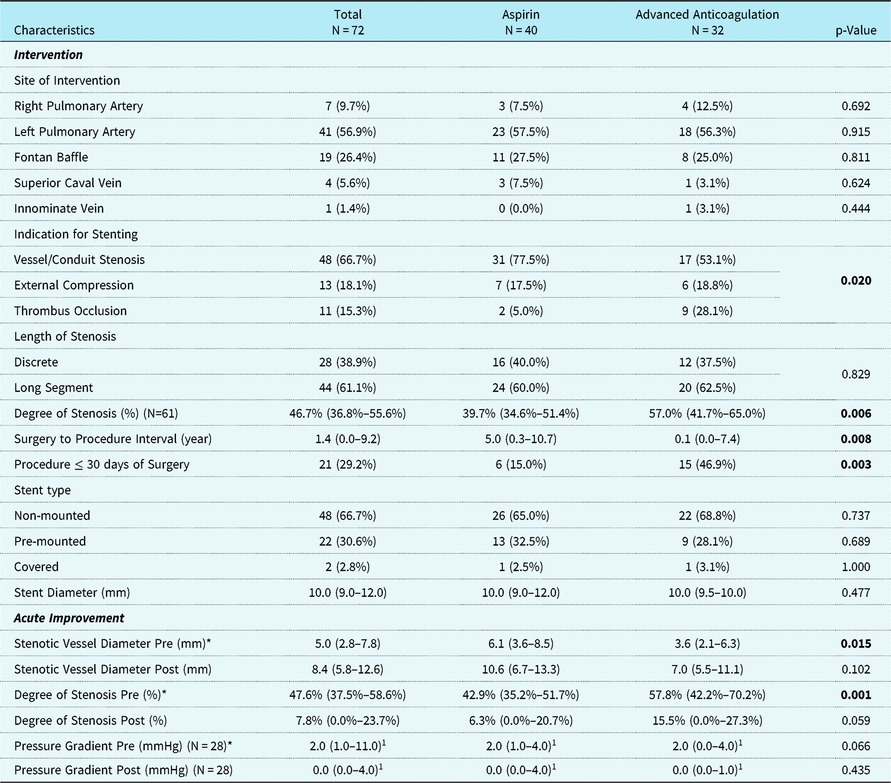
Procedural-level data are shown in Table 2. Of all the implanted stents, 41 were in the left pulmonary artery (57%), 19 in the Fontan baffle (26%), seven in the right pulmonary artery (10%), four in the superior caval vein (6%), and one in the innominate vein (1%). Indications for stenting included vessel/conduit stenosis (n = 48, 67%), external compression (n = 13, 18%), and thrombotic occlusion (n = 11, 15%). Long segment stenosis was seen in 44 cases (61%) while discrete stenosis was seen in 28 interventions (39%). Excluding patients who had complete atresia/occlusion of branch pulmonary arteries (and therefore stenosis severity was 100%), the median degree of stenosis was 47% (25th–75th percentile, 37%–56%). Median interval from the time of most recent staged cavopulmonary palliative surgery to procedure was 1.4 years (25th–75th percentile, 0.0–9.2 years), although 21 stents (29%) were implanted within 30 days of surgery. Stent types included unmounted (large diameter) stents (n = 48, 67%), pre-mounted stents (n = 22, 31%), and covered stents (n = 2, 3%). The median rated balloon diameter at the time of stent implantation was 10 mm (25th–75th percentile, 9–12 mm), and the reference vessel diameter of the adjacent normal vessel was 9.6 mm (25th–75th percentile, 6.4–12.8 mm), with a stent to reference vessel diameter ratio of 1.0 (25th–75th percentile, 0.8–1.3).
Procedure-level characteristics

* Paired difference between Pre and Post time points were significant (p < 0.001) using a Wilcoxon signed-rank test.
Values are presented as n (%) or median (25th percentile–75th percentile) unless otherwise noted.
1 Median (minimum – maximum).
Following stent implantation, the stenotic vessel diameter improved from a median diameter of 5.0 mm (25th–75th percentile, 2.8–7.8 mm) to 8.4 mm (25th–75th percentile, 5.8–12.6 mm) as measured angiographically (p < 0.001). When compared to the reference vessel diameter, the degree of stenosis improved from 48% (25th–75th percentile, 38%–59%) pre-intervention to 8% (25th–75th percentile, 0%–24%) post-intervention (p < 0.001). The pressure gradient across the stenosis decreased from a median of 2 mmHg (25th–75th percentile, 1–11 mmHg) to 0 mmHg (25th–75th percentile, 0–4 mmHg) (p < 0.001). Complications were seen in 2 (2.8%) interventions. One patient had compression of the left pulmonary veins after stenting of the right pulmonary artery in the setting of left atrial isomerism and anomalous pulmonary venous return to superior caval vein, requiring surgical stent removal and pulmonary vein repair (Fig 1). The second patient had ventricular fibrillation after completion of case requiring cardiopulmonary resuscitation and defibrillation.
(a) Initial angiogram demonstrating proximal right pulmonary artery stenosis; (b) post-stenting angiogram showed good position and flow through right pulmonary artery stent, however sluggish flow to left pulmonary artery; (c) frontal, and (d) lateral projection of angiogram demonstrated distal left pulmonary vein compression by stent in the setting of left atrial isomerism and anomalous pulmonary venous return to superior caval vein.

The distribution of thromboprophylaxis therapies is shown in Figure 2. After stent implantation, 32 patients (44%) were prescribed advanced anticoagulation and 40 patients (56%) were treated with aspirin only. Careful review of the charts failed to reveal any obvious rationale for thromboprophylaxis strategy other than clinician preference in all but nine cases, where existing thrombus led to use of advanced anticoagulation. Of the 32 patients in the advanced anticoagulation cohort, five patients were on dual therapy (2 advanced anticoagulation agents), and 15 patients (47%) were also concomitantly taking aspirin. In terms of duration, nine patients (28%) were kept on advanced anticoagulation indefinitely, while 23 patients (71%) were prescribed short-term advanced anticoagulation for a median duration of 13.0 weeks (25th–75th percentile, 6.9–27.8 weeks), and then subsequently transitioned to aspirin monotherapy. Not surprisingly, patients on advanced anticoagulation had higher rates of pre-stent thrombus occlusion as their primary indication for intervention (28% versus 5%, p = 0.020) and these patients with higher rates of total occlusion had more severe stenosis (57% versus 40%, p = 0. 006) at the time of initial stenting when compared to patients on aspirin. The advanced anticoagulation group also had a significantly shorter interval between time of surgery and stent implantation (0.1 years versus 5.0 years, p = 0.008). Stent implantation was more commonly performed within 30 days of surgery (47 versus 15%, p = 0.003) in the advanced anticoagulation cohort when compared to the aspirin group.
Distribution of thromboprophylaxis therapies.

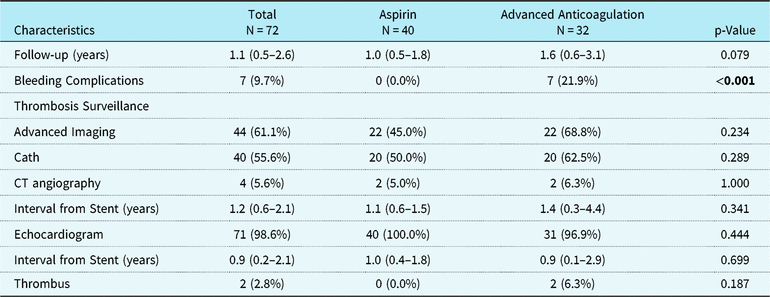
The median patient follow-up was 1.1 years (25th–75th percentile, 0.5–2.6 years; Table 3). Advanced imaging was available in 44 patients (61%). Advanced imaging consisted of repeat conventional angiography (n = 40, 91%) and CT angiography (n = 4, 9%). Follow-up advance imaging was more commonly available in patients on advanced anticoagulation (69 versus 45%, p = 0.234). Median interval between stent implantation to advanced imaging was 1.2 (25th–75th percentile, 0.6–2.1) years. Intra-stent thrombus was seen in two patients on advanced anticoagulation (6.3%) and in no patients on aspirin (p = 0.187). Downstream thrombus was not seen in any of the patients in either cohort. Follow-up echocardiograms were available in nearly all patients (n = 71, 99%). Median interval between stent implantation to echocardiogram was 0.9 (25th–75th percentile, 0.2–2.1) years. In both patients with in-stent thrombus post-stent implantation, the echocardiogram demonstrated thrombus within the stent prior to advanced imaging, while in all other post-stent echocardiograms, there was no evidence of intra-stent or downstream thrombus.
Thrombosis surveillance

Values are presented as n (%) or median (25th percentile–75th percentile) unless otherwise noted.
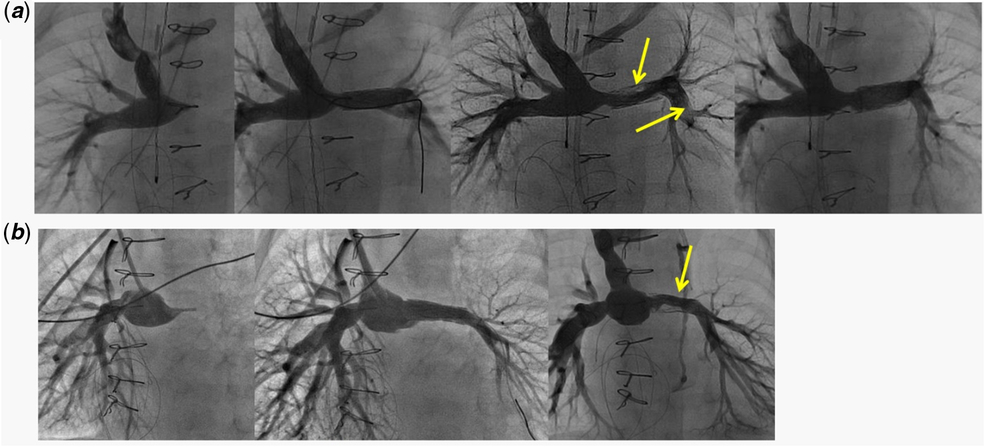
Both the patients who developed post-stent thrombus were critically ill with low cardiac output and were receiving vasoactive support early post-superior cavopulmonary connection operation. In both cases, balloon angioplasty and clot maceration were attempted in the catheterisation laboratory, but recurrent stenosis persisted immediately post-angioplasty. Hence, both patients had premounted stents implanted in their left pulmonary arteries, which resulted in acute improvement in hemodynamics as well as improved perfusion to the left lung (Fig 3). Unfortunately, both patients were found to have in-stent thrombus at 1 and 3 days post stenting despite being on therapeutic heparin infusions. In both cases, in-stent thrombus was first detected on echocardiogram and confirmed angiographically in the cath lab. Both patients underwent transcatheter stent balloon re-dilation in order to macerate thrombus, although one patient required subsequent surgical thrombectomy, stent removal, and pulmonary arterioplasty.
Patient (a) – Left pulmonary artery stented same day post-superior cavopulmonary connection due to thrombus occlusion, on advanced anticoagulation (therapeutic heparin), intra-stent thrombus on echo/cath 3 days post-stenting, left pulmonary artery stent balloon dilated; patient (b) – Left pulmonary artery stented 3 days post-superior cavopulmonary connection due to thrombus occlusion, on advanced anticoagulation (therapeutic heparin), intra-stent thrombus on echo/cath 1 day post-stenting, surgical thrombectomy, left pulmonary artery stent removal and arterioplasty.

There were seven (22%) significant bleeding complications in the advanced anticoagulation group and none in the aspirin cohort (p < 0.001). Bleeding complications included two patients with hematochezia, one patient with subdural hematomas, two patients with abdominal hematomas, one patient with menorrhagia, and one child with diffuse mucosal bleeding. Median interval between stent implantation and presentation of bleeding complication was 34 (25th–75th percentile, 9–331) days. Of these patients, two were on warfarin and clopidogrel, two were on enoxaparin and clopidogrel, two were on warfarin, and one patient was on clopidogrel. Also, five patients were on concomitant aspirin therapy. There was no history of trauma in any of the patients. Only one patient had supra-therapeutic markers of anti-coagulation with an elevated INR, and received oral vitamin-K therapy. Advanced anticoagulation was discontinued in six of the seven patients. One patient (3%) required red blood cell transfusions, and none of the patients required invasive interventions as a result of bleeding complications.
Discussion
We found that following stent implantation into the cavopulmonary connections, later development of thrombosis within the stent or downstream from the stent was rare in patients with palliated single-ventricle heart disease. Furthermore, we found no difference in the development of stent thrombosis between two approaches to thromboprophylaxis for children with single-ventricle circulation (superior and total cavopulmonary connections). The acute results of stent implantation in our single-ventricle cohort were favorable, with significant overall improvements noted including increase of stenotic vessel diameter, reduction in the degree of stenosis, and decrease in the pressure gradient across the region of stenosis. As expected, our study found low rates of complications. In this regard, our study is consistent with previous studies that have demonstrated improvement after stenting in the single-ventricle circulation.Reference Bhole, Wright and De Giovanni6–Reference Udink Ten Cate, Trieschmann and Germund12
Reports have indicated that post-Fontan, there is a low risk of spontaneous thrombosis within the cavopulmonary connections.Reference Faircloth, Miner and Alsaied17, Reference McCrindle, Manlhiot and Cochrane18 Multiple previous studies, including single-centered, multi-centered, and meta-analyses, have shown that in patients with single-ventricle circulations, use of either aspirin or advanced anticoagulation (such as warfarin, heparin, or enoxaparin) is superior to no therapy for prevention of thrombus formation within the cavopulmonary connections in the absence of stent or other implanted devices. The most notable study, by McCrindle et al., was a randomisation to warfarin or aspirin therapy post-Fontan. In their study, there was no difference in appearance of thrombus formation by therapy, while the risk of thrombosis overall was impressive. In their study, 30% of the cohort was found to have thrombus within the Fontan circuit, while the majority of such events were clinically silent. In keeping with the current study, the McCrindle study highlights a bimodal distribution of thrombus formation, including a high risk of thrombus formation in the first months post-Fontan, and a gradually increasing risk of thrombus late (beyond 2 years) post-Fontan. We found that many patients who presented earlier for stent implantation had thrombotic occlusion of pulmonary arteries – these patients tended to be on advanced anticoagulation following stent implantation as well.
There are no available published data supporting more aggressive anticoagulation prophylaxis for the single-ventricle patient with cavopulmonary connections.Reference Monagle, Cochrane and Roberts4, Reference Alsaied, Alsidawi, Allen, Faircloth, Palumbo and Veldtman13–Reference Potter, Leong-Sit and Fernandes16 There are valid reasons for heightened concern for thrombosis following stent implantation in the Glenn or Fontan patient. Intimal disruption caused by vascular expansion in the setting of non-pulsatile flow would appear likely to beget a pro-thrombotic state. Indeed, a case report by Hirono et al. describes post-stent pulmonary artery thrombosis in two patients who underwent left pulmonary artery stent implantation shortly after the Fontan operation.Reference Hirono, Ibuki and Tomita19 Nonetheless, there is a paucity of data regarding the issue of thromboprophylaxis post-stent in the asymptomatic patient with Glenn or Fontan circulation.
If there is little data regarding benefit to advanced anticoagulation, there are data on the risks of bleeding complications on advanced anticoagulation. Similar to the current study, Marrone et al. also demonstrated higher rates of bleeding complications in patients who were maintained on advanced anticoagulation.Reference Marrone, Galasso and Piccolo15 In our study, the bleeding complication events were likewise significant, seen in seven (22%) patients and leading to cessation of advanced anticoagulation therapy in most cases, with red blood cell transfusion in one (3%) patient. Given the published experience with advanced anticoagulation in children with Fontan or Glenn circulations, one should proceed with caution with the use of such agents.
A recent study by Schilling et al. indicated that maintaining a patient on advanced anticoagulation is far more economically costly than use of aspirin alone.Reference Schilling, Dalziel, Iyengar and d’Udekem20 This is not a surprising finding, given the need for monitoring laboratory evaluations, titration of medications, as well as the management of bleeding complications in those patients who endure them. For these reasons, many practitioners will choose to maintain their patients on aspirin alone. However, once a stent has been implanted within the cavopulmonary circuit, concern may reasonably arise for in-stent thrombus formation. Interestingly, while stent thrombosis is reported in other clinical settings, there is no published data describing the risk of thrombosis post-stent implantation in the superior or total cavopulmonary connection setting.Reference Vlachojannis, Smits and Hofma21, Reference Wiebe, Hoppmann and Colleran22 Because aspirin is an anti-platelet strategy and may not be particularly useful for thromboprophylaxis in low shear stress environments, advanced anticoagulation with actual anticoagulation properties is often employed, particularly after foreign body implantation.Reference Hanson and Sakariassen23, Reference Sakariassen, Hanson and Cadroy24 To date, there is a lack of literature that addresses thromboprophylaxis strategies with specific focus on stents in single-ventricle patients.
The goal of our study was to compare the rates of post-stent thrombosis between aspirin and advanced anticoagulation treatment in single-ventricle patients who underwent stent implantation. We found that there was no significant difference in the rates of either in-stent or downstream thrombosis between these two cohorts. There was no detectable risk of thrombus formation with aspirin alone either in-stent or downstream from the stents. Our data suggest that aspirin alone should be adequate thromboprophylaxis for routine stent implantation in single-ventricle patients. It appears from our data that aspirin alone is at least not inferior to advanced anticoagulation in primary thrombus prevention, and also appears to be associated with reduced risk of bleeding complications. These findings remain true when we exclude patients on clopidogrel only from the advanced anticoagulation group, and make a comparison between patients on antiplatelet only (including aspirin and clopidogrel) against those on anticoagulants. The exception to this strategy might be the patient who presents with thrombus within the cavopulmonary circuit who may in fact benefit from advanced anticoagulation. The current study, however, was neither designed nor powered to demonstrate the impact of advanced anticoagulation on dissolution of existing thrombus.
The mechanism of stenosis may play an important role in the risk of post-stent thrombosis. There is evidence that vascular compression may lead to higher rates of post-intervention thrombosis.Reference Spivack, Troutman, Dougherty and Calligaro25, Reference Lin, Zhou and Dardik26 Particularly in low-pressure venous states, recurrent thrombosis has been reported as high as 40% in children undergoing iliac vein stenting for underlying thrombosis.Reference Goldenberg, Branchford, Wang, Ray, Durham and Manco-Johnson27 Indeed, in two of 11 patients (18%) with existing pulmonary artery thrombosis in our series, post-stent thrombus developed acutely, with thrombus not only within the freshly placed stents but also downstream in the peripheral pulmonary arterial bed. What separates these two patients in our series is that both were early post-operative patients who were ill, cyanotic, and in low cardiac output states following the Glenn anastomosis. As noted above, both patients had pre-existing thrombus prior to stent implantation.
Interestingly, while echocardiography is considered unreliable to detect pulmonary artery thrombus – particularly in cavopulmonary flow – the thrombus was seen echocardiographically in both patients. Acute thrombotic occlusion of the superior cavopulmonary connection can be a life-threatening complication which may be best treated medically. Both patients developed early stent thrombosis despite therapeutic heparin drip suggests that more aggressive anticoagulation or even antithrombotic strategies (such as tissue plasminogen activator) may be necessary.
Limitations
Our study was retrospective and treatment strategies were non-randomised, resulting in potential selection bias. For example, the advanced anticoagulation cohort had higher rates of pre-stent thrombus occlusion as the indication for stenting. The specific agent used and the duration of advanced anticoagulation were very variable, and dependent on individual physician prescribing preferences. The timing of follow-up repeat advance imaging was also variable and not standardised in our cohort.
In summary, we found no significant difference in the rate of intra-stent thrombosis between aspirin and advanced anticoagulation treatment for children with single-ventricle circulations (superior and total cavopulmonary connections) in our limited cohort. In light of the significant bleeding complications in patients who were on advanced anticoagulation, aspirin alone may be sufficient therapy for most superior and total cavopulmonary connection patients undergoing stent implantation, while those who had pre-existing thrombus may warrant advanced anticoagulation.
Author ORCIDs
R. Allen Ligon 0000-0002-1022-3430
Financial Support
This research received no specific grant from any funding agency, commercial or not-for-profit sectors.
Conflict of Interest
None.