INTRODUCTION
Phrase-final lengthening in phonetics
Phoneticians have shown that syllable lengthening in preboundary positions is robust within and across languages, and some researchers have argued that it is a linguistic universal (Vaissière, Reference Vaissière, Cutler and Ladd1983). In English, most work has sought to identify which syllabic segments undergo lengthening. Wightman, Shattuck-Hufnagel, Ostendorf, and Price's (Reference Wightman, Shattuck-Hufnagel, Ostendorf and Price1992) lab-based study of professional radio announcers' speech showed that only the rimes of final syllables exhibited lengthening in phrase-final positions. Turk (Reference Turk, Ohala, Hasegawa, Ohala, Granville and Bailey1999) and Turk and Shattuck-Hufnagel's (Reference Turk and Shattuck-Hufnagel2007) studies, on the other hand, found that, while final rimes exhibited the greatest amount of lengthening in preboundary position, the rimes of immediately preceding syllables were also lengthened if they displayed primary lexical stress, although not to the same extent.
While Wightman et al. (Reference Wightman, Shattuck-Hufnagel, Ostendorf and Price1992) and Turk and Shattuck-Hufnagel (Reference Turk and Shattuck-Hufnagel2007) reported lengthening results only in the aggregate, masking any interspeaker variation that might exist, Turk (Reference Turk, Ohala, Hasegawa, Ohala, Granville and Bailey1999) highlighted differences between her two speakers with respect to lengthening. Her male speaker (1) exhibited lengthening in boundary-adjacent conjunctions (e.g., or), while her female speaker did not, and (2) lengthened more on final syllable rimes with primary stress on the second syllable, while her female speaker lengthened more on final rimes with primary stress on the first syllable. Despite such findings of interspeaker variability (for more examples, see Byrd & Riggs, Reference Byrd and Riggs2008; Klatt, Reference Klatt1976), social variation in phrase-final lengthening has remained underexplored. This dearth of research is surprising given the recent growth of sociophonetic research on prosodic and rhythmic variation (Carter, Reference Carter2005; Deterding, Reference Deterding2001; Levon, Reference Levon, Levon and Mendes2016a; Thomas & Carter, Reference Thomas and Carter2006; Thomas & Kendall, Reference Thomas, Kendall and Thomas2019; Zimman, Reference Zimman2013). This paper aims to fill this gap by examining the social factors that govern production-based variation in phrase-final lengthening.
Phrase-final lengthening in sociolinguistics
As noted, variationist work on phrase-final lengthening has been limited, but there are a few studies that deserve mentioning. In their analysis of Mexican Americans and Anglos in Texas, Thomas and Kendall (Reference Thomas, Kendall and Thomas2019) identified a cross-linguistic difference in the extent to which phrase-final lengthening was employed: Spanish overall exhibits more lengthening than English. They did not find any macrosocial factors constraining its use, though. Callier (Reference Callier2011) and Calder, Eckert, Fine, and Podesva (Reference Calder, Eckert, Fine and Podesva2013), on the other hand, did identify social variation for phrase-final lengthening. Callier (Reference Callier2011) showed that actresses in a Chinese TV drama lengthened phrase-final syllables more than the male actors, and Calder et al. (Reference Calder, Eckert, Fine and Podesva2013) identified the same gender pattern as Callier (Reference Callier2011) for a larger sample of adult speakers of California English, such that women lengthened their phrase-final posttonic syllables more than men.
It is clear that both Callier (Reference Callier2011) and Calder et al. (Reference Calder, Eckert, Fine and Podesva2013) hone in on gender as a significant factor in the social conditioning of phrase-final lengthening. But why this feature is linked to gender is unanswerable from these studies alone. As Ochs (Reference Ochs, Duranti and Goodwin1992) has argued, linguistic features become associated with gender only indirectly. Correlations between linguistic features and gender categories are argued to be constructed by the differential signaling of stance-based meanings, which are orthogonal to gender, by speakers belonging to these categories (Eckert, Reference Eckert2014). To uncover what underlies gender variation, then, we have to figure out what these meanings are. And to do this, we have to look beyond gender.
Connecting gender and sexuality
Just as Bucholtz and Hall (Reference Bucholtz and Hall2005) argued that analyses of linguistic constructions of sexuality necessitate a deliberation of how such constructions situate within broader gendered discourses, I suggest that the reverse is also true: sexuality provides a vital lens through which to view and understand gendered linguistic practice. Eckert (Reference Eckert2011), for instance, has shown that the emergence of a heterosexual marketplace accompanies the beginnings of gender divergence among Californian preadolescents. As attaining a partner of the opposite sex becomes paramount, collaborative play between boys and girls turns to the rejection of girls in sports play and the exclusion of boys in important socializing. Her finding that girls lead in the fronting of /ow/, and that the crowd girls—those who orchestrate the intricacies of the heterosexual market—front their /ow/ vowels more than other girls reveals that “the heightened engagement of girls in linguistic innovation is inseparable from their social dominance, which, in turn, is inseparable from their engagement with heterosexuality” (95). This is a clear indication of how sexuality (in this case, heterosexuality) can illuminate the meaning of gender variation both within and across gendered categories.
The studies
In light of the preceding discussion, this paper examines whether sexuality is socially linked to phrase-final lengthening in production and perception. This analysis will allow us to not only further research on the social correlates of phrase-final lengthening, which as noted, is incredibly limited, but it will also help us specify the meaning of the gender variation observed in prior work, given the ideological connections between gender and sexuality. The first component of this paper is a production study that analyzes the use of phrase-final lengthening among a sexually diverse group of speakers.
As I will show, a consideration of sexuality does indeed provide a new perspective on the role of gender in structuring variation in phrase-final lengthening. But, as noted, correlations between linguistic variant and group membership can only be a starting point in understanding the social forces that propagate variation. Research in Third-Wave sociolinguistics (Eckert, Reference Eckert2012) has shown that speakers deploy linguistic features to construct meaning, highlighting that variation is performative—of course constrained by structural linguistic factors—rather than a passive byproduct of an individual's locus in broader social structure. It is in the pursuit of meaning that we can uncover why groups of speakers use variation in particular ways. But how do we examine social meaning objectively? Matched-guise social perception techniques offer one method (e.g., Campbell-Kibler, Reference Campbell-Kibler2011, et alia), which I adopt here. I show that increased phrase-final lengthening is associated not only with gender and sexuality-based meanings like ‘femininity’ and ‘gayness,’ but with exaggerated, expressive affect. I argue that the extent to which certain groups engage in certain affective display is determinate of the feature's broader social patterning. What ultimately emerges from these findings is that variability in expressions of affect may drive macrosocial patterns of variation.
PRODUCTION PATTERNS OF PHRASE-FINAL POSTTONIC LENGTHENING
The production study seeks to determine whether there is a connection between sexuality and phrase-final lengthening in speaker production. I focus on phrase-final lengthening exclusively in multisyllabic words that carry penultimate stress (e.g., California), since there is precedent for social patterning in this context (Calder et al., Reference Calder, Eckert, Fine and Podesva2013). Limiting the words analyzed to this stress-based/syllabic environment also allows for a more controlled analysis. This analysis is thus concerned with the lengthening of phrase-final posttonic syllables (Turk & Shattuck-Hufnagel, Reference Turk and Shattuck-Hufnagel2007), that is, the lengthening of final unstressed syllables. Henceforth, phrase-final posttonic lengthening will be referred to as PFPTL.
Production sample
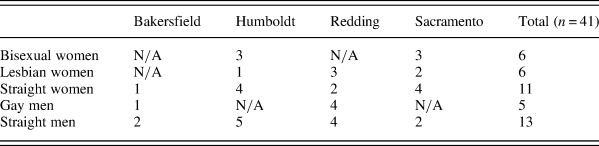
Forty-one speakers were selected from Stanford University's Voices of California (VOC) corpus, which consists of 800+ sociolinguistic interviews of speakers born and raised in California. The gender/sexuality breakdown of the sample is shown in Table 1. Bisexual men are not represented in the corpus and are thus not included here. All speakers are white and between the ages of 18 and 42. They are natives of Northern California (Humboldt County, Sacramento) and the Central Valley (Redding, Bakersfield). While there were too few self-identifying LGB individuals in the VOC corpus to limit the sample to one field site, we find few phonetic differences across the field sites in the VOC corpus, particularly in the vocalic domain where regional divisions are often most clearly demarcated, so this was not considered an issue in sample construction.Footnote 1
Speakers by gender, sexuality, field site
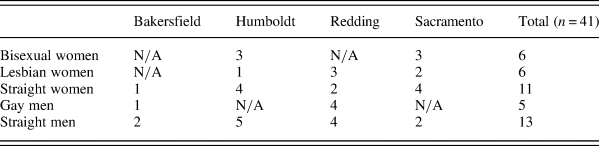
The number of speakers in each gender and sexuality group is relatively small, and readers should be warned that findings based on small speaker numbers should be approached with some degree of caution. This said, smaller samples are to be expected to some extent with minority groups, especially sexual minorities, who are estimated to comprise only about 4.5% of the US population (Gallup.com, 2018). This percentage is smaller still when partitioned by state, ethnicity, and age group, as is the case here. And, ultimately, the numbers of speakers in the five groups are not incomparable to those of many other variationist analyses (e.g., Wassink, Reference Wassink2015).
Methods
Thirty minutes of each speaker's interview were transcribed orthographically using ELAN and aligned using DARLA (Reddy & Stanford, Reference Reddy and Stanford2015) to obtain word and phone intervals. The first 15 minutes of each interview were excluded for being more formal than latter portions. In the Praat TextGrids obtained from DARLA, I created syllable tiers to manually adjust tonic and posttonic syllable boundaries for all phrase-final words carrying primary penultimate lexical stress. Words were deemed phrase-final if they occurred at the end of both an intonational phrase (IP) and syntactic clause. This eliminated IPs with few syllables and kept the IPs analyzed close in length.
Tonic and posttonic syllables were grouped by the Maximum Onset Principle (Kahn, Reference Kahn1976; Turk & Shattuck-Hufnagel, Reference Turk and Shattuck-Hufnagel2007), and manual segmentation of the syllables was aided through visual cues in the waveform and spectrogram as well as through the auditory information carried in the speech signal, following the methodology in Turk and Shattuck-Hufnagel (Reference Turk and Shattuck-Hufnagel2007). If the offset of a segment did not end exactly at the onset of the following sound, the space between the offset and the onset was labeled as part of the onset. It sometimes proved difficult to identify where the tonic syllable ended and the posttonic syllable began. This occurred frequently when the tonic syllable was open and the onset of the posttonic syllable was a sonorant consonant. These words were excluded to avoid spurious duration measurements. Words uttered in creaky voice were also excluded if the dampening of glottal pulses made phone differentiation difficult. The final durations of marked intervals were extracted with a Praat script.
PFPTL was operationalized as the ratio of the duration of the final unstressed syllable to the duration of the penultimate stressed syllable. Higher ratios suggest more lengthening of phrase-final unstressed syllables (the primary interest of this study) in comparison to the stressed syllables that immediately precede them. While some studies have found that boundary-driven lengthening affects syllables that precede the final one, this does not hold for all syllabic contexts. Final syllables lengthen the most (Turk & Shattuck-Hufnagel, Reference Turk and Shattuck-Hufnagel2007; Wightman, Shattuck-Hufnagel, Ostendorf, & Price, Reference Wightman, Shattuck-Hufnagel, Ostendorf and Price1992) and are thus the primary interest here. However, a measure of only final syllable durations does not allow us to distinguish between longer phrase-final syllables and longer syllables overall, so the syllable preceding it provides a point of comparison and a local control for articulation rate.
The ratio measure I adopt here differs from what has been used to capture phrase-final lengthening in past phonetic work, and this is due to the conversational nature of the VOC speech corpus. Nearly all published research on phrase-final lengthening has used scripted speech. The controlled nature of these datasets has allowed for direct durational comparisons of identical words in phrase-final and phrase-medial positions. This method proved problematic for the speech analyzed here. Rarely was it the case that the syllabic structure and stress patterns of a phrase-final word matched that of a phrase-medial word, and this says nothing about identical words in both positions. Comparing segmental durations between phrase-final bisyllabic words with penultimate stress and phrase-medial monosyllabic words, for instance, would result in spurious measurements, because the location of stress in a word has been shown to affect which syllables are lengthened and to what degree (Turk & Shattuck-Hufnagel, Reference Turk and Shattuck-Hufnagel2007). And, none of this takes into the account the issue of comparing syllable durations in words of different lexical frequencies (Bell, Brenier, Gregory, Girand, & Jurafsky, Reference Bell, Brenier, Gregory, Girand and Jurafsky2009), grammatical categories (Anttila, Dozat, Galbraith, & Shapiro, Reference Anttila, Dozat, Galbraith, Shapiro, Kentner and Kremers2020), and other factors known to affect durational patterns. The ratio measure I adopt to operationalize PFPTL limits the measure to syllables within a single word to circumvent these issues.Footnote 2
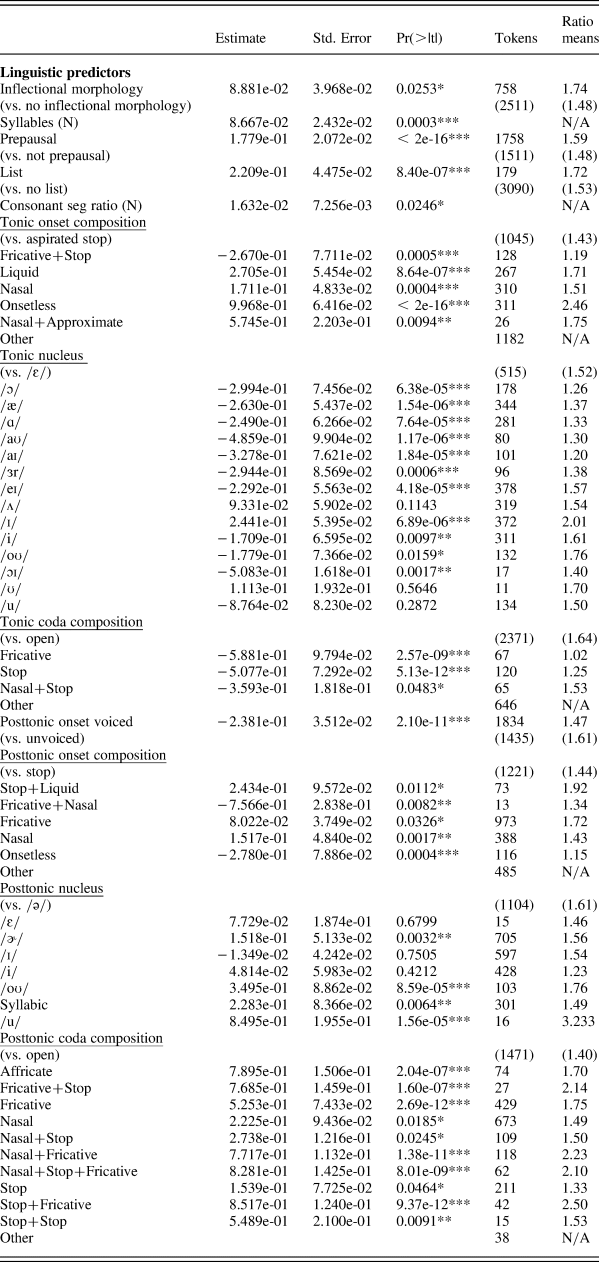
PFPTL is heavily constrained by structural linguistic factors that we need to account for in the statistical analysis. Due to space constraints, and my focus on the social factors, I list these factors below but do not discuss them further. Each tonic/posttonic syllable pair was coded for the following factors.Footnote 3
Syllable level: Number of consonantal segments in tonic and posttonic syllables, grouped by Maximum Onset Principle; Consonant identity (manner of articulation) (Klatt, Reference Klatt1976);Footnote 4 Voicing of consonants preceding and following syllable nuclei (Chen, Reference Chen1970); Nucleus identity (syllabic, or vowel class) (Klatt, Reference Klatt1976).Footnote 5
Word level: Number of syllables per word (Lehiste, Reference Lehiste and Lass1976); Inflectional suffix (Yes/No) (Walsh & Parker, Reference Walsh and Parker1983); Grammatical category (Anttila et al., Reference Anttila, Dozat, Galbraith, Shapiro, Kentner and Kremers2020); Lemma frequency, log-transformed (Bell et al., Reference Bell, Brenier, Gregory, Girand and Jurafsky2009)
Utterance level: List intonation (Yes/No) (Calder et al., Reference Calder, Eckert, Fine and Podesva2013)Footnote 6; Pre-pausal (Yes/No) (≥200 ms) (Campione & Véronis, Reference Campione and Véronis2002; Kachkovskaia, Reference Kachkovskaia, Ronzhin, Potapova and Delic2014); Articulation rate (syllables/phonation time) (Turk & Shattuck-Hufnagel, Reference Turk and Shattuck-Hufnagel2007).
A mixed-effects linear regression model using the lme4 package (Bates, Maechler, Bolker, & Walker, Reference Bates, Maechler and Walker2015) in R (R Core Team, 2018) was fit to the data. The number of posttonic to tonic units obtained for each speaker ranged from 65-140, for a total of 3,269 (based on 6,538 segmented syllables in total). The response variable was the ratio of the duration of final posttonic to penultimate tonic syllables. Raw durational values were used in the calculation of the response variable because log-transformation resulted in no changes to the model. The fixed effects were Gender/Sexuality and the linguistic controls just described. Model fit was assessed through ANOVA comparisons of nested models in R. Gender and sexuality were treated as a combined factor with five levels instead of as an interaction term because gender and sexuality were not fully crossed (i.e., there are no bisexual men in the sample). The model with all linguistic controls is in Table A1 in the Appendix. While the model contains a relatively large number of factors, the data upon which it was built exceeds the recommended 10-20 tokens per factor level necessary to avoid overfitting and allow for reliable coefficient estimation (Harrell, Reference Harrell2001). Due to space constraints, I will not discuss the effects of the linguistic factors on PFPTL, but they can be viewed in the Appendix. There were no qualitative differences in how linguistic constraints patterned by individual or group.
RESULTS
Social factors
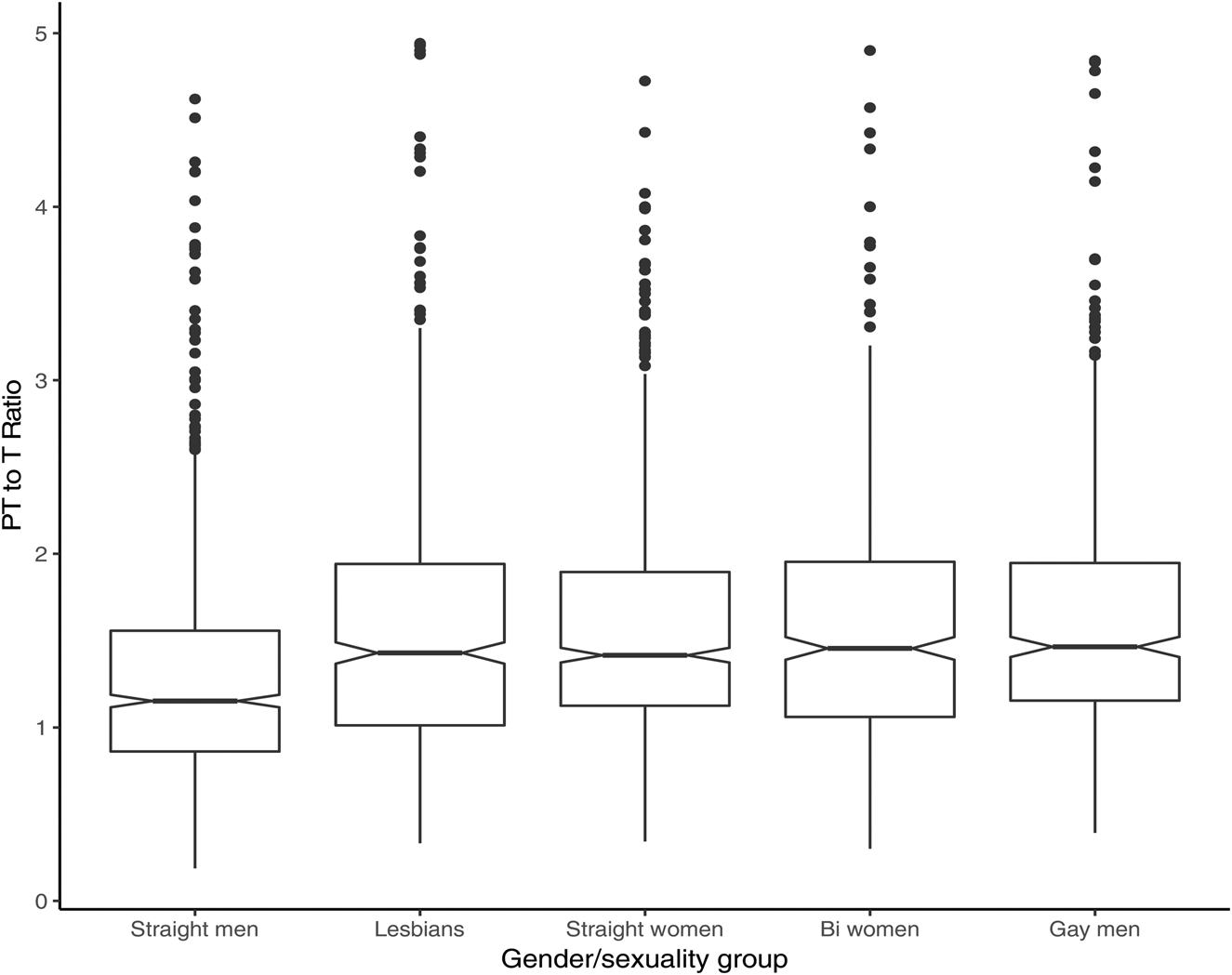
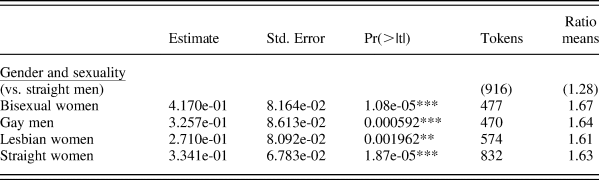
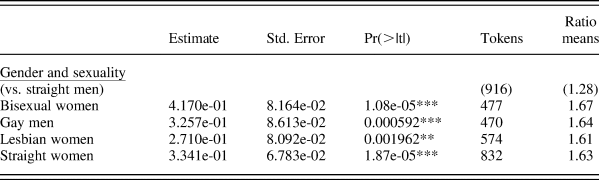
The main effects of gender and sexuality are shown in Table 2. Bisexual women, lesbian women, straight women, and gay men have larger posttonic to tonic syllable duration ratios than straight men.Footnote 7 That is, these four groups exhibit more lengthening of final unstressed syllables in comparison to preceding stressed syllables (more PFPTL) than straight men. All female sexuality groups employ PFPTL to the same degree. Women and gay men also employ PFPTL to the same degree.Footnote 8 These findings are visualized in Figure 1.
PFPTL by gender and sexuality.

Effects of gender and sexuality on PFPTL
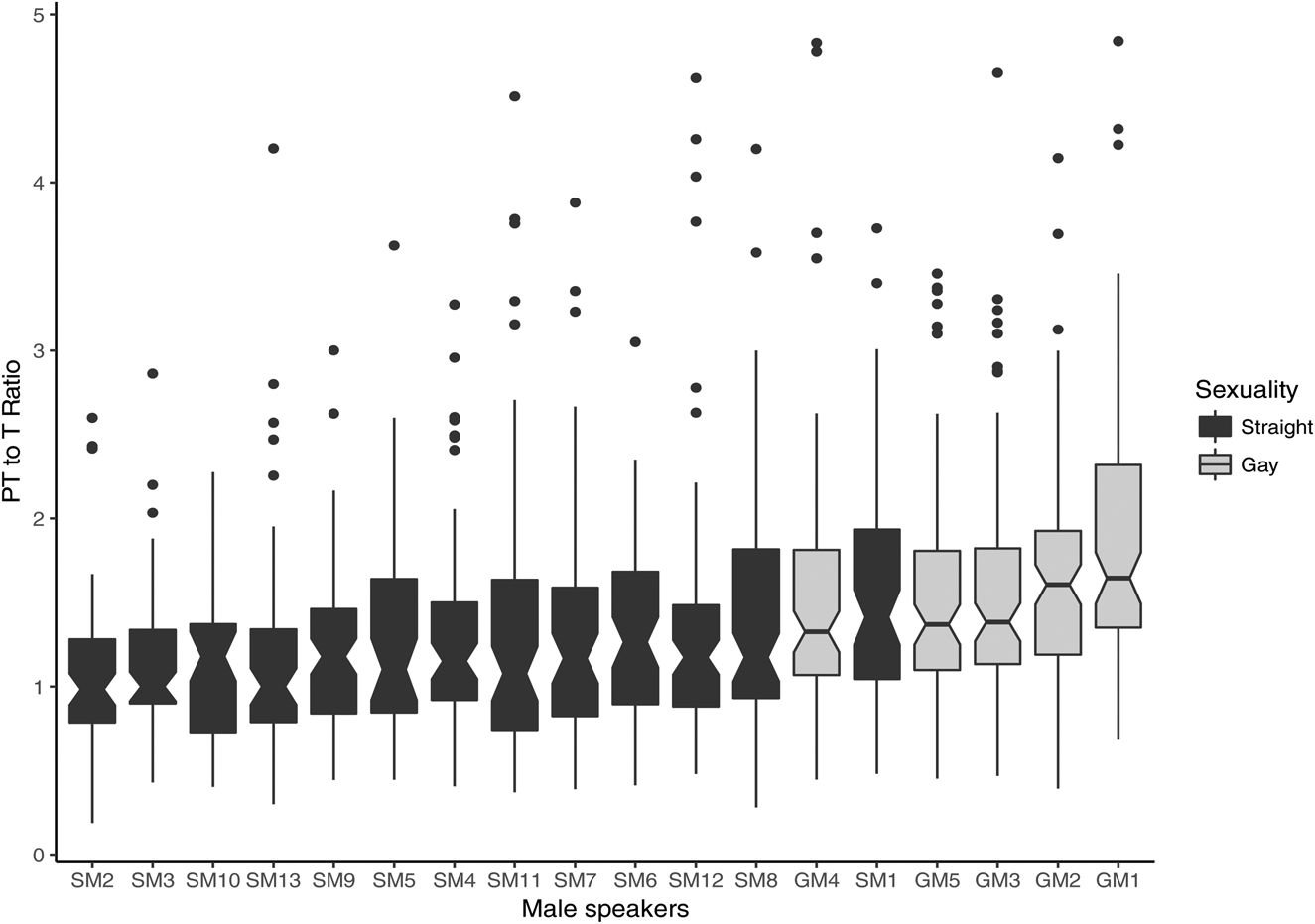
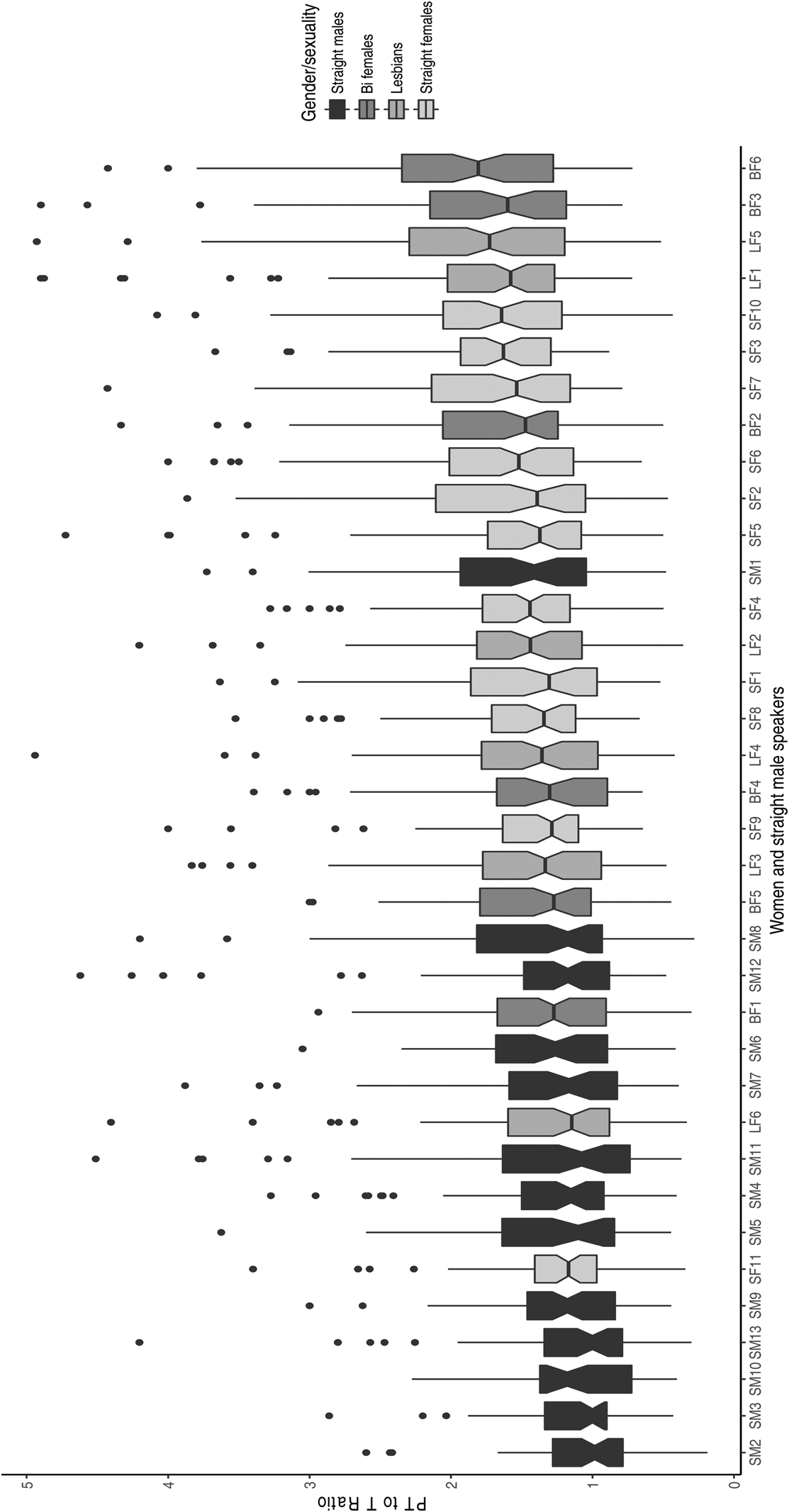
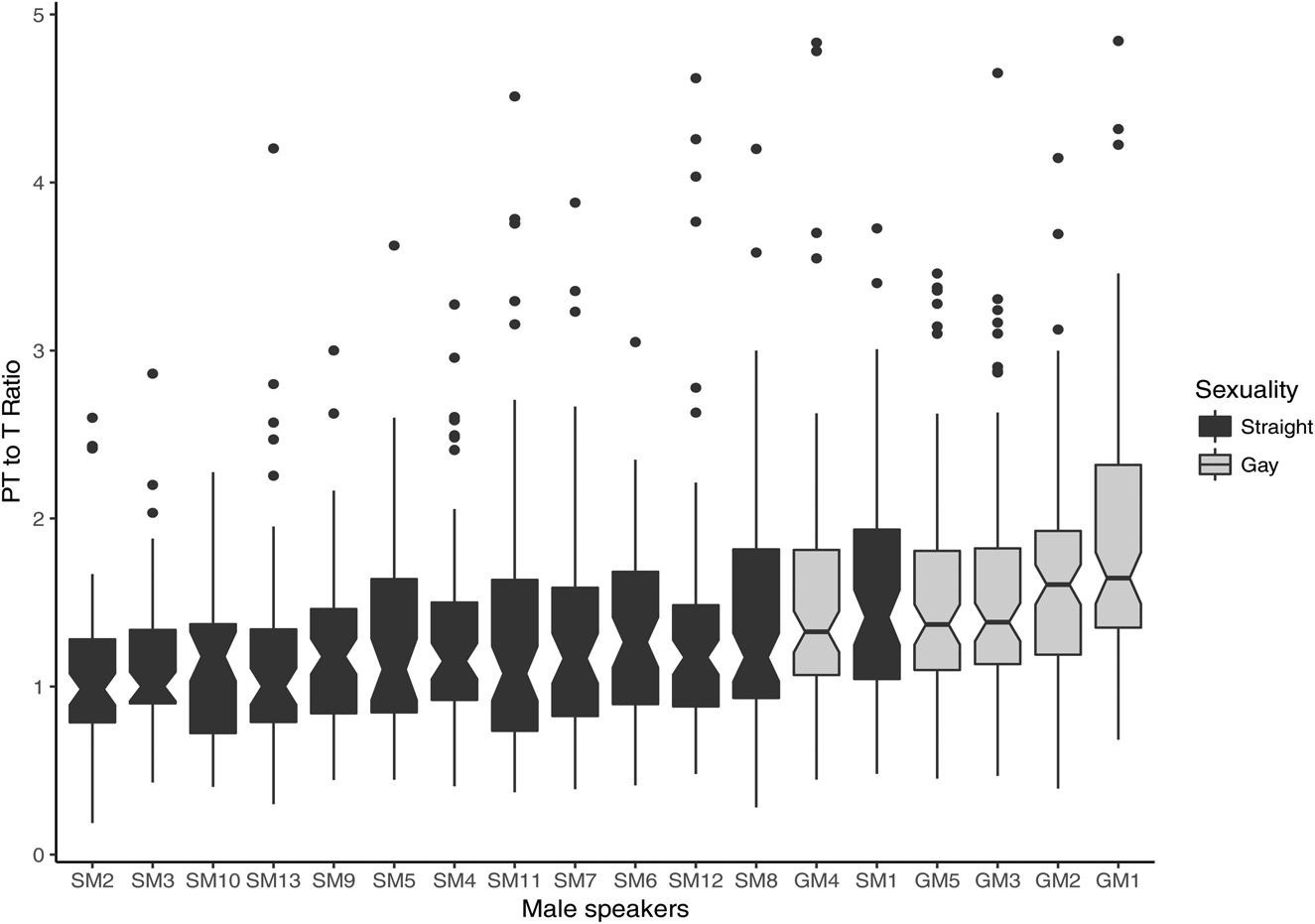
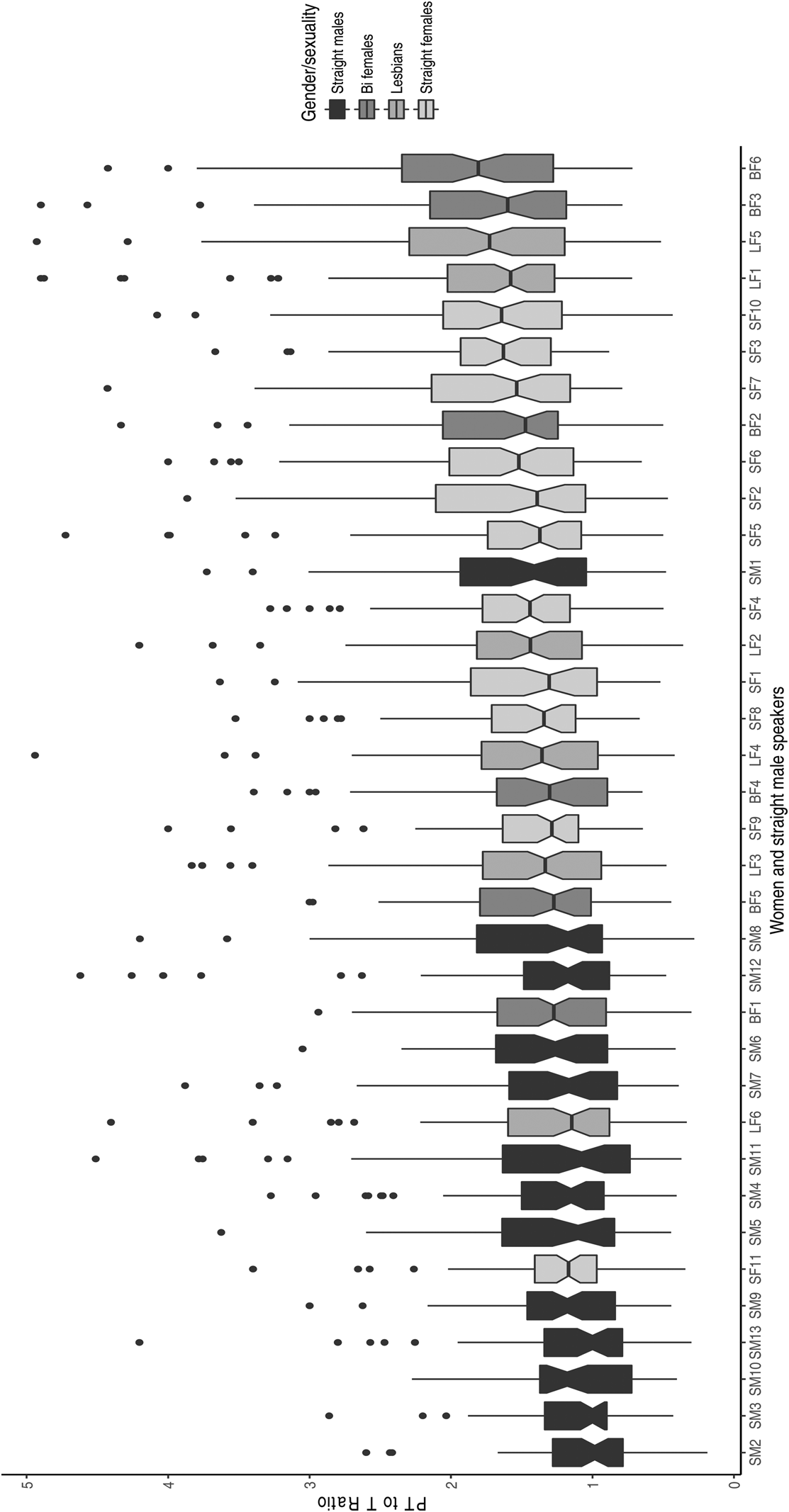
Individual differences. There were two primary group-level differences in PFPTL observed in the statistical model: (1) women employ more PFPTL than straight men, and (2) gay men employ more PFPTL than straight men. However, because the number of speakers in each of the groups is relatively small, it is important to consider the relation between the individual and the group. Is the statistical difference in PFPTL at the sexuality level an artifact of the behavior of only a few individuals? Figures 2 and 3 plot PT to T ratios for each speaker in the sample. Figure 2 plots PT to T ratios for the men, and Figure 3 plots PT to T ratios for all women and straight men. Speakers are ordered by PT to T ratio means.
PFPTL by individual men. GM = gay male. SM = straight male.
PFPTL by individual females and males. BF = bisexual female. LF = lesbian female. SF = straight female. SM = straight male.
As shown in Figure 2, the gay male speakers are situated to the right end of the plot, employing PFPTL to the greatest degree. The four speakers with the highest PT to T ratio mean are gay. It is clear that the group-level difference observed in the statistical model between gay and straight men is not driven by a few outliers.
As for the women and straight men, we see that most straight men, represented in black in Figure 3, are the conservative users of PFPTL. There is, of course, a noteworthy exception (i.e., SM1), but this descriptive generalization supports the overall group-level finding that straight men on the whole employ less PFPTL than women.
There is, however, notable within-group variation among the women. The four speakers with the highest PT to T ratio means are represented by two lesbian and two bisexual women, and four of the five speakers with the lowest PT to T ratio means are also two lesbian and two bisexual women. The lesbian and bisexual women appear to be defining the envelope within which the straight women's variability is contained. The variability in the linguistic behavior of the lesbian and bisexual women accounts for the statistically insignificant differences between these groups.
Discussion
To summarize, the regression model showed that, at the group level, women and gay men in the Californian communities represented here have longer phrase-final unstressed syllables in comparison to preceding stressed syllables than straight men (i.e., more PFPTL than straight men). While the number of speakers in each group is relatively small, Figures 2 and 3 show that these statistically significant gender and sexuality effects are not driven by the linguistic behavior of a few outliers; the individuals predominantly pattern together as groups. There were no statistically significant differences among the female sexuality groups, and this is mirrored in the notable individual variation in PFPTL shown in Figure 3.
That gay men and straight men employ PFPTL to differing degrees contributes to work on phonetic differences among sexuality groups. Most work has centered on /s/ peak frequency (Linville, Reference Linville1998) and center of gravity (Hazenberg, Reference Hazenberg2016; Linville, Reference Linville1998; Podesva & Van Hofwegen, Reference Podesva, Van Hofwegen, Levon and Mendes2016; Zimman, Reference Zimman2013) with gay males producing higher frequencies for both measures. Other researchers have identified differences in the vocalic and prosodic domains, showing that some gay males use more expanded vowel spaces than straight males (Pierrehumbert, Bent, Munson, Bradlow, & Bailey, Reference Pierrehumbert, Bent, Munson, Bradlow and Bailey2004) and employ higher pitch and more creaky voice (Zimman, Reference Zimman2013). That gay and straight males also differ in the extent to which they employ PFPTL expands this catalog of phonetic features linked to male sexuality and opens the door for further work on interrelations among duration, rhythm, and gender and sexual category membership.
No observed quantitative differences among the women is not entirely surprising against the backdrop of past work. Phonetic differences between straight and queer women remain elusive, and, when differences are identified, they are often not replicated in other samples. For instance, while Podesva and Van Hofwegen (Reference Podesva, Van Hofwegen, Levon and Mendes2016) found that lesbians in Redding, California had lower centers of gravity for /s/ than straight women, and Pierrehumbert et al. (Reference Pierrehumbert, Bent, Munson, Bradlow and Bailey2004) and Munson, McDonald, DeBoe, and White (Reference Munson, McDonald, DeBoe and White2006) showed several vowel formant differences between queer women and straight women, Barron-Lutzross (Reference Barron-Lutzross2018) identified no differences in /s/ center of gravity or formant values among her sample of straight, bisexual, and lesbian women in California. We might wonder whether the conflicting findings across studies derive from greater linguistic heterogeneity among queer women than among gay men, as Figures 2 and 3 also show qualitatively.
Finally, the findings shown here complicate the gender pattern observed in Calder et al. (Reference Calder, Eckert, Fine and Podesva2013) and Callier (Reference Callier2011): I only observe gender differences in PFPTL when comparing women and straight men. That there are no differences between women and gay men highlights the importance of incorporating sexuality into variationist analyses, and it also supports the general finding that the phonetic styles of some gay men in the aggregate pattern closer to those of women than straight men's do.
Overall, then, a consideration of sexuality showed us that PFPTL is socially linked to more than gender. But what else does it index? What social meanings are attached to PFPTL, such that gay men and women draw on it more heavily than straight men? To address this question, I perform a matched-guise social perception experiment of PFPTL. Social perception experiments are increasingly employed to uncover the kinds of social meanings that individual linguistic features are imbued with (e.g., Campbell-Kibler, Reference Campbell-Kibler2011; Levon, Reference Levon2006, Reference Levon2007, Reference Levon2014). As such, researchers have used the results of matched-guise studies to explain broader social patterning in linguistic production. Becker (Reference Becker2014) showed that New Yorkers associate a raised bought vowel with “meanness/aloofness” and argued that younger speakers are lowering bought in apparent time in avoidance of these qualities. Also, on the basis of a perception study, Chappell (Reference Chappell2016) suggested that female speakers of Costa Rican Spanish use intervocalic /s/ to access the positive social meanings associated with it. I follow these authors in using a matched-guise social perception experiment to illuminate the production-based variation for PFPTL.
THE SOCIAL MEANING OF PHRASE-FINAL POSTTONIC LENGTHENING
In this section, I outline the methods and results of the matched-guise social perception experiment designed to test the social meanings of PFPTL. As noted, it was hoped that the perception experiment would clarify the meaning of the demographic patterns observed in the production study.
Methods
Participants. 876 participants were recruited from Amazon's Mechanical Turk platform to take the survey. Although the production study was based on the speech of Californians, I sought to elicit perceptions of the feature more broadly and, thus, did not limit the subject pool to state residents. PFPTL is a phonetic feature across varieties of English, so it was expected that all native speakers have encountered variation in PFPTL, employ it strategically in stylistic practice, and share knowledge of its social meanings. I limited the pool of participants to US citizens but did not collect other demographic information aside from gender. Participants on Mechanical Turk tend to be younger, more female, and lower income than the US general population. Their geographic origins are similar to those of Internet users (Ipeirotis, Reference Ipeirotis2010). While some work has shown that listener ideology mediates perception (Hilton, Reference Hilton2018; Levon, Reference Levon2014; Levon & Buchstaller, Reference Levon and Buchstaller2015), the experiment here identifies broad trends in the social meaning of PFPTL and reserves listener-specific effects for future work. The experiment took participants approximately three minutes.
Stimuli. To standardize lexical content, prosody, speech rate, and other factors related to syllable structure, the stimuli for the experiment come from performed speech of eight speakers (four male, four female) of Mainstream American English rather than from speech analyzed in the production study. Three speakers were raised in the Northeastern United States, three in the South and two in the Midwest. Speakers’ ages ranged from 18-29. Six of the eight speakers were white, one was Latinx, and one was Black.
A number of factors were taken into consideration in constructing the form and content of the three stimuli sentences that speakers would perform. First was the identity of the phrase-final words for each of the three stimulus sentences: ‘I'll do it after,’ ‘I filled the water bottle,’ ‘I go there often.’ These words were chosen because they have (1) similar lemma frequencies based on the Corpus of Contemporary of American English (Davies, Reference Davies2008); (2) the same number of syllables; (3) the same number of segments in the tonic and posttonic syllables (assuming syllabic /r/, /n/, and /l/); and (4) three different posttonic syllables. These factors allow us to control for the linguistic conditions across stimuli while also including more than one type of posttonic syllable for generalizability. I chose words that lack (s) and (ING), variants of which are linked to sexuality in perception (Campbell-Kibler, Reference Campbell-Kibler2011; Levon, Reference Levon2006, Reference Levon2007), as well as words that are ‘unmarked’ lexically, because of the role that lexical content plays in perception (Hilton & Jeong, Reference Hilton and Jeong2019).
I recorded myself producing the sentences and asked speakers to match my intonation, speech rate, and duration of syllables in the utterance-final tonic and posttonic syllables as closely as possible. I produced the utterance-final syllables with a duration ratio (posttonic to tonic) of 1.49. Speakers were generally able to match my production closely. The reason I selected the 1.49 ratio is as follows. I sought to include three experimental conditions in the experiment: (1) utterance-final posttonic syllable is short; (2) utterance-final posttonic syllable is long; (3) utterance-final posttonic syllable is of medium length. I determined ratios for the three conditions based on Calder et al.'s (Reference Calder, Eckert, Fine and Podesva2013) findings to ensure that they were rooted in production patterns. I used the 90th percentile of all ratios (2.22) for the long condition; the median value (1.28) for the medium condition; and the 10th percentile (0.76) for the short condition. The ratio I used in my instructional was the average of the 90th percentile ratio and the 10th percentile ratio. Using this average ensured that the long and short conditions would be manipulated equally.
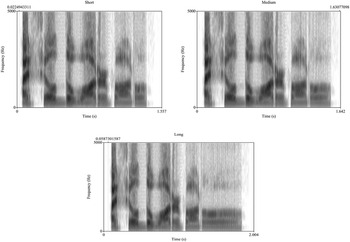
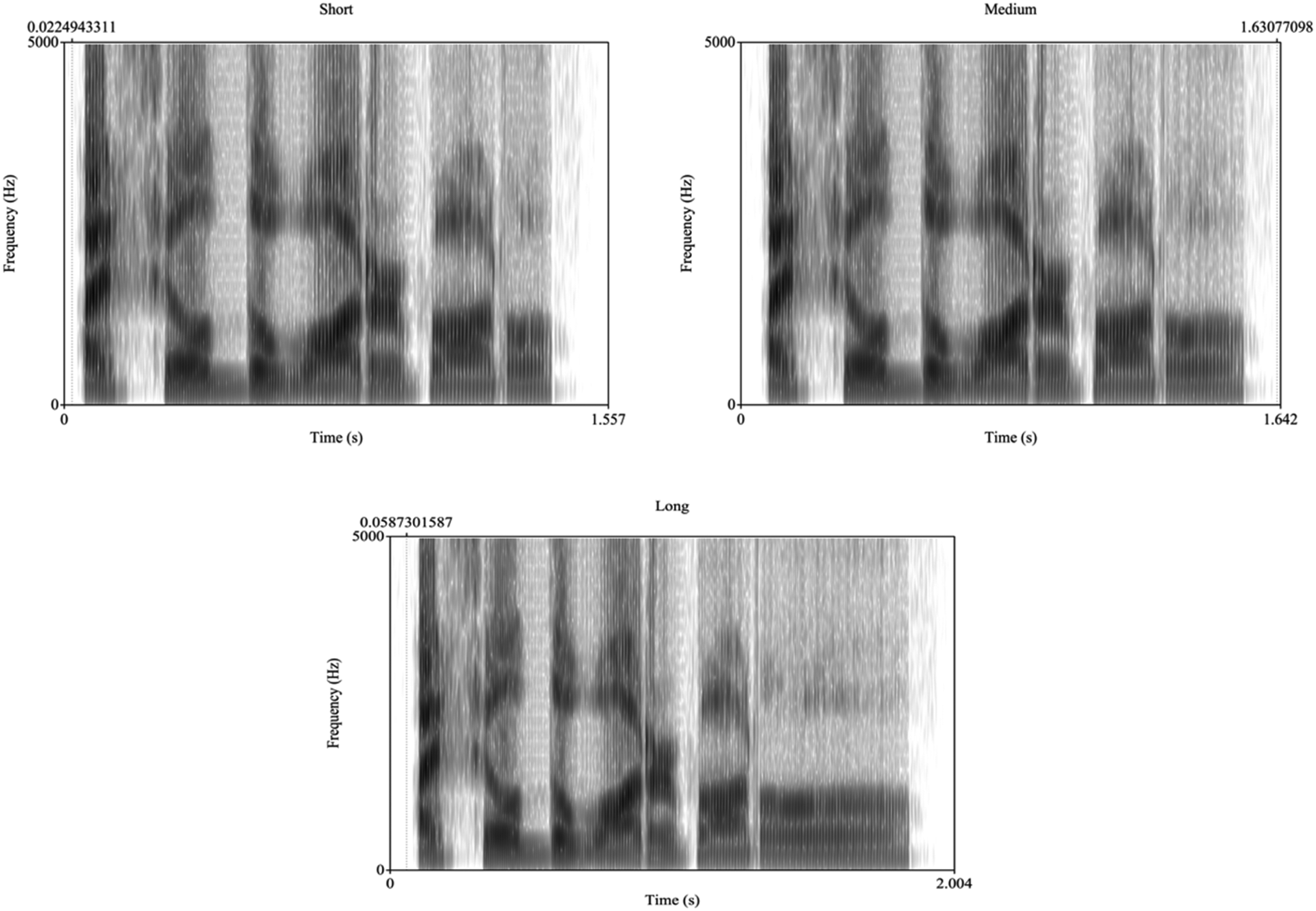
Original productions were digitally copied to achieve three acoustic signals for each utterance for each speaker (72 stimuli total). The posttonic rime of each utterance-final word was shortened for the short condition and lengthened for the long condition from the original 1.49 posttonic to tonic duration ratio, or as close to this ratio as the speakers were able to achieve. I manipulated rime durations using TD-PSOLA (Moulines & Charpentier, Reference Moulines and Charpentier1990) as available in Praat (Boersma & Weenink, Reference Boersma and Weenink2018). This method is frequently used to alter segmental durations while keeping other prosodic features (e.g., f0, intensity) unaffected (cf., Yu, Reference Yu2017). Stimuli were judged by me and others as sounding natural. Examples of manipulated stimuli for each length condition are shown in Figure 4.
Manipulated stimuli for one male speaker saying, “I filled the water bottle.”
Design. Participants heard only a single utterance, sidestepping the need for filler items and keeping the duration of the experiment short. Participants were told that the utterance they were about to listen to had been randomly chosen from a spoken conversation between two people. After hearing the recording, they were asked to rate the speaker with the descriptors provided. The descriptors were situated along a seven-point Likert scale, with the left pole denoting the negative of each descriptor (i.e., ‘not feminine’), and the right pole the positive of each descriptor (i.e., ‘feminine’). The descriptors provided to participants were those that would help me address the following two questions: (1) Is PFPTL associated with gender/sexuality-related meanings in perception? (2) What social meanings might help explain the social patterning of PFPTL in the production study? To address (1), participants were asked to rate male voices along a cline of “not gay”/“gay” and female voices along a cline of “not lesbian”/“lesbian.” Because past work has shown that gay ratings are highly correlated with femininity ratings (Gaudio, Reference Gaudio1984; Levon, Reference Levon2006), and notions of femininity and masculinity are so intimately tied to gender/sexual binaries (Eckert, Reference Eckert2014), participants were also asked to evaluate male and female voices with respect to “feminine” and “masculine” scales.
In deciding which descriptors to include to address (2), I performed a short, open-ended pilot study in which 20 participants on Mechanical Turk were asked to type five words they associate with the speaker of one of the manipulated stimuli. The hope was that this exercise would help me identify meanings uniquely relevant to PFPTL. “Flamboyant” was written independently by several participants for the voice in the long condition, and not at all for the voice in the short condition. I included flamboyance as a descriptor on this basis and because it has been tied to gender and sexual binaries in past work (Eckert, Reference Eckert2014). I also included “emotive” as a descriptor. Linguistic anthropological work has suggested that linguistic features linked to gender “have as their core social meaning a particular affective stance” (Ochs, Reference Ochs, Duranti and Goodwin1992:341). Due to the ideological connections between gender and sexuality outlined in the introduction, we might also hypothesize that features linked to sexuality carry affective meaning. “Flamboyance” certainly carries shades of exaggerated affect, but the inclusion of the emotive descriptor allows me to even more precisely test connections between PFPTL and affectiveFootnote 9 display. Participants were also asked to rate how “young” the voices sound, since younger speakers lead their elders in PFPTL (Calder et al., Reference Calder, Eckert, Fine and Podesva2013). Finally, an attention-check question was also included to weed out participants blindly completing the survey. Six participants failed this question, leaving the total number whose responses were analyzed at 870.
Statistical analyses
Before performing regression analyses to test the effects of lengthening on the descriptors of interest, I conducted an Exploratory Factor Analysis (EFA) in R (R Core Team, 2018) using the Psych and GPArotation packages. EFA narrows down the number of variables by exploring their underlying structure via correlations among them. Specifically, I used it to determine whether any of the seven descriptors could be conflated into broader rating categories. EFA was performed separately for male and female voices because the sexuality question differed by gender (i.e., “gay” versus “lesbian”) and because it became clear that the descriptors correlated differently by gender.
Prior to EFA, parallel analysis (Horn, Reference Horn1965) was carried out using the “fa.parallel” function from the Psych package in R to identify the appropriate number of factors to extract. The analysis suggested a reduction of the seven tested descriptors to three factors for the female voices and two factors for the male voices. Subsequent EFA (oblique rotation) revealed the three factors for the female voices to be (1) the affective intensity rating (combination of “flamboyant” and “emotive” descriptors), (2) the young femininity rating (combination of “young,” “feminine,” and “not masculine” descriptors), and (3) the lesbian rating (“lesbian” descriptor). For the males, EFA revealed the two factors to be (1) the affective intensity rating (combination of “flamboyant,” “emotive,” and “young” descriptors) and (2) the gay male femininity rating (combination of “gay,” “feminine,” and “not masculine” descriptors). The ratings for descriptors grouped under the same factor were averaged before regression analysis.
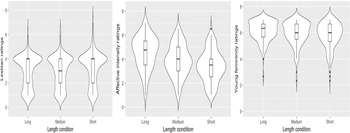
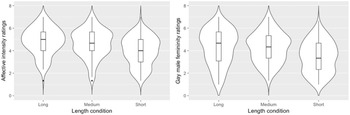
I conducted five mixed-effects linear regression models (one for each factor) using the lme4 package in R. Best-fit models for all factors included length condition as a fixed effect, and random by-speaker and by-word intercepts. Factor ratings are displayed in Figures 5 and 6.
Female voice ratings for combined descriptors.
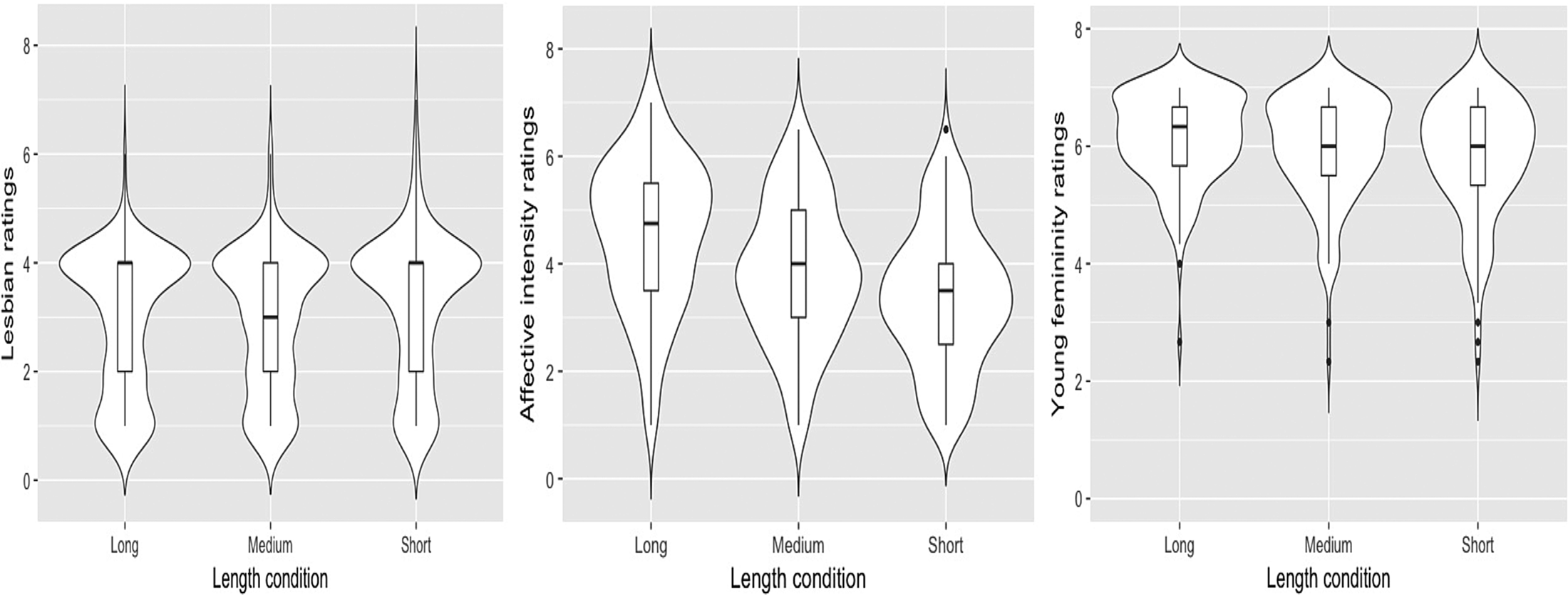
Male voice ratings for combined descriptors.

Results
For male voices, lengthening has a significant effect on the affective intensity rating, such that voices in the long (Est. = 0.74, p < 0.0001***) and medium conditions (Est. = 0.53, p < 0.0001***) received higher scores for affective intensity than voices in the short condition. In other words, male voices with long phrase-final unstressed syllables were viewed as younger and more affectively exaggerated (flamboyant and emotive) than those with shorter syllables. For the gay male femininity rating, a significant effect is also observed. Voices in the long (Est. = 0.80, p < 0.0001***) and medium conditions (Est. = 0.74, p < 0.0001***) received higher ratings than voices in the short condition, suggesting that increased PFPTL contributes to perceptions of gayness and femininity. That is, male voices that have long phrase-final unstressed syllables were more likely to be viewed as belonging to a “feminine gay man” than those that have short syllables.
For the female voices, lengthening also has a significant effect on the affective intensity rating, such that voices in the long (Est. = 0.99, p < 0.0001***) and medium conditions (Est. = 0.33, p < 0.0001***) were perceived as more affectively engaged than voices in the short condition. Thus, just as we saw with the male voices, longer phrase-final unstressed syllables contribute to perceptions of exaggerated affect (i.e., flamboyance and emotiveness). Voices in the long condition were also perceived as younger and more feminine than voices in the short condition (Est. = 0.35, p < 0.0001***). The medium and short conditions do not differ for this factor (Est. = 0.16, p = 0.11). Last, lengthening has a marginal effect on perceptions of sexuality for women, such that voices in the long (Est. = -0.28, p = 0.06) and medium conditions (Est. = -0.29, p = 0.0502) were perceived as less lesbian-sounding than voices in the short condition.
To summarize, PFPTL has a statistically significant effect on the following four factors: affective intensity (both male and female voices), young female femininity, and gay male femininity. Voices in the long condition received higher scores for these factors than voices in the short condition. Voices in the medium condition also received higher ratings than voices in the short condition, except for the young femininity factor.Footnote 10 The results of the perception experiment show that, regardless of gender, increased PFPTL contributes to perceptions of exaggerated affect and femininity.
DISCUSSION
Given the perception results, we can now ask how they illuminate the production-based patterning. In what is to follow, I suggest that differences in affective expression underlie group-level variation in PFPTL. After presenting this proposal, I address why PFPTL in particular is well-suited to conveying affective meaning. I conclude with the implications of these claims for our understanding of macrosocial linguistic variation.
Affect and social difference
What is affect? The term is used differently by sociologists and anthropologists studying social displays of affect, and most do not agree on the kinds of qualities/characteristics that should fall under its conceptual umbrella. For our purposes, I adopt Reeser and Gottzén's (Reference Reeser and Lucas2018) conception of affect, which situates it along a scale encompassing different degrees of expressive intensity. Thus, in referencing “exaggerated affect,” I refer, in part, to the specific identity of the “feelings, moods, dispositions…” of speakers (Besnier, Reference Besnier1990:419), which, in our case, is flamboyance and emotiveness, but also importantly to the degree to which this affect is expressed. Indeed, individuals can ultimately be said to be flamboyant and emotive in distinct ways, but what unites both qualities at their core is affective extravagance. What I suggest is that differences in affective expression and intensity govern the macrosocial patterning of PFPTL in the production study.
Specifically, we saw that increased PFPTL is associated with a particular kind of exaggerated affect in perception, and if we follow the work noted earlier that draws on perceptual social meanings to explain production patterns (Becker, Reference Becker2014; Chappell, Reference Chappell2016), we might say that the social differences in PFPTL production are driven by differences in affective expression: women and gay men employ more PFPTL to express more exaggerated affect (i.e., flamboyance and emotiveness), and straight men employ less PFPTL to express an affect that is more reserved. The precise and nuanced relations among gender and sexual categories, and affect and expressivity, cannot be commented on in-depth for this sample of speakers due to a lack of ethnographic observation. However, what is clear within a broader North American cultural context is that gender and sexual categories are tightly and ideologically enmeshed with different affective and expressive positionings, and speakers belonging to different categories may index these positionings linguistically in unique ways to achieve a variety of social goals (Eckert, Reference Eckert1990, Reference Eckert2014; Kiesling, Reference Kiesling2018; Podesva, Reference Podesva2007, Reference Podesva2011). If more PFPTL signals more exaggerated affect, and less PFPTL signals less exaggerated affect, the social groups may differ in their use of PFPTL as a function of differential orientations to these affective potentials. In this way, the PFPTL variation we observe may be more about variation in affective signaling than gender or sexuality status marking.
Now, one might ask why the indexing of affect in particular underlies the production variation instead of the indexing of other qualities associated with lengthening in the perception study. That is, why is it not the case that women and gay men employ more PFPTL to index femininity or gayness, respectively? To address this question, I appeal to Ochs's (Reference Ochs, Duranti and Goodwin1992) suggestion that linguistic features index gender and gendered qualities indirectly; direct indexes are said to be affectively driven (“affective stances” [341]). For instance, while high rising terminals might be ideologically associated with women's speech, women (and men) have been shown to employ high rising terminals in production to index a variety of affective stances, rather than gendered categories per se (e.g., Levon, Reference Levon2016b). Given ideological connections between gender and sexuality, we might extend Ochs's argument to features that index sexuality as well. Indeed, gayness, femininity, and youngness—the qualities linked to increased PFPTL in perception—certainly populate the indexical field (Eckert, Reference Eckert2008) for PFPTL, but I would argue that these meanings emerge primarily through higher-order indexical reinterpretations of the kinds of people who draw on exaggerated affect and are not primary motivations for the speakers' use of PFPTL. While this is primarily theoretical support for the present argument, empirical support can also be offered. When each of the matched-guise descriptors is statistically modeled separately (i.e., separate regression models testing the effects of lengthening on each of the seven descriptors), lengthening has the greatest effect on “flamboyant” ratings for male and female voices, suggesting that the indexical link to “flamboyance” and, hence, affective expression, may be particularly strong and thus a primary use of increased PFPTL.Footnote 11
There are several qualifications that need to be made with regards to the present proposal. First, the number of gay males in the sample is small, so while they do pattern together as a group (as shown in Figure 2), how generalizable these patterns are outside the present sample is unclear. Second, I do not argue that affect is innate to social groups, but socially derived. Giddens (Reference Giddens1979) highlighted the joint role of structure and agency in giving rise to broad patterns in social behavior. Individuals belonging to the same macrosocial categories experience similar social constraints, and their behavior tends to pattern together, recreating social life in both similar and new ways, as a result. Third, a stylistic analysis of PFPTL's interactional functions could help us test the affect proposal more explicitly. If we assume that group-level social differences in the use of a linguistic feature flow upward from situated moments of interaction (Eckert, Reference Eckert2012), then we should expect to find the women and gay men signal affectively exaggerated stances with increased PFPTL more frequently than the straight men.
Affect as a source of macrosocial variation
The present proposal, if true, has implications for our understanding of the social forces underpinning linguistic variation. Although affect is increasingly pointed to in variationist work to explain patterns of socially meaningful phonetic variation (Eckert, Reference Eckert2010; Levon, Reference Levon, Levon and Mendes2016a; Pratt, Reference Pratt2018), the focus has been on how linguistic features index affect at the level of individual speaker styles and in situated moments of interaction. A follow-up question emerges from this work: Can different groups of speakers vary their use of a linguistic variable precisely because of the affective meaning it communicates? In other words, might affect underlie broad patterns of linguistic variation? Based on the results presented here, this seems plausible. As noted previously, each affective, stylistic move taken up by a speaker on the ground helps construct the linguistic behavior of the broader societal structures they participate in (Eckert, Reference Eckert2012), so my proposal should not be an unexpected one. And indeed, work in anthropology has long suggested that “social groups may differ in the general intensity of their affective displays” (Besnier, Reference Besnier1990:435). If language is one semiotic resource that can be deployed to index different degrees and kinds of affect, then we should predict that linguistic features are used differentially across groups as a function of this affective variability.
Iconicity and PFPTL
Before concluding, I would like to comment briefly on why PFPTL may be affectively linked. Kroch's (Reference Kroch, Guy, Feagin, Baugh and Schiffrin1994) work on the speech of upper-class Philadelphians touched on the role of iconicity (i.e., form-meaning associations) and its connection to affect in grounding the social meaning of linguistic variation: “Upper class speech is characterized by a drawling and laryngealized voice quality and, contrastingly, by a frequent use of emphatic accent patterns and of intensifying modifiers. These features are iconic and have, perhaps for that reason, an intense interactional effect” (15). Assuming also that iconicity underpins certain patterns of variation and the meanings these patterns index, I suggest that PFPTL's connection to affect is explained by the notion of “iconicity of quantity” (Haiman, Reference Haiman1980) and process of rhematization (Gal, Reference Gal2013). The notion of iconicity of quantity states that linguistic variants with “more” linguistic material tend to be associated with intensified meanings cross-linguistically. The perception experiment showed this intensification at play explicitly with PFPTL, such that speakers who lengthen more (thereby expressing more linguistic material) are seen as more affectively exaggerated than those who lengthen less (and express less linguistic material). Rhematization, the process by which linguistic features are ideologically taken to be iconic of social types and meanings, may explain the intensification of affect itself, as speakers who express more linguistic material are naturally seen as more expressive (i.e., affectively exaggerated) than speakers who lengthen less. Speakers may recruit these associations in their deployment of PFPTL, creating the group-level patterns observed in the production study.
CONCLUSION
This paper presented the results of production and perception studies on phrase-final posttonic lengthening. The production study revealed that gender and sexuality are significant predictors of PFPTL, such that women and gay men in a sample of native Californians make greater use of PFPTL than straight men do. Results of the perception study showed that increased PFPTL is also linked to gender and sexuality in perception, as well as exaggerated affect. I argued that affect is at the core of the socio-indexical potential of PFPTL, and that the speaker groups index this meaning differentially in production. What this finding suggests is that variability in affective display may structure linguistic variation at the macrosocial level and that this fact may especially be true for gender and sexuality-based variation. Whether affect can structure other kinds of macrosocial variation, such as socioeconomic class or aged-based patterns, or even play a role in the propagation of linguistic change, is still unclear. But I would argue that connections between the linguistic and affective realms is robust enough at this point to warrant more serious consideration of these matters.
ACKNOWLEDGMENT
I am grateful to Rob Podesva, Penny Eckert, Arto Anttila, and Cynthia Clopper for feedback on this project. I am also very thankful to several colleagues at Stanford who allowed me to record and phonetically manipulate their voices for the perception experiment, and to all those who have participated in and conducted interviews for the Voices of California project. Thanks also to several anonymous reviewers for their suggestions.
APPENDIX
lmer model for effects of linguistic controls on the ratio of the duration of phrase-final posttonic to tonic syllables. n = 3,269. For onset and coda compositions, only significant levels are shown due to space constraints; n's for the non-significant levels are amalgamated in the other category. Conditional R2 = 60%