Most of the vitamin A activity in animal foods is due to the all-trans retinol, a β-ionone ring with a side chain composed of two isoprene units and four double bonds in trans configuration. All-trans retinol is defined to possess 100% vitamin A activity. Among retinol cis isomers, 13-cis retinol has the largest biopotency (75%) relative to all-trans retinol, 9-cis isomer has a biological activity of 19%, 11,13-di-cis retinol of 15% and the others have even lower vitamin A activity (Weiser & Somorjai, Reference Weiser and Somorjai1992).
During processing and storage, isomerization of trans retinol to the cis forms occurs, with consequent alteration of the retinol bioavailability and biological activity. Milk and dairy products are considered to be a major source of vitamin A, which is present in the retinol esterified form and, in low amounts, as provitamin (carotenes).
Vitamin A is generally considered heat resistant and stable during storage, however the data on retinol stability are sometimes contradictory. Different factors which can affect retinol isomerization have been described in the literature. Trans-cis isomerization can be directly promoted by light, the relative amount of different cis isomers depending on the wavelength and the light permeability of the containers (Murphy et al. Reference Murphy, Engelhardt and Smith1988; Vassila et al. Reference Vassila, Badeka, Kondyli, Savvaidis and Kontominas2002). Low pH values (pH<4·5) may cause both isomerization and de-esterification of vitamin A esters to the more labile free retinol (Erdman et al. Reference Erdman, Poor and Dietz1988). Some authors indicate that fat soluble vitamins are not affected by mild heat treatments such as pasteurization (Lampert, Reference Lampert and Lampert1975; Haroon et al. Reference Haroon, Shearer, Rahim, Gunn, Mcenery and Barkhan1982), however other stronger treatments such as ultra-high temperature processing and sterilization can induce loss of fat soluble vitamins, due to the concomitant effect of other factors such as residual O2, light exposure, fat content, container material or storage conditions.
Reports on retinol stability depend on whether the analytical method used has involved separation of the retinol compounds. While reverse phase HPLC has been mostly used for total retinol content, leading to overestimation of vitamin A activity, if cis isomers are present, normal phase HPLC has been employed for trans retinol and its degradation products (Stancher & Zonta, Reference Stancher and Zonta1982; Woollard & Indyk, Reference Woollard and Indyk1986; Panfili et al. Reference Panfili, Manzi and Pizzoferrato1994; Brinkmann et al. Reference Brinkmann, Dehne, Oei, Tiebach and Baltes1995; Duarte-Favaro et al. Reference Duarte-Favaro, Iha and Bianchi2003).
Moreover, error introduced during the preparation of samples can create large discrepancies in the final nutrient values. As a consequence, some authors report no significant vitamin A loss (Le Marguer & Jackson, Reference Le Marguer and Jackson1983), while others, using chromatographic methods that allow the separation of vitamin A isomers, without producing cis artefacts, report more significant losses (Stancher et al. Reference Stancher and Zonta1982; Panfili et al. Reference Panfili, Manzi and Pizzoferrato1994; Brinkmann et al. Reference Brinkmann, Dehne, Oei, Tiebach and Baltes1995).
The most ubiquitous 13-cis isomers have been found in various types of dairy products including cheese, thermally processed milk, margarine and butter, cream, yogurt and fermented milks, at different concentrations (Woollard & Fairweather, Reference Woollard and Fairweather1985; Woollard & Indyk, Reference Woollard and Indyk1986; Panfili et al. Reference Panfili, Manzi and Pizzoferrato1994, Reference Panfili, Manzi and Pizzoferrato1998, Reference Panfili, Chimisso, Manzi and Pizzoferrato1999; Brinkmann et al. Reference Brinkmann, Dehne, Oei, Tiebach and Baltes1995; Sierra et al. Reference Sierra, Prodanov, Calvo, Olano and Vidal-Valverde1996; Marconi & Panfili, Reference Marconi and Panfili1998; Gambelli et al. Reference Gambelli, Manzi, Panfili, Vivanti and Pizzoferrato1999).
Other factors could influence retinol levels, such as the binding to milk proteins (Perez & Calvo, Reference Perez and Calvo1995), the localization of vitamin A into fat globule (Zahar et al. Reference Zahar, Smith and Martin1995), the concomitant presence of antioxidants (Smith & Berge, Reference Smith and Berge1997; Jung et al. Reference Jung, Lee and Kim1998) and storage.
A correlation between the severity of heat treatments and the 13-cis isomer levels in milk and dairy products has been demonstrated. As a result, the ratio between 13-cis and all-trans retinol, named degree of retinol isomerization, was suggested as a process indicator (Panfili et al. Reference Panfili, Manzi and Pizzoferrato1998, Reference Panfili, Chimisso, Manzi and Pizzoferrato1999). Such index, relative to the lipidic fraction, could supplement the more widely used proposed treatment indices involving protein and carbohydrate modifications.
The purpose of this work was to investigate the effect of microflora on retinol isomerization. Trans retinol degradation in milk was assessed, by means of a reliable HPLC technique, during storage and after addition of specific microorganisms, with the aim of better understanding which other factors, apart from those cited in literature, could be responsible for vitamin A degradation.
Materials and methods
Samples and microbial strains
In order to show retinol and its cis isomer concentration in raw milk at two different storage conditions, a pooled sample of raw cow milk (20 litres), collected at a local farm, was used. Two aliquots of milk (500 ml each) were taken from this sample and were stored, in the dark, in closed glass bottles, at 4°C for 96 h and at 22°C for 24 h. At fixed time intervals (4, 8, 24, and 48, 96 h for samples at 4°C) sample aliquots were collected and analysed for microbial count, pH, acidity and content of retinols.
In order to investigate the effect of single microrganisms on the concentration of retinol compounds, different microorganisms were separately inoculated into a commercial pasteurized milk sample and the evolution of retinol isomers, together with microbial growth, pH and acidity values, was monitored with time (2, 4, 6, 8 h). Pasteurized milk, which undergoes a light thermal treatment (72–74°C for 15 sec) that has a slight influence on retinol isomerization, was chosen as model system.
The microorganisms tested in this experimentation were Lactobacillus casei DSM 20011, Enterococcus faecium DSM 20477 (DSMZ, Braunschweig, Germany), Kocuria varians AL12 and Streptococcus thermophilus S1 (S.T.A.A.M. Department collection, University of Molise), representative of Lactobacilli, Enterococci, Micrococci, and Streptococci, respectively.
The strains were stored in appropriate media at 4°C and propagated twice in reconstituted skim milk (Oxoid), before experimental use.
Aliquots of milk were inoculated with each strain to a final amount of about 4 log cfu/ml. Aliquots of milk were used as control or with lactic acid added to achieve the same degree of acidity obtained with Strep. thermophilus after 8 h incubation (about 23°SH). Each sample was incubated, in the dark, for 8 h, at each strain optimum temperature.
At the end of incubation the microbial counts were determined on specific substrates as described below. For each sample retinols, microbial count, pH and acidity were determined.
Microbial counts
Ten ml from each sample of milk were aseptically withdrawn and suspended in 90 ml sterile quarter-strength Ringer's solution. Decimal dilutions were performed in the same diluent solution and then inoculated in duplicate on appropriate media. The following microorganisms were investigated: lactic acid bacteria and Lb. casei, counted on MRS agar (Oxoid, Basingstoke, United Kingdom), incubated at 28°C for 48 h; total mesophilic count on PCA (Oxoid) at 28°C for 48 h; psychrotrophic microorganisms on PCA plus 10% skim milk (Oxoid) at 4°C for 10 d; Micrococci and Kr. varians on MSA (Oxoid) at 30°C for 48 h; Enterobacteriaceae on VRBGA (Oxoid) at 37°C for 48 h; Enterococci and Ent. faecium on Slanetz and Bartley medium (Oxoid) at 37°C for 48 h. Strep. thermophilus was counted on M17 agar (Oxoid) at 37°C for 48 h, Eumycetes on YPD agar (10 g yeast extract/l, 20 g bacteriological peptone/l, 20 g glucose/l, 20 g agar /l) at 28°C for 96 h.
Titratable acidity and pH
A pH meter (Crison Instruments, Alella, Spain) was used to monitor pH. Acidity, expressed as Soxhlet-Henkel degrees (°SH), was measured as reported by Tateo (Reference Tateo and Tateo1978).
Retinol determination
Retinols were determined according to the method used by Panfili et al. (Reference Panfili, Manzi and Pizzoferrato1994). Three separate determinations for each sample were carried out. Briefly, 5 ml milk samples were saponified under nitrogen in a screw-capped tube with 5 ml ethanolic pyrogallol (60 g/l), 4 ml ethanol (95%), and 1·5 g potassium hydroxide. After alkaline digestion at 70°C for 40 min the tubes were cooled in an ice bath and 15 ml sodium chloride (10 g/l) were added. The suspension was then extracted twice with 15 ml portions of n-hexane/ethyl acetate (9/1 v/v). The organic layer was collected and evaporated to dryness, the dry residue was dissolved in isopropyl alcohol (1%) in n-hexane. Extracted samples were analysed by high-performance liquid chromatography, under normal phase conditions, using a 250 mm×4·6 mm i.d., 5 μm particle size, Kromasil Phenomenex Si column (Torrance, CA, USA) and a HPLC analytical system comprising a Waters Model 510 solvent delivery system (Milford, MA, 01757, USA), equipped with an injector with a 50 μl loop (Rheodyne, Cotati, CA) and a Waters Model 470 programmable multiwavelength spectrofluorimeter, set at an excitation wavelength of 325 nm and an emission wavelength of 475 nm. For quantification experiments a photodiode array detector (Waters Model 991), set at 325 nm, was used and spectra were recorded from 220 nm to 400 nm. The chromatographic solvents were: (A) propan-2-ol (1%) in n-hexane and (B) n-hexane in a multi-linear gradient elution at a flow rate of 1·5 ml/min. Results were evaluated by a Waters Millennium Chromatography system. The analytical performance of the adopted methodologies was previously reported. In particular, recovery results confirmed that there was no evidence of significant interconversion of retinol isomers in a standard solution of all-trans retinol, subjected to the entire saponification procedure (Panfili et al. Reference Panfili, Manzi and Pizzoferrato1994, Reference Panfili, Manzi and Pizzoferrato1998).
All-trans retinol and 13-cis retinol standards were from Sigma (Sigma Chemical Co., St Louis, USA). Since other cis retinols are not available, they were calculated at 325 nm on a concentrated sterilized milk sample by means of k1 and k2 correction constants, as reported by Brinkmann et al. (Reference Brinkmann, Dehne, Oei, Tiebach and Baltes1995). This sample was used as a standard for fluorescence quantification. The 13-cis/all-trans ratio (%), named degree of retinol isomerization, was calculated as a ratio between 13-cis retinol and all-trans retinol and was expressed as percentage.
All other reagents were of analytical or HPLC grade and were purchased from Carlo Erba (Milano, Italy).
Statistical analysis
Data are reported as mean and standard deviation for at least three separate determinations for each sample. For every analysis the method precision range was confirmed by a RSD % lower than 5%. Data showing the evolution of 13-cis/all-trans ratio (%) due to different microorganisms were subjected to ANOVA test. Significance of difference was defined at P<0·05.
The correlation between monitored variables (microbial counts, pH, acidity, total cis and 13-cis/all-trans ratio) was expressed with the r Pearson coefficient of correlation. A Statistical Software Package for Windows (SPSS Inc., Chicago, USA) was used.
Results and Discussion
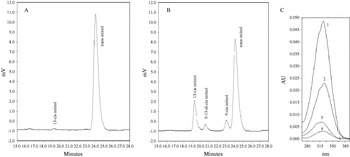
The HPLC chromatograms of 13-cis, retention time (RT): 18·8 min, all-trans retinol, RT: 23·5 min, in raw milk and in a milk sample stored at room temperature are shown in Fig. 1A and 1B, respectively. In raw milk 13-cis retinol is present in small amounts; in milk stored at room temperature its amount increases together with other compounds. These have been tentatively identified as cis retinol isomers, probably 9-13-di-cis, RT: 20·3 min, and 9-cis retinol, RT: 22·7 min, by means of the relative retention times with respect to 13-cis retinol and all-trans retinol, fluorescence behaviour and by comparison of the obtained absorbtion spectra with literature data (Brinkmann et al. Reference Brinkmann, Dehne, Oei, Tiebach and Baltes1995; Duarte-Favaro et al. Reference Duarte-Favaro, Iha and Bianchi2003) (Fig. 1C).
Chromatograms of retinol isomers in (A): raw milk and (B): raw milk sample stored at room temperature. (C) Spectra of all-trans retinol (1) (λmax=325 nm), 13-cis retinol (2) (λmax=328 nm), 9-cis retinol (3) (λmax=322 nm) and 9-13-di-cis retinol (4) (λmax=323 nm).

Literature data and our previous published and unpublished results demonstrated the presence of cis isomers in several milk and dairy products; in particular, raw milk can have different 13-cis/trans retinol isomerization ratio levels, ranging from 0 to 2% (Woollard et al. Reference Woollard and Indyk1986; Holand et al. Reference Holand, Unwin, Buss and Holand1989; Panfili et al. Reference Panfili, Manzi and Pizzoferrato1994, Reference Panfili, Manzi and Pizzoferrato1998). The degree of retinol isomerization was also reported in cheeses ranging from 7 to 68% (Holand et al. Reference Holand, Unwin, Buss and Holand1989; Panfili et al. Reference Panfili, Manzi and Pizzoferrato1994, Reference Panfili, Manzi and Pizzoferrato1998).
Milk is an ideal medium for growth of several microorganisms, which are able to produce intra and extra cellular enzymes, leading eventually to compound degradation.
At 4°C a slight decline in pH has been found after 96 h storage (from 6·72 to 6·52), together with a slight increase in titrable acidity (from 6·0 to 6·4°SH).
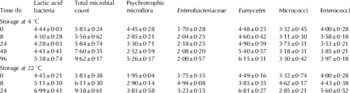
Enterobacteriaceae, Micrococcaceae and Enterococci showed values almost constant during storage, while a remarkable increment of mesophilic microbial count after 24 h storage has been observed. An increment in psychrotrophic microflora, in lactic acid bacteria and in Eumycetes has also been noticed (Table 1).
Microbial counts (log cfu/ml) during storage at 4°C and 22°C

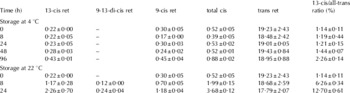
Table 2 shows the evolution of retinol isomers and of 13-cis/all-trans ratio (%), during storage at 4 and 22°C.
Evolution of retinol isomers (μg/100 ml) and the 13-cis/all-trans ratio (%) during storage at 4°C and 22°C

–Not detected
Small amounts of 13-cis (0·22 μg/100 ml) and 9-cis (0·30 μg/100 ml) were observed at the reception of milk. At 96 h storage at 4°C their content increased to 0·43 and 0·45 μg/100 ml, respectively, together with a slight decrement in trans retinol (from 19·23 ml to 18·95 μg/100 ml). Consequently, the 13-cis/all-trans ratio (%) shifts from 1·1 to 2·3% at the end of storage.
When storing milk at 22°C, a more extensive decrease in pH values (from 6·72 to 6·14) and an increase in acidity (from 6·0 to 9·1°SH) occurred at 24 h storage.
A remarkable increase of microbial mesophilic count at 24 h storage was observed. An increment in lactic acid bacteria, psychrotrophic microflora, Enterobacteriaceae, Enterococci and Eumycetes was noticed till the end of storage (Table 1).
During storage a variation of all cis isomers of retinol was observed (Table 2). The 13-cis/all-trans ratio (%), already increased after 8 h storage (>6%), shifted from 1·1 to 12·7% at the end of storage.
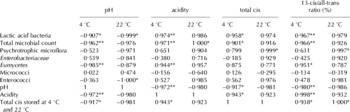
The evolution of the 13-cis/all-trans ratio (%), either at 4 or 22°C, has been correlated with values of microbial counts, pH, acidity and total cis (Table 3). At 4°C a good correlation was observed with the acidity values (P⩽0·01) and with the Total Microbial Count, Lactic acid bacteria (P⩽0·01) and Eumycetes (P⩽0·05). At 22°C, good correlations were found with acidity values and with almost all microbial groups, with the exception of Eumycetes and Micrococci. A negative correlation was observed between the 13-cis/all-trans ratio (%) and pH and trans retinol values at both storage temperatures.
Pearson coefficients of correlation between the microbial counts, pH, acidity, total cis and 13-cis/all-trans ratio (%) in raw milk samples stored at 4°C and 22°C

* 95% confidence level; ** 99% confidence level
It is worth noting that these data, although showing a close correlation with the microbial growth, have been obtained on a mixed population, in which microorganisms could interact, leading to different growth and metabolic conditions.
In order to better understand the bacterial effect on retinol isomerization and to identify the contribution of the single microbial groups, different microorganisms were separately inoculated in a commercial pasteurized milk sample and the evolution of retinol isomers, together with microbial growth, pH and acidity values, was monitored during time (2, 4, 6, 8 h).
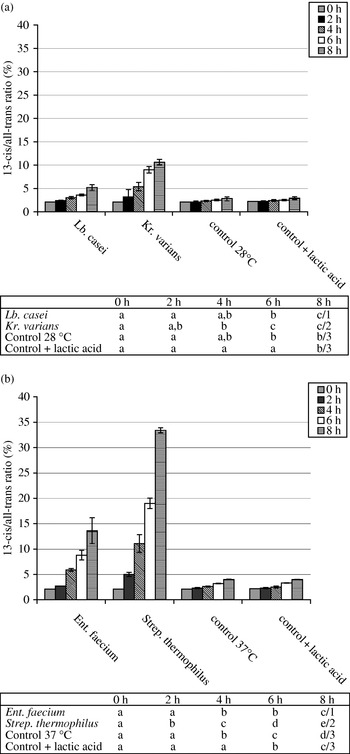
Among different microorganisms those tested in this experimentation were Strep. thermophilus S1, Lb. casei DSM 20011 and Ent. faecium DSM 20477 whose groups (Lactic acid bacteria, Enterococci) have been proved to show a good correlation with the degree of retinol isomerization. We included in the analysis also Kr. varians AL12 (Micrococci), which, in raw milk, at both storage temperatures, had no correlation with 13-cis/trans isomerization. The contributions of the single microbial groups on retinol isomerization are shown in Fig. 2a & b.
Evolution of 13-cis/all-trans ratio (%) due to different microorganisms at (a) 28°C and (b) at 37°C.
Values within the same row with a different letter are significantly different (P<0·05) in the degree of retinol isomerization during time. The presence of different numbers within column at 8 hours indicates a significant difference between samples (P<0·05)

Lb. casei, after 8 h, showed a viable count of about 6 log cfu/ml, together with an increase in acidity (from 5·75 to 8·50°SH). It was the strain showing the lowest isomerization ability (Fig. 2a). Ent. faecium, viable count after 8 h of 6·3 log cfu/ml and acidity increment from 5·75 to 8·00°SH, caused a significant (P<0·05) 13-cis/trans retinol isomerization (Fig. 2b).The most active in causing retinol isomerization was Strep. thermophilus (viable count after 8 h of 6·8 log cfu/ml and acidity increase from 6·50 to 22·2°SH), with the 13-cis/all-trans ratio (%), shifting significantly (P<0·05) (Fig. 2b). Contrarily to what expected, also Kr. varians (Micrococci), whose growth trend was lower than the others (5·3 log cfu/ml at the end of storage), determined significant (P<0·05) increments in the 13-cis/all-trans ratio (%) (Fig. 2a).
Loss in total retinol content was observed during time (data not shown). This is probably due to the further degradation or conversion of cis-isomers into other forms not detectable with the used analytical procedure.
At 8 h storage, the 13-cis/all-trans ratio (%) differed significantly (P<0·05) between all inoculated samples and controls, in which a slight increase in the isomerization ratio occurred, probably due to the residual microflora of pasteurized milk.
Variations in retinol isomers were not found in control samples with added lactic acid, thus excluding, in our conditions, any influence of acidity in causing decline in vitamin A activity. This data was also confirmed by results obtained with Ent. faecium, which causes retinol isomerization, without affecting acidity values (from 5·75 to 6·00°SH).
These findings demonstrate, in our condition, the predominant effect of added microorganisms over other physical/chemical factors and their different isomerisation ability.
The determination of the retinol isomers is of importance not only for a more precise evaluation of vitamin A activity but also for the contribution to the knowledge of the different phenomena developing during the processing and storage of foods.
The retinol isomerization ratio could therefore be used not only as an index of the heating process, but, after a deeper investigation of the associated biological mechanisms, also as an index for the evaluation of the microbial quality of milk.
In order to find the presence of specific biological factors that cause retinol isomerization (i.e.: specific enzymes, metabolic pathways) and their biological significance, further studies are in progress, so as to improve the knowledge of a topic not yet investigated.