By most accounts, the introduction of glass trade beads in Alaska began in AD 1741 when Vitus Bering made initial contact with Native peoples in southern Alaska (Bundy et al. Reference Bundy, McCartney and Veltre2003; Francis Reference Francis, Fitzhugh and Chaussonnet1994; Grover Reference Grover2016; unless otherwise noted, all dates in this report are AD). Technically, that event ended Alaska's prehistoric period, and although Russian traders were active in southern Alaska for the next 125 years, their direct influence in the Arctic (i.e., north of the Arctic Circle) was slight (Ray Reference Ray1975:129). In essence, arctic Alaska remained prehistoric for another century. Certain Russian trade materials—including tobacco, metal, and beads—did trickle north into arctic Alaska during the last half of the eighteenth century, although it is likely that some exotic goods may have come directly from Siberia via Bering Strait–native trade rather than the Russians (Grover Reference Grover2016; Spencer Reference Spencer1959:378). Although the majority of the beads traded in Alaska by the Russians were drawn beads manufactured in Europe or Russia, some beads produced in China known loosely today as “Padre” (Blair et al. Reference Blair, Pendleton and Francis2009:82) or “Cook” beads (Bundy et al. Reference Bundy, McCartney and Veltre2003; Crowell Reference Crowell1997; Grover Reference Grover2016) were also traded (Crowell et al. Reference Crowell, Yesner, Eagle and Hanson2008; Dumond and VanStone Reference Dumond and VanStone1995). The Chinese beads were manufactured by a procedure called “winding” (Francis Reference Francis1986:36), a distinctly different manufacturing technique than that used to make the drawn beads discussed in this report (see Bead section). Although some examples of the Chinese beads can be somewhat similar in color and size to the beads discussed here, they are easily distinguishable from them because of their manufacturing hallmarks.
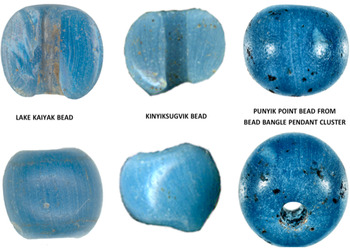
Most of the non-native trade materials found in arctic Alaskan Native sites are connected with the commercial whaling era, which began about 1850 and ushered in a period when Natives of arctic Alaska were exposed to sustained Euro-American presence, trade goods, and culture (Bockstoce Reference Bockstoce1986:180–204; Ray Reference Ray1975:124; Spencer Reference Spencer1959:378). As a result, most Native sites in arctic Alaska that contain non-native materials date to the later commercial whaling period rather than the earlier Russian activity (Bockstoce Reference Bockstoce1986:180–204; Burch Reference Burch2005:235). Whaling-era sites are hallmarked by items such as musket balls; bullet molds; cartridge cases; pieces of bone, ivory, and antler that have been cut by a metal saw; native-style tools made from salvaged (smelted) metal rather than traditional materials (stone, bone, antler, ivory); and glass beads of the period (Bockstoce Reference Bockstoce1986:180–204, Reference Bockstoce2009:331–332). The glass beads discussed here (Figure 1) are of a variety previously unreported in Alaska. Furthermore, radiocarbon dates associated with these beads show that their presence predates Russian activity by multiple centuries, and Columbus's “discovery” of the New World by decades.
High-resolution images of glass beads from the three sites discussed herein. The images display the diagnostic physical characteristics of the IIa40 glass beads. Two views are shown of each bead. One bead is shown from each site. Images not to scale. Photographs by Lester Ross.

The Beads
The undecorated glass beads recovered from the three arctic Alaskan sites discussed in this report have the following attributes: monochrome turquoise blue (7.5B5/6 Munsell), slightly translucent, short to long, and asymmetrically oblate spheroidal and oblate ovoidal in shape (Figure 1; Ross Reference Ross2005). The beads range in size from 5.0 to 7.5 × 4.0 to 7.4 mm (greatest diameter × length), with cylindrical perforations ranging from 1.4 to 1.8 mm in diameter, and they weigh 0.3–0.5 g each. The glass contains miniscule bubbles that occur in longitudinal lines paralleling the perforation, indicating that the bead is a drawn rather than a wound type (Francis Reference Francis1988; Karklins Reference Karklins2012). The slight S-curve exhibited by some bubble lines is characteristic of beads finished by the a speo process (Ross Reference Ross2005), as is their somewhat irregular shape (Francis Reference Francis1998a; Karklins Reference Karklins1993).
Archaeologists and bead researchers generally regard the bead classification system developed by Kenneth and Martha Kidd (Reference Kidd and Kidd1970) as the standard for historic trade bead identification (Karklins Reference Karklins2016). The arctic beads fall within the parameters of their IIa40 variety, and they have been ascertained as such by archaeologists experienced with their identification (Ross Reference Ross2005). IIa40 beads are most commonly found in New World contexts dating from approximately 1550 to 1750 and occasionally extending into the nineteenth century at sites in the Caribbean, Central America, and along the eastern seaboard of North America and the eastern Great Lakes (Bennett Reference Bennett and Hayes1983; Bradley Reference Bradley and Hayes1983; Deagan Reference Deagan1987:156–183; Kenyon and Kenyon Reference Kenyon, Kenyon and Hayes1983; Miller et al. Reference Miller, Pogue, Smolek and Hayes1983; Smith Reference Smith and Hayes1983). Common regional names for the bead include “Early Blue” and “Ichtucknee Plain,” among others.
The Sites
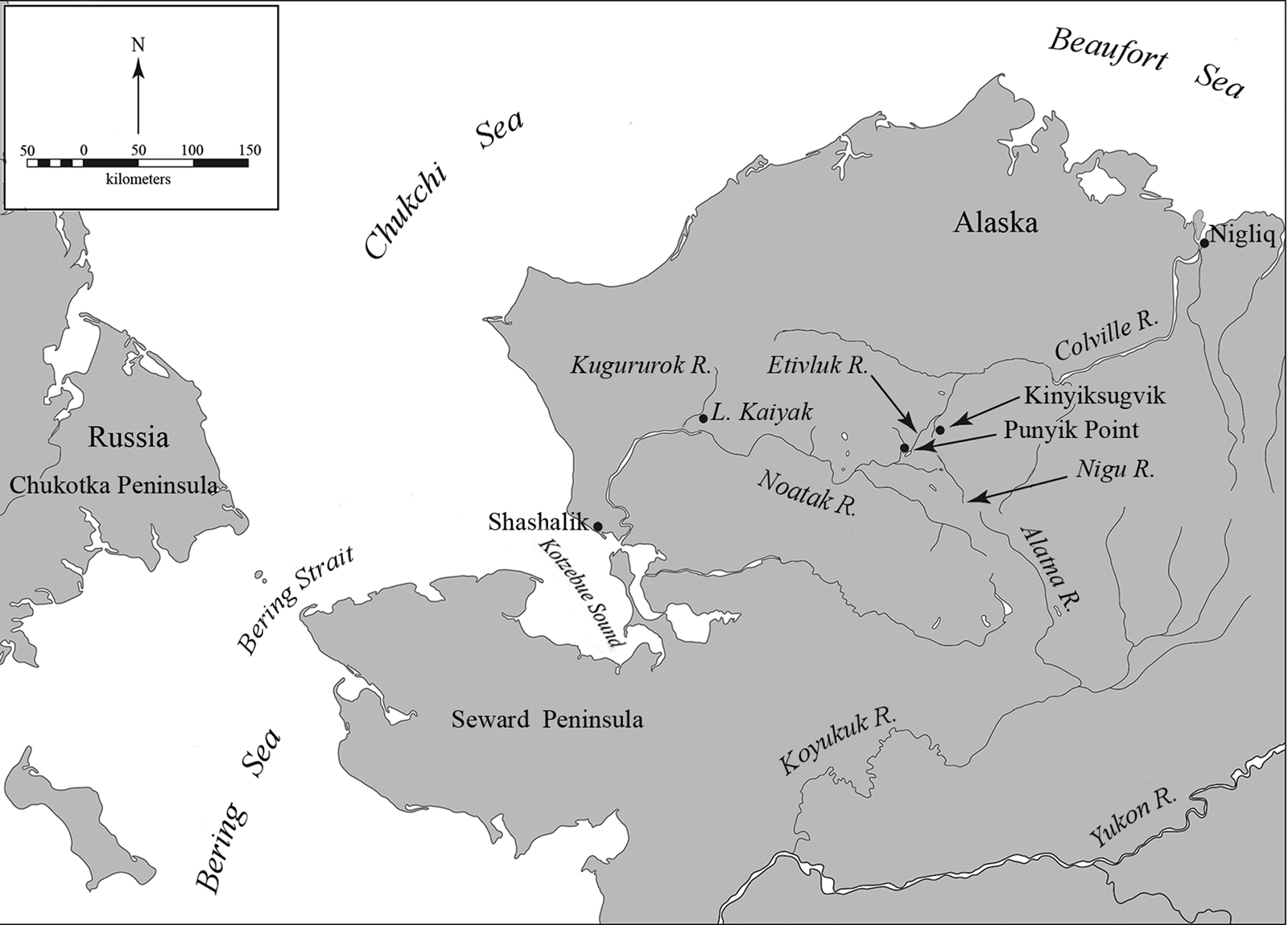
IIa40 glass beads were first discovered in arctic Alaska at the Punyik Point site (49-XHP-00308) by William Irving more than 60 years ago, although he did not identify them as such (Irving Reference Irving1964). The site is located along the north shore of Etivlik Lake at the northern margin of the western Brooks Range (Figure 2). Straddling the Continental Divide, the site lies in tundra 175 km above the Arctic Circle. The most conspicuous aspect of this multicomponent site is the remains of about 45 semi-subterranean houses and cache pits largely attributable to a Late Prehistoric Eskimo occupation (Irving Reference Irving1964).
This map shows the proximity of Alaska to Russia across the 85 km wide Bering Strait, the locations of the three Late Prehistoric Eskimo sites discussed in this report, the trading locales of Sheshalik and Nigliq, and the important river drainages of the region. Sheshalik was a primary trading locale of the people of northwest Alaska and occasionally people to the west across the Bering Strait. The Noatak River drainage was a primary travel route that linked the Kotzebue Sound region to the arctic interior via the Aniuk River and Flora Creek. At Punyik Point this route connected interior Alaska with the arctic coast.

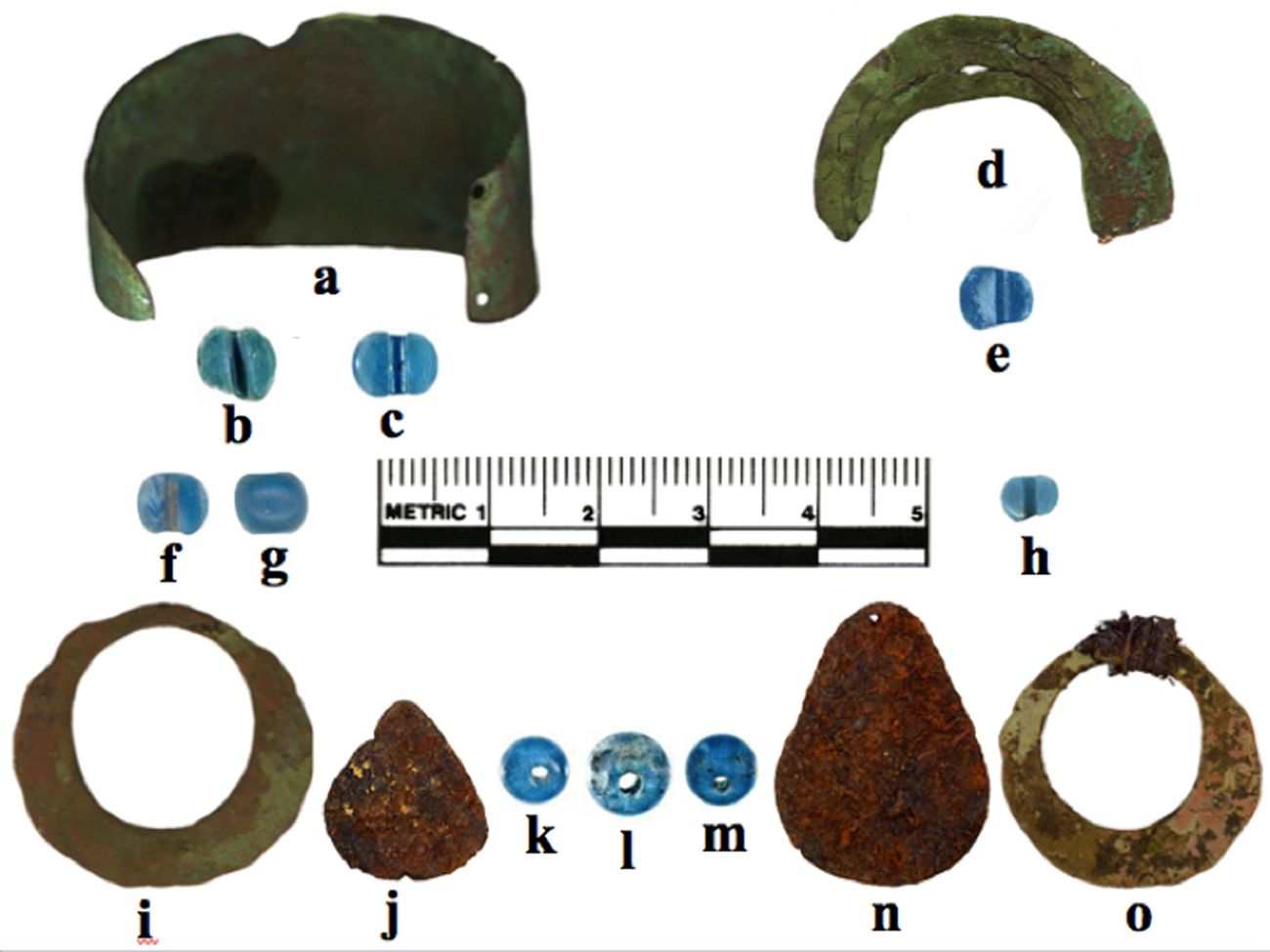
Irving identified five distinct periods of occupation at the site based on artifact typology: the Denbigh Flint Complex; the Norton, Ipiutak, and Late Prehistoric Eskimo cultures; and a historic period occupation postdating 1741. Irving believed the site had been occupied during the historic period because he unearthed four turquoise-blue glass beads (two complete and two halves), a circular copper bangle, and a copper bracelet, all of which he mistakenly assumed were of Euro-American origin (Irving Reference Irving1964; Figure 3).
IIa40 glass beads and associated objects recovered from Late Prehistoric Eskimo sites in arctic Alaska: (a) copper bracelet and (b–c) split glass beads recovered from the interior of two semi-subterranean houses excavated by William Irving at Punyik Point in 1961; (d) bangle fragment and (e) split glass bead recovered from the interior of semi-subterranean house H11 excavated by the authors at Punyik Point in 2005; (f–g) the matching halves of a single glass bead, each half recovered from semi-subterranean Houses 1 and 2 at Lake Kaiyak by Gilbert-Young in 1996; (h) half glass bead excavated by the authors at Kinyiksugvik in 2007; (i, o) copper bangles, (j, n) iron pendants, and (k–m) glass beads excavated by the authors at Punyik Point in 2004. Objects (i–o) are the components of an item of personal adornment (necklace or bracelet) recovered together in a 5 cm cluster in an open area of the site and not associated with any cultural feature. Not pictured are two complete glass beads excavated by Irving in 1954 and 1961 from mixed deposits in two semi-subterranean houses. The present location of those beads is unknown. Beads (b), (c), and (e) from Punyik Point; (f) and (g) from Lake Kaiyak; and (h) from Kinyiksugvik may have been split so that they could be mounted in a lip ornament known as a “labret.” All beads are Kidd and Kidd's (Reference Kidd and Kidd1970) IIa40 variety. Photographs by Lester Ross, Charles Adkins.

The next reported occurrence of IIa40 beads in the region was at another Late Prehistoric Eskimo site at Lake Kaiyak (49-MIS-00032) by Gilbert-Young (Reference Gilbert-Young2004), located 176 km above the Arctic Circle and 222 km west of Punyik Point (Figure 2). The site consists of eight semi-subterranean house pits and four cache pits. Houses 1 and 2 had been vandalized around 1995, and during the 1996 salvage excavations of the undisturbed portions of the houses, two halves of a single IIa40 bead (one half from each house) were recovered (Gilbert-Young Reference Gilbert-Young2004). Neither house was radiocarbon dated at the time of excavation, but both were thought to date to 1578–1760 based on artifact typology. The half beads were originally misidentified as halves of a wound Chinese bead, but they were later correctly identified as the IIa40 variety by Ross (Reference Ross2005). The bead halves, which refit into one bead, were the only artifacts made by non-Natives that were recovered from the houses. They were interpreted as demonstrating the contemporaneity of the two houses and dated them to the historic period (Gilbert-Young Reference Gilbert-Young2004).
In 2004 and 2005, the authors conducted an assessment of the Punyik Point site to determine if it had been degraded during the decades following Irving's work and to collect additional archaeological data. Using accelerator mass spectrometry (AMS) radiocarbon dating, we corroborated Irving's four periods of prehistoric occupation, but we found no Native occupation dating to the historic period (Kunz Reference Kunz2005).
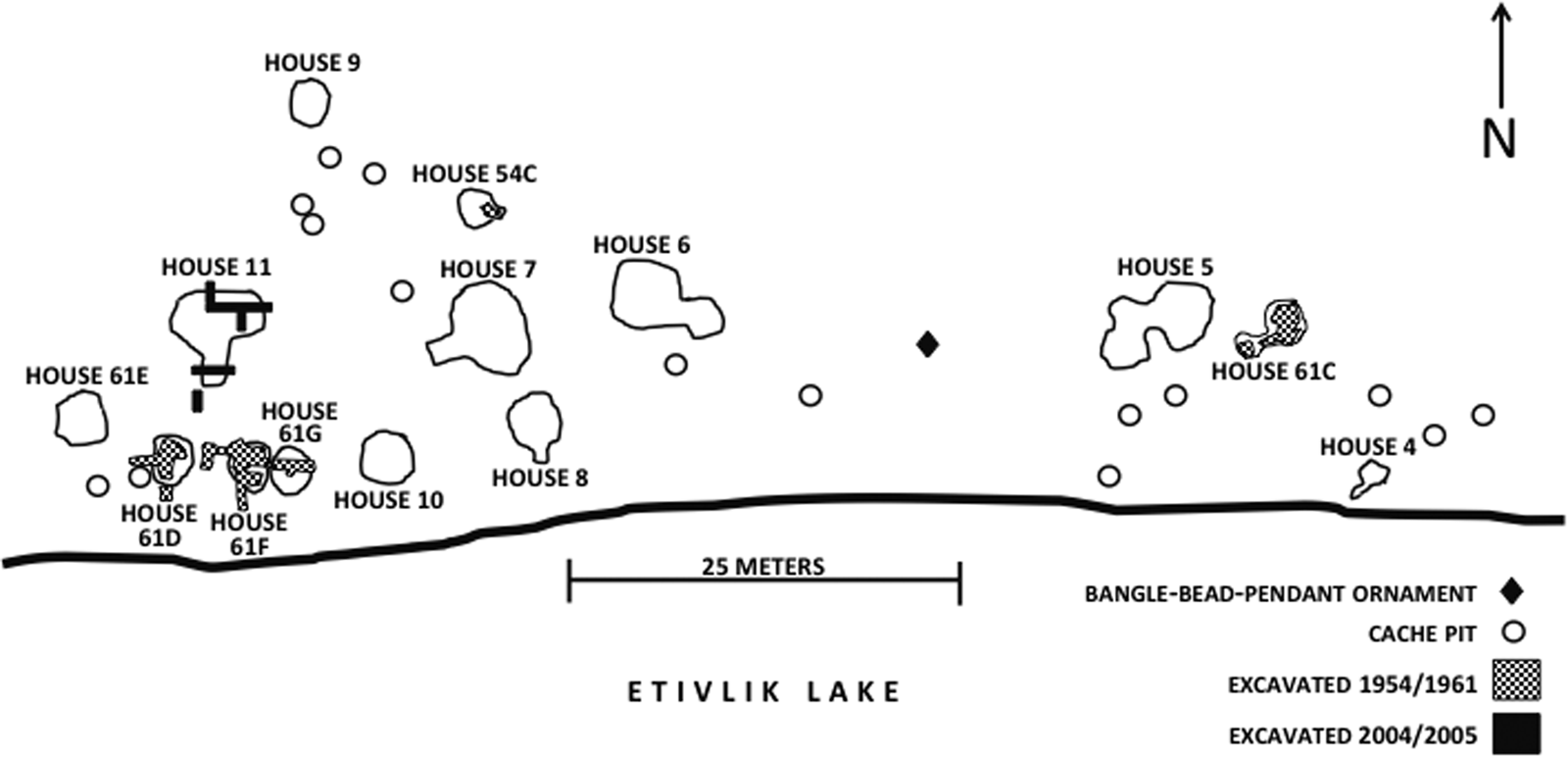
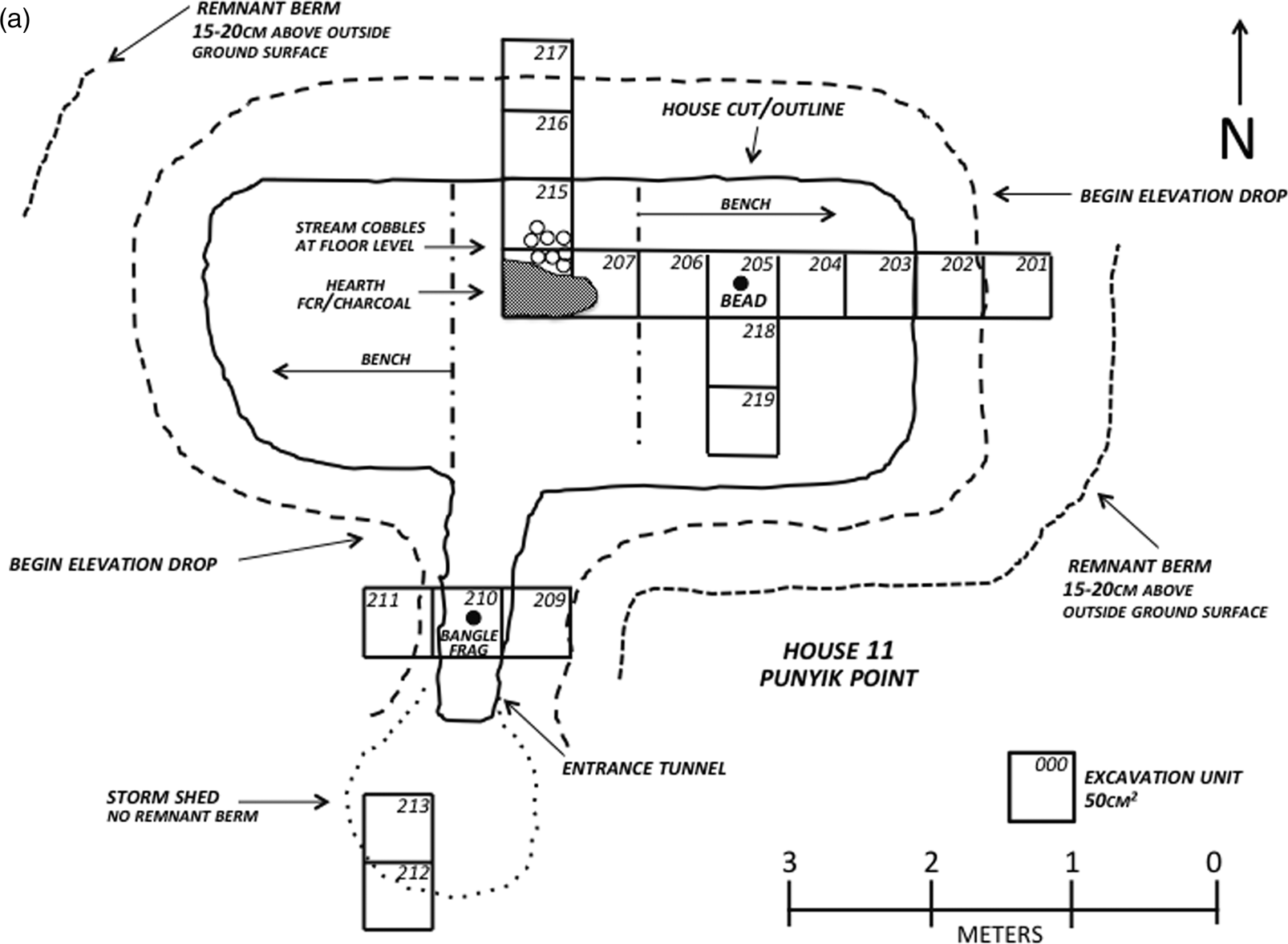
Because of the known presence of metal objects at the site, we conducted a metal-detector survey during our reinvestigation. The survey revealed the presence of 86 metallic objects at scattered locations across the site, 79 of which were quite modern items incorporated in the surface vegetation mat (e.g., tin cans, silverware, spikes, and cartridge cases). These latter items can be attributed to Irving's excavation crews and/or modern-era hunters. Beneath the 8 cm thick surface vegetation mat, at a depth of 2–4 cm below the surface of the soil profile, four other metal occurrences were recorded: (1) a copper bracelet, (2) a copper bangle fragment, (3) a piece of scrap copper, and (4) a discrete 5 cm diameter cluster of eight artifacts (Figure 3). This cluster contained two circular copper bangles; the twine wrapped around one of the copper bangles; two thin, flat, teardrop-shaped pendants of iron; and three IIa40 beads (Figure 3i–o). The proximity of these eight objects to one another—all of them small, perforated objects that can be strung together—suggests that they were components of a single article of personal adornment, probably a necklace or bracelet. The lone bangle fragment was associated with semi-subterranean House 11, whereas the other items, including the cluster of eight artifacts, were found in open areas of the site between cultural features (Figure 4). Additionally, the excavation of House 11 produced half of a IIa40 bead (Figure 3e). A total of eight beads have been recovered from the site, four by Irving (two complete and two halves) and four by the authors (three complete and one half).
Map of the central portion of the Punyik Point site showing both the open area where the bangle/bead/pendant artifact was recovered by metal detector survey and the location of House 11 where a bangle fragment and a bead were recovered through excavation.

In 2007, the authors conducted archaeological excavations at a site at the southwestern end of Kinyiksugvik Lake in the Nigu River valley, 20 km north of Punyik Point. The Kinyiksugvik site (49-XHP-00115) lies on a hillside above the lake, and it contains 28 semi-subterranean houses and 41 cache pits (Davis et al. Reference Davis, Linck, Schoenberg and Shields1981:375–395). Our excavations revealed both prehistoric and contact period occupations that were originally differentiated by artifacts and later corroborated by AMS radiocarbon assays. One half of a IIa40 bead was recovered during excavation (Figure 3h).
All three of these sites have archaeological components related to Late Prehistoric Eskimo, and they occur along a generalized travel route crossing arctic Alaska (Burch Reference Burch1975, Reference Burch1976, Reference Burch2005:116; Figure 2). The route follows the drainages of the Noatak, Nigu, Etivluk, and Colville Rivers, along which the sites discussed are found. This route connects the trading center of Sheshalik near the mouth of the Noatak River and Bering Strait with the trading center of Nigliq, at the mouth of the Colville on the Beaufort Sea coast, which is 1,287 km overland to the northeast (Burch Reference Burch1975, Reference Burch1976, Reference Burch2005:180–195; Grover Reference Grover2016; Figure 2). Sheshalik was the scene of an important trade fair, and it drew Native groups from both sides of the 85 km wide Bering Strait (Burch Reference Burch2005:180–195; Giddings and Anderson Reference Giddings and Anderson1986:35–37; Grover Reference Grover2016). Consequently, it was a port of entry for goods from northeast Asia (Bockstoce Reference Bockstoce2009; Cooper et al. Reference Cooper, Mason, Mair, Hoffecker and Speakman2016; McCartney Reference McCartney, Shaw, Harritt and Dumond1988). Although a few non-Native items have been recovered from prehistoric sites in the region, they are—almost without exception—metal, and their presence is singular and scattered (Cooper et al. Reference Cooper, Mason, Mair, Hoffecker and Speakman2016; Mason Reference Mason1998), a situation dissimilar to that of the IIa40 beads discussed here. Given these circumstances and the uniqueness of the beads (i.e., no other occurrence of IIa40 beads within thousands of kilometers), we think it more than likely, if not probable, that the 10 beads recovered from the three sites arrived at Sheshalik as part of a group and then dispersed from there. Besides being on the Sheshalik-Nigliq route, Punyik Point and Kinyiksugvik also lie on the Nigu, Alatna, Koyukuk, and Yukon Rivers route that connects the study area with interior Alaska (Burch Reference Burch1975, Reference Burch1976).
A Brief History of Italian Bead Manufacture
European glassmaking originated in Venice around 700 (Francis Reference Francis1998a). By at least the early eleventh century, Venetian glassmakers were organized into a guild (Francis Reference Francis1998a, Reference Francis2008). At the same time, Venetian trade was expanding, and by the thirteenth century, it was trading deeply into the Asian continent (Bergreen Reference Bergreen2007:27). By the last decades of the fourteenth century, Venice had dominated regional glass manufacturing (Blair et al. Reference Blair, Pendleton and Francis2009:56; Francis Reference Francis1998a) and established solid trading relationships throughout Asia (Bergreen Reference Bergreen2007:27). In 1291, all glass production was moved from central Venice to the island of Murano as a fire safety precaution but also to allow tighter governmental control over an increasingly profitable industry (Blair et al. Reference Blair, Pendleton and Francis2009:56; Francis Reference Francis1998a).
The first record of Venetian glass beads occurs in 1268 (Gasparetto Reference Gasparetto1958:182), and a reference to the use of Venetian glass beads in embroidery follows in 1296 (Francis Reference Francis1998a). This may suggest that the manufacture of embroidery beads (i.e., typically beads less than ca. 4 mm in diameter) may have been occurring by that time, although beads larger than 4 mm are also used for that purpose (Francis Reference Francis1988; Karklins Reference Karklins2012). Twelve years later, in 1308, the Margariteri bead-makers guild was established (Blair et al. Reference Blair, Pendleton and Francis2009:56; Francis Reference Francis1998a), indicating that beadmaking had become important enough to warrant regulation.
Margariteri guild beads were made initially by the furnace-winding method (Francis Reference Francis1988, Reference Francis2008). Furnace-wound beads were made by dipping an iron rod (mandrel) into molten glass in a furnace and twisting it until a bead was built up (Blair et al. Reference Blair, Pendleton and Francis2009:56–57; Francis Reference Francis1988). The rod creates the bead's perforation, and coating applied to the rod's surface, like kaolin, allows the bead to be easily struck off (Francis Reference Francis1988). Beads of this type tend to be large and imperfect with large perforation diameters (Francis Reference Francis1988). Winding causes any inclusions in the glass—such as striations, swirls or bubbles—to align at 90° to the perforation, which is an identifying hallmark of this bead type (Francis Reference Francis1988; Karklins Reference Karklins2012). By the last third of the fifteenth century, the Margariteri stopped making furnace-wound beads and adopted or developed the tube-drawing method of bead manufacture (Blair et al. Reference Blair, Pendleton and Francis2009:56–57; Francis Reference Francis1988). In 1486, a second glass bead-making guild, the Paternostri, was established (Blair et al. Reference Blair, Pendleton and Francis2009:56; Francis Reference Francis1998a).
Drawn beads are made from a glass tube sometimes referred to as a “cane” (we will use the term “tube” exclusively because “cane” can also refer to the drawn, solid-glass rods used in bead decoration and the production of lamp-wound beads [Francis Reference Francis1988]). Initially, researchers thought that drawing a tube was started by blowing a bubble in a glass gather (Kidd and Kidd Reference Kidd and Kidd1970). Subsequent study, however, has shown that this is likely not the case (Blair et al. Reference Blair, Pendleton and Francis2009:55). To make the tube, a gather of molten glass was shaped into a stubby, thick-walled cylinder on the end of an iron called a “pontil.” A smaller gather of cooler glass on a flat-ended post was melded with the cylinder. Two people—one holding the iron, the other holding the post—walked rapidly away from each other, drawing the glass out to form a tube of the desired diameter (hence the term “drawn bead”). Simultaneously, other workers fanned the tube until it was cool enough to be laid across a wooden support framework. The tube was then cut into sized segments that would become beads (Blair et al. Reference Blair, Pendleton and Francis2009:55; Francis Reference Francis1998a; Karklins Reference Karklins1993; Kidd and Kidd Reference Kidd and Kidd1970). It is not known which guild invented tube drawing (Blair et al. Reference Blair, Pendleton and Francis2009:55; Francis Reference Francis2008), but history and circumstances strongly suggest that it was the Margariteri because they had been making glass beads for more than 150 years before the formation of the Paternostri guild in 1486.
The final drawn-bead production step is a reheating process that smooths the uneven ends of the tube segments. There are two procedures for doing this, and which procedure is used depends on the size of the bead being finished. Beads smaller than approximately 4 mm in diameter (seed beads) were placed in a heated iron pan and stirred to smooth the rough edges. This process was termed a ferrazza (“on the pan”; Blair et al. Reference Blair, Pendleton and Francis2009:65; Francis Reference Francis1998a). Beads larger than roughly 4 mm in diameter could be finished by either painstakingly grinding the ends of each tube segment or placing multiple segments on the tines of a circular tool that was inserted into a furnace and rotated, thereby heating and smoothing out the rough ends and making the segment more spherical. This process was termed a speo (“on the spit”; Blair et al. Reference Blair, Pendleton and Francis2009:53; Francis Reference Francis1988; Karklins Reference Karklins1993).
If the Margariteri developed tube drawing and the a ferrazza and a speo finishing procedures, as seems likely, then they were the makers of all sizes of drawn beads prior to approximately 1486. This suggests that the Paternostri emerged as an offshoot of the Margariteri, with the primary distinction between the two bead-making guilds being the size of the beads they produced: the Margariteri making beads generally smaller than 4 mm in diameter and finishing them by a ferrazza, and the Paternostri making beads larger than 4 mm in diameter and finishing them by a speo (Blair et al. Reference Blair, Pendleton and Francis2009:56–57; Francis Reference Francis1988, Reference Francis2008).
The development of tube drawing, as well as a ferrazza and a speo finishing procedures, allowed for the profitable mass production of beads. Despite Venetian attempts to maintain its monopoly, bead manufacturing had spread to other European cities by at least the last decade of the sixteenth century (Blair et al. Reference Blair, Pendleton and Francis2009:56; Francis Reference Francis1998a). As guild trade secrets were ferociously guarded, the history and development of these methods is currently unclear. The only hard facts we have are the years when the Margariteri (1308) and Paternostri (1486) guilds were established, but how long tube drawing existed and how long a ferrazza and a speo finished drawn beads were made prior to approximately 1486 is unknown.
It is expected that some time lag would occur between bead development, successful production, and subsequent guild establishment. But how long? Francis (Reference Francis1998b, Reference Francis2008) offers a clue, pointing out that the man most likely responsible for the development of tube drawing died in 1460, implying a development period for that technique of at least 25 years. The lag time for the formation of a guild to engage in and govern that production is demonstrated by the time lapse of as much as 40 years between the initial observation/production of glass beads in Venice in 1268 (Gasparetto Reference Gasparetto1958:182) and the formation of the Margariteri glass bead-makers’ guild in 1308 (Blair et al. Reference Blair, Pendleton and Francis2009:56; Francis Reference Francis1998a). Finally, if the Margariteri were the inventers of the drawn-bead manufacturing procedures, which seems likely, then it is quite possible that IIa40 beads, which Francis (Reference Francis1988, Reference Francis2008) states is one of the earliest drawn-bead varieties, could have been manufactured and dispersed decades prior to 1486.
Artifact Analysis
Instrumental neutron activation analysis (INAA) is used to quantify the relative amounts of chemical elements in a material (Eby Reference Eby2017). This is accomplished by bombarding the sample with neutrons, causing each elemental component to become a radioactive nuclide. As the radioactivity of the nuclides decay, they emit gamma rays whose energies are unique to each element present. The energy emitted by the decay process is proportional to the element's atomic number, thereby allowing elemental identification. Samples of glass from the same manufacturing source made at the same time will display the same general “elemental fingerprint.” Variations beyond a minor degree would indicate different geographical and/or temporal origins.
In the early 1990s, INAA was used to analyze IIa40 beads from sites in the eastern Great Lakes region (Hancock et al. Reference Hancock, Chafe and Kenyon1994). The beads were determined to be from three time periods based on associated artifacts: Period I (1580–1600), Period II (1600–1620), and Period III (1620–1650). A subsequent study of beads from the same region extended the temporal range of the IIa40 beads (Kenyon et al. Reference Kenyon, Hancock and Aufreiter1995). The beads from both studies were analyzed for the presence of 11 elements. Bead element profiles from sites of the same approximate age were compared to see if there was continuity among the element profiles. Although there was appreciable overlap in many of the elements, it was statistically determined that there was enough differentiation in certain key elements (e.g., Ca, Na, Cl, Cu) through time to establish chronological groupings (Hancock et al. Reference Hancock, Chafe and Kenyon1994:Tables 2 and 4; Kenyon et al. Reference Kenyon, Hancock and Aufreiter1995:Tables 1 and 2). To be clear, these studies used INAA to determine chronological groupings, but unfortunately not geographical origins.
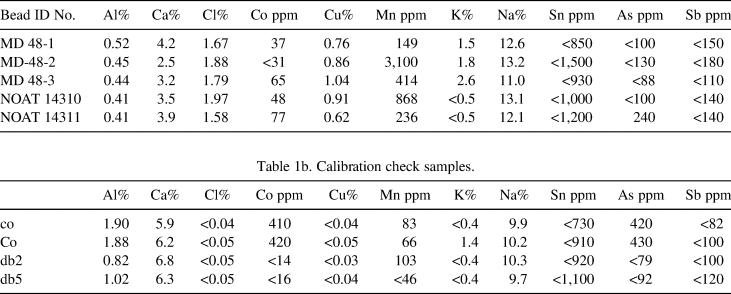
In 2005, Ron Hancock conducted INAA on five of the Punyik Point beads, including all three from the pendant/bangle/bead cluster, and two beads from William Irving's earlier excavations (Table 1; Hancock Reference Hancock2005). When compared to the earlier INAA studies’ elemental profiles, in particular to their key elements’ ratios (Hancock et al. Reference Hancock, Chafe and Kenyon1994:Figures 2–4; Kenyon et al. Reference Kenyon, Hancock and Aufreiter1995:Figures 2–4), the data show that the Alaskan beads are made of soda glass, typical of fifteenth-century Venetian and later European manufacture (Blair et al. Reference Blair, Pendleton and Francis2009:71, 76–77; Francis Reference Francis1988), and they are unequivocally of the IIa40 variety. Their elemental profiles, however, overlap broadly with all of Hancock and colleagues’ (Reference Hancock, Chafe and Kenyon1994) time periods, not aligning specifically with any of the chronological groupings. In effect, the Alaskan INAA data are not currently useful in assessing the beads for chronological purposes.
Punyik Point IIa40 Glass Bead Samples Analyzed by Instrumental Neutron Activation Analysis (INAA) at the McMaster Nuclear Reactor in Hamilton, Ontario, Canada.

The copper bangles and iron pendants associated with the Punyik Point beads (Figure 3) were analyzed at the University of Alberta Department of Chemical and Materials Engineering (Wayman and Cooper Reference Wayman and Cooper2005). Analysis of the iron pendants showed they are made from smelted iron. Smelted metal attributed to northeast Asia has been recovered in arctic Alaska sites dating as early as the first millennium AD and is the probable source for the pendants (Cooper et al. Reference Cooper, Mason, Mair, Hoffecker and Speakman2016; McCartney Reference McCartney, Shaw, Harritt and Dumond1988). The circular bangles are made from natural/native copper, cold-hammered into shape, and they are certainly of native manufacture (Wayman and Cooper Reference Wayman and Cooper2005). The bangles are fashioned so that the ends overlap to form a complete circle. A length of plant fiber (twine) was wrapped around the overlapping ends of the bangles to draw them tight so that the bangle could be securely strung (Figure 3o). Although Cooper's (Reference Cooper2012:Figure 3) map shows four copper sources within several hundred kilometers of Punyik Point, those sources contain little or no free copper. Significant sources of naturally occurring copper are the Copper River drainage of south-central Alaska, approximately 800 km to the south—the presumed source for most copper in Alaskan Native sites (Cooper Reference Cooper2012)—and the Coppermine River drainage of the Central Canadian Arctic, approximately 1,600 km to the east. Unfortunately, none of these metallic items possesses culturally diagnostic traits, and none can be used to date the associated beads.
Radiocarbon Assays
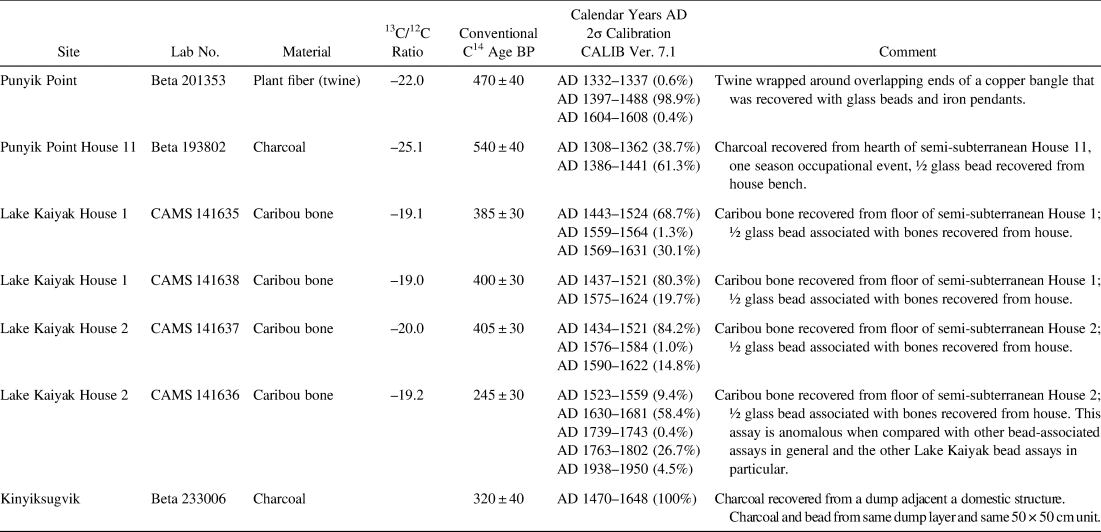
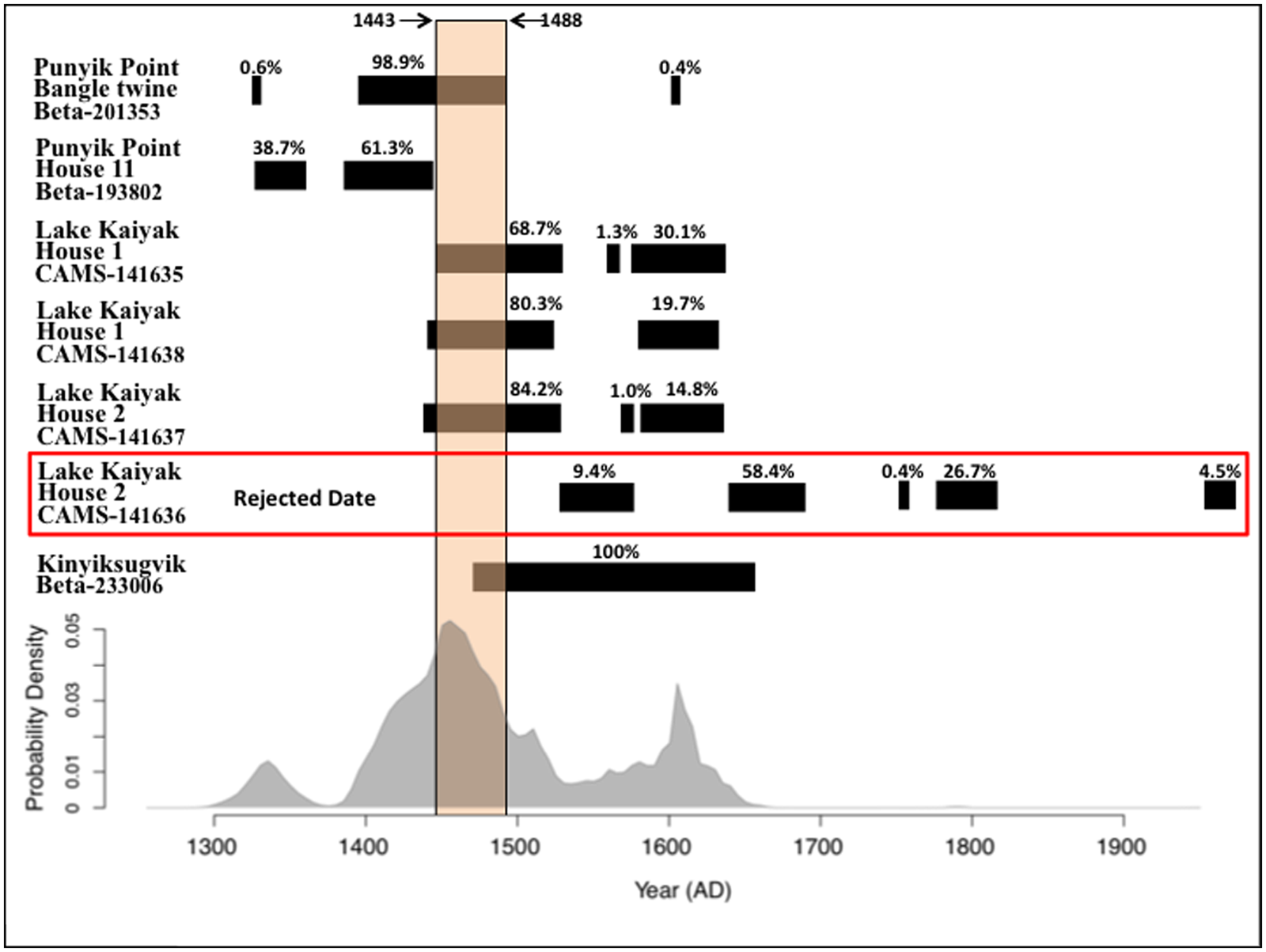
As outlined in previous sections, other potential sources of data (historical documents, INAA, and associated metal artifacts) are unclear or mute relative to helping us date the arrival of the IIa40 beads in arctic Alaska. Consequently, we rely on AMS radiocarbon dating of organic material associated with the beads to date them by proxy, with the exception of the bangle/bead/pendant artifact, which is dated by the vegetal twine that is part of the artifact. Unless otherwise noted, all radiocarbon dates shown here are calibrated utilizing Calib7.1/Intcal13 (Reimer et al. Reference Reimer, Bard, Bayliss, Beck, Blackwell, Ramsey, Buck, Cheng, Edwards, Friedrich, Grootes, Guilderson, Haflidason, Hajdas, Hatté, Heaton, Hogg, Haughen, Kaiser, Kromer, Manning, Niu, Reimer, Richards, Scott, Southon, Staff, Turney and van der Plicht2013; Stuiver et al. Reference Stuiver, Reimer and Reimer2020) and presented at the 2σ (95.4%) level of confidence (Table 2, Figure 5). All of the organic material assayed was associated with one or more IIa40 beads, and calibration created several temporal segments for each assay, except for Kinyiksugvik, which had a single temporal segment. That said, the alignment of the fifteenth-century temporal segments as plotted in Figure 5, overlapping between 1443 and 1488, exhibits the greatest probability for representing the time period during which the beads arrived at the sites.
Sample Data and Results from AMS Radiocarbon Assays of Material Associated with IIa40 Glass Beads Recovered from Three Late Prehistoric Eskimo Sites in Arctic Alaska.

The horizontal black bars plot the distribution of the temporal range (calendar years AD) of each radiocarbon assay associated with the IIa40 beads from the three sites. The tan column highlights the time period where the bangle twine, which is considered to have an indubitable association with the bangle/bead/pendant artifact, and three other assays overlap. It also emphasizes the probability density of the alignment of those dates. Because of the presence of a glass bead in House 11, the authors feel that assay (Beta-193802) may have been made on charcoal from wood a few decades old when it was burned, which is why the date falls slightly outside the overlap period (see text for discussion). The Lake Kaiyak House 2 CAMS-141636 assay is anomalous when compared with the other Lake Kaiyak assays and is dismissed from consideration (see text for discussion).

Of all the dates run, the radiocarbon assay with the opportunity for best accuracy (i.e., degree of correctness for an age, based on certainty of association between the dated material and the behavior or event that the archaeologist is seeking to date in the past) and the best precision (i.e., “the time interval within which a 14C-infered age expression lies” [Taylor and Bar-Yosef Reference Taylor and Bar-Yosef2016:130]) for dating the earliest-known presence of IIa40 beads in arctic Alaska is Beta-201353 (Table 2, Figure 5). This assay was run on thin vegetal twine that had been carefully wrapped around the overlapping ends of a copper bangle (Figure 3o) from the eight-component bead/bangle/pendant cluster at Punyik Point (Figure 4). The wrapping of the twine prevented the bangle from slipping off of the cord of the necklace/bracelet of which it was a part. The twine is a component of the artifact, and its association with the beads is unquestionable. Furthermore, the twine was a short-lived material—possibly one made from the inner bark of a shrub willow (Burch Reference Burch2005:187)—that was likely replaced regularly, so there would be no significant time lag between when the twine plant was photosynthesizing and when it was used to hold the ornament together. More than 98% of this date's 2σ probability falls in the temporal segment spanning cal AD 1397–1488. There is only a 1% probability that the date falls outside of that temporal segment (Table 2, Figure 5).
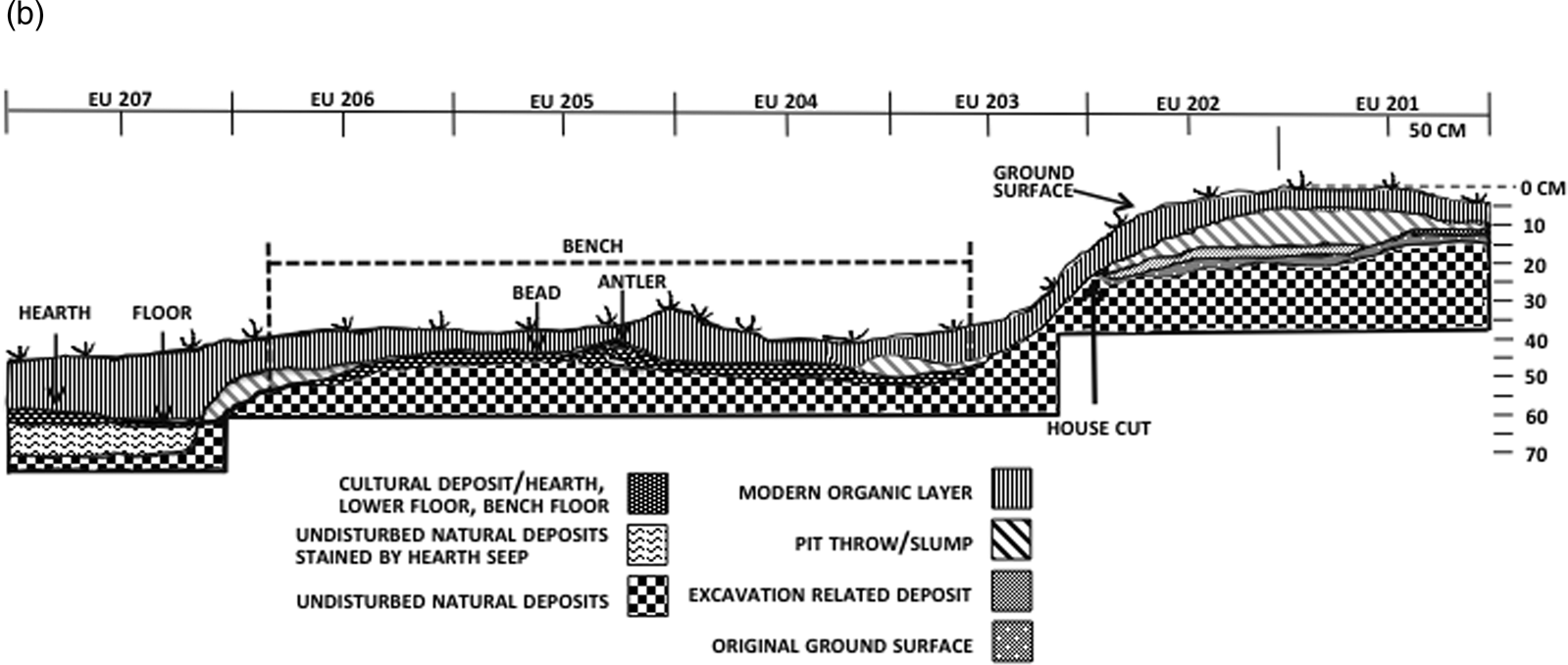
We believe the next most accurate date is from a piece of hearth charcoal from House 11 at Punyik Point (Beta 193802). Unlike many semi-subterranean houses in arctic Alaska—including several at Punyik Point, which have multiple overlapping floor layers and hearth layers indicating several periods of occupation—House 11 has only a single 2–3 cm thick floor/bench layer (in which the IIa40 bead was found) and a single layer of charcoal in the central hearth. This indicates a single period of occupancy—in this case, one winter season (Figure 6a and 6b). There is no stratigraphic evidence or other indication that any bioturbation has occurred within House 11 or that there was any type of subsequent use after the dwelling's abandonment.
Plan view of House 11 at Punyik Point showing the relationship of the bangle fragment and bead to each other, the house features, and the excavation units.

Profile of the north wall of excavation units 201–207 of House 11 at Punyik Point showing the relationship of the bead and the hearth.

The charcoal was not identified to species, but it likely came from surrounding stands of shrub willow (Salix spp.), which is the only locally occurring woody plant that is plentiful enough to have enduring firewood value (Gubser Reference Gubser1965:240). The unlikely alternative is spruce (Picea spp.), the nearest examples of which are approximately 20 km to the south, or alder (Alnus spp.), which occurs sporadically in this region. In addition, we believe the charcoal is willow because the placement of the site at this locality is undoubtedly due to the extensive willow stands that grow there (Binford Reference Binford1980:212–213; Gubser Reference Gubser1965:73, 111–112, 240; Ingstad Reference Ingstad1954:126). We are not aware of any published or unpublished reports of any inland, late-prehistoric winter-habitation locale above latitudinal treeline (68° N) that is not situated in or adjacent to a sizeable stand of shrub willow. Gubser (Reference Gubser1965:240) notes that in some cases, a large early to mid-twentieth-century Nunamiut family, probably equal in size to two late-prehistoric families (Burch Reference Burch2006:89), would burn as much as 50 lb (22.7 kg) of willow in a 24-hour period.
Most of the House 11 assay's probability falls in the cal AD 1386–1441 span, which is several decades earlier than the mean of the overlap of the other bead-related dates (Table 2, Figure 5). As with any wood, shrub willow consists of the carbon that was fixed from the atmosphere during the summer that a particular growth ring was established. Consequently, a radiocarbon age of the wood charcoal may predate the year that it was burned if the assay sample came from wood deep within the shrub's stem, or if the wood was from a shrub that stopped growing some length of time before it was burned. This situation (i.e., “old wood effect”) can overestimate the ages of cultural material associated with charcoal radiocarbon ages. In the case of the House 11 date, research suggests any potential old wood effect would likely be only a few years to decades.
Support for this comes from the dendrochronology of shrub willow sampled from various locations on the North Slope of Alaska that indicates they are rarely more than 60 years old, and often only around 30 years old (Ackerman et al. Reference Ackerman, Griffin, Hobbie and Finlay2017, Reference Ackerman, Griffin, Hobbie, Popham, Jones and Finlay2018; Andreu-Hayle et al. Reference Andreu-Hayle, Gaglioti, Berner, Levesque, Anchukaitis, Goetz and D'Arrigo2020; Tape et al. Reference Tape, Hallinger, Welker and Ruess2012). Given this, a shrub willow whose age was approximately 60 years in 1488 initiated stem growth around 1428, and a willow whose age was 60 years in 1443 initiated stem growth around 1383. It is also worth noting that the innermost (oldest) growth rings of arctic shrub willows comprise a very small portion (volume) of the stem. As such, charcoal from early-growth wood is much less likely to be encountered and/or selected for assay than charcoal from recent-growth stem wood, which is of greater circumference and comprises a much greater volume of the stem. The House 11 date is only a few decades out of alignment with the adornment object bangle twine date and the house dates from Lake Kaiyak (see below). The difference between the oldest calibrated age of the bangle artifact and the oldest calibrated age of the House 11 assay is 47 years, an offset easily attributable to wood several decades dead when burned. Consequently, we believe it very likely that House 11's assayed charcoal came from a stem that had been dead for several decades when it was burned rather than from early-growth stem wood. Regardless, we view the House 11 date as consistent with the other bead-associated dates in Figure 5.
We believe the next most accurate dates are those deriving from Lake Kaiyak. Subsequent to the 1996 excavations at the site (Gilbert-Young Reference Gilbert-Young2004), Houses 1 and 2 were radiocarbon dated as part of another project, with two assays from each house (Shirar Reference Shirar2011). The radiocarbon dates from House 1 (Cams-141635, Cams-141638) and House 2 (Cams-141636, Cams-141637) derive from unmodified caribou bones from the floors of each house (Shirar Reference Shirar2011). Although both beads and faunal remains derived from the same houses, and no evidence of bioturbation was reported by Gilbert-Young (Reference Gilbert-Young2004), the direct association between deposition of the beads and the deposition of the faunal remains is less secure than the hearth charcoal and twine dates from Punyik Point. Stratigraphic evidence (Gilbert-Young Reference Gilbert-Young2004:25) and the fact that the bead halves found in each house refit to form a single bead clearly demonstrate that the two houses were occupied at the same time. Both dates from Lake Kaiyak House 1 are essentially the same, ranging from cal AD 1437 to 1631, with the greatest probability falling between cal AD 1437 and 1524 (Table 2, Figure 5). Although one of the House 2 assays (Cams-141637) produced a nearly identical date to those from House 1, the other House 2 date (Cams-141636) intercepts the calibration curve at five places between the early sixteenth and mid-twentieth centuries, and it is clearly suspect. Although the faunal remains from the site indicate a single fall-winter occupation, which is reinforced by the artifact assemblage (Gilbert-Young Reference Gilbert-Young2004), it is not impossible that the aberrant date is (1) the result of later temporary reuse of this house, (2) a subsequent dumping episode, (3) is simply anomalous, or (4) was somehow contaminated in the 13–14 years of museum storage between excavation and radiocarbon assay.
The last date to consider comes from Kinyiksugvik (Beta-233006), and we feel it is the least secure for accurately dating the presence of the IIa40 bead at the site. The half bead from this site was not found in situ. Instead, it was found during water-screening of troweled soil from what is interpreted as a midden or dump area adjacent to a dwelling. An assay on willow charcoal from the excavation unit and level from which the bead was recovered returned a single date range of cal AD 1470–1648. The stratigraphy in this area was shallow and complex, likely illustrating multiple dumping episodes over an unknown length of time. The fact that the bead was recovered from a dump likely explains the temporal offset between this date and the other dates discussed above (Table 2, Figure 5), given that such deposits are often subject to animal bioturbation. Similarly, the object might have been curated longer and lost at a later time period than the beads at the other sites—a scenario known as the “heirloom effect” (Adams Reference Adams2003:49). In short, although the dated piece of charcoal and the bead were both found in close proximity (i.e., from the same excavated layer within a 50 cm2 excavation unit), the security of association between the two is considered “low” (Taylor and Bar-Yosef Reference Taylor and Bar-Yosef2016:130), and the likelihood of the dated material to correctly represent the timing of any one dumping episode (i.e., accuracy) should be viewed accordingly.
Conclusion
The AMS radiocarbon assays with the highest accuracy, as far as can be ascertained based on security of association, and precision for dating the earliest-known presence of IIa40 beads in arctic Alaska are (1) the one associated with the bead/bangle/pendant cluster at Punyik Point (Beta 201353) and (2) the one associated with House 11 (Beta 193802) at Punyik Point (Table 2, Figure 5). Taking into account the approximately 60-year limit on willow ages and/or possible “old wood effect” with the House 11 date, we conservatively date the beads at Punyik Point to the age range provided by the twine date from the bead cluster: 1397–1488. Discounting the aberrant date from Lake Kaiyak House 2 (Cams-141636), as well as the low accuracy of the Kinyiksugvik date, the remaining bead-associated AMS dates overlap comfortably in the 1443–1488 timeframe (Table 2, Figure 5). Although it is possible for the actual date of any 14C assay to fall anywhere within the temporal segments generated by its calibration, the highest probability is accorded to the largest temporal span. Taken together, the probability density of the assays indicates the arrival of the beads in Alaska between approximately 1443 and 1488 (see bottom of Figure 5).
Although the manufacturing history of IIa40 glass beads is somewhat obscure, the chronology developed from the radiocarbon assays from the three arctic sites supports an arrival of the beads in the decades prior to the formation of the Paternostri guild in 1486. Francis (Reference Francis1988) states that drawn seed beads were being made at least by 1490 and probably earlier by the Margariteri. By general consensus, most bead researchers agree that any drawn bead produced in fifteenth-century Europe was made in Venice (Blair et al. Reference Blair, Pendleton and Francis2009:71, 76–77). Although Francis (Reference Francis1988) states that IIa40 beads made by the Paternostri were among the earliest of the larger drawn beads to be produced, a conundrum arises in the fact that the first physical evidence of their production in Europe is around 1590 in the Netherlands, over 100 years after the founding of the Paternostri guild (Francis Reference Francis1988). The fact that IIa40 trade beads are present in some Central and North American sites by at least 1550, and probably earlier, refutes the European evidence, which probably reflects a lack of current historical research rather than a terminus a quo for the bead variety. Given these circumstances—the time lag between bead development and production, and the radiocarbon dates of the arctic Alaska beads—there should be little doubt that some manner of production of IIa40 beads was occurring in Venice prior to the founding of the Paternostri guild. As such, this not only indicates an earlier production of drawn-glass beads finished by the a speo process than is currently accepted, but it also establishes their availability and distribution well before 1486.
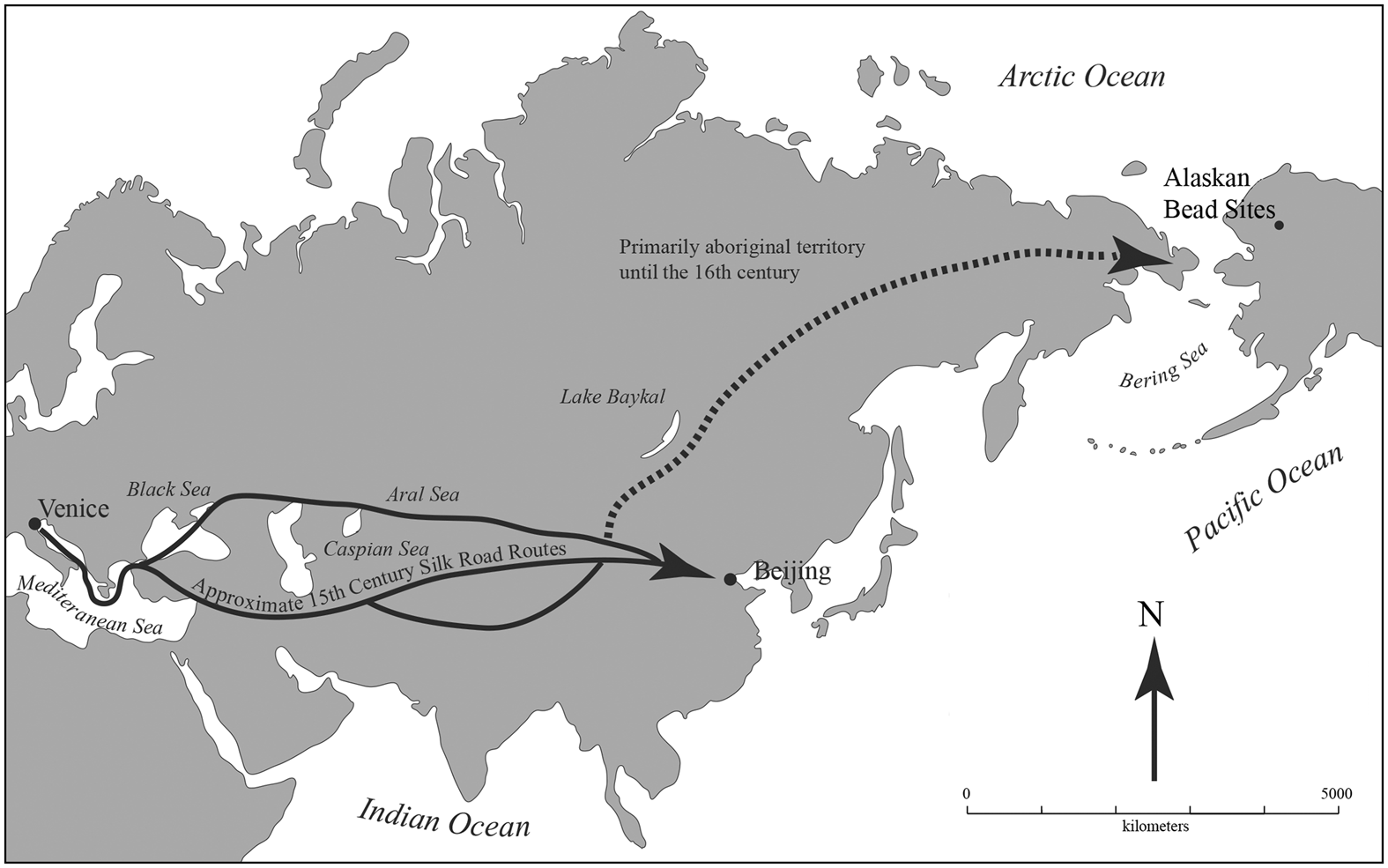
So, how did the IIa40 beads travel from Venice to arctic Alaska? With the exception of arctic Alaska, there is no evidence that beads of this variety occur anywhere in the Western Hemisphere prior to 1492, and the most parsimonious explanation is that they traveled eastward from Venice across Eurasia along routes that are currently unknown. We suggest the following scenario: prior to and during much of the Renaissance period, Venice was a major force in trade with Asia (Bergreen Reference Bergreen2007:13–25). Venetian goods moved along various maritime and overland trade routes, including the so-called Silk Road, which connected Europe and the Middle East with India and China via Central Asia. (Bergreen Reference Bergreen2007:27–28; Figure 7). Along such eastbound routes, these early Venetian beads found their way into the aboriginal hinterlands, with some moving to the Russian Far East and, ultimately, to the Bering Strait region and into Alaska (Figure 7). A growing body of evidence from the Bering Strait region indicates that the movement of non-native materials from northeast Asia to northwest Alaska has been occurring via undefined routes since the first millennium AD, if not longer (Burch Reference Burch2005:231; Cooper et al. Reference Cooper, Mason, Mair, Hoffecker and Speakman2016; Grover Reference Grover2016; McCartney Reference McCartney, Shaw, Harritt and Dumond1988; Mason Reference Mason1998). The paucity and limited variety of non-native objects recovered from prehistoric sites in the region, however, suggests that such occurrences were uncommon and that they do not demonstrate a consistent trade in such goods.
The location of the three Late Prehistoric Eskimo sites in arctic Alaska that contain IIa40 Venetian glass trade beads is shown in relation to Venice, selected generalized fifteenth-century European overland trade routes, and the generalized trans-Eurasian aboriginal network that the beads likely followed eastward for 17,000 km from Europe across Siberia and the Bering Strait to Alaska.

The arctic Alaska IIa40 beads represent the first evidence of an overland connection between Europe and northeast Asia/Alaska prior to the sixteenth century. That the IIa40 beads reported here traveled eastward roughly 17,000 km from Venice to arctic Alaska before 1492, facilitated by Early Renaissance and aboriginal trade routes, is the most parsimonious explanation of the present data. Prior to the discovery of the “New World” across the Atlantic, no other practical possibility existed. This finding is reinforced by a complete absence of IIa40 beads of any age elsewhere in Alaska, anywhere in North America west of the Great Plains, or anywhere across the Canadian arctic (Ross Reference Ross2005).
Acknowledgments
The authors’ work at Punyik Point and Kinyiksugvik was aided by the volunteer efforts of Sarah Meitl, Dale Slaughter, Susan Will, Stacie McIntosh, Jean Schaeffer, Richard Reanier, Natasha Slobodina, and Daniel Odess. We thank Sarah Jansen for translating the abstract into Spanish. We also thank Benjamin Gaglioti and Daniel Mann for reviews of earlier versions of the manuscript, as well as Jeffrey Mitchem and six anonymous reviewers (especially reviewer #5) for insightful comments that improved the quality of this report. The excavations mentioned in the text were performed by federal agency personnel working on federal lands. No permits were issued. All radiocarbon assays from Punyik Point and Kinyiksugvik mentioned here were paid for by the Bureau of Land Management, US-DOI.
Data Availability Statement
Artifacts from Punyik Point and Kinyiksugvik are accessioned and curated at the University of Alaska Museum of the North in Fairbanks, Alaska, and by National Park Service curatorial facilities in Anchorage, Alaska.