INTRODUCTION
A number of scholars, Ricento (Reference Ricento and Recento2000) in particular, have called for studies that link the macro and the micro in language policy research. In turn, Baldauf (Reference Baldauf2006) has convincingly argued for the need to distinguish between micro language policy and micro implementation of macro policies. The term ‘micro implementation of macro policies’ refers to the various ways in which local agents orientate to the realisation of top-down policies, either conforming to them or resisting them (Baldauf Reference Baldauf2006:157). Studies that adopt this perspective, also known as implementation studies, are evaluative in nature. By contrast, the term micro policy is used when local agents ‘create what can be recognised as a language policy … as a response to their own needs and their own language problems’ (Baldauf Reference Baldauf2006:155). Studies under this perspective, also known as micro policy studies, may or may not relate the micro to the macro. In other words, so far, the relationship between the macro and the micro in language policy has been approached from two different perspectives, namely micro implementation studies and micro policy studies.
A third way of thinking about the link between the macro and the micro in language policy research, hereafter referred to as an interpretive perspective, is, in my view, possible. In this perspective, macro language policies are viewed as contexts for micro-level language choice practices. As any other context, macro language policies are seen as shaping relevant micro practices while, at the same time, through those very same practices, they are talked/written into being (Heritage Reference Heritage1984; Drew & Heritage Reference Drew, Heritage, Drew and Heritage1992; Heritage & Clayman Reference Heritage and Clayman2010). The aim of this article is to substantiate this perspective, drawing on a specific translanguaging (García Reference García2009) practice I have observed in Rwanda in texts that, according to Sebba (Reference Sebba2002, Reference Sebba2013), can be described as ‘most highly regulated’ (MHR).
The practice can be described as translinguistic apposition. A common definition of apposition (see for example Quirk, Greenbaum, Leech, & Svartvik Reference Quirk, Greenbaum, Leech and Svartvik1985:1300–20) is as a syntactic structure whereby two noun phrases with a similar meaning are placed next to each other, the second functioning as an explanation, clarification, rename and so on of the first. In turn, two types of appositives can be found, namely restrictive and nonrestrictive appositives. A restrictive appositive significantly narrows the scope of the noun it is appositioned to while a nonrestrictive appositive does not. As a result, a nonrestrictive appositive can be deleted without any (major) effect on content while a restrictive appositive cannot. Consequently, a nonrestrictive appositive is set off from the main structure of the sentence, usually by devices such as commas, brackets, dashes, and so on, while a restrictive appositive is not.
In Rwanda, especially in MHR texts, nonrestrictive appositives can be realised bilingually, as shown in (1) below.Footnote 1
(1) Imyanzuro_y_Umwiherero_w…zi_abakuru_b_igihugu.pdf.274kB- primature.gov.rw; accessed December 6, 2014.
Gushyiraho politike n'amategeko yo kubaka amazu aciriritse (low cost housing) no gushyiraho uburyo bunoze bwo kubaka ayo mazu kandi akabonekera ku gihe cyateganyijwe.
‘To develop policies and regulations on building low cost houses (low cost housing) and appropriate modalities for building those houses such that they are available on time.’
Extract (1) reproduces the text of one of the recommendations of the most recent Umwiherero w'Igihugu,Footnote 2 as posted on the webpage of the Prime Minister's office. In the extract, a Kinyarwanda noun phrase (amazu aciriritse) is used and, as if to clarify and specify it, an English equivalent (low cost housing) is juxtaposed to it. Extract (2) comes from the booklet of the manifesto of Itorero ry'Igihugu, a governmental organisation in charge of promoting the Rwandan culture. In the example, the English word volunteers is juxtaposed to its Kinyarwanda equivalent as if to clarify its meaning.
(2) Itorero ry'IgihuguFootnote 3
…ku buryo bw'umwihariko bagira nk'abakorerabushake (volunteers) mu buryo bwo kwimenyereza imirimo
‘…in particular they could have volunteers (volunteers) by way of training for jobs’
As for extract (3), it comes from an electronic notice board at the headquarters of the Rwandan Immigration Authority and juxtaposes the Kinyarwanda phrase for ‘licence’ and its French equivalent.
(3) https://www.migration.gov.rw/Usaba-indi-Passport-mu-gihe.html; accessed July 5, 2013.
Umucuruzi ugaragaza ko afite ibicuruzwa byangirikira mu mahanga …, akagaragaza n'icyemezo cy'ubucuruzi (registre de commerce).
‘A business man/woman who is able to demonstrate that his/her goods are being damaged abroad … and shows his licence (his licence).’
This translanguaging practice may at first be seen as impossible (in the ethnomethodological sense) on theoretical as well as on sociolinguistic grounds. At the theoretical level, the texts in which the practice has been observed, such as those mentioned above, belong to the category Sebba (Reference Sebba2002, Reference Sebba2013) describes as ‘most highly regulated’. These are written texts that are addressed to a wide and anonymous audience. According to Sebba, such texts strongly adhere to the ‘ideology of the standard’, which, at the level of language choice, translates into a ‘monolingual ideology’. Therefore, in such texts, translanguaging is impossible in principle. In addition, in the case of Rwanda, this type of language alternation is in principle impossible given the country's sociolinguistic context. Rwanda recognises Kinyarwanda, French and English as its official languages, but Rwandans' plurilingual competences form a continuum ranging from monolingualism in Kinyarwanda to trilingualism in Kinyarwanda, French, and English, via degrees of Kinyarwanda-French and Kinyarwanda-English bilingualisms. That is, the reality on the ground is that of great diversity in plurilingual competences. In such a context, translanguaging in MHR texts is impossible in principle as there appears to be a clash between the need for the standard (uniformity) as required by the text type and the actual diversity on the ground. More concretely, given this diversity and in the absence of any possibility for face-to-face negotiation, there is no guarantee that meanings will be understood as meant and that functions such as explanation and clarification will be served as intended. An empirical question, which this article will seek to resolve, is how, in the absence of any predefined standard competence, the observed practice of translinguistic apposition can be accounted for. In this article, I argue that the possibility of translinguistic apposition in MHR texts in Rwanda is accountable by reference to the country's macro language policy. I demonstrate that the macro language policy allows for trilingualism in Kinyarwanda, French, and English to be assumed as standard and, therefore, for translinguistic apposition in MHR texts to be possible. In other words, I show that the macro policy shapes the local practice of translinguistic apposit ion and, conversely, that through the very same local practice, the macro language policy is written into being.
DATA
Although the practice of translinguistic apposition is routine in MHR texts in Rwanda, in this article a case study methodology is adopted for in-depth understanding. The practice is examined with reference to one online news media outlet, namely www.igihe.com (hereafter, Igihe). The outlet has been under regular monitoring since March 2012 and countless examples of translinguistic apposition were identified. The following are two examples from Igihe.
(4) Isura nshya mu rubanza rwa Mugesera (April 18, 2014)
Uburyo bwo gufata amajwi bwasabwe na Mugesera nyuma yo kuvuga ko abanditsi hari byinshi bibacika akifuza ko haba uwandika inyandiko mu mpine (steno dactylographer), ataboneka hakaba gufata amajwi mu rukiko kw' ibihavugirwa byose.
‘Mugesera asked for audio recording after he said that transcribers miss a lot of what is said in court. He expressed the wish to see a stenographer (steno dactylographer) employed and, failing this, everything which is said in the court audio recorded.’
(5) Kutabonekera igihe kw'imifuka ipakirwamo Sima bidindiza imikorere ya CIMERWA (August 8, 2012)
Ku byerekeye igabanya ry'abakozi bagera ku 136 riherutse gukorwa muri CIMERWA, Sekimonyo yavuze ko byaturutse ku nyigo icukumbuye yakozwe n'inzobere mu micungire y'inganda (Industrial Management) zo muri sosiyete Crowe Howard ikorera mu gihugu cya Kenya, ubwo zerekanaga ko CIMERWA ikeneye abakozi batarenze 125 kugira ngo igabanye ibitubya umutungo (Dépenses) bityo hagakoreshwa abakozi bake bashobora kurushaho gufatwa neza ndetse bakanongera umusaruro.
‘Regarding the recent retrenchment of almost 136 employees in CIMERWA, Sekimonyo said that it was recommended by a recent report by experts in industrial management (industrial management) from Crowe Howard, a company based in Kenya. The experts said that, in order to reduce its outgoings (expenses), CIMERWA needed no more than 125 employees, who will be very well paid and therefore more productive.’
Through sustained observation, the following properties have emerged. First of all, as examples (4) and (5) show, translanguaging in appositive structures can take the direction Kinyarwanda–French, just as it can take the direction Kinyarwanda–English. However, although less common, the direction French/English–Kinyarwanda, as in examples (6) and (7), is also possible.
(6) Dance Group Needs Public Attention (November 30, 2011)
He argued that Rwandans have not been supportive since majority prefer hiring traditional dancers (Itorero).
(7) The Culture Lab Umurage, L'héritage culturel de Kigali' (January 4, 2011) En plus de ces activités, il s'y passe aussi des veillées culturelles pendant lesquelles sont donnés des concerts de harpes traditionnelles ≪Inanga≫, jouées par des virtuoses de la harpe.
‘In addition to these activities, they also organise cultural evenings during which songs are performed using traditional harps ≪harps≫ by experts.’
Second, translinguistic apposition never juxtaposes French and English. Likewise, no languages other than Kinyarwanda, French, and English are involved. Third, where Kinyarwanda, French, and English are concerned, there seems to be a division of labour. As a general rule, Kinyarwanda is juxtaposed to either French or English, as in examples (6) and (7) above, with reference to Rwandan traditional/cultural realities and concepts, while French and English are excluded from this area of signification. Finally, in translinguistic apposition on Igihe, there is a preference for the pattern Kinyarwanda–English over the pattern Kinyarwanda–French. The account developed in the following sections addresses all of these properties.
CONTEXT
The Common European Framework for Languages makes a distinction between the multilingualism of societies and the plurilingualism of speakers, whereby it is recognised that, in a multilingual society, members may have differing plurilingual competencesFootnote 4. This distinction societal multilingualism/individual plurilingualism nicely captures the situation in Rwanda. At the societal level, Rwanda recognises three official languages, namely Kinyarwanda, French, and English (Constitution of the Republic of Rwanda, 2003, article 5). This official multilingualism is a result of a complex history (precolonial, colonial and postcolonial) that cannot be discussed in detail here (see Gafaranga, Niyomugabo, & Uwizeyimana Reference Gafaranga, Niyomugabo and Uwizeyimana2013 for a summary). A crucial period in this history is the 1990–1994 civil war. The war pitted the then government and a rebel group, largely recruited from exiles who had left the country because of earlier bouts of political unrest since the late 1950s, and spearheaded by refugees formerly based in Uganda. The war ended when the rebels defeated the government forces. This turn of events led to the massive return of former refugees and the creation of new ones. This period is significant because, before the war, Rwanda was officially bilingual in French and Kinyarwanda and, after it, it became trilingual in Kinyarwanda, French, and English. The current trend is for the country to become bilingual in Kinyarwanda and English, after dropping French.Footnote 5
At the individual level, Rwandans are diversely competent in the official languages. To denote these differing competences, Rwandans use the language-based categories ‘Francophone’ and ‘Anglophone’. The category Francophone mostly comprises Rwandans who were in the country before the war and a few who returned from French-speaking countries (e.g. Burundi and Congo). As for Anglophones, they are former refugees from English-speaking countries, mostly Uganda. The social linguistic categories Francophone and Anglophone can easily be extended to the Rwandan diaspora as, following the war, some have settled in English speaking countries (e.g. Uganda, Kenya, UK, and the US), while others have settled in French-speaking countries, mostly France and Belgium.
However, the categories Francophone and Anglophone are grossly reductionist and do not adequately capture the actual reality on the ground. To start with, note the significant absence of the category ‘Rwandophone’, an absence that indexes the fact that every Rwandan is assumed to be proficient in Kinyarwanda. In addition, the education system in place between 1994 and 2009 might have rounded, but not completely removed, the linguistic differences among those who attended it. During this period, a bilingual education system was implemented whereby there were French medium schools and English medium schools, with children compulsorily taking the other language as a subject. Third, in Rwanda, as in many other multilingual countries, the languages are not kept separate and everybody is exposed to all of them, although differently. In other words, in reality, Rwandans have many and diverse plurilingual competences in the three official languages, although, in terms of numbers, the balance definitely tilts in favour of monolingualism in Kinyarwanda. According to some reports, over 95% of the population can speak Kinyarwanda, up to 5% of the population are bilingual in Kinyarwanda and French, a tiny minority of 3% are bilingual in Kinyarwanda and English, and an even tinier minority are trilingual in Kinyarwanda-French and English (Samuelson & Freedman Reference Samuelson and Freedman2010). Finally, it is worth noting that some Rwandans have access to additional languages (e.g. Swahili, Russian, Chinese, etc.) due to their particular histories, for example, their education. Briefly, the reality on the ground is one of diverse plurilingual competences, ranging from monolingualism in Kinyarwanda to trilingualism in Kinyarwanda, French, and English, via degrees of bilingualism in Kinyarwanda and French and of bilingualism in Kinyarwanda and English, and occasional other additional languages. It is precisely because of this diversity that the issue of the possibility of translanguaging in MHR texts in Rwanda arises.
As I have already indicated, the data for this article come from Igihe, an online media outlet, more precisely a multi-author blog, owned by Igihe Ltd. This is a media and IT company registered in Rwanda with the declared purpose of facilitating ‘our audience to access fast and reliable news through the internet’.Footnote 6 The paperFootnote 7 is published in three versions corresponding to the three official languages.Footnote 8 Updates, contributed either by Igihe's own staff or by members of the general public, are posted throughout the day. In terms of readership, the intended audience is presumably anybody with internet access, whether Rwandan or not. In practice, however, the actual readership appears to be made up of Rwandans (in Rwanda and in the diaspora). Indeed, even though the paper is available in three language versions, among readers there is a clear preference for Kinyarwanda. To give just one example, a story on the Rwandan military personnel on a UN mission in the Central African Republic was posted in all three languages. The English version came first on February 16, 2014 at 9:22am, the Kinyarwanda version was posted a day later on February 17, 2014 at 8:03am, and the French version was posted on February 17, 2014 at 9:05am. At 12pm on February 19, 2014, the Kinyarwanda page had registered 12,268 hits, 1,854 people had visited the English page, and 1,275 visitors had been registered by the French page. Further evidence of the fact that a Rwandan audience is targeted is the following. An important aspect of Igihe, as any other blog, is the provision for readers' comments. Comments are exchanged almost exclusively in Kinyarwanda, even when a story has also been published in the other languages. In terms of the consumption of Igihe texts, the typical literacy event can safely be assumed to be private.Footnote 9 The most popular stories on Igihe are those with a political content. They register most hits and generate a lot of comments, often expressing antigovernment views that, in the current sociopolitical context, could land the author in a great deal of difficulties if identified. Clearly, for such opinions to be expressed, anonymity and therefore privacy has to be assumed. In turn, because of this private nature of the literacy event, in-text practices, including language choice, can be assumed to be standard, that is, accessible to everybody independently of their linguistic background. Although two types of texts can be found on Igihe, namely news articles and readers’ comments, for convenience this article is based almost exclusively on news texts.
IGIHE AS A MHR TEXT AND THE THEORETICAL POSSIBILITY OF TRANSLINGUISTIC APPOSITION
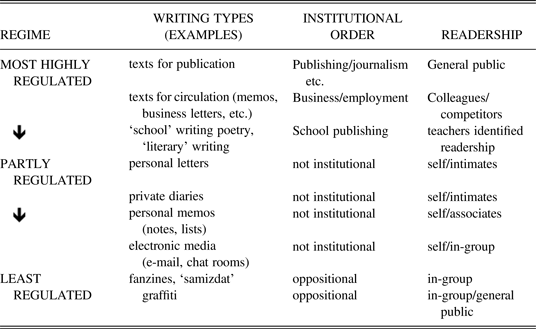
In a discussion of ‘language alternation in writing’, Sebba (Reference Sebba2002) offers a typology of texts based on the degree to which language is ‘standardised and controlled’ as in Table 1. Based on the criteria in the table, texts in Igihe can be seen as fitting in the category of most highly regulated texts: They are published and they are intended for a general and anonymous public. At the institutional level, they are produced by a registered company, namely Igihe Ltd. Even when they originate from members of the public, as is normal practice for multi-author blogs, they are ‘professionally’ edited.Footnote 10
Regulation regimes for different texts (www.ling.lancs.ac.uk/staff/mark/vigo/regspace; accessed March 19, 2013).

Sebba (Reference Sebba2002) observes what he calls the ‘ideology of the standard’ and comments that it is strongest in the case of MHR texts on two levels, namely the level of spelling and that of language choice. Regarding language choice, he writes:
In printed texts, monolingualism is the norm and the great majority of texts are written in a single language. Even where texts are produced bilingually, for example for official purposes, this in practice always means that two (or more) separate monolingual texts are created, one of which is a complete or partial translation of the other.
Elsewhere, Sebba speaks of hegemonic monolingualism: ‘an ideology that legitimates only texts that conform to the norms of a single (usually named and standardised) language’ and finds its influence to be ‘exerted particularly strongly on printed texts which are produced for public consumption’ (2013:100). Based on these observations, translinguistic apposition on Igihe can be seen as impossible in principle.
However, Sebba is quick to note that there may be ‘exceptions, and different norms apply in some language communities, allowing for the production—routinely or occasionally, depending on the community—of multilingual texts’ (2013:100). Additionally, Sebba notes that ‘the internet has produced a large additional space, relatively free from normative constraints, in which speakers can practise multilingualism in written, computer-mediated communication’ (2013:100). These additional observations, together with the facts noted earlier about Igihe—being online, its overall organisation in three language versions, and the practice of translinguistic apposition—call for a closer scrutiny. Particularly important here is the fact that the paper is produced online, which, if taken literally, may lead to the view that Igihe is only ‘partly regulated’ and ‘free from normative constraints’. However, as shown in the paragraphs below, the linguistic reality in the paper does not support this view.
Sebba (Reference Sebba2013) identifies two major multilingual text types, namely parallel texts and complementary texts, based on three criteria: language-spatial relationship, language-content relationship, and linguistic mixing. At the overall level, Igihe meets the language-spatial relationship of a parallel text since it is published in three language versions. But it fails to meet the language-content relationship of a parallel text. Indeed, not everything published in one language is published in the others and, if something is published in all three versions, the three versions need not be published simultaneously. That is, the three versions are not mere translations of one another. For example, at the point of writing (Monday, February 17, 2014 at 2pm), a story on the split within an opposition party (Rwanda National Congress) was heading the news in the Kinyarwanda version, but was only secondary news in the French version, and was not even featured (yet) in the English version. A story featuring the President's speech on healthcare was a headline in the English version but was not even featured as secondary news either in Kinyarwanda or in French. That is to say, at the overall level, Igihe has features of both parallel texts and complementary texts.
Two comments are worth highlighting. First, the fact that the paper appears in three language versions, even if versions are not complete translations of each other, does not mean Igihe is unregulated. Indeed, according to Sebba (Reference Sebba2002), MHR texts may consist of ‘separate monolingual texts … one of which is a … partial translation of the other’. Second, it is important to note the assumption about readers' plurilingual status that the overall organisation of Igihe entails. According to Sebba (Reference Sebba2013), a parallel text type assumes monolingual readers, hence equivalent content in all of the languages involved, and a complementary text type assumes a bilingual readership, as what is said in one language is not necessarily repeated in the other (2013:109). Given the distribution of content on Igihe as briefly discussed above, it is easy to see that, at the overall level, a Kinyarwanda-French- English trilingual readership is assumed. Readers' plurilingual competence is assumed to be such that they can access the texts in any of the three languages. Trilingual competence is assumed to be standard among readers. The question is: where does this assumption come from? How can this assumption of trilingual competence be seen as warranted?
While the criterion of language-spatial relationship and that of language-content relationship can be examined at the macro level of the paper as a whole, that of linguistic mixing can only be examined at the level of individual texts. The question here is whether specific articles on Igihe are multilingual or not and, if they are, whether they can still be seen as regulated. In many cases, texts are monolingual in the sense that they do not contain any instance of language alternation. Clearly, in these cases, the monolingualism norm applies and nothing indicates that the texts are not regulated. Could the same norm be seen as still applying in the cases where translinguistic apposition is observed? Alternatively, can translinguistic apposition be seen as a challenge to hegemonic monolingualism? Could texts containing translinguistic apposition be seen as not very regulated?
Code-switching (CS) scholars have shown that, in multilingual discourse, two types of language alternation can be identified. In some cases, the otherness of language alternation is oriented to as such, and, in some other cases, it is not (Auer Reference Auer1984; Gafaranga Reference Gafaranga2007). In the latter case, researchers speak of the bilingual medium (Gafaranga Reference Gafaranga2007), of unmarked codeswitching (Myers-Scotton Reference Myers-Scotton1993) and, more generally, of code-mixing. In the former, the term language alternation as deviance from the medium (Gafaranga Reference Gafaranga2007:148) seems appropriate. In suggesting that language alternation is in principle impossible in MHR texts, Sebba (Reference Sebba2002) does not take into account the above distinction, but I would like to argue that it is very significant. In the case at hand, translinguistic apposition can be seen as a challenge to hegemonic monolingualism, and therefore as impossible in principle, only if the otherness of language choice is not oriented to as such. But if language alternation is an instance of deviance from a monolingual medium, it cannot be seen as a challenge to the same medium with reference to which it is identified. Instead, in this case, translanguaging can be seen as reinforcing the monolingual norm, from which it derives its value.
Available evidence indicates that, in translinguistic apposition on Igihe, the otherness of language choice is oriented to as such. Consider the following two instances of what we might call other-language-ness formulation. In general, the term ‘formulation’, as used in Conversation Analysis, is when participants describe and/or name the activity they are involved in (Garfinkel & Sacks Reference Garfinkel, Sacks, McKinney and Teryakian1970). In line with this, other-language-ness formulation can be understood as when participants explicitly indicate that a particular item deviates from the on-going medium, notably by naming its origin.
(8) Un monument de la culture rwandaise en plein effondrement, (August 12, 2011) Ce jeudi, autour de 17 h, à l'hôpital Roi Fayçal, Sentore Athanase débarque sur une chaise roulante dans un état que seul un home intègre (imfura en Kinyarwanda) peut supporter.
‘This Thursday at around 17 h, Sentore Athanase landed at the Roi Fayçal Hospital in a state that only a man of character (‘man of character’ in Kinyarwanda) can bear.’
(9) 2012: Ibihugu byaje ku isonga mu bukire ku isi (April 19, 2013)
Ubundi iyo bagiye kureba ibihugu bikize kurusha ibindi bareba umusaruro wabyo ku mwaka, ibyo bita mu ndimi z'amahanga Produit Interieur Brut (PIB)/Gross Domestic Product (GDP), ungana n'umusaruro wose w'igihugu mu nzego zose ukuyemo igishoro batanze.
‘In establishing the relative wealth of countries, they look at their annual income, what they call in foreign languages Gross Domestic Product (PIB/GDP), which amounts to the difference between a country's total production and its investment.’
In extract (8), the writer formulates the other-language-ness of ‘imfura’, referring to it as Kinyarwanda. Likewise, in extract (9) the writer formulates the other-language-ness of produit intérieur brut and gross domestic product, describing them as coming from indimi z'amahanga ‘foreign languages’.Footnote 11 The point about formulation, as Heritage (Reference Heritage and van Dijk1985) and Drew (Reference Drew, Glenn, Lebaron and Mandelbaum2003) note, is that it is rare, but significant, in discourse. That is, in discourse, activities are often accomplished without being formulated as such. In the above instances, for example, other-language-ness formulation could have been avoided and the result would have been what I refer to as translinguistic apposition. Conversely, each instance of translinguistic apposition can easily be ‘other-language-ness formulated’. Therefore, it can safely be concluded that, in translinguistic apposition, the other-language-ness of the juxtaposed item is oriented to as such.
Further evidence of other-language-ness in translinguistic apposition can be found in situations such as extract (4) above and extract (10) below.
(10) Urwanda rugiye gushyira ku isoko ry'iBurayi impapuro z'agaciro milioni 400 (April 17, 2013)
U Rwanda rurateganya gushyira impapuro z'agaciro-faranga (Treasury Bonds) ka miliyoni 400 z'amadolari y'Amerika ku isoko ry'imari i Buraya, kugira ngo rukomeze guteza imbere ubukungu bwarwo.
‘Rwanda is going to issue treasury bonds (treasury bonds) worth $400 for the European market in order to support its development.’
In both extracts, the writer has to express a reality (‘steno dactylographer’ in extract (4) and ‘treasury bonds’ in extract (10)) for which no Kinyarwanda expression exists (yet) as it is not very common in the Rwandan context. To overcome the difficulty, he/she coins a new expression and, recognising the possibility that it might not be understood, back-translates it into English. The fact that the writers went to the extent of coining new Kinyarwanda expressions even though they had access to the right expressions in English demonstrates their orientation to the other-language-ness of the English expressions. Note that, in less ‘regulated’ situations, for example informal conversation, the items would typically be inserted, the process leading to a bilingual medium.
A third piece of evidence can be found in situations such as extract (11). In the absence of an original Kinyarwanda word for ‘roundabout’, Kinyarwanda has borrowed and integrated the French word rond point as rompuwe. In the extract, the original French word is appositioned to this French-origin Kinyarwanda word. Clearly, were it not for the regulated nature of the discourse, the French word would have been inserted.
(11) Ibintu 20 byahindutse mu Rwanda mu myaka makumyabiri ishize (April 14, 2014)
Ikindi kandi ni uko hari ahabaga feruje, ariko ubu zikaba zarakuweho zigasimbuzwa rompuwe (Rond point/Roundabout).
‘The other thing is that, where there used to be traffic lights, sometimes you now find roundabouts (roundabout/roundabout).’
Briefly, in translinguistic apposition, the other-language-ness of the appositioned item is oriented to as such, whether it is formulated or not. Therefore, translinguistic apposition cannot be seen as a challenge to hegemonic monolingualism and, as a result, it cannot be used as evidence that the texts in which it appears are unregulated. All in all, Igihe is a multilingual paper with monolingual articles, whether or not they contain instances of translinguistic apposition. That is, Igihe and specific texts within it demonstrably belong to the category ‘most highly regulated’ texts. More importantly, as translinguistic apposition is not a challenge to hegemonic monolingualism, the issue of its possibility at the theoretical level dissipates.
THE SOCIOLINGUISTIC POSSIBILITY OF TRANSLINGUISTIC APPOSITION
As we have seen, the issue translinguistic apposition raises at the sociolinguistic level is that there is a potential clash between a defining requirement of the text-type and the reality on the ground. The practice assumes that competence in Kinyarwanda, French and English is standard among the readership while, in reality, no such standard competence exists. As we have seen, the reality on the ground is one of great diversity of plurilingual competences. In reality, as we have seen, trilingual competence in Kinyarwanda, French, and English can be found only among a very small minority of Rwandans. In turn, this diversity of competences, particularly the lack of competence in all three languages, leads to the question of how translanguagers can be confident that their meanings will be understood as intended. A possible counter-claim here could be that the problem does not even arise, as translinguistic apposition is a mere case of what Eastman & Stein (Reference Eastman and Stein1993) call language display. In language display, competence in the switched-to language is not required as language alternation only serves a symbolic function. However, this claim is contradicted by deviant instances (see deviant case analysis in Heritage Reference Heritage1984), such as in extract (10). As we have seen, Rwanda has issued its first treasury bonds. In reporting the event, the writer coined the expression impapuro z'agaciro-faranga for the reasons we have seen and juxtaposed the English equivalent to it. Right after, a flurry of comments calling for the term treasury bond to be explained followed until a reader came in with the following explanation.
(12) A comment from a reader (April 17, 2013)
Ibi biranyereka ko Economics ari ubumenyi budapfa kwisukirwa. Abantu bose ntibashoboye gusobanukirwa na Bond icyo aricyo na logic behind it. Bond ni urupapuro rugurishwa na Central Bank cyangwa indi company ku buryo bwo kwaka inguzanyo (loan) kuko abantu barugura batanze cash (liquidity) maze Leta cg iyo company ikabona amafaranga iba ikoresha mu igihe ruzarangirira (maturity) kitaragera ngo Leta cg company yishyure cash yakiriye igurisha (principal) n'inyungu ziyaherekeje (underlying interest). Aha rero kugirango izo bonds zigurwe, Leta cg company zigomba kuba zifitiwe icyizere (reputation or trust) ku isoko mpuzamahanga ry'imari, niyo mpamvu habaho Credit Rating System ikorwa na Standard.
‘This shows me that economics is not a cup of tea for everyone. Not everybody has been able to understand what bond means and the logic behind it. A bond is a piece of paper sold by a central bank or any other company by way of securing a loan (loan). People buy it in cash (liquidity) and, thereby, the state or company gets the money to spend until the time comes (maturity) for the state or company to reimburse the money it received (principal) and the interest that it has accrued (underlying interest). For those bonds to sell, the state or company must be trusted (reputation or trust) on the international monetary market, and that's the reason why you have the Credit Rating System by Standard.’
The fact that, on this occasion, readers have explicitly orientated to the referential meaning of the appositioned item confirms that, even in the many cases where they do not, they potentially could. Also, the fact that, on this occasion, translinguistic apposition has failed confirms that the success of the strategy cannot be taken for granted and therefore that the issue of its possibility is a real one. In other words, the linguistic phenomenon at hand cannot be reduced to mere language display. In the following, a two-step account of the possibility of translinguistic apposition at the sociolinguistic level is proposed.
Step one: ‘Ascribed’ linguistic competence
Sebba (Reference Sebba2013) highlights the limits of current models of spoken CS for the study of CS in written texts. Two major sources of difficulties are identified, namely the interactive nature of spoken discourse and its sequential organisation vs. the absence thereof in written discourse (2013:109). In other words, in spoken discourse meanings are negotiated interactively and understandings revealed, confirmed, or rejected in the sequences of participants' actions. This possibility of negotiation is unavailable in the case of written discourse, especially ‘where one or both of the interacting parties is anonymous’ (2013:109). It is precisely because of this absence of the possibility of local negotiation in MHR texts that standard practices, including at the level of language choice, must be adopted. That is to say, the need for the standard is not merely ideological; it can also be practical. On this count alone, current models of CS can be anticipated to be inappropriate for translinguistic apposition.
There are also problems inherent to models of CS relative to the Rwandan sociolinguistic situation as described above. A running assumption in current models of CS is what I might call the language competence fallacy. This is the idea that, in order to alternate languages, participants must be competent in the languages involved. Along these lines, Meeuwis & Blommaert's (Reference Meeuwis, Blommaert and Auer1998) comment that current models of CS imply ‘that the code- switching speakers actually “know” (the) languages (involved)’ (1998:77). It is in recognition of this language competence fallacy that, as Sebba (Reference Sebba2013:112–13) reports, the concept of code-switching is increasingly challenged and alternative ones (e.g. translanguaging (García Reference García2009), plurilingual languaging (Jørgensen Reference Jørgensen2008) or metrolingualism (Otsuji & Pennycook Reference Otsuji and Pennycook2009)) are gaining increased currency.
However, even though models of CS cannot be imported wholesale to account for translanguaging practices in written texts, they cannot be rejected wholesale either (Sebba Reference Sebba2013). In the case of translinguistic apposit ion, some of the understandings developed in studies of CS can be usefully drawn upon. Top among these is Auer's view that
bilingualism is (not) something inside the speaker's head, but (rather) a displayed feature of participants' everyday behaviour … bilingualism is a predicate ASCRIBED TO AND BY PARTICIPANTS on the basis of visible, inspectable behaviour. (Reference Auer and Heller1988/2000:169, emphasis added)
The same view is shared by Gafaranga (Reference Gafaranga2001), Torras (Reference Torras, Richards and Seedhouse2005), Torras & Gafaranga (Reference Torras and Gafaranga2002), Cashman (Reference Cashman2005), and others according to whom bilingualism is a social identity (Antaki & Widdicombe Reference Antaki, Widdicombe, Antaki and Widdicombe1998:2). Following the ethnomethodological tradition, these authors argue that, in order to talk, bilingual participants categorise themselves and one another either as monolingual in language A or in language B or as bilingual in languages A and B. Furthermore, they argue that this ascription and categorisation need not reflect participants' actual competence in those languages.
Evidence can easily be found in support of this view. Consider extract (13) below, an instance of what one might call self-initiated medium self-repair. In the extract, participant D has held his addressee not to be competent in English and proceeded to repair its use, without any prior enquiry as to whether the addressee really and truly cannot understand what is said in this language.
(13) (Gafaranga Reference Gafaranga2012)
D: Ufite homework – devoir
‘Do you have a homework – homework’
A: Ahaaa! Ni ikibazo gikomeye
‘Ahaaa! It's a big problem’
Also consider extract (14) below. The interaction started in Kinyarwanda and then switched to French. In turn 1, B uses Kinyarwanda in a first pair part of an adjacency pair. In 2, C provides a relevant second pair part, indicating thereby that, for all practical purposes, she is competent in Kinyarwanda. However, she delivers her contribution in French. In 3, B moves from his previous use of Kinyarwanda to French. Therefore the switch to French by B cannot be explained in terms of C's objective and demonstrated lack of competence in Kinyarwanda.
(14) (Gafaranga Reference Gafaranga2010)

Extract (15) is even more interesting.
(15) (Adapted from Gafaranga Reference Gafaranga2007)
In example (15), A runs into difficulty finding the word for what he wants to say, namely municipalité, and draws on English to signal to his co-participant exactly what it is he is having problems with. In turn 6, B produces the repair, and in 7 A ratifies it. In using English and hoping that it will help get around the self-initiated-other-repair problem (Gafaranga Reference Gafaranga2012:511), A holds B to be objectively competent in English. And in providing the repair, B confirms this competence for all practical purposes. In turn 5, however, A undertakes to repair the very same choice of English. By so doing, A holds B, and indeed himself, not to be bilingual in English. In other words, in so many words, A can be paraphrased as having said that, here and now, we're not doing being competent in English even though objectively we are. Briefly, bilingualism is not what people really are, but rather what they hold each other to be for the purpose of on-going interaction. Language choice is accountable, not in terms of actual competence in languages X, Y, and Z, but in terms of the linguistic competence participants ascribe to one another for the purpose of the interaction at hand. If this view of what it means to be bilingual is adopted, the issue of the possibility of translinguistic apposition on Igihe is quickly resolved: writers hold their readers to be competent in Kinyarwanda, French, and English. Whether they actually are is beside the point.
However, as it is, this account of the possibility of translinguistic apposition leaves one important issue unresolved. The account allows for any language to participate in the structure. According to the explanation so far, translinguistic apposition can involve any language, the only deciding factor being the writer's own plurilingual status. That is to say, under this explanation, it would be possible for writers to draw on their own plurilingual competence independently of their readers' competence. Under such a view, translinguistic apposition would indeed be seen as a case of language display. The limit of this view has already been demonstrated. In addition, the view that any language can participate in the structure is not supported by the data. In the data, only Kinyarwanda, French, and English are ever involved in translinguistic apposition. Despite my best effort, I have not been able to locate a single instance of translinguistic apposition involving a language other than Kinyarwanda, French, or English. In the sections below, I argue that the empirical fact that only Kinyarwanda, French, and English are involved in translinguistic apposition is accountable by linking the macro-level language policy and the micro-level language choice practice.
Step two: Macro language policies as contexts for micro language choice practices
It is almost a truism to say that language choice acts are context-embedded. To understand the context-embeddedness of translinguistic apposit ion, the notion of context itself must be clearly understood. A useful starting point is the following observation by Goodwin & Duranti (Reference Goodwin, Duranti, Duranti and Goodwin1992:3).
When the issue of context is raised it is typically assumed that the FOCAL EVENT cannot be properly understood…, unless one looks BEYOND THE EVENT ITSELF TO OTHER PHENOMENA (for example cultural setting, speech situation, shared background assumptions) within which the event is embedded…. The context is thus a FRAME (Goffman Reference Goffman1974) that surrounds the event being examined and provides RESOURCES FOR ITS APPROPRIATE INTERPRETATION. (emphasis added)
In the observation it is highlighted that any idea of context implies a focal event, that is, the phenomenon being investigated. Without a focal event, there is no context. In the observation, it is also highlighted that the context consists of phenomena other than the focal event itself. Finally, it is highlighted that the context is a resource for the interpretation of the focal event. This last point must be highlighted further. Given a focal event, phenomena outside it are potentially infinite. However, out of that potential infinity, only phenomena contributing to the appropriate interpretation of the focal event are retained as its context. In this respect, Drew & Heritage (Reference Drew, Heritage, Drew and Heritage1992), Heritage & Clayman (Reference Heritage and Clayman2010), and especially Schegloff (Reference Schegloff, Drew and Heritage1992) speak of the relevance of context.
A closer look at the notion of context has revealed two possible ways of thinking about context, respectively termed a bucket view and a context-renewing view (Drew & Heritage Reference Drew, Heritage, Drew and Heritage1992:21). In the bucket theory, the context is seen as static and independent of the focal event. The context-renewing view, by contrast, holds that discourse is shaped by the (relevant) context and that, in turn, through discourse, the relevant context is revealed and renewed. In other words, through discourse, the relevant context is talked into being. Schegloff (Reference Schegloff, Drew and Heritage1992) speaks of the procedural consequentiality of context. This context-renewing view of context has been adopted in a variety of studies, those of institutional talk in particular (see Heritage & Clayman Reference Heritage and Clayman2010:20–33 for a succinct review). Other studies have related language choice and specific sociolinguistic contexts. For example, Gafaranga (Reference Gafaranga2010,Reference Gafaranga2011) shows how language shift, as a sociolinguistic context, shapes participants' talk. Both studies investigate language choice among the Rwandans in Belgium, where language shift is reported to be taking place from Kinyarwanda-French bilingualism to monolingualism in French. This sociolinguistic situation is demonstrated to lead to the adoption of specific conversational practices, namely medium request (Gafaranga Reference Gafaranga2010) and transition space medium repair (Gafaranga Reference Gafaranga2011). Conversely, Gafaranga argues, by adopting these specific practices, members of the community talk language shift into being. Building on the view that language choice practices are shaped by the sociolinguistic contexts in which they take place and, therefore that through the very same language choice practices, relevant sociolinguistic contexts are talked into being, it may be argued that the practice of translinguistic apposition as observed on Igihe is shaped by the Rwandan sociolinguist ic context and, conversely, that through translinguistic apposit ion, that sociolinguistic context is written into being. A convenient way of referring to this sociolinguistic situation is in terms of the Rwandan macro language policy.
Writing language policy into being
Spolsky (Reference Spolsky2004) has convincingly argued that language policy can be seen as comprising three components: language management, language ideologies and beliefs, and language practices. According to Spolsky, language management (or declared language policy; Shohamy Reference Shohamy2006) refers to ‘the formulation or proclamation of an explicit plan or policy, usually but not necessarily written in a formal document, about language use’ (2004:11). In this respect, the Constitution of the Republic of Rwanda (2003, article 5) states:
The national language is Kinyarwanda.
The official languages are Kinyarwanda, French, and English.
This macro language policy shapes the practice of translinguistic apposition on Igihe and is shaped by it in many ways. First of all, as we have seen, the overall organisation of the paper and the local practice of translinguistic apposition, in contradiction with the reality on the ground, are based on the assumption that competence in Kinyarwanda, French, and English is standard among readers. As we have seen, in reality, Rwandans' plurilingual competences are diverse and only a tiny minority can actually claim trilingual competence in Kinyarwanda, French, and English. An empirical question was therefore felt to be how this assumption of trilingual competence among readers can be seen as accountable.
To address this question, we begin by noting that Kinyarwanda, French, and English are the very same languages that the Constitution recognises as official. The assumption that citizens standardly know these languages can easily be understood by reference to the language-rights literature. According to language-rights theorists, it is a ‘civic duty to be competent in the (official) language’ (Rubio-Marin Reference Rubio-Marin, Kymlicka and Patten2003:71). Evidence for this civic duty is found in practices such as the requirement for immigrants applying for naturalisation to demonstrate competence in the official language through language tests. In other words, given the Rwandan macro policy, readers of Igihe, as competent members of the Rwandan society, can warrantably be assumed to be competent in its official languages. Conversely, given the same macro policy limiting the official languages to Kinyarwanda, French, and English, citizens cannot be warrantably assumed to know any other language, even though, as individuals, they in fact may. The macro language policy shapes and constrains the practice of translinguistic apposition. In turn, given the routine nature of the practice, by redeploying it yet for another first time in specific instances, writers write the constitution into being. In praxis terms, Kinyarwanda, French, and English are the official languages of Rwanda because they can warrantably be used to accomplish specific interactional activities, in this case translinguistic apposition.
Although Rwandans can warrantably be assumed to be competent in the country's official languages, the constitution actually does not specify whether competence should be had in one of them, in some of them, or in all of them. In the absence of any detail, each institution has to develop its own interpretation. For example, the available evidence is that the Rwandan Parliament has adopted the view that Rwandans are either Francophones or Anglophones. As a result, as reported in Gafaranga, Niyomugabo & Uwizeyimana (Reference Gafaranga, Niyomugabo and Uwizeyimana2013), texts of draft bills take the form of parallel texts (Sebba Reference Sebba2013), and are compulsorily available in Kinyarwanda, French, and English. Recently, the National Bank of Rwanda has issued a new 500 Rwandan francs note with parallel texts in Kinyarwanda and English (see Figure 1). Through this action, only competence in Kinyarwanda and/or in English is assumed.
New 500 Rwandan Francs note (www.igihe.com, September 24, 2013; accessed June 17, 2014).
In view of its language choice practices, Igihe can be seen as having interpreted the macro policy as implying competence in all three languages. At the macro level, as we have seen, Igihe has adopted the structure of complementary texts (Sebba Reference Sebba2013). A number of observations at the micro level of translinguistic apposition can be accounted for along the same lines. In many cases, Kinyarwanda is juxtaposed with one other language. In other cases, as in extract (5), consecutive structures may involve different languages. And there are even situations where all three languages are involved in the same structure, as in extracts (16) and (17).
(16) Ninde ufite uburenganzira bwo gusaba pansiyo y'ubusaza (July 2, 2014)
Igihe noneho umukozi asabye amafaranga ye y'izabukuru atarageza ku myaka 15 y'ubwiteganyirize , ahabwa amafaranga y'ingunga imwe (allocation unique/lumpsum).
‘When an employer requests his pension before they have completed 15 years of service, they get a lump sum (lump sum/lump sum).’
(17) Uburundi bwibutse Perezida Ntaryamira waguye mu ndege ya habyarimana (April 8, 2014)
Imihango yo kwibuka uyu wahoze ari umukuru w'igihugu yaranzwe n'igitambo cya misa muri katedarale ya Regina Mundi ndetse no gushyira indabo ku mva ya Nyakwigendera ariko nta mbwirwaruhame (discours/speech) yigeze itangwa.
‘Remembrance ceremonies for this former head of state consisted of a church service at the Regina Mundi cathedral and the laying of flowers at his tomb but no speeches (speech/speech) were pronounced.’
In short, on Igihe the Rwandan macro policy is given a specific interpretation, that is, it is written into being.
We have observed a division of labour among the three official languages of Rwanda in translinguistic apposition. While Kinyarwanda is switched to in the context of Rwandan traditional and cultural realities, French and English are excluded from this area. A binary system, +/− cultural reality, seems to be at work. This functional distribution of the Rwandan official languages in translinguistic apposition is indexical of the macro policy. According to the Rwandan constitution, Kinyarwanda is the national language. At the ideological level, Kinyarwanda is strongly associated with the Rwandan culture and national identity (see Gafaranga et al. Reference Gafaranga, Niyomugabo and Uwizeyimana2013 for a detailed discussion). By contrast, French and English are associated with technology, science, and modernity. Indeed, one of the reasons evoked for adopting these languages in a country that, for all practical purposes, is monolingual is that Kinyarwanda is not developed enough to express fully these realities. According to Spolsky, such beliefs about language and language use are an important component of a language policy (2004:5). Other authors have spoken of the ideological or perceived language policy (Shohamy Reference Shohamy2006). In translinguistic apposition, this ideological dimension of the Rwandan macro language policy is renewed through the functional differentiation of the languages involved. This aspect of the Rwandan macro policy also accounts for the fact that, as mentioned earlier, switching from Kinyarwanda to either French or English is far more common than the other way round. Kinyarwanda needs these languages more than they need it.
The same binary system, +/− cultural reality, leads to yet another aspect of the Rwandan macro language policy and, in turn, explains yet another feature of translinguistic apposition. This is the fact that, in Rwanda, while French and English are seen as complementing Kinyarwanda, between themselves they are seen as duplicating each other. To understand this, we can refer to Fishman's (Reference Fishman1967/2000) argument that functional differentiation is a prerequisite for two languages to exist side-by-side. While Rwanda had been bilingual in Kinyarwanda and French as a result of its colonial past, English was recognised for the first time as having some role to play in the Rwandan multilingualism as part of the Arusha Peace Accord (1993),Footnote 12 an accord which was meant to resolve the then on-going civil war. Recall that the war opposed the Rwandan Government and a rebel movement spearheaded by Anglophone refugees. However, the Accord provided that English would be allowed only for three years, during which time the returnees would learn French. That is to say, the negotiators as policy makers did not envision a situation where French and English would co- exist on a permanent basis. However, history has proved them wrong and English never went away. Rather, today, as we see below, there is evidence that it is displacing French, presumably because, with both French and English serving the same function and English being ‘associated with the dominant drift of social forces’ (Fishman Reference Fishman1967/2000:87), they cannot exist side-by-side. Briefly, the sociolinguistic structure of the Rwandan multilingualism can be represented as in Figure 2 below, meant to capture the crucial fact that French and English are not in contact but in parallel with each other. This aspect of the Rwandan macro language policy shapes and is shaped by the practice of translinguistic apposition on Igihe. As mentioned earlier, while cases of translinguistic apposition with the patterns Kinyarwanda–French and Kinyarwanda–English are common, French and English are never juxtaposed to each other. Also, as extracts (11), (16), and (17) show, French and English can actually co-occur in the same instance accomplishing the same job relative to Kinyarwanda, that is, duplicating each other.
The Rwandan sociolinguistic structure.
Finally, as we have noted, in translinguistic apposition, the pattern Kinyarwanda– English appears to be more common than the pattern Kinyarwanda–French and this too is accountable. The constitution recognises three official languages but, in reality, the influence of French is fast and noticeably decreasing. Language displacement is taking place in favourof English. For example, the medium of instruction has already changed from French to English in all Rwandan schools (Samuelson & Freedman Reference Samuelson and Freedman2010). It is increasingly becoming acceptable to omit French in official documents (see the newest bank note of 500 FRW in Fig. 1). Even when the three languages are still co-present, there is a tendency to push French physically to a third position, as in the following letterhead (Figure 3), in contradiction with the constitution, which suggests it is the second official language (Gafaranga et al. Reference Gafaranga, Niyomugabo and Uwizeyimana2013:321). In other words, there is a gap between the declared policy, which recognises three official languages, and the practiced policy (Bonacina-Pugh Reference Bonacina-Pugh2012, Papageorgiou Reference Papageorgiou2012), which in effect sidelines one of them. This aspect of the Rwandan macro language policy shows at the level of the practice of translinguistic apposition, that is, shapes it, through a reduced presence of French compared to English. French is becoming less of a resource for local interactional practices such as translinguistic apposition.
Letterhead of the Rwandan Parliament.
SUMMARY AND CONCLUSION
As mentioned in the introduction, a call has been made for language policy research to integrate macro and micro level analyses (Ricento Reference Ricento and Recento2000). In turn, the notion of micro is currently understood either to refer to the micro implementation of macro policies or to micro policies (Baldauf Reference Baldauf2006). This article has proposed a third possible view of the linkage between the macro and the micro in language policy research. I have referred to this view as an interpretive perspective. In this view, macro language policies are seen as contexts for micro language choice practices. That is to say, macro language policies are viewed as ‘resources for the appropriate interpretation’ (Goodwin & Duranti Reference Goodwin, Duranti, Duranti and Goodwin1992:3) of micro-level language choice practices. Alternatively, macro language policies are seen as shaping micro language choice practices and, in turn, through micro language choice practices, macro-level language policies are renewed, that is, talked/written into being.
To substantiate this view, in this article, I have examined a specific language choice practice I have observed in many Rwandan MHR texts and on Igihe in particular. Referred to as translinguistic apposit ion, the practice consists of realising an appositive structure in two languages. A number of observations on the structure were noted. In the data, translinguistic apposition could take the direction Kinyarwanda–French, Kinyarwanda–English, and the other way round. It was observed that switching from Kinyarwanda to English is more common than switching from Kinyarwanda to French. It was observed that switching between French and English is noticeably absent as is switching involving languages other than French, English, and Kinyarwanda. And it was found that, where Kinyarwanda, French, and English are involved, a division of labour exists such that Kinyarwanda is used in the context of Rwandan cultural realities while French and English are not. Above all, translinguistic apposit ion was predicted to be impossible in principle on theoretical and/or on sociolinguistic grounds. On theoretical grounds, translinguistic apposition could at first be seen as impossible because of the nature of the texts in question (Sebba Reference Sebba2002, Reference Sebba2013). And, on sociolinguistic grounds, translinguistic apposition was predicted to be impossible because it assumes competence in the languages involved as standard while the Rwandan public, the target readership, actually have diverse plurilingual competences. Therefore, this article set out to account for the possibility of translinguistic apposition, to interpret it, using Igihe as a case study.
At the theoretical level, the possibility of translanguaging was quickly dealt with by demonstrating that the texts on Igihe are monolingual either in Kinyarwanda, or in French or in English, and that writers, when they switch from this monolingual medium, orient to the other-language-ness of the relevant item. That is, the texts were demonstrated to adhere to a monolingual ideology. To this extent, translanguaging in appositive structures was not seen as a threat to hegemonic monolingualism. Therefore our discussion turned to the possibility of translinguistic apposition from a sociolinguistic position. A two-step account was proposed. In a first step, it was argued that translanguaging in appositive structures, just like any other language choice practice, is accountable, not by reference to participants' actual competence in the languages involved, but rather by reference to the competence participants ascribe to one another. That is to say, on Igihe, writers ascribe to their readers competence in Kinyarwanda, French, and English. In a second step, we examined the specific properties of translinguistic apposition and demonstrated that they are all accountable by reference to the Rwandan macro language policy. In that sense, we demonstrated that the Rwandan macro language policy shapes and constrains in detail the practice of translinguistic apposition and that, conversely, through the very same practice, the macro language policy is written into being. In conclusion we can say that, according to the perspective developed in this article, macro language policies and micro language choice practices are interdependent, that they elaborate each other.