Extended-spectrum β-lactamases (ESBLs) are enzymes that confer resistance to most β-lactam antibiotics, including penicillins, cephalosporins, and the monobactam aztreonam.Reference Bradford 1 Since they were first described in 1983 in Germany, ESBL-producing Enterobacteriaceae (ESBL-E) have increasingly been identified as pathogens and have become endemic in many healthcare settings and communities.Reference Ben-Ami, Schwaber and Navon-Venezia 2 , Reference Rodriguez-Bano, Navarro and Romero 3 Multiple global surveillance programs have documented increasing ESBL-E prevalence worldwideReference Fedler, Biedenbach and Jones 4 – Reference Goossens and Grabein 6 in both adult and pediatric populations.Reference Badal, Bouchillon, Lob, Hackel, Hawser and Hoban 7 This surveillance, combined with a lack of effective treatments for ESBL-E infections and the potential risk of transmission among patients in hospital settings, have led to the development of strategies to monitor and control ESBL-E colonization and transmission.
The rise of ESBL-E prevalence in pediatric patients is concerning. Although well characterized in adults, the epidemiology, risk factors, outcome, therapies, and control measures for ESBL-E in pediatric patients has remained largely unknown. The limited data in this population have primarily been generated by studies of outbreaks in pediatric intensive care units or neonatal intensive care units (NICUs). During outbreaks, vehicle-based transmission (eg, through artificial nails of hospital staff) or vector-based transmission (eg, cockroach infestations) have contributed to the spread of pathogens.Reference Gupta, Della-Latta and Todd 8 , Reference Cotton, Wasserman and Pieper 9 These differ from risk factors described in non-outbreak settings, where patient characteristics including younger gestational age, low birth weight, prolonged mechanical ventilation, length of hospital stay, invasive devices, and antibiotic use independently increase a patient’s risk for ESBL-E colonization or infection.Reference Crivaro, Bagattini and Salza 10 , Reference Shakil, Akram, Ali and Khan 11 ESBL-E infections have been associated with poor outcomes as measured by prolonged hospital stay, delay in effective therapy, and mortality.Reference Cosgrove 12 – Reference Schwaber, Navon-Venezia, Kaye, Ben-Ami, Schwartz and Carmeli 14 Patients with ESBL-E rectal colonization have an increased risk for developing ESBL-E infections.Reference Martins, Moreira, Riley and Santoro-Lopes 15 , Reference Reddy, Malczynski and Obias 16
Of the myriad of strategies to prevent transmission of ESBL-E among hospitalized patients, active surveillance to identify and isolate patients colonized with ESBL-E has been a common practice, especially in high-risk populations such as NICU patients. Active surveillance continues to be the recommendation of the Centers for Disease Control and Prevention as a core prevention strategy.Reference Wilson, Livermore and Otter 17 This strategy was first introduced in the mid-1980s to control an outbreak of ESBL-producing Klebsiella pneumoniae infection. Although active surveillance was originally conducted for infection control purposes, the data collected have been increasingly utilized to assist in the selection of empirical antibiotic therapy in the setting of possible infection.Reference Blot, Depuydt, Vandijck, Vandewoude, Peleman and Vogelaers 18
At the Children’s National Health System (CNHS), active surveillance for ESBL-E colonization has been conducted in the NICU since the early 1990s, when ESBL-E was emerging and a point-prevalence study revealed colonization rate of nearly 30% in the unit. The primary purpose for initiating active surveillance was to reduce the risk for ESBL-E transmission. Since then, other changes have been implemented on the unit including but not limited to physical environment design, infection control practices, and improved safety culture. The aims of this study were to evaluate the efficacy and financial impact of active surveillance on ESBL colonization and infection in our level IV NICU and to assess the need for continuing this practice by reviewing 19 years of data.
Methods
Study setting
The NICU is a level IV unit offering care for premature infants transferred from hospitals throughout the Washington, DC, metropolitan region. Before 2009, the unit was an open ward with 6 bays and 1 swing area with 2 shared rooms, for a maximum capacity of 48 patients. In 2009, the unit moved to a newly designed 54-bed space with 46 primary rooms and 2 shared bays that could accommodate 4 patients each. In 2017, the unit expanded to 60 beds through the addition of several private rooms in the adjacent space.
A NICU-specific ESBL-E protocol requires patients to be screened for ESBL-E colonization by testing rectal swab specimens collected upon admission and weekly thereafter, until the patient tested positive or was discharged from the hospital, whichever occurs first. Patients are placed on contact precautions for the entire hospital stay if ESBL-E is detected in a specimen collected for either active surveillance or clinical diagnosis. Healthcare providers are required to wear a single-use gown and gloves upon entry to a patient room or bay for those patients assigned to contact precautions.
As reported previously, the unit has had additional active surveillance for the detection of vancomycin-resistant Enterococcus (VRE)Reference Singh, Leger, Campbell, Short and Campos 19 and methicillin-resistant Staphylococcus aureus (MRSA),Reference Song, Cheung, Klontz, Short, Campos and Singh 20 respectively. The VRE surveillance was undertaken from 2003 to March 2017, while MRSA surveillance was implemented in 2015 and is ongoing. The VRE active surveillance was conducted only once by testing rectal swabs collected upon patient admission, whereas MRSA surveillance is conducted by testing nasal swabs collected upon patient admission and weekly thereafter until the patient becomes MRSA positive or is discharged, whichever occurs first.
Study patients and data sources
In this study, we included patients admitted to the CNHS NICU between January 1999 and March 2018. Active surveillance for ESBL-E colonization was conducted between January 1999 and March 2017 among all patients admitted to the unit.
An electronic microbiology data repository was searched to identify NICU patients that had ESBL-E isolated from specimens collected for active surveillance or for clinical diagnosis. Patients were considered to have a subsequent infection if an infection due to the same ESBL-E pathogen detected by active surveillance occurred after colonization was detected and before discharge.
In September 2005, the institution implemented an electronic medical record system, which made data extraction feasible. Thus, for this study, the medical charts for patients admitted after September 2005 were reviewed to extract additional information related to patient characteristics (ie, demographics, gestational age, and birthweight), clinical diagnosis, prognosis, and to determine factors that could distinguish infection versus colonization. Administrative databases were queried to obtain the annual number of patient admissions as well as patient days.
Microbiology testing methods
Identification of Enterobacteriaceae species was conducted using the Centers for Disease Control and Prevention MacConkey Agar (MAC) protocol. The detection and confirmation of ESBL–E was performed using the MicroScan Walkaway System (Beckman Coulter, Brea, California). Enterobacteriaceae isolates with an elevated minimum inhibitory concentration (MIC) for cefotaxime (CEFO) (>2µg/mL) or ceftazidime (CEFT) (>1 µg/mL) were suspected for ESBL-E. An isolate was considered positive for ESBL production if there was a ≥8-fold difference between MICs of CEFO or CEFT when tested alone compared to the MICs of these antibiotics when tested in the presence of clavulanic acid, as determined automatically by the MicroScan Walkaway System.
Definitions
Hospital-acquired ESBL-E colonization or infection was defined as ESBL-E detected for the first time from a specimen collected for either active surveillance or clinical diagnosis after a patient had been admitted for at least 2 days, with the day of admission considered as day zero. The overall incidence rate of ESBL-E colonization or infection was defined as the number of ESBL-E colonizations or infections per 100 patient admissions. The hospital-acquired incidence rate was defined as the number of hospital-acquired ESBL-E infections per 1,000 patient days.
To estimate the cost associated with ESBL-E active surveillance, published data were used to calculate the direct costs associated with both the required supplies and laboratory technician time to process specimens collected for Klebsiella pneumoniae carbapenemase (KPC)–producing Enterobacteriaceae active surveillance in the University of Virginia Health System, Charlottesville, Virginia, in 2012.Reference Mathers, Poulter, Dirks, Carroll, Sifri and Hazen 21 Although this cost analysis was specifically for KPC-producing Enterobacteriaceae, it provided itemized direct costs for supplies that our laboratory uses to process specimens collected for ESBL-E active surveillance. This study estimated that active surveillance cost $11.37 and $2.47 (2012 US$ value) if a specimen was confirmed to be positive or negative, respectively.
Statistical analysis
Data were managed using Microsoft Excel (Microsoft, Redmond, WA). Descriptive analyses computing percentages for categorical variables and averages for continued variables were performed using STATA software (StataCorp, College Station, TX). A U-chart was constructed to describe changes in the hospital acquired ESBL-E colonization and/or infection rate, while Poisson regression was conducted to examine the statistical significance of the changes over time.
Our institutional review board approved this study.
Results
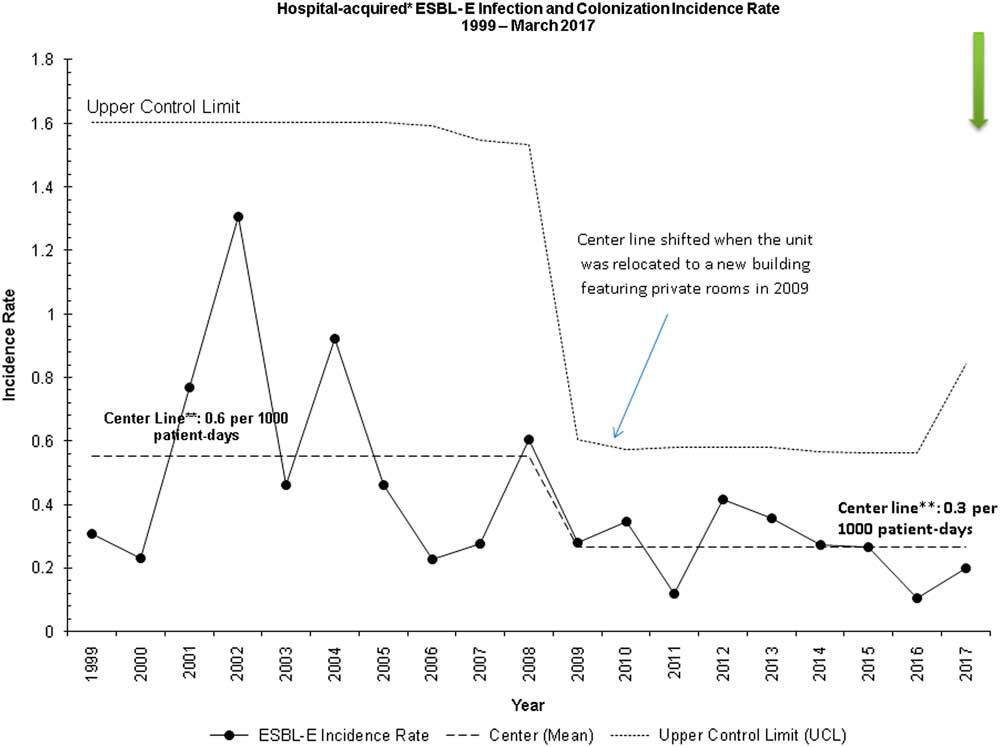
Between 1999 and March 2017, a total of 171 NICU patients were found to have ESBL-E infection or colonization on admission (n = 60; 35.1%) or to have acquired the organism during the hospitalization (n = 111, 64.9%). The overall incidence rate of ESBL-E colonization or infection was estimated to be 1.4 per 100 patient admissions, or 1.2 per 1,000 patient days. The overall hospital-acquired ESBL-E incidence rate was estimated to be 0.41 per 1,000 patient days, and this rate had declined since 2002 (Poisson regression coefficient, −0.08; 95% confidence interval [CI], −0.13 to −0.33; P = .009) (Fig. 1), with an average of 6 cases detected annually. A significant decline as indicated by a central-line shift on the U chart, was observed in 2009 when the unit moved into its current single-bed unit featuring private patient rooms. Active surveillance using rectal swabs identified 150 patients (87.7%) colonized with ESBL-E. The remaining 21 patients were identified from specimens collected from tracheal aspirates (n = 12), urine (n = 4), abdominal fluid (n = 1), eye (n = 1), blood (n = 1), ventilator fluid (n = 1), and a wound (n = 1) in symptomatic patients when clinicians suspected neonatal sepsis or pneumonia. Of the 150 patients that were colonized with EBSL-E as indicated by the positive surveillance result, 14 (9.3%) progressed to develop 1 or more subsequent infections caused by the same ESBL-E species found in the rectal swab specimens collected for active surveillance. These infections included urinary tract infection (n = 7), bacteremia (n = 6), eye infection (n = 1), meningitis (n = 1), and complications following ventriculoperitoneal shunt and intestinal atresia repair procedures (n = 2). With a total of 35 infections in this cohort, the incidence rate of ESBL-E infection was 0.13 per 1,000 patient days.
Hospital-acquired ESBL-E infection and colonization incidence rate in the neonatal intensive care unit at Children’s National Health System, 1999–March 2017. Hospital-acquired was defined as the detection of ESBL-E for the first time from a specimen collected for either active surveillance or clinical diagnosis after patient being admitted for 48 hours or longer. The center line was calculated as the average incidence rate.

Klebsiella pneumoniae (43.4%) was the most frequently identified ESBL-E by active surveillance, followed by Escherichia coli (25.8%) and Serratia marcescens (6.9%). In contrast, Serratia marcescens (37.5%), K. oxytoca (20.8%), and E. coli (20.8%) were the 3 most common ESBL-E pathogens detected among specimens collected for clinical diagnosis.
Between April 2017 and March 2018 after active surveillance was discontinued, 4 patients were found to have ESBL-E in specimens collected for clinical diagnosis including tracheal aspirates (n = 3) for pneumonia and drainage (n = 1) for cellulitis. Of the 3 patients with a tracheal aspirate specimen growing ESBL-E, only 1 patient was clinically treated for a new onset of pneumonia. Thus, with 2 infections in this cohort, the incidence rate of ESBL-E infection was 0.10 per 1,000 patient days.
Epidemiology
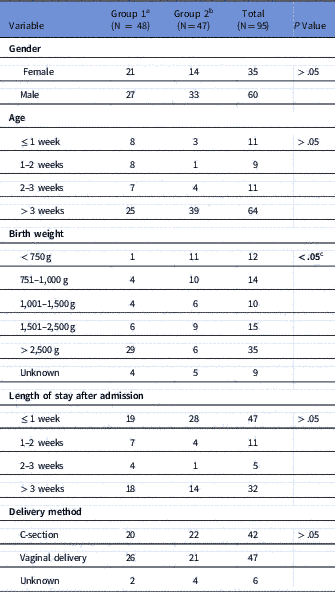
Of the 95 patients who screened positive for ESBL-E between September 2005 and March 2017, 60 (63.2%) were male, 25 (26.3%) had a birth weight <1,000 g, and 47 (49.5%) were the product of a vaginal delivery. Of these 95 patients, 47 (49.5%) were transferred after a 48-hour or longer hospitalization at another healthcare facility or were readmitted after a recent hospitalization at CNHS. Except for birthweight, these 47 patients had similar characteristics compared to the remaining 48 patients who were admitted from home or from another healthcare facility with <48 hours at that facility (Table 1).
Characteristics of Patients With the First ESBL-E Colonization Detected by Active Surveillance Between September 2005 and 2016

a Patients admitted from home or from an outside hospital after staying for ≤48 h.
b Patients transferred from another healthcare facility following ≥48 h hospitalization or readmitted after a recent hospitalization.
c Statistical significance.
Estimated direct cost for active surveillance
During the study period, the estimated NICU admission rate was ~700 admissions per year with a daily occupancy of 45 beds per day, resulting in a total of 14,914 patient days annually. Given that a rectal swab was collected upon admission and weekly during hospitalization, ~50,950 specimens were collected and processed for ESBL-E surveillance. Given that active surveillance detected 150 patients with an ESBL-E pathogen, the positive detection rate was ~3 per 1,000 specimens collected. Furthermore, by applying $11.37 per specimen for confirmed positive or $2.47 per specimen for confirmed negative specimens, we estimated that the total direct cost of processing these specimens was $127,187.00, accounting for both supply cost and laboratory technicians. Using the active surveillance approach, it cost an average of $848 to detect 1 patient colonized with ESBL-E.
Discussion
In this study, we analyzed ESBL-E active surveillance data systematically collected in a level IV NICU for 19 years. Until now, most of our knowledge about ESBL-E in NICUs in US hospitals has come from reports involving an outbreak. In this study, we sought to determine the incidence of ESBL-E colonization and infection in a NICU where transmission of ESBL-E pathogens remains at an endemic level using the largest dataset available in this population.
In this patient cohort, the incidence rate for ESBL-E colonization was 1.4 per 100 patient admissions. Of these ESBL-E–colonized patients, ~10% had 1 or more subsequent positive ESBL-E cultures from specimens collected from other sources following a clinical concern of infection. Both of these numbers were substantially lower than the incidence rate of 2.2 per 100 patient admissions and the 25% rate of progression from colonization to infection observed in adult ICU patients in the United States and in NICUs outside the United States.Reference Arhoune, Oumokhtar and Hmami 22 – Reference Harris, McGregor and Johnson 24 Overall, in this study, ESBL-E colonization was detected at a rate of 3 per 1,000 specimens submitted. Factors potentially contributing to the low ESBL-E incidence rate and detection rate could include the reliance on rectal swab samples only for testing, as well as the use of traditional culture methods, which have the potential to fail to accurately detect the presence of an ESBL in all strains of E. coli and K. pneumoniae.Reference Bradford 1
The rise of antimicrobial resistance, combined with the lack of new antibiotics in the developmental pipeline, have led to a significant health threat to humans. Over the past several decades, both gram-positive and gram-negative bacterial organisms have exhibited resistance to first-line antibiotics or to multiple classes of antibiotics. Infections caused by these resistant organisms have fewer effective therapies, and therefore were linked to increased morbidity and mortality. Once a resistant organism emerges, strategies to prevent its spread are limited to early identification and early isolation, which are accomplished by active surveillance, followed by institution of strict contact precautions. These strategies have been repeatedly proven cost-effective in reducing transmission and infection of multidrug-resistant gram-positive pathogens, such as methicillin-resistant S. aureus and vancomycin-resistant Enterococcus in multiple clinical studies conducted nationally and internationally.Reference Verhoef, Beaujean and Blok 25 – Reference Evans, Kralovic, Simbartl, Jain and Roselle 28 Amid rising incidences and outbreaks of multidrug-resistant gram-negative bacteria in 2006 (including ESBL-E), the Centers for Disease Control and Prevention recommended the use of these 2 strategies in high-risk patient populations to prevent their transmission in healthcare settings.Reference Siegel, Rhinehart, Jackson and Chiarello 29 These measures continue to be recommended by a joint working group in the United Kingdom after an extensive review of evidence published over a 70-year span.Reference Wilson, Livermore and Otter 17 Nonetheless, this study reveals a low rate of EBSL-E colonization detected by active surveillance and a low rate of progression from colonization to infection in NICU patients, suggesting that the benefits of ESBL-E active surveillance in NICUs with endemic ESBL-E transmission might be offset by the high costs associated with laboratory testing and contact isolation practices.
Importantly, the ESBL-E transmission rate in the CNHS NICU steadily declined over the 19-year study period. Previous studies conducted in NICUs with a baseline ESBL-E prevalence rate as high as 24% have shown that active surveillance in conjunction with contact precautions is effective in reducing transmission risk.Reference Benenson, Levin and Block 23 As demonstrated by a single-center, retrospective, observational study conducted in a NICU in Sweden, once-a-week surveillance was an effective strategy to reduce transmission by nearly 80% compared to surveillance on demand.Reference Rybczynska, Melander, Johansson and Lundberg 30 Nonetheless, in addition to the consistent use of this weekly active surveillance and contact precautions, our study has demonstrated that private rooms may have further contributed to the observed success in limiting the transmission of ESBL-E. Based on these data, we stopped the active surveillance for the ESBL-E in this unit. For 12 months after the discontinuation of active surveillance, ESBL infection rates have remained unchanged, indicating that the existing measures (ie, private rooms, contact precautions, and handwashing) may be far more important contributors to low rates than active surveillance alone. These findings suggest that the change of stopping active surveillance will result in cost savings of ~$70,000 over 10 years.
Active surveillance can be optimized by identifying a subcohort of patients with greater likelihood of ESBL-E colonization. However, in our study, comparison of patients with a recent stay of >48 hours in a healthcare facility to those without such exposure did not identify a distinct set of patient characteristics or a threshold associated with the increased likelihood of ESBL-E colonization detection.
Our study has several limitations. As a retrospective observational study, we lacked patient-specific data prior to 2005 and the inability to adjust for other changes in practice that would have occurred during the study period. These changes, including improved use of antibiotics and other advances in medical care, might have contributed to the decreased ESBL-E transmission in our unit. Because the unit had additional active surveillance for VRE and/or MRSA between 2003 and the present, patients could be placed on contact precautions before or after becoming ESBL-E positive, which would further reduce the risk of ESBL-E transmission. Lastly, we did not assess clinical benefits, if any, associated with the early identification of ESBL-E colonization.
In summary, we report that ESBL-E transmission and infection in the CNHS NICU has remained uncommon over a long period. Active surveillance for ESBL-E in this setting might have contributed to the prevention of ESBL-E transmission when used in conjunction with contact precautions and private rooms, but it became increasingly costly when incidence continued to decrease. Thus, we have decided to discontinue the active surveillance, and we continue to emphasize the use of fundamental infection control strategies, including proper hand hygiene, contact precautions, and appropriate antibiotic use, to combat antimicrobial resistance, including that of ESBL-E pathogens, in our NICU.
Acknowledgments
Authors would like to thank Jeffrey Li for proofreading this manuscript and Michelande Ridore for assistance in constructing the U chart.
Financial support
No financial support was provided relevant to this article.
Conflicts of interest
All authors report no conflicts of interest relevant to this article.