Introduction
Our understanding of the flora on the Philippine island of Palawan has been held back by a lack of basic alpha taxonomic research, in turn hampered by the paucity of herbarium collections from the island. Recent collections from Palawan as part of the Philippine Plant Inventory project have thus provided a welcome addition to our knowledge.
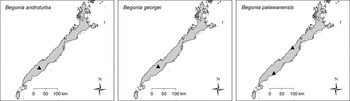
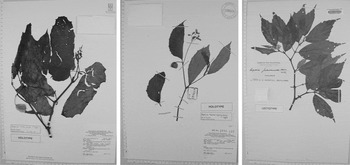
Begonia sect. Petermannia is the most species-rich section of the genus in Asia, containing 247 species (Hughes, Reference Hughes2008). Previously, only one species of Begonia from this section was known from Palawan, the endemic B. palawanensis Merr. (Merrill, Reference Merrill1912; Hughes, Reference Hughes2008). Here we describe two new species in Begonia sect. Petermannia, B. androturba C.Coyle and B. georgei C.Coyle, both also endemic to the island (Figs 1, 2). Their novelty and endemism has been confirmed following consultation with types and specimens for the other Philippine and Bornean species in Begonia sect. Petermannia in A, B, BISH, BM, BO, BRIT, E, K, L, MICH, P, PNH, SING and U. Protologues were consulted when no specimens were available.
Given the small number of specimens for all three species covered it is likely that more species will be found with further collecting. Therefore, this revision must be regarded simply as a starting point for further research rather than ‘the final word’. All specimens cited are available as digital images from Hughes & Pullan (Reference Hughes and Pullan2007).
Key to Begonia sect. Petermannia on Palawan
1a. Leaf base wedge-shaped 2
1b. Leaf base with one large lobe B. androturba
2a. Petioles glabrous, stipules > 15 mm long, male flowers with 4 tepals B. georgei
2b. Petioles with short hairs, stipules ≤ 15 mm long, male flowers with 2 tepals B. palawanensis
Species Descriptions
Begonia androturba C.Coyle, sp. nov. Sect. Petermannia. Figs 1,2.
Ab omnibus speciebus Begoniae sectionis Petermanniae insulae Palawanae foliis basis valde lobatus distincta. – Type: Philippines, Palawan, Tindogan District, Mantalingajan Mt. Range, Mt. Gantung, NNW slopes of headwaters of Tagwaya River, 19 viii 1996, 8°59′N, 117°49′E, Pipoly & Romero et al. 38072 (holo BRIT).
The distribution of Begonia androturba C.Coyle, B. georgei C.Coyle and B. palawanensis Merr. on Palawan.

The types of Begonia androturba (left; holo BRIT), B. georgei (middle; holo BISH) and B. palawanensis (right; lecto BM).

Erect caulescent herb c.1.5 m high. Stem slightly woody, glabrous, internodes 3–9 cm apart. Stipules lanceolate, c.12 × 5 mm, glabrous, with a filiform extension at the tip, deciduous. Leaves alternate; petiole 1.5–7.5 cm long, glabrous; lamina oblong-ovate, basifixed, asymmetric, with a well-developed basal lobe on one side giving a cordate appearance, other side rounded, 11–19.5 × 4.5–6.5 cm, midrib 8–14.5 cm long, venation palmate-pinnate, upper surface dark green with fleshy hairs scattered midway between the veins, underside red/maroon, with short fleshy hairs spaced along the veins and minute brown bristles scattered between the veins, margin dentate with main veins ending in teeth with shorter teeth between, apex acuminate. Inflorescence bisexual, terminal or pseudo-axillary, protogynous, with a single main axis, female flowers basal, male flowers distal and crowded in congested fascicles which are spaced in a linear fashion c.1 cm apart; bracts oval-lanceolate with an extended tip, 4–5 mm long, 2–3 mm wide, margin entire, laxly deciduous. Male flower: pedicel 3–5 mm long, glabrous; tepals 2, ovate-orbicular, white tinged with pink, glabrous, truncate at base, c.5 × 5 mm, margin entire; androecium symmetric, stamens 15–20, filaments fused at base into a short column, 0.5–1 mm long, slightly unequal; anther c.0.75 mm long, elliptic-globose, dehiscing through slits about half the length of the anther, slightly hooded, connective not extended. Female flowers unknown. Fruit rounded at base, pale brown, dehiscent, pedicel up to c.3 cm long; wings equal, extending along the pedicel for 3–5 mm, rounded at the tips, 20–28 × 5–7 mm; capsule oval, 12–20 × 6–8 mm; locules 3, placentae bifid.
Habitat. Found on steep slopes on ultramafic soils at altitudes of c.800 m.
Proposed IUCN conservation category. EN B2a,b(iii) (IUCN, 2001). It is only known from four collections from Mt. Gantung at altitudes of 700–800 m. The vegetation at this altitude is severely degraded and the protection status of the Mt. Mantalingahan region has yet to be officially declared, hence the conservation status proposed above.
Additional specimens examined. Palawan: Tindogan District, Mantalingajan Mt. Range, Mt. Gantung, NNW slopes of headwaters of Tagwaya River, 16 viii 1996, Pipoly & Romero et al. 37755 (BRIT); ibid., 17 viii 1996, Pipoly & Romero et al. 37815 (BRIT); ibid., 17 viii 1996, Pipoly & Romero et al. 37875 (BRIT).
This species is distinct from the other known species in Begonia sect. Petermannia from Palawan in having oblong-ovate leaves with a well-developed basal lobe on one side giving a cordate appearance, rather than lanceolate leaves which are cuneate (wedge-shaped) at the base; it is also a larger, coarser plant. The unbranched inflorescence with its clusters of male flowers spaced along a central axis is also distinctive. Its large size and congested inflorescence are somewhat reminiscent of Begonia ramosii Merr. (Luzon), but the leaves of B. androturba are more oblong in shape and the inflorescence has a more distinct central axis. The epithet ‘androturba’ (‘male crowd’) is derived from the inflorescence morphology.
Begonia georgei C.Coyle, sp. nov. Sect. Petermannia. Figs 1,2.
A Begonia palawanensis flore masculis tepalis 4 (haud 2) et petiolis glabris diagnoscenda. – Type: Philippines, Palawan, Brookes Point, Mt. Mantalingahan, 4 iii 1992, G.C.G. Argent & E. Romero PPI 9669 (holo BISH; iso BRIT, E [as G.C.G. Argent & E. Romero 92165]).
Erect caulescent herb c.1 m high. Stem slightly woody, glabrous, c.4 mm wide when dry, internodes 3–9 cm apart. Stipules broadly lanceolate, 17–25 × 5–7 mm, glabrous, with a filiform extension at the tip, deciduous. Leaves alternate; petiole 1–2.5 cm long, glabrous; lamina lanceolate, basifixed, asymmetric, base cuneate or rounded with one side decurrent on the petiole for c.2 mm, 8.5–13 × 2.5–5.5 cm, midrib 8.5–13 cm long, venation palmate-pinnate, upper surface green, glabrous, underside glabrous, margin glabrous, double dentate, apex acuminate. Inflorescence terminal, protogynous, bisexual or male; bracts ovate, 4–9 × 2–4 mm, margin entire, deciduous. Male flower: pedicel 5 mm long, glabrous, tepals 4, white or pink; outer tepals subovate, glabrous, 7–12 × 6–8 mm, margin entire; inner tepals obovate, c.5 × 2 mm; androecium symmetric, stamens 15–20, filaments slightly fused at base, slightly unequal; anther longer than the filament, 1.5 mm long, basal ones subsessile, inner ones on a very short filament, oblong-elliptic, dehiscing through slits longer than half the length of the anther, slightly hooded, connective not extended. Female flowers unknown. Fruit on a c.1.5 cm fairly stout pedicel; wings equal, 15 × 3–6 mm, rounded at the tips, extending along the pedicel for 2 mm; capsule oval, c.10 × 5 mm; locules 3, placentae bifid.
Habitat. Found in moist gulleys in montane/mossy forest at 1100–1700 m.
Proposed IUCN conservation category. VU D2 (IUCN, 2001). The isolation of the locality of this species from the nearest human habitation appears to have slowed further degradation (G. Argent, pers. comm.). However, given the apparent very restricted distribution of the species and the lack of any formal protection status for the site the category above is appropriate.
Additional specimens examined. Palawan: Brookes Point, Mt. Mantalingahan, 13 v 1947, G. Edaño PNH564 (PNH); ibid., 13 v 1947, G. Edaño PNH568 (PNH).
This species is vegetatively most similar to Begonia palawanensis but can be readily distinguished vegetatively by its glabrous petioles, larger stipules and slightly more asymmetric leaves with venation which is usually more palmate-pinnate than pinnate. The male flower tepals have four (not two) tepals and are also noticeably larger with much larger anthers; the female flowers remain unknown. Begonia palawanensis and B. georgei are most similar to B. longistipula Merr. (Samar, Mindanao) with which they share membranous leaves of a broadly similar shape and an erect branching habit; inter alia B. palawanensis differs in having much smaller fruit and stipules; B. georgei differs in having male flowers with four tepals. Argent & Romero 9669 was chosen as the type because the label indicates there are 10 duplicates, although the whereabouts of seven of these are unknown; unfortunately none were found to be incorporated in the PNH collections at the time of writing. The epithet honours the collector, George Argent. The isotype in E bears the original collection number (G.C.G. Argent & E. Romero 92165) rather than the PPI number. Begonia georgei is known from three collections on Mt. Mantalingahan, at relatively high altitudes of 1100–1700 m where the vegetation is comparatively intact and at a considerable walking distance from the nearest habitation.
Begonia palawanensis Merr. (Sect. Petermannia), Philipp. J. Sci. 6: 380 (1912 [‘1911’]); Merrill, Enum. Philipp. Fl. Pl. 3: 126 (1923). – Type: Philippines, Palawan, Napsahan, ix 1910, E.D. Merrill 7232 (lecto BM, designated here; isolecto B, BM, K, L, P, PNH). Figs 1,2.
Erect caulescent herb, c.50 cm high. Stem slightly woody, sparsely hairy or glabrous, 3–5 mm wide when dry, internodes 1.5–7.5 cm apart, nodes swollen. Stipules lanceolate, c.10 × 3 mm, glabrous, with a filiform extension at the tip, deciduous. Leaves alternate; petiole 4–15 mm long, red, with scattered short hairs denser than on the stem; lamina lanceolate, basifixed, slightly asymmetric, base cuneate to rounded, one side usually decurrent on the petiole for c.1 mm, 8–13 × 4–5.5 cm, midrib 8–13 cm long, venation pinnate-palmate; upper surface dark green, glabrous, underside pale green with scattered minute brown bristles, veins with occasional short hairs, margin with short hairs on the teeth, shallowly dentate, apex acuminate. Inflorescence up to 7 cm long, cymose, terminal, protogynous, bisexual, female flowers basal; bracts at the base of the inflorescence similar to the stipules, in the male part much smaller, 1–2 mm long, 1 mm wide, margin entire, deciduous. Male flower: pedicel 1–5 mm long, glabrous, tepals 2, pink, glabrous, ovate-orbicular, truncate to rounded at base, 4–5 × 4–5 mm, margin entire; stamens 15–20 in a small dense head; anthers small, c.0.5–0.75 mm, subglobose, hooded, dehiscing through slits half as long as the anther, filaments shorter than the anther, especially short in the basal stamens. Female flowers unknown. Fruit rounded at base, pale brown, dehiscent, pendulous, obtriangular; wings extending along the pedicel slightly, equal, rounded at the tips, 9–15 × 3–4 mm; capsule oval, 8–10 × 5–6 mm; locules 3, placentae bifid.
Habitat. ‘On banks of small streams in forests about 4 m above sea level’ (Merrill, Reference Merrill1912).
Proposed IUCN conservation category. EN B2a,b(iii) (IUCN, 2001). This assessment is based on the considerable pressures facing low altitude forest in Palawan (DENR/UNEP, 1997) and the fact that Begonia palawanensis is currently only known from two localities.
Additional specimen examined. Palawan: Brookes Point, 25 i 1991, F. Gaerlan & E. Sagcal 159 (BRIT).
This species is only known from two collections, including the type, and according to the protologue appears to be restricted to lowland forest. Given its lowland habitat it is possible that with further collecting this species would be found to be more widespread, contrary to the case of montane endemic species.
Acknowledgements
The support of the M. L. MacIntyre Trust, the Sibbald Trust, NERC Masters Studentships and SYNTHESYS (grants NL-TAF 1608, FR-TAF 1416 and DE-TAF 2181) is gratefully acknowledged. The curators of A, B, BISH, BM, BO, BRIT, E, K, L, MICH, P, PNH, SING and U are thanked for facilitating access to specimens. Mark Tebbitt and an anonymous reviewer are thanked for their insightful and constructive comments which helped the authors to improve the manuscript.