Introduction
Flue-cured tobacco (Nicotiana tabacum L.) is a major agricultural commodity in North Carolina, accounting for nearly $US650 million in farm gate receipts per annum (USDA 2018). Flue-cured tobacco from North Carolina is desired by international cigarette manufacturers due to its flavor and aroma (Brown and Snell Reference Brown, Snell and Fisher2017), which is in part achieved by exceptional weed control programs that help to ensure maximized leaf yield and quality while reducing the presence of weed material in cured leaf.
In current times, seven active ingredients representing Weed Science Society of America (WSSA) herbicide site of action groups 1, 3, 8, 13, 14, and 15 have been approved for use in commercial tobacco production (Vann et al. Reference Vann, Fisher, Inman, Seagroves and Whitley2017, Reference Vann, Fisher, Inman, Korres, Burgos and Duke2019). Among these herbicides, sulfentrazone (group 14), clomazone (group 13), and pendimethalin (group 3) are used most commonly by U.S. growers for residual, season-long weed control (Fisher et al. Reference Fisher, Burke, Price, Smith and Wilcut2006). Sulfentrazone is the primary herbicide used to control Palmer amaranth (Amaranthus palmeri S. Watson) (Vann et al. Reference Vann, Fisher, Inman, Seagroves and Whitley2017), which is one of the most troublesome and difficult to control weed species in the southern United States (Webster Reference Webster2013).
Widespread glyphosate-resistant (GR) Palmer amaranth has increased the reliance of group 14 herbicides in GR crops such as cotton, corn, and soybeans (Cahoon et al. Reference Cahoon, York, Jordan, Everman and Seagroves2014). As a result, Palmer amaranth that is resistant to group 14 herbicides have been confirmed in the U.S. states of Arkansas, Illinois, and Tennessee (Heap Reference Heap2019). Although Palmer amaranth resistance to protoporphyrinogen oxidase (PPO) has not yet been confirmed in North Carolina, there is suspicion that it may be present at very low levels (Mahoney Reference Mahoney2019; Place et al. Reference Place, Ammons and Everman2018). Should the dominant Palmer amaranth biotypes express resistance to PPO-inhibiting herbicides, commercial tobacco farmers will be left with marginal options for season-long chemical control (Vann et al. Reference Vann, Fisher, Inman, Seagroves and Whitley2017).
S-metolachlor is a soil residual herbicide applied preemergence (PRE) or before transplanting (PRETR) and belongs to WSSA group 15, which is labeled for use on more than 70 crops worldwide to control certain annual grasses and small-seeded broadleaf weeds (Shaner et al. Reference Shaner, Jachetta, Senseman, Burke, Hanson, Jugulam, Tan, Reynolds, Strek and McAllister2014; Zemolin et al. Reference Zemolin, Avila, Cassol, Massey and Camargo2014). S-metolachlor is presently labeled for use in a number of tobacco-producing countries; however, use patterns in a U.S. production system have not been described. The objectives of this study were to 1) identify the appropriate application placement and rate of S-metolachlor and 2) generate the crop tolerance data required to support a federal label for tobacco production in the United States.
Materials and Methods
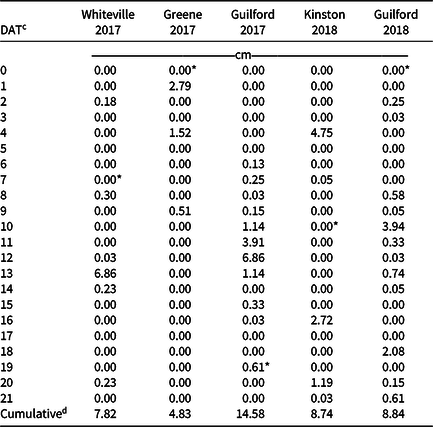
Field experiments were conducted in 2017 at the Border Belt Tobacco Research Station near Whiteville, North Carolina (34.4092°N, 78.7904°W), one on-farm location in Greene County, North Carolina (35.4869°N, 77.6291°W), and one on-farm location in Guilford County, North Carolina (36.0819°N, 79.6878°W). Research was repeated in 2018 at the Lower Coastal Plain Research Station near Kinston, North Carolina (35.2998°N, 77.5743°W) and at an additional on-farm location in Guilford County (36.1244°N, 79.611°W). Soil descriptions for each environment are presented in Table 1. Planting density in all environments was 14,820 plants ha–1, despite slight variation in row spacing (Table 1). Daily and cumulative precipitation for the 21-d period following herbicide application is presented in Table 2.
Description of soil series and texture, pH, humic matter, cation exchange capacity, row spacing, herbicide application dates, transplanting dates, final harvest dates at each growing location. a

a Abbreviations: CEC, cation exchange capacity; HM, humic matter.
b Fine-loamy, siliceous, semiactive, thermic Typic Paleaquults (70%–90% sand, 0%–30% silt, 0%–15% clay).
c Fine, mixed, active, thermic Ultic Hapludalfs (43%–85% sand, 0%–50% silt, 0%–20% clay).
d Fine-loamy, kaolinitic, thermic Typic Kandiudults (70%–90% sand, 0%–30% silt, 0%–15% clay).
e Fine-loamy, siliceous, subactive, thermic Aquic Paleudults (70%–90% sand, 0%–30% silt, 0%–15% clay).
f Fine, kaolinitic, thermic Typic Kanhapludults (43%–85% sand, 0%–50% silt, 0%–20% clay).
Daily and cumulative precipitation for each growing environment 21 d after herbicide application, 2017 and 2018. a,b

a Rainfall data provided by the North Carolina Climate Office – Climate Retrieval and Observations Network of the Southeast Database.
b Asterisks (*) denote transplanting date (Table 1).
c Abbreviation: DAT, days after herbicide application.
d Cumulative precipitation refers to total rainfall from the herbicide application date through 21 days later in each environment (Table 1).
The mean plot size was four rows wide by 15 m long, with the center two rows of each plot used for data collection and harvest. Recommended transplanting dates (Table 1), planting procedures, and other cultural practices for growing, harvesting, and curing were used (Fisher Reference Fisher2017). Treatment structure was a randomized complete block design with a two-by-two factorial arrangement of two S-metolachlor (Dual Magnum®, 914 g ai L−1, Syngenta Crop Protection, LLC, Greensboro, NC) application placements by two S-metolachlor application rates. S-metolachlor was applied at 1× and 2× the manufacturer’s generally recommended use rate (1.07 and 2.14 kg ai ha−1) both pretransplanting incorporated (PTI) and PRETR. Application rates of S-metolachlor were based upon current label recommendations established in other cropping systems (Anonymous 2019). A nontreated, cultivated control plot was included within each replication. Treatments were replicated three or four times within each environment. All herbicides were applied with a CO2-pressurized backpack sprayer equipped with TeeJet TTI 11002-VP nozzles (Spraying Systems Co., Wheaton, IL) calibrated to deliver 187 L ha−1 at 173 kPa.
Standard management practices were employed at each location and followed North Carolina Cooperative Extension Service recommendations (Fisher Reference Fisher2017). Experimental areas were conventionally tilled with a disc harrow to a depth of 10 cm to remove vegetation from previous crops. After disc harrowing, a field cultivator was utilized to produce a fine, homogenized soil texture. A ripper/bedder was subsequently used to form a high row ridge (bed) measuring approximately 20 to 25 cm in height. Plots were subsequently tilled again with a field cultivator to remove the crest of each row ridge, thus allowing for a flatter application surface measuring roughly 5 cm in height. PTI treatments were then applied to the soil surface and were immediately rebedded using the ripper/bedder with no further incorporation before rebedding. The manner in which PTI treatments were incorporated concentrates the herbicide being used in the center of the row bed, or plant rooting zone. This incorporation method may promote herbicide injury compared to the practice of broadcast applying an herbicide to the entire field, incorporating uniformly with a disc harrow or field cultivator, then bedding, and was implemented in order to simulate a worst-case scenario PTI application. After incorporation and rebedding, the row ridges were again removed with a field cultivator to a similar height achieved by a mechanical transplanter (approximately 12 to 14 cm). Pretransplanting treatments were applied directly to the soil surface. Tobacco transplanters at each location were adjusted to minimize disturbance of the soil surface during transplanting. The methodology employed in this study was previously described by Fisher et al. (Reference Fisher, Smith and Wilcut2003a, Reference Fisher, Smith and Wilcut2003b).
Posttransplanting cultivation events were performed in all plots to promote the continued building of a high row ridge and to eliminate early-season weed infestations. The number of cultivations each season was determined by personnel from each location based on soil and environmental conditions. On average, cultivation events occurred two to four times at each location and were suspended approximately 45 d after transplanting, when crop size prevented cultivation without crop damage. No other weed control measures were performed after this interval.
Visual estimates of tobacco injury were collected 2 and 6 wk after transplanting (WAT) using a scale of 0 to 100, with 0 = no injury and 100 = total plant death. Tobacco injury consisted of a composite rating of growth reduction and number of stunted plants relative to the nontreated control. Additionally, stalk height of 10 tobacco plants per plot were measured after final harvest. In 2018, tobacco stalk heights were also recorded at final cultivation which occurred 6 WAT.
Plots were harvested four times, once for each stalk position group and cured in forced-air bulk curing barns at each location. After curing, weights of cured leaf from each plot were recorded by stalk position to determine yield. Leaf quality was assessed using USDA grading standards, which were then correlated to numerical values based on information published by Fisher et al. (Reference Fisher, Vann, Barnes and Fisher2017). Each USDA quality grade has an associated numerical grade index value ranging from 1 to 100 that describes leaf maturity and ripeness (Bowman et al. Reference Bowman, Tart, Wernsman and Corbin1988). For each plot, 50-g composite samples of cured leaves were prepared using a weighted-mean calculation to represent each stalk position. Composite cured leaf samples (50 g) were also collected from each treatment for analysis of total alkaloid and reducing sugar concentrations using the methods outlined by Davis (Reference Davis1976).
Analysis of variance was conducted using the PROC Mixed procedure in SAS (version 9.4, SAS Institute, Cary, NC) to test the effects of herbicide program on visual injury, stalk height, yield, quality, value, and leaf chemistry. Two statistical analyses were conducted for each parameter. A Dunnett’s t-test was used to compare the nontreated control to each treatment combination of S-metolachlor application method and rate in the first analysis. In analysis two, the nontreated control was excluded, resulting in a two-by-two factorial designation for the main effects of S-metolachlor application placement (PTI and PRETR) and rate (1× and 2×). Data for the nontreated control was not included in analysis of visual estimates of tobacco injury; therefore, visual injury was not subjected to a Dunnett’s t-test. In both analyses, herbicide rate and application placement were considered to be fixed effects, whereas environment and replication were considered as random effects. Treatment means were reported using least square means. Means were separated using Tukey’s honestly significant difference (HSD) test at P ≤ 0.10. Injury was most pronounced at the Whiteville and Kinston locations; therefore, data for those two environments are presented individually. Results for Guilford-2017, Greene-2017, and Guilford-2018 were similar; therefore, data for these locations were pooled, and are referred to as combined locations.
Results and Discussion
Whiteville
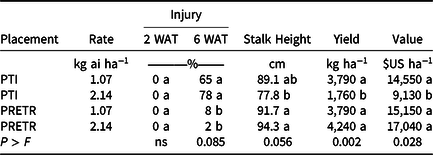
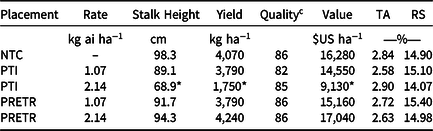
Tobacco injury was not observed 2 WAT but was significant 6 WAT (Table 3). At 6 WAT, injury was influenced by the interaction of S-metolachlor application placement and rate. Visual injury following PTI applications was 65% and 78% in response to 1× and 2× rates, whereas at these same rates applied PRETR, injury was 8% and 2% (Table 3). A similar effect on stalk height after harvest was observed (P = 0.056). Regardless of application rate, tobacco plants in treatments receiving PRETR applications were taller than those in the PTI-2× treatment (Table 3). Stalk height in the PTI-1× treatment was intermediate (Table 3), thus indicating that slight recovery from early-season injury may have occurred at the lower application rate. Furthermore, when using the Dunnett’s t-test, plants in the PTI-2× treatment were 29.4 cm shorter than the nontreated control (P = 0.003; Table 4).
Flue-cured tobacco visual injury 2 and 6 wk after transplanting, end of season stalk height, yield, quality, and value at the Whiteville growing location as influenced by the interaction of S-metolachlor application placement and rate. a,b

a Treatment means followed by the same letter within the same column are not significantly different according to Tukey’s honestly significant difference test at P = 0.10.
b Abbreviations: PTI, pretransplanting incorporated; PRETR, pretransplanting soil applied; WAT, weeks after transplanting.
End of season stalk height, cured leaf yield, quality, value, and total alkaloid and reducing sugar concentrations resulting from S-metolachlor placement and rate compared to the nontreated control using Dunnett’s t-test at the Whiteville growing location in 2017. a,b

a Abbreviations: NTC; nontreated control; PTI, pretransplanting incorporated; PRETR, pretransplanting soil applied; RS, reducing sugar; TS, total alkyloid.
b Asterisks (*) indicate significantly different from the nontreated control at the α = 0.10 level.
c Cured leaf quality is assessed on a scale of 1 to 100, with 100 being of the highest quality.
Injury and stunting observed in the PTI-2× treatment reduced cured leaf yield and value by 2,320 kg ha−1 (P = 0.002) and $US7,150 ha−1 (P = 0.007) relative to the nontreated control (Table 4). When the nontreated control was removed from data analysis, cured leaf yield and value were influenced by the interaction of S-metolachlor application placement and rate. Both parameters were maximized in PRETR or the PTI-1× treatments (Table 3). The PTI-2× treatment produced the lowest yield and value (Table 3), following the previous trends noted in reference to injury and end of season stalk height. Within this environment, cured leaf quality and chemistry (total alkaloid and reducing sugar concentration) were not affected by treatments (Tables 3 and 4).
Significant injury resulting from the S-metolachlor applied PTI was not surprising, as other herbicides applied to tobacco in this manner also cause injury (Collins and Hawks Reference Collins and Hawks2013; Fisher et al. Reference Fisher, Smith and Wilcut2003b; Peedin Reference Peedin, Davis and Neilsen1999). Though it is difficult to explain why injury was not observed in Whiteville 2 WAT, it is likely due to a combination of rainfall and coarse soil texture (Tables 1 and 2). Whiteville received 0.18 cm of rainfall between S-metolachlor application and transplanting and 7.65 cm in the 2 WAT (Table 2). A single event delivered 6.86 cm of rainfall 6 d after transplanting, which could have leached PTI treatments further into the soil profile and rooting zone. It is likewise possible that the onset of injury symptoms simply required too much time in order for it to be observed 2 WAT. A similar observation was reported by Abukari et al. (Reference Abukari, Shankle and Reddy2015), who noted that marketable storage roots of sweet potato [Ipomoea batatas L. (Lam)] declined by 18% and 30% in the absence of rainfall and by 55% and 79% in the presence of rainfall when S-metolachlor was applied at 0.86 kg ai ha−1 and 1.43 kg ai ha−1, respectively.
Kinston
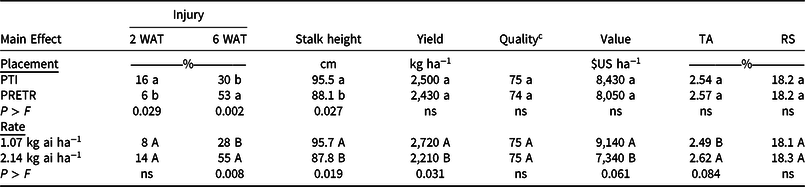
Injury was documented as early as 2 WAT at the Kinston location and was influenced by application placement. Tobacco injury was higher with PTI (16%) compared to PRETR (6%), while application rate was not significant 2 WAT (Table 5). Interestingly, the opposite was observed relative to application placement 6 WAT. The PRETR placement (53%) was more injurious than PTI (30%; Table 5). Application rate was also significant, as the 2× application rate resulted in nearly 30% more injury relative to the 1× rate (Table 5). The interaction of application placement and rate was not significant at either rating interval.
The influence of S-metolachlor application placement and rate to flue-cured tobacco visual injury 2 and 6 wk after transplanting, end of season stalk height, yield, quality, value, and total alkaloid and reducing sugar concentrations at the the Kinston growing location. a,b

a Treatment means followed by the same lower-case or upper-case letter within the same column and main effect are not significantly different according to Tukey’s honestly significant difference test at P = 0.10.
b Abbreviations: PTI, pretransplanting incorporated; PRETR, pretransplanting not incorporated; RS, reducing sugar; TS, total alkyloid; WAT, weeks after transplanting.
c Cured leaf quality is assessed on a scale of 1 to 100, with 100 being of the highest quality.
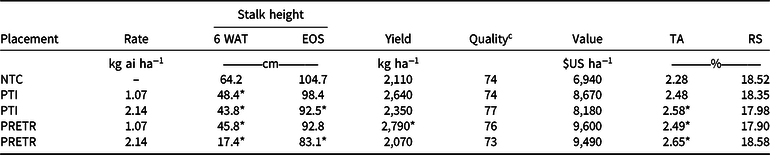
Tobacco plant height 6 WAT was maximized in the nontreated control (64 cm) and reduced by 16, 20, 18, and 47 cm in the PTI-1× (P = 0.011), PTI-2× (P = 0.002), PRETR-1× (P = 0.004), and PRETR-2× (P = <0.001) treatments (Table 6). When the nontreated control was removed from the data analysis, the interaction of application placement and rate was significant (P = 0.006). Plants within the PTI-1× (48 cm), PTI-2× (44 cm), and PRETR-1× (46 cm) treatments were significantly taller than those in the PRETR-2× treatment (17 cm). Stunting was likewise apparent after final harvest, which was 121 d after transplanting in this environment. Compared to the nontreated control, PTI-2× (P = 0.065) and PRETR-2× (P = 0.001) treatments reduced stalk height (Table 6). The main effects of rate and application were likewise significant (Table 5). Tobacco stalk height was 7 cm taller in PTI treatments relative to PRETR, and 8 cm taller in 1× versus 2× treatments (Table 5).
Stalk height, cured leaf yield, quality, value, and total alkaloid and reducing sugar concentrations resulting from S-metolachlor placement and rate compared to the nontreated control using Dunnett’s t-test at the Kinston growing location in 2018. a,b

a Abbreviations: EOS, end of season; NTC, nontreated control; PTI, pretransplanting incorporated; PRETR, pretransplanting soil applied; RS, reducing sugar; TA, total alkaloid; WAT, weeks after transplanting.
b Asterisks (*) indicate significantly different from the nontreated control at the α = 0.10 level.
c Cured leaf quality is assessed on a scale of 1 to 100, with 100 being of the highest quality.
A significant yield increase of 680 kg ha−1 is observed in the PRETR-1× program (P = 0.056) when the combination of S-metolachlor placement and rate are compared to the nontreated control using Dunnett’s t-test (Table 6). This is most likely due to improved weed control and moderate plant injury. Interestingly, the main effect of S-metolachlor placement was not significant for cured leaf yield, quality, value, or cured leaf chemistry, despite early- and midseason injury (Table 5). In contrast, cured leaf yield and value were improved by 510 kg ha−1 and $US1,800 ha−1 as the application rate was reduced from 2× to 1× (Table 5). In addition, cured leaf total alkaloid concentration was affected by S-metolachlor application rate, with the 2× rate having a higher concentration than the 1× rate (Table 5). The decline in total alkaloid concentration is likely a result of vegetative dilution since yield was simultaneously improved in the 1× rate (Table 5). In general, factors that improve cured leaf yield will likewise reduce total alkaloid concentration as a result of increased biomass and root growth (Henry et al. Reference Henry, Vann and Lewis2019). Cured leaf quality and reducing sugar concentration were not influenced by application rate in this environment.
Increased injury resulting from PRE applications of S-metolachlor have been reported in other crops. For example, Sikkema et al. (Reference Sikkema, Shropshire and Soltani2009) reported that visible injury was generally greater in black and white dry bean (Phaseolus vulgaris L.) with S-metolachlor alone or in combination with fomesafen applied PRE relative to PPI. S-metolachlor injury in two black bean cultivars was also documented by Soltani et al. (Reference Soltani, Shropshire, Cowan and Sikkema2004). Most consistently, PRE applications were more injurious compared to PPI applications, and were attributed to exposure of bean seedlings to higher concentrations of the herbicide during emergence (Soltani et al. Reference Soltani, Shropshire, Cowan and Sikkema2004). At Kinston 6 WAT the injury from S-metolachlor applied PRETR is likely a result of the high application rate and coarse-textured soil, followed by a 4.75-cm rainfall event 4 d after application (Table 2) that could have leached the herbicide into the rooting zone. Crop injury resulting from high rates of S-metolachlor has been documented in other crops as well. Meyers et al. (Reference Meyers, Jennings and Monks2012) reported that S-metolachlor applied at 3.4 kg ha−1 immediately after transplanting reduced sweetpotato growth by 23%, and that growth reduction was less when the herbicide was applied at 2.2 kg ai ha−1 (6%) and 1.1 kg ha−1 (0%). Fennimore et al. (Reference Fennimore, Smith and McGriffen2001) found fresh market spinach (Spinacia oleracea L.) to be tolerant to S-metolachlor up to rates of 1.06 kg ai ha−1 across multiple soil types, with rates above 1.06 kg ai ha−1 producing unacceptable injury. Similar observations were documented in transplanted lettuce, where crop injury was directly related to PRETR rates of S-metolachlor. Lati et al. (Reference Lati, Mou, Rachuy, Smith, Dara, Daugovis and Fennimore2015) reported that injury increased as application rate increased but, rates up to 2.8 kg ai ha−1 caused little to no injury.
S-metolachlor has the potential to leach in soils with less than 2% organic matter (Shaner et al. Reference Shaner, Jachetta, Senseman, Burke, Hanson, Jugulam, Tan, Reynolds, Strek and McAllister2014) and a high risk of crop injury in coarse-textured soils, particularly when intense rainfall occurs soon after application (Anonymous 2019; Procópio et al. Reference Procópio, Silca, Santos, Ferreira, Miranda and Siqueira2001). At Kinston, it is plausible that rainfall leached PRETR herbicides into the rooting zone and leached PTI herbicides below the rooting zone. According to label recommendations, S-metolachlor application should not exceed 1.42 kg ha−1 for coarse-textured soils (Anonymous 2019), similar to those found at the Kinston field site (Table 1). In addition, Kinston received a total 8.74 cm of rainfall in during the first 3 wk after herbicide application (Table 2), which may have been sufficient to leach S-metolachlor through the soil profile (Gannon et al. Reference Gannon, Hixson, Weber, Shi and Yelverton2013; Procópio et al. Reference Procópio, Silca, Santos, Ferreira, Miranda and Siqueira2001). This phenomenon was previously reported by Bollman and Sprague (Reference Bollman and Sprague2008) who documented increased injury in sugarbeet (Beta vulgaris L.) following significant rainfall within 7 d after PRE applications. The two biggest rainfall events at Kinston occurred 6 d before and after transplanting (4.75 and 2.72 cm, respectively; Table 2).
Combined Locations
Visual injury was <1.5% among all treatments 2 WAT and was not influenced by treatments. At the 6 WAT interval, the main effect of S-metolachlor rate was significant (P = 0.013) with the 2× rate (5%) injuring tobacco more than the 1× rate (2%). Injury was relatively low in the combined environments (≤5%) and did not affect stalk height, yield, quality, or value (data not shown). In addition, the Dunnett’s t-test was not significant for those same parameters (data not shown); further indicating tobacco tolerance to S-metolachlor was acceptable at these locations. In contrast, the cured leaf total alkaloid concentration was influenced by the interaction of application method and rate (P = 0.068). An immediate trend is not apparent, except that alkaloids were greatest in the PTI-2× treatment (3.13%) and lowest in the PRETR-2× treatment (2.89%). Alkaloid levels in the PRETR-1× (2.99%) and PTI-1× (2.96%) treatments were intermediate. Cured leaf reducing sugar concentration was influenced by herbicide application method (P = 0.007), with the PRETR application (14.0%) having a higher sugar concentration than the PTI application (12.9%). Despite significant differences in total alkaloid and reducing sugar concentration, it is not likely that these treatments would affect cigarette quality as concentrations of both compounds are within normal ranges for flue-cured tobacco (Collins and Hawks Reference Collins and Hawks2013). The Dunnett’s t-test was not significant for total alkaloids and reducing sugars.
The ability of tobacco to tolerate S-metolachlor within the combined growing environments, regardless of application rate or placement, is likely a combination of soil type and precipitation. At both Guilford County locations, the soil type allowed for higher application rates of S-metolachlor (Table 1), based upon current label information (Anonymous 2019). In addition, the leaching potential of S-metolachlor is largely dependent on soil type (Zemolin et al. Reference Zemolin, Avila, Cassol, Massey and Camargo2014); leaching potential of S-metolachlor decreases with an increase in soil clay content (Gannon et al. Reference Gannon, Hixson, Weber, Shi and Yelverton2013). Therefore, it is likely that the higher clay content of the Guilford County locations restricted S-metolachlor movement through the soil. Though the soil type at the Greene County-2017 location (Table 1) would prohibit applications above 1.4 kg ha−1, precipitation was relatively low in this environment and it is plausible rainfall was insufficient to leach S-metolachlor into the rooting zone (Table 2).
Tolerance of flue-cured tobacco to S-metolachlor can vary depending on herbicide application rate, application placement, environmental conditions, and soil characteristics. The combination of environmental conditions, specifically rainfall and soil characteristics, appear to have the greatest influence on the movement of S-metolachlor through the soil profile which, in turn, may impact injury potential. Generally, tobacco was much more tolerant to S-metolachlor applied at the 1× rate, regardless of herbicide placement, environmental conditions, and soil characteristics. Furthermore, PRETR applications appear to be more suitable for commercial applications in tobacco when compared to those applied PTI. Despite the safening activity afforded by PRETR applications, intense rainfall (>6.0 cm before and/or after transplanting) may move the herbicide into the rooting zone and does offer potential for growth reduction that could be greater than acceptable.
It may also be plausible that the two rates evaluated were simply too high for pretransplanting conditions. Ultimately, further research is warranted to identify appropriate application rates for coarse-textured soils where tobacco is more commonly produced. Additional methods of incorporation, such as the use of a field cultivator or rotary-tiller, should also be evaluated with respect to PTI applications.
Acknowledgments
We thank Tyler Whaley and Chris Jernigan for coordinating the on-farm research trial in Greene County. We extend our gratitude to A&M Clapp Farms (Guilford County) and Murphy Farms (Greene County) for hosting research trials. Finally, we thank the staff of the Border Belt Research Station in Whiteville; the Lower Coastal Plain Research Station in Kinston; and Rick Seagroves and Scott Whitley with the Tobacco Research Program at North Carolina State University for their efforts with trial establishment, treatment application, and data collection. This research received no specific grant from any funding agency, commercial or not-for-profit sectors. No conflicts of interest have been declared.