I. INTRODUCTION
In industrial hot forming processes, high-temperature deformation behaviors of metals or alloys are very complicated under variable hot deformation parameters, such as deformation temperature, strain rate, strain, etc. Reference Lin and Chen1 Meanwhile, the microstructural evolution (dislocation generation, phase transformation, etc.) in metals or alloys often occurs during hot deformation. Reference Chen, Cui and Chen2,Reference Smirnov, Konovalov, Pushin, Uksusnikov, Zvonkov and Zajcev3 Additionally, complex deformation mechanisms (strain hardening, dynamic recovery, dynamic recrystallization, etc.) further affect the final mechanical properties of materials. Reference Momeni, Ebrahimi and Faridi4−Reference Serajzadeh, Ranjbar Motlagh, Mirbagheri and Akhgar6 The constitutive models are often used to analyze the high-temperature deformation behavior and predict flow stress. Reference Lin and Chen1 Therefore, the establishment of accurate constitutive models to predict the high-temperature deformation behavior is very important for optimizing hot forming parameters.
In recent years, considerable constitutive models have been developed to describe the high-temperature deformation behavior of metals or alloys. Lin and Chen Reference Lin and Chen1 presented a critical review on some experimental findings and constitutive models for metals or alloys under hot working. The constitutive models were mainly composed of three categories, including the phenomenological models, physically based models and artificial neural network models. Among phenomenological constitutive models, the Arrhenius hyperbolic-sine equation is most widely used. Reference Lin and Chen1 Considering the effect of strain on material constants, some researchers proposed the revised Arrhenius models to describe the high-temperature deformation behaviors of steels, Reference Lin, Chen and Zhong7–Reference Churyumov, Khomutov, Solonin, Pozdniakov, Churyumova and Minyaylo10 aluminum alloys, Reference Chen, Zhao and Yu11–Reference Lin, Xia, Chen and Chen13 magnesium alloys, Reference Tali, Mazinani, Ferdowsi, Ebrahimi and Marvi-Mashhadi14,Reference Liao, Wu, Wu, Zhu and Lee15 and other alloys. Reference Pilehva, Zarei-Hanzaki, Fatemi-Varzaneh and Khalesian16,Reference Shukla, Narayana Murty, Sharma and Mondal17 Meanwhile, based on physical and metallurgical backgrounds, Mirzadeh Reference Mirzadeh18–Reference Mirzadeh20 developed suitable constitutive equations to describe the flow behaviors of magnesium alloys, aluminum-based composites, etc. Also, some improved Johnson–Cook constitutive models have been developed to predict the high-temperature flow stresses of steels, Reference Salari, Naderi and Bleck21–Reference Akbari, Mirzadeh and Cabrera24 titanium alloys, Reference Cai, Wang, Zhai, Li and Yang25 aluminum alloys, Reference Lin, Li and Jiang26,Reference Tan, Zhan, Liu, Huang, Guo and Yang27 etc. Among physically based models, the Kocks-Mecking model, in which the dislocation density is treated as an internal variable representing the microstructural state of materials, is widely applied to describe the high-temperature deformation behaviors of different alloys. Reference Kocks and Mecking28,Reference Liang, Nan, Ning, Li, Zhang, Shi and Guo29 Combining dislocation density theory with dynamic recrystallization mechanism, some physically based constitutive models are developed to describe the strain hardening, dynamic recovery and dynamic recrystallization behaviors of titanium alloy, Reference Ning, Luo, Liang, Guo, Zhang and Tan30 GH4169 superalloy, Reference Lin, Chen, Wen and Chen31 SA508-III steel, Reference Dong, Chen and Cui32 42CrMo steel, Reference Lin, Chen and Zhong33 N08028 alloy, Reference Wang, Liu, Zuo and Chen34 ultralow carbon stainless steel, Reference He, Xie, Yang, Wang and Zhang35 etc.
Due to the excellent high-temperature characteristics, Ni-based superalloys are widely applied in aviation and energy industries. In past decades, several constitutive models Reference Lin, Chen, Wen and Chen31,Reference Lin, Li, Li, Chen, Chen and Wen36–Reference Satheesh Kumar, Raghu, Bhattacharjee, Appa Rao and Borah39 were developed to predict the flow stresses of Ni-based superalloys. Reasonable processing maps of some typical Ni-based superalloys were established to optimize hot deformation parameters. Reference Wen, Lin, Li, Chen, Deng and Li40–Reference Liu, Ning, Nan, Liang, Li and Zhao43 Also, the dynamic recrystallization behaviors, Reference Lin, Wu, Chen, Chen, Wen, Zhang and Li44–Reference Ning, Xie, Li and Fu48 grain boundaries characteristics, Reference Chen, Lin, Chen, Li, Wen, Zhang and He49 hot tensile fracture characteristics, Reference Lin, Deng, Jiang, Wen and Liu50 and necking behavior during superplastic deformation Reference Huang, Qi, Yu, Xin, Liu, Sun and Hu51 of some typical Ni-based superalloys were investigated. Additionally, the influences of the initial δ phase (Ni3Nb), one special precipitate in nickel-based superalloys, on hot deformation behaviors are very complex. Lin et al. Reference Lin, Deng, Jiang, Wen and Liu52 found that the δ phase can cause the obvious work hardening at the beginning of hot tensile deformation, and then accelerates the flow softening by promoting the dynamic recrystallization with further straining. Wen et al. Reference Wen, Lin, Chen, Chen, Zhang, Liang and Li53,Reference Wen, Lin, Chen, Deng, Chen, Zhang and He54 discussed the effects of initial aging time (initial δ phase) on work-hardening behaviors, processing map, and microstructural evolution of GH4169 superalloy. He et al. Reference He, Lin, Chen, Chen, Wen and Chen55 discussed effects of pre-treatment on hot deformation behavior and processing map of an aged nickel-based superalloy. Lin et al. Reference Lin, He, Zhou, Wen and Chen56 developed a new constitutive model for hot deformation behaviors of GH4169 superalloy considering the effects of the initial δ phase.
Obviously, reasonable research studies were carried out to study the high-temperature deformation behavior and establish the constitutive models for Ni-based superalloys. However, the physical mechanisms of high-temperature deformation behavior need to be further investigated, and the developed constitutive models still cannot apply under time-variant hot working condition. In present study, isothermal compressive tests are carried out for a Ni-based superalloy at different deformation temperatures and strain rates. The high-temperature deformation characteristics before peak stress are focused. A detailed analysis of strain hardening effect and dynamic recovery behavior is conducted. The effects of deformation temperature, strain rate and initial grain size on flow stress are analyzed in detail. According to the dislocation density theory, a new unified physically based constitutive model is developed to describe the strain hardening effect and dynamic recovery behavior of the studied superalloy. Furthermore, the developed constitutive model is successfully used in the time-variant hot working conditions.
II. MATERIALS AND EXPERIMENTS
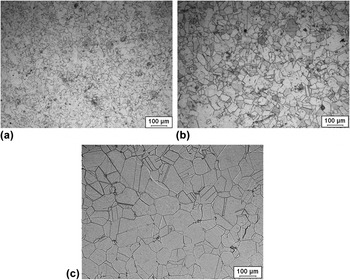
A commercial Ni-based superalloy is applied in the present study with the chemical composition (wt%) of 52.82Ni–18.96Cr–5.23Nb–3.01Mo–1.00Ti–0.59Al–0.03C–0.01Co–(bal.)Fe. The material was received in a wrought state. Cylindrical samples were machined with 8 mm diameter and 12 mm height. Firstly, the samples were solution treated at 1040 °C for 0.75 h to homogenize the microstructure and immediately followed by water quenching. Considering the effects of initial grain size on high-temperature deformation behavior, three different initial grain sizes, 33, 48, and 75 μm, were obtained by suitable pre-treatments. Figure 1 shows the original microstructures of the studied superalloy with different initial grain sizes. It can be found that the microstructures consist of fine equiaxed grains, and there are no obvious precipitates. The isothermal compressive tests were performed on a Gleeble3500 thermo-mechanical simulator. The samples were first heated to the deformation temperature at a heating rate of 10 °C/s, and then soaked for 5 min at the deformation temperature before loading. Five deformation temperatures (920, 950, 980, 1010, and 1040 °C) and four strain rates (0.001, 0.01, 0.1, and 1 s−1) were applied in present study. The height of samples were isothermally compressed with 70% reduction, and followed by water quenching. The experimental data were automatically recorded by testing system during isothermal compression.
Optical microstructures of the studied superalloy with initial grain sizes of: (a) 33 μm; (b) 48 μm; (c) 75 μm.

III. HIGH-TEMPERATURE DEFORMATION BEHAVIOR
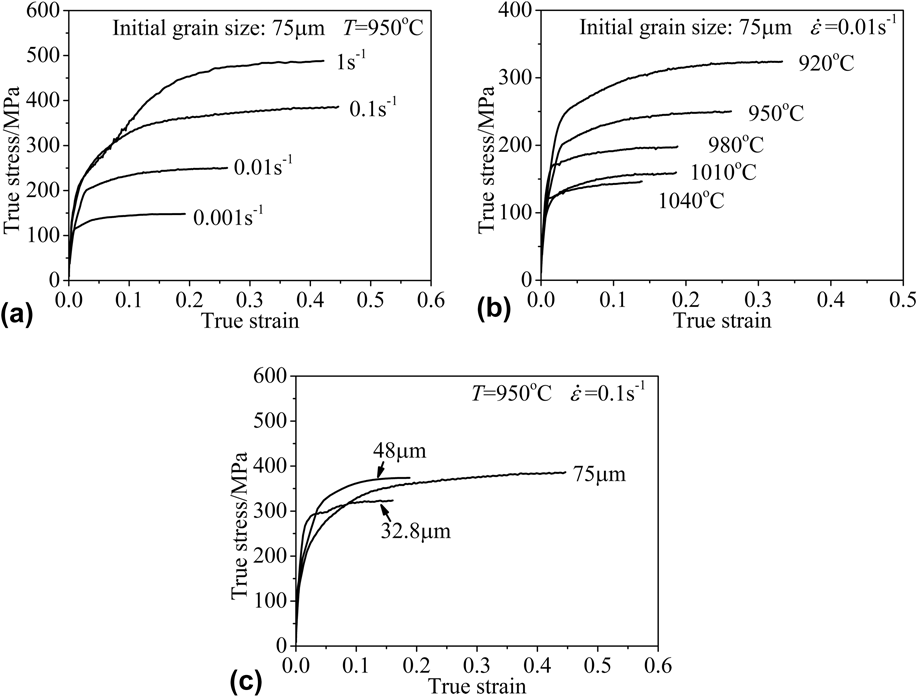
Figure 2 shows the typical true stress–true strain curves of the studied superalloy before the peak stress. Obviously, deformation temperature, strain rate and initial grain size significantly affect the high-temperature deformation behavior of the studied superalloy. From Figs. 2(a) and 2(b) it can be found that the flow stress increases with decreasing deformation temperature or increasing strain rate. In the elastic deformation stage, the flow stress is proportional to the elasticity modulus of the material, and there is no obvious microstructural evolution. When the plastic strain appears, the strain hardening induced by dislocation generation and multiplication further promotes the increase of flow stress. Meanwhile, the effects of dynamic recovery on flow stress become more and more significant with the further straining. With the increase of strain, the strain-hardening rate gradually decreases, and the increasing rate of flow stress decreases, showing a typical strain hardening-dynamic recovery stage. When the strain-hardening rate decreases to zero, the peak stress is reached. It can be concluded that the flow behavior is mainly affected by the competition between the strain hardening and dynamic softening under plastic deformation. Of course, the dynamic recrystallization is another main mechanism for the dynamic softening of alloys with low stack fault energy, such as the studied Ni-based superalloy, austenitic steel, etc. Reference Momeni, Kazemi, Ebrahimi and Maldar57–Reference Quan, Wang, Liu and Zhou60 According to authors' early work, Reference Lin, Chen and Zhong33,Reference Chen, Lin, Chen, Li, Wen, Zhang and He49 the critical strain (εc) for the occurrence of dynamic recrystallization always is lower than the peak strain (εp, corresponding to peak stress). Moreover, the relationship between critical strain and peak strain can be usually represented as εc = kεp. k is the material constant, and 0.8 < k < 0.85. Thus, the dynamic recrystallization stage is very short before peak stress, and the effects of dynamic recrystallization on the high-temperature deformation behavior of the studied superalloy before the peak stress are not obvious.
Typical true stress–true strain curves of the studied superalloy at: (a) deformation temperature of 950 oC and initial grain size of 75 μm; (b) strain rate of 0.01 s−1 and initial grain size of 75 μm; (c) deformation temperature of 950 oC and strain rate of 0.1 s−1.

From Fig. 2(c), it can be found that the effects of initial grain size on the high-temperature deformation behavior are significant. The strain-hardening rate of the studied superalloy with fine grain is higher than that with coarse grain at an early deformation stage. On the one hand, the microstructure with fine grains provides numerous grain boundaries for strengthening the material. On the other hand, the mean free path of dislocation in the microstructure with fine grain is short, and the rapid increase of dislocation density results in the high strain-hardening rate. When the critical dislocation density is reached, the dynamic recrystallization takes place. Therefore, the strain hardening-dynamic recovery stage of the studied superalloy with fine grains is shorter than that with coarse grains. Due to the effects of dynamic recrystallization on high-temperature deformation behavior, the peak stress of the studied superalloy with fine grains is lower than that with coarse grains.
IV. A UNIFIED PHYSICALLY BASED CONSTITUTIVE MODEL BASED ON DISLOCATION DENSITY THEORY
Generally, the hot deformation process of alloys can be divided into two stages, including elastic and plastic stages. Compared with the plastic stage, the elastic stage is very short, and can be simply described by Hooke's law. Furthermore, the effects of deformation parameters and initial grain size on high-temperature deformation behavior are very complicated. Meanwhile, the complex microstructural evolution often occurs in the plastic stage.
When the externally applied loading exceeds the yield limit of the material, the macroscopic plastic deformation appears. Meanwhile, the movement of dislocations in crystal lattices takes place in the microscale. According to Sec. III, the dynamic recrystallization stage is very short before peak strain which corresponds to peak stress, and the effects of dynamic recrystallization on the high-temperature deformation behavior of the studied superalloy before peak strain are not obvious. Then, the deformation stage before peak strain can be simplified as a strain hardening-dynamic recovery process. Therefore, the following sections focus on the high-temperature deformation characteristics before peak strain. Based on the classical dislocation density theory, Reference Kocks and Mecking28 the flow stress can be assumed as:
 $$\sigma = {\sigma _{\rm{y}}} + {\sigma _{\rm{i}}}\quad ,$$
where σy is the yield stress and σi is the stress induced by the interactions of dislocation substructures.
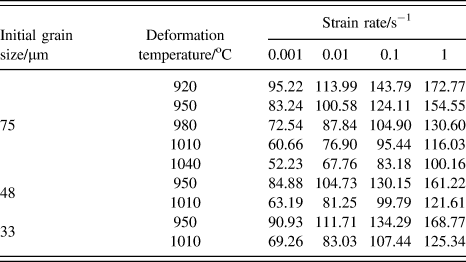
The values of yield stresses under the tested conditions can be directly obtained from the true stress–true strain curves, as listed in Table I. It can be found that the yield stress of the studied superalloy not only depends on deformation temperature and strain rate, but also on the initial grain size. According to authors' previous work, Reference Chen, Lin and Ma61 the yield stress can be assumed as,
 $${\sigma _{\rm{y}}} = {A_{\rm{y}}}d_0^{{m_{\rm{y}}}}{\left( {\dot \varepsilon \exp \left( {{{{Q_{\rm{y}}}} \over {RT}}} \right)} \right)^{{n_{\rm{y}}}}}\quad ,$$
where A y, m y, and n y are material constants, Q y is experimental activation energy, and R is the universal gas constant [8.314 J/(mol K)].
The values of yield stresses (σy) under the tested conditions (MPa).

Substituting the data listed in Table I into Eq. (2), the values of material parameters A
y, m
y, n
y, and Q
y can be determined by
 $\ln {\sigma _{\rm{y}}} - \ln \dot \varepsilon$
, lnσy − 1/T, and lnσy − lnd
0 plots, as shown in Fig. 3. Then, it is easy to evaluate the average values of A
y, m
y, n
y, and Q
y as 0.708, −0.123, 0.09, and 663.870 kJ/mol, respectively. Therefore, the model for yield stress of the studied superalloy can be expressed as,
 $${\sigma _{\rm{y}}} = 0.708d_0^{ - 0.123}{\left( {\dot \varepsilon \exp \left( {{{663870} \over {RT}}} \right)} \right)^{0.09}}\quad .$$
Relationships of: (a)
 $\ln {\sigma _{\rm{y}}} - \ln \dot \varepsilon$
; (b) lnσy − 1/T; (c) lnσy − lnd
0.

According to the Taylor model, Reference Kocks and Mecking28 the stress induced by the interactions of dislocation substructures (σi) can be expressed as,
 $${\sigma _{\rm{i}}} = M\alpha \mu b\sqrt {{\rho _{\rm{i}}}} \quad ,$$
where ρi is the average dislocation density. M is the Taylor orientation factor and usually is selected as 3.06 for face-centered-cubic (FCC) alloys. Reference Mecking, Kocks and Hartig62 α is a dislocation interaction constant Reference Lindgren, Domkin and Hansson63 and selected as 0.3 in the present study. μ is the temperature-dependent shear modulus, which is given by μ = 86.94 − 0.027 T. Reference Fukuhara and Sanpei64 b is the Burgers vector, which is equal to 2.54 × 10⁻¹⁰ m. Reference Fisk, Ion and Lindgren65
Based on the previous analysis, strain hardening and dynamic softening are two main competitive mechanisms during hot deformation. So, it can be assumed that the dislocation density evolution in the strain hardening-dynamic recovery stage consists of two items. i.e., the accumulation rate of dislocation density
 $\left( {{{\dot \rho }_{\rm{i}}}} \right)$
is the summary of strain hardening item
 $\left( {\dot \rho _{\rm{i}}^ + } \right)$
and dynamic recovery item
 $\left( {\dot \rho _{\rm{i}}^ - } \right)$
.
 $${\dot \rho _{\rm{i}}} = \dot \rho _{\rm{i}}^ + - \dot \rho _{\rm{i}}^ - \quad .$$
According to the Orowan equation, the accumulation rate of dislocation density is proportional to the strain rate and inversely proportional to the mean free path of dislocation (Λ).
Reference Lindgren, Domkin and Hansson63
So, the strain hardening item
 $\left( {\dot \rho _{\rm{i}}^ + } \right)$
can be expressed as,
 $$\dot \rho _{\rm{i}}^ + = {M \over b}{1 \over \Lambda }{\dot \varepsilon ^{\rm{p}}}\quad .$$
The mean free path of a mobile dislocation can be obtained from summation of the inverses of grain size (d 0) and substructure diameter (s i). In the present study, the effects of dynamic recrystallization on high-temperature deformation behavior are ignored, and the grain size is assumed as a constant.
 $${1 \over \Lambda } = \left( {{1 \over {{s_{\rm{i}}}}} + {1 \over {{d_0}}}} \right)\quad .$$
The substructure diameter can be represented as,
 $${s_{\rm{i}}} = {{{k_{\rm{w}}}} \over {\sqrt {{\rho _{\rm{i}}}} }}\quad ,$$
where k w is the strain hardening coefficient.
Dislocation annihilation induced by dynamic recovery is a thermally activated process. When a moving dislocation annihilates with an existing immobile dislocation, dynamic recovery takes place. So, the rate of dislocation annihilation
 $\left( {\dot \rho _{\rm{i}}^ - } \right)$
can be expressed as a function of dislocation density.
 $$\dot \rho _{\rm{i}}^ - = {f_{\rm{v}}}{\rho _{\rm{i}}}\dot \varepsilon \quad ,$$
where f v is the dynamic recovery coefficient.
According to previous analysis, the high-temperature deformation behavior is very sensitive to strain rate, deformation temperature and initial grain size. Thus, the evolution of dislocation density is also significantly dependent on the tested conditions. In the present study, the strain hardening coefficient (k w) and dynamic recovery coefficient (f v) are both assumed as the functions of deformation temperature, strain rate, and initial grain size.
 $${k_{\rm{w}}} = {A_{\rm{w}}}d_0^{{m_{\rm{w}}}}{\left( {\dot \varepsilon \exp \left( {{{{Q_{\rm{w}}}} \over {RT}}} \right)} \right)^{{n_{\rm{w}}}}}\quad ,$$
 $${f_{\rm{v}}} = {A_{\rm{v}}}d_0^{{m_{\rm{v}}}}{\left( {\dot \varepsilon \exp \left( {{{{Q_{\rm{v}}}} \over {RT}}} \right)} \right)^{{n_{\rm{v}}}}}\quad ,$$
where A w, A v, m w, m v, n w, n v, Q w, and Q v are material constants. The subscripts w and v refer to the strain hardening and dynamic recovery, respectively.
From Eqs. (5)–(9), the evolution equation for dislocation density can be summarized as,
 $${\dot \rho _{\rm{i}}} = {M \over b}\left( {{{\sqrt {{\rho _{\rm{i}}}} } \over {{k_{\rm{w}}}}} + {1 \over {{d_0}}}} \right)\dot \varepsilon - {f_{\rm{v}}}{\rho _{\rm{i}}}\dot \varepsilon \quad .$$
To extent the applicable scope of the developed constitutive model, an iterative procedure is used, and the variables are updated in each strain increment. The initial dislocation density is considered as 1 × 10¹¹ m−2 for the studied superalloy. Reference Fisk, Ion and Lindgren65 The evolution of dislocation density in a strain increment (Δε) can be expressed as the following difference form.
 $$\Delta {\rho _{\rm{i}}} = {M \over b}\left( {{{\sqrt {{\rho _{\rm{i}}}} } \over {{k_{\rm{w}}}}} + {1 \over {{d_0}}}} \right)\Delta \varepsilon - {f_{\rm{v}}}{\rho _{\rm{i}}}\Delta \varepsilon \quad .$$
The stress increment (Δσi) induced by dislocation evolution can be expressed as,
 $$\Delta {\sigma _{\rm{i}}} = {{d{\sigma _{\rm{i}}}} \over {d{\rho _{\rm{i}}}}}\Delta {\rho _{\rm{i}}} = \left( {{1 \over 2}\alpha M\mu b{\rho _{\rm{i}}}^{{{ - 1} \mathord{\left/ {\vphantom {{ - 1} 2}} \right. \kern-\nulldelimiterspace} 2}}} \right)\Delta {\rho _{\rm{i}}}\quad .$$
In the study, the above complex equation and iterative procedures are programmed in MATLAB software. Eight material constants (A w, A v, m w, m v, n w, n v, Q w, and Q v) are calibrated and optimized by a derivative-free method in the inner toolbox. The derivative-free method is an efficient method to determine the minimum of unconstrained nonlinear multivariable functions. The optimized material parameters are listed in Table II.
The optimized values of the material parameters.

V. RESULTS AND DISCUSSION
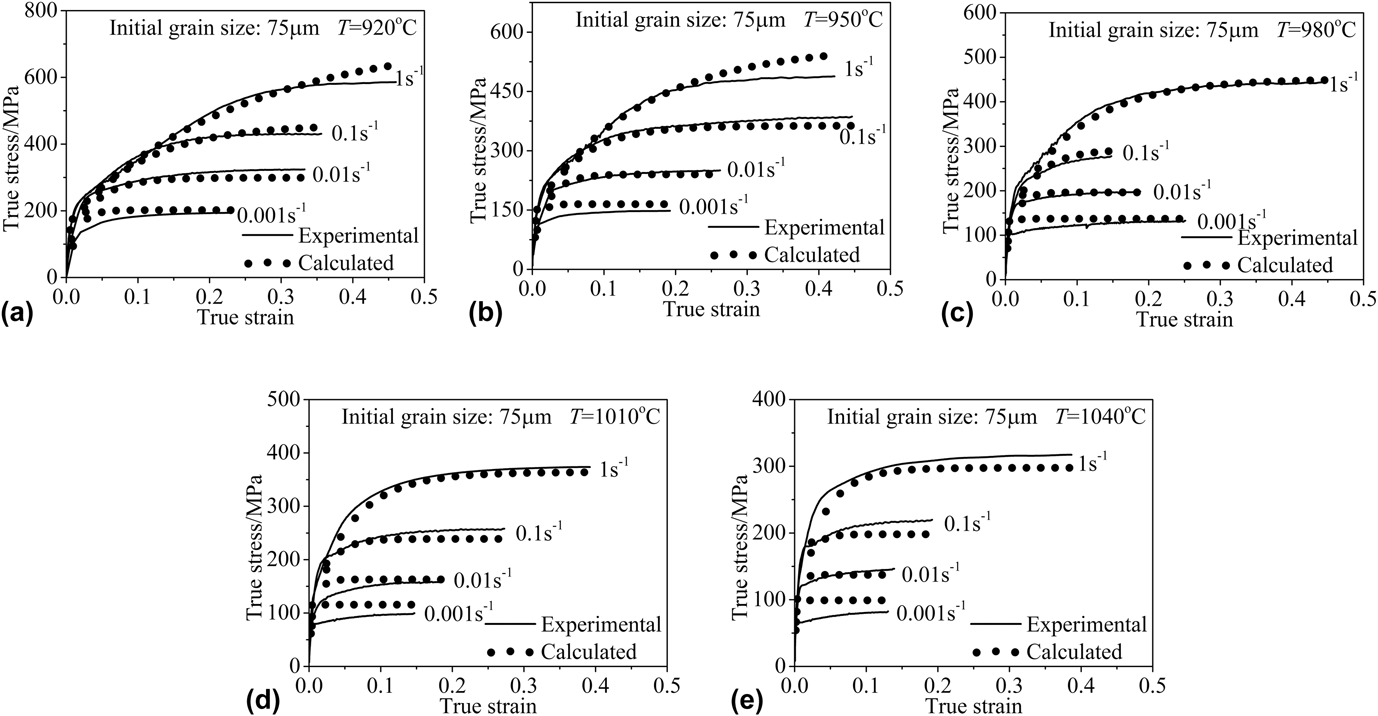
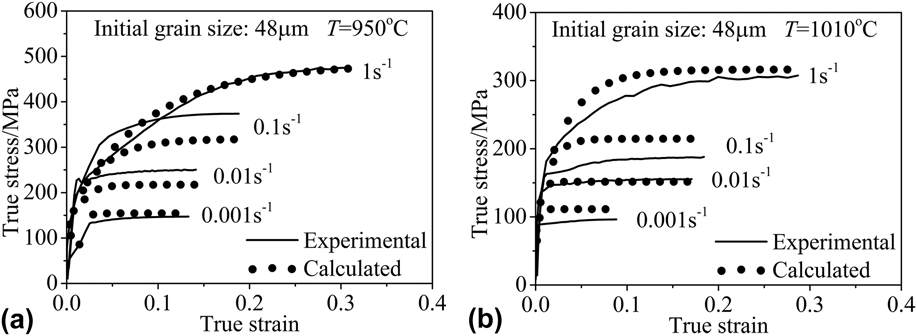
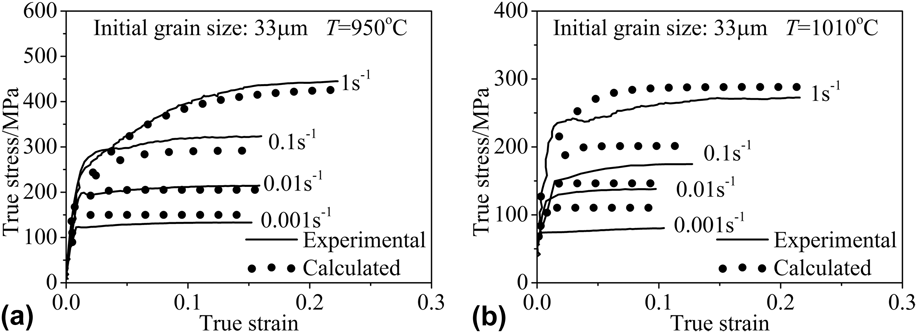
To verify the developed constitutive model, the comparisons between the experimental and calculated flow stresses are carried out. Figures 4–6 show the experimental and calculated true stress-true strain curves of the studied superalloy under all the tested conditions. Obviously, the calculated results well agree with the experimental ones. The correlation coefficient (R) between the experimental and calculated flow stresses is also evaluated to verify the prediction accuracy of the developed constitutive model.
 $$R = {{\sum\nolimits_{i = 1}^N {({E_i} - \bar E)({P_i} - \bar P)} } \over {\sqrt {\sum\nolimits_{i = 1}^N {{{({E_i} - \bar E)}^2}\sum\nolimits_{i = 1}^N {{{({P_i} - \bar P)}^2}} } } }}\quad ,$$
where E
i and P
i are the measured and predicted values, respectively.
 $\bar E$
and
 $\bar P$
are the mean values of E
i and P
i, respectively. N is the number of samples.
Experimental and calculated flow stresses under the initial grain size of 75 μm and the deformation temperatures of: (a) 920 oC; (b) 950 oC; (c) 980 oC; (d) 1010 oC; (e) 1040 oC.

Experimental and calculated flow stresses under initial grain size of 48 μm and the deformation temperatures of: (a) 950 oC; (b) 1010 oC.

Experimental and calculated flow stresses under initial grain size of 33 μm and the deformation temperatures of: (a) 950 oC; (b) 1010 oC.

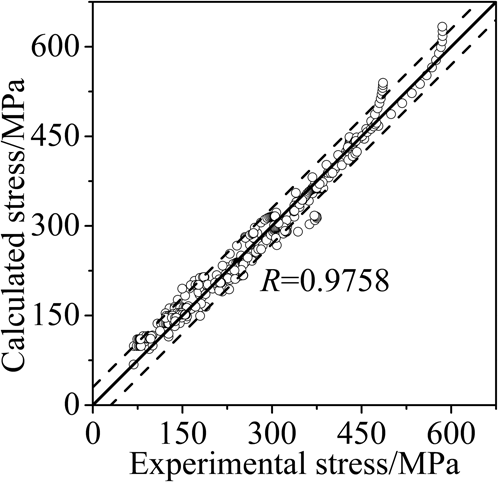
Figure 7 shows the comparisons between the experimental and calculated flow stresses of the studied superalloy under all the tested conditions. The correlation coefficient of the experimental and calculated flow stresses is 0.9758. From Fig. 7, it can also be found that the majority of the values are approximately in a scatter band of ±30 MPa. It can be easily concluded that the developed constitutive model has an excellent capability to describe the strain hardening effect and dynamic recovery behavior of the studied superalloy under different initial grain sizes, deformation temperatures, and strain rates.
Comparisons between the experimental and calculated flow stresses (Dashed lines indicate a deviation of ±30 MPa).

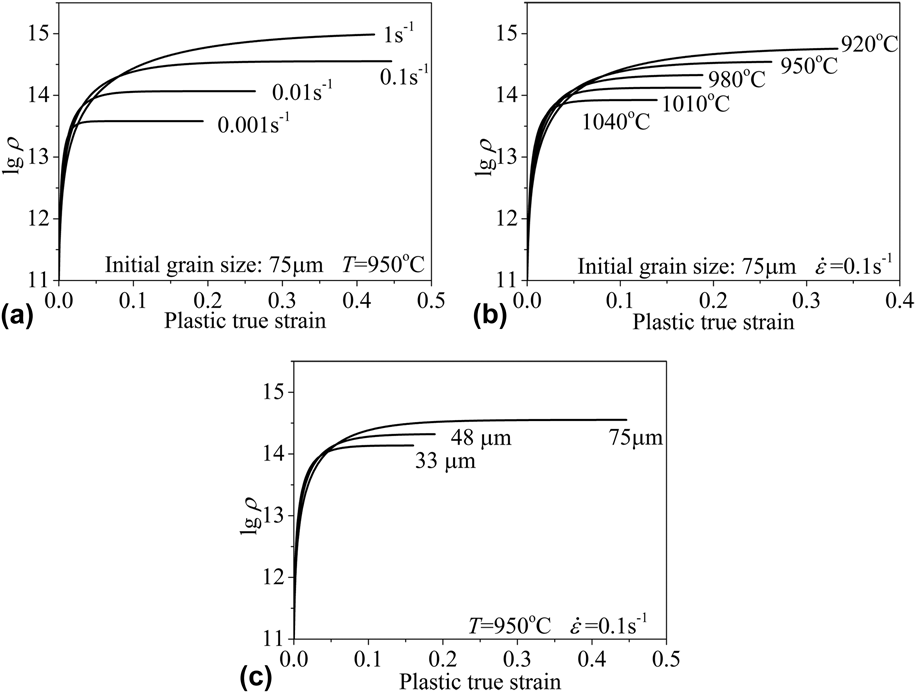
Figure 8 shows the dislocation density evolution predicted by the developed constitutive model under the tested conditions. From Fig. 8, it can be found that the dislocation density roughly increases with decreasing deformation temperature or increasing strain rate/initial grain size. In the early deformation stage, the dislocation density increases sharply. With the further straining, the accumulation rate of dislocation density gradually decreases due to the occurrence of dynamic recovery. When a dynamic equilibrium between strain hardening and dynamic recovery is obtained, the dislocation density maintains as a relatively steady value. Meanwhile, the flow stress also reaches a saturated stage, as shown in Fig. 2.
Evolution of dislocation density in the studied superalloy under: (a) deformation temperature of 950 oC and initial grain size of 75 μm; (b) strain rate of 0.1 s−1 and initial grain size of 75 μm; (c) deformation temperature of 950 oC and strain rate of 0.1 s−1.

VI. APPLICATION OF THE ESTABLISHED MODELS IN TIME-VARIANT HOT WORKING PROCESS
Due to the switch of processing routes, the changes in the strain rate and deformation temperature are inevitable for the industrial hot forming process of metals or alloys. However, seldom constitutive models can describe the high-temperature deformation behavior under time-variant hot working condition. Here, the developed constitutive model can accurately describe the strain hardening effect and dynamic recovery behavior of the studied superalloy under the time-variant hot working conditions.
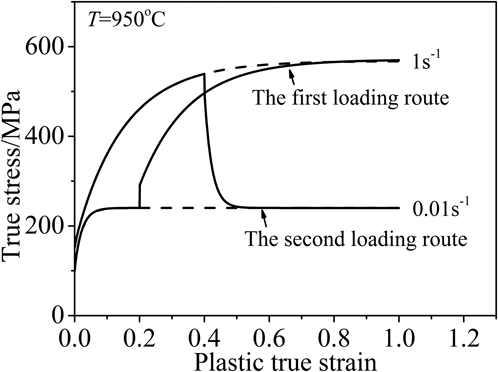
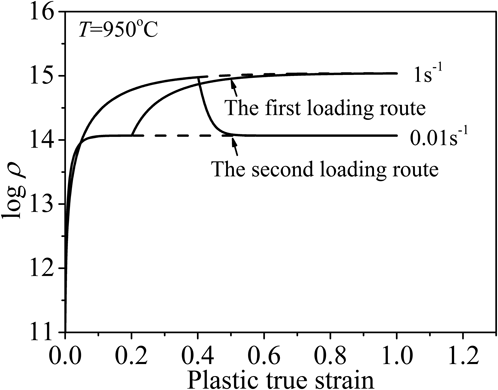
The designed iterative procedures allow the updates of the strain rate and deformation temperature in each strain increment during the whole hot deformation. Meanwhile, the yield stress (σy), strain hardening coefficient (k w) and dynamic recovery coefficient (f v) can be updated in each strain increment. To further illustrate this point, two hypothetical loading routes at a deformation temperature of 950 oC are given, as shown in Fig. 9. In the first loading route, the strain rate is abruptly increased from 0.01 s−1 to 1 s−1 when the strain is 0.2. In the second loading route, the opposite change is presented under the strain of 0.4. Figure 10 shows the hypothetical dislocation density evolution of the studied superalloy under the tested conditions shown in Fig. 9. In Figs. 9 and 10, the dashed lines represent the true stress-true strain curves and dislocation density evolution curves obtained by the iterative procedures under the constant strain rates of 0.01 s−1 and 1 s−1, respectively. It can be found that the hypothetical changing strain rate routes coincide with the constant strain rate curves in the early deformation stage. When the strains reach the abrupt points, the preset strain rates are suddenly updated as the new strain rate, and the subsequent true stress-true strain curves/dislocation density evolution curves are gradually approximate to the reset constant strain rate curves.
Hypothetical true stress-true strain curves at the deformation temperature of 950 oC.

Hypothetical dislocation density evolution at the deformation temperature of 950 oC.

VII. CONCLUSION
The strain hardening effect and dynamic recovery behavior of a Ni-based superalloy are studied by isothermal compression tests. Based on the dislocation density theory, a new unified physically based constitutive model is proposed. It is assumed that the changes in flow stress are attributed to the interactions of dislocation substructures. Considering the coupled effects of the hot deformation parameters on the high-temperature deformation behaviors, the yield stress, the strain hardening coefficient and dynamic recovery coefficient are expressed as functions of deformation temperature, strain rate and initial grain size. To describe the high-temperature deformation behavior under the time-variant hot working condition, the interactive algorithm is applied in the developed constitutive model, which allows the updates of material parameters in each strain increment. The comparisons between the experimental and calculated results indicate that the developed constitutive model can accurately describe the strain hardening effect and dynamic recovery behavior of the studied superalloy. Moreover, the developed constitutive model is successfully applied to describe the high-temperature deformation behavior under the time-variant hot working processes of the studied superalloy.
ACKNOWLEDGMENTS
This study was supported by the National Science Foundation of China (Grant No. 51375502), the Project of Innovation-driven Plan in Central South University (No. 2015CX002), the National Key Basic Research Program (No. 2013CB035801), and the Open-End Fund for the Valuable and Precision Instruments of Central South University, China (No. CSUZC201525).