Introduction
With the spread of digital technologies, and more recently, artificial intelligence (AI) across wide sectors of the economy, digital poverty reduction has increasingly become a central topic for researchers in social sciences such as economics, finance, international business, and entrepreneurship (Chen, Chang, & Bruton, Reference Chen, Chang and Bruton2017; Si, Ahlstrom, Wei, & Cullen, Reference Si, Ahlstrom, Wei and Cullen2020; Sutter, Bruton, & Chen, Reference Sutter, Bruton and Chen2019). As the world’s population has now surpassed 8 billion people across more than 190 countries, and despite recent improvements in global living standards (McCloskey & Carden, Reference McCloskey and Carden2022; Tomizawa, Zhao, Bassellier, & Ahlstrom, Reference Tomizawa, Zhao, Bassellier and Ahlstrom2020), large numbers remain quite poor (United Nations, 2015). The most recent estimates suggest that about 3.74 billion people live below the $6.85-a-day poverty line (World Bank, 2025). Against this backdrop and given the growing opportunities afforded by digital entrepreneurship and AI, a key question arises as to how these technologies can further assist more of the poor to escape poverty.
Poverty and needed economic growth represent vital areas of study for management (and allied social science) scholars (Ahlstrom, Reference Ahlstrom2010; Lucas, Reference Lucas1988; Sunder & Modukur, Reference Sunder and Modukur2024; Wu & Si, Reference Wu and Si2018). In recent years, while increasing amounts of research on poverty and entrepreneurship’s role have been conducted (Alvarez & Barney, Reference Alvarez and Barney2014; Bruton, Ahlstrom, & Si, Reference Bruton, Ahlstrom and Si2015; Si, Zahra, Zhang, & Shan, Reference Si, Zahra, Wu and Jeng2020), work has been slower to develop specifically on digitization and AI’s impact on poverty. The rapid and broad-based economic growth in recent decades has enabled large numbers of people to escape poverty, such that extreme poverty (income below about $2 per day) has fallen to less than 10 percent of the world’s population (Bruton et al., 2015; McCloskey & Carden, Reference McCloskey and Carden2022). However, while some countries and regions have experienced dramatic improvements in poverty reduction, many areas with large numbers of impoverished people remain and could benefit greatly from the effective poverty alleviation that comes through entrepreneurship. Management scholars and economists (e.g., Ahlstrom, Reference Ahlstrom2010; McCloskey & Carden, Reference McCloskey and Carden2022; Si, Zahra, et al., Reference Si, Zahra, Wu and Jeng2020) increasingly recognize that vibrant entrepreneurship may constitute a significant part of the solution to global poverty. A related line of inquiry focuses on how contemporary AI and digital technologies are transforming traditional ways of doing business and, in turn, reshaping opportunities for poverty reduction (Suddaby, Bruton, & Si, Reference Suddaby, Bruton and Si2015), which is the focus of this special issue of Management and Organization Review.
Digital poverty reduction refers to efforts, approaches, strategies, and solutions aimed at reducing poverty (in a country or region) through the application of digital technologies, digital inclusion initiatives, and AI technologies. Today’s world is being increasingly transformed by AI and digital technology: access to technology and the internet has thus become essential for exploring and studying the issues of firm and economic growth with concomitant poverty reduction (Tomizawa et al., Reference Tomizawa, Zhao, Bassellier and Ahlstrom2020; Wang, Ahlstrom, Nair, & Hang, Reference Wang, Ahlstrom, Nair and Hang2008). Digital poverty reduction is thus about how entrepreneurs use digital technologies to solve poverty.
In addition, comprehensive reviews suggest that AI and digital technologies can positively influence income generation, capability development, and social capital formation at the Base of the Pyramid (BoP; Prahalad, Reference Prahalad2005). These technologies also affect the enabling factors essential for scaling and sustaining such business models (Bruton et al., 2015; Jain & Koch, Reference Jain and Koch2020), thereby contributing to broader regional economic growth (Tomizawa et al., Reference Tomizawa, Zhao, Bassellier and Ahlstrom2020). The application of AI and digital technologies in entrepreneurship has the potential to significantly transform traditional patterns of intergenerational poverty and existing BoP-based poverty (e.g., Si, Ahlstrom, Wei, & Cullen, Reference Si, Ahlstrom, Wei and Cullen2021; Wu, Si, & Liu, Reference Wu, Si and Liu2022). This special issue seeks to develop new theoretical lenses to better understand AI and digitally enabled poverty reduction, with the goal of providing novel solutions and exploiting unprecedented opportunities for the impoverished.
Literature Review
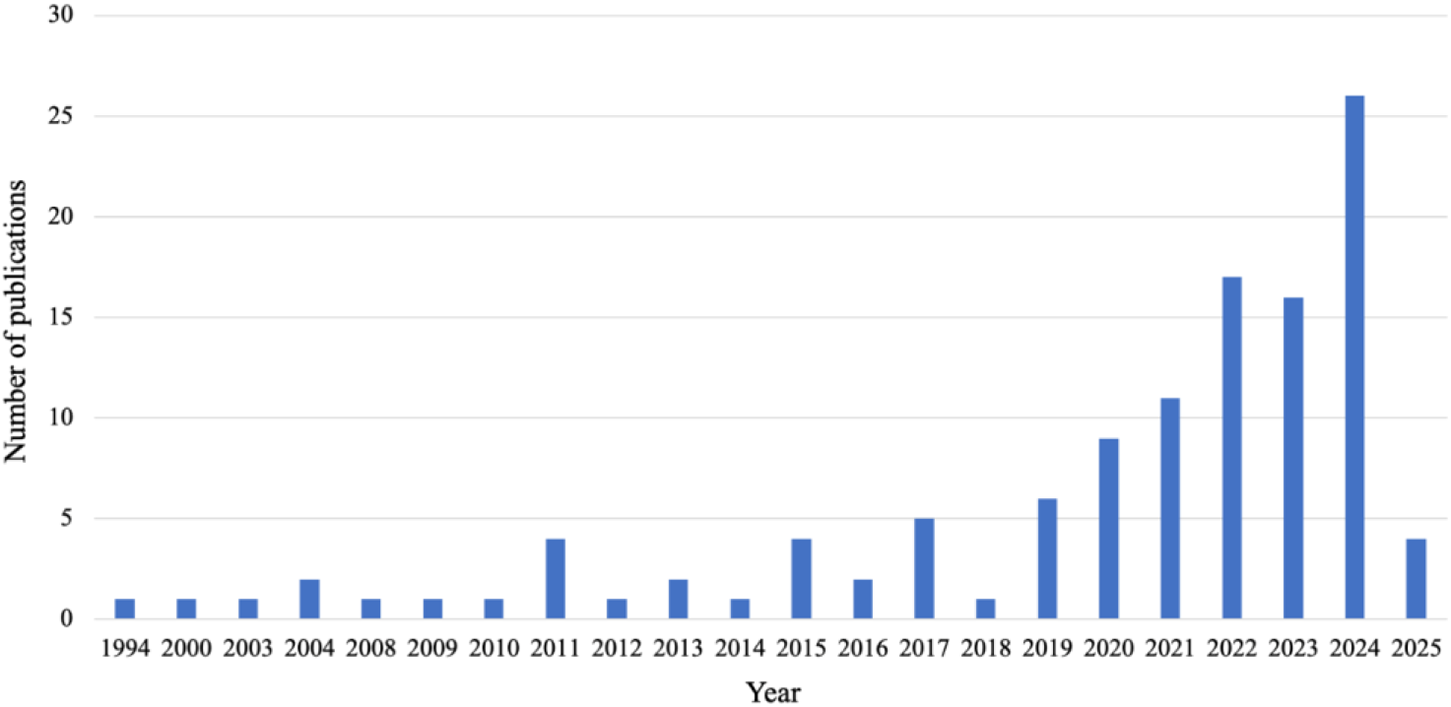
To better understand research approaches to digital poverty reduction and entrepreneurship, we conducted a systematic review of journals listed in the UK ABS list (rating 3 and above), as of March 31, 2025. We used the Clarivate Web of Science database, restricting the search to titles, abstracts, and keywords, with the search terms: ‘Digital AND Entrepreneurship AND Poverty’. This search initially yielded 355 articles published between 1994 and March 2025. After excluding irrelevant studies (i.e., those not addressing digital technologies, entrepreneurship, or poverty reduction), 117 articles were retained. The annual distribution of these articles is shown in Figure. 1, and the major contributions on digital poverty reduction and entrepreneurship are summarized in Table 1.
Digital poverty reduction and entrepreneurship literature from 1994 to 2025

Figure 1 Long description
The bar graph title reads Number of publications. The horizontal axis label reads Year. The horizontal axis shows years: 1994, 2000, 2002, 2004, 2008, 2009, 2010, 2011, 2012, 2013, 2014, 2016, 2017, 2018, 2019, 2020, 2021, 2022, 2023, 2024, 2025. The vertical axis label reads Number of publications. The vertical axis range is 0 to 30. Bar values by year: 1994 equals 1. 2000 equals 1. 2002 equals 2. 2004 equals 2. 2008 equals 1. 2009 equals 1. 2010 equals 1. 2011 equals 4. 2012 equals 1. 2013 equals 2. 2014 equals 0. 2016 equals 4. 2017 equals 3. 2018 equals 5. 2019 equals 3. 2020 equals 6. 2021 equals 9. 2022 equals 11. 2023 equals 17. 2024 equals 16. 2025 equals 26.
Literature summary of digital poverty reduction and entrepreneurship

Table 1 Long description
The table catalogs research articles on digital poverty reduction and entrepreneurship, listing each article’s title, authors, journal, publication year, citation count, and discipline label. Coverage runs from 1994 through 2025, with the most recent entries in 2024 and 2025. The most cited item is Neumeyer et al. (2021, IEEE Transactions on Engineering Management) with 165 citations, followed by Ahsan (2020) with 137, Soluk et al. (2021) with 123, Tim et al. (2021) with 113, and Hua and Huang (2021) with 109. Several 2024 finance-focused papers are already highly cited, including Zhang et al. (2024) with 106 and Xu, Qiong et al. (2024) with 54, alongside other 2024 works in the 20 to 30 citation range. Many 2025 papers have zero to two citations, consistent with recency. Discipline tags span information systems, management, entrepreneurship, finance, economics, marketing, tourism, and social innovation, so citation counts are not directly comparable across fields and reflect a snapshot rather than normalized impact.
Drawing on the above literature, the findings of the eight papers in this special issue, and the guest editors’ discussions on poverty reduction and entrepreneurship in the digital age, we synthesize these varied approaches into five distinct theoretical perspectives, which are elaborated in the following section.
Theoretical Perspectives
Si, Ahlstrom, et al. (Reference Si, Ahlstrom, Wei and Cullen2020) found that the existing literature on poverty reduction through entrepreneurship is relatively concentrated in three main areas. First, some studies attribute poverty to a lack of resources among the poor and focus on compensating for these deficiencies to alleviate poverty (Sutter et al., Reference Sutter, Bruton and Chen2019). Second, other work traces the origins of poverty to geographical constraints, including factors such as location, access to ports and rivers, transportation infrastructure, and regional systems and governance (Bradley, Postlethwaite, Klotz, Hamdani, & Brown, Reference Bradley, Postlethwaite, Klotz, Hamdani and Brown2012; Sachs, Reference Sachs2003; Williams & Moser, Reference Williams and Moser2019). Third, poverty has also been linked to constraints on the development and quality enhancement of the poor themselves, such as limited access to education, insecure land ownership, restrictive household registration systems, and underdeveloped legal and commercial institutions – all of which can impede opportunity recognition and hinder the pursuit of entrepreneurial opportunities (De Soto, Reference De Soto2000; Fischer & Reuber, Reference Fischer and Reuber2014; Lin & Si, Reference Lin and Si2014; Rodrik, Subramanian, & Trebbi, Reference Rodrik, Subramanian and Trebbi2004; Vaona, Reference Vaona2005).
However, the emergence and widespread application of digital technologies (DT) and AI offer new ways to address the root causes of poverty along the three dimensions described above. First, DT provide the poor with greater resource mobility, opportunities to circumvent extractive institutions (Acemoglu & Robinson, Reference Acemoglu and Robinson2012), and enhanced prospects for value creation and appropriation (De Soto, Reference De Soto2000; McCloskey & Carden, Reference McCloskey and Carden2022; Tomizawa et al., Reference Tomizawa, Zhao, Bassellier and Ahlstrom2020). Second, DT mitigate traditional geographical constraints – including those related to location, regional systems, policies, and even physical space requirements (given the minimal space needed for many digital businesses) – thereby opening up new opportunities (Javadian, Nair, Ahlstrom, Moghaddam, Chen, & Lee, Reference Javadian, Nair, Ahlstrom, Moghaddam, Chen and Lee2023). Third, DT can, to some extent, alleviate constraints on the learning, capability enhancement, and personal transformation of the poor, gradually reshaping their mindsets and behavioral patterns. Based on this, we summarize the following perspectives on this cutting-edge research issue.
Digital Poverty Reduction Perspective
More specifically, early work on poverty focused on Bottom of the Pyramid (BoP) theory, which aims to reduce poverty among those at the base of the income distribution through entrepreneurship and, in turn, promote regional economic development (Linna, Reference Linna2013; Si, Yu, Wu, Chen, Chen, & Su, Reference Si, Yu, Wu, Chen, Chen and Su2015; Si, Zahra, et al., Reference Si, Zahra, Wu and Jeng2020). Prahalad (Reference Prahalad2005) and Prahalad and Hammond (Reference Prahalad and Hammond2002) proposed that the core element of BoP-oriented poverty reduction is to improve the quality of life of BoP populations. Accordingly, BoP approaches seek to lift the poor by reducing their expenditures and increasing their savings, as well as improving their access to affordable goods and services (London, Reference London2009). Proponents of the BoP perspective have also encouraged large enterprises to engage with poor communities as viable markets and to explore how the poor can become active consumers (Hart & Christensen, Reference Hart and Christensen2002; Prahalad & Hammond, Reference Prahalad and Hammond2002), thereby taking a more strategic and marketing-oriented approach to poverty alleviation (Christensen, Ojomo, & Dillon, Reference Christensen, Ojomo and Dillon2019).
Digital poverty reduction builds on and extends these traditional approaches – such as the BoP perspective – by combining them with new opportunities arising from digital technologies for the poor as both consumers and entrepreneurs (Christensen et al., Reference Christensen, Ojomo and Dillon2019; Si et al., Reference Si, Hall, Suddaby, Ahlstrom and Wei2023). Emerging digital technologies have enabled the development of new, technology-based poverty reduction models (Sunder & Modukur, Reference Sunder and Modukur2024). For example, digital platforms, e-commerce, mobile financial services, and AI-enabled agents have created novel pathways for poverty reduction and supported the emergence of numerous digital entrepreneurial ventures. Socially, digital poverty reduction promotes social mobility by empowering marginalized groups – such as rural populations, youth, and people with disabilities – through improved access to education, networks, and markets (Parthiban, Sun, Qureshi, & Bandyopadhyay, Reference Parthiban, Sun, Qureshi and Bandyopadhyay2024; Wang, Zhang, White, & Fan, Reference Wang, Zhang, White and Fan2024). Economically, it fosters development and growth by enabling low-income individuals to reach remote markets, lower transaction costs, and scale their businesses more effectively (Si et al., Reference Si, Hall, Suddaby, Ahlstrom and Wei2023).
Digital Platform Empowerment Perspective
Digital platform empowerment offers a new, technology-enabled perspective on poverty alleviation. Platform theory has a long history in strategic innovation, but contemporary platform research differs in important ways from earlier strategic management concepts (Cusumano, Gawer, & Yoffie, Reference Cusumano, Gawer and Yoffie2019). In general, a platform connects two or more user or geographic groups. In the context of poverty, platform empowerment refers to models that help poor residents access entrepreneurial incubation channels or self-employment opportunities on digital platforms – such as generating income by selling their own products and thereby reducing poverty (Bruton, Mejia-Morelos, & Ahlstrom, Reference Bruton, Mejia-Morelos and Ahlstrom2025; Si et al., Reference Si, Yu, Wu, Chen, Chen and Su2015). Digital platform empowerment emphasizes the transformative role of digital and socio-economic platforms in enabling inclusive participation and value co-creation within development ecosystems. In contrast to traditional poverty alleviation models that rely primarily on government or donor-led interventions, a platform approach focuses on network-based infrastructures that connect the poor to markets, finance, knowledge, and innovation opportunities.
Platforms such as e-commerce marketplaces (including those operating in parts of Africa and in refugee camps) and mobile payment systems allow entrepreneurs to bypass traditional barriers such as limited physical infrastructure or restricted access to banking services. These digital commerce platforms can generally be divided into two models: those initiated by entrepreneurs and those initiated by governments. The bottom-up model, driven spontaneously by farmers and other local actors, reflects an ‘entrepreneurship by the poor’ approach, in which individuals use e-commerce platforms to sell local traditional products – and even nonlocal products – directly to broader markets, sometimes with assistance from major retailers (Bruton et al., Reference Bruton, Mejia-Morelos and Ahlstrom2025). A well-known example of platform-enabled poverty alleviation is the ‘Taobao Village’ phenomenon in China. On the one hand, Taobao Villages help farmers sell agricultural products to external markets via digital platforms, increasing their incomes; on the other hand, ‘rural Taobao’ services procure daily necessities and production materials for villagers at a lower cost, indirectly reducing household expenditures. The practices and experiences of Taobao Villages thus provide an excellent context for in-depth research on digital poverty reduction. From this perspective, poverty is reframed not only as income deprivation but also as a connectivity deficit, underscoring the importance of integrating marginalized populations into digital and socio-economic networks. The digital platform empowerment perspective offers a technology-based, dynamic, and systemic lens for understanding how digital infrastructures and collaborative ecosystems can catalyze large-scale social and economic empowerment for poverty reduction.
Plight Behavior Perspective
The plight behavior perspective emphasizes the behavioral transformation from ‘poor’ to ‘in plight’ as central to poverty reduction (Si et al., Reference Si, Yu, Wu, Chen, Chen and Su2015). In the current age of AI and digital technologies, these tools can facilitate such a transformation. ‘Poor’ and ‘plight’ are related but distinct concepts. Poverty (‘poor’) is typically a passive condition, with individuals relying mainly on external support. ‘Plight’, by contrast, denotes a more proactive stance: although individuals still face hardship, they recognize opportunities to improve their situation. When people in plight can continually perceive opportunities to earn income, their attitudes and behaviors tend to become more proactive and positive; they begin to observe, learn, and attempt to overcome difficulties.
To a certain extent, absolute poverty is difficult to eradicate entirely. Poverty research suggests that the poor are often passive both in their attitudes and behaviors and in facing structural constraints beyond their control (Si et al., Reference Si, Yu, Wu, Chen, Chen and Su2015; Yan, Si, Zhu, & Zhang, Reference Yan, Si, Zhu and Zhang2022). To assist them, governments and entrepreneurs have traditionally adopted remediation approaches that focus on alleviating poverty through direct provision of resources and capital (Sutter et al., Reference Sutter, Bruton and Chen2019). This remediation perspective commonly assumes that poverty is primarily driven by resource scarcity – such as a lack of seed capital or other physical assets (Alvarez & Barney, Reference Alvarez and Barney2014; Wu & Si, Reference Wu and Si2018) – and that grants, foreign aid, or microfinance are therefore key to poverty reduction. However, large-scale, ongoing direct aid has been shown to be of limited effectiveness (Easterly, Reference Easterly2002). The poor-to-plight transformation perspective thus focuses on how passive recipients can develop more active agency. In this regard, digital technologies increasingly expand the possibilities and opportunities for would-be plight entrepreneurs to learn, cultivate positive attitudes and behaviors, and thereby more effectively reduce their poverty.
Digital Indigenous Entrepreneurship Perspective
The indigenous entrepreneurship perspective has become a key focus in research on entrepreneurship and poverty reduction in recent years. Indigenous entrepreneurship refers to entrepreneurial activity whereby local low-income residents reduce poverty through self-employment and locally rooted ventures (Javadian et al., Reference Javadian, Nair, Ahlstrom, Moghaddam, Chen and Lee2023). These residents often maintain distinctive local cultures and group norms that, while valuable, can also shape opportunity structures and contribute to the persistence of poverty. In recent years, however, successful cases of entrepreneurship-led poverty reduction have encouraged many local residents to attempt to change local poverty conditions and promote the development of their communities and surrounding regions through indigenous entrepreneurship (Javadian et al., Reference Javadian, Nair, Ahlstrom, Moghaddam, Chen and Lee2023; Peredo et al., 2004).
Indigenous entrepreneurship and poverty reduction nonetheless depend to some extent on external support from government agencies, as well as private and civil-society organizations (Bruton et al., Reference Bruton, Mejia-Morelos and Ahlstrom2025; Javadian et al., Reference Javadian, Nair, Ahlstrom, Moghaddam, Chen and Lee2023). Poverty reduction through indigenous entrepreneurship involves implementing context-sensitive solutions tailored to the specific environments of impoverished areas and the conditions of different poor households (Croce, Reference Croce2017). Digital technology has been widely applied in this domain, creating two-way connections between poor regions and broader markets, breaking down geographical barriers, and providing crucial support for entrepreneurship and poverty reduction in these areas. It also enhances access to skills development and other educational training for the poor (Chang & Xu, Reference Chang and Xu2023). At the national and regional levels, such digitally enabled initiatives can reinforce local poverty reduction efforts through digital entrepreneurship strategies (Parhankangas & Colbourne, Reference Parhankangas and Colbourne2023).
Technological and Policy Perspectives
Technologies such as mobile apps, cloud computing, and AI aim to ‘democratize business’ by providing affordable tools and access to capabilities that were previously out of reach for low-income users. For example, the diffusion of low-cost smartphones and rapid internet penetration in LMICs – such as roughly 70% mobile phone ownership in Sub-Saharan Africa – has made digital entrepreneurship increasingly feasible for low-income populations, delivering computing power and high-speed communication that, just 25 years ago, were largely confined to large firms. Well-designed public policies can further amplify digital entrepreneurship’s contribution to poverty reduction by expanding connectivity, supporting digital literacy, and fostering enabling ecosystems (Chohan & Hu, Reference Chohan and Hu2020).
Public–private partnerships are also critical for scaling such solutions. Effective policies can expand the role of digital entrepreneurship in poverty alleviation by lowering data costs, subsidizing equipment, and improving infrastructure, thereby increasing low-income entrepreneurs’ access to digital tools (Soluk, Kammerlander, & Darwin, Reference Soluk, Kammerlander and Darwin2021). Government-supported digital training programs, for instance, have improved the skills of rural entrepreneurs in low- and middle-income countries while also helping them manage cyber risks (Chohan & Hu, Reference Chohan and Hu2020; Soluk et al., Reference Soluk, Kammerlander and Darwin2021). In addition, robust digital poverty reduction policies can strengthen regulation to curb corruption and mitigate improper relationships among stakeholders (Zhou, Zha, Qiu, & Zhang, Reference Zhou, Zha, Qiu and Zhang2024). Together, these policies and partnerships are crucial for nurturing the growth of digital entrepreneurship and, in turn, reducing poverty.
Special Issue Articles
The intersection of digital technology, entrepreneurship, and poverty reduction represents a vital area of inquiry in today’s rapidly changing world. Across the eight articles in this Special Issue, a primary common thread emerges: the transformative potential of technology to foster change and expand inclusive economic opportunities, especially for marginalized populations (McCloskey, Reference McCloskey2013; McCloskey & Carden, Reference McCloskey and Carden2022; Mokyr, Reference Mokyr2016). Each study in this special issue examines distinct contexts and strategies in which digital solutions not only provide tools for entrepreneurial activity but are able to catalyze broader social change. Taken together, they show how innovations in digital entrepreneurship and AI can address systemic poverty and enable individuals to break cycles of poverty and plight, thereby advancing our understanding of this nexus and contributing to sustained improvements in quality of life and health in impoverished communities worldwide.
Technology Entrepreneurship, the Poor, and Socialism
The first article of the Special Issue by Bruton, Li, and Garud (Reference Bruton, Li and Garud2026) examines faster growth technology entrepreneurship under conditions of a more government directed system (Fallows, Reference Fallows1995; List, Reference List and Lloyd2022). Prior research on technology entrepreneurship has been grounded almost exclusively in the free-market frameworks developed primarily in the Global North. Bruton, Li, and Garud (Reference Bruton, Li and Garud2026) hold that context matters, and that researchers should also examine technology entrepreneurship in roughly half the world where increased government involvement and even ownership of business seeks to promote economic development (Bruton et al., Reference Bruton, Ahlstrom and Si2015; Fallows, Reference Fallows1995; List, Reference List and Lloyd2022). As such, this article investigates how the principle of common prosperity adopted in many of the Global South systems shapes technology entrepreneurship under conditions of the more developmental state. Focusing first on China – a global technological leader and one of the world’s largest generators of patents – Bruton et al. (Reference Bruton, Li and Garud2026) show through two cases that concern for the poor is not incidental but integral to technology entrepreneurship there. The authors also extended the analysis to a second socialist context outside China, demonstrating the broader relevance of common prosperity for understanding the relationship between technology entrepreneurship and poverty alleviation. Taken together, these cases suggest that research on technology entrepreneurship should move beyond Global North capitalist assumptions and instead account for societal context, particularly the emphasis on common prosperity. Incorporating such perspectives invites researchers to reconsider the role of technology and entrepreneurship in conjunction with a more developmental state in advancing the common good and reducing poverty (Bruton et al., Reference Bruton, Ahlstrom and Si2015).
Digital Poverty in the Global South
As noted, despite substantial digital investment and stakeholder initiatives, many people in the Global South remain largely excluded from meaningful digital participation. This systematic literature review by Ofori, Matos, and Tavalaei (Reference Ofori, Matos and Tavalaei2026) synthesized 122 empirical studies published from 2003 to 2024 across Asia, Africa, Latin America, and Oceania to examine key stakeholders, the challenges they face, and the strategies used to promote sustainable digital inclusion. Drawing on stakeholder theory and digital ecosystems theory, the review identifies ecosystem fragmentation as a central bottleneck. Thus, this Special Issue advances stakeholder theory by introducing the concept of ecosystem coordination stakeholders (ECS), a role-based stakeholder group whose salience stems not only from their power, legitimacy, and urgency, but also from their capacity to coordinate. Their findings underscore the need for policy frameworks that build and strengthen institutional capacity for coordination, extend ecosystems theory by recognizing coordination as an essential developmental requirement, and inform design strategies tailored to specific fragmentation patterns across diverse regional contexts. Overall, the study provides management and policy insights on digital poverty that may also be relevant to other complex problems requiring effective, sustained, multi-stakeholder collaboration.
Social Innovation and Poverty Reduction: A Stakeholder Mobilization Process Model
The next article, by Wakayama, Parboteeah, and Par (Reference Wakayama, Parboteeah and Par2026), addresses social challenges for a sustainable future through a social process that engages a broad range of stakeholders. Relatively few studies have captured how stakeholders are mobilized at scale to drive social innovation and reduce poverty. This third study in the special issue specifically investigates the process of social innovation through the lens of stakeholder mobilization. It develops a process model grounded in a large set of empirically observed ‘stakeholder actions’, documenting who did what, when, and for whom, and with what consequences – within six social enterprises tackling increasingly unsustainable challenges faced by more than one million smallholder farmers in Japan. The model specifies five essential stakeholder tasks that propel social innovation both individually and collectively, emphasizing the intricate nonlinear dependency cycles among these tasks. By doing so, it extends the literature on social innovation and sustainability. Finally, the findings show how digital technologies can help alleviate poverty among Japanese smallholder farmers.
Digital Financial Inclusion and Income Stratification: Implications for Entrepreneurship and Poverty Reduction
Digital financial inclusion (DFI) has been widely recognized for its potential role in reducing poverty by fostering entrepreneurship (Manobal, Mohapatra, & Giri, Reference Manobal, Mohapatra and Giri2025). However, how DFI benefits various social classes remains an open question. Accordingly, the fourth study by Su, Zahra, Zhang, and Shan (Reference Su, Zahra, Zhang and Shan2026) examines the impact of DFI on social stratification across lower-, middle-, and upper-income classes at key entrepreneurial stages, including venture creation, investment, and performance. Using data from 36,557 household-wave observations in the China Household Financial Survey, the study found that (1) lower-class households are less likely than upper-class households to establish entrepreneurial ventures, but are more likely than middle-class households to do so, and (2) they invest less in entrepreneurial ventures and achieve lower entrepreneurial performance than their middle- and upper-class counterparts.
The results further show that although DFI positively affects entrepreneurial venture creation, investment, and performance among lower-class households, these benefits are weaker than those observed for middle- and upper-class households. Overall, the study advances an integrated view of DFI by demonstrating its differential effects by income class and entrepreneurial stage, and it contributes to the ongoing debate over whether DFI can serve as a universal poverty-reduction solution.
From Hardship to Salvation: Entrepreneurs’ Poverty Experience and Digital Poverty
Digital entrepreneurship is also important because of its potential to alleviate poverty (Si, Zahra, et al., Reference Si, Zahra, Wu and Jeng2020). Drawing on imprinting theory, the next study (Lin & Lin, Reference Lin and Lin2026) examines how entrepreneurs’ past poverty experience shapes their poverty-reduction outcomes. Using two waves of survey data from more than 200 digital entrepreneurial ventures in rural China, Lin and Lin (Reference Lin and Lin2026) found that entrepreneurs’ prior poverty experience has a significant positive effect on poverty-reduction outcomes. This effect is mediated by the firms’ digital capabilities.
Moreover, when entrepreneurs face greater resource constraints, the imprinting-to-capability pathway is strengthened, amplifying the indirect effect of poverty experience on poverty-reduction outcomes. Overall, the study deepens the understanding of the micro-level mechanisms through which digital entrepreneurship contributes to poverty alleviation and offers a more nuanced framework for examining the intersection between personal history and entrepreneurial outcomes in poverty reduction. It also advances imprinting theory by introducing a process-oriented perspective in which capability formation serves as a key mechanism through which early-life adversity is transformed into entrepreneurial outcomes.
The Paradox of Poverty Reduction: How Digital Economy Development Widens the Urban-Rural Income Gap in China
Coordinated urban and rural development is crucial for reducing inequality and achieving common prosperity. Using panel data from 57 counties in Zhejiang Province from 2015 to 2019, the study by Ding, Yu, Shi, and Liu (Reference Ding, Yu, Shi and Liu2026) examines the impact of digital economic development on the urban–rural income gap, with particular attention to its role in digital poverty alleviation and the underlying transmission mechanisms. The results show that digital economy development contributes to poverty alleviation by significantly increasing household income in both urban and rural areas, but it simultaneously widens the urban–rural income gap.
Mechanism analyses indicate that nonagricultural employment, innovation, and entrepreneurship mediate this relationship, disproportionately benefiting urban areas. Heterogeneity tests further reveal that disparities in human capital and the business environment intensify the widening effect of digital economic development on the income gap, whereas improved infrastructure reduces barriers to resource flows, thereby mitigating it. Overall, the findings highlight the dual effects of digital economic development, offering actionable policy insights for advancing digital poverty reduction while addressing regional disparities to support common prosperity.
Does Digital Financial Knowledge Participate in Poverty Alleviation? A Moderating Study with Microfinance in Pakistan
This study by Nadeem, Akhter, and Hoang (Reference Nadeem, Akhter and Hoang2026) examines the relationship between microfinance and poverty alleviation, accounting for the moderating effects of both digital and traditional financial knowledge, as well as social capital. The data comprise survey responses from 500 clients of conventional and Islamic microfinance institutions in Bhakkar, one of Pakistan’s most active microfinance districts.
Using structural equation modeling, the study finds that digital financial knowledge positively moderates the link between microfinance effectiveness and poverty alleviation. A similar moderating effect is observed for social capital when traditional financial knowledge is included in the model. However, this pattern does not hold when digital financial knowledge is incorporated. Overall, the findings highlight the importance of promoting both financial literacy and digital skills to maximize microfinance’s positive contribution to poverty reduction.
Digital Literacy, Digital Entrepreneurial Mindset, and Poverty Alleviation in Vietnam
Drawing on Social Cognitive Career Theory and the Human Capital Approach, this study by Pham, Nguyen, Dang, and Nguyen (Reference Pham, Nguyen, Dang and Nguyen2026) examines how digital literacy shapes the digital entrepreneurial mindset (DEM) and contributes to poverty reduction through digitally driven innovation in Da Nang, Vietnam. Using an exploratory design and thematic analysis of in-depth interviews with 11 entrepreneurs, the findings show that digital literacy strengthens entrepreneurial self-efficacy, goal orientation, and outcome expectations – thereby fostering DEM and supporting poverty reduction. As one of the first studies to link digital literacy, entrepreneurship, and poverty alleviation in Vietnam, it offers a foundation for future empirical research on the role of entrepreneurs’ digital skills in sustainable development and the positive impact both digital and entrepreneurship training can have.
Summary of Special Issue Articles
Beyond the common thread of the transformative potential of technology to foster change and expand inclusive economic opportunities, the eight contributions collectively demonstrate that digital technology and AI shape poverty alleviation through a set of interlocking mechanisms operating at multiple levels of analysis. At the macro-institutional level, the articles by Bruton et al. (Reference Bruton, Li and Garud2026) and by Ding et al. (Reference Ding, Yu, Shi and Liu2026) foreground the role of states and developmental regimes – showing, on the one hand, how principles such as common prosperity can embed concern for the poor into technology entrepreneurship, and, on the other, how the digital economy development can simultaneously lift incomes and sometimes widen urban–rural gaps, thereby revealing important policy trade-offs. At the meso level, Ofori et al. (Reference Ofori, Matos and Tavalaei2026), and Wakayama et al. (Reference Wakayama, Parboteeah and Par2026) highlight the importance of stakeholder coordination and ecosystem design, demonstrating that digital poverty reduction hinges not only on technological access but also on the orchestration of diverse actors and the task interdependencies that drive social innovation at scale. At the micro level, Su et al. (Reference Su, Zahra, Zhang and Shan2026), Lin and Lin (Reference Lin and Lin2026), Nadeem et al. (Reference Nadeem, Akhter and Hoang2026), and Pham et al. (Reference Pham, Nguyen, Dang and Nguyen2026) unpack heterogeneity in how households and entrepreneurs benefit from digital finance, capabilities, literacy, and mindsets, showing that income class, prior hardship, financial knowledge, and digital skills condition who can translate new tools into meaningful entrepreneurial and poverty-reducing outcomes. Together, these studies provide a more nuanced and contingently grounded picture of digital entrepreneurship for poverty alleviation – one that recognizes both its empowering potential and its uneven, sometimes paradoxical, distribution of benefits. In doing so, they move the conversation beyond simple narratives of ‘technology as panacea’ toward a richer understanding of the institutional, ecosystem, and individual capabilities required for digital technologies and AI to contribute credibly and sustainably to poverty reduction.
Thus, the diverse perspectives presented across these studies highlight the multifaceted aspects of digital entrepreneurship as providing pathways to poverty alleviation, particularly in developing economies. By illuminating how digital capabilities, stakeholder dynamics, and institutional conditions shape entrepreneurial outcomes, the research collectively deepens our understanding of when and for whom technology-driven initiatives are most likely to generate material improvements. Taken together, the findings challenge traditional paradigms that treat poverty reduction as primarily the result of broad income transfers or uniform ‘one-size-fits-all’ programs. Instead, they point to more targeted policy and future research agendas that support inclusive economic development and sustained growth through technology adoption.
Discussion
Digital poverty reduction refers to the process of achieving poverty reduction and broader development by popularizing, applying, and innovating digital technologies to improve the economic, social, and human-capital conditions of poverty-affected areas and groups. Grounded in digital inclusion, it follows an empowerment-oriented pathway: through mechanisms such as information access, capacity building, resource connection, and market participation, it strengthens the sustainable development capabilities of poor populations.
In terms of its ‘research and development’ progression, digital poverty reduction is often described as evolving through three stages. The early stage (2000–2010) focused on the digital divide and infrastructure construction. The transformation stage (2010–2020) centered more on ‘digital empowerment for poverty reduction’, emphasizing inclusive growth. The deepening stage (2020–present) develops a ‘digital ecological poverty reduction’ perspective, focusing on the systematic effects of the platform economy, AI, and big data on poverty governance. Overall, theoretical development reflects an evolutionary logic from ‘technological accessibility’ to ‘capacity empowerment’, and ultimately to ‘ecological symbiosis’.
Future Research Directions
Although this Special Issue has generated valuable contributions on how poverty can be reduced through adoption of digital technology, several areas warrant further research. First, as with earlier waves of technology, digital technologies and AI are often designed as relatively general solutions, yet both history and emerging evidence suggest that social benefits can vary widely across contexts. For instance, while China has achieved notable poverty reduction progress, many such advances remain at early stages in other regions. Future research can therefore examine how these efforts move beyond basic adoption and instead build enduring capabilities – enabling entrepreneurs to offer better products and services at lower costs, thereby supporting poverty reduction in a sustainable manner.
Second, more work is needed on the systematic mechanisms through which digital ecosystems operate. Research should further clarify how digital technology, entrepreneurship, innovation, and social governance interact in coordinated poverty-reduction pathways, and it should provide both theoretical and policy support for building an inclusive, sustainable digital society – one in which opportunity can expand broadly (Christensen, Ojomo, & Dillon, Reference Christensen, Ojomo and Dillon2019). Finally, scholars based in the Global South should be further supported and studied, including how they increasingly collaborate with international colleagues to tackle some of the world’s most pressing social problems.
Conclusion
If this Special Issue and introductory essay could convey one central message, it would be that the transformative potential of digitalization and AI offers substantial promise for alleviating poverty, principally via innovation and new venture creation, as well as through concomitant improvements in living standards (Ahlstrom, Reference Ahlstrom2010; McCloskey, Reference McCloskey2013; Si et al., Reference Si, Zahra, Wu and Jeng2020). By equipping marginalized communities with both technology access and enhanced entrepreneurial opportunities, these innovations strengthen people’s ability to improve their livelihoods while triggering broader advances that can raise living standards for all, supporting a more inclusive and sustainable path of economic development. For this reason, business researchers should also increasingly embrace this important topic.
Steven Si (ssi@commonwealthu.edu) is a distinguished professor of entrepreneurship at Zhejiang University, China and a professor at Commonwealth University of Pennsylvania, US. He has published many research articles in leading entrepreneurship and innovation journals such as Strategic Entrepreneurship Journal, Journal of Business Venturing, Technovation, and others. He is an associate editor of Technovation (2021–present). He has served as a special issue guest editor in the recent years for journals such as Strategic Entrepreneurship Journal, Journal of Engineering and Technology Management, Entrepreneurship and Regional Development, Technovation, Journal of Business Venturing, Asia Pacific Journal of Management, Asian Business & Management, and others. His latest book, Business, Entrepreneurship and Innovation toward Poverty Reduction was published by Taylor and Francis in 2022.
David Ahlstrom (ahlstrom@baf.cuhk.edu.hk) is associate dean (research) at Hong Kong Metropolitan University, and emeritus professor at The Chinese University of Hong Kong. His research focuses on innovation, entrepreneurship, and managing in Asia. He has published over 180 peer-reviewed articles in journals such as Strategic Management Journal, Academy of Management Review, Journal of International Business Studies, Journal of Management Studies, Organization Science, Journal of Business Venturing, Academy of Management Perspectives, and Journal of World Business. He was recognized as a ‘highly cited researcher’ by Clarivate during 2017–2019. He is former editor-in-chief of Asia Pacific Journal of Management and edited special issues for Entrepreneurship: Theory and Practice, Technovation, Management and Organization Review, Journal of World Business, New England Journal of Entrepreneurship, and several others.
Jeremy Hall (Jeremy.K.Hall@sussex.ac.uk) is professor of innovation studies, director of the Science Policy Research Unit (SPRU), at University of Sussex Business School, and former editor-in-chief of the Journal of Engineering and Technology Management. His research investigates the social impact and unanticipated outcomes of innovation and entrepreneurship, sustainable supply chains and social inclusion, where he has collaborated with a range of natural and social scientists with funding from numerous funding agencies. He has published widely in business, management, and policy journals and has edited special issues for Business and Society, Ecological Economics, International Journal of Operations & Production Management, Journal of Business Venturing, and Technovation.
Jiang Wei (weijiang@zju.edu.cn) is the Changjiang chair professor of innovation and strategic management and dean at school of management at Zhejiang University, China. He has published over 100 research articles in journals such as Journal of International Business Studies, Management and Organization Review, Technovation, R&D Management, Asia Pacific Journal of Management, and others. He also served as a guest editor for special issues for Entrepreneurship and Regional Development, Technovation, and others.
Victor Cui (victor.cui@uwaterloo.ca) is the Conrad research excellence chair and associate professor at the Conrad School of Entrepreneurship and Business, University of Waterloo, Canada. His current research focuses on geopolitical risks (e.g., US–China decoupling), technological innovation, IPR protection, and business strategy. His research has been published in leading journals such as Strategic Management Journal, Journal of International Business Studies, and Research Policy. He is a senior editor at Management and Organization Review, International Business Review, as well as Asia Pacific Journal of Management. His research has reached a wide audience via media outlets such as Fortune, Canada Broadcast Company, and Global News.