Free and fair elections are central to democracy, allowing citizens to hold leaders accountable (Downs Reference Downs1957) and creating a bond between people and the system (Anderson et al. Reference Anderson2005; Banducci and Karp Reference Banducci and Karp2003). Yet, electoral malpractice continues to challenge the integrity of elections across new and old democracies (Mauk Reference Mauk2020; Norris and Grömping Reference Norris and Grömping2019).Footnote 1 Holding leaders accountable for their actions is a crucial task for democratic citizens, especially when democracy's rules are broken. When politicians and parties meddle with elections, people's ability to make reasoned and informed decisions, revise their views, and punish the perpetrators becomes an important check against undemocratic tendencies. Yet, recent evidence questions voters' ability to hold leaders and parties accountable for cheating in elections, showing that voters rarely vote against their party to punish political malfeasance (for example, corruption and violating democratic principles, such as electoral fairness) (Anduiza, Gallego and Munoz Reference Anduiza, Gallego and Munoz2013; Breitenstein Reference Breitenstein2019; Eggers Reference Eggers2014; Graham and Svolik Reference Graham and Svolik2020; Klašnja Reference Klašnja2017; Solaz, De Vries and de Geus Reference Solaz, De Vries and de Geus2019; Svolik Reference Svolik2019). This poses an important problem for the viability of contemporary democracy.
In this article, I examine why partisans rarely sanction electoral malpractice by their party. Studies of political malfeasance have primarily examined whether individuals sanction in- and out-party malfeasance equally by looking at the effects on vote choice (see, for example, Carey et al. Reference Carey2020; Graham and Svolik Reference Graham and Svolik2020). However, this disguises important differences in the ways partisanship distorts responses to malpractice. I take a different approach and examine the different steps in how partisans respond to revelations of malpractice. When people receive information revealing electoral malpractice, they must first change their beliefs about facts (Did this happen?), they must then interpret these factual beliefs (How illegitimate or consequential was it?), and, finally, they must update their views based on these interpretations (Is it enough to change preferences?) (Gaines et al. Reference Gaines2007).
This allows me to distinguish between two substantively different explanations for why partisans rarely vote against their party to sanction electoral malpractice. According to the first perspective, pervasive partisan biases may prevent citizens from viewing in-party malpractice as problematic. Partisans may apply double standards, viewing out-party malpractice as more illegitimate than otherwise identical in-party malpractice (Claassen and Ensley Reference Claassen and Ensley2016). Partisans may interpret revelations of malpractice in ways that reflect well on their party by outright denying that their party meddled with elections, dismissing it as inconsequential or finding reasons to exonerate their party (Bartels Reference Bartels2002; Bisgaard Reference Bisgaard2015; Bisgaard Reference Bisgaard2019; Taber and Lodge Reference Taber and Lodge2006; Zaller Reference Zaller1992). A second explanation emphasizes that partisans may accurately update their views and reduce support for their party but not enough to change their relative preferences. While people prefer clean elections, they also hold clear partisan preferences, and partisans may be willing to tolerate unfair procedures when they generate favourable outcomes (Bøggild and Petersen Reference Bøggild, Petersen, Shackelford and Hansen2015; Brockner and Wiesenfeld Reference Brockner and Wiesenfeld1996). Although partisans may fully acknowledge and disapprove of malpractice by their party, it may not be enough for them to vote against it.
The differences between these explanations are particularly important to studies of accountability for electoral malpractice and political malfeasance broadly. If voters continue to support politicians who enrich themselves through public office, violate democratic rules and norms, or tamper with elections, we must understand the underlying causes. Are citizens so biased by partisan allegiances that they are unable to view in-party malfeasance as illegitimate? Or, are partisans willing to sacrifice a degree of legitimacy for desired political outcomes? If we do not understand how the response chain breaks, we are hard-pressed to fix it.
I use pre-registered survey experiments in Mexico and Denmark (both n = 2,500) to randomize information revealing electoral malpractice and which party meddled, and to measure different steps in how partisans evaluate this information. Mexico and Denmark are useful settings for this study, as they differ on most theoretically relevant factors that could shape how people respond to electoral malpractice, allowing me to generalize the conclusions to a broader population of democratic countries (Seawright and Gerring Reference Seawright and Gerring2008). I focus on perceived electoral fairness and two key attitudes towards government: support and perceived legitimacy. Government support is the attitude ‘by which a person orients himself to an object either favorably or unfavorably, positively or negatively’ (Easton Reference Easton1975, 436). Legitimacy refers to people's perception that government is entitled to rule (Gilley Reference Gilley2009; Levi, Sacks and Tyler Reference Levi, Sacks and Tyler2009; Lipset Reference Lipset1960; Tyler Reference Tyler1997; Tyler Reference Tyler2006). These are related but distinct attitudes, as the same individual can acknowledge the government's right to govern while disliking its decisions and policies. Indeed, such consent is a hallmark of democracy (Anderson et al. Reference Anderson2005). The novel contribution of this study lies in breaking down the steps in how partisans adjust their views in response to revelations of malpractice, allowing me to disentangle the two explanations outlined earlier. The outcomes allow me to examine how partisans interpret information revealing malpractice, how they attribute blame and their relative preferences. Additionally, this study examines these partisan gaps outside the United States, which has received by far the most attention (see, for example, Carey et al. Reference Carey2020; Graham and Svolik Reference Graham and Svolik2020; Tomz and Weeks Reference Tomz and Weeks2020).
The experiments offer two key findings. Across two widely different contexts, I find that voters do not apply a partisan double standard when evaluating information revealing malpractice. Across outcomes that measure the different steps in the response chain, I find no differences in how in- and out-partisans perceive or react to revelations of electoral malpractice. However, although partisans sanction in- and out-party malpractice similarly, malpractice revelations do not necessarily drive voters to defect from their party. Instead, partisans with very strong party attachment hold opposing parties in such low esteem that even information revealing malpractice does not change their minds. Although strong partisans disapprove firmly of in-party malpractice, they nevertheless remain relatively more supportive of an in-party government that has cheated than of an out-party government that has not. Partisans who hold very strong preferences for their party and hold opposing parties in very low esteem are willing to tolerate malpractice to avoid an out-party government. These findings contribute to our understanding of how partisanship drives tolerance of election cheating by shedding light on the risks and costs associated with electoral malpractice, as well as on how parties might be able to get away with foul play, even as they lose political support and legitimacy.
Partisan Responses to Malpractice
It is well established that people's attitudes towards political authorities are influenced by the fairness of political procedures, such as elections (Birch Reference Birch2008; Blader and Tyler Reference Blader and Tyler2003; Bøggild Reference Bøggild2016; Hibbing and Theis-Morse Reference Hibbing, Theis-Morse, Sullivan, Snyder and Sullivan2008; Magalhães and Aguiar-Conraria Reference Magalhães and Aguiar-Conraria2019; Ulbig Reference Ulbig2008; Wilking Reference Wilking2011). However, elections produce very clear and tangible outcomes, creating partisan winners and losers. As people have clear preferences for certain election outcomes, they may think differently about malpractice depending on whether they side with the winners. Recent work suggests that people view elections as more suspicious when opposing parties win (Anderson et al. Reference Anderson2005; Beaulieu Reference Beaulieu2014). Moreover, recent research shows that voters rarely vote against their party to punish political malfeasance, such as corruption and violating democratic principles (Anduiza, Gallego and Munoz Reference Anduiza, Gallego and Munoz2013; Eggers Reference Eggers2014; Graham and Svolik Reference Graham and Svolik2020; Klašnja Reference Klašnja2017; Svolik Reference Svolik2019). Solaz, De Vries and de Geus (Reference Solaz, De Vries and de Geus2019) even argue that partisan in-group loyalty may drive partisans to reward their party for corruption as a knee-jerk expressive reaction. These findings have led to concern about the viability of democracy.Footnote 2
The main goal of this study is to contribute to our understanding of this concern by examining why partisans do not vote against their party to punish malpractice. Previous studies have primarily examined whether people punish in- and out-party malfeasance equally, for example, by looking at the effects on vote choice. However, this approach disguises important nuances in the ways partisanship can distort citizens' responses to malpractice. We can break down the steps in the process leading from learning about in-party malfeasance to changes in voting behaviour. When people receive information revealing electoral malpractice, they must first change their beliefs about facts (Did this happen?), they must then interpret these factual beliefs (How illegitimate or consequential was it?), and, finally, they must update their views based on these interpretations (Is it enough to change preferences?) (Gaines et al. Reference Gaines2007). Partisan identification can influence how this process plays out in different ways. Examining whether partisans sanction candidates who violate electoral rules by investigating vote choices disguises how the response-chain breaks, establishing only whether it breaks. In the following, I distinguish between two substantively different explanations for why partisans do not sanction malpractice at the polls. Are partisans unable to view in-party malpractice as illegitimate and problematic? Or, do partisans accurately interpret information revealing malpractice and update their views accordingly but hold such strong prior beliefs that they do not change preferences? These are very different explanations, but they are observationally equivalent when looking at vote choice.
First, according to motivated reasoning theories, partisanship raises a ‘perceptual screen through which the individual tends to see what is favorable to his partisan orientation’ (Campell et al. Reference Campell1960, 133). People are ‘guided by what they already know and believe’ when they interpret and respond to new information (Doherty and Wolak Reference Doherty and Wolak2012, 304). Receiving information contradicting closely held beliefs may drive people to deny ‘facts’ or dismiss them as inconsequential (Bartels Reference Bartels2002; Taber and Lodge Reference Taber and Lodge2006; Zaller Reference Zaller1992). Getting the facts right can even fuel motivated reasoning, as people may become highly selective in how they attribute blame and responsibility (Bisgaard Reference Bisgaard2015, Reference Bisgaard2019). Even if partisans are forced to acknowledge that an election was unfair, they are adept at finding reasons to avoid blaming their party.
According to this perspective, partisans tolerate in-party malpractice because they apply double standards when evaluating revelations of electoral malpractice, disapproving more strongly of malpractice by opposing parties (Anderson and Tverdova Reference Anderson and Tverdova2003; Claassen and Ensley Reference Claassen and Ensley2016). When exposed to information about electoral malfeasance by their party, partisans hold two competing cognitions: they have clear party preferences; and they know that their party cheated. As such ‘dissonance is uncomfortable’, individuals ‘tend to modify one of the cognitions to avoid it’ (Anduiza, Gallego and Munoz Reference Anduiza, Gallego and Munoz2013, 1668). Splitting with their party is difficult, so partisans have motives to bend their interpretation of malpractice or avoid holding their party to blame. Claassen and Ensley (Reference Claassen and Ensley2016), for instance, argue that people view election cheating through such a partisan filter (see also Tomz and Weeks Reference Tomz and Weeks2020). Hence, partisans could interpret information about in-party malpractice in ways that fit their closely held beliefs. Applied to the steps outlined earlier, partisans could outright deny that their party has cheated, implying that revelations of malpractice do not cause in-partisans to adjust their perceptions of election fairness. Partisans could also interpret malpractice revelations in ways that downplay their severity. In that case, we should see that the negative effects of malpractice on perceived election fairness are attenuated among the perpetrator's supporters. Finally, partisans may acknowledge that the election suffered but avoid holding their party accountable, implying that the effects on support and legitimacy are attenuated among co-partisans. Based on this, I expect that partisans process information about malpractice in ways that reflect well on their party, leading to the following hypothesis:
Hypothesis 1 (H1): Individuals disapprove more strongly of electoral malpractice by opposing parties than otherwise identical malpractice benefiting their party.
On the other hand, partisans could accurately interpret information revealing malpractice and adjust their views on the election, government and their party accordingly but not so much that they change relative preferences (see Gerber and Green Reference Gerber and Green1999; Hill Reference Hill2017). Elections create winners and losers, and provide clear and tangible outcomes that people care greatly about. Even if citizens process information about electoral malpractice in an unbiased way, they may not split with their party because perceptions of procedures and outcomes interact in forming attitudes towards authorities (Brockner and Wiesenfeld Reference Brockner and Wiesenfeld1996; Magalhães and Aguiar-Conraria Reference Magalhães and Aguiar-Conraria2019). Krehbiel and Cropanzano (Reference Krehbiel and Cropanzano2000) show that unfavourable outcomes coupled with unfair procedures are associated with anger and frustration, whereas favourable outcomes generated by unfair procedures are associated with guilt and shame. That is to say, people react differently to unfair procedures when they provide desired outcomes; there is an instrumental brake on the moral outrage produced by procedural unfairness (Bøggild and Petersen Reference Bøggild, Petersen, Shackelford and Hansen2015). In other words, although partisans may disapprove strongly of in-party malpractice, they may nevertheless refrain from voting against their party. When responding to information about wrongdoing, partisans balance preferences for procedures and outcomes, and may prioritize partisan considerations over electoral legitimacy. This is a very different explanation from the one expected by theories of motivated reasoning because it implies that people produce unbiased interpretations of, and react negatively to, revelations of malfeasance.
According to this view, partisans acknowledge and disapprove of electoral violations by their party, but the loss of electoral integrity is outweighed by other partisan gains. In a recent experiment, Graham and Svolik (Reference Graham and Svolik2020) found that American voters would rather vote for an in-party candidate who violates democratic principles than switch party loyalties. Rather than failing to acknowledge in-party malpractice, they argue, voters fail to ‘prioritize democratic principles … when doing so goes against their partisan identification’ (Graham and Svolik Reference Graham and Svolik2020, 406). This suggests that information about malpractice is processed similarly regardless of partisanship but that the negative effects on support and legitimacy are not sufficient to change partisans' relative preferences. Although in-partisans would withdraw support, they would nevertheless feel more supportive of their party than of an opposing party. In other words, even co-partisans update their opinions in the right direction but not enough to prefer an opposition party (see Hill Reference Hill2017). In this perspective, partisans' willingness to tolerate electoral malpractice depends on how strongly they value desired political outcomes. As partisans who hold particularly strong party attachments also place greater value on specific outcomes, which would limit the negative reactions to malpractice, they should be more likely to respond to malpractice revelations in this way.
In this view, we should see no differences between in- and out-partisans regarding the steps outlined earlier: in- and out-partisans interpret information revealing malpractice similarly and adjust their views on election fairness, government support and legitimacy in parallel. However, some partisans remain more supportive of an in-party government that has meddled with elections than of a ‘clean’ opposition government. Based on this, I derive the following hypothesis:
Hypothesis 2 (H2): Individuals prefer an in-party government that has engaged in electoral malpractice to an out-party government that has not.
Experimental Design
To examine why partisans rarely vote against their party to sanction malpractice, I administered survey experiments to nationally representative samples of Mexican and Danish adults (both n = 2,500) between 21 December 2020 and 4 January 2021, which independently randomized information revealing electoral malpractice and which party meddled. Before sampling the majority of respondents and pre-registering, a small pilot sample was made available to examine the workings of the vignettes. The surveys were administered by YouGov.
Case Selection
The survey-experimental approach necessarily narrows the focus to a few cases. I chose a diverse pair to mimic a most-different-systems design. Mexico and Denmark represent markedly different contexts and are, therefore, ideal settings. While both countries are democratic, they differ on most other theoretically relevant characteristics that could otherwise influence the relationship between malpractice and people's attitudes towards government. First, whereas Denmark is a long-standing democracy that has rarely experienced electoral malpractice (Elklit Reference Elklit, Christiansen, Elklit and Nedergaard2020), Mexico has only recently transitioned to democracy and has a long history of manipulated elections (Cantú Reference Cantú2019; McCann and Domínquez Reference McCann and Domínquez1998). As a consequence of socialization into democratic governance, Danes might be more willing to respond to electoral malpractice.
Secondly, Denmark is considerably wealthier than Mexico. Scholars have long recognized that political support and regime legitimacy are positively influenced by economic performance (Easton Reference Easton1965). In a recent study, Rød (Reference Rød2019) finds that election fraud primarily increases the risks of protests when it is coupled with economic grievances. Similarly, economic performance may weaken the electoral consequences of corruption (Klašnja and Tucker Reference Klašnja and Tucker2013). In other words, people may only respond to malpractice under certain economic conditions.
Finally, in Mexico, politics is markedly more polarized. Mexican politics is more divided and dominated by a few large parties, whereas Danish politics is rather non-polarized, and multiple parties tend to coalesce to form a government. As Mexican politics and society are more divided into antagonistic camps, Mexican partisans may be more willing to sacrifice electoral integrity to win elections (Graham and Svolik Reference Graham and Svolik2020). Choosing such diverse cases enhances the generalizability of the study's conclusions (Blair and McClendon Reference Blair, McClendon, Druckman and Green2021; Mutz Reference Mutz2011; Seawright and Gerring Reference Seawright and Gerring2008). As Mexico and Denmark vary on democratic and electoral legacies, economic performance, and political polarization, such differences are zeroed out. If I find evidence of either partisan influence in both cases, there is reason to believe that such patterns apply to a broader population of democracies. Of course, a reasonable concern remains whether the findings travel to democracies that differ on other key features. I return to this concern in the discussion.
Experimental Vignettes
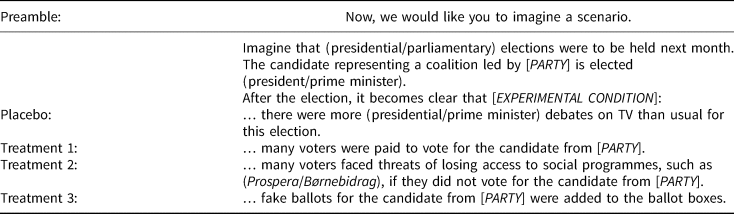
The experiments randomly assigned each respondent to one of three treatment conditions or a placebo condition. The treatment groups read vignettes about either vote buying, voter pressure or ballot-box stuffing. The control group read a placebo vignette about the number of televised debates (see Table 1) (for translations, see Online Appendix B). As people may not respond similarly to different types of malpractice (Szakonyi Reference Szakonyi2021), I randomize three different types, allowing me to examine the consequences of malpractice more broadly. In all of the following analyses, I collapse all treatment groups to estimate the average treatment effect of revealing any type of malpractice. Findings are substantively and statistically similar for non-collapsed treatments (see Online Appendix G) and all treatment–party combinations (see Online Appendix O).
Experimental wording (Mexico/Denmark)

Note: N (Denmark) = 2,526; control group n = 623 (24.66 per cent); Treatment Group 1 n = 637 (25.22 per cent); Treatment Group 2 n = 629 (24.90 per cent); and Treatment Group 3 n = 637 (25.22 per cent). N (Mexico) = 2,528; control group n = 630 (24.92 per cent): Treatment Group 1 n = 635 (25.12 per cent); Treatment Group 2 n = 628 (24.84 per cent); and Treatment Group 3 n = 635 (25.12 per cent).
The vignettes also randomized which party had employed illicit strategies. In Denmark, these were the Social Democrats and the Liberals. This two times four design results in eight vignettes. In Mexico, these were Morena, the Partido Revolucionario Institucional (PRI) and the Partido Acción Nacional (PAN), resulting in a three times four design (twelve vignettes).Footnote 3 Respondents were asked to rate the election's fairness, their level of government support and perceived government legitimacy after reading a vignette.
The vignettes were designed with two considerations in mind. First, to eliminate ambiguity about information credibility and malpractice severity, the vignettes stated that something (treatment or placebo) has ‘become clear’ and that the malpractice involved ‘many’ voters or ballots. Previous research has found that information credibility and malpractice severity may influence how citizens perceive and respond to malfeasance information (Schedler Reference Schedler2013; Weitz-Shapiro and Winters Reference Weitz-Shapiro and Winters2017). Such wording has been successfully employed in similar experiments (Szakonyi Reference Szakonyi2021).
Secondly, the vignettes were identical in both countries except for country-specific references to parties, social programmes or election type, yielding cross-country comparability. However, this naturally limits the context sensitivity of treatments, effectively reducing the level of authenticity that can realistically be achieved. While the three types of malpractice are well known in Mexico (Cantú Reference Cantú2019; McCann and Domínquez Reference McCann and Domínquez1998), Danes are unlikely to be familiar with them. To ensure that Danish respondents responded meaningfully to treatments, the vignettes were kept short, unambiguous and hypothetical. Importantly, the case selection provides variation on how strong the information in the treatment appears to respondents. Finding similar patterns of partisan responses in both cases effectively demonstrates that the results are not driven by the treatment authenticity. Faced with a trade-off between comparability and authenticity, I chose to keep the vignettes as identical as possible to avoid adjusting treatments to contexts (Blair and McClendon Reference Blair, McClendon, Druckman and Green2021). Moreover, research has shown that people's responses to hypothetical scenarios largely mimic their real-world behaviour (Hainmueller, Hangartner and Yamamoto Reference Hainmueller, Hangartner and Yamamoto2015). Later, I discuss how these choices may influence the type and magnitude of partisan responses to malpractice information. Online Appendix B discusses compliance with the American Political Science Association (APSA) (2020) guidelines to address ethical concerns with exposing respondents to fictitious information about parties employing malpractice.
Measurements
The main outcomes of interest are government support, perceived government legitimacy and perceived election fairness. I measured support using a thermometer of citizens' (un)favourable attitudes towards government. Respondents rated the government on a 0–10 scale, where 0 is ‘dislike a great deal’ and 10 is ‘like a great deal’. Perceived government legitimacy is measured by asking respondents about the extent to which they thought the government had a right to make binding political decisions on a five-point scale, where 1 is ‘not at all’ and 5 is ‘to a very large extent’.Footnote 4 Support and legitimacy are neighbouring but quite different attitudes (see, for example, Gilley Reference Gilley2009). Indeed, the consent of political opposition to the entitlements of government is a hallmark of democracy (Anderson et al. Reference Anderson2005). I measured perceived election fairness by asking respondents to rate the honesty of the election on a five-point scale, where 1 is ‘the election was conducted unfairly’ and 5 is ‘the election was conducted fairly’.
These outcomes allow me to distinguish between different steps in how people process information about malpractice. Measuring election quality judgements allows me to examine whether partisans perceive in-party malpractice as less consequential than otherwise identical out-party malpractice, whereas government support and legitimacy allow me to examine whether partisans exonerate their party from blame, as well as establish relative preferences. All outcome questions refer back to the election and elected government from the vignettes (for survey items and distributions, see Online Appendix A).
To examine the impact of partisanship on citizens' responses to electoral malpractice, the survey asked respondents to rate different parties on a five-point, like–dislike scale before receiving a treatment or placebo. This measure captures how positively respondents view their party (in-group affection) and how negatively respondents view political opponents (out-group affection) (Abramowitz and Webster Reference Abramowitz and Webster2018), and is suitable for cross-country comparisons (Wagner Reference Wagner2020). I match respondents' pre-treatment like–dislike scores to the party from the vignette they receive to create a five-point measure of co-partisanship with the party mentioned in respondents' vignettes. Hence, 1 (5) indicates that respondents dislike (like) the party they have read about a lot (strong out-partisans and strong co-partisans, respectively), whereas a score of 3 on this measure indicates respondents who feel neither positive nor negative towards the party they read about (‘neutrals’). Findings are robust to measuring partisanship based on vote choice and self-reported identification (see Online Appendix H).
Findings
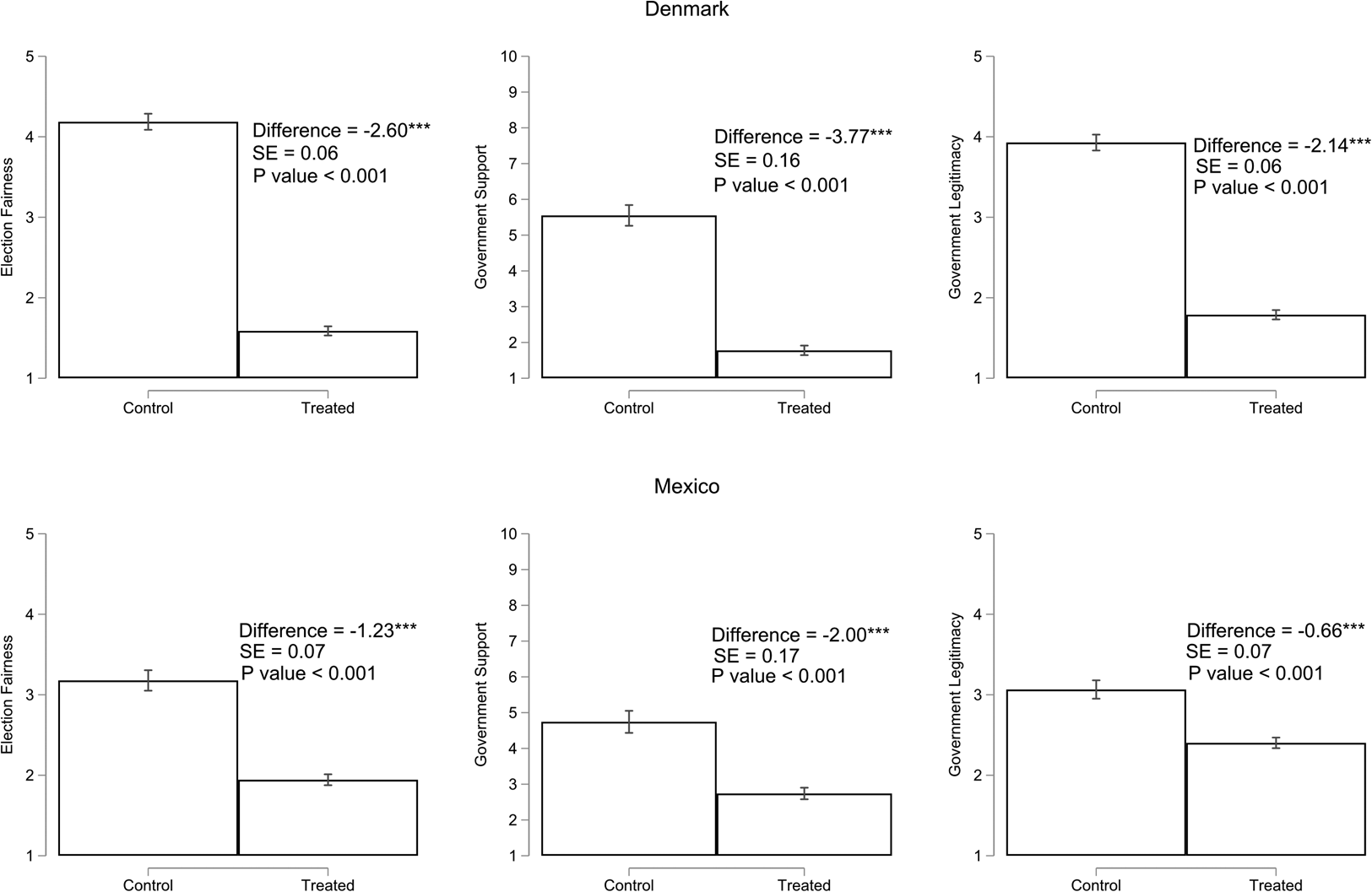
How do people react to revelations of electoral malpractice? Figure 1 presents the difference in means on perceived election fairness, government support and government legitimacy based on unstandardized ordinary least squares (OLS) regression estimates using robust standard errors (see Online Appendix D). The estimates in Figure 1 reflect the averages regardless of which party meddled.Footnote 5
Malpractice reduces perceived election fairness, government support and legitimacy.
Notes: The figure displays mean values conditional on treatment assignment based on unstandardized OLS regression estimates. Depicted with a 95 per cent confidence interval. N (Denmark) = 1,915 and N (Mexico) = 2,059.

When a party cheated to win an election, people's election quality judgements dropped markedly, as expected. The difference in means on perceived election fairness corresponds to standardized effects of −1.68 (Denmark) and −0.83 (Mexico).Footnote 6 Respondents also used information about electoral malpractice to inform their attitudes towards government. When a party meddled with an election, respondents became significantly less supportive of government (37 and 20 percentage point drops in Denmark and Mexico, respectively). Additionally, participants understood that democratic legitimacy comes from winning free and fair elections. Revealing electoral malpractice had strong negative effects on perceived legitimacy. This drop is most pronounced in Denmark, but the standardized effect on legitimacy was nevertheless −0.48 in Mexico. The baseline levels of perceived election fairness and legitimacy are, perhaps unsurprisingly, considerably higher in Denmark, suggesting that Danes are generally more trusting of elections and governments.
In short, people who receive credible information revealing that a party meddled with an election change their views on the election and government. The results in Figure 1 are based on complete-case analysis. An unavoidable concern with survey attrition is that the respondents who dropped out might have responded differently to the vignettes than those who remained in the study. In Online Appendix J, I take different approaches to show that the results are robust to potential attrition bias.
Why Do Partisans Not Get it Right?
Why do partisans rarely punish their party at the polls for cheating in elections or violating democratic norms? The main aim of this study is to address this question. I derived hypotheses about two different partisan influences. First, I predicted that people apply a partisan double standard to electoral malpractice, disapproving more strongly of malpractice by political opponents (H1). Secondly, I predicted that partisans accurately adjust support for their party but that they also balance preferences for winning elections and clean elections, leading people to prefer an in-party government that meddled with an election to an out-party government that did not (H2).
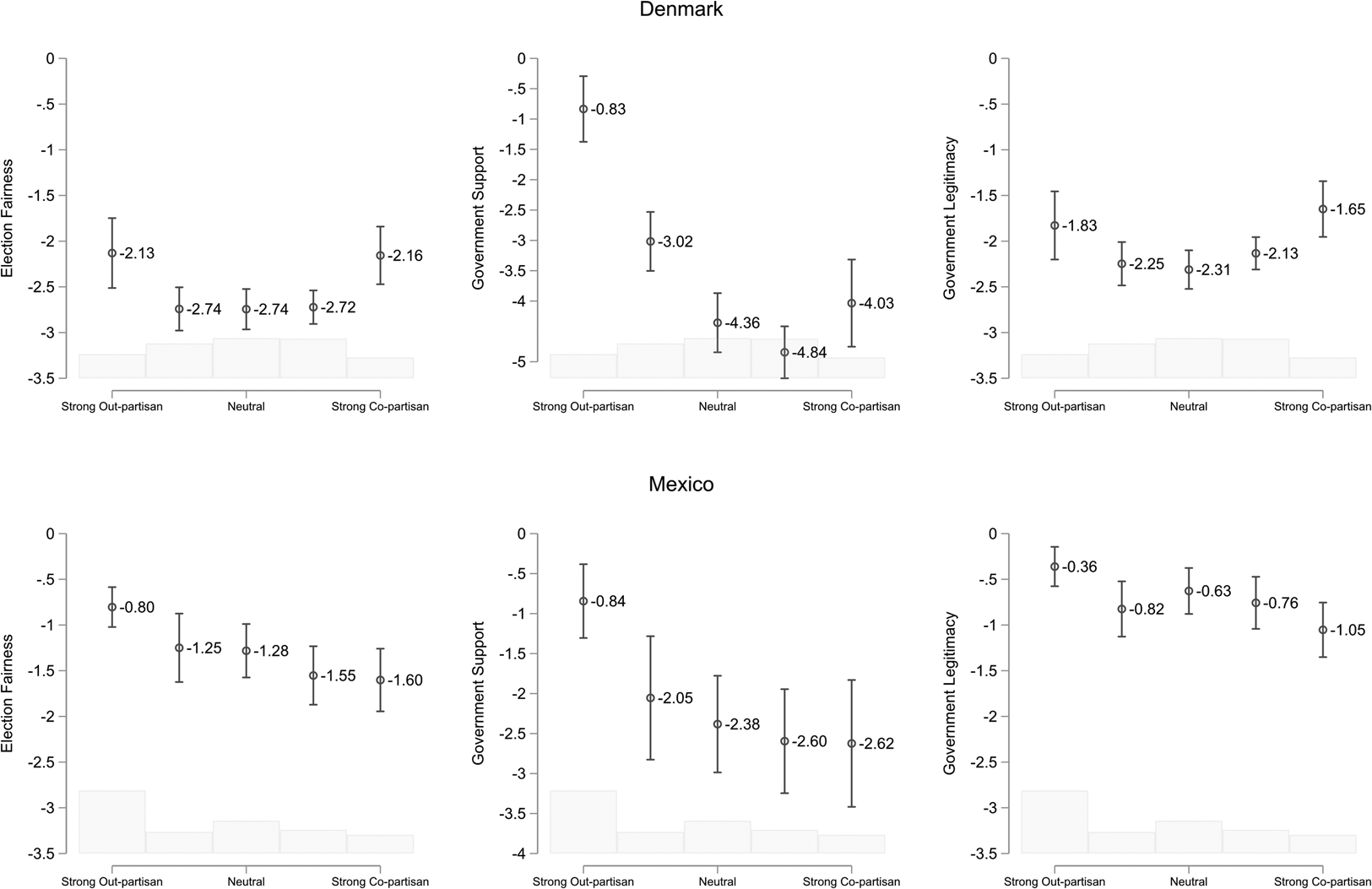
Regarding partisan double standards, I expect that people interpret information revealing malpractice in ways that fit their partisan preconceptions in one of two ways. First, if partisans deny that their party meddled with elections or dismiss it as inconsequential, information revealing malpractice should produce zero or smaller effects on perceived election fairness for in-partisans. Secondly, if such information motivates partisans to selectively attribute blame, it should have similar effects on perceived electoral fairness across partisanship, while the effects on government support and legitimacy should be smaller among in-partisans. In contrast, H1 would be disproved if the conditional treatment effects are not smaller among in-partisans. Figure 2 displays treatment effects conditional on partisanship based on the unstandardized OLS regression estimates (see Online Appendix E).
Partisans do not disapprove more strongly of out-party malpractice.
Notes: Marginal effects of treatment conditional on partisanship. Depicted with a 95 per cent confidence interval. Bars show density histogram of partisanship (Y-axis squeezed for readability). N (Denmark) = 1,880 and N (Mexico) = 1,996.

As Figure 2 shows, there are no signs of partisan-motivated reasoning. In Denmark, respondents negatively adjusted perceived electoral fairness regardless of whether their party benefited, though the effects are slightly smaller among strong partisans on both ends of the scale. This suggests that partisans do not deny that their party meddled with elections or dismiss it as inconsequential. Likewise, revealing malpractice produced similar negative reactions regarding legitimacy across partisanship, suggesting that partisans accurately hold their in-party government accountable. Finally, Figure 2 shows that revelations of malpractice cause people to adjust government support downwards regardless of partisanship. That is to say, partisans do punish both their party and opposing parties for meddling in elections. Similarly, the three graphs at the bottom of Figure 2 show that revelations of electoral malpractice produce negative reactions on all outcomes in Mexico regardless of partisanship. Across all outcomes, partisans punish their party for tampering with elections, clearly demonstrating that pervasive partisan biases do not drive them to bend their interpretations of malpractice revelations to fit partisan preconceptions.
Indeed, Figure 2 suggests that information about malpractice produces more negative reactions among co-partisans of the perpetrator. However, because people are naturally more supportive of an in-party government ex ante, co-partisans have higher levels of pre-treatment support and subsequently more room to adjust. Online Appendix M shows that the difference between groups disappears when taking these baseline levels into account. For instance, in Denmark, the drop in government support among strong co-partisans is 48 per cent, whereas the drop among strong out-partisans is 60 per cent. Similarly, the drop in support among strong co-partisans in Mexico corresponds to 31 per cent, whereas the drop is 40 per cent among strong out-partisans. Hence, Figure 2 effectively shows that partisans do not apply a double standard, disapproving more strongly of out-party malfeasance than otherwise identical in-party malfeasance. The results in Figure 2 are very similar when estimating linear interaction effects and using an alternative measure of partisanship (see Online Appendices F and H).
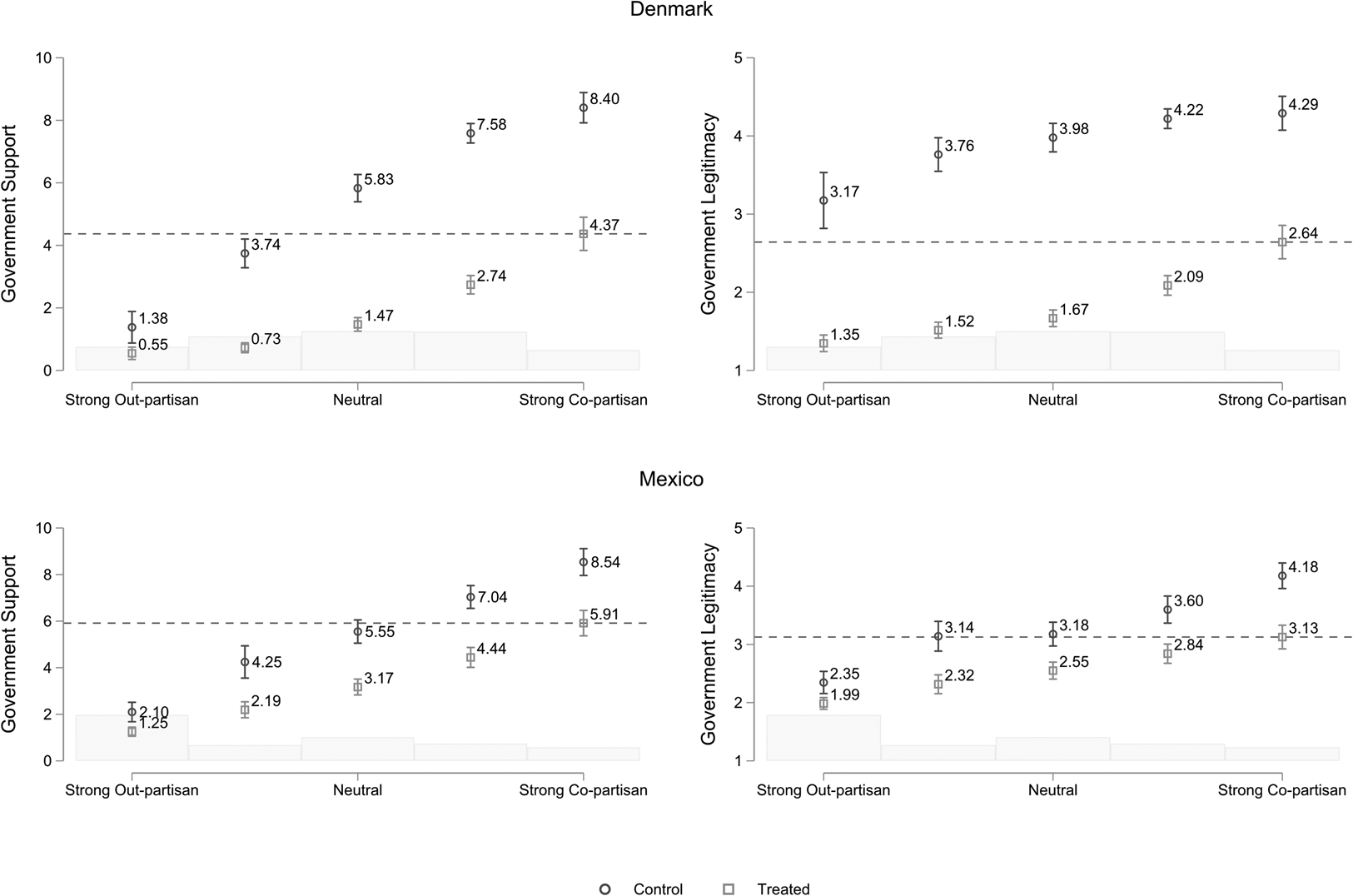
Overall, the results provide strong evidence that people do not apply partisan double standards when evaluating malpractice: voters produce unbiased interpretations of malpractice and update their views accordingly in both countries. This is good news for democracy. But are people ready to split with their party because of electoral malpractice? H2 hypothesized that although partisans accurately update their views and reduce support for an in-party government that has tampered with elections, they would nevertheless prefer such an in-party government that has engaged in malpractice to an out-party government that has not. H2, therefore, concerns relative levels of support among the different experimental groups. H2 would find support if the level of support people express for an in-party government that has cheated is higher than the support they would have expressed for an out-party government that has not cheated, and it would be disproved if this is not the case. To investigate this, I compare relative preferences as measured by government support across treatment conditions and partisanship (see Arias et al. Reference Arias2018). Figure 3 shows mean levels of government support and legitimacy for treatment and control groups across partisanship.
Strong partisans are more supportive of in-party governments despite reducing support.
Notes: Predicted mean support and legitimacy conditional on co-partisanship and treatment, with 95 per cent confidence intervals. Dotted line is mean value for strong co-partisans in the treatment group. N (|Denmark) = 1,880 and N (Mexico) = 1,996.

Figure 3 effectively shows people's willingness to sacrifice legitimacy to win elections. The top panel in Figure 3 shows that revealing electoral malpractice caused shifts in Danes' views on government legitimacy. Voters tend to view an in-party government as more legitimate, but after reading about electoral malpractice by their party, people changed their views on which government was most legitimate. Learning that their party had tampered with the election was sufficient for even strong partisans to acknowledge that an opposition government is more legitimate. That is to say, the level of perceived legitimacy among strong co-partisans in the treatment group (M = 2.64) is lower than the level of perceived legitimacy they would have expressed for a non-cheating out-party government they feel very negatively towards (M = 3.17).
However, I also find that Danes nevertheless remain quite supportive of their party despite its electoral interference. Reading about in-party malpractice caused partisans to feel much less supportive of government but not to the extent that they felt relatively more positive towards an opposition government that had not meddled with elections. To see this, compare in-partisans in the treatment group to out-partisans in the control group. The estimated difference in support between strong in-partisans in the treatment group and strong out-partisans in the control group is approximately 30 percentage points (p < 0.001). The corresponding gap between moderate in-partisans and strong out-partisans is 13.5 percentage points (p < 0.001). This demonstrates that partisans feel relatively more supportive towards an in-party government that has cheated than towards an out-party government that has not. As this is not the case regarding legitimacy, Figure 3 effectively shows that partisans are willing to tolerate electoral malpractice to avoid a government they feel very negative towards. However, using moderate out-partisans in the control group as a baseline, I find that strong co-partisans in the treatment group are only 6 percentage points more supportive (p = 0.080) and that moderate co-partisans in the treatment group are 10 percentage points less supportive (p < 0.001). When partisans hold opposing parties in very low esteem, even revelations of malpractice do not change their minds: they are willing to sacrifice electoral integrity and government legitimacy to avoid opposition governments that they feel very negatively towards. Online Appendix L shows comparisons for all groups.
Results from the Mexican participants largely tell the same story. The two graphs in the bottom panel of Figure 3 show that Mexicans continue to support their party in government despite its involvement in electoral malpractice. The gap between strong co-partisans who have read about malpractice and strong out-partisans who have not is approximately 38 percentage points (p < 0.001). The corresponding gap between moderate co-partisans and strong out-partisans in the control group is 24 percentage points (p < 0.001). These gaps are comparable to the Danish ones, albeit slightly larger. The gap between strong co-partisans in the treatment group and moderate out-partisans in the control group is 17 percentage points (p < 0.001), whereas the same difference was small and insignificant in Denmark. As expected given the higher level of polarization, Mexicans are more willing to tolerate electoral malpractice if their party benefits. Regarding perceived legitimacy, Figure 3 shows that information revealing electoral malpractice forces even those with a strong partisan attachment to update their perceptions of legitimacy. Interestingly, strong partisans find an in-party government involved in malpractice to be as legitimate as a non-cheating government for which they have no particular affection (neutral). The baseline level of legitimacy among strong out-partisans is remarkably low, suggesting that negative partisanship is pervasive (Abramowitz and Webster Reference Abramowitz and Webster2018): people hold remarkably negative views of opposition governments, despite not having tampered with elections.
Overall, these findings strongly support H2. Strong partisans tend to prefer an in-party government despite its involvement in electoral malpractice to a ‘clean’ opposition government. Importantly, this is not because they apply partisan double standards or turn a blind eye to in-party malpractice. In contrast, partisans objectively acknowledge the legitimacy costs of in-party malpractice and reduce their support for such government. However, the findings also show that strong partisans hold such strong prior beliefs about opposing parties that they are nevertheless willing to tolerate a degree of election interference if it ensures that an out-party does not win control of government. Hence, the findings indicate that partisans would be ready to sanction their party for cheating in elections if viable alternatives exist. In both Mexico and Denmark, the drop in government support among co-partisans is large enough that they would likely switch to another party they support at a much more moderate level. When multiple parties exist, people can more reasonably be expected to split with their preferred party and vote for the nearest alternative, which also highlights the importance of examining these dynamics outside the United States.
Discussion and Conclusions
This study contributes to our understanding of how partisanship shapes responses to electoral malpractice by clearly distinguishing between two explanations: pervasive partisan biases may prevent citizens from viewing in-party malpractice as wrong or problematic; or partisans may accurately update their views in response to malpractice but hold such strong priors that they nevertheless refrain from voting against their party. The experiments demonstrated that both Mexicans' and Danes' tolerance of malpractice was conditional on whether their party benefited. This was not driven by partisans turning a blind eye to cheating by their party or applying double standards in evaluating the use of malpractice, whereby they disapprove more strongly of out-party malpractice than of otherwise identical in-party malpractice. People were remarkably objective evaluators of elections, sanctioning malpractice equally whether their party or the opposition benefited. However, although partisans punish their party for cheating in elections, they do not necessarily defect from it. Instead, I find that people with strong partisan loyalties hold opposing parties in such low esteem that even revelations of electoral malpractice by their preferred party do not change their minds: strong partisans remain relatively more supportive of an in-party government that has cheated than of an out-party government that has not, even though they strongly disapprove of malpractice. These partisans express greater support for their in-party than they would have expressed for an out-party, even though their party was involved in electoral malpractice. The strongest partisans, in other words, are willing to tolerate electoral malfeasance to avoid an opposition government. These findings suggest that partisans' tolerance of malpractice arises not from pervasive biases in how partisans process information revealing malpractice, but from a tendency for strong partisans to hold opposing parties in such low esteem that even malpractice revelations are not enough to change their relative preferences. They trade off preferences for clean elections for desired outcomes. Having randomized which party employed illicit tactics to win elections and whether malpractice occurred, the experiments show that voters across two widely different democratic contexts would likely refrain from voting against their party to punish malpractice if it could prevent a party they feel very negatively towards from winning control of government.
Previous studies have suggested that people disapprove more strongly of malfeasance by opposition parties than of otherwise identical in-party malfeasance (see, for example, Anduiza, Gallego and Munoz Reference Anduiza, Gallego and Munoz2013; Claassen and Ensley Reference Claassen and Ensley2016; Solaz, De Vries and de Geus Reference Solaz, De Vries and de Geus2019; Tomz and Weeks Reference Tomz and Weeks2020). In contrast, I provided compelling evidence that democratic citizens evaluate electoral malpractice similarly regardless of whether their party benefits. People who side with the party that was revealed to have employed unfair election tactics were not more likely to deny that it happened or to dismiss it as inconsequential. Nor did acknowledging electoral malpractice motivate partisans to selectively attribute blame and responsibility. Conversely, the experiments corroborate recent studies on violations of democratic principles. In a seminal study, Graham and Svolik (Reference Graham and Svolik2020, 406–7, emphasis in original) argued that most people do not ‘prioritize democratic principles in their electoral choices when doing so goes against their partisan identification’ and that people ‘will not cross party lines to punish a co-partisan for violating democratic principles’. Similarly, my findings demonstrate that while electoral malpractice substantially erodes support and legitimacy even among strong in-partisans, they also hold opposition parties in such low esteem that such erosion is effectively limited. People realize that a government that uses electoral malpractice is less legitimate, but they nevertheless prefer it to an opposition government. These findings shed new light on why partisans react differently to political malfeasance and speak not only to the risks and costs associated with malfeasance, but also to how parties may be able to get away with foul play even as they lose political support and legitimacy.
It is worth considering how the experimental design may have affected how partisans respond to revelations of malpractice, as well as the magnitude of their responses. The experiments attributed malpractice to a party rather than a single candidate. Partisanship reflects the affective attachment to a party, and scholars have shown that partisans care primarily about winning partisan control of government and less about individual candidates (Abramowitz and Webster Reference Abramowitz and Webster2018). This study has examined how in-party loyalty shapes the tolerance of malpractice. However, it could be argued that it is easier for voters to punish individual in-party candidates for engaging in electoral manipulation. Hence, while I find that strong partisans hold opposing parties in such low esteem that even revelations of electoral malpractice do not change their minds, partisans may think quite differently about candidates. There may even be different mechanisms at play when people evaluate candidates who have engaged in malpractice; voters may more directly trade off candidate competence, experience or other characteristics against electoral malpractice; or they may be less motivated to defend their party when only a single candidate violates electoral rules. On the other hand, it is not given that it is easier for voters to punish individual candidates. In two-party systems like the United States, for instance, voting against an in-party candidate is essentially equivalent to sanctioning a party, and previous work on the candidate level corroborates my findings (Graham and Svolik Reference Graham and Svolik2020).
Similarly, the experiments examine the influence of malpractice revelations on generalized support. However, partisans may not express such generalized support on election day. Hence, while I find that strong partisans feel more supportive of and sympathetic towards their party than an out-party despite disapproving of in-party malpractice, it may be that partisans would sanction their party by not turning out to vote. Such a sanctioning mechanism would grant an exit option to partisans who cannot persuade themselves to vote for the opposition party. The findings presented here cannot directly speak to such considerations of manifest support, and future research could make important contributions to the field by examining differences between generalized support and manifested support in response to political malfeasance.
Additionally, the analysis compares respondents' level of support for an in-party government that has employed malpractice to the level of support they would have expressed for an opposition government that has not. Some experiments in the literature directly investigate how voters choose among two alternatives. While such an approach cannot explain why partisans would not vote against their party to sanction malpractice and is therefore ill-suited for this study, it may be argued that people would have responded differently to a direct-choice scenario. My findings cannot directly establish how people would choose among alternatives, but they do show people's levels of support under different conditions (that is, how sympathetic respondents feel towards different governments). Comparing support levels effectively shows that partisans feel more favourable towards an in-party government despite acknowledging and punishing its electoral malpractice. Although people reduce support to an in-party government when it cheats in elections, this negative adjustment is not enough to tip the scales in favour of an opposition government. Similarly, the experiments use real-world parties to examine how partisan attachments shape voters' responses to malpractice. Hence, although the experiments do not explicitly present other information about the parties (such as policy positions or ideology), respondents were likely aware of such positions. Reassuringly, recent evidence from candidate-choice experiments suggests that people would likely behave similarly when presented with a choice (Graham and Svolik Reference Graham and Svolik2020; Svolik Reference Svolik2019).
This study focused on Mexico and Denmark. These cases were selected because they vary on the most important parameters that could otherwise influence reactions to malpractice, which improves the possibility of drawing conclusions that apply to a broader population of democracies (Blair and McClendon Reference Blair, McClendon, Druckman and Green2021; Seawright and Gerring Reference Seawright and Gerring2008). However, a reasonable concern remains as to whether the dynamics uncovered here apply to contexts that differ on other important features. For instance, people in socio-economically less developed democracies may think differently about electoral malpractice. Similarly, in many democracies, elections are contested not along programmatic differences, but rather along ethnic cleavages (Fjelde and Höglund Reference Fjelde and Höglund2016), and voters may think differently about malpractice in such contexts (Kramon Reference Kramon2016). Moreover, both Mexico and Denmark are characterized by relatively low levels of partisan media parallelism. In some of the countries that have recently experienced democratic recessions (for example, the United States, Hungary and Turkey), people tend to get very different accounts of events from partisan media, which may make them more ready to disregard negative information about their parties. The findings presented here do not travel to such contexts without invoking further assumptions. This study has focused on partisan responses to malpractice in two diverse democracies. The analyses can, therefore, guide thinking about these issues outside Mexico and Denmark, which was a key criterion in selecting these countries. Yet, further research is needed to confirm that these findings apply to other settings and political contexts.
Finally, the experiments asked how partisans would respond to clear revelations of malpractice. To that end, I presented the evidence of malpractice as undisputed and with limited uncertainty about its scope, while still allowing some ambiguity about the consequences for election results. On the one hand, this leaves less room for partisans to rationalize that malpractice did not occur or deny that it had any influence on the election. Studies finding evidence of partisan-motivated reasoning have provided much more ambiguous information to respondents (see, for example, Anduiza, Gallego and Munoz Reference Anduiza, Gallego and Munoz2013; Klašnja Reference Klašnja2017), and partisan biases tend to be less pervasive when people are confronted with unambiguous evidence (Doherty and Wolak Reference Doherty and Wolak2012; Parker-Stephen Reference Parker-Stephen2013). On the one hand, partisans may, therefore, be ready to disregard in-party malpractice when they are unsure about the scope of malpractice. On the other hand, the experiments did leave room for partisan rationalization regarding the consequences of electoral malpractice. A recent study by Tomz and Weeks (Reference Tomz and Weeks2020) shows that Americans employed double standards when judging foreign electoral interventions, such as hacking into voting machines. It is not evident that the information provided here leaves considerably less room for partisan-motivated reasoning. To examine whether partisan biases appear in more uncertain instances, follow-up experiments could provide more inconclusive information about whether malpractice took place or include partisan disagreement about whether it happened.
The analysis reveals substantive differences between Mexico and Denmark. Electoral malpractice has negative effects on attitudes towards government in both countries, but they are markedly stronger in Denmark, and while strong partisans are unlikely to be swayed by revelations of malpractice, Mexicans are much more fixed in their loyalties.Footnote 7 Explaining these differences is outside the scope of this article, but one possible explanation is that historical trajectories shape how people think about elections and electoral malpractice. Denmark and Mexico have markedly different experiences with democracy and elections, which could influence how people react to malpractice. For instance, Mexicans are much more sceptical about the prospects of a fair election prima facie. The cases were selected because they vary on the most relevant factors that could influence the relationship. While the findings provide compelling evidence of the effects of malpractice and partisanship on people's views on government across democracies, they cannot isolate contextual factors that may explain variation between democracies. Cross-country analysis could potentially shed light on these dynamics.
Overall, this study has important implications for our understanding of partisanship and the tolerance of election cheating. Scholars can build on these insights to examine more comprehensively how citizens form their perceptions of election quality, as well as how they respond to violations of electoral rules and norms. In particular, this study should advise scholars to consider more carefully the underlying reasons why partisans respond differently to infringements on democratic rules and norms. As citizen support is a crucial underpinning for the vitality and stability of democracy, we must take into account how people perceive and respond to malpractice if we are to successfully consolidate democracy around the world.
Supplementary Material
Online appendices are available at: https://doi.org/10.1017/S0007123422000126
Data Availability Statement
Data Availability Statement. Replication data for this article is available at: https://doi.org/10.7910/DVN/WQVJDO
Acknowledgements
I would like to thank Jakob Tolstrup, Sven-Erik Skaaning, Kristian Vrede Skaaning Frederiksen, Suthan Krishnarajan, David Delfs Erbo Andersen, Lasse Egendal Leipziger, Martin Vinæs Larsen, Martin Bisgaard, Rune Slothuus and Clara Neupert-Wentz, as well as four anonymous reviewers, for their valuable comments.
Financial Support
Support for this research was provided by the Department of Political Science, Aarhus University.
Competing Interests
None.
Ethical Standards
The research was conducted in line with the ethical standards contained in the 1964 Declaration of Helsinki and its later amendments, as well as APSA (2020) guidelines.
Pre-registration
This research was pre-registered with the Center for Open Science (OSF) (see: https://osf.io/ce538).