At 2251 h (Beijing time) on Wednesday, August 12, 2015, a warehouse storing a total of 11,383 tons of hazardous chemicals, including 800 tons of ammonium nitrate, 680 tons of sodium cyanide, and 229 tons of nitrocellulose, caught fire and exploded at the Port of Tianjin, which is in the Binhai New Area of Tianjin, China. 1 The first responders were unable to keep the fire from spreading. Initially, about 200 firefighters arrived at the scene and 36 fire engines tried to control the fire with water, which caused a series of more violent chemical reactions. At 2330 h, the first explosion occurred. Shortly thereafter, a second more powerful explosion happened. The explosions resulted in 173 dead or missing (including 104 firefighters) and 798 hospital admissions as of December 10, 2015. The Tianjin explosions are the largest chemical incident since the founding of the People’s Republic of China in 1949 and involved a total energy equivalent to 450 tons of trinitrotoluene (TNT). 1 Chemical incidents can result in fire, explosions, and releases of hazardous materials. These incidents can occur during the production, handling, storage, and transportation of hazardous chemical products. There have been many serious chemical incidents in past years, such as the Texas City disaster in 1947Reference Richardson 2 and the Mexico City disaster in 1984.Reference Arturson 3
Tianjin is the largest coastal city in northern China with a total municipal population of 15 million. The city has more than 140 large-scale general or specialty hospitals and a capacity of 80,000 beds. Emergency medical services (EMS) are provided by the Tianjin Emergency Medical Center, which has more than 140 ambulances distributed in Tianjin. Usually, the EMS response is for triage, treatment, and transport of patients at the disaster site, whereas the hospitals mainly deal with the wounded and provide the definitive treatments. After the explosions, the disaster plan for emergency medical and health rescue was initiated, and the leading group of medical treatment was promptly established by the Tianjin metropolitan government. On August 14, the strategy of 4 centralizations (4Cs), which refers to centralized patients, centralized experts, centralized resources, and centralized treatment, was established for the medical response in this disaster. This was the first time the concept of 4Cs was used in China.
In this article, we present the responses of EMS and the hospitals to the unprecedented Tianjin explosions and summarize the lessons that can be learned from the disaster.
METHODS
This was a retrospective analysis of the responses of EMS and hospitals to the Tianjin explosions in China. Data on injuries, outcome, patient flow, and resource use were obtained from the Emergency Response Office of the National Health and Family Planning Commission of China and from news reported by the hospitals in Tianjin.
RESULTS
The explosions resulted in 165 deaths (including 99 firefighters), 8 missing (including 5 firefighters), thousands of people injured, and 30,000 people homeless. At 2334 h on August 12, 2015, the hazardous chemicals explosions rocked Tianjin Port. Soon after, the Tianjin Emergency Medical Center received the first emergency call from the scene of the explosion and dispatched the nearest ambulance. After 12 minutes, at 2346 h, the first ambulance arrived on scene, about 100 m away from the core area of the explosion site. Subsequently, 46 ambulances and 143 prehospital care professionals were dispatched to the scene. A total of 198 wounded were transferred to hospitals by ambulance in the first 8 hours of the disaster. The remaining casualties arrived at the hospitals by their own means.
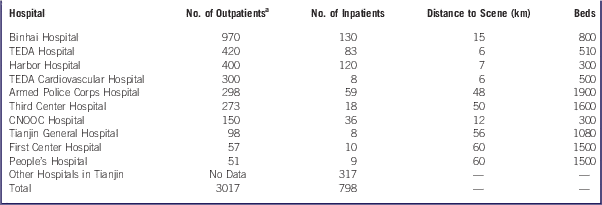
A massive number of wounded surged into nearby hospitals within the first 12 h after the explosions (Table 1). Peking University Binhai Hospital is the largest hospital in the Binhai New Area, 15 km away from the explosion site, in which most of the wounded were treated. All staff members of Binhai Hospital were recalled 30 minutes after the explosions. The hospital experienced an abrupt surge in the number of wounded in the first 2 hours after the explosions. Floors 2 to 5 of the hospital’s outpatient building were immediately opened for the walking wounded, and other wounded were triaged to the emergency department to undergo assessment and treatment. The green emergency channel was quickly established for all wounded from the explosions, and no registration was needed and no fee was charged. At 4 h on August 13, nearly 5 hours after the explosions, more than 800 patients had been treated with debridement, suturing, and bandaging to stop bleeding at the outpatient department. A total of 130 patients were admitted to the hospital, including 12 critical cases treated in the intensive care unit, and 41 cases underwent surgical operations within 12 hours after the explosions. Like Binhai Hospital, other hospitals in Tianjin also made responses to the explosions. In total, there were more than 4000 wounded outpatients in hospitals on the night of August 12, and 798 wounded were admitted to 45 local hospitals (Table 1).
Characteristics of the Hospitals in Tianjin

a The number of outpatients refers to the number of emergency patients in the hospital within the first 12 h.
According to the strategy of the 4Cs, patients injured in the explosions were centralized from small hospitals to large-scale general hospitals, and critical patients were mainly centralized in 5 hospitals, including Binhai Hospital, Tianjin General Hospital, Armed Police Corps Hospital of Tianjin, Tianjin First Center Hospital, and TEDA Hospital. These hospitals received 69 cases, 35 cases, 29 cases, 21 cases, and 8 cases, respectively, after August 14. Patients were centralized to hospitals under the principle that patients with the same injuries be transferred to the same hospitals for centralized treatment. For example, all burned patients were collected at the Armed Police Corps Hospital of Tianjin, which hosts a special burn department. The ratio of patient centralization was 20.3% (162 were transferred among all 798 inpatients). More than 9000 medical staff and 335 experts from Beijing, Shanghai, and Tianjin were called together to treat the wounded in the Tianjin explosions. The Tianjin Blood Center obtained a total of 1982 units of blood in the first 24 hours after the explosions.
As of March 1, 2016, 6 people had died after rescue in the hospitals. The in-hospital mortality rate of the explosions was 0.75% (6 deaths among all 798 inpatients). Also at this time, fewer than 20 patients were still in hospitals receiving rehabilitation therapy, and the remaining wounded had been discharged.
DISCUSSION
This study presented the EMS and hospital responses to the Tianjin explosions, both of which were quick and successful. We showed how the strategy of the 4Cs was applied to a mass casualty and identified a relatively low in-hospital mortality rate of less than 1%. This was attributed to the strong leadership of the Chinese government, the timely action of fearless prehospital care responders on scene, the correct application of the 4Cs strategy, and the abundant medical resources prepared for disaster.
We confirm the success of the medical response to the explosions. Meanwhile, lessons and experiences should be summarized from the disaster. On August 15, 2015, Chinese President Xi Jinping urged authorities to learn from the “extremely profound” lessons paid for with blood in the Tianjin explosions. 4 What lessons can we learn from the incident? This is the main purpose of this study. Below are the lessons that can be drawn from this disaster.
On-Scene Security Assessment Is Necessary for Any Explosion
It is very important to assess the on-scene security before entering the disaster scene, especially in the case of fires and explosions of hazardous chemicals. Usually during the training and daily work of firefighters, however, it is heavily emphasized that fighting fire is a firefighter’s sacred mission, regardless of personal security. Lack of on-scene security assessment was the leading cause of the death of 104 firefighters in the Tianjin explosions. Similarly, prehospital care professionals often are too anxious to save lives and ignore their personal safety on scene. Prehospital care professionals rushed into the core area of the explosion site without any protection, which was surrounded by tons of hazardous materials. In this case, it was a very dangerous rescue process. Determining where it is safe is very difficult in the early stage of an explosion, and it is necessary to enter the explosion zone to save lives. Thus, EMS crews should wear protective clothing and masks.
Personal Protective Equipment Should Be Prepared
The first responders including prehospital care professionals arrived on the scene of the explosions and did not wear any protective equipment through the whole night. There was a series of explosions of hazardous chemicals, and there were tons of dangerous materials on the scene. When approaching the scene, all rescuers should wear level A personal protective equipment to protect themselves from potential contamination. This teaches us that level A personal protective equipment should always be available on each ambulance everywhere.
Decontamination Should Be Done
Decontamination is an important consideration for all people involved in a hazardous materials explosion before admittance to the hospital. The most important principle of decontamination is summarized by the key phrase, “strip and shower.”Reference Koenig 5 It sounds easy but is seldom done in reality. In the Tianjin explosions, decontamination was not done by EMS or by the hospitals. It was a fact that there were no favorable conditions for EMS to decontaminate on scene, but the simplest method of decontamination should have been done of removing the patients’ clothing, which could remove at least 70% to 85% of the contaminants.Reference Koenig 6 Both solid and liquid toxic substances adhered to the clothing of wounded firefighters and people, and can pose a risk to patients or other health care personnel. Therefore, their clothing should be removed before they enter the hospitals.
Triage Should Be Improved
Triage is one of the most important missions of medical response both for EMS and hospitals in any disaster. The number of outpatient cases in the top 10 patient-receiving hospitals within the first 12 hours was 3017, and there were many injured casualties having no records. Only 198 wounded were transferred by EMS to hospitals, which accounted for up to 6.5% (198 were transferred among all 3017 outpatient cases). Most of the wounded went to nearby hospitals by their own means. Thus, hospital triage played a significant role in the rescue work after the explosions. The wounded were triaged based on the simplest principle of “walking or not.” The walking wounded who were considered to have minor injuries were guided to the outpatient building, while the rest who were considered to have critical injuries were treated at the emergency department. At hospitals, re-triage was required for every admitted patient at multiple levels. It is very difficult to carry out triage for hospitals in which emergency departments are far from outpatient buildings. If a massive number of wounded surge into the emergency department, it would result in chaos. What we have learned from the explosions are to open the outpatient building and triage by the principle of “walking or not” to deal with mass wounded. Furthermore, given that there were cases of both overtriage and undertriage in the medical rescue work, the efficiency of triage should be improved.Reference Aylwin, Konig and Brennan 7 , Reference Guo-Qiang, Shi-Ke and Xin 8
The Strategy of 4Cs Should Be Popularized
The wounded who were admitted to small hospitals at the early stage of the explosions were handled by the principle that those with the same injuries were transported to the same hospitals. Thus, most wounded in the explosions were centralized together in large-scale general hospitals in order to get centralized treatment. Accordingly, the centralized experts and resources were easily distributed to hospitals according to the types of the wounded. A total of 162 wounded were centralized, with the ratio of patient centralization at 20.3% (798 inpatients in total). Of these 162 patients, 69 patients (accounting for 42.6%) were transferred to Binhai Hospital, which accepted the largest number of patients in the explosions. The best way hospitals can prepare is to base their response on a strong foundation of daily health care.Reference Wang, Yin and Zhang 9 , Reference Kellermann and Peleg 10 The biggest advantage of the strategy of the 4Cs is that it is easy to manage the wounded of an explosion, and this strategy should be widely popularized.
The Disaster-Consciousness of the Public Should Be Heightened
Homeless people nearby the explosions experienced fear and sadness, anger and protest after the blast. On August 15, 2015, damaged residences were opened temporarily to accommodate the homeless people with their daily necessities; most of them, however, brought their clothing and bedsheets, which had been seriously polluted by the explosions. These things could not be used anymore, but the homeless people did not know this. The disaster command center should notify the victims of explosions of what can be taken and what cannot be taken beforehand. In addition, Chinese people often tend to put property first and life second, lacking disaster-consciousness and knowledge. It is incumbent upon the government to educate the Chinese people and improve this situation. As for the training of disaster medicine and public health preparedness, we should learn from Japan.Reference Ishii 11
CONCLUSION
Following the August 12, 2015, explosions, 198 casualties were transported by EMS but the vast majority of the estimated 4000 casualties self- or buddy-transported to 45 area hospitals, resulting in 798 admitted. A total of 162 (20.3%) were later transferred to 1 of 4 centralized tertiary care centers for specialty care. There were 323 (40.5%) surgeries in the first 12 hours. The majority of the 173 dead or missing were firefighters (n=104). Only 6 (3.4%) died after admission to the hospital. We self-identified scene security, personal protective equipment, hospital-based decontamination, and triage as areas for improvement. Civil and medical authority provided leadership and adapted quickly to the catastrophe. The 4Cs concept should be popularized, and the public should have greater awareness and preparation for disasters.
China is a disaster-prone country, constantly at risk of simultaneous multiple disasters in different parts of the nation at any point in time. We must draw lessons from the explosions and make full use of them in future disasters.
However, this was a retrospective, descriptive study of the August 12, 2015, series of hazardous chemical explosions in the Tianjin Port of China collected in the weeks following the incident. In addition to recall bias of circumstances in the immediate aftermath, registration and the care provided to a large number of the ambulatory casualties were not recorded. Estimates of total casualties are a consensus, and inaccuracy may have affected the denominator when calculating later rates and percentages.
Funding
Our work is supported by the Research Special Fund for Public Welfare Industry of Health from the National Health and Family Planning Commission of China (No.201002014) and the Capital Health Research and Development of Special (No.2011-1018-01).
Contributions
Jinjun Zhang and Tianbing Wang conducted the literature survey and drafted the paper. Jun Zhang collected the data; Baoguo Jiang and Da Fan reviewed the paper. Among the authors, professor Wang, Xu, and Jiang took part in the rescue after the explosion as invited experts. Professor Zhang is the president of Binhai Hospital and was responsible for the management of the wounded in the hospital.