Introduction
Generalized anxiety disorder (GAD) is a chronic and highly prevalent anxiety disorder that is characterized by excessive worry associated with fatigue, restlessness, muscle tension, irritability, sleeping difficulty, and concentration problems (Kessler et al., Reference Kessler, Gruber, Hettema, Hwang, Sampson and Yonkers2008). In addition to cognitive and emotional anxiety symptoms, individuals with GAD exhibit a variety of autonomic dysfunction symptoms, including palpitations, sweating, hot flashes, and shaking (Jetty et al., Reference Jetty, Charney and Goddard2001; Tully et al., Reference Tully, Cosh and Baune2013). GAD has been linked to the onset and progression of cardiac disease, and in many instances has been associated with adverse cardiovascular outcomes (Frasure-Smith and Lesperance, Reference Frasure-Smith and Lesperance2008; Martens et al., Reference Martens, de Jonge, Na, Cohen, Lett and Whooley2010; Tully et al., Reference Tully, Winefield, Baker, Denollet, Pedersen, Wittert and Turnbull2015). Autonomic dysregulation underlying the disorder has been proposed to be responsible for the link between GAD and cardiovascular morbidity and mortality.
The autonomic nervous system (ANS) has two distinct divisions, namely the sympathetic (SNS) and parasympathetic nervous systems (PNS), that link the brain and the heart. The PNS regulates heart rate (HR) via the vagus nerve arising from the brain stem region. Efferent vagal fibers functionally slow HR and actively counteract the opposing effects of SNS on the heart. Because SNS and PNS firing alters spontaneous sinus node depolarization, HR and rhythm thus convey information about ANS influence on the heart. To date, analysis of spectral heart rate variability (HRV), a noninvasive assessment of subtle beat-to-beat variations in HR, has gained widespread acceptance in assessing ANS modulation (Chalmers et al., Reference Chalmers, Quintana, Abbott and Kemp2014). Of note, spectral HRV examination during the supine-standing-supine test (5 min in each position) has recently been used with psychiatric disorders (Tonhajzerova et al., Reference Tonhajzerova, Ondrejka, Javorka, Turianikova, Farsky and Javorka2010; Chang et al., Reference Chang, Chang, Tzeng, Kuo, Lu and Huang2013a) and cardiovascular diseases (Galuszka et al., Reference Galuszka, Opavsky, Lukl, Stejskal, Zapletalova and Salinger2004). This test can measure the dynamic loading of the ANS, reflecting a shift from PNS predominance at rest to SNS control while standing, and also SNS predominance while standing to PNS dominance during supine recovery (Galuszka et al., Reference Galuszka, Opavsky, Lukl, Stejskal, Zapletalova and Salinger2004).
In most previous studies, the association between GAD and HRV has been evaluated under resting conditions; however, the results of those studies have been mixed. Some studies, including ours, have showed that GAD patients exhibit increases in HR and decreases in variability (i.e. low vagal control) at rest as compared to healthy controls (Lyonfields et al., Reference Lyonfields, Borkovec and Thayer1995; Thayer et al., Reference Thayer, Friedman and Borkovec1996; Chang et al., Reference Chang, Chang, Tzeng, Kuo, Lu and Huang2013b; Pittig et al., Reference Pittig, Arch, Lam and Craske2013; Kemp et al., Reference Kemp, Brunoni, Santos, Nunes, Dantas, Carvalho de Figueiredo, Pereira, Ribeiro, Mill, Andreao, Thayer, Bensenor and Lotufo2014). However, no differences in resting HRV vagal modulation have been reported (Hammel et al., Reference Hammel, Smitherman, McGlynn, Mulfinger, Lazarte and Gothard2011; Fisher and Newman, Reference Fisher and Newman2013; Levine et al., Reference Levine, Fleming, Piedmont, Cain and Chen2016), and Licht et al. (Reference Licht, de Geus, van Dyck and Penninx2009) demonstrated that resting vagus-mediated HRV reductions in patients with GAD are driven by the effects of antidepressants alone but not by GAD itself. Moreover, a small sample size study reported higher resting vagally-mediated HRV in patients with GAD (n = 11) as compared to control subjects (n = 41) (Shinba, Reference Shinba2017).
Relatively little research has examined the relationship between GAD and HRV reactivity, and also with inconsistent results. The first study, conducted by Lyonfields et al. (Reference Lyonfields, Borkovec and Thayer1995) and including 30 participants, reported that patients with GAD showed blunted changes in HR and vagal index of HRV through experimental worry and adverse imagery induction. However, subsequent studies with small sample sizes (range: 35–118) have revealed no differences in vagal reactivity to mental stress tasks (Hammel et al., Reference Hammel, Smitherman, McGlynn, Mulfinger, Lazarte and Gothard2011; Fisher and Newman, Reference Fisher and Newman2013; Diamond and Fisher, Reference Diamond and Fisher2016). Furthermore, contrary to the above findings, two small-scale studies (both sample sizes⩽42) have reported that GAD exhibited greater HR in response to hyperventilation tasks (Pittig et al., Reference Pittig, Arch, Lam and Craske2013), and was associated with greater vagal withdrawal during both imagery and worry induction than in controls (Levine et al., Reference Levine, Fleming, Piedmont, Cain and Chen2016).
Obviously, the previous conflicting findings may be due to underpowered data collected from relatively small sample sizes, and confounding effects from medications (e.g. antidepressants). Furthermore, several factors, such as age, sex, body mass index (BMI: kg/m2), smoking status, habitual physical activity, medical conditions, and comorbid mental disorders, may have an impact on ANS function (Pradeep et al., Reference Pradeep, Sambashivaiah, Thomas, Radhakrishnan, Vaz and Srinivasan2012; Jiang et al., Reference Jiang, Zhang, Ye, Lei, Wu, Zhang, Chen and Xiao2015; Alvares et al., Reference Alvares, Quintana, Hickie and Guastella2016). Failure to control these confounding effects may also be responsible for mixed results. Moreover, inadequate adjustment of confounding factors may lead to a statistical artifact known as ‘reversal paradox' – the relationship between two variables may be reversed, diminished, or enhanced when another variable is statistically controlled (Tu et al., Reference Tu, Gunnell and Gilthorpe2008). Thus, to address all these issues, analyses with a large sample size and better methodology are needed. Propensity score matching (PSM), a relatively new method, has been applied to reduce bias by assembling a sample in which confounding factors are balanced between groups (McCaffrey et al., Reference McCaffrey, Griffin, Almirall, Slaughter, Ramchand and Burgette2013). The PSM technique has distinct advantages over traditional regression-based approaches, including (1) ability to analyze observational data to ‘mimic' the design of randomized controlled trials, (2) capture of complex non-linear relationships between groups and covariates without overfitting, (3) bias reduction by assessing the propensity score without regard to outcome variables, and (4) being more interpretable and less prone to violations of model assumptions (McCaffrey et al., Reference McCaffrey, Griffin, Almirall, Slaughter, Ramchand and Burgette2013). Thus, in addition to the conventional regression approach, PSM was used as a more reliable covariate adjustment method in the present study.
The aim of this study, using a large cohort with appropriate covariate adjustment, was to test whether GAD patients, particularly those free of drug use and comorbidity, had altered patterns of HRV at rest and/or in response to postural challenges, as compared to healthy controls.
Methods
Participants
The research protocol was reviewed and approved by the Institutional Review Board of Tri-Service General Hospital (TSGH), a medical teaching hospital belonging to the National Defense Medical Center in Taipei, Taiwan. The study participants were all unrelated ethnic Han Chinese. Before research began, all participants signed informed consent forms. Their demographics and lifestyle variables were obtained, including age, gender, BMI, smoking status (yes/no) and habitual exercise (yes/no). Subjects' systolic (SBP) and diastolic blood pressure (DBP) were also recorded.
In total, we recruited 1832 subjects. The patient group consisted of 682 patients with GAD, who were recruited from clinical settings at TSGH. Each patient was evaluated by an attending psychiatrist using the Chinese Version of the Mini-International Neuropsychiatric Interview (MINI) (Sheehan et al., Reference Sheehan, Lecrubier, Sheehan, Amorim, Janavs, Weiller, Hergueta, Baker and Dunbar1998) to reach the DSM-IV criteria for a primary diagnosis of GAD. Participants with a comorbid diagnosis of organic brain disease (e.g. stroke), schizophrenia, bipolar disorder, or substance dependence were excluded. However, depression (e.g. major depression, dysthymia) and/or other anxiety disorders (e.g. panic disorder, phobic disorder) were not excluded from the whole-sample analyses. Furthermore, participants' physical morbidity including cardiovascular disease (CVDs) (e.g. coronary heart disease or hypertension), diabetes mellitus, dyslipidemia (e.g. hypertriglyceridemia or hypercholesterolemia) and other chronic diseases (e.g. thyroid, kidney, and liver diseases) and use of medications (e.g. cardiovascular drugs, antidepressants, and benzodiazepines) were also recorded according to self-report and medical chart review. This patient group included 326 GAD patients who were free of comorbidity and drug use (i.e. drug free for at least two weeks before enrollment).
The normal control group included 1150 healthy participants. These subjects received a medical checkup at TSGH, which comprised physical examination, SBP and DBP measurements, thoracic radiography, electrocardiography (ECG), and biochemical analyses (e.g. fasting glucose, lipid profiles and thyroid function). Individuals were free of physical illness, including CVDs, metabolic disorders, liver or kidney disease, malignancy, neurological disorder or obesity (BMI ⩾ 30 kg/m2). In addition, they were also free of mental disorders (e.g. schizophrenia or affective disorders), based on the assessment using the Chinese Version of the MINI (Sheehan et al., Reference Sheehan, Lecrubier, Sheehan, Amorim, Janavs, Weiller, Hergueta, Baker and Dunbar1998) by a well-trained research assistant. Finally, none of them had been taking any medications, as determined by self-report, for at least 1 month before entering the study.
Assessment of anxiety and mood levels
We used the Chinese version of the Beck Anxiety Inventory (BAI) (Lin, Reference Lin2000), a 21-item questionnaire, to assess subjects' self-reported severity of anxiety. Items were rated as 0 (not at all) to 3 (severe) for the last week, with higher total scores indicating greater levels of anxiety. Participants' depression levels over the prior two weeks were evaluated via the self-reported, 21-item Chinese version of the Beck Depression Inventory-II (BDI) (Chen, Reference Chen2000). Likewise, higher scores represent more severe depression. Both the Chinese BAI and BDI have been shown to have high validity and reliability (Chen, Reference Chen2000; Lin, Reference Lin2000).
Assessment of ANS function
An SA-3000P HRV analyzer (Medicore Co., Ltd., South Korea) was used to acquire, store, and process ECG signals. All participants were examined during the daytime (8:00–16:00) in a quiet, temperature-controlled room. After 15 min for rest and stabilization of HR, the patients remained in each position for 5 min during a supine-standing-supine test (changes in body position over a 5 s time interval). R–R intervals were measured during baseline supine position; orthostasis (after changing of posture from lying to standing during 5 s) and recovery supine position (after changing of position from standing to lying during 5 s). The 5-min HRV recording in each position, which collects at least 300 R–R intervals, is recommended by the Task Force standards for short-term HRV analysis (Task Force of the European Society of Cardiology and the North American Society of Pacing and Electrophysiology, 1996).
The HR was calculated using averaged R–R intervals for each segment. Power spectral analysis was further performed using a fast Fourier transform-based nonparametric algorithm. The power spectrum was then converted into frequency-domain indices, which consisted of the low-frequency (LF) power (0.04–0.15 Hz), the high-frequency (HF) power (0.15–0.4 Hz), and the ratio of LF to HF (LF/HF) (Task Force of the European Society of Cardiology and the North American Society of Pacing and Electrophysiology, 1996). PNS control of HRV is represented by HF, whereas both vagal and SNS control of HRV is jointly represented by LF. The LF/HF ratio is considered to mirror sympathovagal balance or to reflect SNS modulations (Task Force of the European Society of Cardiology and the North American Society of Pacing and Electrophysiology, 1996). A natural logarithmic transformation was used to correct the skewed distribution of the HRV measures.
Covariates
Age, gender, BMI, smoking status, habitual exercise, medical diseases (CVDs, diabetes mellitus, dyslipidemia and other chronic diseases, respectively), psychiatric disorders (depression disorders and other anxiety disorders, respectively) and medications (antidepressants, antipsychotics, mood stabilizers, benzodiazepines and cardiovascular drugs, respectively) were used as covariates in regression models to compare GAD patients with healthy controls (original cohort). Likewise, using the regression-based approach, age, gender, BMI, smoking status and habitual exercise were also used as covariates when analyzing drug- and comorbidity-free GAD patients and healthy controls (unmatched cohort). To minimize the potential effects of confounding factors, we used PSM to ‘balance’ confounders (i.e. age, gender, BMI, smoking status and habitual exercise) between drug- and comorbidity-free GAD patients and healthy control groups. The PSM was performed using SPSS R-plugin PSMATCHING3.03 (Thoemmes, Reference Thoemmes2012), and R version 3.1.1 (http://www.r-project.org), based on logistic regression with a caliper width of 0.2. After PSM algorithm, 323 drug- and comorbidity-free GAD patents and 323 healthy controls were matched for analyses (matched cohort). A balance test, by Hansen and Bowers (Reference Hansen and Bowers2008), was used to examine the overall balance of covariates. In the present study, the non-significant test result indicated a balance of covariates (χ2 = 0.75, df = 5, p = 0.98).
Statistical analysis
Categorical variables in patients and controls were compared using the χ2 test, while the independent sample t test was used to compare continuous variables. For each HRV measure, a two-way repeated measures ANOVA was performed with the Greenhouse–Geisser correction to adjust for the violation of the sphericity assumption. F-tests were used to examine differences in baseline resting HRV indices between GAD patients and controls. When a significant interaction (group × condition) effect was found, F-tests were also performed among case-control groups for responses to postural change (i.e. data of standing minus baseline supine, and recovery supine minus standing, respectively). Effect sizes are reported as Cohen's d values; d < 0.2 is considered small, between 0.4 and 0.6, medium, and >0.8 large (Kemp et al., Reference Kemp, Brunoni, Santos, Nunes, Dantas, Carvalho de Figueiredo, Pereira, Ribeiro, Mill, Andreao, Thayer, Bensenor and Lotufo2014). According to a priori power analysis for a repeated measures ANOVA conducted in the software G*Power (Faul et al., Reference Faul, Erdfelder, Buchner and Lang2009), which assumed two groups with three repeated measures, a total sample size of at least N = 198 would be necessary for the detection of small effect with a statistical power of 80%, α = 0.05 and an assumed nonsphericity correction of 0.75. Furthermore, if the true effects are small (Cohen's d = 0.2), a power of 99.9% can be reached when the studied sample size is larger than 610. Statistical significance was defined as p values <0.05 (two-tailed).
Results
Sample characteristics
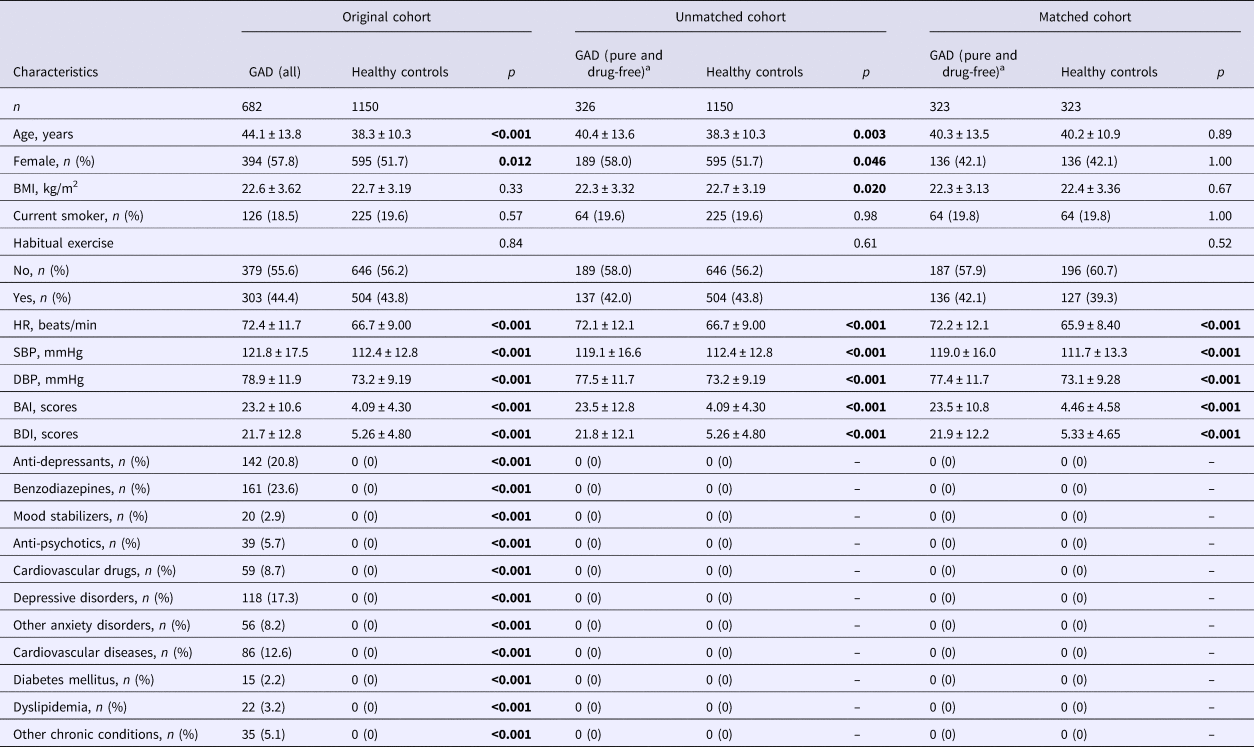
The demographic and clinical characteristics of study participants are shown in Table 1. In our original cohort, GAD patients were significantly older and had a higher female percentage as compared with healthy controls. Also, in the unmatched cohort, drug- and comorbidity-free GAD patients had significant differences in age, gender ratio and BMI when compared to healthy controls. However, in the propensity-matched cohort, there were no statistically significant differences in covariates between drug- and comorbidity-free GAD patients and healthy controls. All patients in our study had BAI scores ⩾8, indicating at least mild to severe anxiety (Lin, Reference Lin2000). As expected, patients with GAD in the three cohorts all had significantly higher BAI and BDI scores, as compared with healthy counterparts. In addition, HR, SBP and DBP were also higher in the three patient groups than in healthy controls.
Demographic data and clinical characteristics of the study subjects

BAI, Beck Anxiety Inventory; BDI, Beck Depression Inventory-II; BMI, body mass index; HR; mean heart rate; SBP, systolic blood pressure; DBP, diastolic blood pressure; GAD, generalized anxiety disorder.
Continuous variables are reported as mean ± standard deviation; categorical variables are listed as column-wise percentage.
Bold indicates statistically significant p-values.
a GAD patients who were free of medications and comorbidities.
Repeated measures of HRV indices
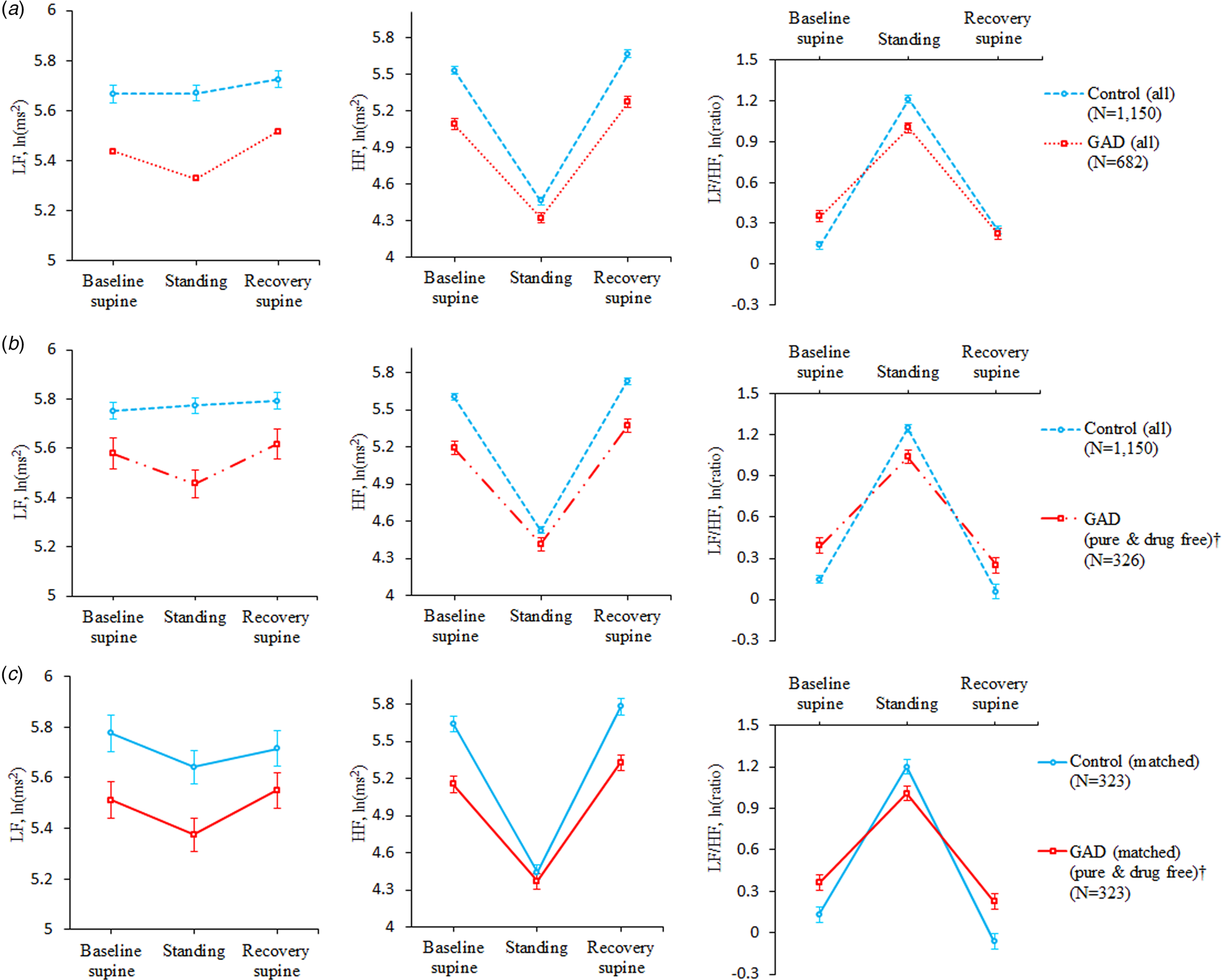
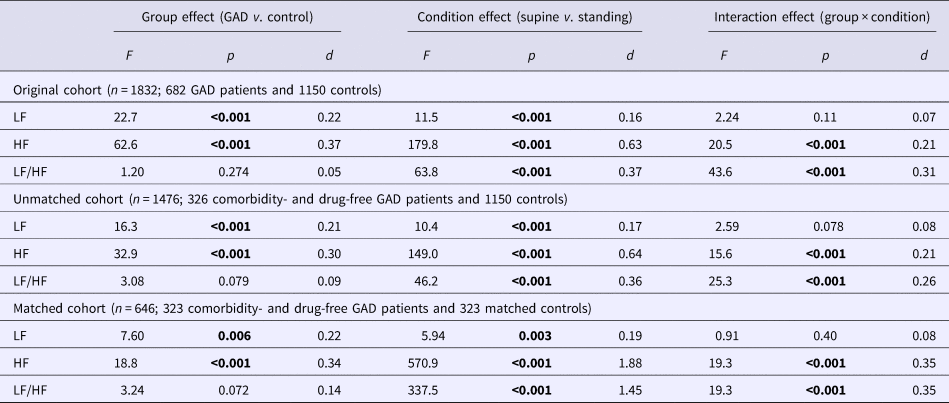
Figure 1 presents the HRV data obtained from the GAD patients and the controls. The results of two-way repeated measures ANOVA for HRV indices are shown in Table 2. Analyzed in the original cohort, the main effects of both position changes (the response to orthostasis and clinostasis) on all HRV indices were significant. Furthermore, the effect of group (GAD v. control) was significant for LF and HF, but not LF/HF. Moreover, the results of repeated measures ANOVA showed significant interaction effects between the main factors (group × body position), with respect only to HF and LF/HF. When comparing two groups in the unmatched cohort, results showed the same pattern. Furthermore, analyses of data from the propensity-matched cohort also showed a similar pattern.
Spectral heart rate variability data in (a) original cohort, (b) unmatched cohort and (c) propensity-matched cohort. †GAD patients who were free of medications and comorbidities. GAD, generalized anxiety disorder; LF: low-frequency power; HF, high-frequency power; LF/HF, ratio of LF to HF.

Results of two-way repeated measures ANOVA for spectral indices of HRV

GAD, generalized anxiety disorder; HRV, heart rate variability; LF, low-frequency power; HF, high-frequency power; LF/HF, ratio of LF to HF.
Bold indicates statistically significant p values.
HRV indices in the baseline supine
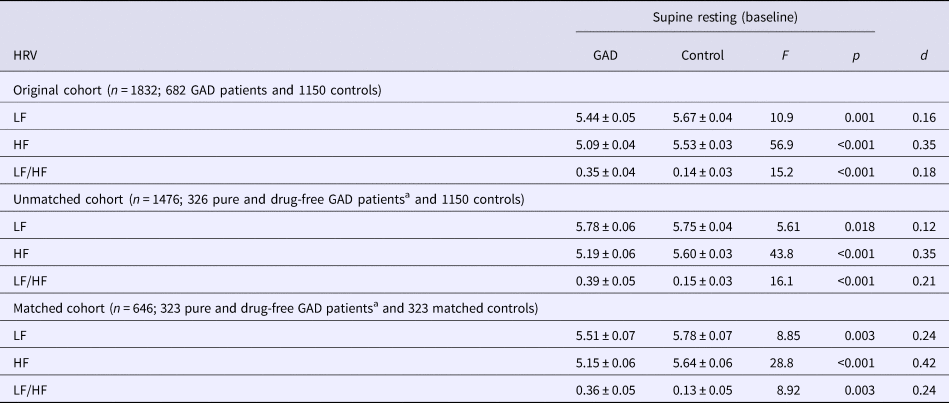
The results for baseline resting HRV indices are shown in Table 3. Analyzing the original cohort, patients with GAD had significantly lower LF and HF but higher LF/HF than the controls in the baseline supine (for LF, HF and LF/HF: d = 0.16, 0.35, 0.18, respectively). Likewise, the results analyzed in the unmatched cohort were similar. When we analyzed the matched cohort, these findings remained. However, the effect sizes of GAD on resting HRV indices all became bigger (for LF, HF and LF/HF: d = 0.24, 0.42, 0.24, respectively).
Inter-group differences in baseline resting spectral HRV indices

GAD, generalized anxiety disorder; HRV, heart rate variability; LF, low-frequency power; HF, high-frequency power; LF/HF, ratio of LF to HF.
Data are presented as mean ± standard error.
a GAD patients who were free of medication and comorbidities.
Response of HRV indices to postural change
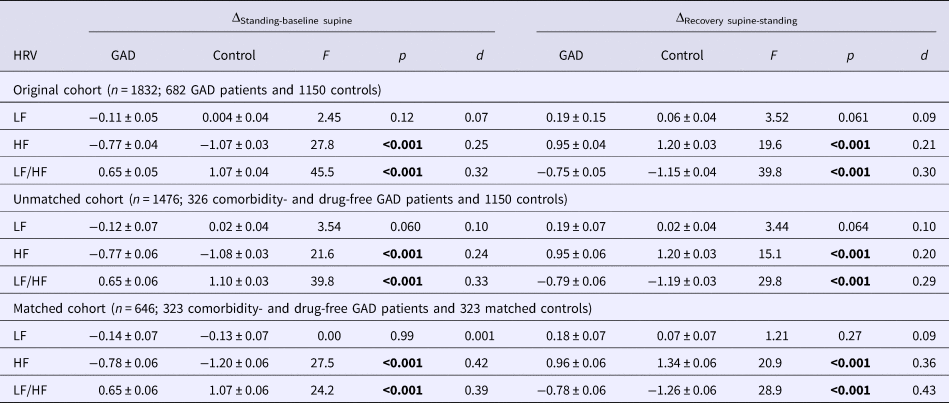
In the original cohort analyses, as shown in Table 4, patients with GAD had diminished HF and LF/HF responses to both orthostasis (d = 0.25 and 0.32, respectively) and clinostasis (d = 0.21 and 0.30, respectively), as compared to the controls. Similarly, the results analyzed in the unmatched cohort exhibited the same pattern. Furthermore, analyses of the propensity-matched cohort data also confirmed the results. However, the effect sizes of GAD on HRV reactivity all became more robust (for HF and LF/HF reactivity: d = 0.36–0.42 and 0.39–0.43, respectively).
Spectral heart rate variability (HRV) in response to postural maneuvers

GAD, generalized anxiety disorder; LF, low-frequency power; HF, high-frequency power; LF/HF, ratio of LF to HF.
Data are presented as mean ± standard error.
Bold indicates statistically significant p values.
Discussion
To our knowledge, this is the first well-powered study that has simultaneously examined differences in resting HRV and HRV reactivity by using frequency-domain HRV analyses between medication- and comorbidity-free GAD patients and healthy controls during the supine-standing-supine test, based on a relatively novel PSM covariate adjustment approach. The main results of our study are summed up as follows.
First, through analyses with the original cohort, we found that patients with GAD exhibited lower LF and HF but higher LF/HF than healthy controls at rest (baseline supine), indicating GAD is associated with an altered sympathovagal balance with reduced vagal modulation. Our results are consistent with earlier studies (Lyonfields et al., Reference Lyonfields, Borkovec and Thayer1995; Thayer et al., Reference Thayer, Friedman and Borkovec1996; Chang et al., Reference Chang, Chang, Tzeng, Kuo, Lu and Huang2013b; Pittig et al., Reference Pittig, Arch, Lam and Craske2013; Kemp et al., Reference Kemp, Brunoni, Santos, Nunes, Dantas, Carvalho de Figueiredo, Pereira, Ribeiro, Mill, Andreao, Thayer, Bensenor and Lotufo2014), suggesting that GAD basal autonomic state is characterized by decreased PNS control. However, Licht et al. (Reference Licht, de Geus, van Dyck and Penninx2009) reported that although resting vagal modulation is reduced in patients with anxiety disorders, these reductions are driven by antidepressant medications. Furthermore, GAD has a high rate of comorbidity with other psychiatric disorders, particularly major depression, and other anxiety disorders (Noyes, Reference Noyes2001), which have also been reported to have an impact on resting vagal modulation. Thus, focusing on unmedicated GAD patients, free of any comorbidity, is required to reveal the association between GAD and resting vagal modulation. When we compared drug- and comorbidity-free GAD patients with controls (unmatched cohort), the results still remained. Moreover, to avoid statistical ‘reversal paradox' phenomenon, a PSM technique was used to minimize the confounding effects. A similar pattern was also identified when analyses were conducted in the propensity-matched cohort. However, the effect sizes of GAD on resting HRV became larger (e.g. for resting HF, Cohen's d = 0.42) than the traditional regression-based approach (e.g. for resting HF, Cohen's d = 0.35). In sum, based on a large sample using the PSM method, our findings here provide strong evidence to support the view that GAD itself is associated with reduced vagally-mediated HRV at rest, regardless of medication or comorbidity.
Second, analyses of the original cohort showed that GAD patients exhibited a blunted ANS (HF and LF/HF) reactivity to both active orthostatic and clinostatic testing. Furthermore, analyses in the unmatched cohort also revealed a similar pattern. Moreover, matched cohort data analyses confirmed these findings and found that effects became more robust (e.g. for HF reactivity, Cohen's d = 0.36–0.42) than with the traditional regression-based method (e.g. for HF reactivity, Cohen's d = 0.20–0.25), further highlighting the importance of PSM for covariate adjustment. Our findings are in line with the results of Lyonfields et al. (Reference Lyonfields, Borkovec and Thayer1995), indicating a rigid or inflexible PNS response to challenges. Indeed, our study cohorts all had a statistical power of >99.9% to detect an effect even recognized as small (Cohen's d = 0.20), including the propensity-matched cohort (n = 646). However, as far as we know, all previous studies mentioned in the Introduction were conducted using small sample sizes (range: 30–118) to approach autonomic reactivity in GAD patients as compared to controls. In addition, these past studies have seldom appropriately controlled for covariates, e.g. using the PSM approach. Therefore, previous inconsistent results regarding vagally-mediated HRV reactivity would be explained by data from underpowered studies, and also lack of appropriate covariate adjustment.
Third, two GAD-specific longitudinal studies have shown that GAD patients have an augmented risk for CVDs, such as coronary heart disease and myocardial infarction (Frasure-Smith and Lesperance, Reference Frasure-Smith and Lesperance2008; Martens et al., Reference Martens, de Jonge, Na, Cohen, Lett and Whooley2010). Notably, decreased cardiac vagal function has been reported to be associated with an elevated risk for cardiac morbidity and mortality, as reviewed by Thayer and Lane (Reference Thayer and Lane2007). Importantly, a recent meta-analysis has indicated that only tricyclic antidepressants can have a ‘small' effect (Cohen's d < 0.2) on reducing resting vagal modulation, but other commonly used antidepressants (e.g. selective serotonin reuptake inhibitors or serotonin-norepinephrine reuptake inhibitors) cannot (Alvares et al., Reference Alvares, Quintana, Hickie and Guastella2016). Interestingly, based on the PSM approach, we observed more robust effects in the near-medium range (Cohen's d ≈ 0.4) for medication-free GAD patients, therefore suggesting that effects cannot be solely attributable to antidepressant use, and highlighting that both attenuated vagus-mediated HRV at rest and in response to posture maneuvers may be the core mechanisms linking GAD to subsequent cardiovascular events.
Finally, recent research has demonstrated that lower resting vagal modulation and attenuated vagal response to orthostatic stress are both predictors of future general anxiety symptoms (Greaves-Lord et al., Reference Greaves-Lord, Tulen, Dietrich, Sondeijker, van Roon, Oldehinkel, Ormel, Verhulst and Huizink2010; Kogan et al., Reference Kogan, Allen and Weihs2012). Our study's demonstration that GAD patients had attenuated vagally-mediated HRV at rest and in response to postural maneuvers may complement these previous studies, together suggesting that the two autonomic indices may not only be psychophysiological markers, but also endophenotypes for GAD. Future prospective studies to examine whether lower resting vagal modulation and blunted vagal response to stress task predict the development of GAD, and even comorbidity of GAD with CVDs, are warranted.
Several limitations should be mentioned in the present study. We did not control the influence of respiratory rate, which has been revealed to impact the HRV indices in patients with severe mental disorders, including schizophrenia and bipolar disorder (Quintana et al., Reference Quintana, Elstad, Kaufmann, Brandt, Haatveit, Haram, Nerhus, Westlye and Andreassen2016). Nonetheless, this may not affect our findings, as previous research examining GAD and HRV found no effect of respiration rate on HRV after statistically adjusting for respiration rate (Thayer et al., Reference Thayer, Friedman and Borkovec1996). Moreover, as recent evidence has questioned whether LF reflects SNS and/or PNS control (Reyes del Paso et al., Reference Reyes del Paso, Langewitz, Mulder, van Roon and Duschek2013), the interpretation of LF/HF as sympathovagal balance or SNS modulations should be made with caution. Therefore, although our study findings indicate that GAD is associated with higher sympathetic modulation at rest, additional studies [e.g. cardiac noradrenaline spillover: using coronary sinus blood sampling and noradrenaline isotope dilution methodology (Kingwell et al., Reference Kingwell, Thompson, Kaye, McPherson, Jennings and Esler1994)] for adequately assessing SNS control are necessary to confirm our results. Last, the participants recruited here were all Han Chinese; thus, replication research using large, racially diverse samples, with an adequately-controlled method such as ours, are needed to validate the current research findings.
Conclusion
In summary, using a large sample and a relatively novel PSM approach, our data suggests that GAD is associated with altered sympathovagal balance, characterized by attenuation in both the resting vagal modulation and vagal reactivity to posture maneuvers, with an almost medium effect size (Cohen's d ≈ 0.4). Furthermore, these effects are independent of medication use and comorbidity status.
Author ORCIDs
Chuan-Chia Chang, 0000-0001-9639-6158
Acknowledgements
The authors thank Ms Hsiao-Hsin Hung for her assistance in preparing the manuscript. Preliminary results were presented as a poster at the 24 November 2018 45th Annual Military Medicine Symposium, Taipei, Taiwan.
Financial support
The present study was supported by grants from the Tri-Service General Hospital, National Defense Medical Center, Taipei, Taiwan (TSGH-C105-122) and the Medical Affairs Bureau, Ministry of National Defense, Taipei, Taiwan (MAB-106-108).
Conflict of interest
None.
Ethical standards
The authors assert that all procedures contributing to this work comply with the ethical standards of the relevant national and institutional committees on human experimentation and with the Helsinki Declaration of 1975, as revised in 2008.