Introduction
The health of people with chronic medical conditions is particularly vulnerable to the disruptions caused by public health disasters,Reference Mokdad, Mensah, Posner, Reed, Simoes and Engelgau1 especially when there is massive damage to the medical infrastructure.Reference Ford, Mokdad and Link2 In a survey of Hurricane Katrina evacuees in San Antonio, Texas, nearly 70% of all medications dispensed in shelters were for chronic conditions, with those for cardiovascular disease being the most common.Reference Jhung, Shehab and Rohr-Allegrini3 Another survey of Katrina evacuees in Houston, Texas, found that approximately 40% had conditions such as hypertension, diabetes, and asthma, and 29% of those who were supposed to be taking medications reported problems getting prescriptions filled.4 This work on medication disruptions lends support to the recommendations of both government agencies5, 6 and national organizations7-Reference Versel9 that people with chronic illnesses should be prepared for disasters by stockpiling extra supplies of medications. The impact of these recommendations on preparedness behaviors appears to be questionable, however, as estimates of the proportion of US households with emergency medication supplies range from 38% of people with chronic illnesses having less than a week's supplyReference Rottman10 to 50% of the general population having a three-day supply.Reference Murphy, Cody, Frank, Glik and Ang11
A wide range of chronic illnesses has long been documented among veterans of the US armed forces,Reference Banta, Andersen, Young, Kominski and Cunningham12-Reference Williams, Miller and Fincke16 and a growing literature has found a relatively greater prevalence of several chronic conditions among veteran women compared with veteran men.Reference Bean-Mayberry, Huang and Batuman17 Due to their daily use of medications, veterans with chronic illness could be at great risk of complications due to disaster-related medication disruptions; however, the prevalence of personal medication preparedness among chronically ill veterans currently is not known. Given that the Fourth Mission of the Veterans Health Administration addresses the issue of emergency management for veterans and the general population, this is a question worthy of attention. An analysis of longitudinal data on a cohort of veteran men who experienced the 1994 Northridge earthquake in Los Angeles, California, found that having a greater number of pre-disaster health problems independently predicted greater post-disaster health issues.Reference Dobalian, Stein and Heslin18 This relationship of chronic illness and disaster impact among veterans underscores the importance of emergency medication preparedness for this population, particularly in states such as California that have a relatively high frequency of disasters. Using data collected from a probability sample of California residents, this study provides population-based estimates of medication preparedness among veteran men, veteran women, nonveteran men, and nonveteran women.
Methods
Data
Data were obtained from the 2009 California Health Interview Survey (CHIS), a cross-sectional telephone survey conducted by the University of California, Los Angeles Center for Health Policy Research. Respondents were a representative sample of households randomly drawn from stratified areas in California. The adult sample size is 47,614 (response rate, 19.5%). Weights were constructed to adjust for nonresponse and for differences across households in the probability of sampling adults. Full details of CHIS methods are available elsewhere.19 Analyses of these public-use data were exempted from review by the Institutional Review Board of the Veterans Administration Los Angeles Healthcare System.
Analytic Sample
Because the target population for this study is adults taking at least one daily prescribed medication for a chronic condition, analyses were restricted to respondents who answered “yes” to the question: “Do you take any medication daily that a doctor prescribed?” There were 28,167 respondents who reported taking daily prescribed medication in the 2009 CHIS, representing 59.2% of the total adult sample. When the analytic weights were applied, the 28,167 respondents represented approximately 11,829,500 adults in California in 2009.
Dependent Variable: Medication Preparedness
Respondents were asked, “Do you have at least an extra two-week supply of all the prescription drugs you take every day?” Respondents who answered “no” were then asked, “Could you get an extra two-week supply of all of your prescription drugs?” These survey questions were the two dichotomous (yes/no) dependent variables. Consistent with recommendations of the Florida Division of Emergency Management,6 the two-week supply referenced in this question represents a midpoint between the three-day supply recommended by the California Emergency Management Agency5 and the one-month supply recommended by the Mayo Clinic.8
Independent Variables
The key independent variable in these analyses combines veteran status and gender into the following four categories: veteran men, veteran women, nonveteran men, nonveteran women. Veteran status was ascertained with the question, “Did you ever serve on active duty in the Armed Forces of the United States?”
Insurance and income are likely to affect a person's ability to obtain extra medication supplies for emergencies, because they help cover the associated costs. Two variables on health insurance were included in the analysis, the first indicating the type of coverage the respondents had; the second variable was based on the question, “Are you covered for your prescription drugs?” Insurance plans often require copayments for emergency medications,Reference Carameli, Eisenman, Blevins, d'Angona and Glik20 and the associated out-of-pocket costs could affect access even among those who are insured. The potential effect of these costs on low-income populations justified the inclusion of a variable on annual household income, ranging from “less than $20,000” to “more than $80,000.”
The analysis included variables to assess preparedness among respondents who had been diagnosed with asthma, diabetes, and hypertension. As indicators of functional health, the analysis included a variable identifying respondents who had disabilities, and a variable identifying respondents who had difficulty leaving home to perform errands and other tasks. The model also included respondents’ scores on the Kessler 6 scale, a composite measure derived from responses to six items on nonspecific psychological stress.Reference Kessler, Andrews and Colpe21
Because previous work suggests that older people are more likely to have emergency supplies,Reference Murphy, Cody, Frank, Glik and Ang11 the analysis included a six-category variable on age, grouped into 19-29, 30-39, 40-49, 50-59, 60-69, and 70 and above. Following work showing racial/ethnic differences in preparedness,Reference Eisenman, Wold and Fielding22 the analysis included a variable indicating whether respondents were African American, American Indian, or Alaskan Native (AIAN), Asian or Pacific Islander (API), Latino, white, or “other.” Education was categorized as high school or less, a two-year degree or some college, and a bachelor's degree or higher. Three variables were included to characterize household structure: number of household members, a variable indicating whether the respondents had children living at home, and a nominal variable on marital status.
Analyses
Analyses were conducted with the Stata 12.0 software program (Stata Corporation, College Station, Texas USA) to weight prevalence estimates to the California population. Within the four veteran/gender groups, the percentage of respondents who had an extra two-week supply of medications and—among respondents who did not have a supply— the percentage who were able to obtain one, were calculated. Frequencies and means of the independent variables within each of the four groups also were calculated. Two multivariate logistic regression models were fitted to identify independent correlates of medication preparedness (“having an extra supply” and “able to obtain an extra supply”). To facilitate interpretation of the multivariable model results, odds ratios were transformed into adjusted percentages with 95% confidence intervals. In the multivariable models, nonveteran women were the reference (or “drop out”) category, and each of the other three veteran/gender groups were compared with nonveteran women. Post-estimation Wald tests were used to assess whether there were statistically significant differences in the remaining comparisons of nonveteran men vs veteran men, nonveteran men vs veteran women, and veteran men vs veteran women.
Results
Characteristics
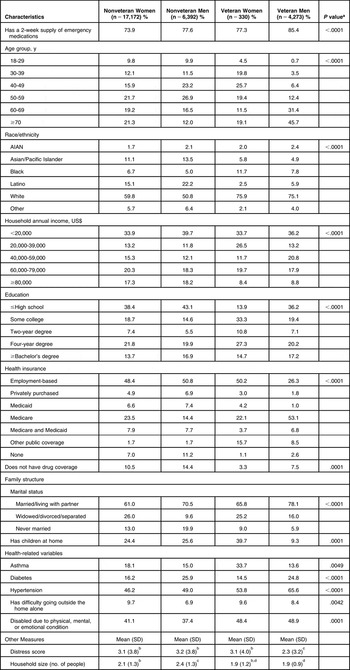
Table 1 shows the characteristics of adults in California taking daily medications, by veteran status and gender. Before adjusting for differences among the four veteran/gender groups in socioeconomic characteristics, 85.4% of veteran men had an extra two-week supply of prescription medications, compared with 77.3% of veteran women, 77.6% of nonveteran men, and 73.9% of nonveteran women (P < .0001). Higher percentages of veteran men and women had prescription drug coverage (92.5% and 96.7%, respectively) than did nonveteran men and women (85.6% and 89.5%, respectively; P = 0.0001). Approximately 11% of nonveteran men and 7% of nonveteran women were uninsured, which was three to 10 times higher than the portion of veteran men (2.6%) and veteran women (1.1%) who were uninsured (P < .0001). The prevalence of diabetes was similar in the two groups of men (veterans 24.8%, nonveterans 25.9%); both groups of men had diabetes at a rate approximately 10% higher than in both groups of women (veterans 14.5%, nonveterans 16.2%; P < .0001). Further, higher percentages of veteran men and veteran women had physical, mental, or emotional disabilities (48.9% and 48.4%, respectively) than did nonveteran women (41.1%) and nonveteran men (37.4%) (P = .0001). Finally, the prevalence of asthma among veteran women (33.7%) was markedly higher than that among nonveteran women (18.1%), and more than twice as high as among nonveteran men (15.0%), and veteran men (13.6%; P = .0049).
Characteristics of Adults in California Using Daily Medications, by Veteran Status and Gender, 2009 (N = 28,167)

Abbreviation: AIAN, American Indian or Alaskan Native; SD, standard deviation
aP values are from F tests.
b-dMean estimates with the same superscript letter were not significantly different (at P < .05) from each other using Bonferroni-adjusted tests.
Multivariable Analyses
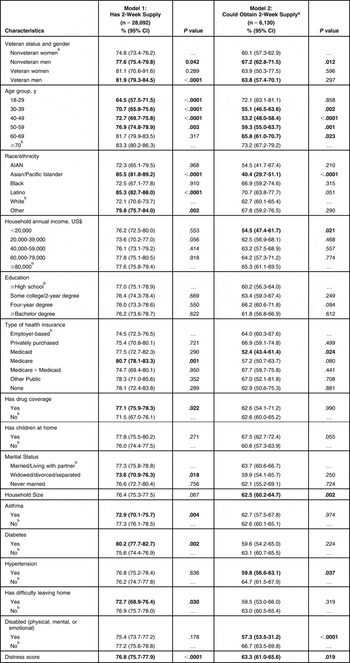
Differences in medication preparedness among the four veteran/gender groups decreased after accounting for demographic and socioeconomic characteristics (Table 2). The unadjusted 8% difference between veteran men and women dropped to 0.8% in the multivariable model. Still, a significantly higher percentage of veteran men had extra medication supplies than did nonveteran women (81.9% and 74.8%, respectively; P < .0001). The adjusted percentage of nonveteran men with extra medication supplies (77.6%) was also greater than that among nonveteran women (P = .042). Although the prevalence of preparedness between veteran men and women differed by less than 1.0%, the Wald test result of this difference was statistically significant (P = .014). Results from the other Wald tests were not significant.
Adjusted Percentages from Multivariable Models of (1) Having an Emergency Supply of Daily Medications and (2) Being Able to Obtain a Supply, Among Respondents Without a Supply. Bolded results are significantly different from reference group in the logistic regression model.

Abbreviation: AIAN, American Indian or Alaskan Native
a This model was restricted to those respondents who indicated they did not have an emergency medication supply. For Model 1, the analytic sample size of 28,092 is 99.7% of original sample of 28,167. For Model 2, the analytic sample size of 6,130 is 99.7% of original sample size of 6,146.
bThis category was the reference group in the model.
As shown in the Model 1 column of Table 2, emergency medication supplies were less common among respondents with employment-based health insurance than they were among those with Medicare; further, respondents with drug coverage were more likely to have emergency medications than were those without coverage. With each successively older age group, there were increases in the percentage of respondents who had extra supplies of medication. More respondents of API, Latino, and “other” backgrounds had emergency medications than did whites. Compared with those who were married or had cohabitating partners, respondents who were widowed, divorced, or separated were less likely to have medications. Respondents with asthma were less likely than those without asthma to have emergency medication supplies, but respondents who had diabetes were more likely than those without diabetes to have them. Respondents who reported difficulty leaving home were 5% less likely to have emergency medications than were those who did not report difficulty.
Among the 6,130 respondents who did not have an emergency medication supply (Model 2, Table 2), several variables were associated with reporting they could obtain one. Respondents in the three age groups between ages 30 and 59 were less likely to report they could obtain a supply, compared with respondents age 70 and over. Those of API backgrounds were less likely to say they could obtain a medication supply than were whites. Medicaid recipients were less likely to say they were able to obtain medications than were those with employer-based insurance. Average household size was associated with being able to obtain a supply. People with hypertension were less likely to say they could obtain an emergency supply than were those without hypertension, whereas disabled people were more likely than the nondisabled to say they could obtain one. Results from the post-estimation Wald tests were not significant.
Discussion
This study is the first to provide population-based estimates of personal medication preparedness among veterans with chronic conditions, using data from a survey that was sufficiently large to allow separate estimates of preparedness for veteran women. Levels of personal medication preparedness were higher in this population than those in previous studies,Reference Rottman10, Reference Murphy, Cody, Frank, Glik and Ang11 and the percentage of veteran men and women with extra supplies of medication was higher than that of their nonveteran counterparts. Veterans may be more likely than others to be prepared for public health emergencies because of their training to work in combat zones and other emergency situations, which perhaps engenders in them a culture of preparedness or self-reliance. It is also possible that people who choose to enlist in the military are different from the general population in ways that also make them more likely to be better prepared for emergencies. Contrary to the current study, previous work in the general Los Angeles County population found that men were less likely than women to have emergency supplies on hand in the event of a disaster.Reference Eisenman, Wold and Fielding22 If the VHA medical system has had an impact on veterans’ levels of preparedness, then the greater prevalence of medication preparedness among veteran men than women may reflect the disproportionate representation of men in the VHA patient population.
Socioeconomic factors are likely to be among the most substantial barriers to obtaining extra medication supplies. In the wake of Hurricane Katrina, a sample of evacuees cited lack of health insurance or other financial resources as the main reason they cut back on prescription medications.Reference Kessler23 The current study findings are consistent with previous work suggesting that having Medicare is associated with medication continuity in the aftermath of disasters.Reference Kessler23 Respondents without drug coverage had a relatively low level of medication preparedness, probably because they faced higher out-of-pocket costs for medications. Unfortunately, data on any insurance copayments or coinsurance were not available in the CHIS data set; such measures would be helpful for this analysis, because it is possible that the relatively low levels of preparedness among the “working age” participants between ages 18 and 59 were related to employment-based coverage that was less generous in terms of copayment or coinsurance provisions.
People with diabetes were more likely to have an extra supply of prescription medications than people without diabetes. Evacuation can lead to abrupt changes in dietary intake; along with a lack of diabetes medication, this can cause substantial reduction in glycemic control. Preparedness among people with diabetes may reflect lessons learned from previous experiences with symptoms of unmanaged hyperglycemia.Reference Cefalu, Smith, Blonde and Fonseca24 In a study by Kessler,Reference Kessler23 people with conditions that quickly become symptomatic when treatment is disrupted (eg, respiratory conditions such as asthma) were less likely to cut back on their medications than were those with conditions that take a longer time to become symptomatic even if treatment is disrupted (eg, cancer). The current findings were not entirely consistent with that pattern, however, as respondents with asthma were less likely to have emergency medications than were those without asthma. People often use asthma medications irregularly and only in certain situations (eg, exposure to smoke or dust). On the other hand, most people with insulin-dependent diabetes have had at least one hypo/hyperglycemic episode and are aware of the adverse consequences of being without insulin. The finding that respondents with hypertension were less likely to be able to obtain a supply is a concern because of the increased risk of stroke this may entail. The low level of medication preparedness among people who had difficulty leaving home, as well as people with disabilities, could be addressed with mail-order refills (which often cover longer periods of time than non-mail-order refills).
A previous study in Los Angeles County found that Latinos were more likely to report having emergency supplies than were whites.Reference Eisenman, Wold and Fielding22 Similarly, in the current study medication preparedness among respondents from three of the five racial/ethnic minority groups (API, Latino, and “other”) was higher than that among whites. Previous research notes the tendency of API, Latino, and other non-white families to rely on close relatives and local social networks to provide health-related support to chronically ill elders and others, largely because of cultural differences that may lead them to trust relatives over health providers.Reference Klinenberg25, Reference Pang, Jordan-Marsh, Silverstein and Cody26 It is possible that the greater likelihood of having emergency medications among the API, Latino, and “other” racial/ethnic minority groups reflects the ability of extended family networks to ensure that medical needs are met.
In the full sample (Model 1), APIs were more likely than whites to have emergency medications; however, in the subgroup without emergency medications (Model 2), APIs were less likely than whites to say that they could obtain them. In California, the API label refers to an extremely diverse array of ethnic groups. The relatively well-established Chinese-American communities of California are characterized by higher average socioeconomic status than are other API subgroups such as the more-recently immigrated Cambodian, Laotian, and Hmong communities.Reference Tseng, McDonnell, Takahashi, Ho, Lee and Wong27 Thus, it is possible that the divergent results for the API group in Models 1 and 2 are due to an unbalanced distribution of API ethnic groups across these two analyses, ie, less-resourced API communities may have been disproportionately represented in the subgroup of API respondents in Model 2 (who did not have emergency medications). Unfortunately, more specific information on ethnicity was not released to the public in the CHIS 2009 data set.
Limitations
Several limitations of this study should be acknowledged. It is possible that individuals who choose to enlist in the military are more disposed to preparedness than are those who do not enlist; had there been data available to distinguish veterans who were drafted from those who chose to enlist, this question could have been addressed empirically to some degree. There were also no data available on the number of prescription medications that respondents were taking, and it is possible that respondents taking a high number of medications were not aware of the quantity they had for each medication. To the extent that older age and poor health status are associated with the use of more medications, the multivariable models may help account for these differences. As with previous surveys, it should be noted that the medication preparedness measures in this study were based on self-report, making it likely that some responses were biased due to social desirability. Finally, the CHIS did not identify which veterans were users of VHA services; future rounds of this survey should include questions to identify this subgroup of the veteran population.
Conclusion
The Veterans Health Administration addresses disasters from a systems level, with a focus on supporting national, state, and local emergency management; public health; safety; and homeland security. Measuring preparedness at the personal level, the current study shows that the chronically ill target population of the VHA has a relatively high prevalence of emergency medication supplies. Given the health complications that can result from disaster-related medication disruptions, this is a promising finding, particularly in the state of California. Disasters are a national concern, however, and the personal preparedness of veterans in all parts of the nation should be assessed; these findings could serve as a useful reference point for such work in the future.