Introduction
The Digitaria genus in the Poaceae family comprises over 300 species. Of them, two species are cultivated as key components for food and nutritional security in western Africa: Digitaria exilis Stapf (white fonio) and Digitaria iburua Stapf (black fonio). D. exilis exhibits wide distribution from Senegal to Lake Chad, while D. iburua is restricted to Nigeria and Togo (Blench, Reference Blench2012). Genomic data resources have been developed for D. exilis: 21 polymorphic microsatellites (Barnaud et al., Reference Barnaud, Vignes, Risterucci, Noyer, Pham, Blay and Billot2012, Reference Barnaud, Vigouroux, Diallo, Saidou, Piquet, Barry, Bakasso, Zekraoui, Rivallan, Kane and Billot2017), chloroplast SNPs (Scarcelli et al., Reference Scarcelli, Barnaud, Eiserhardt, Treier, Seveno, d'Anfray and Vigouroux2011), full chloroplast genome sequences (Mariac et al., Reference Mariac, Scarcelli, Pouzadou, Barnaud, Billot, Faye and Couvreur2014) and recently transcriptomic sequences (Sarah et al., Reference Sarah, Homa, Pointet, Contreras, Sabot, Nabholz and Ruiz2016). The polymorphic SSRs currently available for white fonio are still insufficient for accurate genetic studies of the population. Moreover, D. iburua and wild relatives such as D. longiflora, which are potential sources of diversity and adaptation, have no genomic resources available. The recently published transcriptome for white fonio amounts to a unique library, which can be used for in silico microsatellite development. SSR markers generated in this way can be directly associated with traits and are more transferable between related species (Varshney et al., Reference Varshney, Graner and Sorrells2005). Our study explored this asset to develop new SSR markers for D. exilis and provides the first set of SSR markers for its relatives.
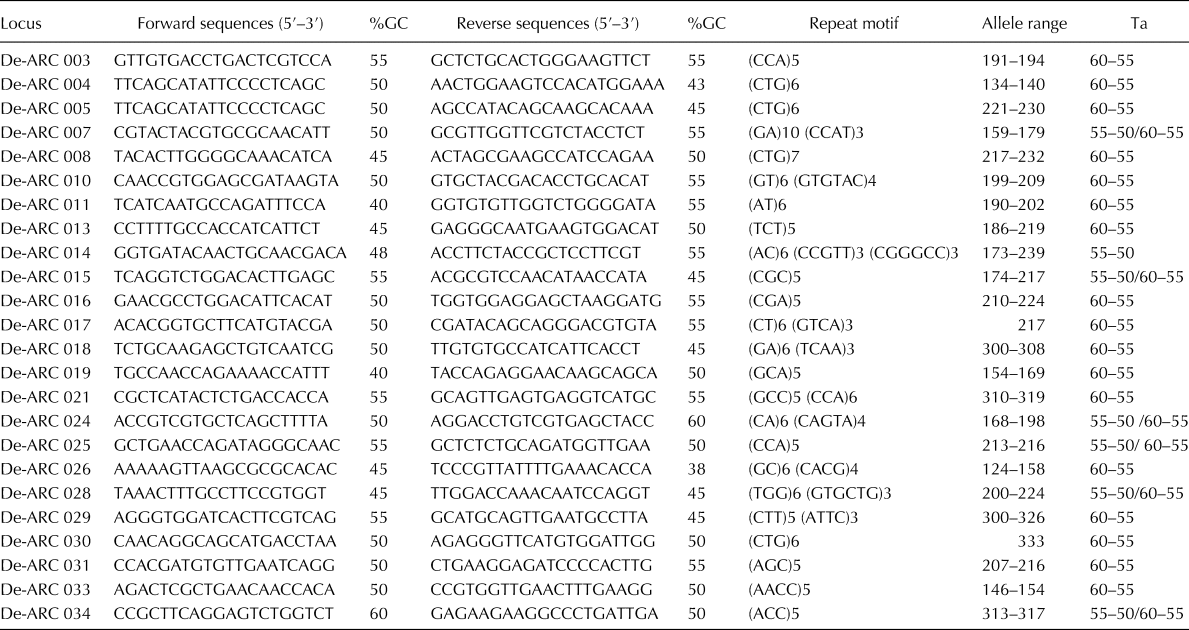
Characteristics of 24 SSR markers designed from Digitaria exilis

T a, annealing temperature (°C).
Experimental
D. exilis transcriptome sequences (FASTA format, GFF3 format freely available at http://arcad-bioinformatics.southgreen.fr/), representing 37,327 unigenes, were screened for SSR presenting at least five repeats. A total of 159 SSRs were detected (one SSR per 219 kb). Based on a PCR Tm of 60°C, a primer size of 20 bp, and specific amplification size ranges (80–180, 180–280 and 280–380 bp), a total of 126 primer pairs were successfully designed using SAT software (SouthGreen platform, http://galaxy.southgreen.fr/galaxy/, Dereeper et al., Reference Dereeper, Argout, Billot, Rami and Ruiz2007). A subset of 37 was randomly selected, synthesized and tested on 44 accessions: 29 D. exilis from Benin, Burkina Faso, Mali, Guinea, Niger, Senegal and Togo (Clément and Leblanc, Reference Clément and Leblanc1984), five D. iburua from Nigeria and 10 D. longiflora from Senegal (online Supplementary Table S1). Accessions were selected to provide a good representation of available genetic diversity (Barnaud and Billot, pers. comm.). Genomic DNA was extracted from fresh leaves as described by Barnaud et al. (Reference Barnaud, Vignes, Risterucci, Noyer, Pham, Blay and Billot2012). Forward primers were tailed with a 5′-M13 universal sequence [CACGACGTTGTAAAACGAC] (Schuelke, Reference Schuelke2000) and the corresponding M13-tail primer was labelled with one of the four dyes FAM, NED, PET or VIC and added to the PCR mix. Accessions were genotyped as described in Barnaud et al. (Reference Barnaud, Vignes, Risterucci, Noyer, Pham, Blay and Billot2012). PCR products were run in a multiplexed ABI Prism 3500 and sized with GS600LIZ (regional genotyping platform, http://www.gptr-lr-genotypage.com). Genotyping data were checked and scored by three different persons using GeneMapper 5.0 software and generated a dataset of 100 alleles in the three species.
Using GenAlEx 6.5 (Peakall and Smouse, Reference Peakall and Smouse2012) for markers showing a maximum of two alleles in genotypic profiles of individuals, we calculated observed heterozygosity (H o), expected heterozygosity (H e) and the inbreeding coefficient (F IS) (online Supplementary Table S4). The distribution of genetic diversity within and between species was estimated through: (i) a principal component analysis performed using the package FactoMineR (Husson et al., Reference Husson, Josse, Le and Mazet2007) and FactoExtra (Kassambara and Mundt, Reference Kassambara and Mundt2017), (ii) a discriminant analysis of principal components (Jombart et al., Reference Jombart, Devillard and Balloux2010) implemented in the adegenet package (Jombart, Reference Jombart2008), (iii) an analysis of molecular variance, carried out with GenAlEx 6.5 (Peakall and Smouse, Reference Peakall and Smouse2012) and (iv) a neighbour-joining tree implemented in the ape package (Paradis et al., Reference Paradis, Claude and Strimmer2004). All analyses were performed using R statistical software (R Core Team, 1995–2015).
Discussion
Of the 37 primers, 24 showed clear amplification profiles (Table 1). The observed amplification rates were 65% (24/37), 62% (23/37) and 46% (17/37) for D. exilis, D. longiflora and D. iburua, respectively. Transferability of the 24 D. exilis amplified loci to its relatives was estimated at 96% (23/24) and 71% (17/24) for D. longiflora and D. iburua, respectively. Polymorphism rates of 71% (17/24), 74% (17/23) and 35% (6/17) were observed in D. exilis, D. longiflora and D. iburua, respectively.
Depending on loci and species, genotypes exhibiting over two alleles is expected for putative tetraploid genomes (Adoukonou-Sagbadja et al., Reference Adoukonou-Sagbadja, Schubert, Dansi, Jovtchev, Meister, Pistrick and Friedt2007, online Supplementary Fig. S1, Tables S2 and S4). We found genotypes exhibiting over two alleles and a high level of observed heterozygosity (H o) (online Supplementary Table S4). This is likely associated with duplicated SSR loci. Data were thus recorded as a binary data type (0 = absence, 1 = presence of allele, online Supplementary Table S3) as described by Roullier et al. (Reference Roullier, Rossel, Tay, Mckey and Lebot2011) for polyploid species.
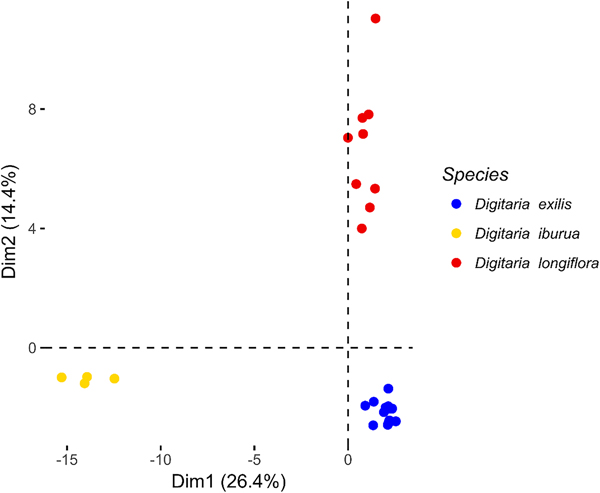
Structure analyses were congruent and showed that the new markers were useful in distinguishing the three species (Fig. 1, online Supplementary Figs. S2 and S3). PCA1 (26.1%) separated D. iburua from D. exilis and D. longiflora and PCA2 (14.1%) clearly distinguished D. exilis from D. longiflora. This separation was confirmed by the AMOVA with 77% of genetic variance found between species (PhiPT = 0.77; P < 0.001). In spite of the relatively low geographical distribution of D. longiflora accessions, the level of genetic diversity observed was striking, as shown by the accession dispersion in Fig. 1. The organization of genetic diversity, the higher polymorphism, the transferability and the amplification rate observed for D. exilis and D. longiflora may suggest strong proximity between their genomes. This is in accordance with the assertion that D. longiflora is the wild progenitor parent of D. exilis (Adoukonou-Sagbadja et al., Reference Adoukonou-Sagbadja, Schubert, Dansi, Jovtchev, Meister, Pistrick and Friedt2007). The lower transferability of these EST-SSRs on D. iburua and the structure observed suggests that this species is more distant. As expected for EST-SSRs, a smaller number of alleles (1–11) were observed (online Supplementary Table S2) compared with those developed by Barnaud et al. (Reference Barnaud, Vignes, Risterucci, Noyer, Pham, Blay and Billot2012), who relied on genomic DNA. EST-SSRs show polymorphism within transcribed or expressed regions and their level of genetic variability might be more constrained.
Population structure based on PCA. The colours correspond to the different species: D. exilis, D. longiflora, D. iburua.

This study provides fundamental information for implementing genetic diversity assessments, appropriate conservation plans and breeding programmes for Digitaria sp. genetic resources.
Supplementary material
The supplementary material for this article can be found at https://doi.org/10.1017/S1479262118000400
Acknowledgements
This work was supported by the West Africa Agricultural Productivity Program (WAAPP/PPAAO 2A CERA 58 ID06) and the core budget from the Centre de Coopération Internationale en Recherche Agronomique pour le Développement (CIRAD). The authors thank the Deutscher Akademischer Austausch Dienst (DAAD) for the grants awarded to KFO, and the National Cereal Research Institute, Baddeggi, Niger State, Nigeria for providing the accessions. The Editor and the reviewers are acknowledged for their valuable comments.