The extensive Cataractonium report by P.R. Wilson, published by the Council for British Archaeology in two volumes in 2002,Footnote 1 was the first to record a small collection of six phallic amulets from the burial of an infant — a context and collection which, it is here argued, is worthy of review. The objects in question are published as ‘six phallic amulets representing male and female symbols'.
FORM
All are flat-backed, curved in profile and mould-cast in copper alloy; all incorporate four key features (fig. 1):
1. A central scallop shell with hand-incised radial lines emanating from the narrow edge;
2. A squat phallus, with moulded detail at the glans expanding from one side of the scallop;
3. An arm with a moulded wrist-band or bracelet, terminating in a clenched fist with extended index finger at the opposing side to the phallus;
4. An integral, D-shaped perforation or suspension block running laterally through the scallop shell.
The fist-and-phallus pendant group from Catterick. They are displayed in sequential order from YORYM:1980.54.9464.1 at the left of the image to YORYM: 1980.54.9464.6 at the right. Scale 1:1. (© York Museums Trust (Yorkshire Museum) [CC BY-SA 4.0])

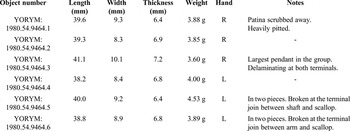
Three of the amulets are ‘right-handed’ and three ‘left-handed’; the direction of curve of the amulet is defined by which hand is dominant as the curve keeps the thumb of the clenched fist on the internal line. Subtle differences in manufacturing, finishing, wear through use or post-depositional damage are visible between the six amulets. Casting marks are evident around the suspension block, but there has been considerable manual finishing to the objects. Minor variations in size (see Appendix, Table 1) and the shape of the scallop and glans on each suggest the use of individual moulds. The suspension blocks show use-wear on the interior of the rim. The definition between fingers is hand-incised, as is the detail on the scallop shell ridges, resulting in variation in finger length and overall hand size. The number of striations on the scallop ridges varies between six and seven.
CONTEXT
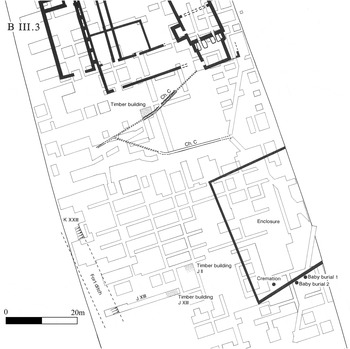
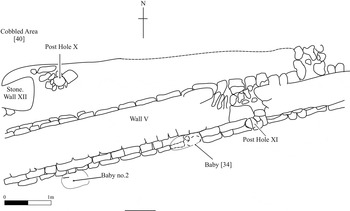
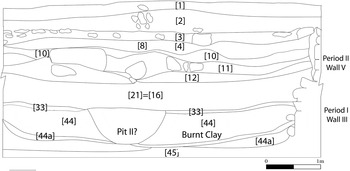
Difficulties in interpreting the contextual relationship of features at Cataractonium arise from the variable quality of features recorded in plan and section during John Wacher's excavations in 1959. While the interpretation of the site as a whole has not suffered, the contextual interpretation of these objects has. The amulets were found within the Catterick Bypass site (Site 433), in an enclosure which formed part of Insula VI and consisted of a rectilinear stone-built wall over 100 m in length (fig. 2).Footnote 2 Within the deposited archive, a single plan of Area D XI survives (fig. 3), recording a single wall (Wall V), shown in multiple phases on a single plan and apparently drawn from the upper level of Period II (a.d. 125–60); on this the area containing the baby burial in question, marked as Baby [34], is dashed to show a general area of disturbance. Unfortunately, the only stratigraphic plan for Area D XI was taken at the western corner of the square trench (fig. 4). This, unfortunately, bisects Wall V rather than showing it in full section. No stratigraphic plan of Wall V and its associated features was made, or at least none survives.
Plan of Wacher's excavations at Site 433, showing Phase III structures. The enclosure wall (see fig. 3) is at the south of this site.

Digitised plan of Area D XI, showing Wall V and the locations of the cuts containing both infant burials. The exact relationship between Baby Burial 1, labelled [34] and the wall remains unclear.

Digitised plan of the section of Area D XI, taken along the western edge of fig. 3, showing context [16] abutting the Period II (a.d. 125–60) Wall V.

The six amulets recorded as a group were actually found within two different sealed contexts, both dated to Period III of Site 433 (a.d. 160–200). Unfortunately, the site reports do not record which one of the six amulets was not associated with the main group. The primary group of five are from an inhumation grave of an infant either ‘incorporated into the footing of the enclosure wall or, more probably, inserted subsequently’.Footnote 3 This is a sealed context (D XI 34, fig. 3) which certainly penetrated into the upper levels of Period I (a.d. 80–125), giving a terminus post quem of a.d. 125. The possibility that it also truncated wall features of Period II (a.d. 125–60), as suggested by fig. 3, might further indicate a later terminus post quem of a.d. 160, though the earlier, certain date is used here. The infant, aged less than a year old at death, probably lay extended and may have been interred in a coffin.Footnote 4 A single bone needle of type 1b was also associated.Footnote 5
The sixth amulet of the Catterick collection was located independently. Associated with traces of a leather band, the amulet was found in a sealed context (D XI 16) abutting the wall foundation on the exterior southern face of the enclosure at the south-east corner of the excavated site. The main group was thus situated in relationship to an earlier wall footing and the single amulet sited in a sealed context immediately south of this enclosure wall; both are on the exterior side of the enclosure. Unhelpfully, while context D XI 34 only appears in plan, context D XI 16 only appears in section, so we do not know the full extent of the feature, only that it probably relates to the same Period II phase. No clear relationship exists between the two amulet-bearing contexts within the recorded archive. D XI 16 appears, in section, c. 2.5 m south from its junction with Wall V (fig. 4) and so cannot be a great physical distance from the main group of amulets. The only other evidence for funerary activity in this area takes the form of a second infant burial 1.5 m south-west of the above burial (fig. 3, also associated with the line of the enclosure wall) and a single cremation within the enclosure.
DISCUSSION
Crummy, in her discussion on the use of amuletic grave goods in infant burials in Britain, commented that the objects included with infants are, of course, ‘resonant with more complex religious and cultural meaning, consistently building up the iconography of protection, including victory over death and resurrection’.Footnote 6 Some aspects of the imagery on the Catterick group is considered below in relation to these ideas.
FIST-AND-PHALLIC AMULETS IN A GROUP
Using the phallus as part of an artistic tradition is a Roman import into Britain;Footnote 7 the combination of phallus and fist is an Imperial one.Footnote 8 Phallic imagery is a common feature across the Roman world with the magical use of male genitals being somewhat facilitated by the fact that they are easy to represent in a simple and stylised form and recognisable when divorced from the rest of the body.Footnote 9 The artistic similarities between the six objects at Catterick allow them to be discussed as a single set of objects rather than six individual variants of the fist-and-phallus type. The Catterick group of five is the largest collection of the fist-and-phallus amulet type from a single context in Roman Britain.
Greep rightly argues that the Colchester examples, primarily recorded from first-century contexts, were intended to be worn as individual pieces rather than act as a feature of a more complex necklace arrangement,Footnote 10 though we may question the application of this argument to the group discussed here. The Catterick publication presumes, quite explicitly, that the amulets were intended to be worn individually;Footnote 11 however the possibility that the group represents a single necklace should not be discounted. The lack of a directly comparable group from elsewhere in Roman Britain and a variation of 2.9 mm between the largest and smallest add further interest to the group of amulets from Catterick.
The phallic image is multiplied in this group. Such ‘polyphallism’ is not unknown in the Roman world — the tintinnabula are perhaps the most well-known examples and in Britain there are small metallic figures depicting multiple phalli on a single object.Footnote 12 More usually, polyphallism incorporates multiple phallic images on a single figure, each an integral part of the other. In the Catterick fist-and-phallus set, this is more evident as a repetition or multiplication of a single image than the incorporation of additional phallic images onto one focal piece. The repetition of the phallic image in this case includes a small degree of variation between the hand-incised finishing of the scallop shell and manus fica on each. The slight asymmetry of this polyphallism is a point of note.
A pair of two small bone pendants depicting fish from a single context at Catterick are also worthy of mention here.Footnote 13 The two belong to a very small, dispersed collection of which only six pendants are known.Footnote 14 The pendants are not phallic, but the discovery of two examples of an unusual pendant type potentially used in a single necklace and otherwise interpreted as occurring singly, is certainly relevant in the light of the Catterick fist-and-phallus group.
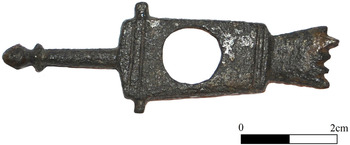
While no other fist-and-phallus objects were recorded from Catterick, two examples have been recorded from nearby Eboracum (York), the legionary fortress and administrative centre. The first is an elongated fist-and-phallus mount or amulet (fig. 5).Footnote 15 It has a central sub-rectangular frame which tapers slightly towards the fist side. A squat right hand extends directly from the frame. It is unclear whether the index finger is raised and the remaining fingers clenched, or if the thumb is tucked beneath the index finger. Both are acceptable forms of the manus fica found in Romano-British contexts.Footnote 16 The opposing end of the plate has an elongated, circular-section shaft extending. A moulded, reeled neck joins a stylised, biconical glans to the shaft. A large circular hole in the centre of the central plate makes for an unusual pendant; this example may not be intended for wearing upon the body but for attachment onto a building, harness or even a standard. Excavated in Blake Street, York, within the legionary fortress, this amulet is stratified in Phase 3 of the site, securely dated to a.d. 100–60.
The fist-and-phallus mount from York with a realistic manus fica and stylised phallus. Scale 1:1. (Image © York Archaeological Trust)

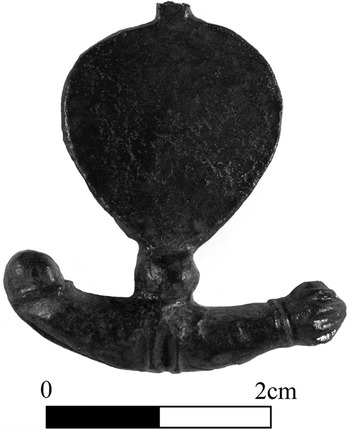
The other example from York is a flat-backed harness pendant of copper alloy (fig. 6).Footnote 17 A clenched fist with stylised knuckles or fingers forms one end of a convex bar, the other is a phallus in profile. This bar is slung beneath a larger peltate panel, at the top of which a suspension loop is evident. Two small, raised grooves separate the fist and phallus images. On the strength of the Catterick group, these two grooves may possibly be interpreted as having a vulvate decoration, and thus comparable with the scallop imagery on the Catterick fist-and-phallus group. The harness pendant is comparable with Bishop's type 8l, dating from the first century.Footnote 18
Fist-and-phallus harness pendant from York. Scale 1:1. (© York Museums Trust (Yorkshire Museum) [CC BY-SA 4.0])

THE SCALLOP SHELL
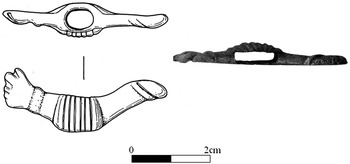
The scallop shell, as the central image on each of the Catterick pendants, is a rare inclusion to a fist-and-phallus pendant. Only a single comparison for this iconography is available — a pendant from Suffolk recorded by Judith Plouviez in 2000.Footnote 19 The only major difference between this example and those from Catterick is the expansion of the suspension block to create an ovular suspension loop rather than the D-shaped block with a flat back seen in the Catterick assemblage (fig. 7). The ovular-shaped block expands behind the flat-backed glans and manus fica. The expansion of the suspension block might suggest that the Suffolk example is designed to hang freely, rather than directly against a surface, although the physical suspension is unlikely to prove problematic given its size.
Drawing of a fist-and-phallus amulet recorded from Suffolk with the Portable Antiquities Scheme in 2000, compared with the lateral view of one of the Catterick group. Scale 1:1. (Left image © Portable Antiquities Scheme [CC BY-SA 2.0]; right image © York Museums Trust (Yorkshire Museum) [CC BY-SA 4.0])

Further examples of fist-and-phallus amulets from the Roman world incorporate this triplication of an apotropaic image,Footnote 20 though they often incorporate an additional phallic image rather than something as intrinsically female as a scallop. Perhaps the best examples of the incorporation of an additional phallus into the fist-and-phallus type come from Vindonissa (Windisch, Switzerland), where over 27 examples of polyphallic harness pendants are recorded.Footnote 21 The Vindonissa collection consists of individual examples of harness pendants (of Bishop type 6)Footnote 22 which include a flaccid penis and testicles at the central bow between the fist-and-phallic elements. As a comparative group it is certainly important in the context of the Catterick evidence, but the distinction between strung amulets and harness pendants is significant, as is the difference in the central engendered icons between the groups.
Comparable copper-alloy scallop shells in Romano-British contexts are, perhaps, best known from isolated discoveries of mounts.Footnote 23 The hemispherical shape and ridge decoration lend themselves to studs and escutcheons if projecting outwards. When concave, the shell can be used in the basin of oil lamps, such as a ceramic example from London dated to a.d. 100.Footnote 24 As a votive or religious image, the scallop is most clearly associated with the birth of Venus from the sea foam.Footnote 25 This motif appears as the central design of a mosaic from Hemsworth (Dorset), now in the British Museum.Footnote 26 Scallops are also used in apsidal rooms in St Albans and at Bucklersbury in London.Footnote 27
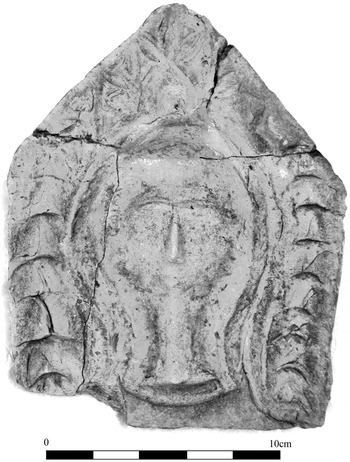
As a magical or religious image it is associated with a female figure and thus provides a prominent juxtaposition to the masculine associations of the fist and phallus. As an apotropaic symbol, female, explicitly sexual, imagery is less well attested in Roman Britain than its male counterpart, but the difference in form may not indicate difference in use. It has been argued that a series of antefixae from York depicting female busts (fig. 8) include stylised vulvate decoration surrounding the frame.Footnote 28
Ceramic antefix depicting a female bust surrounded by a vulvate motif. Scale 1:2. (© York Museum Trust (Yorkshire Museum) [CC BY-SA 4.0])

Venus, represented physically or via an avatar (such as a scallop) is an important chthonic motif, the evidence for which is extensive and varied. Venus, in her pipe-clay form, has been found in funerary contexts in nearby York.Footnote 29 In the south-east of Britain, the presence of a pipe-clay Venus in inhumations has been interpreted as a grave good connected to women who died in childbirth,Footnote 30 as well as being directly associated with the third-century burial of a child at London.Footnote 31 The scallop shell also appears as a chthonic motif on the lids of lead coffins at Lullingstone, Chatham and Crayford (Kent), ColchesterFootnote 32 and London.Footnote 33 It has been considered as an allegorical parallel to the womb and is seen flanked by dolphins (themselves associated with rebirth and the afterlife) in a bronze ‘casket’ handle from Woodcuts (Wilts.).Footnote 34 Returning to York, Venus' companion Cupid flanks the inscription on the sarcophagus of Julia Victorina.Footnote 35 This latter example expands the argument for an association between Venus and infant mortality, as the inscription mourns both Julia and her four-year-old son, Constantius. Venus is also depicted on a table designed for the serving of libations to the dead (Henig's ‘Mensa Dolenda’) from Caerleon.Footnote 36
PHALLIC IMAGERY AND INFANT INHUMATION IN ROMAN BRITAIN
Infant graves in Roman Britain can include a range of apotropaic objects. A study focusing on Colchester identified examples of lunulae, phalli, amber figures, canine teeth, bells, beads, finger-rings, figures of bears, and coins.Footnote 37 No other examples in Roman Britain record the use of fist-and-phallus amulets in such a context.
Most infant graves remain free from grave goods. Consequentially it has been argued that the families of children buried with grave goods are, therefore, ‘different’ from the main populationFootnote 38 and this idea can, perhaps, be extended to the infant with whom these amulets were buried at Catterick. Indeed, the Catterick group has (albeit briefly) been considered as a foundation deposit for a temenos in Insula VI,Footnote 39 represented by Walls III and V (figs 2–3), even though the precise function of this enclosure remains unclear. Such a possibility cannot be discounted, of course, as infant skeletons are used elsewhere as foundation deposits,Footnote 40 while an association between infant burials and buildings is well developed in Roman Britain.Footnote 41 But if Baby Burial 1 (D XI 34) was a foundation deposit, the fact that it penetrates into the upper levels of Period I (a.d. 80–125) removes any possibility it was a foundation deposit for, at least, the earlier wall of the enclosure (Wall III, fig. 4). The possibility that it may also truncate the later wall edges of Period II (a.d. 125–60) might point in the same direction for Wall V, suggesting an association with an even later phase.
A clear association between the fist-and-phallus type and Roman military contexts is offered by Greep in the Colchester small finds report and several other examples of the fist-and-phallus type are recorded from Roman Britain including London, Chester, Canterbury, Fishbourne and Wroxeter, many of which are from unpublished collections.Footnote 42 A direct parallel for an inhumation grave containing an amulet of this type is currently absent from Roman Britain; the nearest comparable example to this funerary rite in Britain is, perhaps, the use of a single phallic image in a group of multiple apotropaic images from the grave of an infant at Colchester.Footnote 43 Phallic pendants are also known from an adult inhumation at Guilden Moren (Cambs.) and a child inhumation at Verulam Hills Field (St Albans).Footnote 44 It would be significant to note at this point the assertion by Pliny that ‘infants are under the especial guardianship of Fascinus',Footnote 45 the god or genius associated with the phallic image. Although the infant in the grave group remains unsexed, it would come as no surprise to learn that it was male. Small gold rings bearing phallic symbols, like those from LondonFootnote 46 and Faversham,Footnote 47 are clearly intended to be worn by children (a type correlated by Varro) and directly associated with Fascinus.Footnote 48 This type is yet to be identified from Yorkshire, but a gold phallic pendant from KnaresboroughFootnote 49 is of a type recently associated with the protection of children.Footnote 50
Crummy grouped a series of reverse types on coins, used in an apotropaic fashion in infant burials in Colchester, as representing female or maternal figuresFootnote 51 and suggested that these thus have direct relevance to sick or dead children.Footnote 52
SUSPENSION
The single example in the group subjected to over-cleaning (fig. 1, far left) has had the surviving patina removed, but offers a glimpse of the original colour of this group of amulets. They are, as with all copper alloys, bright and brassy objects which are generally conspicuous when worn upon the body. Normal attachment for a phallic amulet would incorporate a circular suspension loop through which a chain or strap might be threaded or onto which it was tied. The existence of a lateral suspension block in the Catterick fist-and-phallus group forces a reconsideration of this method of attachment. These amulets are flat-backed, suggesting that the moulded side is the primary aesthetic focus and the undecorated, flat side lay against the body. Discovery of ‘traces of a leather band’Footnote 53 with the individual pendant develops the interpretation of how such an amulet was physically suspended, although the existence of this important piece of information did not prevent the ambiguous assumption in the published report that these were ‘probably … suspended by a chain through the central perforation’.Footnote 54 Suspension from a chain might have resulted in the visible wear of only the upper facing part of the suspension block; use-wear of this nature is not evident on any of the group. Suspension via a leather strap is suggested by contextual finds as well as necessity. The survival of a leather band also demonstrates a working life outside of deposition for at least one of the collection.
The possibility that this group was originally worn by an adult as a single collection is a strong one (though no obvious explanation, other than casual loss, presents itself to explain how one of the six became disassociated) and should be seriously considered. The deposition in an infant grave of a group of five of these amulets would not require a suspension strap linking the objects together, but this remains a possibility. The adornment of the amulet group on the living infant remains an open issue. The converse conclusion of the group is that the single example was never associated and that the amulet type was used by at least two different individuals — an argument strengthened by the single comparable example from Suffolk showing that the type is not confined to Catterick.
A parallel group of small finds also affected by the issue of ambiguity regarding its suspension as a group comes from Intercisa (Hungary): six small bone fish-pendants were located in a pit with two other pendant types.Footnote 55 Although the finds are published, the contextual relationship remains undisclosed leading to speculation over whether this represents a single necklace or fragments of several. In the Catterick examples a lack of obvious impact damage to the exterior faces of the scallop shells suggests that, if worn as a group, they were separated from each other. Other accoutrements, such as beads, added to such a necklace is a possibilty but their omission from the burial might raise as many questions as it would answer.
OTHER PHALLIC AMULETS IN YORKSHIRE
As phallic images the Catterick fist-and-phallus group is not unique, but exists within a larger provincial and cultural appreciation of the phallic image as an aesthetic icon, an apotropaic symbol, a rude gesture and a symbol of fertility and virility.Footnote 56 Within the modern county boundaries of North Yorkshire, a number of small metal charms including aspects of this imagery are comparable. Plouviez's Reference Plouviez and Crummy2005 analysis of phallic objects from Suffolk using Portable Antiquities Scheme data highlighted the importance of using this resource in the study of the hugely variable phallic small-finds assemblage.
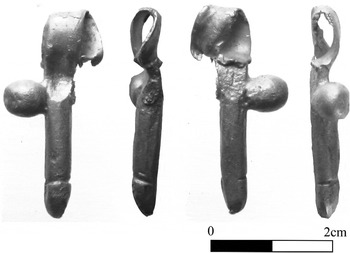
At least two other phallic harness pendants are recorded from the region, from Stamford BridgeFootnote 57 and Malton,Footnote 58 and several additional phallic charms, designed for suspension as a pendant, are known. The phallic belt mounts are of a military type occurring across the province.Footnote 59 These include a copper-alloy pendant from SettingtonFootnote 60 (near Malton) and a small example in gold from KnaresboroughFootnote 61 (fig. 9). The Portable Antiquities Scheme also records a phallic object from Harrogate,Footnote 62 a phallic-headed pin from Malton,Footnote 63 and a possible phallic pendant from Hambleton.Footnote 64 The manus fica symbol also has utility without the phallic association, as shown by a pewter pendant from Richmond, North Yorks.Footnote 65
Four lateral views of a gold phallic pendant from Knaresborough, PAS: SWYOR-E56143. Scale 2:1. (© Portable Antiquities Scheme [CC BY-SA 2.0])

While the vast majority of suspended phallic charms, pendants and objects from Roman Britain are made of metal, other materials are used. The bone fist-and-phallus type from Colchester has already been mentioned. Antler roundels are also used as a frame for a carved phallic image;Footnote 66 in Yorkshire, examples are known from MaltonFootnote 67 and Castleford.Footnote 68
As a physical symbol, the phallic image forms the major anatomical identifier for images of Priapus. The virility god is recorded on a small number of figurines in Yorkshire at Selby, Helmsley, Ripon and York.Footnote 69
There is a clear relationship between the phallic image and military establishments in Britain and Eboracum (York) is no stranger to the image. Three carvings in medium relief discovered during excavations of the interior of the fortress wall each depict a simply represented phallus, each using a single stone as a frame.Footnote 70 In northern military contexts it also appears as carvings on the bridge at Chesters fort, at Vindolanda, east of Birdoswald and at Carlisle, but not at Catterick.Footnote 71 Additionally, two finials, recorded as having coming from funerary sculpture in York (although this is now uncertain), were described as phallic.Footnote 72
CONCLUSIONS
The traditional interpretation of the fist-and-phallus amulet type as a masculine device derives from a contextual relationship with the Roman military. The Catterick examples do not refute this part of the argument. An association of the phallic image with the apotropaic protection of children is developing within the archaeological record of Roman Britain, but an association of the fist-and-phallus type with children has not previously been made. The Catterick examples are second-century in date, within the ‘early’ date suggested for the use of phallic amulets in Britain.Footnote 73 Crummy considers the phallic charm as intended to ‘confer virility or potency on its owner’ and as an obvious fertility symbol.Footnote 74 The contextual relationship at Catterick instead generates a link between the apotropaic function of the image and protection of deceased infants — potency, virility and fertility are not characteristics associated with, or greatly needed by, infants. A combination of protective imagery (the phallus and the manus fica) and the regenerative and chthonic associations of the scallop/Venus within this context identify the Catterick fist-and-phallus pendants as purely apotropaic symbols. While the use-wear on the suspension loops clearly shows use in life, their imagery has been carefully considered as an appropriate, protective inclusion in an infant grave.
APPENDIX
MEASUREMENTS, WEIGHTS AND CONDITION NOTES OF THE SIX PENDANTS

ACKNOWLEDGEMENTS
Thanks to staff of the Yorkshire Museum and York Archaeological Trust for access to material and to Pete Wilson (Historic England) and Catrina Appleby (Council for British Archaeology) for access to fig. 2. I am thankful for the comments from both anonymous referees for this paper. Finally, I am especially grateful to Dr Stephen Greep for reading two earlier drafts of this paper and for providing some additional reading.